Puros Huerfanos 52X

I recently smoked a cigar from Drew Estates that was so surprisingly bad that I had to go out and buy a few more just to ensure that my first impression wasn’t a sign of premature senility.  (Or maybe the fact that I went out and bought more is the sign itself.)

That review has been put on hold until my senses recover from my flirtation with disaster.  In the meantime, I thought I’d give Drew Estates another opportunity with Puros Huerfanos, a Famous Smoke exclusive which is described as an “ultra premium first overrun.” I’m not sure if that description is internally consistent, but the price was right on a sampler pack so I snapped up a few.

The story on these cigars is that they were somehow “orphaned,” as if they were left by a skittish teenager at the convent door. I’m not sure if this story is meant to inspire pity or suspicion. Maybe both.

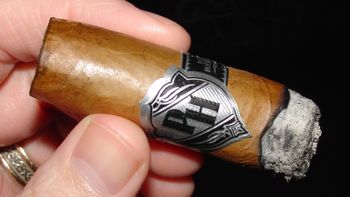
These “ultra premiums” are available in four sizes — robusto, toro, corona, and belicoso — and are a blend of Brazilian, Dominican and Nicaraguan long leaf tobaccos in an Ecuadorian Connecticut wrapper. Sometimes I wonder if a reputable cigar maker could wrap sawdust and carpet trimmings in an Ecuadorian Connecticut wrapper and get away with it. There seems to be no better way to dress up a cigar than with a golden buttery shade wrapper. (For the record, the very attractive PH 52X is entirely free of sawdust and carpet fibers.)

Construction Notes

Pro: In addition to its general aesthetic appeal, the Puros Huerfanos 52X is a well rolled cigar. All of the samples I’ve smoked so far have exhibited a fine draw and an even burn, though some of them seem to burn rather quickly.

Con: The ash is a little crumbly and they burn a little hot in the last third.

Overall very good construction.

Tasting Notes

The opening notes of the Puros Huerfanos 52 are dry and papery with an earthy aftertaste. Dirt might be an acquired taste, but I’ve come across some wonderfully earthy smokes in my time. Combining those flavors with paper and tannin might not suit everyone though, I admit.

In any case, the earthiness is quickly replaced by a smooth nutty flavor. The smoke texture is creamy and the strength is mild enough that this cigar could make decent breakfast material. The middle section of the stick is less tannic and sweeter. The aroma is typical of good Connecticut shade wrapper — sweet and floral, with some woody characteristics. The finish lengthens and the dry aftertaste lingers.

There isn’t much of a transition into the last third, as there rarely is with mild cigars. The flavors seem to settle on dry wood with a sweet floral component, balanced by a slightly dry bitterness on the tongue. My only concern is that the smoke gets too warm in the last lap. Smoking this cigar past the band is not recommended, or in my case, even possible.

Conclusion

Right now it looks like the robustos are selling for around 70 USD per box of 25, and the belicosos for around 80. That’s a reasonable price for this smoke. It’s well made, tastes okay (if dry and a bit greenish are okay), and it’s relatively cheap. It won’t knock your socks off, but if you’re in the market for a mild morning smoke it might be worth a shot.

If you can, try a few before you buy a box.
Final Score: 84

Saint Luis Rey Maduro vs. Serie G Maduro

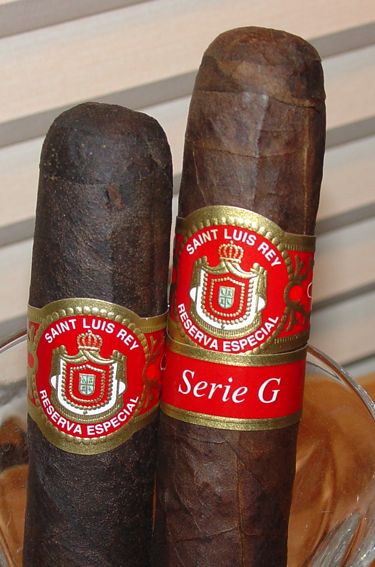
This week’s journey into the humidor is a tale of two maduros, cigars that have different compositions but share a common name: Saint Luis Rey. They are both products of the mammoth Altadis USA, the largest producer of cigars in the US. When they aren’t suing smaller companies for trademark infringement they have been known, on occasion, to roll out a decent stick.

Saint Luis Rey is an old Cuban brand name, and in accordance with the rule that all cigars with traditional Cuban cigar names must have an American counterpart, the non-Cuban SLR emerged from the Big Bang of the Cigar Boom in the mid 1990’s. This “original” SLR has done well, having spawned eight vitolas — some in tubes, cabs of 50, and even pequenos. It is available in both natural and maduro wrappers, but the maduro employed here is Mexican San Andres, which is complemented by a Nicaraguan binder and fillers from Honduras, Nicaragua, and Peru.

The “new” SLR is the Serie G. It was first introduced in 2006, when various cigar blenders engaged the novel concept of the double maduro blend — in this case both binder and wrapper are Connecticut Broadleaf. The filler is Nicaraguan. A year later the Serie G Natural, with a Nicaraguan Habano wrapper, was added to the menu.

Bearing the same name might be the cause of some confusion between these two cigars, and whether this is deliberate or not (I have my theories) I hope to clarify the matter by obscuring the air with smoke.

St. Luis Rey Reserva Especial Maduro

The standard Saint Luis Rey — the “Reserva Especial” — is quite distinguishable from the Serie G. Aside from a slightly smaller ring gauge, the wrapper on the Reserva is a flat, almost matte black color. I was a little worried that it might be dyed, but aside from color there was no evidence of that. The roll is solid, and the cap is ugly, but serviceable. Most of it came off when I clipped the head, leaving a clean cut anyway.

The burn is mostly even (no mean feat for any maduro cigar) but the ash is weak and flaky. (This was the first ash I’ve had fall in my lap in quite a while.) The draw, on the other hand, is perfect, producing billowing clouds of smooth smoke.

After a pleasantly peppery introduction, the core flavors are sweet wood and dark chocolate. It isn’t remarkably complex, but the blend is smooth as it gradually transitions in the last section to a sweet char. Aromatic isn’t exactly the word for this cigar — it’s pungent and quite powerful, more of a bonfire kind of cigar with it’s rich smell of tar and pine resin. A good room-clearing stogie if ever the need should arise.

St. Luis Rey Serie G Maduro

There are far fewer sizes to choose from in the Serie G formulation, but the rotund rothchilde has been a favorite of mine for years.  All of the vitolas in this line have over-sized waistlines; at a 54 ring gauge the rothchilde and the belicoso are the thinnest ones.

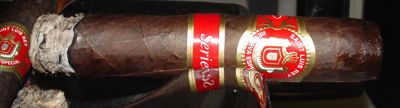
The Serie G is a little bit richer, a little bit smoother, and not quite as sweet as the regular SLR Maduro. This cigar is lighter in appearance (though still dark) and more natural looking, with its mottled and leathery wrapper. The roll is solid — sometimes a little too solid — and very well packed. From time to time I’ve had a tight draw with the rothchilde, but it burns well. The ash is a little stronger than the standard line SLR, but it still flakes a bit.

The core flavors are a piney wood with sweet char. There isn’t any pepper here until the last third of the cigar, and even then it stays pretty smooth. In the mid-section there are notes of leather and earth, but what I mostly find are the straightforward classic maduro flavors — wood, sweet char, and a touch of chocolate. It’s not heavy on the sweetness or the coffee/cocoa flavors, but it’s quite smooth. Like the regular SLR Maduro, the Serie G creates a pungent resting smoke.

Conclusion

Both of these cigars are fine everyday smokes, especially the Serie G, which is a bit more complex than the standard line. What sets them both apart is the price — the Serie G is just over 3 bucks a stick, and the regular line is well under that. One online retailer is selling the regular SLR for 55 USD per box of 25, and that officially makes this a bargain cigar.  Keep an eye out for these if your financial advisor (or your spouse, who are often one and the same) is getting cranky about your discretionary spending.

Final Scores:

Saint Luis Rey Reserva Especial Maduro: 86

Saint Luis Rey Serie G Maduro: 88

Mi Barrio El Puro

The business side of the cigar world is a rapidly changing affair. This has been especially evident with a worldwide recession and the steady barrage of draconian government tax policies. The net effect is easily seen here: what used to be EO Cigars is now EO Brands, after an early summer split with Miami Cigar and a merger with Rocky Patel. The reason given for the new arrangement is that EO wants to lower prices — a laudable  objective, but not one that bodes well for the industry at large.  A few months after these developments I started seeing Mi Barrio cigars selling at reduced prices on one of the big online retail outlets. That is not usually a good sign, but in this case it seems to be a result of the business environment rather than production quality.

So I’m not sure whether I should put this review in the present or the past tense. Mi Barrio was originally designed as a limited edition cigar anyway, but at this time it is still on the market. I’ll be optimistic and hope for the best.

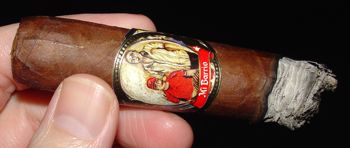
Mi Barrio is produced by EO Brands and manufactured by Pepin Garcia’s My Father Cigars in Esteli, Nicaragua. The first size that was introduced is the one I’m smoking today, the one called “El Puro,” a fat double corona made in July 2008 and released later that year at the IPCPR. (Or was it the RTDA?)

Only 1000 boxes in each of four sizes were slated for production. The toro was released in the fall of 2008, and the churchill and torpedo were unleashed in the summer of 2009. The bands and boxes feature art by Cuban artist Edin Gutierrez — a different design for each size. The band for El Puro, the double corona, shows Orestes Espinosa, Sr. (the father of EO Brands’ Erik Espinosa) and Pepin Garcia.

Like most of Pepin Garcia’s cigars, this one is a Nicaraguan puro.

  • El Puro – 7 x 52 (double corona)
  • El Acere – 6 x 50 (toro)
  • El Forro – 7 x 48 (churchill)
  • El Billetero – 5 1/2 x 52 (torpedo)

I’ve had a few of these double coronas put away since early 2009, and this is my last one. I have really enjoyed this cigar because it has all of the qualities that I really enjoy in a Nicaraguan puro without any of the harshness. They’re smoking so well right now that I just couldn’t hold off on them any longer.

Construction Notes

At 7 inches long and with a 52 ring gauge, the “El Puro” double corona is an imposing stick. The wrapper is leathery, but somewhat dry in appearance. A few veins are apparent but not obtrusive. The overall effect is leathery. The roll and the cap are just about perfect, as is to be expected from My Father Cigars.

The draw on this cigar is effortless, and smoke wafts gently from the head after each puff. Inside or on a still day, this cigar is almost as much a pleasure to view as it is to smoke.

The only criticisms I can make are that the burn is uneven at times and the ash is a bit flaky. But these minor flaws are completely outweighed by its finer qualities.

Overall excellent construction.

Tasting Notes

Mi Barrio’s double corona is a medium-bodied cigar — by EO/Pepin standards I almost want to call it mild. It is certainly milder than any of the 601 or Don Pepin cigars (Blue, Black, and White labels.) Instead of high octane tobacco and an explosion of black pepper what Mi Barrio offers is a more even tempered, but still flavorful experience.

The smoke in the first third is remarkably creamy, and though there is a touch of pepper in the first half-inch the primary flavors are of earth and cocoa. It is surprisingly mild and a bit dry.

In the mid-section the flavors turn sweeter with caramel accents and a hint of vanilla. The flavors remind me a little of Vegas Cubana, but more substantial and complex.

The pepper returns in the last third, but in a complementary rather than a dominant way. I’m reminded of charred oak barrels and at one point thought I tasted bourbon. (Not that bourbon would be the best companion for this cigar, unless you like it weak, which means I am not letting you near my bourbon.) But most importantly, this cigar stays smooth to the band.

Conclusion

Mi Barrio in this large format is a smooth and cocoa-laden smoke that any fan of medium-bodied cigars will enjoy.  It isn’t tremendously complex, but it is certainly satisfying. And coming from My Father Cigars in Esteli, the construction is as perfect as you’ll get in a Nicaraguan puro. The only hitch might be the price — around ten bucks a throw. But with the turbulence in the market and EO Brands’ commitment to lower prices, that ten dollar mark might fall.

Or Mi Barrio may just ride into the sunset. Or become gentrified. Whatever happens to barrios these days… In that case, I’m glad I had the chance to smoke a few before they’re gone.

Final Score: 90