Henry Clay Honduran Hermoso

cnv0260.jpg

In the early 1900s, two of the leading brands of Havana cigars in the United States were Henry Clay and Villar y Villar, both owned by Gustavo Bock’s Havana Tobacco Company. In the wake of the Spanish American War and the American occupation of Cuba, tobacco trusts were created to establish a foothold in the industry. I always wondered why a Havana cigar would be named after a prominent American statesman like Henry Clay — that’s why, or at least partly why. Gustave Bock, along with establishing several brands which would survive into the next century (if in name only) is also credited with creating the first cigar band. Why is still up for debate.

Rudyard Kipling took note of the brand as well in his poem “The Betrothed.” The line is repeated so often in cigar literature that it’s almost become a cliche, but here it is for the millionth time:

There’s peace in a Larranaga, there’s calm in a Henry Clay

But the best cigar in an hour is finished and thrown away.

Henry Clay came to mind the other day as I was reading Doris Kearns Goodwin’s recent book about Abraham Lincoln: Team of Rivals. Lincoln called Clay “the man for a crisis” because he was primarily responsible for the Missouri Compromise which saved the United States from civil war for forty years. He was one of the great mediators between the North and South; in fact his headstone in Lexington Cemetery reads “I Know no North – No South – No East – No West.” If Kipling found calm in a Henry Clay, Clay himself must have been remarkably even tempered.

And while many other cigar bands bore the names of eminent politicians, Henry Clay survived as a brand up to the revolution in 1959. Evidently Castro didn’t care for the name. (Actually, Castro wanted to “communize” cigars as well as people and have ONE brand only. Che Guevara wouldn’t hear it.)

So today there is no Henry Clay Havana, but there are two others, a Dominican and a Honduran. The Dominican line is easily distinguished because the entire line is maduro only. The Honduran version is made in Danli, but the components are mostly Nicaraguan. The wrapper and binder are both Nicaraguan, and the filler is a blend of Honduran, Nicaraguan, and Peruvian leaf. At one time there was also an H2000 line, but unfortunately they appear to have been discontinued. (Too bad really. They were nice smokes.) The Hondurans are produced for Santa Clara cigars (JR) while the Dominicans are made by Altadis. How they can use the same brand name is somewhat mystifying, but trademark law is not exactly my forte.

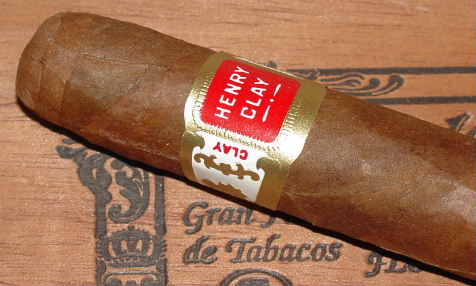
“Hermosos No. 4” is a Cuban commercial vitola which is actually a little bit narrower than this Hermoso. The Henry Clay Hermoso is a traditional robusto at 5 inches by a 50 ring gauge. The Cuban vitola is the same length, but a 48 ring gauge.

This cigar has a rough, somewhat dry wrapper. Not the most attractive stick around, but the draw is good and it takes an easy light. The construction on this robusto is quite good all the way around: even burn, solid gray ash, the works.

This is what I’d call a real stogie. It’s a medium bodied easy smokin’ seegar. A nice aroma with a mild spice to it that is very pleasant — nothing fancy, but pleasant. The flavors fall in the earthy category, bordering on metallic at times. I have to say I wasn’t crazy about the flavor, but it’s mild enough not to be overbearing in that regard. The aftertaste follows suit.

The last third of this cigar gets into tarry territory, so it’s not one I’ll ever nub, but the first half to two-thirds was a decent everyday smoke. I doubt I’d ever spring for a box of these guys, but having a few around for in-between times could be a good thing.

Henry Clay was the master of the compromise. While brokering a peace between factions that were destined for a bitter and violent war was no mean feat, I’d have to say this cigar is a compromise of sorts as well. It’s a middle of the road cigar that won’t compromise your budget. At around $2.50 a stick it’s a pretty good deal.
Ashton Virgin Sun Grown Belicoso No. 1

cnv0259.jpg

At one point in the dim and distant past the name Ashton referred to a line of pipes. In the mid 1980’s Robert Levin, owner of Holt’s Cigar Holdings, decided to launch his own brand of cigars and appropriated the Ashton name for his cigars. The first Ashton was a mild bodied cigar with a Connecticut Shade wrapper made by Henke Kelner of Davidoff fame. This was before the days of Cigar Aficionado and the cigar revolution that it started, so business was slow and marketing was difficult. Ashton would take some time to be noticed by the smoking masses.

By the late 80’s Levin’s friends the Fuentes were in on the production of Ashtons, making the Ashton Cabinet series and Ashton Aged Maduros. Business grew, slowly but surely and with the “boom” Ashtons were flying off the shelves. By 1994 Levin was distributing a million cigars a year, and today produces about six million Ashton cigars.

In the early 90’s Levin began to research an extension to the Ashton line. He was looking for something robust, a rich full bodied cigar, and the line was to be called Ashton Crown. The wrapper was to be from Chateau de la Fuente, the same wrapper used on Fuente’s Opus X cigars. But the tremendous success of the Opus X meant that Chateau de la Fuente wrapper was going to be in short supply, to say the least. As a replacement Carlito Fuente suggested an Ecuadorian Sumatra seed wrapper from the Oliva farms. Levin tried it and was blown away. It was every bit as powerful as he hoped and sensed that it would age extremely well.

Carlito Fuente and Richard Meerapfel (the angel of Cameroon leaf) are credited for the name “Virgin Sun Grown.”

Ashton VSGs are made in the Dominican Republic by the Fuentes. The binder and filler are Dominican and the wrapper is of course the same Ecuadorian leaf noted above. Reportedly the filler includes an extra helping of ligero to pump up the volume — one taste proves that is an entirely credible claim.

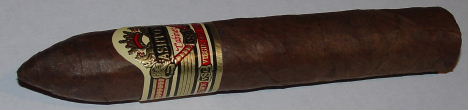
The wrapper is very similar to the wrapper on the Diamond Crown cigar — an unusual colorado maduro with even and widely spaced veins. A prelight pull shows an easy draw and a slightly sweet taste. I’ve had this specimen in the humidor for about six months, so it’s had some time to rest and get to know its neighbors. Unfortunately, it’s time for this VSG to bid farewell to the Toranos (such nice people) and the Plasencias (what a sense of humor!) and meet its destiny.

This is a powerful but graceful cigar. The first half is marked by a leathery foundation that wavers at times to cedar. The finish is lengthy, but not persistent. By the time you’re ready for another puff the finish is just taking its leave, and you’re ready for another taste.

The second half becomes a little woodier, as if the leather and the cedar have switched places and now the wood takes precedence. Some peppery notes are also in evidence, and the flavor becomes a bit sweeter. There are some lighter spices in there along with the pepper — I thought I detected cinnamon at one point, but it didn’t recur. Maybe I was hallucinating. Or maybe just buzzed. In any case, I was really impressed by the smoothness of this smoke. It’s surprisingly well balanced for a heavyweight blend. Well, I guess it’s not THAT surprising when you consider who made it.

This belicoso is a very robust smoke, but it’s not overpowering. You will definitely want to enjoy a full meal before sitting down with this one, and a strong refreshment is advised. I pulled an old bottle of Oban from the back of the liquor cabinet — Edan’s video reminded me I still had a couple drams left in the bottle. (And a better cigar to accompany it.)

Padron 1964 Anniversary Imperiales

cnv0257.jpg
Ask any experienced cigar smoker anywhere in the world what are the best non-Cuban cigars, and inevitably two brands will make every list: Fuente’s OpusX and Padron’s Anniversary line. And if they don’t make the “best” list, they will certainly make the most-hyped list. Unfortunately, they also make the most expensive list.

But for special occasions, only the best will do.

The Anniversary 1964 line celebrates the 30th Anniversary of the Padron cigar company. The Padron family has been in the tobacco farming business since the 1850’s, originally in the famous Vuelta Abajo region of Cuba. Like so many other cigar patriarchs, Jose Orlando Padron came to the United States from Cuba in the early 1960’s with little more than a few dollars and a dream. That dream would germinate in 1964, eventually growing into one of the most successful and highly respected cigar companies in the world.

In speaking of their company, the Padrons are fond of the term “vertically integrated.” By this they mean that their cigars are purely Padron, from bottom to top. They own their own farms, grown their own tobacco, control the fermentation, storage and aging processes, oversee the many stages of rolling the cigars, and finally distribute the cigars themselves. This level of control allows very strict quality management, and quality and consistency is what Padron is all about. Padron makes about 5 million cigars each year, but only about ten percent of those are Anniversary cigars. When a product sells this well at a premium price, it is a mark of honor that Padron does not increase production at the expense of quality. It’s also remarkable that the standard Padron line still sells for less than 5 dollars a stick despite the huge popularity of the brand. That’s integrity.

The Padron 1964 Anniversary, like all Padron cigars, is a Nicaraguan puro. All sun grown tobacco is used. Frequently sun grown tobacco is associated with power, but with the Anniversary it should really suggest great flavor rather than sheer strength. The tobaccos are carefully aged for four years before they are selected for the Anniversary blend.

The Anniversary is square pressed to resemble the Cuban cigars patriarch Jose Orlando remembers smoking in Cuba, the H. Upmann Number 4 in particular. It comes dressed in a double band — the trademark band overlaps a counterfeiting control band bearing a serial number to guarantee authenticity. Yes, this is a highly valued cigar.

At 6 inches in length and a 54 ring gauge, the Imperiales are the toro entry in this line. Padron Anniversary cigars are also available with a maduro wrapper. Aficionados of this dandy cigar often use the acronyms PAN (Padron Anniversary Natural) and PAM (Padron Anniversary Maduro) to refer to the different species.

The construction of this PAN is perfect. An easy draw allows a nice volume of smoke with each pull, and the ash held for as long as I cared to admire it. I had to be careful not to smoke this one too quickly. It’s much milder than I expected, and yet full of delicate flavor, so my natural reaction was to draw on it more often than necessary. Its distinguishing characteristic is superior balance, not strength, so I had to consciously slow down a little when it started to get a bit hot.

A mild but flavorful woody base serves as the 1964’s foundation. Above this floats an elegant aroma that always reminds me of the first days of fall when my neighbors stoke their fireplaces with juniper logs. This is a serene smoke, to be enjoyed without distractions and appreciated like an unexpected holiday.

I wish I could describe with better precision what this cigar tastes like, but in this case my inability might be a good thing. Descriptions of sensual pleasures are often elusive, and always subjective. For various reasons I don’t grade cigars, but I do keep a short list of my favorites, and right now this one is sitting comfortably in the top five.

Carlos Torano Exodus 1959 Toro

It’s been a while since I tried the Exodus, several years in fact, so I thought it was about time to fire up another one. The stand-up guys at the Stogie Review have generously offered a box of Exodus 1959 Double Coronas to the Dog Watch Social Club for a contest which you can win by entering here.

I’ve been so loyal to the Torano 1916 Cameroons and the Signatures that I sort of forgot about the Exodus 1959. cnv0252.jpgThe DWSC contest reminded me that it would be good to reacquaint myself with this benchmark cigar.
The 1959 Exodus is made in Torano’s Honduran factory in Danli. Released in 2001, this version is sometimes called the “Exodus Gold” to distinguish it from the Silver version which was released the following year. These parejos are box pressed, and the toro measures a solid 6 inches with a 50 ring gauge.

Vital Statistics:

Wrapper: Honduras (H2000)

Binder: Honduras

Filler: Costa Rica, Dominican Republic, Honduras, Mexico, and Nicaragua

I would expect a lot of complexity from a cigar with such a diverse blend, especially when it is topped off with the “controversial” H2000 wrapper. H2000 was used widely during the cigar boom in the late 1990’s, during which it was also roundly criticized as flame proof and compared at times to asbestos.

H2000 (AKA Habana 2000) was originally developed in Cuba as an alternative to the corojo and criollo strains which were very susceptible to various kinds of blight. Agronomists crossed “true” corojo, the trademark wrapper leaf developed by Diego Rodriguez in the 30’s, with Bell 61-10, a type of cigarette tobacco. The new strain resulted in a thick leaf that was indeed more disease and pest resistant, but cigar makers found it difficult to ferment and smokers almost universally complained that it burned badly, sometimes resulting in the binder and filler burning completely and leaving a hollow shell of H2000 wrapper. Not good!

Since that time it appears that either the strain has been improved, or processing methods have been developed to persuade the petulant H2000 wrapper leaf to burn properly.

This toro’s wrapper is smooth and almost waxy. The prelight scent is rich with just a tinge of ammonia. It cuts easily and the prelight draw is perfect.

The Exodus 1959 Toro fires up easily, and goes right to work building a solid white ash that holds for two inches. This baby burned perfectly straight. So much for those H2000 complaints.

I found this cigar to be similar in flavor profile to the Torano Signature — it has an earthy base with overtones of coffee, though not as strong in the coffee department as is the Signature. There is also an element of sweetness, as if a couple teaspoons of sugar were thrown into the coffee. And while we’re at it, some cream. This is definitely a smooth smoke.

The complexity of the five-country blend results in a spectrum of flavors that spans from the tannic element in the coffee flavor to the sweet aroma, all firmly grounded in a rich earthy smoothness. The finale was a dose of peppercorns zinging on my tongue. Cap this off with superb construction and a price point in the four dollar range, and you have one fine cigar.

My only complaint is that it seems to burn fairly quickly: from ignition to band this cigar lasted only 45 minutes. But I have to admit that I was probably enjoying this smoke a little too much to take my time. That would also explain the buzz — which reminds me to note that this is a full bodied cigar, best enjoyed after a meal.

If you win the DWSC contest, you’re in for a real treat!

Vegas de Tabacalera Esteli Toro

cnv0249.jpg
I’ve been working my way through a couple of Cuban Crafters sampler boxes (which are a steal, by the way, at 20 USD for 12 different cigars) and have worked up to the Tabacalera Esteli toros. So far out of the sampler boxes I’ve really liked La Carolina torpedos, but I’ve felt a little lukewarm about everything else. I was hoping the Tabacalera Esteli would bump up my opinion a little bit.
As usual, the Cuban Crafters website waxes resplendent about their product, but here are the fundamentals:

The Filler is a triple-cured aged Cuban Seed Habano 2000 tobacco. The Binder and Wrapper are aged Cuban Seed Habano Criollo, also harvested from their own fields.

The Vegas de Tabacalera Esteli is a Nicaraguan puro, with all the tobacco coming from Kiki Berger’s farms near Esteli. There is a nice (but way too short) interview with Kiki in the Summer 2006 issue of Smoke magazine, where he explains his philosophy of cigar blending:

Smoke: Why grow tobacco and make cigars in Nicaragua?

Berger: It’s not just Nicaragua; it’s the Esteli area. The volcanic ground is very thick and dark, so you get this flavor that is sweet and strong. A lot of people want to make cigars very strong but they forget about taste. My cigars have full body, but they also have taste. Just making it strong is not enough. I learned that from my friend Orlando Padron, and I learned that from my father. When people try to copy Padron they make the mistake of making a strong cigar without any flavor. That’s the difference between me and other manufacturers. They want to to make a cigar that knocks you on your behind, but that’s not good. You have to give character to a cigar.

The VdTE toro has a rough and dark colorado maduro wrapper, though calling it colorado maduro is cutting it close — it’s nearly dark enough to be a full maduro. The roll is somewhat soft, but the draw is perfect.

It lights with some difficulty. The wrapper seems a little reluctant to burn, and this will be a continuing problem as the cigar progresses to its final destination in the butt bucket.

The first flavor is woody, but sharp. The first inch is fairly harsh, and then it mellows a bit into a rich wood and charcoal combination. I would say this flavor is fairly commonplace for Nicaraguan cigars, but here it seems a little unbalanced. It’s a very forthright full bodied smoke.

I like the aroma though — despite the wrapper’s burning problems it produces a very nice scent of juniper and something slightly floral, which I find unusual for a cigar with a heavy swing. Unfortunately it’s overpowered by the charcoal flavor and an uneven burn that is really distracting.

This stick has been at 65% RH for about a month now, so I can’t blame the burning issue on storage problems. The wrapper has really nice aromatic qualities, but it definitely has some burn issues.

Overall, I liked this cigar. It’s a full bodied, rich tasting cigar with an unusual and great smelling aroma, but the combustion problems would keep me from springing for a box.

Rocky Patel Sun Grown Petite Corona

cnv0245.jpg
In early June I did some shopping around for a short smoke that would satisfy my craving for a full bodied cigar, and yet could be consumed in less than 30 minutes. This in an effort to minimize the amount of time I would spend baking on the deck in the summer heat.

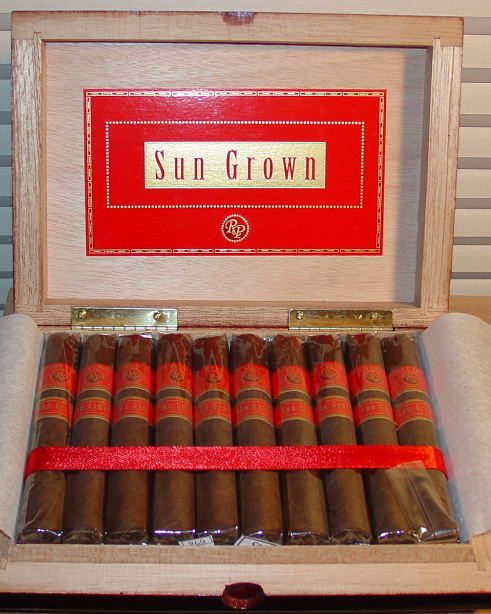
I found exactly what I was looking for in the Rocky Patel Sun Grown Petite. There’s nothing so intoxicating as cracking open a full box of cigars and inhaling the scent of aged tobacco, so it’s lucky for me that I had the presence of mind to take a picture before I dug in.

Rocky Patel’s Sun Grown line has been in and out of production since 2004. Apparently something went awry with the blend at one point in time and Rocky put a halt on production. Rocky’s reputation in this regard is pretty much impeccable — you’re getting the high quality cigar you expect, or you get nothing at all. The glitch in the blend was corrected in due course and today we have Sun Growns aplenty.

The highlight of this cigar is the Ecuadorian Sumatra wrapper, sun grown (of course) and aged for 5 years. In discussing his favorite growing regions, Rocky said in an interview with cigar.com,

I love the Sumatra from Ecuador. I think that wrapper has tons of flavor, strength, and it has that sweetness and it burns very very well compared to the wrappers used in Nicaragua or Honduras which are very thick, if you want the strength…

The wrapper on this cigar is so dark that it could almost be confused for maduro. It’s oily and deep in color, enriched with a reddish tone that makes it a real looker. Complementing the wrapper are a Nicaraguan binder, and filler from three countries: Brazil, the Dominican Republic, and Nicaragua. That’s a lot of leaf in one little corona, but it results in a sophisticated and well balanced blend.

There’s a lot of power packed into this little cigar. It starts up with a burst of pepper that burns off after a minute or two. Then a band of coffee and chocolate flavors comes marching in and trades choruses… is that coffee, no, it’s more like cocoa, no it’s coffee… and the sweetness of the wrapper suggests once again that it is maduro. But it’s much more aggressive than maduro, sweet but headier and more potent.

The burn and construction of all the cigars in this box was consistently good, though I am still testing. Maybe one of the last five sticks will disappoint, but somehow I doubt it.

The finish is long on these Sun Grown petites, and the aftertaste is a lasting reminder that you have just enjoyed a robust, though diminutive, cigar. It’s been a while since I smoked one of the larger sizes in this line, but I believe these little guys can stand up to the big boys. Try em. You’ll like em.


Maria Mancini Robusto Larga Maduro

cnv0244.jpg

The Maria Mancini is an economical cigar from Nestor Plasencia, maker of Mayorga, American Stogies, and a number of other brands including his own Plasencia and Plasencia Organica cigars. Nestor is the main reason I’m not in bankruptcy at the moment — he makes great cigars at a really reasonable price. The Maria Mancini is available for well under 3 dollars, and it’s a fine smoke.

This was the last survivor from a box I bought in the spring of 2005. When I first got the box I thought these Robustos smoked pretty well, but not great. They were a little rough and one dimensional. I let them sit for a few months and they improved tremendously.

The Robusto Larga measures six inches by a 50 ring gauge, and is made in Honduras. The information available online about this stick is conflicting — one site says they’re made in Cofradia, another says Danli. One site says the wrapper is Costa Rican, another says Mexican. Everyone agrees the binder is Honduran, but one site says the filler is Nicaraguan, another Honduran. In this case, I don’t think the specifics matter all that much. The real question: are they worth the 45 USD for a box of 20?

I reckon so, if you can sit on em for a couple months and let them settle down a little. After a few months they smooth out a little, and after a year they’re close to creamy. The primary flavor is wood, accented by the sweetness from the maduro. After a year and half this stick has really mellowed so there is no harshness at all; there’s not much complexity either, but for an econo stick it has plenty of flavor.

The main complaint I have is an uneven burn, which they all seem to suffer from, and a tight roll, which some (but not all) exhibit. The square press of this stick might have something to do with that. A year and a half in the humidor let this particular sample stretch its legs and get comfy, and it most definitely is a better cigar for it.

Aging a box of two dollar cigars might seem a bit extravagant, or ludicrous, but I think it’s the thing to do with Maria Mancinis. At the very least, let them sit for a couple months. And then sit back, open a cold Milwaukee’s Best, fire up a Mancini and laugh at those happy shiny people in Cigar Aficionado.

Fonseca Serie F Robusto

cnv0241.jpg

I’ve been working my way through the previously mentioned MATASA robusto sampler, and I have to say they’re all good smokes. The standard Fonseca is an outstanding mild cigar, but the Serie F and the Habanos Sellecion are excellent as well.

The “F” in “Serie F” is for Fuerte — for you gringos, that means STRONG. But strong is a relative term. Think of this as strong for a Fonseca — compared to the standard Fonseca line, the Serie F is indeed a heavier smoke. But in comparison to other full or heavy bodied cigars, it’s not exactly Godzilla.

Manuel Quesada, the man behind MATASA and Fonseca cigars, is not a fan of strong cigars, and it is only because of the “general trend” toward heavy bodied cigars that he started blending them. (I say “general trend” with some hesitation. It’s well known that the best selling cigars in the United States are still very mild, with Macanudo leading the pack.)

The “F” series was introduced in 2002 in one size only, the Toro. Soon after, the robusto and a smaller breva was added. They are manufactured in the MATASA factory in the Dominican Republic.

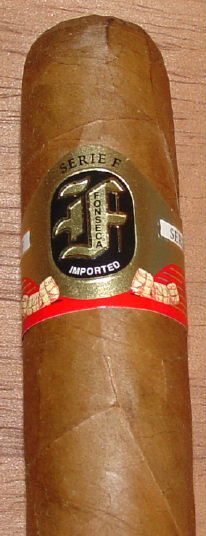
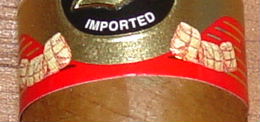
What we have here is a cigar that is very similar in many respects to the standard Fonseca — a luscious Connecticut Shade wrapper is the primary similarity. They also share a Mexican binder, so the difference is in the filler. The Serie F uses a brawnier blend of Dominican and Nicaraguan ligero to pump up the volume a bit.cnv0243.jpg These fillers are aged in tercio bales, a process which Quesada says keeps the moisture content in the bale higher over time, resulting in a more flavorful leaf. On the band are pictured little packages which are presumably tercio bales.

The robusto is a plump 5 x 52 with a beautifully golden EMS wrapper. There are a few graceful and unobtrusive veins. The draw is a little bit tight on these, a trait they have in common with the Habanos Sellecion. All the samples burned slowly, forming a solid ash that was gray in color with streaks from dark gray to black. The burn was fairly even, though not perfect. No corrections were required.

The underlying flavor is earth with some shavings of cedar. Floating over this is a wonderfully nutty, lightly spicy aroma. To me this cigar smells remarkably similar to the standard Fonseca, a very good thing indeed, but the flavor is definitely darker. This flavor grows deeper towards the end, culminating in a rich, somewhat graphitic taste. The finish at this point leans toward the long side of the spectrum, and the aftertaste is just a tad tannic.

But I have to agree with Quesada when he says the Serie F is “strong but not overpowering.” I would rate the power of this stick at a solid medium, but the taste as rich. It’s a nicely balanced blend, the earthy filler integrating well with the wrapper’s lighter notes of spice and wood.

Overall I think the Habanos Sellecion is a somewhat better choice, but the Serie F is a nicely nuanced smoke as well.


La Gloria Cubana Reserva Figurados “Selectos de Lujos”

cnv0239.jpg

A couple months ago I had the pleasure of smoking one of the smaller LGC Reservas in maduro, the Felicias. A very fine little smoke. So I couldn’t pass up its big brother, the “Selectos de Lujos,” a handsome looking Salamones style figurado.

This particular size in the Reserva Figurados line was selected by Cigar Aficionado magazine as one of the best cigars of 2004, earning a 93, the top scorer along with other stellar smokes like the Cohiba Siglo VI and Ashton’s VSG Spellbound.

The “Luxury Selection” is a large perfecto measuring 7 1/4 inches with a ring gauge of 54 at its widest point. Before production the tobaccos are aged for four years, including three months in specially designed cedar bins to impart an extra spicy cedar kick.

The Ecuadorian Sumatra seed wrapper on this baby is a beauty. The Nicaraguan binder and the filler blend of Nicaraguan and Dominican leaf work with the wrapper to create a harmoniously mild to medium-bodied cigar, but the wrapper steals the show.

cnv0240.jpg

The foot lights up easily with barely a spark from my torch lighter. The draw is excellent and the burn is slow. A nice volume of smoke is produced with every lazy puff.

The first taste is of cedar, soon accompanied by a very pleasant, almost sweet aroma from the wrapper. If I had to guess I would have said this was Cameroon — but no, this is just a very carefully selected and prepared Ecuadorian leaf with a lot of mellow spice.

The smoke from this cigar is extremely smooth, almost creamy. Despite the big flavor I found the finish to be short, leaving a neglible aftertaste.

Toward the mid-way point it builds to about a medium body and picks up just a hint of bitterness. Truth be told, the first quarter of this cigar is brilliant, the next quarter very good, and the rest is just plain good. The only letdown is that there isn’t too much development here — it’s a very tasty cigar, but not terribly complex.

The “Selectos de Lujos” is a fairly pricey cigar, but not over the top at around 7 USD per stick — pretty reasonable for a large figurado of this quality. I’d say it’s worth every nickel if you’re in the mood for a mellow and tasty smoke with top notch construction.

JR Cigars Weekly Special Conundrum

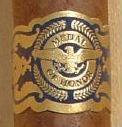
The weekly special announced by JR Cigars this past Wednesday was for its custom made and designed Medal of Honor cigars.cnv0237.jpg I have enjoyed and even reviewed one size in this line, so I was surprised to see that they are being discontinued. I was not surprised, subsequently, to hear that there was a run on the weekly special and supplies were quickly exhausted. They were very smooth and tasty smokes, typical Villazon quality, big Honduran flavor. I’m glad I still have a few ferretted away in the humidor.

What interests me is that the replacement chosen by JR is an entry in their Library Editions series. I have always been curious about these cigars, but have never taken a chance on them. I have also been curious about the Flor de A. Allones cigar, a reportedly heavyweight smoke– also from Villazon– that I’ve been looking at and wondering about for a few months now. So I was happy to see that the Library Edition on sale is “The Old Man and the Sea,” the Flor de A. Allones selection. (And included with that is a free book called The Complete Guide to Habanos.)

Now what caught my attention is the size of the Flor de A. Allones in the Library Edition : 6.25 x 45. Glancing through the Villazon cigars in the JR Catalog, Excalibur, El Rey del Mundo, Punch, etc., I don’t see any cigars in that size. A few come close, but I didn’t see any that are exactly those proportions…

Except for ONE: the Medal of Honor cigars. Both “The Intellect” and “The Shadow Prince” are 6.25 x 45. And ALL of the Villazon entries in the Library Editions, Bolivar, Excalibur, El Rey del Mundo, etc., measure 6.25 x 45. Same cigar maker, same size… SAME CIGAR??

Eh… probably not. Looking at the composition, the Flor de A. Allones is not the same as the Medal of Honor Intellect. But the Punch entry, “The Prince” by Machiavelli, does appear to have the exact same composition and size as the Medal of Honor “Intellect.” But is it really the same cigar?

And the more important question: how much longer can Cigarfan fend off his weekend chores by pretending to be hard at work on the computer, cooking up purposeless and cockamamie theories about the marketing practices of cigar distributors?

Not much longer, I’m afraid. Just long enough to pull the trigger on that Allones deal. Have a great Labor Day weekend everyone.