Onyx Reserve Toro

In my review of the Romeo y Julieta Reserve Maduro I noted that the wrapper used for that cigar is the same as the one used for the Onyx Reserve (as well as the delightful Backwoods). At the time I expressed surprise because the Romeo tastes nothing like the Onyx. After trying this Onyx, which has been idling in my humidor for about a year, I think I will have to back off a little from that statement.

cnv0222.jpg

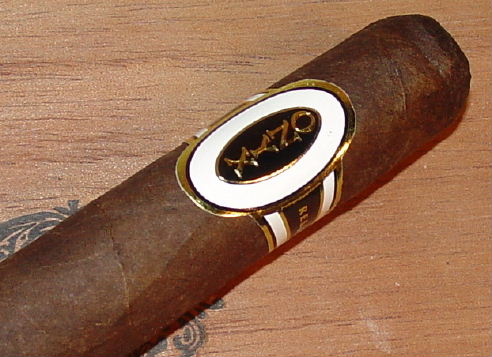
The Onyx Reserve, like the Romeo y Julieta Reserve Maduro, is made in La Romana, Dominican Republic, for Altadis USA. The wrapper is Connecticut broadleaf maduro. The binder is Nicaraguan, and the filler is a three country blend of Nicaraguan, Dominican, and Peruvian leaf. Yes, it’s the same combination used in the R y J Reserve Maduro. Could they be made in the same factory, even? Perhaps.

The wrapper is a solid dry maduro with just a touch of dust. I’m not sure if this is plume or what, but it gives the cigar a very matte black look. The first taste is rich and earthy, similar to but not quite as bold as the Romeo y Julieta Reserve Maduro. (Keeping in mind the age of this sample, it may have mellowed a bit.) The earth blends in well with the sweetness of the maduro.

It gets woodier and takes on a little pepper at the half-way point. The funky overtones give way to bittersweet chocolate, and this flavor pretty much takes it to the finale. It’s a little salty on the tongue, and the aroma is very cedary and at times even floral. The only real drawback is a bitter aftertaste.

The construction on this stick was perfect. The draw is generous and the burn is even all the way. It forms a respectable dirty gray ash that has a yellowish tinge.

This is a great medium bodied cigar, in the same class as the Romeo y Julieta Reserve Maduro and K. Hansotia’s Signature 101, but better. Considering how close it is to the R y J in flavor and composition, and the fact that the Onyx sells for about a third less than the Romeo, I know which one gets my vote.

Of Fidel and Flies

While the American cigar community keeps an avid watch for news of Fidel Castro’s demise, (and the unlikely possibility that his successor will shower democracy on the Cuban people, and the even more unlikely possibility that Fidel’s death will result in Bush lifting the embargo) I have been pondering a different question.

diptera.jpg

How effective is cigar smoke as an insect repellent?

My next door neighbors have a stable of a dozen or more horses that they board and train. It’s great to sit on the patio with a tasty stogie and watch the kids learning to ride. What’s not so great is that horses have a way of generating flies, and with the heat this year the flies are out of control.

In my own experience, I think the flies may be discouraged, but not entirely deterred by cigar smoke. How does one identify a frustrated fly? It lands and it flies away. Then lands again. Flies again. Is this an indication of dipteric bliss? Is it repelled by or — God forbid — attracted to the gentle aroma of my Rocky Patel Vintage Second?

And furthermore, is it true that cheap stogies are more effective than quality cigars at repelling insects?

I thought I’d turn to the experts for answers.

At first glance it appears it appears that cigar smoke is more effectively applied against mosquitoes than flies.

All smoke discourages mosquitoes, whether it’s from a wood fire or a big old Cuban cigar,” says Jonathan F. Day, a professor with the University of Florida’s mosquito research laboratory. “And the mosquitoes prefer to stay upwind, where most of the people are sitting anyway, because they don’t like the smoke either. You’re only keeping the mosquitoes away in one quadrant.” (1) “Every year news stories appear touting the mosquito-repelling benefits of ingesting mega-doses of B vitamins, brewer’s yeast, garlic, beer, whisky, cigars, and cigarettes. While some of these remedies may render the user temporarily immune to the effects of mosquito bites (alcohol) or may temporarily protect the user (and friends) from a down-wind attack (smoke) none have ever been shown in controlled scientific studies to protect users from biting insects.” (2)

As fans of the tobacco leaf we all appreciate the relaxing and stimulating effects of nicotine in small doses. And most of us are familiar with the unpleasant feeling of queasiness and discomfort which comes from too much Vitamin N. At even higher doses, (much higher doses) nicotine is toxic and has been used as an insecticide. So it should be effective as an insect repellent, right?

Citronella coils and candles are weakly repellent, says Joseph Conlon of the American Mosquito Control Association, but a cloud of smoke from a smudge pot or a cigar will work, if you’re willing to let it surround you. (3)

But for the last word on this subject I will have to turn to the ultimate authority on bugs and cigars: the fisherman.

In Trout Madness Robert Travers advises anglers to “smoke cheap Italian cigars, which smell like a flophouse mattress fire mixed with rotting Bermuda onions. They will, however, keep insects and most respectable ladies at bay.”

On the other hand, Anthony Acerrano says “This age-old problem has spawned a lot of pseudo remedies and folklore that yield limited or purely imaginary results, such as smoke cures (cigars, coils, smudge fires). Aside from being a good excuse to light up a malodorous stogie, cigar smoke does little to repel mosquitoes and flies; certainly it does nothing to keep them off below-neck areas.”(4)

So the jury is still out on the application of cigar smoke to insect control. My gut feeling is that the effectiveness of the smoke is directly proportional to the size of the cloud and inversely related to the price of the cigar. But I pledge to continue research in this area and will report back any significant findings.

fidel-castro_che.jpg

I now return you to your regularly scheduled deathwatch.

1. Michael Browning, Anti-Mosquito Products
2. Jonathan Day, Repellent Wars
3. James Gorman, Searching for ways to cope with Buzz of Mosquito Season
4. Anthony Acerrano, Bug Off!

CAO Sopranos “Associate”

cnv0220.jpg

Each time we turn into The Sopranos we get to see Tony Soprano in his car, lighting up a cigar as the opening credits roll. So it is fitting that HBO should extend a meaty palm to CAO and license the Sopranos edition of cigars. In 2005 they did just that, and at the RTDA that year CAO unleashed three sizes of pricey Sopranos smokes.

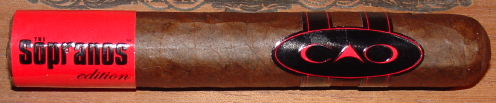
This is the smallest of the three sizes, the Associate, a standard robusto at 5 x 52. Also available are the Soldier (toro) the Boss (double corona) and the just released “Tony Soprano Signature,” an extra-large toro with a 60 ring gauge.

The wrapper used for the Sopranos series is Brazilian mata fina. I was interested for this reason to see how it would compare to CAO’s Brazilia line, which uses a Brazilian arapiraca leaf rather than mata fina. The cigar is completed with a Honduran binder and an interesting combination of Nicaraguan, Dominican and Columbian filler. Columbian leaf is a rarity as well, but CAO has used it before in their CX2 double-cameroon sticks.

I was frankly quite surprised by the Associate. I was expecting something along the same lines as the Brazilia Gol! — something rich and spicy. Instead, the Associate turns out to be a sweetheart.

The wrapper on this cigar is an attractive shiny maduro, and the roll is flawless. It fired up without a hitch and burned straight all the way. It forms a solid white ash that wants to spend some time with you before hitting the ashtray.

The first flavor is a delicate sweetness, a smoky maple syrup. The smoke is surprisingly light and smooth, and at no point did it develop any kind of bite. There is a hint of licorice, but that’s it from the spice cabinet. The base flavor is earthy, but even this is fairly muted. Mostly this is just a very relaxing easy-going cigar. Toward the end it turns up the chocolate. After removing the band and nearly burning my fingertips I laid this one to rest.

The Sopranos “Associate” is a refined and relaxing cigar that took me by surprise. It’s not the powerhouse I expected, but considering the fact that my expectations were based on a fictional family of mobsters on television, perhaps I get what I deserve.

Unfortunately the price on this limited edition from CAO is a little bit prohibitive. But I would recommend it anyway as a special treat, especially for tough guys with a soft spot.

Cusano Corojo 1997 Robusto

cnv0219.jpg

The term “Corojo” has been used to describe both a particular type of wrapper leaf and the style of a cigar. In the case of the Cusano Corojo, it’s a little of both.

The original corojo leaf was developed in Cuba on a plantation called Santa Ines del Corojo by agriculturalist Diego Rodriguez. This leaf became famous for its delicate and silky texture as well as its flavor and fine burning qualities. Genuine corojo was Cuba’s premier wrapper leaf for several decades.

But cultivation of corojo in Cuba came to a halt in the mid 90’s because the strain is highly susceptible to blue mold and other diseases. Corojo hybrids were then developed that could withstand the ills that cigar tobacco is heir to. Among the more famous — and infamous — Cuban hybrids are H2000, Corojo 96 and Corojo 97.

The corojo on the Cusano Corojo is a hybrid of some sort, but as owner Michael Chiusano said in Smoke Magazine, “You can make an orange pest-resistant without turning it into something other than an orange.” From this I take it that Chiusano means that his corojo is still Corojo, and bears at least a family resemblance to the original Cuban variety.

Cusano’s corojo is grown naturally tapado under cloud cover in Ecuador. The original crop was harvested in 1996 and the seeds from this harvest were selected and produced the 1997 wrappers the following year. The 1996 Corojo was released with a Connecticut binder, but the 1997s have a spicy Mexican Sumatra binder. The filler is Dominican in both cases. The brand was first released in 2004.

The wrapper on this robusto is a toothy dark colorado maduro. I used a punch on the cap and found the preliminary draw to be very good. The cap itself was not applied with the greatest care, but the rest of the cigar looks to be in good shape.

When I whipped the cello off this stick I thought I detected a whiff of ammonia. Not strong, but present. Lighting up this cigar confirmed my first impression — this cigar is a youngster. The first taste is grassy and slightly bitter, and it remains this way to the end. The aroma is toasty and delicate, but the greenish flavor doesn’t do the wrapper justice.

Additionally, the ash is crumbly and a mottled gray and black in color. Min Ron Nee in his seminal work on Post-Revolution Havana Cigars notes that this phenomenon is caused by incomplete combustion of the leaf. I’m not sure if this is true or not, but it is relatively common with unaged Cuban cigars.

Try this. Torch the black/grey ashes. They become white. The black/grey ashes are due to incomplete combustion. The black particles might be partially burnt organic molecules, because they are too large to be combustible.

He goes on to say that the fermentation process causes the breakdown of these molecules, resulting in complete combustion and a white ash.

Again, I don’t know if MRN’s explanation carries any scientific weight, but it is, as Plato says, “a likely story.” What I do know is that this is the second Cusano cigar I’ve tried that has tasted like this.

Aside from the green issues, this is a very well constructed medium-bodied smoke. Toward the mid-point it turns a bit musky, and the aroma remains pleasantly toasty throughout.

Like the Cusano 18 Double Connecticut I think the Corojo 1997 shows great potential, but it’s not there yet. I’m going to pick up a few and stow them away for a few years to see if my hypothesis is correct. Both the 18 Double CT and the Corojo 1997 are reasonably priced — well worth the investment of time and space in my humidor.

Carlos Toraño Signature Perfecto

cnv0218.jpg

The Toraño Signature series was introduced in 2000 and has garnered both rave reviews and many new fans since then. This is one of the last Toraño series I had yet to try, and it turns out to be one of the best. I chose the perfecto the other evening because I was looking for something with a lot of flavor in a fairly small package.

The Signature perfecto is a true torpedo, being tapered at both the head and foot. It measures 5 inches long and weighs in at a 50 ring gauge at its thickest point. Both head and foot are slightly open, but the head still needs a clip to open it up a bit.

The wrapper is a deliciously oily sungrown Brazilian maduro. The binder is Connecticut broadleaf, and the filler is a blend of Nicaraguan and Dominican piloto cubano. The roll is solid all the way and exhibits an open draw even before the foot opens up.

The Signature perfecto opens up with an earthy introduction, similar in flavor to the base flavors in Toraño’s 1916 Cameroon. Here, however, the spice of the Cameroon is replaced by a sweet maduro accented with flavors of Columbian coffee and leather. It starts out with a very light bite, but this quickly mellows out and by mid-point the smoke is smooth; not creamy exactly, but carefree. The flavor continues with an earthy base. Eventually the leather gives way to sweet wood, until the two-thirds point (just past the first band) where it becomes slightly bitter, signalling the end of the cigar for me.

The Toraño Signature perfecto is a dry, earthy cigar with excellent construction that could be enjoyed at any time of the day. If you’re in the mood for an earthy medium-bodied cigar and have a fiver taking up space in your wallet, trade it in at your B&M for this perfecto. I doubt you’ll be disappointed.

Rocky Patel Vintage 1992 Juniors

cnv0216.jpg

Well, Las Vegas wasn’t hot enough for me, so I’m spending a week in Phoenix. I brought a few cigars along with me, but since I’m not smart enough to go someplace with a more temperate climate I’m still smoking the small gars.

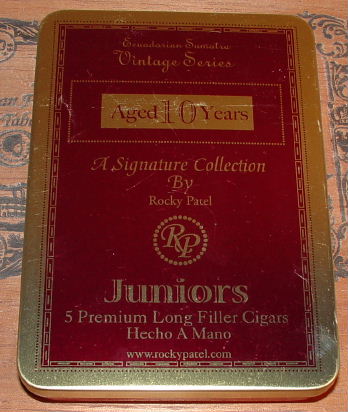
The Rocky Patel Juniors are nice looking small cigars, and they taste very similar to the larger 1992 Vintage smokes. I have developed a preference for the 1990 Vintage because I’ve had some back luck with construction on the 92s. But the Juniors have been perfect so far: they light up easily on a single match, burn straight, and have a firm but easy draw.

Cigarcyclopedia classifies this one as a “short panatela.” At 4 x 38 it’s too big to be a cigarillo, but not fat enough to be a petite corona.

The Ecuadorian wrapper on these is a nice looking rich colorado maduro and has all the great flavor of the larger sized Vintage 92s. There’s a woody flavor throughout most of the stick with a little bit of cinnamon spice upon first light. Along the way there are sweet notes of chocolate and some darker coffee flavors that float above the wood. The flavor is not as pronounced as it is on the larger sizes, for obvious reasons, but it’s a faithful replication on a much smaller scale.

I’ve smoked three of these so far and have found that they last about twenty minutes to the first band. Take that off and you can get another good five minutes out of the stick before it starts to burn a little too hot and sharp for comfort.

I purchased a tin of these for about 9 USD, a pretty good deal considering the price of the regular sizes in this line. The reasonable price and full flavor of these little guys gives them a thumbs up from me. One of the better short smokes I’ve had this summer.

La Gloria Cubana Reserve Felicias Maduro

cnv0211.jpg

La Gloria Cubana Reserve Figurados were introduced by Ernesto Perez-Carrillo in 2004 as a limited edition cigar. Only two master rollers, hand picked by Ernesto for their superior skills, are assigned to the Reserve Figurados. The tobaccos for this line are aged for three months in specially designed cedar bins to impart an extra spiciness — and then they are aged for three months further in the box.

The line was expanded in 2005 to include two maduro wrapped cigars — the Regalias Perfectos, and the Felicias Maduro pictured above. These are the only two sizes wrapped in Connecticut broadleaf maduro, but they are also available in Ecuador grown Sumatra.

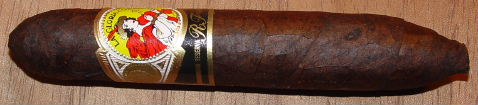
The size is 4 5/8 by 49, a small but beautiful figurado reminiscent of Fuente’s Hemingway Short Story. The wrapper on this cigar is rich with oil and smells good enough to eat. So good in fact that I think I’m going to give you a close up:

cnv0213.jpg
The name “Felicia” is a tribute to Ernesto’s mother. You know she has to be proud of her son. It’s a beautiful cigar, and a testament to the fine art of cigar rolling.

Like most LGCs this one is made in the Dominican Republic. The binder is Nicaraguan, and the filler is a Nicaraguan-Dominican blend. The prelight draw is tight due to the perfecto foot — once this burns off the draw is also perfecto.

The initial taste is peppery, sharp but not strong. There is a little bit of a bite. The aroma is of sweet wood — cedar, almost piney. A few minutes later there’s some sweetness from the maduro, and a bit later some sulfur. The aroma remains true to its cedary base.

I picked this cigar tonight because I wanted something fairly short. By 8:30 it had cooled down outside to about 107 degrees from the 114 during the day. It wasn’t a double corona kind of evening, by my standards anyway. Even so, this cigar lasted a good 45 minutes. My only gripe is that it burned a little hot toward the end, but by that time the coal was touching the band anyway and it was time to go in and cool off.

The aftertaste is rich and chocolatey — strangely similar to the scent of the cigar in a pre-lit state. So in this way it comes full circle. A very nice smoke. I’d really like to try the larger Regalias sometime, perhaps in the fall when the desert is a little more cigar friendly.

I received this smoke as part of a sampler trade on Club Stogie. Thanks Bonggoy!

Peterson Gran Reserva Robusto

cnv0209.jpg

Peterson has a long established reputation as an Irish pipe maker. I smoke a pipe on occasion, and two of the three pipes I own are Peterson system pipes. The “system” was invented by Charles Peterson in the late nineteenth century, a few years after he joined the tobaconnist brothers Friedrich and Heinrich Kapp on Grafton Street in Dublin. The Peterson system employs an extra chamber in the pipe that funnels some of the moisture produced by the tobacco and results in a dry carefree smoke. They’re quite popular pipes even today, a hundred and some odd years later.

An exact replica of Charles Peterson’s favorite pipe has been released to celebrate the 140th anniversary of the company. Engraved on the silver band is the phrase “When stolen, please return to 55, Grafton Street. Charles Peterson.” And that is the beauty of pipes — they can be returned after curious thieves have given them a joy ride. Not so with cigars, I’m afraid.

The Peterson Gran Reserva line was introduced at the RTDA trade show in 2004, but it wasn’t Peterson’s first foray into cigar production. In 1995 they came out with the Peterson Hallmark series, but it was washed away by the storm of the boom years.

Peterson pipes are distributed by Ashton here in the U.S., so perhaps it was natural for Peterson to ask Ashton to give the Peterson name another shot at a cigar line. Ashton makes several well known and highly sought after cigars under their own name, so who better to partner with?

Peterson’s Gran Reserva is produced at the Flor de Copan factory in Santa Rosa de Copan, Honduras, and is imported and distributed by Ashton. The filler is a Honduran-Nicaraguan blend, the binder is Nicaraguan, and the wrapper is a smooth but dry Cameroon leaf. Not quite the toothiest Cameroon around, but tasty.

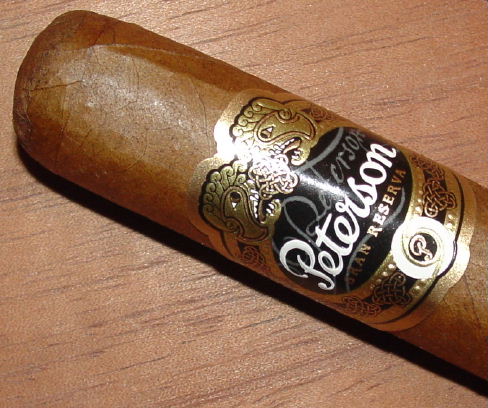
Some of the wrappers have water spots carefully arranged at the back of the cigar. (Clever.) The roll is firm and the prelight draw is very good. The caps are well formed and tight on the head of the stick.

The Gran Reserva fires up with a burst of spice typical of Cameroon wrapper. It’s a little rough at first, but smooths out after a half inch or so. It maintains a medium body throughout the smoke, gathering a little strength toward the end, but not enough to become truly heavy. The base flavor is leather. Combined with the spicy floral aroma from the wrapper this is a tasty smoke.

The samples I tried were fairly dry. I found minor splits in the wrapper after the half-way point, but they didn’t affect the cigar and weren’t large enough to be annoying. They also seemed to burn quickly, which may be another indication that they enjoy more tropical storage conditions. (My humidor has been reading in the 65 – 67% range.)

The Peterson Gran Reserva reminded me a little of the Ashton Heritage Puro Sol, but it didn’t have the same depth. They share the same fine aroma, but the Puro Sol just seems to have a more refined and complex flavor.

Despite this perhaps unfair comparison, the Peterson is a fine cigar, and I will be trying these again in the future after storing them at a higher RH. I’m going to consider these first two just a trial run.

Vega Talanga Tercio

cnv0208.jpg

Vega Talanga debuted in 2002 from the cigar division of US Tobacco, better known as the producers of Skoal and Copenhagen smokeless chew. Since then that part of UST has been transferred to Swisher/General Cigars as part of a settlement in an antitrust suit. The information I have is dated previous to that takeover, so caveat lector.

The term “tercio” at one time referred to a 16th century Spanish military formation, also known as “the Spanish square,” a mixed infantry formation that utilized pikemen and musketeers to capitalize on the brute strength of the pikes and the long-range abilities of the muskets.

In the cigar world, however, a tercio is a bale of cigar tobacco sealed in the bark of the royal palm tree. This reportedly creates a tighter seal than the plastic, burlap, or cardboard materials often used to bale tobacco. This method results in less loss of moisture and forces the recirculation of air throughout the bale, making a more flavorful tobacco. (At least that’s what Manuel Quesada says, and who am I to argue?)

The Talanga Valley is located in the Francisco Morazan province of Honduras about a two hours drive north from Danli. Much of the tobacco is grown encallado — sheltered behind large stands of king grass to protect it from the wind — and is sun grown, resulting in a stronger leaf. Combine this with the deep fermentation the tobacco receives in the tercio, and you have the makings of a rich and powerful smoke.

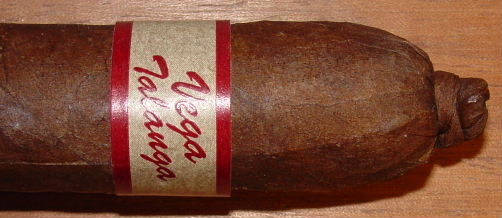
Instead of the standard spanish cedar box, the Vega Talanga Tercio is presented in packages of palm bark just like the ones used to process the raw tobacco. The raw unfinished character of the cigar is emphasized again by its untrimmed foot, and a pig tail cap. The Tercios are produced in Danli using Talanga tobacco for wrapper, binder, and most of the filler, but the filler is supplemented with some Nicaraguan leaf.

Vega Talanga has introduced a new corojo line available in three sizes, but so far the Tercio is only available in one size: a 6 x 54 toro. The roll seems rather soft, and the draw is very easy. The wrapper is rough and leathery with a rich colorado color.

A little effort is required to light this cigar since the foot is flagged and the flaps are folded over onto the foot. But once it gets going, it requires no further maintenance. The burn is a bit uneven at times, but it corrects itself. The softness of this stick is a little weird, but it doesn’t seem to affect the draw or the burn.

The flavor is unusual, and I can’t quite pin it down. The smoke is very smooth, almost creamy in texture, but the flavor is of various shades of earth. At first it tastes of minerals, after a couple inches it turns musky, and the last transition is to a slightly woody flavor. I’m not comfortable with these descriptors, but it’s the closest I can get. It’s an easy smoking cigar, but complex. I can’t compare it to anything — this cigar produces flavors outside the standard spectrum, I think.

The aftertaste is a little bitter, somewhat metallic. A peaty scotch companion comes to the assist here.

All in all a very interesting smoke. I have an Astral Talanga Valley in the humidor that I may have to pounce on soon, because now I want to know if the unusual flavors in the Vega Talanga are coming from the Talanga Valley, or from Vega Talanga…

Dynamite 652

cnv0202.jpg

From Indianhead, makers of American Stogies, comes Dynamite — in corojo and maduro wrappers. At less than two bucks in my B&M they’re so cheap I had to try both.

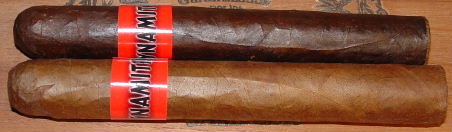
Taking a page from Rocky Patel’s Edge and Camacho’s El Legendario, Dynamite cigars are presented in rough boxes of 24 sticks. Like those cigars the Dynamite was at one time unbanded, but at some point Indianhead began releasing them with very corny orange bands. The wrappers on these cigars are so nice and shiny that the bands are a distraction, in my opinion, but at least they allow me to tell them apart from the Edges and Legendarios in my humidor.

As you can see, even though these are the same size cigar, they are not the same length. We aren’t dealing with Habanos here. And while the wrappers are quite tasty looking the roll in both cases is quite bumpy. Fortunately this does not affect the overall construction, which happens to be excellent.

Corojo

The Corojo version starts out surprisingly smooth for a cigar named after the world’s premier explosive. It has a mellow, slightly nutty, and very muted flavor. It burns slowly with a good volume of smoke. Sitting out on the back porch, watching the sun go down and hoping for a breeze which I did not get, I sort of wished it would burn faster. No such luck– this baby takes its time.

Like most “bargain” type cigars this one peters out at the midway point; unlike some of those same cigars this one doesn’t turn rank. It remains a very smooth, nutty smoke to the end. The aftertaste builds and becomes a little waxy and unpleasant. This combined with a downturn in flavor resulted in my disposing of it about an inch from the band.

Maduro

The maduro version is a very smooth and mellow cigar. It shares the same fine construction as the corojo, with an easy light and an even burn, but without the same robust volume of smoke. It also seems to burn a little more quickly than the corojo.

The maduro 652 does not have a whole lot of complexity, but at this price I wasn’t expecting it. It isn’t quite as sweet as I’d expected– instead there is a licorice like tang over a base of char. Like the corojo it has a somewhat waxy aftertaste, but not as pronounced. There is no bite at all. It’s one of the smoothest cigars I’ve smoked recently. Not the tastiest, but very suave.

Overall, these are good everyday cigars. Factor in the price, and they’re great everyday cigars. Indianhead has done it again with the Dynamite line, though I might quibble a little with the name (and the band.)

Pick up a few for walking the dog or handing out to fishing buddies.