

The Jameson Cigar Company was founded in 2008 and the Red and Black Labels were the company’s inaugural releases. The well-known (and well-reviewed) Declaration and Santos de Miami lines were soon to follow, but I like to think that the first blends from a cigar maker are what makes or breaks the brand’s reputation. So it’s about time that I got around to smoking a few of them.
The Red Label was initially released with a Sumatra wrapper, but the line was reblended in 2009 with an Ecuadorian Connecticut cover leaf. A binder from Honduras and aged Dominican filler form the core of Jameson’s mildest blend.
Five sizes are in production:
- Corona – 5 x 44
- Perfecto – 5 x 54
- Torpedo – 6 x 54
- Robusto – 5 x 50
- Toro – 6 x 52
One of the flavors that I love to discover in a cigar is coffee — sometimes it presents itself as cocoa, or chocolate — but the bean is the thing that rings my bell. So coffee is a frequent companion to my daily cigar, and I know I’m not alone.

Rockstone "Good Day Sunshine"
It makes sense for this reason that Brad Mayo, the founder of Jameson Cigars, is now also in the coffee business. Rockstone Coffee was established in 2009 as an adjunct to the cigar side of Mayo’s business, and he was kind enough to send along some samples for me to taste. (The Red Label robustos were on my own dime.)
Construction Notes
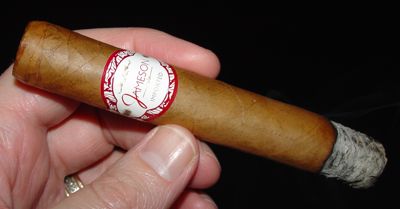
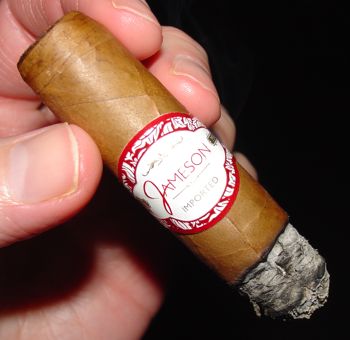
The shade wrapper on the Jameson Red Label robusto is so light it’s almost amarillo — it’s the color of freshly baked bread, and it has the soft texture typical of Connecticut seed shade leaf. The roll is firm but draws well, and the cap is finely executed with a triple wrap and a flat head.
Most cigars with shade wrappers produce an ash with a very consistent color, usually a smooth light gray. The Red Label, on the other hand, produces a light-colored ash with striations of darker gray and black. The ash is solid, but more importantly, the cigar burns evenly.
Overall construction: excellent.
Tasting Notes
I like a mild smoke every once in a while, and Connecticut Shade, whether the genuine article or grown elsewhere, is a deliciously aromatic leaf. But take the band off the cigar and one mild shade stick usually tastes just like any other. Not so with Jameson’s Red Label.
A tannic tartness lets the smoker know up front that this cigar is going to be a little bit different. The qualities typical of mild shade cigars are also there — a creamy texture (though not as buttery as some), a sweetly floral aroma, and a subtle aftertaste that starts the cigar off gently. There is a woody undertone to the flavor in the first half, and a tiny pinch of pepper on the retrohale.
The second half of the cigar becomes increasingly earthy, and the aroma seems more caramelized than floral. What is surprising at this point is the spice on the palate. The strength of the cigar remains fairly mild, but the flavor is on full. The tannic notes that initially characterize the smoke become increasingly difficult to detect through the earth and pepper.
Rockstone Coffee

Rockstone Guatemala Candelaria
The “Good Day Sunshine” Blend is quite mild, tasty, and easy to drink. The dark-roasted flavors that are so popular with mainstream java junkies are in attendance, but the beans are not over-roasted, which is the problem with the mainstream stuff. The roasty flavors are really well balanced here.
Both of the Rockstone coffee blends work well with the Red Label, and they’re both nice roasts, but I preferred the Guatemalan. There is an acidic spring to this coffee that pairs with the tannin in the cigar as if they were made for each other. The roast is light, maybe a city-plus at most, and this allows the region character to express itself freely. It’s a bold, bright cup with a nice body. The notes of lemon would make me think it was an Ethiopian Yirgacheffe rather than Guatemalan, but then I would be wrong. In that case I would be happy to be wrong as long as I could still grind up a handful of these beans for my breakfast brew.
Conclusion
Pairing the Jameson Red Label with Rockstone coffee was a most enjoyable experiment for me, and my taste buds are still thanking me. (I wasn’t expecting such a long finish on a mild cigar…) And my wallet isn’t complaining too loudly either: the Red Label robusto sells for around $4-5, and the coffee runs around $16 per pound. Both the cigar and the coffee have more character than others in their class, and both are definitely worth tracking down.
http://www.rockstonecoffee.com/
https://www.jamesoncigars.com/
Final Score: 88
 Cigarfan.net