Cigar Wrapper Issues: Mold, Bloom, and Spots

bloom1.jpg

We are approaching that time of year when conscientious cigar collectors look to their humidors with concern and trepidation. Well, concern anyway. I’ll reserve the trepidation for myself. Tobacco beetles, mold, the perfect RH and temp for aging my precious smokes — all these worries infect my otherwise pacific pastime.

And I know I’m not alone. I’m always surprised when I look at the hit counts for this blog and see that our All Time Most Popular Post is not a remarkably incisive review of the hottest new release from Pepin. It’s a short throwaway post about mold on cigars. (See this post for pictures of the afflicted.)

“Is it mold or plume?”

That is the question. The cigar is fuzzier than a two week old kitten, but Polonious behind the register is telling you it’s “aging very nicely.” Fuzz factor aside, it normally takes years to develop bloom on a cigar. Unless your shop sells vintage cigars, it is unlikely to be plume.

But it’s not often easy to tell the difference between mold and bloom if you don’t know what to look for. The most common type of cigar mold, in my experience, is the white variety that occurs in small patches on the wrapper. Unfortunately I don’t have as much experience with plume (aka bloom) but the distinguishing characteristic is that plume is not patchy like mold is.

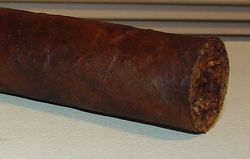
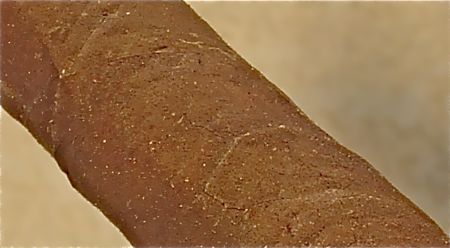
Pictured above is a four year old cigar with a very light dusting of plume. It’s really hard to photograph, but it sparkles if turned at the right angle in the light. I adjusted the saturation in an attempt to highlight the crystals. It is far less dramatic, but oh so much more delightful than patches of mold. Vitolas.net has a much better photo of a blooming ’95 Opus X here.


Plume is a crystallization of oils from the cigar wrapper, and it appears as a fine spray of sugar, more or less evenly distributed across the surface of the stick. Mold, on the other hand, is a living and social creature that likes to gather in colonies. Well, maybe not social, but you get the point — it shows up in discrete separate spots, making your cigar look like a petri dish.

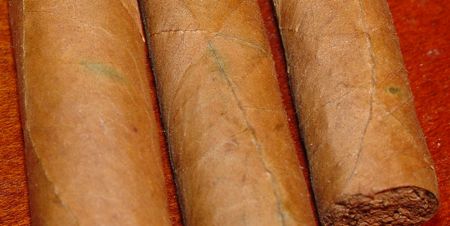
Green patches
green-spots-1.jpg

Getting tobacco to grow is not hard. Tobacco is a weed (and I like it, to quote the verse) and it will grow wild, unsupervised, with heartfelt abandon. But growing attractive, flavorful tobacco, particularly wrapper leaf for cigars, is not easy. It is hard. Very hard.

Something as uneventful as the fall of a tiny pink blossom from the top of the plant onto the leaf below can damage the leaf, resulting in a blemish, or worse, “blossom rot.”

“If you can’t get to the tobacco on time,” explains Lawrence Palombo (of General Cigar) on a tour of the fields, “it starts flowering, the blossoms drop off onto the leaves below and rot, damaging the leaf.”¹

Years and years of breeding and experimentation have gone into the methods used to produce the golden leaf we love, much of it in an effort to dodge the diseases tobacco is heir to and the pests who would like to beat smokers to the Punch. But it isn’t a perfect science. There is one factor that agronomists and vegueros will never be able to control with precision — the weather.

Nearly all the wrapper anomalies that aren’t attributable to mold or plume are caused by water appearing at inopportune times on the leaf. Most leaves that are damaged in this way never make it to the roller’s table, but occasionally they do. Often the resulting cigars are sold as seconds. Or Havanas.

Controlling moisture is essential. If a curing barn is too humid, there is a danger that the tobacco leaf will become mottled or will rot before drying. On the other hand, overly dry air inhibits the chemical transformations that are necessary for the tobacco to dry properly, leaving green traces of cholorophyll on the leaf. For these reasons, the veguero must open or close the casa’s doors accordingly, carefully maintaining a constant temperature and relative humidity inside.²
green-spots-2.jpg

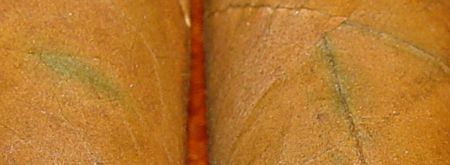
Green patches caused by imperfect curing are most commonly found on the delicate claro shade wrappers of Cuba and the Connecticut River Valley. They’re sometimes called “frog eyes” (not to be confused with the more damaging tobacco fungus called “frog-eye leafspot.”) They usually show up as small, relatively minor blemishes like those pictured here. They are clearly discolorations and not growths like mold.

It isn’t clear to me exactly what causes these green spots, but it appears that excess moisture at some point in the process causes patches or streaks in the leaf to resist curing.

“The rain prevented the tobacco from maturing the way it should,” says David Perez (of ASP in Ecuador.) “We had a lot of green spots, a lot less yield per acre…”

Tobacco grown during the El Niño years is easy to spot. Some is subtly marred, with a few green spots on the wrapper known as frog eyes. These spots usually aren’t detectable in the fields, but the eyes blossom in the curing barn as the moisture is drawn from the tobacco.³

While there doesn’t appear to be a singular cause of green spots, the important thing is that they really are harmless. They detract from the overall appearance of the wrapper, but they don’t affect the flavor or burning quality of an otherwise perfect cigar.

Water Spots

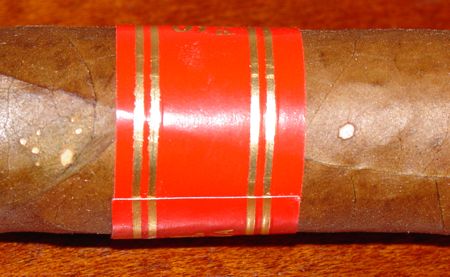
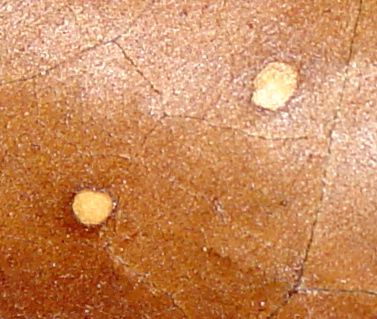
The other common imperfection of the harmless type is the water spot. These usually occur as very light yellowish-white circular patches that stand out against the light brown of a shade grown wrapper.
water-spots-1.jpg

It is commonly believed that drops of rain water sitting on the leaf cause damage to the chlorophyll in the leaf, eventually affecting the curing process so that instead of degrading from green to brown, the pigment in the spot turns lighter than normal.

Spots are about the size of a pinhead, random, and generally lighter than the wrapper. Althrough there has been some debate about what causes the spots, the general concensus is that these are just splashes of water that have marred the leaf.

Remember that wrapper leaf is very delicate, and can be bruised by something as seemingly harmless as a steady pelting of rain. The spots of water then act as lenses to focus sunlight on these points and slightly discolor the leaf.4
water-spots-2.jpg

The causes of wrapper imperfections are varied, and in the final analysis not all that important. What is important is to be able to differentiate between mold and harmless flaws. Mold can destroy a cigar, whereas small leaf spots are almost always harmless. And if you are lucky enough to have a blooming, pluming box of vintage smokes — then, my friend, you have done very well for yourself indeed.

NOTES

  1. Wrapped Up: Some of the World’s Best Cigars Use Connecticut Tobacco Wrapper Leaves” Cigar Aficionado, Winter 1992
  2. The Havana Cigar: Cuba’s Finest, Charles Del Tedesco. Abbeville Press, 1997
  3. Land of Fire: Ecuadoran Cigar Wrapper Tobacco Thrives in a World of Volcanoes and Perpetual Cloud Cover” Cigar Aficionado, March/April 2000
  4. The Complete Idiot’s Guide to Cigars, Ted Gage. Alpha, 1997

Nestor Miranda Special Selection Robusto Grande

miranda1.jpg

————–

UPDATE FOR 2009: This cigar has been reblended by Pepin Garcia and is  now produced in Nicaragua at Garcia’s Tabacalera Cubana.

————–

Nestor Miranda is the maker of the Don Lino line of cigars, and his Miami Cigar Company is the U.S. distributor for La Aurora. (Please see Lucky7’s background about Nestor in his review of the Don Lino Africa for a good overview of the company and the man.)

Nestor Miranda’s “Special Selection” is a new line so I was hoping to provide a little more detail on the blend, but scouring the internet and interrogating cigar shop personnel was not particularly effective this time. What I ended up with was a hodge podge of conflicting information.

Putting this information on the Miami Cigar Company website would just be too easy. So I found myself in the data mine, digging with some sharpened kitchen cutlery by the light of a Prince Blazer. (While the Blazer burns hot enough to weld metal, it isn’t reknowned for its luminosity. My search results reflect that.)

The unsubstantiated results of my foray into the darkness:

  • This is Nestor’s “personal cigar,” the one he hands out to friends and colleagues, etc.
  • It is available in two sizes, a 5 1/2 x 54 robusto grande, and a 6 x 60 toro grande.
  • It comes in a choice of two Nicaraguan wrappers, oscuro or rosado.
  • One retail site says this cigar is “predominately Honduran.” Another says the binder is Nicaraguan, and the filler is Nicaraguan ligero.
  • In a 2007 Cigar Aficionado interview, Nestor Miranda announced that a special Don Lino edition would be released with his signature “next year.” This is not marketed as a Don Lino cigar, but the box does indeed bear the signature of Nestor Miranda.

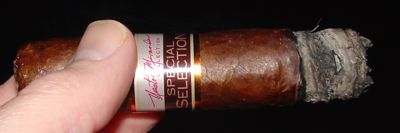
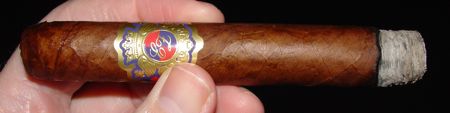
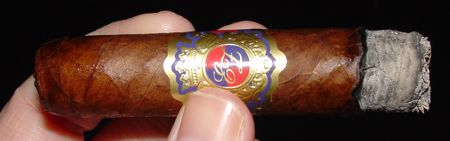
Aesthetically, this is a nice looking stick. The wrapper is a swirl of dark brown to nearly black, and it glistens with oil. The tobaccos for this stick have been aged for three years (at least according to one vendor site) and judging by thenmss3.jpg appearance of the wrapper, I don’t doubt it. There are some prominent veins and the head is a little lopsided, but I don’t really mind that in a rustic maduro cigar. I also like the band — a feature I usually try to ignore — for its simplicity.

The very best and the very worst qualities of the Special Selection are apparent as soon as flame meets foot. The best is an aroma of sweet hickory char that rises with the first thick puff. The worst is a burn that slacks off like a high school senior in May.

There isn’t a whole lot of transition from start to finish, but what it starts with it carries to the finish line and personally I never got tired of it. It’s a medium to full bodied blend with a medium length finish that has no sharpness at all. After a couple inches the smoke becomes a little creamier in texture, but the flavors remain consistent — it’s basically what you expect from a maduro, sweet char, but with an aroma like grilled meat and maple syrup. Scrumptious!

Construction values are high with regard to the roll and the draw, but the wrapper is as ornery as it is tasty. It burns unevenly, with difficulty, and requires frequent correction. Threats of tunneling have to be kept in constant check and detract from an enjoyment of the rich flavor this cigar has to offer.

nmss2.jpg

It also produces one of the darkest, most crumbly and generally unpleasant ashes I’ve ever seen. It’s so ugly it’s actually interesting to look at. So I guess in a way that adds to its entertainment value, but not in a way that enhances the experience exactly.

Overall, I really found this to be a cigar of distinction, in more ways than one. I really enjoyed the flavor but the burn was alternately annoying and fascinating in its perversity. Ultimately I think the outstanding flavor outweighs its problems, and in terms of flavor it’s one of the better maduro cigars out there. Unfortunately when I went back to the B&M where I initially found these they were sold out, with no expectation of resupply.

They are still available from a few online vendors at a reasonable price — around $100 a box. I can’t recommend this cigar completely without reservation, but if you don’t mind tending the burn in exchange for a rich woodsy flavor and a heady aroma, go for it.

nmss4.jpg

Camacho 1962 Robusto

cam62.jpg

After a somewhat unfortunate, but educational trip down memory lane with the Camacho Havana, I thought it would be nice to fire up a few Camachos of more recent vintage. Like the Havana, the 1962 is a medium bodied blend with a criollo wrapper, so I snagged a fiver on C-bid a couple months ago hoping that I would like it as much as the Havana. The fresh Havana blend, I should say.

The big word on Camacho has lately been their 10th Anniversary Limitada (a triple corojo which should be hitting the shelves any day now) and the Triple Maduro, which has gotten mixed reviews. The 1962 was released sometime last year, but has existed in relative obscurity, perhaps because it is a Cigars International exclusive.

Some cigars are rock stars, some are the guys next door. More often than not I’d rather have a beer and a smoke with the guy next door. Lose the ad glamor and give me a break on the price, please. (CAO is ridiculous with this sort of thing — nightclub glitz, Flavorettes, but I’m giving them a break because the samurai parody is friggin hilarious… if you haven’t seen it and you have a few minutes to spare, check it out.)

The only serious marketing the Camacho 1962 is getting is a fancy label and some nice pricing at CI, and that’s just fine by me. A funny ad and hot chicks are nice, in moderation, but the bottom line is that if it smokes well, the cigar will sell itself.

The 1962 shares the double band conceit that is becoming more common of late. Ignoring this, a close examination of the wrapper shows a moderately dry wrapper, smooth with just the beginnings of plume — very fine but sparse crystals light up the wrapper if you hold the cigar at the right angle to the light. The cap is a little sloppy, but it shears off nicely and a quick prelight draw shows just the right amount of resistance.

The first third is dominated by a dry, mildly tart, almost citric flavor. A dash of pepper here and there spices it up a little. The middle section stays on the same path, but adds a touch of sweetness to the dry wood flavors. The aroma is compelling though — an interesting musky smell combined with cedary sweetness. The burn wavers a little, but is self-correcting. The ash is a solid dirty gray and only requires two trips to the ashtray if you’re a long-asher.

The ’62 robusto saves the best for last: a bittersweet chocolate flavor overtakes the dry woodiness for a last minute comeback. The aroma slides from musk into coffee punctuated by clove. The finish stays very dry to the end, and serves up a good dose of black pepper as a coda.

This is an interesting and fairly complex cigar with great construction, but it is very dry tasting. As strange as it sounds, I think lemonade might actually work with this smoke. It reminds me a little of Ethiopian Yirgacheffe coffees, and like Yirg it might take some getting used to. It’s an intriguing medium-bodied cigar.

Retail prices are around 4 USD, but you can usually snag them for far less on Cbid. The 1962 does not have a typical Camacho flavor, so if that’s what you’re after you might want to sample a few before bidding on a box. But for an everyday, sitting-around-the-garage (and thinking about getting rid of that old PC monitor and cleaning things up but not really) kind-of-cigar… it’s not bad.

Aging Report: Camacho Havana Monarca

camhav1.jpg

Introduction
There is no dearth of information on the internet about how to store and age cigars. Vintage cigar smokers have been hoarding boxes in their climate controlled cellars for a long time now, and they’re the real experts on the subject. Now I’d be happy to pontificate on the 70/70 rule for you (I don’t agree with it.) And I’ll tell you all about the Great Cellophane Debate (it’s air permeable and taking it off doesn’t make a damn bit of difference.) And some will agree with me. Some won’t.

What I can’t tell you is how aging affects cigar flavors and performance, because I don’t know. But I aim to find out.

Up until a few months ago I didn’t even date the singles in my humidor. Now most of them have neat little stickers on them and my humble collection looks like it has smallpox. I do have a few boxes that I had the presence of mind to date stamp, but not many. Smoke ’em if I got ’em is usually what I do, and quite promptly, so there aren’t too many cigars in my humidor that have escaped that pithy credo for long.

But there are a few long-term survivors. Periodically I plan to round up these refugees and put them to the test for a new category here called “Aging Reports.” Most of them will be cigars that I have reviewed here before, so there will be a reference point of comparison.

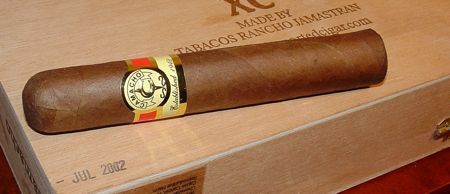
But this Camacho Havana is an unusual case: a box that I purchased already aged. I didn’t know it would be aged when I received it in the mail, but I was happy about it, because an aged cigar is always better… right? The box was stamped 2002 and by all appearances it was kept in great condition. But now that I’ve burned my way through most of the box, I have to say that an aged cigar is not always, without exception, a better cigar.

The Report

The Camacho Havana has been around for a long time. According to cigarcyclopedia it was originally produced in Nicaragua in the 1960’s. Later production was moved to Honduras, where it remains today. Like many Camacho cigars, the Havana is a Honduran puro — in this case a Jamastran criollo wrapper surrounding a corojo blend filler.

This is a great looking and well constructed robusto. The burn on all of these oldsters has been sharp and even, they have a perfect draw, and they form a strong solid light gray ash. Absolutely no complaints there whatsoever.

When I first received these about six months ago I noticed that they seemed incredibly mild when compared with the box of churchills I started in 2006. The Havana line is relatively mild, for a Camacho, but they still have a nice little kick to them when fresh. The flavor, if memory serves, is basically leather with a dash of black pepper. I like the fresh ones quite a bit.

After smoking through most of this 2002 box I have come to the conclusion that they are well past their prime. They still have a nice aroma — it’s almost like fresh sawdust and mild ginger. But the body has been completely sapped out of these poor seniors, and there’s nothing that Richard Simmons can do about it. No Sweatin’ to the Oldies for these guys.

There is almost no flavor left here. They start out super mild, and at the mid-point they take on a slightly unpleasant burnt rubber flavor, like air from an old tire. The wrapper is still putting out good vibrations, but it has no backup from the filler so I have been pitching them at this point, mostly from boredom.

The Camacho Havana line is normally a punchy smoke, and I would expect that a certain amount of age would mellow it a bit, but obviously six years is a few years past the mark. The aroma is still quite nice, though very subtle, and that’s about all that remains of a once admirable cigar.

I am doing a little research about tobacco chemistry and the aging process and if I can make any sense of some very technical papers I will post my findings here in the near future. Meanwhile, check out Stogie Fresh, where the good Doctor compiles reviews and ratings of many premium cigars at different points in the aging process. Definitely worth a gander if you’re at all curious about cigar aging.

El Rey del Mundo Olvidados Robusto

The phenomenon of brand extension is in evidence once again with El Rey del Mundo Olvidados. The original “King of the World” is a Cuban marca, but in the U.S. we are more familiar with the Villazon version blended by Estelo Padrón in Honduras. I don’t know how many boxes of oscuros I’ve consumed over the years, but for a long time it was my “go to” smoke.

In 2006 Padrón developed El Rey del Mundo Real with a Honduran wrapper from San Agustin, but in my opinion it fails to live up the “original” broadleaf maduro ERDM.erdmo1.jpg

The newest blend was created by protegés of Estelo Padrón for Cuban Imports, who are themselves no strangers to brand extensions: in 2006 they unveiled their Por Larrañaga “Cuban Grade” and last year the H. Upmann “Signature,” both Altadis owned brands. With ERDM Olvidados they add a player from General Cigar to their team.

They came up with a diverse blend for this cigar. The filler includes ligero from Nicaragua, viso from Honduras, and seco leaf from the Dominican Republic. The binder is a Connecticut broadleaf, and the star of the show is a dark Ecuadorian grown Sumatra wrapper.

Big ring gauges are another theme for this line. The Chateau E Epicure is the smallest at 52, and they only go up from there. The full rundown:

  • Chateaux R Robusto – 5 x 54
  • Chateaux E Epicure – 6 x 52
  • Chateaux T Torpedo – 6 1/8 x 54
  • Chateaux X “X” – 6 x 60
  • Chateaux D Double Corona – 7 1/4 x 54

Normally I don’t find a ring gauge over 52 very comfortable, but for this review I picked up a couple of the 54 ring gauge robustos (because this was the only size the shop had in stock.) My Palio sliced off the cap nicely, though it was a little cumbersome in the cutter. A prelight pull revealed a nice draw but not much else to enlighten me.

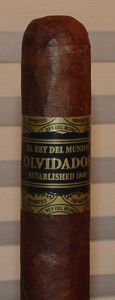
The wrapper on this cigar is rough and maduro in color, much darker than you’d expect from Ecuadorian Sumatra. It reminds me a little of the wrapper on the standard ERDM — it’s a little bit chipped at points and looks weathered. The antique style of the black and bronze band fits in perfectly with this look. The roll is solid and despite the large footprint it takes a light with ease.

What is most impressive about this cigar is how smooth it is. Maybe I’m getting used to all these Nicaraguan cigars that start out with a blast to the palate, but this one was a nice change from that. There’s nary a scratch or burn anywhere here. Just a very easy going, medium bodied full flavored smoke from start to finish.

The predominating flavor here is a sweet woody char very similar to what I find in another Villazon cigar — Flor de A. Allones. The first half of the Olvidados is also characterized by a salty element that went in and out of balance with the sweetness of the smoke. It certainly wasn’t overpowering, but at times I thought it could be a little overbearing.

The middle part of the cigar achieves a better equilibrium. The aroma is almost syrupy, and the flavor is balanced and round. The saltiness is no longer in the smoke as much as it is in the aftertaste. A cool drink is helpful at this point.

But unfortunately the last section was not really to my liking. The flavors become more one-dimensional, focusing on charcoal, and the aftertaste gets a bit sour. I found on both attempts that I couldn’t quite finish the cigar. Up to this point I thought it was pretty good, though overall this cigar is a little too salty for me.

El Rey del Mundo Olvidados scores very well on construction, and would score fairly well on taste — especially in the middle section — were it not for the last third where the aftertaste turns a little sour. The flavors here are very similar to what I find in Flor de A. Allones — which is fitting in a way, since Antonio Allones was one of the founders of the Cuban El Rey del Mundo. But if you like the currently available Allones blend from Villazon, you’ll probably like this one as well. As for me, it’s time to light up something else.

Prices run in the 7 USD range.

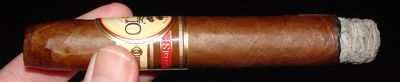
Oliva Special “S” Torpedo

I have to admit that I haven’t yet fallen in love with any Oliva cigars. The Serie V blend has gotten a lot of press in the past year, (including a 93 rating and a spot in Cigar Aficionado’s top five for 2007) but I’m sorry to say it didn’t even make my list last year. A good cigar, sure, but it just didn’t captivate me like it did many others. Even the Master Blends have made only an average impression on my grizzled palate.olivas5.jpg

But if there’s one way to get me, it’s with a sun-grown Ecuadorian wrapper. So I couldn’t pass up Oliva’s Special “S” when I spied a box of torpedos at the tribal smoke shop. They’re one of Oliva’s more expensive cigars, so I only picked up a few, but they certainly looked tasty.

The Special “S” is built around a Nicaraguan habano filler and Nicaraguan “cuban seed” binder, with a sun-grown Ecuadorian Sumatra seed wrapper that has been cedar aged for five years. Interestingly, the wrapper is grown by the Oliva Tobacco Company, which is a completely different company (and family) from the Oliva family who makes “Oliva” cigars. Profiles of these companies can be found in our Angel 100 and Oliva Serie V reviews.

This series was introduced by Oliva in 2006 as a “complex, medium to full bodied blend.” The Oliva website includes an aging recommendation for each of its lines: the Special S, according to the site, will reach full maturity in 5 years. Unfortunately in my case 5 weeks was all the aging I could muster.

This is a very well rolled cigar, and it turns out to have superb construction across the board. Its aesthetic appeal stems from a dark colorado claro wrapper with very fine veins and a moderately oily appearance. The seams of the torpedo head are wrapped so tightly they’re nearly invisible. It’s almost heartbreaking to cut this baby, but it’s the only way to separate the glitter from the gold.

Decapitation accomplished, it’s on to the first stage of this complex and rich cigar. The Special S is bold from beginning to finish, but it starts with a powerful flourish of pepper on the nose and tongue. The finish is long and the aftertaste powerful right from the start, which can be a little startling. I usually like to settle into a cigar, but this one straps you in and stomps on the accelerator as soon as the light turns green. Just gotta hang on.

olivas2.jpg

The strong peppery flavors muddy my palate for the first part of this smoke, but in the background there seems to be leather and sweet spice. After an inch or so the pepper lets up and the aroma becomes more prominent. I think this is where the leathery element is coming from — leather and an almost fruity sweetness. An interesting combination. At this point the smoke is medium in body, but I can feel the nicotine already. I also get a little tongue burn, which makes me ease up on the throttle a bit.

The next stage transitions to wood and cocoa flavors, and the smoke takes on a smoother texture. The flavor is still quite bold, but the finish and aftertaste are a little more civilized. There is a slight burn on the throat, but the flavors and aroma are well balanced.

The last third gets earthier and exemplifies what I think of as “Nicaraguan Habano.” It’s an earthy flavor accented by a sweet woody, caramel-like aroma. The flavor begins to sharpen at this point, returning to the opening stage of the cigar. The finish grows longer again, and the aftertaste is very pronounced. And then the nicotine sneaks up… and smacks me in the noggin, whips me around and gives me one in the gut, and then, reluctantly, I am finished. Finito.

It’s safe to say that this is not a beginner’s cigar. And while this is a very good cigar right now, I think the aging advice on Oliva’s website is well heeded. There is an edge to this smoke that will be blunted over time, and I think that will be a good thing. Now if you prefer a smoke with a little sting to it, these are ready to smoke right out of the box.

As long as you don’t mind the other sting: the one to your wallet. A 20 count box of these runs around $170 US.

olivas3.jpg

Vegas Cubanas Generosos by Don Pepin Garcia

vc1.jpg

With the manifold array of brands issuing from the factories of Jose “Don Pepín” Garcia, it is interesting to note that only six of them bear the imprint of the master’s name. Vegas Cubanas (by Don Pepín Garcia) is one of them.

Introduced in 2005, before the Pepín renaissance reached full bloom, Vegas Cubanas was just another “boutique” cigar from Miami’s El Rey de Los Habanos.

By contrast with the swooning that accompanied Tatuaje, Padilla Miami, and later on San Cristobal, vclabel.jpgVegas Cubanas never really attracted that much attention. Perhaps because it’s a lighter-bodied cigar? Or because it is in relatively good supply? (When we all know that the power hitters and the “exclusive” limited editions are by definition better. Right?) In the retail shops I frequent this one is usually shunted off to the side, in the vicinity of the Tatuajes, Series JJ, El Centurion, etc., but never in the same spotlight.

So maybe they were trying to amp up the label a bit when El Rey de Los Habanos gave Vegas Cubanas a makeover in 2007: new box art, a new band, and cellophane. (Matt’s review shows the somewhat lackluster original band.)


Like most of Pepín’s blends, this one is a Nicaraguan puro. The wrapper is touted as “Habano Rosado Claro” and under the hood there’s a “Cuban Seed Corojo 99 blend.” Vegas Cubanas are available in six sizes:

  • Invictos – 5 x 50
  • Generosos – 6 x 50
  • Delicias – 7 x 50
  • Imperiales – 6.125 x 52
  • Magnates – 7.625 x 49
  • Coronas – 5.5 x 44

Early in my journey through the vast cigar wilderness I became partial to the toro size. I found that most draw problems could be avoided with a larger ring size, and a six inch cigar allows a little more room for development than a stubby robusto, so I gravitated to the toro, or corona grande, or whatever name is applied to a cigar with a 48 to 52 ring gauge and a length from 6 to 6 1/2 inches. Construction qualities have generally improved over the years, but I still like this size.

vc2.jpg

So the one I reached for was the Generosos. The wrapper on this cigar is an attractive colorado claro, with an emphasis on the colorado. It has a sleek appearance without being oily. A close examination shows a small amount of tooth, but not enough to overcome the overall smooth impression. The roll is solid and the head bears the classic cuban triple-cap we expect from El Rey de Los Habanos.

Once lit, the Generosos opens with a tannic woody flavor and a smattering of pepper. Compared to a blend like the DPG Blue Label, this one is a sweetheart. After half an inch or so, the tannins and the wood merge and morph into the smooth cocoa flavor that for me defines DPG’s lighter bodied cigars. The finish at this stage is lingering, but mild — just a slightly earthy aftertaste, and a grazing of a scratch on the back of the throat.

Into the two-thirds stage the smoke evens out and takes on a wonderfully creamy and smooth texture. If by “body” you mean the texture of the smoke, this is a full bodied cigar at this point. But it’s not powerful; it’s simply full on the palate, like a full bodied Sumatran coffee with cream: it sits heavily on the palate, but doesn’t overwhelm with nicotine.

The final stage of the cigar features a gentle transition from smooth cocoa flavors to a darker, earthier taste. Up to this point, the wrapper has not really distinguished itself. For most of the way the wrapper melds nicely with the rest of the blend, but in the last couple inches the wrapper contributes an aroma that steps out and shouts Twang! It’s a sweet, spicy, caramel inflected aroma that defies description, but you know it when it shows up at your door.

My only complaint, and it is a minor one, is that the burn was uneven throughout the length of this smoke. It wasn’t serious enough to affect the balance of the flavors, but it was just a tad annoying.

In the brick and mortar retail shops this cigar sells in the $6-7 US range. Boxes can be found for around $130 online, which is quite decent for a cigar of this quality. It compares favorably to the more expensive Troya Classico and Cabaiguan lines, though I’d have to say this one is a less complex experience than those.

From first light to last ash, Vegas Cubanas is an everyman’s cigar. It does not stomp on the terra like some of Pepín’s other blends; it steps lightly and sings a tuneful little ditty. It’s bound to please everyone, at one time or another, with the exception of those who insist on double ligero for breakfast. If I had to smoke nothing but these for a long time, I might get a little bored, but I’d be happy.

vc3.jpg

E. Zarzuela Toro Fuerte

ezfuerte.jpg

First introduced in 2005, E. Zarzuela is a relative newcomer to the world of “boutique” cigars. This particular line is sometimes called the “Premium” line to distinguish it from Zarzuela’s milder-bodied “EZ” series released in 2006. Both are made in the Dominican Republic.

The Zarzuela website is sparing in detail about the company, but it does tell us that the chief blenders of this cigar — Felix Rodriguez and Eddy Fontana Zarzuela — have previous manufacturing experience with Arturo Fuente and La Gloria Cubana. So they come with impressive credentials.

The Zarzuela Premium has been rated highly in Smoke magazine and by cigarencyclopedia.com, and since I’m always game for a small production cigar I thought I should check it out.

One of the arcane aspects of the cigar industry is the seemingly arbitrary way that different shapes and sizes obtain their frontmarks — why double coronas are often called “churchills” and why toros are sometimes called “corona grandes” and so on. Here is a case in point: this “Toro Fuerte” measures 5 x 50, which is the standard robusto format. But there is no “Robusto.” On the other hand, there are two toro sizes in the line, the 6 x 52 “Toro Grande” and the 6 x 54 “Long Drive.” And to augment this toro madness, the petite coronas are called “Toritos.”

The torpedo size is refreshingly called Torpedo (I would have suggested Toro-pedo) and the 7 x 50 double corona is called, of course, Churchill.

The Zarzuela Premium features a Nicaraguan Cafe Habano wrapper, some Dominican piloto cubano for binding, and filler composed of Nicaraguan ligero and Dominican piloto. Habano, piloto, and ligero…sounds like a powerful brew.

ezar.jpg

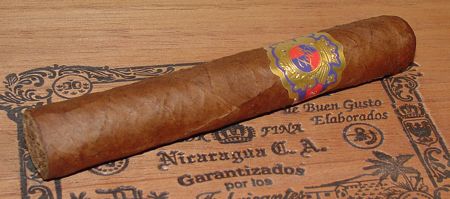
The wrapper on the Toro Fuerte is a splotchy colorado maduro, but it has a nice oily sheen and a roughshod leathery appearance. The prelight scent is tannic with maybe a tinge of ammonia, just enough to raise a pucker. The roll is solid and the draw quite firm.

The first few puffs taste dry and woody but in just a few seconds the wrapper kicks in a sweet and complex aroma typical of Nicaraguan habano. After smoking for five or ten minutes a solid and uniformly light gray ash forms that adds to the aesthetic appeal of this cigar. The burn is perfectly even up to this point.

Just after the one-third point the draw opens up like a door and this robusto becomes truly enjoyable. The burn is perfectly even and the ash holds solid. It’s not as strong as I had guessed it would be — it’s more a medium body smoke at this point, with a short finish and very little aftertaste. The aroma is the highlight at this point — a sweet, almost fruity perfume that blends well with the woody and leathery base flavors of the tobacco.

At the two-thirds point the body begins a gradual ascent to medium-full, some tannins enter the fray, and the flavor takes on an earthier aspect. The last third gets meatier yet, the finish grows and the aftertaste becomes more mineraly. Meanwhile the wrapper continues its sweet leathery contribution.

This cigar goes through a lot of changes in a short amount of time, but remains balanced all the way. Construction values are also very high. The tannins come heavier in the last third of the cigar, which may be by design, as some smokers love this tart flavor, or it could be youth. If the latter, this cigar will only improve over time.

A box of 24 will run around 100 USD, which in most places puts it in the $5 to $8 per stick range. Very reasonable, I think, for a cigar of this quality. Don’t take the “Fuerte” in its name too seriously, since this turns out to be a solid medium-bodied cigar. The flavors are good, and the aroma is outstanding. If that’s your style, I say go for it.

The E. Zarzuela Toro Fuerte is not a typical Dominican cigar — it’s closer to a Nicaraguan, but less powerful than what you’d expect from Pepin or Padron. And that’s what I love about boutique cigars: they’re usually not what you expect. This is a nice one.

ez3.jpg

Nestor Reserve Maduro

nestor-reserve.jpg

“Learn thou the worth of a dollar and how to keep it from damning thee.” –Joseph Seamon Cotter, Sr.

The other day I received in the mail sad tidings from the gentleman who claims to manage my meager stock portfolio. Like most people struggling to save for retirement (a very distant shore) I try to take the long view. But as I watch my modest investments dwindle further into the mire, my thoughts turn from luxury limited edition cigars to the humble bundle smoke, a suitable companion for a season of economic decline.

Unlike the federal government, I am not entirely comfortable with a budget extending far beyond my means, and since I am as yet unable to print money myself, I must instead seek solace in cheap Honduran stogies. Luckily there are a few out there, and there is a man named Nestor Plasencia.

Nestor over the years has produced a number of quality budget smokes — Maria Mancini, Mayorga, American Stogies, among others, and while none of these are exactly stellar cigars, they’re solid blue collar fare. And as I watch the foreign tourists pour in to feast on the weak dollar, I’m feeling bluer all the time.

So I thought I was exercising fiscal responsibility when I low-balled a “Mega Sampler” of these Nestor Reserves on Cigarbid. I’d tried the toro size previously and thought well of it, so when I came away a winner with a bid of 19 dollars I thought I hit the big time. 20 cigars for 19 dollars. Can’t beat it, right?

In the past I’ve really enjoyed the Connecticut version of this cigar — a mild and smooth smoking robusto that is unfortunately no longer available. The Maduro version is still kicking though, and comes in the standard sizes: corona, double corona, robusto, toro, and torpedo. The wrapper is Honduran, while the filler is a Honduran/Nicaraguan blend. The really interesting ingredient here is a Cameroon binder.

Curiously, the first thing I noticed upon slicing open my “Mega Sampler” bundle was that one of the double coronas was round, and the rest of them were square pressed. In fact, all the cigars were square pressed except for that one odd double corona. I figured that must be The One, the Neon of the cigar matrix. So I cut it, torched the end and prepared myself for a leisurely smoke.

Double Corona

But it was not to be. It wasn’t plugged, exactly, but it was extremely tight. I cut a bit more off the head to no avail. Diagnostically palpating the cigar to find a plug, I found that the plug seemed to start at the head and end somewhere close to the foot. Exploratory surgery was my only option. I cut it in half and gave the remainder a hearty pull. Nothing. Flat line. Most definitely not The One.

On to the next contestant, a square pressed double corona. No draw problems this time, but even before lighting it I was greeted with a bitter and unpleasant taste from the wrapper leaf. For the next ten minutes I couldn’t stop spitting and the taste seemed to worsen. The smoke wasn’t bad — woody, with some earthiness and a semi-sweet maduro aroma, but the flavor from the wrapper on my tongue was unbearable. And so round two sent me staggering to the corner with two unsmokeable cigars lying pathetically in the ashtray.

But I couldn’t give up now. After all, Cigars International calls this cigar “chocolate thunder.” Cigar Insider gave it an astounding 93! My double corona experience must have been a fluke. On to the robusto size.

Robusto

The prelight impression this cigar makes is a good indication of how it smokes: mild and grassy. What lies hidden — until flame is set to leaf — is how smelly it is.

The first third is mild, smooth and focuses on sweet hay. After an inch a vegetal flavor makes an entrance, and the finish is mildly metallic. The Cameroon adds an earthy accent in the second third, blending nicely with the sweet aroma of the maduro. The robusto becomes increasingly earthy into the final stretch, a little flinty but still quite mild.

This cigar most emphatically failed the wife test. She coughed and waved her arms and put on quite a show for me and the dogs. But she’s right — this is a very smelly cigar, but in a sweetish maduro kind of way.

Toro

The toro is not quite as grassy, and not quite as mild as the robusto. It’s a little woodier, but it retains that flinty, metallic aftertaste. The maduro-cameroon tango is a little more animated in this size: it’s sweet and smooth, but tangier than the robusto. It tastes more like the double corona, but lacks the construction problems I had with those.

Torpedo

The torpedo smokes very much like the toro. It might be a tad smoother, but it seems so similar to me that any difference could easily be chalked up to what I was drinking or what I had for dinner on a given night.

Conclusion

What all the Nestor Reserve Maduro cigars have in common is this: they’re all relatively mild, smooth smoking cigars with a stinky disposition. They tend to burn erratically, but with one exception they all drew well and had decent construction. One annoying thing about them is that the wrapper bleeds and leaves brown stains on one’s lips and fingers. Along with the consistently oscuro coloration of the wrapper, this is a good indication that the leaf has been “cooked,” or artificially treated (perhaps even dyed) to speed up the fermentation process and achieve a uniform hue. I can’t say with total certainty that is what we have here, but it certainly seems like a possibility.

So, in the final analysis, are the Nestor Reserves worth two bucks a pop? It’s not easy to find a decent cigar for under two dollars, but with some effort it is possible. I don’t think this is Nestor’s best effort, and while there are some admirable qualities here (the cameroon binder is an intriguing touch) I think there are probably better bargains out there. It’s a passable yard gar, but even at less than a dollar a stick at auction I will probably seek out other pastures. I’m trying to be frugal, not masochistic.

-cigarfan

Padilla 1948 Torpedo

1948.jpg

All of Ernesto Padilla’s year-branded cigars correlate to an event in the life of his father, the Cuban poet Heberto Padilla. The Padilla 1948 was named for the year in which Heberto’s first book of poems, Las Rosas Audaces, was published. Incredibly, he was only 16 years old at the time.

The 1948 follows the success of Padilla’s Signature 1932 — both are blended by Jose “Don Pepín¨ Garcia, though the ’48 is produced in his Esteli, Nicaragua facility rather than in Miami. Four sizes are currently in production: robusto, churchill, lancero and torpedo.

If you know the cigars of Don Pepín, you will immediately recognize the sweet corojo that wraps the ’48. The blend is, as usual, a combination of Nicaraguan criollo and corojo, but for me the wrapper is what seals the deal. While I like what Pepín has done with Connecticut Shade (in the 601 Black and the Cabaiguan Guapo) and maduro (in the Series JJ and the 601 Blue & Green labels) there’s still nothing like this Nicaraguan corojo.

1948-foot.jpg

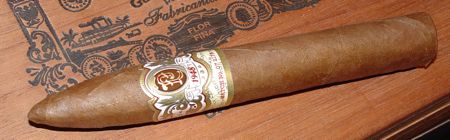
The wrapper on the 1948 is a natural but dark looking colorado claro; not quite dark enough to reach colorado maduro, but there’s enough red in there to make it darker than the average colorado claro. It’s a little dry looking with significant veining. The foot is a little bit loose, but the rest of the cigar is firmly rolled. The head is flawlessly formed. There appears to be some lighter colored tobaccos, or very fine stems, at the foot; the head reveals the same thing after clipping.

Usually I find the strongest prelight scent to come from the wrapper of a cigar, but not in this case. The wrapper has a mild tobacco smell to it, while the foot has a stronger earthier scent. (Perhaps this is what I should expect from a foot.) There also seems to be something grainy about the scent, sort of like whole grain cereal, which can only mean one thing: this cigar is good for you!

The 1948 torpedo lights easily after a smooth clipping. The draw is good and the burn is mostly even: a little waver here and there, but it corrects itself and needs no supervision.

The first third is typical of most Pepin blends, but a little less aggressive. It starts up sweet and toasty with a touch of pepper on the tongue. Almost immediately the core flavors come to the fore: cocoa, caramel, and black pepper. It’s comparatively mild for a Pepin blend; it’s reminiscent of the Padilla Signature 1932, but not as intense. There is perhaps a little less complexity in the 1948, but it’s still a very engaging smoke.1948c.jpg

Into the second third the pepper dies away and is replaced by a dry woody flavor. The cocoa persists throughout the duration of the cigar, but at this point the aroma also takes on a spicy sweet character. I’m detecting something like cinnamon… maybe. Whatever it is lends delicacy to the aroma without overtaking the basic bean flavors of the smoke.

The last segment of the cigar continues to sing the same sweet beany, mildly spicy refrain. I’m usually not one to nub a cigar, but I like this one well into the band region. And speaking of the band, I should mention there are two on this cigar: the additional one is a counterfeit control label that is discreetly placed below the Padilla band. Whether this is really necessary, I don’t know, but in any case it’s tastefully executed. (pssst… mister. I got them Piddillers you like. 49.99 a box!)

Overall, the Padilla 1948 torpedo turns out to be one of my favorite blends from the master of vanguard Nicaraguan cigars. It’s medium bodied, well constructed, smooth, and oh so tasty. If you’re really into the heavy Tatuajes and 601s, the’48 might not float your boat. On the other hand, if you’ve developed a craving for Pepin’s signature corojo but prefer the lighter side of life, this cigar is for you.

Retail prices ring up in the 8 to 10 USD range, which seems about average for upper echelon cigars these days. (Reasonably priced ones, that is.) It may not be an everyday smoke for the budget minded, but in this case you definitely get what you pay for… and maybe just a little bit more.

-cigarfan