Augusto Reyes Nativo Corona

arn-corona.jpg

Unlike many of the big names in the Dominican and Central American cigar industry, this one has no Cuban ancestry. The Augusto Reyes family has roots in the Dominican Republic and the Dominican tobacco world going back 150 years and six generations, though much of that time has been in the agricultural and leaf brokerage side of the business rather than in cigar manufacturing.

Currently the Augusto Reyes family of companies includes a leaf importing concern (Tobacco Leaf Sorting S.A.), a company that processes Dominican leaf only (Capas Nacionales), and two cigar manufacturers: Corporacion Cigar Export and De Los Reyes Inc.

The first Reyes-operated cigar factory was established in 1990 in Navarette. Over the years they have produced several different private label cigars but the only one to gain much recognition is the Fittipaldi brand designed for Emerson Fittipaldi, the racing legend.

It was only in 2006 that the Reyes came up with a blend they could truly call their own. It was fittingly introduced at the wedding of Augusto Reyes to Monika Kelner. (I was unable to determine if Monika is a relation of Hendrik, but it wouldn’t surprise me!) After the wedding those who had tried the cigar began to clamor for more, so it was readied for commercial production and finally released at that year’s RTDA.

This blend also has the honor of being the first non-Cuban cigar to be featured at the “Epicur Dinner” hosted by the the Spanish cigar club of the same name. As Augusto explains, it is a more powerful Cuban style blend that Spanish smokers frequently prefer. This style has also developed a following in America, so we are lucky to have the same cigar available now in the U.S. It is currently being distributed here by SAG Imports, who also bring us Fonseca and Joya de Nicaragua.

There are now three lines of the Augusto Reyes brand: the Criollo and Epicur lines — both of which are finished with Ecuadorian Connecticut wrappers — and this one, the Nativo, a Dominican puro. The Reyes have been experimenting with wrapper crops in the DR since the 1960s and at various times have provided wrapper leaf to other companies, but the Criollo 98 wrapper for the Nativo comes from a farm dedicated to AR cigar production. It is complemented by an olor binder and a piloto/criollo filler blend.

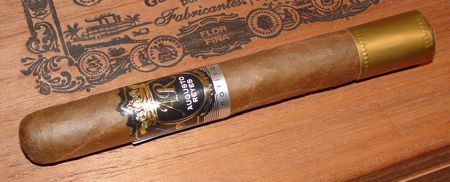
The Nativo is available in seven sizes from double corona to a 4 x 34 perla. The corona size I’ve been smoking measures 5 1/2 inches by a 44 ring gauge. They’re nice looking smokes with wide bands and a decorative gold ribbon at the foot. The wrapper is a creamy looking colorado claro with very moderate veining and a few small water spots. The cap is nicely formed and the stick is firm to the touch. My only initial concern was that the feet on a couple of these seemed underfilled.

The prelight scent from the wrapper is very mild. The draw is acceptable (maybe just a tad loose) and a prelight draw results in some grassy and coffee bean flavors.

The loose fill at the foot made for a difficult light, and one sample had a seriously deficient burn. Consistency problems aside, I found this to be a complex and fascinating little stick.

It starts up with an earthy, dusty quality that quickly takes on a peppery edge. The base flavor is leathery with a dollop of musk that rises from the wrapper. This wrapper, despite its smoldering hesitance, is extremely pungent. In fact, when my wife stepped outside for a moment she thought the kids down the block might be smoking something illegal. “No,” I told her, “it’s my cigar. Which isn’t illegal. At least not yet.”

The AR Nativo produces a good volume of smoke that I would characterize as full bodied in terms of texture and mouth feel, but medium in terms of strength. The flavors become more concentrated as the cigar burns, getting spicier as the ash gets longer. That is, if the ash actually succeeded in getting longer…which leads to what might be a problem with this cigar.

The first sample I smoked went out several times, needed constant adjustment, and developed an ash that was flaky, crumbly and tragic to behold. And while I have to say I really enjoyed the rich peppery flavor and musky aroma of this cigar, its burning qualities (or lack thereof) really weighed it down. The second cigar was much better — it burned straight and the ash didn’t peel away like the first one, but without constant puffing (which results in a hot smoke) it went out. To be fair, I have to say that I let these rest for less than a week after receiving them in the mail… but even so, the construction could probably use a little work.

The retail price on these is in the 7 to 9 USD range, which makes them the most costly of the three Augusto Reyes lines. Lower prices may be found online, but I’ll be trying a few different sizes before I invest in a box. The smooth peppery flavor and funky aroma have convinced me to give the Nativo another shot, but if other sizes have the same inconsistency I won’t be returning. There are just too many great cigars out there right now to put up with faulty or inconsistent construction in a 7 dollar smoke.

-cigarfan
JFR – “Just For Retailers” Corona Gorda

jfr.jpg

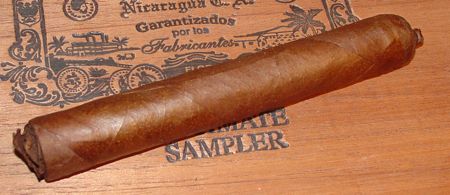
I was trolling for goodies in a local cigar shop the other day and happened to notice an unfinished crate crammed inconspicuously into the corner under some big-ticket Ashtons. The box was filled with toro sized cigars. I didn’t see a brand advertised, and they didn’t have bands. What they did have was alluringly oily wrappers, beautifully rounded heads, and triple caps finished with tight neat pig tails. And the feet were flagged. Sitting nicely in the box they looked like a bunch of shoeless orphans getting ready to go to church.

When I asked after their pedigree, the counter guy said “They’re called JFRs. Four something a stick. You can hardly buy a cigar for four bucks.” This was not exactly a glowing endorsement, but they looked sweet, and yeah, the guy is right. Four bucks is not much for a handmade cigar these days.

JFR stands for “Just For Retailers,” and they mean it. Don’t look for them online. They’re made by Tabacalera Tropical, and originally they were blended by none other than Jose “Don Pepin” Garcia. Or so the story goes.

Pedro Martin successfully escaped the Castro regime in the early 60’s and subsequently spent almost two decades in the American tobacco industry before he entered the cigar market with Tropical Tobacco in 1978. Martin has produced cigars at various times in Cuba, the Dominican Republic, and Central America, and has had his hand in the making of brands as diverse as Avo and Ashton (at Tabadom) and the current stable of Tropical blends like Lempira and Indianhead.

“Don Pepin” Garcia’s first employer after his exodus from Cuba in 2001 was Eduardo Fernandez’ Aganorsa in Esteli, Nicaragua — the same Aganorsa which in 2002 acquired Martin’s Tropical, which at that point became Tabacalera Tropical. It seems most likely that if Garcia blended the original JFR, it was during this time. And the fact that Fernandez is still Garcia’s primary tobacco supplier lends the JFR blend an even darker shadow of Pepin ancestry. But no birth certificate.

Tropical doesn’t acknowledge these cigars on their website, and an email for information was unsuccessful as well, so I remain unsure of the JFR’s constitution and provenance. The word on the street is that these are made in Honduras with a Nicaraguan corojo/criollo blend. After smoking a few of these, that sounds quite plausible. There are reportedly four sizes: robusto, toro, supertoro (corona gorda) and torpedo.

The wrappers on these cigars are really attractive — a nice sheen of oil enhances a slightly toothy surface throughout. The few I’ve smoked so far have been competently constructed, though one had a significant soft spot and uneven roll. Despite this it drew well and burned without a hitch.

The JFR introduces itself with a spicy but smooth flavor; it’s not as peppery as a Pepin, but it has that Nicaraguan bite. The base flavor is leathery with spicy accents. Over the course of the cigar this flavor creeps along and builds while the smoke texture gathers weight and grows from medium to full in body. The aroma of this cigar is somewhat sweet and combines really well with the leathery foundation.

About halfway through this smoke I sensed the strength beginning to sneak up on me and I noticed a little harshness on the throat. The spices get darker at this point, more peppery, more Pepiney. There are some coffee flavors at this point, and maybe a little hazelnut on the nose. By the last third the smoke is very rich, quite strong and the harshness begins to mount. I normally put the butt to bed at this point.

More than a Pepin blend, this one reminds me of Illusione. Either that or a St. Luis Rey Regios. It’s not as complex or as refined as the Illusione (I’m thinking of the 888) and it’s bolder than the Regios, but there seem to me some similarities. If you told me these were Illusione “rejects” I might just believe you.

Rejects or not, they’re decent smokes for $4 or less. The counter guy undersold these, but they appear to sell themselves just fine.

-cigarfan

Best Cigars of 2007


punchito.jpg

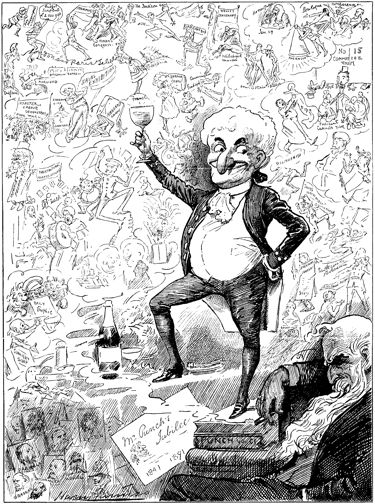
It’s that time again: time to raise a toast with Punch to the demise of weary old 2007, dozing like that gent with the stogie, and usher in a new year.

It was a good year for cigars. In fact, we found ourselves a bit stymied by our good fortune as we tried to winnow down our lists to the top ten of the year. A lot of really good smokes did not make the cut, either because we were blessed by a bounty of brilliant cigars or because we simply didn’t smoke them this year. Last year’s winner, the Padron Anniversary Imperial, didn’t even make a showing this year because… well… we were too busy smoking up every cigar from Jose “Don Pepin” Garcia we could lay our hands on. No time (or budget, really) for Padron Annis in 2007 — an error I for one will surely try to remedy in 2008.

A word about our selections: Lucky7’s taste tends toward the full-bodied end of the spectrum, while mine inclines toward the medium side. We both appreciate fine cigars of all persuasions, but like anyone we gravitate toward our particular preferences.

I suppose I’ve done enough yammering for one year, so onward and forward:

Lucky7’s Best Cigars of 2007

10. Ashton Estate Sun Grown 21 Year Salute

9. Padilla Signature 1932 Robusto

8. Illusione cg4 – White Horse

7. Don Pepin Garcia Cuban Classic – Black Edition Robusto

6. Tatuaje Cabinet (Brown Label) Regios

5. San Cristobal Clasico by Ashton

4. Don Pepin Garcia Serie JJ Belicoso

3. El Centurion Emperadores by Don Pepin Garcia

2. EO 601 Serie Habano Oscuro (Green Label) La Fuerza

And Lucky7’s Number One cigar of 2007…

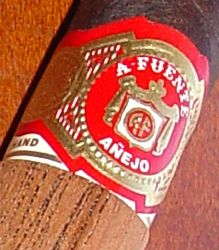
1. Arturo Fuente Añejo Reserva Shark #77 Cameroon

aflabel.jpg

Cigarfan’s Best Cigars of 2007

10. Trinidad 100th Anniversary Toro

9. Cuba Aliados Anniversary

8. Avo Domaine “50”

7. Sabor Cubano Petite Torpedo

6. EO 601 Habano Oscuro Tronco

5. San Cristobal Fabuloso

4. Carlos Toraño Noventa Esperanza

3. Illusione ~888~ (Churchill)

2. Troya Classico LXIII (Churchill)

and Cigarfan’s number one cigar of 2007…

1. Arturo Fuente Hemingway Work of Art (Maduro)

cnv0393.jpg
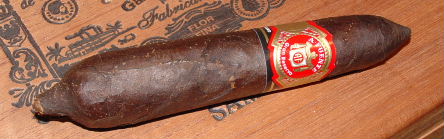
Arturo Fuente Work of Art Maduro

Despite all the buzz (literally and figuratively) generated this year by El Rey de Los Habanos and Tabacalera Cubana, Arturo Fuente has shown up Don Pepin in the last leg of the race with a couple of special limited edition cigars. It is with some hesitancy that we narrow down our picks to ten from a field of dozens of great smokes, but it’s no accident that Fuente has taken the grand prize this year. These are truly some of the best cigars made anywhere.

Have a safe New Year’s Eve, and a Great 2008, everyone!

-cigarfan

EO 601 Habano Oscuro Tronco

601-oscuro.jpg

Of all the new cigars I’ve tried this year (new to me, that is) I think the 601 Connecticut Black Label is the most interesting. The juxtaposition of a creamy Connecticut seed wrapper with a spicy Pepin core blend is truly an epicurean experience. And even if it isn’t my favorite blend from the hands of Don Pepin, it demonstrates the manifold nature of his skill. Just when you’re ready to settle in for another welcome, but familiar smoking experience, he pulls out the rug and presents a new blend with its own distinguished and delicious qualities.

With years of experience as one of Cuba’s premier blenders and rollers, it should be no surprise that his talents are diverse. In some ways it seems more of a surprise that he has been able to both keep up with the demand, and at the same time create even more new blends with tobacco that is almost always from the same region. While other cigar makers feel it necessary to advertise their “six-country” blend, Pepin Garcia is happy with just…Nicaragua. And so far, so are we!

Corojo wrappers have been, and probably always will be, a mainstay for the primary Pepin blends, but this year he has been going to the maduro well with a little more frequency. The Series JJ Maduro, the 601 Maduro, and now the 601 Habano Oscuro. (Is it a mere coincidence that Habanos S.A. is now releasing maduros as well? Probably.)

The folks at United Tobacco Inc have gone to the dark side twice now with their EO 601 series — first with the 601 Maduro (Blue Label) and once again with the 601 Habano Oscuro (Green Label). The Greens were just introduced this year at the RTDA, and so far they have elicited nothing but praise from lovers of full bodied and rich tasting cigars.

The 601 Green is a Nicaraguan puro — filler, binder and wrapper all from farms in Nicaragua. Coming from Tabacalera Cubana this is a familiar formula, but the curve is in the wrapper: a deeply fermented Habano. Both Lucky7 and I were really impressed with the appearance of this toothy leaf: rich, oily, and shall we say, redolent of the pasture. Nice and smelly, the result of a thorough fermentation.

Five sizes of this blend have been released:

  • Trabuco (a whopping grand corona at 6 1/8 x 58)
  • La Fuerza (5 1/2 x 54 robusto)
  • La Punta ( 5 1/2 x 52 perfecto)
  • Tronco (5 x 52 robusto)
  • Corona (5 x 42)

Construction
Construction qualities are good to very good; both of us noticed that the draw was very firm. Otherwise, this stick burns slowly with a good volume of cool smoke. The ash is light to medium gray with some black striations. I thought the ash was a bit crumbly, but I have to admit that I approached this cigar with caution and smoked it very slowly which may have had an effect on the burn in general. I found a mostly even burn, while Lucky7 had to apply the torch a few times to keep his ash in line.

Flavor

I found the Habano Oscuro to be a full bodied ride from the first puff. The introductory Pepin pepper is present in the first half inch, but it’s not overwhelming; just a nice wake-up call. Both of us noted coffee and anise as core flavors in the first third; Lucky found some wood in the mix as well.

Into the second third I got lots of chocolate and a bouquet of licorice liqueur — smooth, pronounced, but not aggressive. (Did I mention that I take this cigar slooooowly?) Lucky found toasted nuts and cherry, a “creamy sweet” aroma, and a medium-length dark chocolate finish.

In the last third Lucky7 noted a little burnt cocoa and “a noticeable pickup in strength; not harsh, just strong with a little bitterness.” And as I lay reeling on the floor I found that I had to concur with his final comment: “big nicotine buzz.” No kidding. Tronco means trunk (or log) in Spanish, but it also has a colloquial meaning with a pejorative connotation — something like dolt, or dimwit. Kind of like the way I felt when I finished this cigar. But in a good way, of course.

Conclusion

The 601 Habano Oscuro Tronco is a big-boned cigar with lots of flavor and a surprisingly friendly disposition. It is indeed quite powerful, but take a little time with it and it won’t leave you legless. A full stomach and a little courage are all that’s required for middle-weights like myself. And for lovers of full-bodied cigars, it’s pretty much mandatory. Just smoke it.

Box prices are around 150 USD, about $8-$10 retail. This seems about standard rate for Pepin blends these days. A bit steep, but worth it, as usual.

-cigarfan & Lucky7

Ashton Cabinet Belicoso

ashton-cabinet-beli.jpg

Long ago and far away, in a distant decade called the Eighties, there was an upstart cigar brand called Ashton. Robert Levin, who had been running Holt’s Cigar Company, decided to get into the cigar manufacturing business and borrowed the Ashton name from the respected line of English pipes. The very first Ashtons were produced in the Dominican Republic by Henke Kelner of Davidoff fame, but within a few years Levin began to work with his old friends the Fuentes.

Levin and Carlos Fuente Jr. began developing the Ashton Cabinet blend in the late eighties. The story goes that Levin asked the Fuentes if they could make a Hemingway cigar with a Connecticut Shade wrapper. Carlito Fuente said they could, and after working the blend for a couple years the final result was the Ashton Cabinet cigar. The original release comprised three shaped sizes; today there are ten, including four perfectos.

Levin remarked in an interview for Cigar Aficionado that at the time of release, the Ashton Cabinet was the highest priced cigar on the market. He doesn’t say what that price was, but the original Ashton Churchill at the time sold for $2.50. My, how times have changed.

The Ashton Cabinet was developed right around the time that Tabacalera A. Fuente took over Ashton production from Tabadom. The blend includes “no less than six different tobaccos” and features a golden Connecticut Shade wrapper. The binder and filler are Dominican, and the belicoso in the line is a short torpedo at 5 1/4 inches long by a 52 ring gauge.

This little belicoso is a handsome cigar — with its finely formed head and firm roll it balances nicely in the hand. The wrapper is a smooth colorado claro typical of quality shade leaf, but I noticed in one sample that the color varied within the leaf. The section toward the foot was a slightly tawnier shade than the upper half. A little distracting, but not a serious defect.

This cigar starts up with a dry flavor that some have described as bitter, but I wouldn’t go that far. This astringency dissipates after half an inch or so, within a few pulls at most, and is replaced by a mild nutty flavor. The smoke becomes increasingly creamy, and then the distinguishing element of the Ashton Cabinet comes to light: a deliciously sweet aroma that in a strange way reminds me of bubblegum. Not as cloying as a big wad of Bazooka, but to me there is something very confectionary about it.

Into the second half the flavor gets nuttier and the creamy texture of the smoke approaches a medium body. At times a dash of pepper touches the palate and throat, but the overall impresson is smooth and sweet with some light kitchen spice.

The burn tends to be a bit erratic but is mostly self-correcting, and the draw is just about perfect. Aside from the wavery burn this stick earns good marks for appearance and construction.

The Ashton Cabinet Beli is a tad pricey at around 8 USD, and I can think of cigars that are comparable in quality that are more affordable (La Tradition Cubana comes to mind) but this is indeed a high quality premium cigar. If price isn’t a determining factor, this is certainly a cigar to try if you’re after a light to medium bodied cigar with that creamy spice one often finds with Connecticut Shade.

-cigarfan

Review Contest at Cigar Inspector

Just a quick reminder to cigar reviewers everywhere: Cigar Inspector is holding a cigar review contest. The prize is an ST Dupont X-Tend lighter, which must be a fine piece of equipment because the retail price is astronomical. Cigar Jack, myself, and of course the Inspector himself will be judging submissions to bestow the laurels, and the lighter, upon the most excellent scribe of the smoke.

So far there are only a few reviews in the bag, and the level of competition has been a bit sleepy, so sharpen your pencil or fire up your laptop or wipe down your slate and get smoking. Give it up for the Inspector and walk away with a lighter worth more than my car. Well, almost.

Check out the details here. And good luck!

-cigarfan

Ted’s Made By Hand

teds.jpg


So the question is, of course, who is TED? This is a mystery the makers of Ted’s Made by Hand choose to leave unsolved. For the moment Ted appears to be a riddle wrapped in an enigma wrapped in a bunch of advertising rhetoric, but hey, ya gotta sell cigars somehow. I’ll say this much for Ted’s right off the bat: the distributor was kind enough to offer up a hundred sticks to Club Stogie members to try for free, and that’s about as classy as it gets.

A little research shows that Emprise Cigars, the distributor of Ted’s, is also the outfit behind Maker’s Mark and Courvoisier flavored cigars. Following the thread, it turns out that behind Emprise is English Emprise, a company that specializes in building brands and “riding the coattails of brand loyalty.” Among other licensees in the Emprise stable are the Indianapolis Motor Speedway and the Rudy Giuliani Presidential Committee. (And if you didn’t think the leader of the free world could be a brand, check out the George W. Bush store. The Spalding Group is another Emprise company.) And who is the man behind English Emprise, the Spalding Group, and Emprise Cigars? An entrepreneur named Ted Jackson. Gotcha, Ted.

Ted’s website is sharp, if a bit flashy, and offers up this information about the blend: a Connecticut Shade wrapper, a Dominican binder, and filler from Brazil, Nicaragua and a little more DR. (What Ted’s website does not say, but Cigar Insider does, is that Ted’s cigars are made by Victor Sinclair.) They are rolled in the DR, after which they are packed in “seamless, foil debossed wood boxes.” I’m no design expert, but it looks like Ted has the packaging down pat.

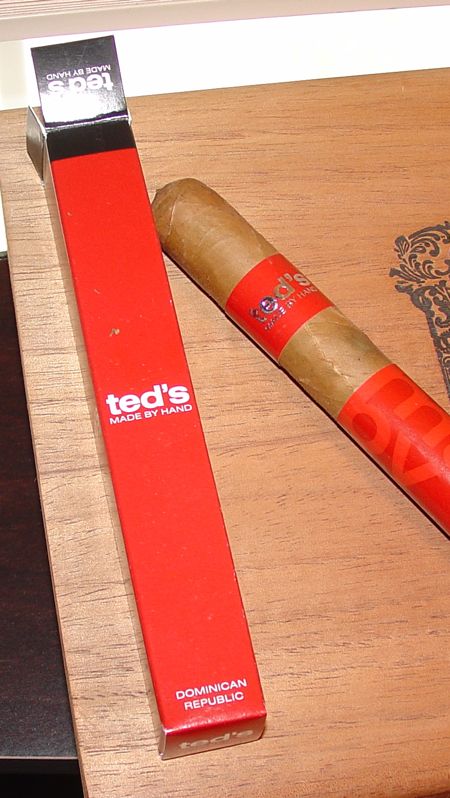
But wait… there’s more! The test package that arrived in my mail box was a marketing marvel: a thin cardboard sleeve holding a box that opens like a book. On the verso a nice photo of some good old boys in a corn field having a laugh and smoking Ted’s handmade cigars. The picture spills over onto the recto side where recessed in the page is another cardboard box containing one of Ted’s finest 6 x 50 Connecticut Shade toros. Snazzy!

On to the cigar, with a caveat: my impressions are based on sampling one cigar only. Bearing that in mind…

Ted’s toro comes equipped with a standard ring in the usual place, plus a large paper sleeve of questionable value that is difficult to remove without damaging the wrapper leaf. The wrapper itself appears smooth and dry with moderate veining but is slightly marred by a pea-sized greenish discoloration near the band.

The prelight scent is grassy. I used a straight cut and took a prelight pull: easy, a little too easy maybe. The prelight flavor is typical light tobacco with a little alfalfa.

It lights without much effort and maintains an even burn for the next hour, leaving a light gray to white ash that flakes a bit and crumbles in the ashtray. As a personal preference I like a tighter draw, but the cigar never burns hot or suffers from burn problems, so the loose draw can’t really be called a construction defect.

Ted’s Made By Hand is a mild cigar with a pleasant floral aroma. The base flavor is nutty with a light woody element that gets increasingly vegetal as the smoke progresses. There isn’t a whole lot of complexity here and the only transition I noticed was at the band, where the flavor starts to muddy and gradually bitters out. The highlight of this cigar is the aroma — a really nice, lightly spiced floral scent. Despite the discoloration, this turns out to be a sweet wrapper.

About the worst I can say about Ted’s is that it’s a little on the boring side. It needs a companion like the Sunday morning paper or some other light diversion. For me it’s more of an accent smoke than a centerpiece. It just didn’t hold my attention all that well.

Fans of lighter bodied cigars in Connecticut Shade will probably dig Ted’s Made By Hand. Otherwise I think they would probably make good breakfast smokes. Retail prices are a little steep, but it looks like discounts can be found, knocking the box price down to around 90 USD for a box of 20. A reasonable price for an aromatic morning cigar.

-cigarfan

Bock y Ca Edicion de Oro Robusto

1.jpg 

Gustav Bock is best known as the first cigar maker to put bands on his Havanas, starting sometime around 1854. At that time most cigars were sold from large bags of loose sticks and couldn’t be identified once separated from the mothership. One story says that Bock invented the cigar band to keep inferior cigars from being sold as his own. Another, more unlikely, tale is that they were designed to prevent staining the fingers of high society ladies (or gents given to the practice of wearing white gloves.) 

But Herr Bock was a master businessman who had a gift for marketing. When he found that he could not break into the American market without brand recognition, even when he was offering his cigars nearly at cost, he developed an ingenious plan. Legend has it that he shipped small lots of cigars to “various undiscoverable places” in the U.S. addressed to George Washington. The undervalued parcels never reached their fictitious destinations and were picked up by customs agents, sold at auction, and thereby entered the American market. The cigars were recognized for their quality, identified by their bands, and eventually gained a loyal following.  

Today we have these bits of cigar lore by which to remember Gustav Bock, but during his lifetime he became a recognized captain of industry. In the latter part of his career, around the turn of the century, Bock’s holdings were consolidated to form Henry Clay, Bock and Co, and later he gained control of the Havana Commercial Company as well. At that time he controlled almost all of the cigar production in Cuba. Later on this company would be acquired by the American Tobacco Company, and eventually all these dealings would end up at the bar of the U.S. Supreme Court as an antitrust issue. Bock was more about big business than cigar bands, but today that is what remains. That, and a brand name.

One of Bock’s better known brands was called “Aguila de Oro” or Golden Eagle, and while the Bock brand name has passed through many hands in the past century, the eagle remains. There appears to be a Dominican made version of this cigar currently available in Europe. Altadis may be marketing one version to the U.S. and a different one to the EU, as it appears to be doing with the VegaFina brand as well.

In any case, the blend on the shelves here in the U.S. is of Nicaraguan origin, with an Ecuadorian Sumatra wrapper and Nicaraguan Habano binder and filler. The line was created (or re-introduced) by Altadis “to compliment our lines of inexpensive premium brands like Gispert and Vega Fina.”

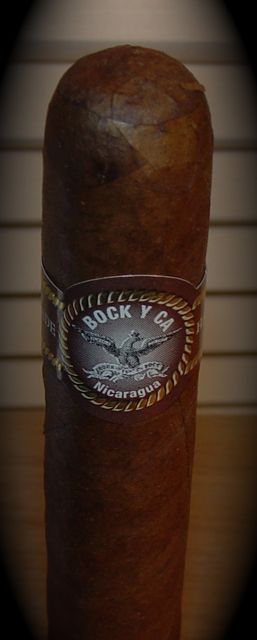
The general appearance of the Bock robusto does nothing to betray the marketing of this cigar as an “inexpensive” brand. It’s rough and the cap is cut unevenly. It looks like it was thrown together in a rush. The prelight wrapper scent is of fresh hay and a prelight pull tastes bright and grassy. The draw is firm but serviceable.

But this cigar shouldn’t be judged by prelight appearances alone; it performs a whole lot better than it looks. It starts up with a pleasant toasty sweet tobacco flavor. Nothing unusual, just straight up smooth and creamy smoke. It’s mild to medium in body with a nice texture and very little bite. It sets up a solid white ash that compares favorably with any premium Nicaraguan cigar I’ve smoked in the past year.

This robusto builds in flavor toward the mid-point, getting a little woodier and by the last third brings a moderate dose of spice and most surprisingly, cocoa. I can’t think of another cigar in this price range that shows up with cocoa in any amount… but this one has it, at least in the mid to final stages. It’s not as thoroughgoing as the premium Pepin blends, but for a fraction of the price I have to say I’m impressed.

And the price is low. Seriously low. A box of Bock y Ca robustos runs around 30 USD. And yes, it’s a box, not a bundle. At this price you can hardly go wrong, unless you’re expecting a full bodied superpremium, which it isn’t. It’s a quality blue-collar medium bodied smoke, for a solid blue collar price. Try a couple. Your wallet will thank you and your palate won’t complain.

For other reviews of good cheap smokes, check out Walt’s Bargain Cigar Breakdown at the Stogie Review. 

-cigarfan 

Pelo de Oro Habano by Felipe Gregorio

cnv0394.jpg

Pelo de Oro Habano from Felipe Gregorio gets its name from the strain of tobacco used for its wrapper. Pelo de Oro — Spanish for “golden hair” — is grown in the highlands of Costa Rica by John Vogel’s Tabacos de la Cordillera, a plantation that specializes in the cultivation of tobacco from “ancestral” Cuban seeds. Over the past twenty years Vogel has accumulated a bank of pre-embargo Cuban seeds obtained from sources in the industry and his colleagues in the field of tobacco genetics.

Whether this tobacco is really comparable to the stuff that went into pre-embargo Cubans is at controversy. At the end of the day, this tobacco is grown in Costa Rica, not Cuba, and I have yet to meet anyone who can reliably compare a flavor today with a memory fifty years old. ( Pre-embargo cigars still exist in the collections of connoisseurs, but it is safe to say they don’t taste now the way they did fifty years ago.) In any case, the preservation of these original seeds is indeed a worthy enterprise. One can only hope that someday Vogel will be able to plant them in Cuba.

As Director of Tabacos de la Cordillera Vogel now produces several lines of cigars, but he also grows leaf from these seeds for other manufacturers, which is where Felipe Gregorio’s Pelo de Oro comes in. Phillip Wynne, founder and president of Felipe Gregorio, wanted to celebrate the 15th anniversary of the company with a new release. He ended up with two: Pelo de Oro Habano, and a line called Power. Both use the pelo de oro wrapper and were introduced in 2006.

Pelo de Oro is available in four sizes, this 6 x 50 perfecto, as well as corona, corona gorda and rothschild formats. The binder used here is Dominican Piloto Cubano, and the filler is composed of aged Nicaraguan leaf. They are presented in traditional cedar chests of 50 sticks.

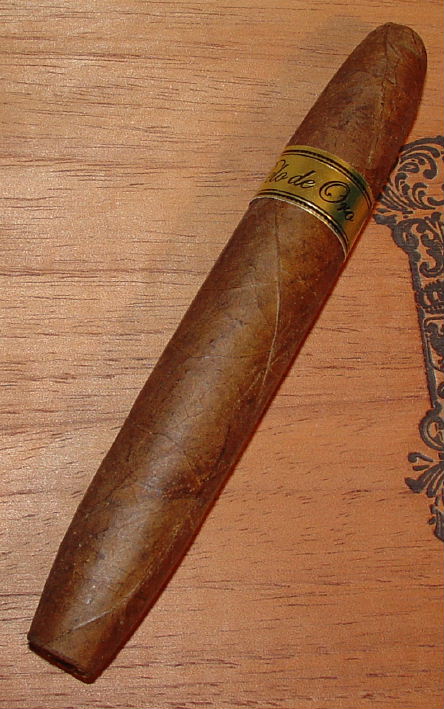
This perfecto is an attractive and refined shape, with a barrel that very gently expands to the advertised 50 ring gauge, though it appears to be much more slender. The wrapper is rough enough that it is difficult to pick out the cap construction, but the slightly flattened head appears to have a triple cap. The wrapper itself is a little splotchy in color, slightly coarse and marred by veins. I’m not sure that this is what I would call “golden hair.” Rapunzel might be a little embarrassed.

The Pelo de Oro Habano is an earthy tasting cigar with an unusual and pungent aroma. I had trouble coming up with descriptors for the scent, but it reminded me of rich wet earth, recently fertilized the natural way. Lots of barnyard, with maybe a smidgen of leather thrown in for balance. The taste is of straightforward tobacco with a vegetal base, somewhat plain but satisfying. As the cigar progressed it didn’t change dramatically, but perhaps became a little sweeter while retaining its rustic edge.

This cigar scores well in the construction department, with an easy draw, even burn and a solid ash. This allowed me the leisure to puzzle over the aroma and enjoy a well -balanced medium-bodied smoke for a good 45 minutes.

Just for kicks I used the cigar evaluation sheet found on the Tabacos Cordillera website and scored the Pelo de Oro perfecto at 17.4 out of 20, or 87 on the standard 100-point scale. I’m not crazy about numerical scoring, but this number sounds about right.

The perfectos retail for around 10 USD each and are sold in boxes of 50. It may be worth picking up a stick or two (preferably at a discount) just to sample this unusual wrapper leaf. For now I think I’ll pass on the cab.

-cigarfan

Arturo Fuente Hemingway Work of Art Maduro

cnv0393.jpg

In the 1960’s and early 70’s the Arturo Fuente company made a cigar in the style of the traditional Cuban perfecto called “Fancy Tales.” They eventually went out of production, but in the early 80’s Carlos Fuente, Jr. sparked a renaissance of the shape with the first Arturo Fuente Hemingway cigar, the 6 x 47 Signature. Carlos Fuente Sr. had learned to make this shape from his father, and to start making them again he first had to recover the original molds. After finding them in the old Ybor City factory, developing the right blend, and discovering that there was genuine interest in this old shape, the Hemingway series became a Fuente mainstay. Five years after the Signature came the Classic and Masterpiece sizes, all with the “Hemingway” perfecto foot, a mark of distinction which today is widely copied by other manufacturers.

The Work of Art is a limited edition cigar, produced in relatively small numbers and released around the holidays as a special treat for Fuente fanatics. The standard Hemingway series employs Cameroon wrapper, so the Connecticut broadleaf maduro version is an even dearer cigar. The WOAM (as it is sometimes called by Fuente followers) is not a parejo with a funny foot like the Signature or the Classic — it’s a figurado of the first order, with a pointy head and a ring gauge that graduates from 46 to a 60.

The blend is a trade secret. As Carlos Jr. explained in a Cigar Aficionado interview, the Fuente family still operates in stealth mode when it comes to guarding their “recipes”:

Q: They’re not written down?
A: They’re not written down.

Q: All your blends? That’s amazing.
A: That’s how my father taught me. We’re from the old school. Remember, I was born in a community where right next to my grandfather’s house was another cigar factory. At night, when they would have conversations, they would go, “Hush. They’re listening.”

So the only specifications available are that the filler is Dominican, as is the binder, and that is all ye need know.

Prelight

On second thought, ye need to know just a little bit more: the wrapper on this stout perfecto is rough and a little bit chipped, like an old saddle that has been well taken care of and handed down through the generations. Kind of smells like an old saddle too, or perhaps the horse that’s been saddled with it. In any case, this cigar definitely has the aura of maturity about it. The sugars from the wrapper add a soft note to the barnyard scent. After clipping the tip and taking a prelight draw I find some hay with a little sweetness.

First Half

The WOAM lights up easily, due in part to its surprisingly open draw. It tends to burn unevenly at first, but evens out with a little coaxing. The initial flavors are nutty with a sweet char. The finish is very short with a mild and clean aftertaste. This little guy produces lots of smooth smoke with every effortless draw. The aroma becomes woodier as the burn progresses and has a syrupy, molasses-like tinge to it. For the first couple of inches this is a very easygoing medium-bodied smoke.

Second Half

Due to the bulbous construction of this cigar most of it is consumed in the first half. The “sweet spot” is just at the mid-point where the flavor gets meatier, turning from smooth nutty flavors to smatterings of earth and black pepper. The aroma at this point is unreal — this is perhaps the most potently perfumey, sweet musky smoke I’ve experienced from a maduro. This is what I’m after in a stinky black stogie: something to make passersby turn around and take notice. It’s an exquisite scent.

The flavors get gradually darker as the cigar comes to a close. The finish grows to a spicy bite and finally signals the end with a dirty bitterness. Parting is such sweet sorrow.

Conclusion

This is a marvelous little cigar. I rarely find much complexity in maduros, but this one has it: nuts, earth, spice, and a rich sweet aroma that invariably leaves me in a puddle. Due to the limited production (and because they’re damned good) prices tend to be inflated when they are in fact available, so be careful. Standard retail price is around 7 or 8 USD, which is extremely reasonable given the quality of the cigar.

If you like a smooth medium-bodied maduro with a lot of complexity, you’ll love this one. Keep an eye out this holiday season for this classic and elusive cigar.

-cigarfan