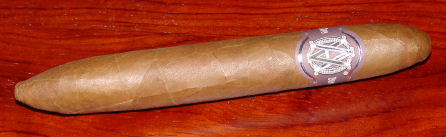
Domaine Avo ’50’

cnv0375.jpg

Avo Uvezian has led a cigar-charmed life. He started out as a jazz pianist and composer, playing and touring as a very young man in Lebanon and the Middle East after World War II. In 1947 he traveled to New York, where he studied at the Juilliard School of Music and eventually was drafted into the Army during the Korean War. (He played piano in the First Army Band.)

After following family members to Puerto Rico and working in the jewelry business for many years he started playing piano at a local resort. He discovered that the guests enjoyed the locally made cigars he kept on the top of his piano, and after giving away one too many of his personal stash, his young daughter Karin suggested that he might as well sell them.

This was the spark that eventually led Uvezian to contact Hendrik Kelner of Davidoff, who had just opened a cigar factory in the Dominican Republic. Avo’s first cigars were called Bolero, but the name was quickly changed to Avo when it was discovered that “Bolero” had already been registered by another manufacturer. The initial production run in 1987 was about five thousand boxes. Today about three million cigars are produced under the Avo brand name and its extensions.

The first Avo cigars – the now Classic line – were released in 1988, but Avo is really more of a song-and-dance man, a self described “PR man,” than a business and paperwork kind of guy, so in 1995 he sold his brand to Davidoff. But he remains, with his trademark Mimbre hat and ice cream suit, the face of Avo Cigars.

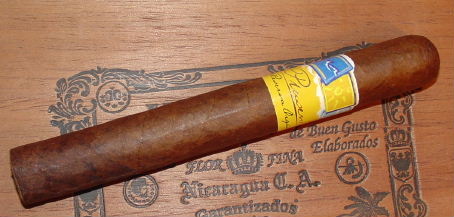
The Domaine Avo was blended to be a stronger version of the original Avo. It was released in 1998 in a robusto size only, but other sizes, including this 6 x 50/54 perfecto, were added in 2001. The filler and binder are a blend of San Vicente and piloto from the Avo farms in the Dominican Republic, and the wrapper is Connecticut shade grown in Ecuador. Production is overseen by the inimitable Henke Kelner in Santiago.

This is a beautiful cigar. For a few months I kept it in the top row of my humidor just so I could admire it during those few moments of indecision when I can’t decide what to smoke. The wrapper is a creamy colorado claro with small veins that are just about evenly spaced. The head and perfecto foot are flawlessly formed. There is an overall sense of proportionality and balance to this cigar that makes me hesitant to commit it to the flame.

The head clips cleanly and the prelight draw is much more generous than I expected, even with a nearly closed foot. After an easy light the draw opens up even more and becomes completely effortless. This cigar exhibits excellent construction all the way around — a great draw and a slow even burn.

The Domaine Avo introduces itself with a handful of sharp peppercorn — a surprise, considering the genteel appearance of the cigar. The finish from the start is quite long, and I found myself thinking “This is an Avo?” The texture of the smoke is smooth and creamy like I would expect from Connecticut wrapper, but the aroma carries all the characteristics of Ecuador, a nice easygoing cedary spice.

After the first inch the pepper fades a bit into a mild woody flavor, balsa-like with a salty element. The spice from the wrapper combines with this flavor very well to create a complex smoky brew. The middle third continues in this vein, with the wrapper stealing the spotlight and the base flavors taking a back seat. Into the last third the pepper kicks in again. I found that I had to smoke slowly to keep the smoke in balance at this point– this is where a slightly tighter draw might be appreciated. But of course the sensible thing is to just slow down a little.

The balanced appearance of this cigar seems to be reflected in the way that it smokes: it ends very much the way it starts, with a lot of spicy drama. In between is a pleasantly pastoral interlude. An extremely classy cigar that falls in the medium body range, maybe stretching to full at the end.

The Domaine Avo “50” is not a cheap date, but you’re not taking this one on the Tilt-a-Whirl at the State Fair. This is an operatic cigar, and in my opinion it’s worth the 8 or 10 dollars it sells for. There are a lot of fantastic cigars in that price range (and less, for that matter) but if price isn’t an object this stick is definitely worth a look.

–cigarfan

Camacho Corojo 11/18

cnv0374.jpg

Camacho’s Corojo Diploma was among the first cigars I reviewed for this blog, so when I cracked the humidor last night and heard that groan from Black Sabbath’s “Iron Man” I knew it was time to revisit one of Camacho’s Special Edition corojo cigars. Sometimes you just want a super heavyweight, and this is one of them.

The 11/18 shares a lot of the same characteristics as the Diploma, but the shape is certainly different. The 11/18 is a bulbous figurado that starts out at the head at around a 48 ring gauge, expands to about a 54 in the center and then narrows again to a 48 at the foot. It’s a rough looking cigar with a ruddy but very oily and thick wrapper, and a cap that looks like it might have been applied by school children. (Obviously it wasn’t, since it cuts perfectly, but aesthetically it leaves something to be desired.)

Like Camacho’s other Corojo cigars, this one is pure unadulterated Honduran leaf from Camacho’s farms in the Jamastran valley. Simplicity itself. The seeds used for this tobacco are descended from the “original” Corojo developed in Cuba, a strain which is no longer in use in Cuba due to its susceptibility to disease and mold. The Special Edition cigars (Diploma, 07/05, and 11/18) are loaded up with extra powerful sun grown ligero from these special corojo plants.

I enjoyed a hearty meal of meat and potatoes in preparation for my after-dinner smoke, and having retired to the porch with a glass of Talisker and this Camacho 11/18 I got right to work. After cutting this cigar with some care I was met with a spicy pre-light flavor with a little salt. The roll is solid and well packed, but it draws really well.

The first third of this beast is full-flavored, but relatively tame. Up front I noticed a sweet cereal taste (as in grain cereal with sweet tobacco overtones, not Fruity Pebbles) which I remember as fairly unique to the Diploma size. I haven’t noticed this with the standard Corojo Monarca, or any other cigar for that matter. There’s also a lot of salt here, and it’s surprisingly smooth. Full flavored, absolutely, but with no harshness. Just the way it should be.

After an inch or so I ran into the problem that everyone speaks of with respect to this cigar: it really does not want to burn evenly. I struggled with the burn throughout the length of this stick and had to correct it every ten minutes, which is usually enough to make me throw out what I’m smoking and head to the humi for another one. But I had this one by the horns, and anything else after this particular cigar would taste like slightly warmish air.

At the mid-point the power of this cigar is at full tilt. The aroma is rich and heady, almost sulfurous, and the flavor is incredibly complex with leather, pepper and sweet tobacco. The aftertaste is earthy and lingering with a very long finish. About half an inch into the two-thirds section, after the bulbous part was nearly consumed, this cigar threw me aside like an old dish rag. At this point the flavor is so overpowering that I think it loses a lot of the subtleties that characterize this smoke. The nicotine content is also very high at this point and if you’re not used to it you really have to take it easy. I walked away with a mild headache and had to go lie down for a while.

The 11/18 is a real work of art I think everyone should try at least once, and if you love full-bodied cigars you’re going to get hooked. The only nagging issue with this cigar is a badly uneven burn. But corojo is rather notorious for having this problem, so this may just be the price you pay for a cigar of this caliber. Well, not the only price. These retail for around 9 to 10 USD per stick.

It’s quite a ride, though not one I’ll be taking everyday.

–cigarfan

H. Upmann Signature Double Eagle

cnv0373.jpg

Like the Por Larrañaga “Cuban Grade,” the H. Upmann Signature is an extension brand created by Cuban Imports in conjuction with Altadis USA. It was introduced earlier this year and looks completely different from the other Upmann lines. As with the PL Cuban Grade, a lot of effort has been expended on the packaging — a striking black box emblazoned with the famous banker’s signature (of course) and a newly designed black and silver band.

Setting this line even further apart is the fact that it is made in Honduras, not the Dominican Republic. The Signature line is blended by Jesus Antonio Pineda Henriquez (about whom I can find nothing on the internets except that he is allegedly a “master blender”) in the Flor de Copan factory.

Available in four sizes, including this lovely 5 x 50 perfecto, the Signature features a Nicaraguan binder, filler from Nicaragua, Honduras and Peru, and a choice of wrappers: either Nicaraguan grown Connecticut Shade, or a San Andres maduro.

The Connecticut Shade Double Eagle is an attractive cigar with a soft roll and a perfectly shaped nipple foot. Easily lit with a single match, the draw opens up almost immediately after the tip is torched. The draw seems a little too easy, but the burn is slow and even. After a couple of inches this stick gets extremely soft, almost mushy between the fingers, so I had to be careful not to crack the smooth golden wrapper.

Like the PL Cuban Grade, the Signature has aroma in spades. A creamy sweet honey-like aroma rises from the foot of this cigar. It’s mild to medium in body, maybe a little more on the mild side, but the flavor grows to a solid medium at the finale. The primary flavor through the first two thirds is toasty, then bready, and it’s nicely accented by the sweet honey and floral hints on the nose. Some gentle pepper makes an entrance at the mid-point and gracefully increases in intensity but never really takes charge.

This is a fine mild cigar with a good amount of complexity. The only detraction is a somewhat dirty aftertaste that is especially noticeable in the first third. Strong coffee might take care of this, since this is really a morning or mid-day smoke anyway.

The H. Upmann Signature line retails in the 5 to 7 dollar range. If you really enjoy mild cigars, this might be worth the asking price. Like the PL Cuban Grade, this is a high quality cigar with a level of complexity unusual for mild bodied smokes. I’m more of a medium to full bodied kind of smoker though, so I’ll probably give this one a pass unless I’m really in the mood for a mild one.

— cigarfan

Angel 100 – O.T.C.

cnv0372.jpg

The Angel 100 series of cigars was named in honor of Angel Oliva, Sr., the patriarch of the Oliva Tobacco Company. Angel Oliva was born in 1907 and came to the United States from Cuba in the late ’20s. After a few years of working odd jobs he found himself working as an assistant to an unsuccessful tobacco broker in Tampa, Florida. Oliva quickly demonstrated his talent for the tobacco trade as well as his keen business skills — he restored his employer’s brokerage to financial health and then he launched his own enterprise, the Oliva Tobacco Company, in 1934.

By the 1950’s Oliva was one of the top distributors of premium tobacco leaf in the world, which at this time meant almost exclusively Cuban leaf. His relationships with Cuban farmers, as well as his company’s ability to buy whole crops and sort the leaf in house, fueled the expansion of the brokerage.

But what Angel Oliva is best remembered for is his distrust of Fidel Castro and his anticipation of the U.S. embargo. Oliva declared Castro a communist before the world really understood him to be one and predicted what would happen to the Cuban tobacco industry. In 1961, one step ahead of Castro’s revolution, the Olivas established a tobacco farm in Honduras, one of the first modern tobacco plantations in Central America. Not long after this, Angel managed to buy up almost four million pounds of Cuban leaf — it turned out to be the last shipment of tobacco from Cuba before JFK signed the embargo into law.

The Oliva empire would eventually extend to almost all of the primary tobacco growing regions of the world: Honduras, Nicaragua, the Dominican Republic (at the request of the Fuente family) and Ecuador. Or perhaps I should say, especially Ecuador. The sun grown wrappers on Ashton’s VSG, Arturo Fuente’s Chateau Fuente and Rocky Patel’s Sun Grown (to name a few) are all from Oliva’s farms in Ecuador. Tobacco from other Oliva farms also goes into brands like La Gloria Cubana, La Flor Dominicana, Pepin Garcia, and just to confuse everyone, some Oliva cigars as well. (The two Oliva families are often confused, but they are totally distinct and separate companies: the Oliva Tobacco Company is the legacy of Angel Oliva, Sr., as opposed to the Oliva Cigar Company, maker of Flor de Oliva, Master Blends, etc.)

The one thing the Oliva Tobacco Company doesn’t do is make cigars. The Angel 100 is actually made by NATSA (Nicaragua American Tobacco, S.A.) in Esteli with all Oliva grown tobaccos: binder and filler from their La Joya farm in Nicaragua, and sun grown wrapper from their La Meca vega in Ecuador. Four sizes were produced, each pressed and packed in boxes of five. The names of the different vitolas all hold some significance for the OTC family:

  • 1961 (6 x 45 corona)
  • La Joya (6 x 54 toro)
  • La Meca (6.12 x 52 torpedo)
  • O.T.C. (6 x 48 corona gorda)

The Angel 100 O.T.C. is a rough looking cigar. The wrapper is veiny and dark, the way sun grown wrappers often are, and the cap is just a bit loose on the head of the cigar. But once clipped it draws perfectly and produces a fine even burn with a solid ash.

When I first received these about a year ago they were harsh and inhospitable cigars. But I still found something intriguing about them, and I liked the aroma, so I put them away thinking they just needed some time to simmer. This turns out to be exactly the case — this is still a forthright and aggressive smoke, but it’s much more docile than it was a year ago. In fact, it’s nearly smooth. Full flavored, most definitely, but easier on the membranes.

The O.T.C. opens up with a medium body, and after the introductory first third it gets close to full. The Nicaraguan character of the cigar really comes through with lots of sweet woody flavors and the wrapper lends a fruity element to the smoke — it reminds me a lot of the wrapper on Rocky Patel’s Vintage 92 cigars, but played at a louder volume. It’s smooth, but with plenty of zing on the palate: pepper on the tongue and cherry in the nose… an interesting combination. And to my surprise it’s not a nicotine powerhouse — it generates a pretty good current, but it didn’t overload my admittedly delicate circuits.

As the cigar burns it develops a more serious character as the heavy Nicaraguan flavors overtake the subtleties of the wrapper. It remains balanced, but the balance shifts a bit. There is definitely enough complexity here to keep the senses guessing.

Just one small caveat: there is something a little odd about this cigar in the first and middle stages, a detergent-like overtone that may not be to everyone’s liking. Personally, I like that springtime fresh scent, but I can see how some might find it a little distracting.

This is a limited edition cigar with only a few sizes still readily available, though at a very reasonable price: about 13 USD per five pack box. It’s a fine cigar for fans of full flavor and a worthy tribute to one of the great cigar men of the twentieth century. Get some now and let them sit. I don’t think you’ll regret it.

— cigarfan

Plasencia Reserva Organica Toro

cnv0371.jpg

The Plasencia Reserva Organica is advertised by its distributor, Indianhead, as “the first completely organically grown cigar to come along since the Indians stopped rolling their own.” I might quibble with the concept of growing cigars, and I’ve read that the Cubans have utilized organic methods extensively, but it must be true that the Plasencia Reserva Organica is the first to be certified as a purely organic cigar.

But I can hear the groans already. Organic hippy dippy shit. But wait! What’s so terrible about eschewing the use of artificial fertilizers and pesticides? It’s hard to say what the long term effects of these chemicals are on tobacco workers and possibly, the end product, so why not see if it’s possible to go without them? Obviously it’s going to be more difficult to cultivate and harvest any crop in this manner, and therefore more expensive, but I don’t see anything intrinsically wrong with it. At the very least it opens the “organic” question for discussion. Have you ever wondered what chemicals are used to produce your favorite cigar?

Nestor Plasencia, Jr. is the madman behind this crazy organic thing, and it only makes sense that he picked up this harebrained idea in a university where he received a degree in Agricultural Engineering. And I suppose being the son of Nestor Plasencia Sr., one of the most prolific cigar makers in Central America, had something to do with it too. Maybe a lot.

To avoid the risk of contamination and because the certification requirements are so stringent, the Organica operation is entirely separate from Plasencia’s other fields and facilities in Esteli and Jalapa. All Nicaraguan tobaccos are used, but only the sturdiest criollo and corojo hybrids make the cut because many of the earlier seeds (such as Camacho’s first generation corojo) are very susceptible to disease and insect damage when they are deprived of chemical fertilizers and pesticides. Organic farmers have to substitute a lot of hard work for chemicals in order to keep their crops in good shape.

And all this extra work comes with a price. The toro checks in at around 7 USD per stick, or $135 for a box of 20.

The PRO toro is a nice looking stick. The wrapper is dark and a bit mottled, a little leathery looking, and has a simple tobacco scent with some grassiness to it. The prelight draw is easy, a little too easy on one sample, but overall the roll is good.

This cigar starts up with a very clean, slightly toasty flavor with a touch of sweetness. I certainly wouldn’t guess this was a Nicaraguan puro if I didn’t know it already. The texture of the smoke is very smooth with a mild body that grows to about a medium at the end. A delicate but indistinct aroma accompanies the mild flavor. I can’t decide if it reminds me more of leather or wood, or neither. It’s not easily distinguishable.

By the midpoint the smoke has built a little body and displays some leathery elements, but not a lot of complexity. One of the big challenges for milder bodied cigars is development and complexity, and unfortunately the PRO doesn’t do very well in this department.

This is a very slow burning cigar. Of the three I’ve smoked for this review, I’ve only been able to finish one, after an hour and a half of insistent puffing. The construction here is fair to good, with a couple samples having a loose roll and requiring periodic touchups with the torch. (Can I call these torch-ups?) The ash is a flaky solid white that tends to blow away if the cigar is not promptly ashed.

I really wanted to like this cigar, but in the final analysis I think it just doesn’t have a whole lot of character. It’s not a bad cigar by any means, but it just didn’t hold my interest for any length of time. It’s a very clean-tasting straightforward cigar with a mild body and a mild character. Maybe a little more ligero is called for, or a spicy non-organic sungrown wrapper. It needs a little something, I think.

Troya Clasico LXIII

cnv0369.jpg

Troya cigars were made in pre-revolutionary Cuba beginning in 1932 and are in fact still made today as a relatively obscure and hard to find machine made cigar. Despite their rarity they have a small but devoted following, as evidenced by the fact that they survived the nationalizing of the industry when many smaller brands were culled out. Like the legend of Troy itself, the brand has endured.

In 1985 a California company began production of a cigar for the American market and saw further opportunities for Troya as a brand name. The original Troya cigars were respected and sold well, but like many of the best cigars of that generation they were battered by the tempest of the 90’s Cigar Boom. But once again, they survived. In 2004 the blend was revamped and another line, the Troya X-Tra, was introduced to appeal to the heavyweight crowd.

The next stop on Troya’s path was at the door of Jose “Pepin” Garcia, one of the hottest cigar makers around. In early 2007 the Pepin-made Troya Clasico was unveiled in three sizes — robusto, toro, and churchill. I haven’t figured out why Troya names their cigars with the numbers they do — their robustos are called 18, toros are 54, and churchills are 63. (The individual digits all add up to nine. Hmmm…) The Clasicos are numerated in this fashion as well, but with the roman numeral instead. Nice touch.

cnv0367.jpg

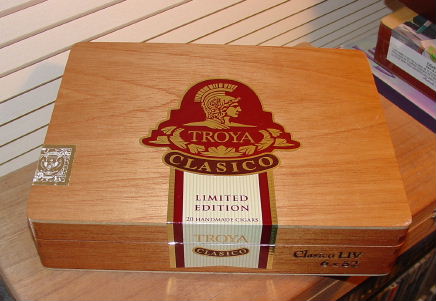
Troya Clasicos are made in Esteli, Nicaragua at Garcia’s Tabacalera Cubana with all Nicaraguan tobaccos. The wrapper is a luscious and dark “corojo oscuro” and the filler is a blend of corojo and criollo from the Jalapa region. The churchill is a 7 inch by 50 ring double corona size, and these come packed 20 to the box. It’s a handsome cigar with an oily, rich looking wrapper and a perfectly triple-capped head.

The churchill starts up in an unusual fashion for a Pepin cigar: it’s buttery smooth. Bean flavors take the vanguard here — cocoa and African coffee (I’ve been roasting some Ethiopian Harrar that has an eerily similar aroma.) Following quickly on this initial impression is a bittersweet woody flavor that fans of Pepin will recognize immediately. The smoke for the first third is relatively mild compared to other Pepin made cigars — relative, that is, to the blast of pepper that introduces many of Garcia’s cigars.

The body picks up more weight into the second and third acts, and ventures into leathery territory. The finish is lengthy and the aftertaste retains the slightly bitter woody flavor that announces itself at the start. What remains the same throughout the duration of the smoke is the delicate caramel-coffee sweetness of the aroma from the wrapper, and I think this is what defines this cigar.

The last third builds, edging towards a full body, and the cigar exits with a tart smack. This is a hallmark of Don Pepin’s blends, and it’s what fans of his cigars appreciate. This is a long smoking cigar (about an hour and a half for me) and while there aren’t any major transitions it is consistently complex and very well balanced throughout.

I was lucky enough to receive a fiver of these from reader Lucky7 (thanks again!) and so far I’ve smoked three. One had a weak plug at the head of the cigar which I was able to bore through with a pipe tool. Other than that these burned quite well and had no serious construction problems.

Troya Clasico churchills are going to run in the 8 to 10 dollar range, and I do believe they are worth the expense. This is a medium to full bodied cigar that reminds me a little of Pepin’s Sancti Spiritus — it’s a less aggressive blend that leaves out none of the complexity or the basic character of his art. If you’ve smoked the Pepin Blue Label or Tatuaje or any of the stronger cigars from El Rey de Los Habanos and found them to be too heavy for your taste, do yourself a favor and try a Troya Clasico. I don’t think you’ll be disappointed.

cnv0368.jpg

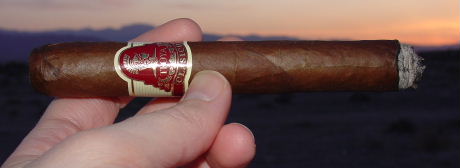
A desert sunset and a fine cigar. Life is good.

FP Habano 98

cnv0370.jpg

I smoke a lot of bundle and “bargain” cigars this time of year because I don’t have the luxury of a man cave, an air-conditioned garage, or a wife who doesn’t give a damn. She does, so I don’t smoke inside the house. And around the time I emerge from the domicile to sneak an evening cigar the thermometer is just dipping below 100 degrees, so it’s either something short, or something cheap that I can toss after half an hour. Either that or I go back into the house looking like Fred Biletnikoff after the Super Bowl. (Sorry to get old school on you youngsters out there, but if you’re old enough to smoke you’re old enough to watch ESPN Classic.)

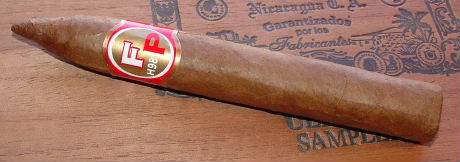
That is not to suggest that the FP Habano 98 is a second class citizen. It is in fact a bundle cigar made by La Tradicion Cubana for Fuller’s Pullers in Madison, Wisconsin, and it’s available for about two bucks a stick. The torpedoes are 6 1/2 inches long and the barrel of the cigar is a 52 ring gauge. The wrapper is a Nicaraguan Habano 98, which I think is a criollo leaf, and the filler is a Nicaraguan and Dominican blend.

This is a decent looking torpedo with a moderately dry wrapper and a somewhat odd looking head. It’s well constructed, and when the tip is clipped it draws perfectly, but the head is sort of lumpy and crooked, like the crown of a crumpled wizard’s hat.

But it burns straight and tastes pretty good, which in the bargain category makes it a winner from the start. It’s a mild cigar which builds at the mid-point to a medium body. The wrapper imparts a pleasant aroma of cedar and spice which hints at what the LTC robusto offers, but the FP H98 doesn’t have the same depth or complexity. (Nor would I expect it to.) The flavor is straightforward mild tobacco with a woody character up to the half-way point where it takes on a tinge of soot. At the two-thirds point the flavor gets muddier and it’s pretty much downhill from there. Like most bundle cigars I find this one is best smoked to the 50 yard line. Beyond that point and you’re on your own.

This is a pretty good cigar for a couple bucks. If you’re in the market for a high quality mild econo smoke it’s worth a look. If there’s another cigar with a wrapper this good selling for under two bucks it would definitely pique my interest.

Counterblaste to Tobacco

james.jpg

In the early seventeenth century Scotland’s King James came to power, succeeding Elizabeth I to the crown of England. James was a great moralist and high on his list of Things to Purge were the Antichrist, Witches, their assorted demonic consorts, and henbane of Peru, otherwise known as tobacco. Witches could be tortured, tried, and burnt. Demons and tobacco posed a slightly greater challenge, so James began his campaign with a war of words. In 1604 his Counterblaste to Tobacco was published and became one of the world’s first diatribes against the gentle art of smoking.

It didn’t work. Whether it was a witch or a fine pipe of Virginia leaf, Englishmen continued to light ’em up. So James took the next inevitable step: taxation. Maybe it was a shrewd play for more revenue, or perhaps a legitimate concern for the souls of his subjects. In any case, the duty on tobacco was raised 4000 percent.

4000 percent, you say? Holy smokes! That’s a rather extravagant raise, if I do say so myself.

And yet that’s nothing compared to what the United States Congress is preparing to do to cigar enthusiasts in 2008.

What would you say to an increase of 20,000 percent? That is the cap on the tax that lawmakers are considering placing on sales of cigars to United States citizens. The current federal excise tax is about a nickel per cigar. The proposed increase is to 53% of the manufacturer’s sales price, with a cap of 10 dollars per cigar. (In addition to state tobacco taxes, sales taxes, tax taxes, etc.)

This isn’t the first time that Congress has threatened the cigar industry (remember the American Jobs Creation Act?) but this new thing looks even more dangerous – and likely – because those who will supposedly benefit are poor kids. The revenues from this gargantuan tax increase are slated for the renewal and expansion of the State Children’s Health Insurance Program, a program which has in the past received largely bipartisan support. Let’s face it: as an elected representative from either side it’s going to be hard to vote down benefits for children.

And look. I’m not a hard-hearted guy. I’ll take a hit for the kids. Hell, raise the tax to a quarter. That’s a 500 percent increase, and based on my consumption it would make my annual contribution about a hundred bucks. I don’t mind a reasonable tax on my hobby for a good cause, but is 50% of the wholesale price a reasonable tax? King James didn’t go that far and he was chasing the Antichrist and his pipe puffing minions!

Cigar sales make up 8 percent of total tobacco expenditure in the United States. 90 percent of total sales are of cigarettes. Under this plan cigarette taxes will increase as well, but only by a “modest” 61 cents per pack, an increase of less than 200 percent. Meanwhile taxes on premium cigars will go up by 2 or 3 dollars on average, with the super premiums getting totally clobbered. Why is this tax so disproportionate? Why are cigar smokers getting the shaft?

And there are other considerations, aside from the basic unfairness of the tax:

  • Cigar shops, especially small mom and pop establishments, will be put out of business with a floor tax that will require them to pay this tax up front on all their current stock when the law goes into effect.
  • More than likely a new black market will emerge, and what will be the costs of policing that?
  • Struggling economies in Central America and the Carribbean that are just now recovering from years of political repression and the effects of hurricanes will be adversely affected when cigar exports are curtailed.
  • What happens to the revenues for SCHIP when the industry being taxed shrivels up or goes underground? How wise is it to rely on a moribund industry to fund health insurance for the youth of America?

A lot of the commentary on the cigar boards has had a political bent blaming the democrats for this proposal, but the only way this bill will pass is if republicans join in with the democrats to override a Bush veto. A majority of republicans on the Senate Finance Committee voted with the democrats today to send this proposal to the full Senate. If successful this will be a bipartisan screwing. Regardless of where you or your representatives stand politically, let them know your opinion on this twenty first century Counterblaste.

You can contact your Senator by clicking here.

La Tradicion Cubana Robusto

cnv0366.jpg

From Miami’s Little Havana comes La Tradition Cubana’s eponymous cigar in a robusto format. I smoked the Sabor Cubano a couple weeks ago and was very impressed, so I couldn’t wait to get my hands on a few of these. This is the original flagship cigar for Luis Sanchez, who started La Tradicion Cubana in 1995. (More info about the company can be found on the Sabor Cubano post.)

This standard size robusto comes equipped with an Ecuadorian wrapper, a Honduran binder, and filler from Nicaragua and the DR. Each cigar is wrapped in cedar before being packed in boxes of 25.

The LTC robusto is a solid stick with a uniform and nearly flawless claro wrapper. The cap is solid and well formed but a little jagged around the edges. A quick pre-light whiff reveals some grassy scents with a dose of barnyard.

The draw seems a little tight on these, but this didn’t really affect the cigar’s performance. A good volume of smoke was forthcoming; it just took a little more effort than I usually care to exert. The flavor of the first third was straight forward clean tobacco, with a smidegeon of pepper. The burn is fairly even thoughout and it leaves a solid ash. (Some reviewers have noted a flaky ash, but this was not my experience.) This is a mild bodied cigar with a mild to negligible aftertaste.

What is notable about this cigar is an outstanding aroma: it starts up with some pleasant cedar elements, but by the mid-point of the cigar the smoke is gloriously spicy. The woody theme continues from here, but it picks up something that almost smells like sandalwood. It’s quite a powerful scent which is nicely balanced by the mildness of the flavor. Unfortunately the flavor seems to wane after the mid-point and goes from slightly peppery to somewhat papery.

The LTC Robusto is worth a test drive if you enjoy mild but highly aromatic smoke. And like all of the cigars from La Tradicion it’s very reasonably priced at around 75 USD per box. The only downside is the mildness: if there were a little more steel to this stick I think I’d have a new goto cigar.

Por Larrañaga “Cuban Grade” Robusto

cnv0365.jpg

A couple months ago I reviewed one of the many cigars proud to call themselves Por Larrañaga, the “Honduran Blend” made in the Flor de Copan Altadis factory, as advertised, distributed and sold by JR Cigars. Well, here we have another Por Larrañaga cigar, made in the same Flor de Copan factory (unless Altadis operates more than one there) but this time blended and distributed by Cuban Imports (who also make the new H. Upmann Signature.)

Is it just me, or would it have made sense to market this cigar under a different name? How many PLs do we need?

Furthermore, if it is absolutely necessary to recycle an old Havana trademark, I would like to suggest one of these from my list of favorites:

  • Caruncho (also Flor de Caruncho)
  • Flor de Pedro Rogers
  • Frank Halls
  • His Majesty
  • La Indiferencia
  • La Flor de Santa Gertruda

(Courtesy Perleman’s Pocket Cyclopedia of Havana Cigars)

The Cuban Grade PL, like the Honduran Blend, has an Ecuadorian grown Connecticut Shade wrapper (though there is also a San Andres maduro available) but instead of Honduran filler the Cuban Grade employs a Mexican binder and a Honduran/Dominican filler blend. The robusto is a standard 5 x 50 in size and sells for around 5 USD retail.

The wrapper on this robusto is a very smooth golden brown with some ripple in the veins. The roll is solid, and after clipping the cap I found the draw to be free and easy. The prelight scent is grassy with a little earth, which in this case was an accurate predictor of what was in store for my palate.

It starts up with a mild earthy flavor and a somewhat floral aroma. This cigar is billed in some places as mild to medium, but it really never gets close to medium in my opinion. The flavor builds a bit and grows a little sweeter toward the mid-point, while the aroma maintains its floral focal point. This cigar has good flavor intensity for a mild-bodied cigar, but it will not satisfy a full-bodied appetite. It leaves a slightly earthy aftertaste that gains a substantial but short finish by the end of the cigar. The burn is very good, even and trouble-free, leaving a solid dirty-gray ash with black streaks. Despite its light flavor and mild body this cigar has a lot of character and a fair amount of complexity.

This lightweight contender has a lot of heart. I’m not so sure about “cuban grade,” but with the rippled veins, streaky ash, earthy flavor profile, and floral aroma I might be persuaded that it was modeled on a very very light version of the Cuban Romeo y Julieta.

But as an old gardener I used to work with would say when I suggested something audacious, like taking a break or something, “Maybe on a Tuesday, sonny.”