Bargain Arganese Rundown

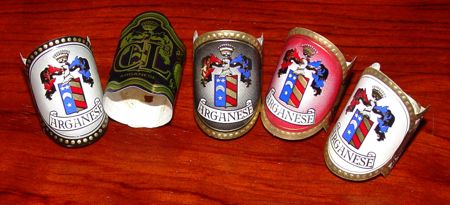
ArganeseBands

I don’t have too much experience with Arganese cigars. I don’t see them in the shops I patronize and I’ve never been curious enough to take a chance on a box online. But when I saw a five-pack sampler of  discontinued blends on sale for less than ten bucks, I bit.

I’m not sure why these are being discontinued, but it’s a great opportunity to pick up some decent smokes for cheap. The last I heard, Arganese was catching flak for some kind of multi-level marketing scheme,  but what I know this company best for are the gloriously cheesy ads that accompanied their entry into the market. The douchebag at a casino table with two made-up blondes draped over his shoulders, or the obese guy on a golf course with the mini-skirted coed caddies… utterly hilarious.

So it’s safe to say that I am not in their marketing demographic.  Which is unfortunate in a way, because these are actually not bad cigars. I only picked up one sampler of these so I can’t in good faith give them a complete review, but I thought I’d offer some short notes this week for the bargain hunters out there.
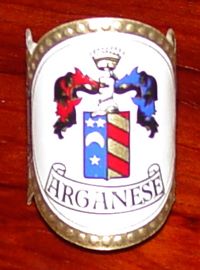
ArgMadThe Maduro doesn’t stray too far from what you’d expect in a Dominican Maduro. The Brazilian wrapper is very toothy, in fact rough to the touch, and the draw is a little tight but it burns well with a straight and solid ash. The flavors are typical, but good: chocolate and nuts, with negligible finish or aftertaste. There is a touch of spice in the last third, but it won’t satisfy the power smoker  — it’s really pretty smooth and mild for the most part. Light to medium in body.  Quite pleasant as an everyday light maduro cigar.
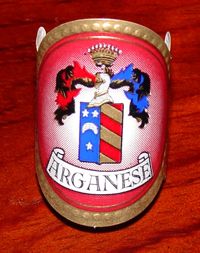
ArgDoubleThe Double Wrap is an impressively built cigar — I think I counted 4 or 5 wraps at the head of this thing. Unfortunately it was unsmokeable. I fought with it for the first inch or so, but the draw was just too tight and what flavors I could get were sharp and metallic. I had to pitch this one and move on to the next.

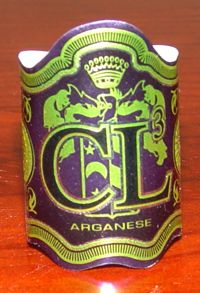
The CL3 ArgCL3 is 100% “first-generation” Cuban-seed Corojo, and it was probably the most interesting smoke in the sampler. It starts up with a peppery bite and a nice caramel accent. The smoke seems a little thin, but the aroma is quite unusual — the only descriptor I could come up with was “gamey.” It burns slowly and is extremely well-behaved for a blend with so much ligero. The only issue I had was the thin smoke body, which is way over-matched by the power of the cigar. This stick has too much nicotine for me, but I did enjoy its distinctive aroma.
The Nicaraguan smokes like a maduro, but it has more kick to it than the Maduro blend. This is also a nice looking stick, and while the draw is a bit tight at first it opens up after a half-inch or so. ModerArgNicately spiced with black pepper and accompanied by some caramel sweetness on the nose, it’s nicely balanced. Chocolate flavors appear in the second half and it gets a bit rough on the throat. It’s not terribly complex, but there’s enough here to keep my interest for the duration of the cigar. A good medium-full bodied smoke.
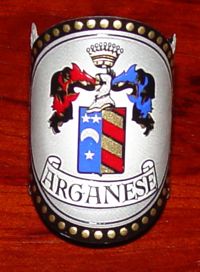
I’d recommend the Connecticut to anyone who appreciates fine shade wrappers. It’s another handsome cigar, and even ArgCTthough the draw was again a little tight it was otherwise well constructed. In most ways it’s typical of Ecuadorian Connecticut — creamy with floral notes, but at one point I thought I could detect apple notes. That was unexpected. In the home stretch it’s mostly nuts and creamy shade-grown goodness. Another really decent smoke.
The Maduro, Nicaraguan, and Connecticut cigars are available in different weights — mild, medium, and full. I honestly don’t know which these were, but I would have to guess they were either medium or full. The Connecticut in particular was quite chewy for this style of cigar.

Conclusion

I wasn’t blown away by any of these cigars, but I wasn’t disappointed either. (It wouldn’t be fair to direct the full force of my derision on the Double Wrap after one bad stick. This time it will merely receive an indifferent shrug.)  For two to three dollars per stick I could see picking up a box or two — probably the Nicaraguan or maybe the Maduro.

These are great value cigars, at least while they’re still around. I had discounted Arganese cigars as a trendy upstart, but I’m happy to report that there is more behind these blends than just a cheesy ad campaign. After smoking all of five cigars from this outfit I’ll be interested to see what’s next on the horizon for them.

J. Fuego “Casa Fuego” Belicoso

CasaFuego

Jesus Fuego is perhaps best known for his work with Rocky Patel’s 1990 and 1992 Vintage blends, but he has come into his own in the last couple of years with Tabacos S.A. and his “J. Fuego” line of cigars.

Like so many other premium cigar makers, Fuego’s family tree stretches back several generations to the fertile soil of Pinar del Rio, Cuba.  His family has been in the tobacco growing business since the 1870’s, in a part of Cuba that would eventually become known as “El Corojo.”  The Fuegos were mostly tobacco producers for the factories in Havana, but Jesus took it a little further along the production line to become an expert in post-harvest tobacco processing.corojo

Fuego holds a master’s degree in agronomy and wrote his thesis on tobacco fermentation after studying at Havana University and receiving training at the Fabrica de Tobacos Francisco Donatien, where he worked on the emerging new Cuban marca called Vegueros.

In the late 90’s he left Cuba and arrived in Honduras, where he went to work for Camacho’s Julio Eiroa.  Later on, while he was working for U.S. Tobacco, he impressed Rocky Patel, who at the time was in the development stages of the blends that would become known as the Vintage 1990 and 1992. Fuego eventually would become Rocky’s “right-hand man,” not only assisting in the blending of his cigars but also supervising many of his factories.  Along the way he would also help to blend my favorite RP blend, the Sun Grown, and the Olde World Reserve as well.

But in late 2006 Fuego decided to step out on his own. With the help of the ubiquitous Plasencia family (the Fuegos and the Plasencias have a long history as neighbors going back to the nineteenth century in Cuba) Fuego introduced his inaugural J. Fuego cigars: the Natural, and the Gran Reserva Corojo No. 1.

Since then he has lent a hand in several other blends, both for his own J. Fuego brand and others such as Defiance by Xikar, a house blend for Famous Smoke (Royal Nicaraguan), and this one for Cigars International: Casa Fuego.Corojo3

The Casa Fuego is made in Honduras with Nicaraguan tobaccos: the wrapper is Nicaraguan Habano, while the binder and filler are corojo. Fuego has a long history with corojo — in fact, his family’s farm in Cuba was called Corojo No. 1 — and the fact that his first employer in Honduras was the Eiroa family says something as well. This guy really knows corojo.

Casa Fuego is available in five sizes:

  • Corona (5.5 x 46)
  • Double Corona (7 x 50)
  • Robusto (5 x 50)
  • Toro (6.5 x 52)
  • Belicoso (6 x 52)

Construction Notes

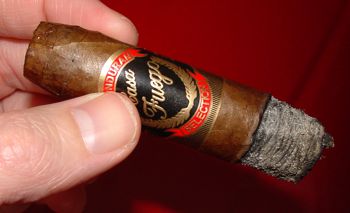
The Casa Fuego Belicoso features a slightly oily golden brown wrapper that shows a nice amount of fine tooth. The roll is a little bit spongy and irregular in places, particularly toward the head of the cigar, but once cut the draw and burn are perfect. These sticks are box pressed, but not square. After they have been in the humidor for a couple weeks the press is barely noticeable.

The ash is a solid dirty gray with lots of white speckles, a common occurrence with grainy wrapper leaf. The toothiness of this wrapper is quite reminiscent of Cameroon, as are some of the other smoking characteristics.

CasaFuego2

Tasting Notes

The Casa Fuego starts up with that typically tannic Nicaraguan flavor — woody, with a smattering of black pepper. The finish is dry and leaves an acidic tang on the tongue. The aroma contributes a sweet note of caramel and blends well with the drier flavors on the palate.

The sharp nature of the smoke softens up a bit after a couple inches. The pepper drops off and is replaced by cocoa or mild coffee, which combined with the residual tannins might come across as bittersweet chocolate. The aroma is spicier at this point, cedary with some mint, which strikes me as very Cameroonian.

The last third turns up the nicotine a couple notches, giving this medium-weight cigar a little more punch. The aroma is almost piney as the ash approaches the band. The aftertaste gets heavy and a bit tarry if rushed, so take it easy across the finish line.

Conclusion

Aside from the fact that the Casa Fuego is a very well made and pleasant cigar, what impresses me the most is the price. The retail price is around 5 USD, but these can be easily had for half that on Cigarbid, the auction arm of Cigars International. For less than three dollars this is a great everyday cigar. Even though it isn’t a spectacular smoke, dollar for dollar this is one of the better buys I’ve made this year.

CasaFuego3

Final Score: 85

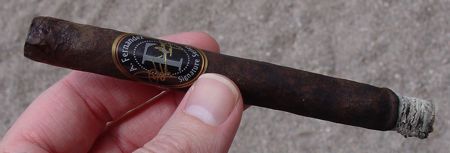
A. Fernandez Signature Maduro Lancero

A

Abdel Fernandez has been hailed as a “rising star” in the cigar world, and judging by the number of established cigar makers who now trust him with their blends, it is safe to assume that his star is still on the upswing. Among a few of his partners are Rocky Patel (RP Signature, Triple Fusion, ITC 10th Anniversary), Ernesto Padilla (Padilla Habano) and Oliva (Sol Cubano Cuban Cabinet.) If you pick up generally unrecognized brands from CI, there’s a good chance that you’ve smoked one of his cigars without knowing it — La Herencia Cubana, La Cuna, Man O’War, and the like. But name recognition is important for obvious reasons, so it’s no surprise that we are now seeing the name A. Fernandez on a cigar band.

Fernandez is based in Esteli, Nicaragua, and grows most of his own tobacco on farms near Esteli, Condega, and the Jalapa Valley. He is relatively new to Nicaragua, having arrived from Cuba only five years ago. Virtually everything ever written about Abdel mentions that he received an education in tobacco from the iconic Alejandro Robaina, so let me join the chorus and reiterate that fact once again.

AFernandezMad2

Construction Notes

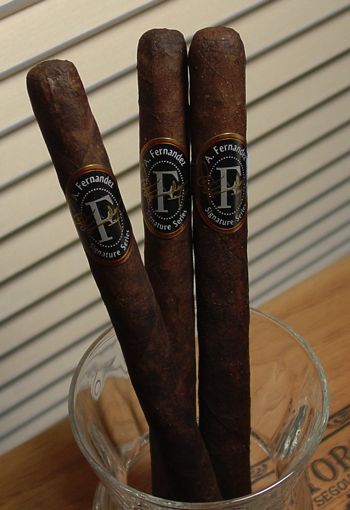
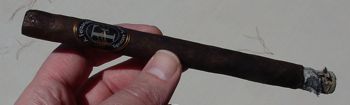
The Fernandez Maduro is a mean looking stick. Maduro wrapper in its natural, unadulterated form is a thick, rustic leaf, so there’s not much to praise here in the way of aesthetics. The equally utilitarian cap is roughly applied, but shears well. The roll is solid. But of course the true test of a lancero with its narrow ring gauge is the draw, and the ones I have sampled have all been perfect in that regard.

The wrapper’s prelight scent is rich and earthy, straight from the barnyard, indicating fine fermentation. Lighting a lancero is easy, and this one fires up without a hitch. The burn wavers a little bit, as maduro leaf tends to do, but it corrects itself eventually. The ash tends to flake during this correction, but otherwise it’s solid and holds fairly well.

AFernandezMad3

Tasting Notes

The aroma from this maduro wrapper takes center stage immediately and doesn’t make an exit until the band is peeled and the butt laid to rest. The wrapper on a lancero is bound to operate in this fashion due to the proportions of the stick, but make it a sweet and rich smelling maduro leaf and it’s guaranteed to be the star of the show. Right up front are the typical flavors of chocolate and char. An inch in and it gets a little spicier. Like a lot of lanceros this one gets a little hot if rushed, but I found that my unfortunate tendency to draw too often was greatly reduced by the prodigious amount of smoke this stick produces.

After the first third the cigar never really transitions to new flavors. There are some lighter woody notes along the way, but the basic theme of chocolate and char continues to the end. The flavors intensify in the last section, but don’t change too much. The finish lengthens and a mild aftertaste of pepper concludes the cigar.

Conclusion

This cigar reminds me a lot of the Padron standard series, in terms of both appearance and taste. It’s not complex, but it’s satisfying: a tasty, straight forward, no-nonsense maduro. The A. Fernandez Signature maduro is a little smoother and doesn’t pack the same punch as a Padron, but for a couple dollars less I think it’s comparable.

I got lucky and picked up these Fernandez lanceros for less than 2 dollars each, but the MSRP is still only 50 USD for a bundle of 20. I believe these are a Cigars International exclusive, and at the moment they appear to be sold out in this size, but hopefully we’ll see them back on the board soon. The bottom line is that this is a quality bargain smoke.

AFernandezMad4

Final Score: 85


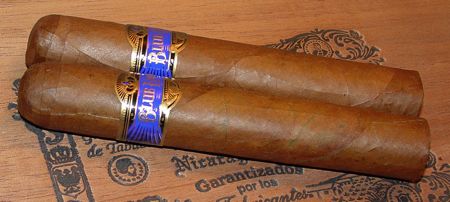
Blue Label Robusto

blue-label

I was a little wary at first of a cigar called “Blue Label.”  Not Gran Habano Blue Label, or STC Blue Label…just Blue Label. This generic sounding name has been used before — in fact, one large online retailer sells both this Blue Label and their own house brand Blue Label, not to mention the Legends Series Blue Label, and the Don Pepin Garcia cigar popularly known as the “Blue Label.”  Aside from the confusion this might engender, it just seems like bad advertising — it doesn’t distinguish the product, and it doesn’t entice the consumer. What would you prefer — a luscious looking double-banded Alec Bradley Tempus, or a homely Blue Label?

Some History

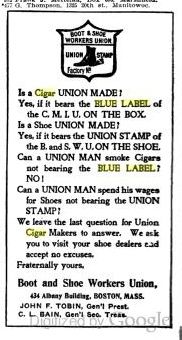
Curiously, the Blue Label has a history in cigar lore, which may or may not have anything to do with the naming of this particular cigar. The original Blue Label wasn’t a blend or a brand; it was the mark of labor union approval.

union-label

The Cigar Maker’s International Union was formed in 1864 in New York City. A fourteen year old cigar maker named Samuel Gompers joined the Cigar Maker’s Union that same year and within ten years became the president of Local 144. In 1881 he helped form the American Federation of Labor (AFL.)  Gompers was eventually elected president of the AFL and is recognized today as a key figure in American labor history.

The Cigar Makers’ Union was one of the first to use labels to distinguish its products — this allowed union members and supporters to buy “union made” whenever possible, and to boycott non-union products. Label committees were formed to determine the conditions under which companies would be allowed use of the label, label custodians and secretaries within the organizations were appointed to administer the union policies, and label “agitators” promoted the use of the label and agitated against non-union made products.

In the official publication of the Cigars Makers’ International Union, members were encouraged to enter poems and songs rejoicing in the glory of union-made cigars:

The Blue Label

Now, friends, if you will listen to what I’ve got to say,
I promise not to keep you long, or ask you any pay,
I want to ask a favor, you’ll agree it is no joke;
please ask for “union” made cigars whene’er you want a smoke

They’re made by good mechanics, they’re made for all mankind;
And if you roam the wide world o’er, no better will you find,
So, boys, be up and doing, be as sly as an old fox,
And see that the “Blue Label” is pasted on each box.

— Fred M. Williams of Union 427, Rahway N.J.

union-adWithin other cigar unions the label had more insidious uses: when Chinese immigrants flooded the country in the late 1860’s, many of them found employment in cigar factories. Displaced or disgruntled white workers formed the Cigar Makers’ Association of the Pacific which subsequently issued cigar box labels reading, “The cigars contained in this box are made by WHITE MEN.”
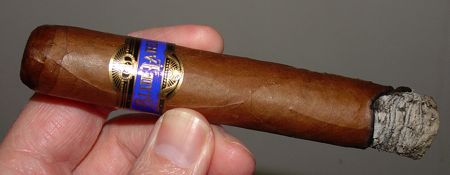
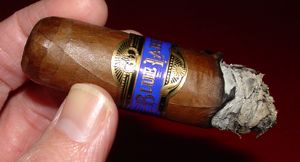
For good or ill, the label was a big deal. The Cigar Makers’ International Union developed several different labels over the years, finally settling on a standardized blue label in 1880. Details of the labels continued to change, frequently enough that these changes are often used today by collectors to date cigar boxes.

So what does that have to do with the Blue Label Robusto? Maybe nothing. But the Blue Label itself is nothing new to the cigar world.

The Cigar

The Blue Label robustos I’ve been smoking lately (while reading hundred-year old cigar trade papers) are made by Guillermo and George Rico of Gran Habano fame. They are produced in the STC factory in Danli, Honduras, and are available in the four standard sizes:

  • Churchill – 7 x 50
  • Corona –   6 x 44
  • Torpedo – 6.5 52
  • Robusto – 5 x 52

Only partial information is available about the blend:

  • Wrapper: Habano (country of origin unstated)
  • Binder: Corojo (country of origin unstated)
  • Filler: Honduran, Nicaraguan, and Dominican

bluelabel2

Construction Notes

The robustos are finely crafted cigars — the wrappers are a semi-glossy colorado claro, consistent in color and smooth in texture. The heads are soundly triple capped and are very attractive. They are rolled rock solid and feel heavy in the hand. All samples drew very well with either a punch or a guillotine cut.

The burn was a little lopsided at times, but always self-correcting. The yellowish-gray ash was a little crumbly, but held on long enough not to create a mess in my lap.

Tasting Notes

The Blue Label starts off with an intensely earthy flavor, very similar to the Gran Habano No. 5 Corojo. A mouthful of dirt is admittedly an acquired taste, but I’m afraid I have acquired it. This flavor does slowly dissipate, turning to oaky wood and vanilla in the middle section, and finally gets a little nutty toward the end. On the other hand, if earthy is not your thing you probably won’t get past the first inch.

The spicy cedary aroma is a really nice touch — ginger and cinnamon or nutmeg, that sort of thing. It’s light enough that it doesn’t overwhelm the medium-strength flavors on the palate, but it’s assertive enough to make a noticeable and pleasant contribution.

The finale is mildly peppery and more powerful than expected.  It’s certainly not a heavy hitting smoke, but they may sneak up on you if you’re smoking quickly and not paying attention.

Retail price for a box of Blue Label robustos is around 60 USD (even less at auction) making this a great blue collar cigar… assuming you can make it past that peaty first inch.

Final Score: 88

bluelabel3

References

Once a Cigar Maker: Men, Women and Work Culture in American Cigar Factories, 1900-1919 by Patricia A. Cooper, 1987

Encyclopedia of U.S. Labor and Working-Class History, edited by Eric Arnesen, 2006

Cigar Makers’ Official Journal, Feb 15, 1903, Chicago.

~cigarfan

Troya X-Tra Cetro

troyaxtra

When Britain’s Imperial Tobacco swallowed up California’s tiny Lignum-2 last summer for a paltry $22 million they were primarily interested in Lignum’s budget cigarette line called “Rave.” I’d never heard of Rave, nor have I any interest whatsoever in cheap cigarettes, but I was momentarily alarmed by the news because Lignum-2 owns one of my favorite premium cigars: Troya Clasico.

Imperial’s acquisition means that Altadis USA will take over distribution. When I saw an Altadis sales rep in the B&M the other day I had to ask him about the fate of Troya Clasico. He said “I think that’s the one they’re keeping,” and that the other lines would most likely be re-blended, or dropped and replaced with other lines.

Which makes sense — if they are going to keep any of the lines it has to be the one Don Pepin Garcia makes. It’s the only DPG blend Altadis owns. Even if it isn’t their best seller, it might be their best cigar.

So it was no surprise when I began to see Troya X-tra Cetros for under 2 dollars a stick in clearance sales and on the auction sites.  A premium cigar for under two bucks? Hell, I’ll try it, even if the line is on the endangered species list.

The traditional Troya is a mild-mannered Dominican blend that was unveiled way back in 1985. The X-Tra was released in 2004 in response to the demand for fuller bodied cigars — it’s a Nicaraguan puro featuring a Corojo 99 wrapper and binder surrounding a criollo filler in the core.  Sound familiar? According to the manufacturer, Pepin had a hand in the early development of the X-Tra, though he was not the sole blender.

The X-Tra line is available (for now) in five sizes which are numbered, as all Troya cigars are, in rather mysterious fashion:

  • No. 18 – Robusto
  • No. 54 – Toro
  • No. 63 – Churchill
  • No. 81 – Torpedo
  • No. 45 – Cetro

The first four are standard size vitolas, but the Cetro is a little unusual. At 6.2 x 45 it’s basically a gran corona.

The wrapper is a rich dark colorado maduro with a few veins and a grainy texture. It’s not the prettiest wrapper around, and the cap is nothing to look at either — just a single flap slapped on tight. But the roll is solid and the cap shears off nicely. The prelight scent is horsey.

troyaxtra2

I’ve tried these in batches of five from three different boxes and have found the draw to be a little inconsistent. Some of them had a perfect draw, some were a little tight. The tight ones were still smokeable, if a little annoying.

First light impressions were that this is a nice medium-bodied Nicaraguan style cigar — lots of corojo sweetness over a base of leather. The coffee and caramel notes that are typical of Nicaraguan corojo are the primary players here.

Aside from the minor draw issues that some of these exhibited, construction values are good: most of them burned plumb-line straight, and the resulting ash is strong and tight.

The mid section seems to me a little juicier than the first, almost fruity at times. As it winds down to the close there isn’t too much of a transition and the cigar doesn’t get much more complex: just continued caramel-tinged coffee that combines with the leathery aroma to create a satisfyingly simple package. It’s somewhat similar to an aged Famous Nicaraguan Corojo.

If there’s anything “extra” as this cigar burns past the secondary band it’s a slight burn at the back of the throat — this is typical of  mid-range Nicaraguan cigars, and is quickly cured with a swig of iced tea or cold beer. That’s really the only fault I could find with this cigar.

The Troya X-Tra is a pretty decent smoke at its regular price, but at closeout prices around 50 USD for bundles of 24 it’s fantastic. If you’re looking for a deal on medium-bodied Nicaraguan corojos, this is a nice pickup. Better be quick about it though.

troyaxtra3

Final Score: 88

~cigarfan

La Herencia Cubana Robusto

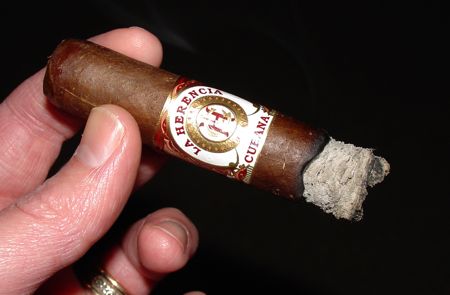
Made in the Tabacalera Fernandez factory in Esteli, Nicaragua, La Herencia Cubana is a great example of how a Nicaraguan cigar in the style of Padron and Pepin does not have to cost over five dollars a stick.

AJ Fernandez is the man behind brands like Padilla Habano, Man O’ War, and Rocky Patel’s ITC 10th Anniversary cigar. AJ is a relatively young guy, but already we are seeing signs that he has a very bright future in the industry. Recently arrived from Cuba after receiving an education in the business from the legendary Alejandro Robaina, he is currently growing his own tobacco in Condega and Jalapa for filler and binder in his new blends.  He has yet to grow his own wrapper leaf, but his close relationships with Nestor Plasencia (his uncle) and the Oliva Tobacco Company have given Fernandez all the resources he needs to create the next stellar Nicaraguan cigar.

La Herencia Cubana (Cuban Heritage) features filler tobaccos from Nicaragua’s three main growing regions: Condega, Jalapa, and Esteli. The wrapper is a dark Ecuadorian Sumatra that shows a fair amount of tooth for this type of wrapper, and seems to have small chips in it like some maduro leaves do. The roll is excellent: solid and consistent, and the cap is uniform and well made.

My first impression upon lighting this cigar is that it could have been made at another, more familiar, Esteli factory: Tabacalera Cubana. The initial blast of pepper lasts for half an inch or so and then settles down to a still aggressive foundation of wood and earth. There is a bright, almost acidic edge to this smoke that stings a bit on retrohaling. The aroma is sweet and earthy, reminding me a little bit of United Tobacco’s Cubao.

An inch or two into this robusto and a couple more familiar Nicaraguan suspects are at the door: cocoa and his cousin coffee. They blend very well with the sweet earthy aroma from the wrapper. The burn is excellent, requires no babysitting, and the ash holds reasonably well. My only complaint at this time is an unpleasant bite in the back of the throat. It’s not so excessive that it overtakes the character of the cigar, but it does prove a distraction.

The last third delivers a pretty good nicotine hit and the finish grows long and increasingly earthy. The sweetness from the wrapper keeps up with the strength of the blend, a mark of superior blending. After the band the flavor gets a little too dirty for my taste, but lovers of strong Nicaraguan tobacco may just want to nub this one.

My first impression when I lit up the Herencia Cubana robusto was that it was “Pepinesque,” and I think I’m going to stick with that description. It’s not as complex or rich as the average Pepin cigar, but there are definitely similarities. The sweet cocoa reminds in particular of EO’s Cubao, but again, without the same depth of flavor.

On the other hand, the price is a little less than what you’d pay for a Cubao or most of the cigars coming from Don Pepin — around 3 bucks a stick, or less if you catch a good deal. Cigars International occasionally offers this blend in an 8-cigar “flight” which is a great way to sample the line.

If you like the peppery cigars coming out of Nicaragua right now and your taste runs to medium-full rather than straight on full-bodied smokes — and your budget is a little cramped — you would do well to check out Herencia Cubana.

Alec Bradley Harvest Selection ’97

A few months ago I finally polished off a box of Alec Bradley Trilogy Cameroons. That box lasted over a year, and while it wasn’t quite up there with Torano’s 1916 cameroon, it was still a good smoke for a reasonable price. I have yet to smoke an Alec Bradley cigar I didn’t like (though I don’t care much for the proportions of the stump sized Maxx.)

Lately AB’s new Tempus brand is hogging the spotlight, and rightly so since the reviews that I’ve seen are almost uniformly favorable. But at nearly the same time that Tempus debuted, Cigars International unleashed an AB exclusive called Harvest Selection ‘97. I haven’t had a chance to smoke the Tempus, but when I saw CI running a Harvest Selection special for two bucks a stick, I jumped on them.

Since these appear to be made exclusively for CI, there isn’t much information about them aside from what CI generously extends to us: a Nicaraguan Habano wrapper (from 1997), plus filler leaf from the DR (1997 piloto cubano), Mexico (1997 ligero), and Nicaragua (criollo, class of 1998.) The description doesn’t specify a binder type, but it does supply lavish praise for the ample oils and medium bodied bouquet, etc. etc.

Which at least simplifies the research part of this review, so thank you CI.

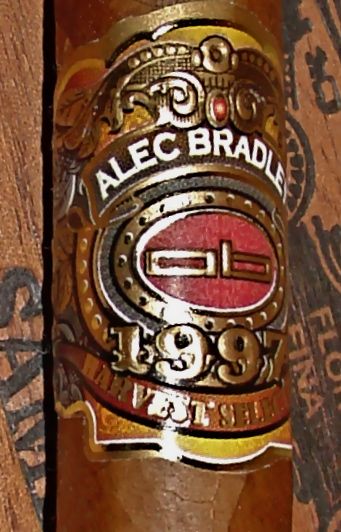
The band on this cigar is just as large and ornate as the one on the Tempus. I’m hard pressed to think of another three-dollar cigar with a band this attractive — all that embossed red, yellow and gold detail is pretty impressive.

Setting off the brilliancy of the band is a golden colorado wrapper that appears almost semi-glossy. There are a few fine veins, but again, for a three-dollar smoke this one’s a looker. The roll is solid and the cap is firmly fixed. No triple wrap, but decent enough.

The draw is initially very good and it stays that way. The first flavors are earthy with a mildly peppery finish. It starts off fairly mild and slowly amps up to about a medium in body. The aroma is excellent, adding a sweet and fragrant element to the earth on the palate. The earthiness here reminds me of a milder version of the Gran Habano No. 5, with maybe a little more pepper (but less strength) than what the Gran Habano provides.

There aren’t any profound transitions in the second half, just a little more peppery intensity with maybe a touch of leather thrown in for good measure. Ironmeden from the Velvet Cigar thought this cigar bottomed out half-way through, but I didn’t find that the flavor vanished as much as it just coasted on. The last third seemed to get fairly dry, so having a neutral-flavored beverage on hand would be a good idea. (I was swilling some cheap light-bodied beer from El Salvador called Taurino.) The aroma from the Harvest Selection remains sweet to the end, but by the final stage the fragrance notes seem woodier and not as earthy as they were at the starting line.

I have noticed no construction issues with these cigars — so far all of them have burned evenly (with a little waver here and there) and have drawn very well.

The Alec Bradly Harvest Selection is not going to blow anyone’s socks off, but it’s a fantastic value. I managed to snag these for well under three dollars shipped, and I’m completely satisfied with them as an everyday casual walk-the-dog kind of cigar.

Nestor Reserve Maduro

nestor-reserve.jpg

“Learn thou the worth of a dollar and how to keep it from damning thee.” –Joseph Seamon Cotter, Sr.

The other day I received in the mail sad tidings from the gentleman who claims to manage my meager stock portfolio. Like most people struggling to save for retirement (a very distant shore) I try to take the long view. But as I watch my modest investments dwindle further into the mire, my thoughts turn from luxury limited edition cigars to the humble bundle smoke, a suitable companion for a season of economic decline.

Unlike the federal government, I am not entirely comfortable with a budget extending far beyond my means, and since I am as yet unable to print money myself, I must instead seek solace in cheap Honduran stogies. Luckily there are a few out there, and there is a man named Nestor Plasencia.

Nestor over the years has produced a number of quality budget smokes — Maria Mancini, Mayorga, American Stogies, among others, and while none of these are exactly stellar cigars, they’re solid blue collar fare. And as I watch the foreign tourists pour in to feast on the weak dollar, I’m feeling bluer all the time.

So I thought I was exercising fiscal responsibility when I low-balled a “Mega Sampler” of these Nestor Reserves on Cigarbid. I’d tried the toro size previously and thought well of it, so when I came away a winner with a bid of 19 dollars I thought I hit the big time. 20 cigars for 19 dollars. Can’t beat it, right?

In the past I’ve really enjoyed the Connecticut version of this cigar — a mild and smooth smoking robusto that is unfortunately no longer available. The Maduro version is still kicking though, and comes in the standard sizes: corona, double corona, robusto, toro, and torpedo. The wrapper is Honduran, while the filler is a Honduran/Nicaraguan blend. The really interesting ingredient here is a Cameroon binder.

Curiously, the first thing I noticed upon slicing open my “Mega Sampler” bundle was that one of the double coronas was round, and the rest of them were square pressed. In fact, all the cigars were square pressed except for that one odd double corona. I figured that must be The One, the Neon of the cigar matrix. So I cut it, torched the end and prepared myself for a leisurely smoke.

Double Corona

But it was not to be. It wasn’t plugged, exactly, but it was extremely tight. I cut a bit more off the head to no avail. Diagnostically palpating the cigar to find a plug, I found that the plug seemed to start at the head and end somewhere close to the foot. Exploratory surgery was my only option. I cut it in half and gave the remainder a hearty pull. Nothing. Flat line. Most definitely not The One.

On to the next contestant, a square pressed double corona. No draw problems this time, but even before lighting it I was greeted with a bitter and unpleasant taste from the wrapper leaf. For the next ten minutes I couldn’t stop spitting and the taste seemed to worsen. The smoke wasn’t bad — woody, with some earthiness and a semi-sweet maduro aroma, but the flavor from the wrapper on my tongue was unbearable. And so round two sent me staggering to the corner with two unsmokeable cigars lying pathetically in the ashtray.

But I couldn’t give up now. After all, Cigars International calls this cigar “chocolate thunder.” Cigar Insider gave it an astounding 93! My double corona experience must have been a fluke. On to the robusto size.

Robusto

The prelight impression this cigar makes is a good indication of how it smokes: mild and grassy. What lies hidden — until flame is set to leaf — is how smelly it is.

The first third is mild, smooth and focuses on sweet hay. After an inch a vegetal flavor makes an entrance, and the finish is mildly metallic. The Cameroon adds an earthy accent in the second third, blending nicely with the sweet aroma of the maduro. The robusto becomes increasingly earthy into the final stretch, a little flinty but still quite mild.

This cigar most emphatically failed the wife test. She coughed and waved her arms and put on quite a show for me and the dogs. But she’s right — this is a very smelly cigar, but in a sweetish maduro kind of way.

Toro

The toro is not quite as grassy, and not quite as mild as the robusto. It’s a little woodier, but it retains that flinty, metallic aftertaste. The maduro-cameroon tango is a little more animated in this size: it’s sweet and smooth, but tangier than the robusto. It tastes more like the double corona, but lacks the construction problems I had with those.

Torpedo

The torpedo smokes very much like the toro. It might be a tad smoother, but it seems so similar to me that any difference could easily be chalked up to what I was drinking or what I had for dinner on a given night.

Conclusion

What all the Nestor Reserve Maduro cigars have in common is this: they’re all relatively mild, smooth smoking cigars with a stinky disposition. They tend to burn erratically, but with one exception they all drew well and had decent construction. One annoying thing about them is that the wrapper bleeds and leaves brown stains on one’s lips and fingers. Along with the consistently oscuro coloration of the wrapper, this is a good indication that the leaf has been “cooked,” or artificially treated (perhaps even dyed) to speed up the fermentation process and achieve a uniform hue. I can’t say with total certainty that is what we have here, but it certainly seems like a possibility.

So, in the final analysis, are the Nestor Reserves worth two bucks a pop? It’s not easy to find a decent cigar for under two dollars, but with some effort it is possible. I don’t think this is Nestor’s best effort, and while there are some admirable qualities here (the cameroon binder is an intriguing touch) I think there are probably better bargains out there. It’s a passable yard gar, but even at less than a dollar a stick at auction I will probably seek out other pastures. I’m trying to be frugal, not masochistic.

-cigarfan

JFR – “Just For Retailers” Corona Gorda

jfr.jpg

I was trolling for goodies in a local cigar shop the other day and happened to notice an unfinished crate crammed inconspicuously into the corner under some big-ticket Ashtons. The box was filled with toro sized cigars. I didn’t see a brand advertised, and they didn’t have bands. What they did have was alluringly oily wrappers, beautifully rounded heads, and triple caps finished with tight neat pig tails. And the feet were flagged. Sitting nicely in the box they looked like a bunch of shoeless orphans getting ready to go to church.

When I asked after their pedigree, the counter guy said “They’re called JFRs. Four something a stick. You can hardly buy a cigar for four bucks.” This was not exactly a glowing endorsement, but they looked sweet, and yeah, the guy is right. Four bucks is not much for a handmade cigar these days.

JFR stands for “Just For Retailers,” and they mean it. Don’t look for them online. They’re made by Tabacalera Tropical, and originally they were blended by none other than Jose “Don Pepin” Garcia. Or so the story goes.

Pedro Martin successfully escaped the Castro regime in the early 60’s and subsequently spent almost two decades in the American tobacco industry before he entered the cigar market with Tropical Tobacco in 1978. Martin has produced cigars at various times in Cuba, the Dominican Republic, and Central America, and has had his hand in the making of brands as diverse as Avo and Ashton (at Tabadom) and the current stable of Tropical blends like Lempira and Indianhead.

“Don Pepin” Garcia’s first employer after his exodus from Cuba in 2001 was Eduardo Fernandez’ Aganorsa in Esteli, Nicaragua — the same Aganorsa which in 2002 acquired Martin’s Tropical, which at that point became Tabacalera Tropical. It seems most likely that if Garcia blended the original JFR, it was during this time. And the fact that Fernandez is still Garcia’s primary tobacco supplier lends the JFR blend an even darker shadow of Pepin ancestry. But no birth certificate.

Tropical doesn’t acknowledge these cigars on their website, and an email for information was unsuccessful as well, so I remain unsure of the JFR’s constitution and provenance. The word on the street is that these are made in Honduras with a Nicaraguan corojo/criollo blend. After smoking a few of these, that sounds quite plausible. There are reportedly four sizes: robusto, toro, supertoro (corona gorda) and torpedo.

The wrappers on these cigars are really attractive — a nice sheen of oil enhances a slightly toothy surface throughout. The few I’ve smoked so far have been competently constructed, though one had a significant soft spot and uneven roll. Despite this it drew well and burned without a hitch.

The JFR introduces itself with a spicy but smooth flavor; it’s not as peppery as a Pepin, but it has that Nicaraguan bite. The base flavor is leathery with spicy accents. Over the course of the cigar this flavor creeps along and builds while the smoke texture gathers weight and grows from medium to full in body. The aroma of this cigar is somewhat sweet and combines really well with the leathery foundation.

About halfway through this smoke I sensed the strength beginning to sneak up on me and I noticed a little harshness on the throat. The spices get darker at this point, more peppery, more Pepiney. There are some coffee flavors at this point, and maybe a little hazelnut on the nose. By the last third the smoke is very rich, quite strong and the harshness begins to mount. I normally put the butt to bed at this point.

More than a Pepin blend, this one reminds me of Illusione. Either that or a St. Luis Rey Regios. It’s not as complex or as refined as the Illusione (I’m thinking of the 888) and it’s bolder than the Regios, but there seem to me some similarities. If you told me these were Illusione “rejects” I might just believe you.

Rejects or not, they’re decent smokes for $4 or less. The counter guy undersold these, but they appear to sell themselves just fine.

-cigarfan

Bock y Ca Edicion de Oro Robusto

1.jpg 

Gustav Bock is best known as the first cigar maker to put bands on his Havanas, starting sometime around 1854. At that time most cigars were sold from large bags of loose sticks and couldn’t be identified once separated from the mothership. One story says that Bock invented the cigar band to keep inferior cigars from being sold as his own. Another, more unlikely, tale is that they were designed to prevent staining the fingers of high society ladies (or gents given to the practice of wearing white gloves.) 

But Herr Bock was a master businessman who had a gift for marketing. When he found that he could not break into the American market without brand recognition, even when he was offering his cigars nearly at cost, he developed an ingenious plan. Legend has it that he shipped small lots of cigars to “various undiscoverable places” in the U.S. addressed to George Washington. The undervalued parcels never reached their fictitious destinations and were picked up by customs agents, sold at auction, and thereby entered the American market. The cigars were recognized for their quality, identified by their bands, and eventually gained a loyal following.  

Today we have these bits of cigar lore by which to remember Gustav Bock, but during his lifetime he became a recognized captain of industry. In the latter part of his career, around the turn of the century, Bock’s holdings were consolidated to form Henry Clay, Bock and Co, and later he gained control of the Havana Commercial Company as well. At that time he controlled almost all of the cigar production in Cuba. Later on this company would be acquired by the American Tobacco Company, and eventually all these dealings would end up at the bar of the U.S. Supreme Court as an antitrust issue. Bock was more about big business than cigar bands, but today that is what remains. That, and a brand name.

One of Bock’s better known brands was called “Aguila de Oro” or Golden Eagle, and while the Bock brand name has passed through many hands in the past century, the eagle remains. There appears to be a Dominican made version of this cigar currently available in Europe. Altadis may be marketing one version to the U.S. and a different one to the EU, as it appears to be doing with the VegaFina brand as well.

In any case, the blend on the shelves here in the U.S. is of Nicaraguan origin, with an Ecuadorian Sumatra wrapper and Nicaraguan Habano binder and filler. The line was created (or re-introduced) by Altadis “to compliment our lines of inexpensive premium brands like Gispert and Vega Fina.”

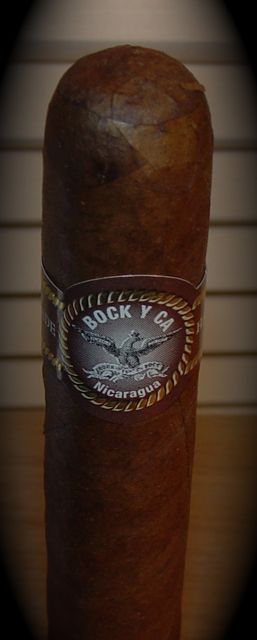
The general appearance of the Bock robusto does nothing to betray the marketing of this cigar as an “inexpensive” brand. It’s rough and the cap is cut unevenly. It looks like it was thrown together in a rush. The prelight wrapper scent is of fresh hay and a prelight pull tastes bright and grassy. The draw is firm but serviceable.

But this cigar shouldn’t be judged by prelight appearances alone; it performs a whole lot better than it looks. It starts up with a pleasant toasty sweet tobacco flavor. Nothing unusual, just straight up smooth and creamy smoke. It’s mild to medium in body with a nice texture and very little bite. It sets up a solid white ash that compares favorably with any premium Nicaraguan cigar I’ve smoked in the past year.

This robusto builds in flavor toward the mid-point, getting a little woodier and by the last third brings a moderate dose of spice and most surprisingly, cocoa. I can’t think of another cigar in this price range that shows up with cocoa in any amount… but this one has it, at least in the mid to final stages. It’s not as thoroughgoing as the premium Pepin blends, but for a fraction of the price I have to say I’m impressed.

And the price is low. Seriously low. A box of Bock y Ca robustos runs around 30 USD. And yes, it’s a box, not a bundle. At this price you can hardly go wrong, unless you’re expecting a full bodied superpremium, which it isn’t. It’s a quality blue-collar medium bodied smoke, for a solid blue collar price. Try a couple. Your wallet will thank you and your palate won’t complain.

For other reviews of good cheap smokes, check out Walt’s Bargain Cigar Breakdown at the Stogie Review. 

-cigarfan