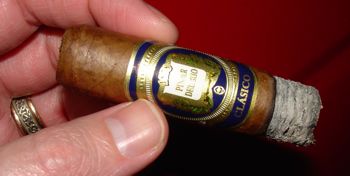
Pinar del Rio Clasico Robusto

PDRClasicoRob

I had planned on reviewing the Pinar del Rio Oscuro Robusto this time around, but I must have pulled from a bad box because both of the cigars I had were underfilled and wouldn’t burn right. I’ve smoked this cigar before and I know this is a better cigar than that, so I decided to shelve the Oscuro review for now.

But I have really been enjoying the Habano Sun Grown robustos that I reviewed a few weeks back, so I was bound and determined to try another PDR this weekend. The Habano Sun Grown and the Oscuro are the flagship blends for PDR, but they have recently released a Connecticut wrapped stick called Clasico. It turned out that I had one of these Clasicos left from some sampler boxes I purchased a few months back. I opened the humidor, and I had the Clasico in my sights.

The Clasico gets no love (or even a mention) on the PDR website, but a recent review in Smoke Magazine offers the following anatomical description:

  • Wrapper: CT
  • Binder: Dom Rep
  • Filler: Dom Rep & Nicaragua

NewHavanaCigars.com lists the binder as Habano, so maybe we can guess that this is piloto cubano. There’s some pepper in this cigar and that may be where it’s coming from.

PDRClasico

Construction Notes

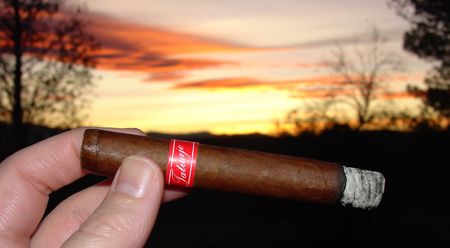
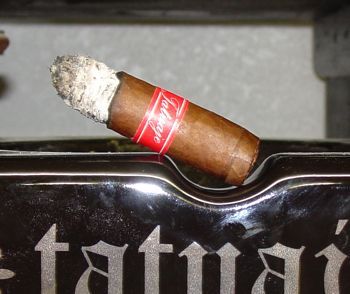
Just about perfect all the way around. The roll is solid, and looking down the business end of this stick it looks like it’s filled quite nicely. The wrapper is typical of shade grown leaf — pretty, with minimal veins and a nice creamy complexion. The head of the cigar is flat in the cuban style, and the seams of the cap are almost invisible. Pre-light this cigar has a dusty, hay-like scent with a touch of cedar.

Once lit, this stogie burns with steady precision — in addition to the creamy and floral qualities of Connecticut Shade, that is one of the nice things about this wrapper. It burns beautifully and builds a solid light gray ash. My only complaint here is that it seems to burn very quickly. I had to stretch this one out to make it last thirty minutes.

Tasting Notes

The Pinar del Rio Clasico opens up with an oaky flavor accented with black pepper on the tongue. The aroma is earthy with a touch of vanilla and the smoke coats the mouth. It’s fairly mild in strength but the smoke itself has a heavier texture, more of a medium body I’d say.  The aroma is not as floral as some Connecticut wrapped cigars — while still soft and creamy the smoke is toasty, like charred oak barrels. As the cigar progresses I don’t notice many new flavors in transition — it sticks to its opening theme for the most part, though the finish grows and becomes a little drier. By the band the aftertaste is predominately earthy with a light peppery seasoning.

The combination of Connecticut creaminess with black pepper had me thinking that this could be a much lighter variation on the 601 Black Label, or maybe La Aurora’s 1495 Connecticut. It’s a mild to medium bodied cigar, but one with lots of flavor. A great morning cigar, or given how quickly it burns, maybe even a nice lunchtime smoke at work.

The robusto rings up at around 4 USD per stick when buying by the box, which is a great price for a quality smoke.  Currently available from New Havana Cigars or you can buy singles from Silo for a few cents more.

Final Score: 87
PDRClasico2

Bering Puro Nicaraguan

BeringPuro

When I see the name Bering I think of two things: a very cold northern sea, and “It’s a Baby” cigars in pink and blue accented aluminum tubes. I’ve always thought of them as drugstore cigars (though on the premium side of the drugstore range) so I was intrigued when I saw the new Bering Nicaraguan Puro.  And as my B&M manager knows well enough, I’m a sucker for anything new and somewhat affordable.

At this time there is no information available about this cigar.  Bering used to be owned by Swisher, but apparently the brand has been pulled away by the gravitational power of the giant Altadis. Maybe that’s the reason for the new extension, but you’d think Altadis could afford a press release, or at least thrown up a page on their website to announce the new arrival.

So I picked this one up pretty much blind. It’s safe to assume that the filler, binder and wrapper are all Nicaraguan. That’s all the detail I have for now.

Construction Notes

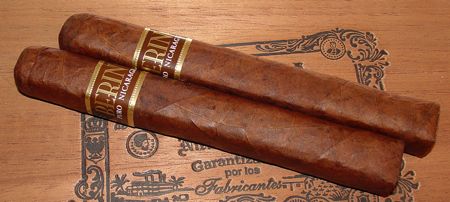
I must plead ignorance about the frontmark because I forgot to look at the box. These measure 6 x 50 — a traditional toro size — and they arrive square pressed.  They’re rustic in appearance, with a dark, mottled colorado maduro wrapper and a serviceable but unattractive double cap. The roll is a little soft.

The prelight scent is alluring, however:  ripe tobacco with a leathery layer.  It lights well though it burns a little unevenly (which is not uncommon for a box pressed smoke.)  Overall  good construction.

BeringPuro2

Tasting Notes

I’m always prepared for a spicy start when I light up a Nicaraguan puro, but the Bering Puro is very smooth by comparison. The flavor, on the other hand, is typical of Nicaraguan tobacco — earth with a touch of black pepper on the palate. The aroma is woody and quite pleasant.

After twenty minutes or so the flavor develops a little more bite, but in compensation offers auxiliary notes of coffee and mild cocoa. The aroma gets a little sweeter, remaining woodsy and pleasantly autumnal.

The last section sacrifices subtlety for strength as the flavors become more and more charred. The finish lengthens and the aftertaste intensifies. By the band the cigar is burning a little too hot and the aftertaste is overwhelmingly burnt.

Conclusion

About half-way through this cigar I found myself thinking, “Padron Lite.” It has some of the same characteristics, but not the same intensity as the standard Padron line. Unfortunately the Bering Puro also has a tendency to cross the finish line a little too early. The first two-thirds of the cigar were quite flavorful and easy to smoke; but the last section burned a little hot and seemed to carbonize between my fingers.

That said, this is still a cigar to try if you like medium to full-bodied Nicaraguan style cigars and are looking for something a little smoother than the Padron 3000 or 4000. Personally, I don’t think the Bering can top Padron for flavor or value (I found the Bering Puro for 5 USD in this size) but a comparison might prove worthwhile for the intrepid Nicaraguan aficionado.

Final Score: 85

BeringPuro3

Aging Report: Cubao No. 5

Cubao1yr

I have been aging cigars for a few years now and have come to the tentative conclusion that aging does not immeasurably enhance the quality of most non-Cuban cigars. Despite this I still have a few boxes put away for testing and comparison purposes.

I have all but given up on aging mild to medium-bodied cigars because the effects of aging seem to be a gradual diminishing of flavor. On the other hand, medium to full bodied cigars are able to withstand and possibly benefit from this moderation, especially when the cigar is a little too aggressive in its fresh state.

The Cubao No. 5 falls into this latter category: a medium-bodied smoke with a few rough edges that might smooth out with some age. After about a year in storage, it’s time to break them out and file a progress report.

My original assessment from September of last year ran as follows:

This toro starts up with that trademark Pepin pepper, but it’s not as powerful as a lot of his heavier blends. … After an inch I’m tasting cocoa and coffee with cream types of flavors, and the aroma from the foot is quite nice. …the way the sweet wood on the nose melds with the spiced cocoa on the palate.

There isn’t a lot of transition in the second half of the cigar, but I’m noticing a dry finish and a little scratch on the throat. Nothing a cold pale ale can’t take of. The intensity doesn’t pick up too much until I hit the band where the pepper ratchets up a bit. The flavor remains sweetly woody up front with cocoa notes in the margin. The pepper stays in the background and in the aftertaste, which is otherwise pretty clean.

Cubao cigars are brought to you by Espinosa y Ortega, makers of 601 and Mi Barrio cigars. They are manufactured by the Garcia family’s Tabacalera Cubana in Esteli, Nicaragua, with Nicaraguan filler and binder leaves and topped off with a dark Ecuadorian Sumatra wrapper. Six sizes are available. At 6 1/8  x 50, the No. 5 is their toro entry.

Cubao1yr2

Construction Notes

A year in the coolerador hasn’t done much for these cigars’ complexion, but of course that wasn’t expected to improve. The Cubao No. 5 is a masculine looking cigar — the wrapper is rough and mottled dark brown to almost black in places. The roll is a little soft, but that may be due to storage. Storage conditions were 60-65% relative humidity, and judging by the loose draw they might do better with a little higher RH. Despite this the stick burned perfectly and never got hot, so no points were lost on that count.

Overall very good construction.

Tasting Notes

I’m not sure why, but it always seems like aged cigars take a minute or two to wake up. The first few puffs of the Cubao are straightforward tobacco, nothing too interesting, but certainly not unpleasant either. After a minute the flavor gets grainier, like cereal with some natural sweetness and a dash of pepper.  The aroma from the smoldering wrapper carries the most interest here — it’s leathery, with a muskiness to it that is very nice.

After twenty or thirty minutes the heart of the cigar opens up and pours out its sad story. “I’ve been locked away for so long in that dark damp cooler and I’ve missed you so much, man.” It’s a familiar story, bittersweet with a dry finish. (A cold beverage is recommended at this point, and put some Hank Williams on while you’re at it.) Coffee and chocolate accents accompany the woody dry flavor, and the aroma continues its heartfelt refrain. “I’m so lonesome, I could cry…”

The last third is where the Cubao becomes most complex, and where the aging difference becomes most evident. The flavor doesn’t change dramatically, remaining sweet and woody for the most part, but the pepper intensifies and the body becomes almost wine-like. The smoke is very smooth and sippable, but still moderate in strength and medium in body. Chocolate notes are more pronounced in the fragrance, making this cigar almost like smoking mole. (As in mole poblano, not the rodent, wise guy.)

A small scratch at the back of the throat is the only real negative here, but it is not as severe as it was in its bolder, fresh state.

Conclusion

A year is not a long time in terms of serious cigar aging, but the effects are still apparent with the Cubao No. 5. In a year’s time these cigars have mellowed a little bit and are starting to show increased complexity. This is a very good cigar to start with, so it’s basically a matter of comparing subtleties. I detected a wider range of different flavors in the aged stock, including some things I didn’t pick up a year ago — notes of leather and musk, and more flavors in the transition after the mid-point. Combined with a slightly less aggressive attack on the back palate, I’m going to say the Cubao is a very good candidate for aging.

For now I will have to retract my conclusion about aging non-Cuban cigars — and revisit these in another year, if I can resist them that long.

Final Score: 90


Cubao1yr3

Padilla Signature 1932 — Old and New

Padilla32

Ernesto Padilla and Jose “Don Pepin” Garcia were like rice and beans for cigar smokers only a couple years ago. They were almost inseparable. But in 2008 they parted ways for a number of reasons: Garcia had too many clients and limited resources, while Padilla wanted more production control.  Insisting that this development would not affect the quality of his cigars, Padilla said, “I’m not looking to make something just as good — I’m looking to make something better.” But these cigars were so good that to make something just as good, let alone better, seemed an unlikely possibility.

But today that possiblility has become a reality, at least in my opinion.  Padilla is producing some stellar smokes in his new Miami factory, Fabrica de Tabacos Padilla. I’ve been enjoying the “new” Signature 1932 so much that I’d almost forgotten that I had a few of the old Pepin blends in storage. I decided to fire them up for this comparison review.

Both the old and the new 1932 cigars are Nicaraguan puros with similar compositions: corojo wrappers with criollo binder and filler blends.  It is important to note that the old and new blends both use tobacco from the same fields in Nicaragua, so there is bound to be a close similarity between them.

Padilla Signature 1932 Robusto — New Blend (2009)

Construction Notes

The wrapper on this robusto is rough and a little ruddier than the old version. A few nicks mar the surface here and there, but the roll is solid and the triple cap is just about perfect. After clipping the somewhat rounded head, the draw is very good. Once lit, the cigar burns slowly and deliberately, requiring some attention to keep it even and prevent it from going out. The salt and pepper ash is a little bit crumbly.

Overall good construction.

Padilla32New

Tasting Notes

I am immediately struck by the similarity between the new 1932 and the old one, but the new one doesn’t seem quite as bold. It’s smoother than the old blend, especially when the old blend was fresh. That characteristically earthy flavor is present in the opening salvo, along with complimentary bean flavors — sometimes coffee, sometimes cocoa.

The middle section is bright and woody, reminding me more of Illusione cigars than anything Pepin makes.

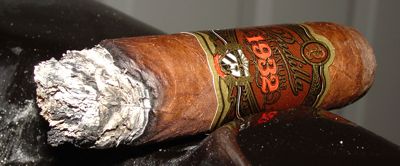
There is a little more kick to the last third, some pepper enters the fray and the sweet caramel-tinged aroma has me hanging on every puff. This why I love Nicaraguan corojo. The flavor picks up some char near the band and starts to get a bit sharp after that, but I hang on to it a little longer just to waft the resting smoke under my nose.

Final Score: 90

Padilla Signature 1932 Corona Gorda — Old Blend (2007)

Padilla32Old

Construction Notes

The wrapper on the old Pepin-made 1932 is a little smoother and slightly more attractive than the new version. The roll is dense and perfectly uniform, and the triple cap is predictably superb. As I clipped the cap on this one, my Xikar failed to evenly slice a tough little vein in the binder — a rare flaw that gave my tongue something to worry over as I proceeded to enjoy this cigar for the next hour and change.

The draw is very good and the burn is excellent. The ash is a solid and evenly shaded light gray. Having this one in storage for a couple years may have improved the combustion characteristics of this stick. Regardless of the reasons for this (and despite that annoying little vein) this was still one of the best constructed cigars I’ve smoked this year.

Overall Superb Construction.

Padilla32Old2

Tasting Notes

Aging this cigar for two years has moderated the flavor somewhat, but it still has plenty to offer. When fresh, this cigar had a lot more of the tannin that is typical of Pepin Garcia blends, and while that aspect is certainly front and center in the first third of the smoke, it is now relatively subdued. In addition to that mildly astringent quality, there is a delicious dose of cocoa and a smattering of white pepper.

The middle section of the cigar seems to be earthier, a little more Cubanesque, with a pleasantly spicy cedar aroma. The tannins have dropped off, but the finish is still quite dry.

The last third transitions to leathery flavors and pours on the peppery spice. The aftertaste is earthy and sharp. Towards the band the flavors muddy but the aroma never quits. I tried to keep this one going as long as I could just to enjoy the resting smoke.

Final Score: 93

Conclusion

Both of these cigars were excellent, two of the best blends I’ve smoked this year. They’re quite similar in style but I would be shocked if they were the exact same blend. The old version is typical of El Rey de Los Habanos — tannic, peppery, and complex — while the new version is brighter, and it has a sweet woody flavor that reminds me more of Illusione than anything Pepin makes. Taking into consideration the fact that I was comparing two different sizes — the new robusto versus the old corona gorda — plus the fact that the old one had two years of age, I would give the edge to the older ’32 based on construction alone.  My scorecard had them even in the taste department — the new blend scored one point higher for overall flavor, but the old one made up for that with a one point edge for balanced complexity. Where the old version pulled ahead was the burn, which was spot on perfect.

You can’t go wrong with either one of these if you dig medium-bodied Nicaraguan puros. The only sticking point with the Padilla 1932 is the price — sadly for us, cigars of this caliber won’t be found in the bargain bin. We’re looking at around 10 to 11 USD for the robusto in either version. If you can find the old blend, snap ’em up. If you can’t, you’ll have found a new friend anyway.

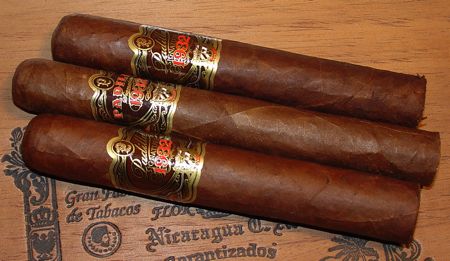
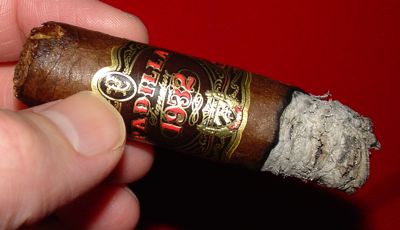
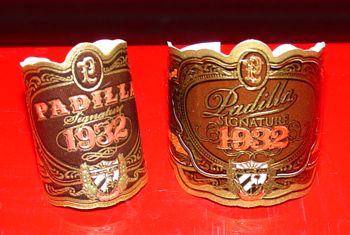
Just be careful to note the difference in the bands — the easiest way to distinguish between the old and new versions is the script. The old version has PADILLA in red block capitals over the 1932, whereas the new version has Padilla in gold script.  If purchasing online, be sure to ask first if the version in stock is the old or new one — or don’t, and enjoy the surprise. Either way you can’t lose.

Padilla32bands

Available from Fumée and Cigarsdirect.

Other Reviews of Note

Fire Up That Cigar compares the old and new Sig ’32s.

La Gloria Cubana Reserva Figurado Flechas

LGCFlechas

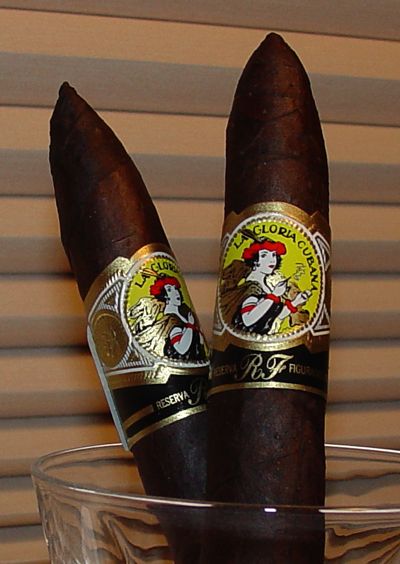
Here at Keepers of the Flame we support the preservation of formal cigar nomenclature, but occasionally a cigar comes with a designation that challenges our dedication. To restore the dignity of this cigar’s title from the abbreviation in the title above, allow me to present La Gloria Cubana Reserva Figurados Flechas Especiales Maduro. But since brevity is the soul of wit (or so I have been told) we’ll call it the LGC Flechas Maddie. In any case, this is a great blend, and one that almost always finds a place in Cigar Aficionado’s annual Top 25.

The big news for La Gloria Cubana is that Ernesto Perez-Carillo will no longer be the guiding force behind the brand.  LGC was first made in Miami by Ernesto’s father, a former Cuban Senator, starting in 1968, and it has been in the family ever since.  Ernesto Sr. nearly sold the brand at one point but decided to keep it when his son decided he wanted a part in the company. Now that son, Ernesto Jr., is leaving the brand behind for very similar reasons: to start a new cigar company with his son, Ernesto III.

That’s a lot of Ernestos to keep straight, but as long as they make cigars this good, I say keep the Ernestos coming.

The Reserva Figurados were first released in 2004 in only three sizes; a year later the number was increased to five. There was a suggestion that the lineup may be reduced again to 3, but so far all five sizes are still on the market:

  • Selectos de Lujos – 7 1/4 x 54  (previously reviewed here.)
  • Flechas Especiales – 6 1/2 x 49
  • Felicias – 4 5/8 x 49
  • Regalias Perfectos – 6 1/4 x 57
  • Piramides Clasicas –  7 1/4 x 56

The wrapper here is a well aged and fermented Connecticut Broadleaf. Beneath this is 4-year old Nicaraguan binder, and the filler is a Nicaraguan-Dominican blend. According to the General Cigar website, this line undergoes a special “cedar-aging” process whereby the cigar components are aged together in cedar bins for six months. They are then rolled by Grade 7 rollers and box aged for an additional three months before shipping.  “Flecha” by the way is Spanish for arrow, a fitting name for this figurado.

LGCFlechas2

Construction Notes

Despite the fact that this cigar is 6 1/2 inches long, it appears to be much smaller due to its proportions. This is a bouquet style perfecto, meaning it is tapered at both ends, but flared near the foot. The widest point is chosen as the measurement for the ring gauge, so it measures a 49 only at that one point. The remaining length of the barrel narrows, making this a smaller cigar than it appears to be on paper.

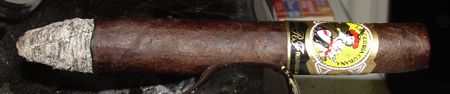
The wrapper is very dark, even for maduro, but not so black as to be suspicious. (In other words, it is certainly a naturally processed maduro leaf.) The pre-light aroma is of rich tobacco with a hint of cedar. The roll is solid all the way around, but one of my samples had a little crook in the head section. Maybe a level 6 roller was sitting in relief that day.

The burn on all of these has been absolutely perfect: straight as a plumb line, and leaving a solid gray ash to remember it by. The draw tends to be a bit tight until the point burns off, but after a few minutes it’s all good.

Overall excellent construction.

Tasting Notes

The Flechas Maduro took a few minutes to hit its stride due to a tight draw at the start. The first flavors are straight tobacco with a little char and it tends to taste a little papery. As soon as the foot opens up the flavors become richer as expected. Cedar makes an entrance and the aroma gets sweeter. There is a little licorice in the aftertaste.

The middle section features more cedar and throws in some roasted nuts. The licorice fades and the aftertaste becomes sweetly chalky. The smoke texture is medium to full in body, but at all times the smoke is full flavored.

The last section, up to the band, is where this cigar returns dividends. Here the aroma is at its most powerful — smoky cedar and sweet hickory in abundance. The flavor is almost meaty at times, but retains most of the previously mentioned attributes — nuts, earth, and rich tobacco. It’s a complex, but smoothly integrated brew.

Conclusion

The LGC Reserva Figurado line of cigars has been in my experience nothing short of excellent, in all sizes, in both natural Ecuadorian Sumatra as well as Maduro. The Flechas Maduro is representative of the line. This is a stellar example of a full-bodied cigar that has no harshness, an unfortunate rarity these days. There is enough complexity here to satisfy the most demanding palate, while remaining smooth enough for novices (assuming that a pretty good nicotine punch won’t spoil the experience.)

The Flechas Maduro carry a premium price of 8 to 9 USD per stick, but I do believe they are worth this asking price. My only hope is that General can maintain the quality of this cigar now that Ernesto Perez-Carrillo is no longer at the helm. And given his track record with LGC and El Rico Habano, it goes without saying that we await with baited cigar breath Ernesto’s new blends.

Final Score: 92

LGCFlechas3

Other Reviews of Note

Patrick A. gives the Flechas Maduro 4 out of 5 stogies for the Stogie Guys.

Cigar Jack finds the Regalias Maduro to be full flavored but less bold than the LGC Serie R.

Herfs up for the Cohiba Club as they give the Selectos de Lujos Maduro an 89.

Tatuaje Havana VI Angeles

TatVIAngeles

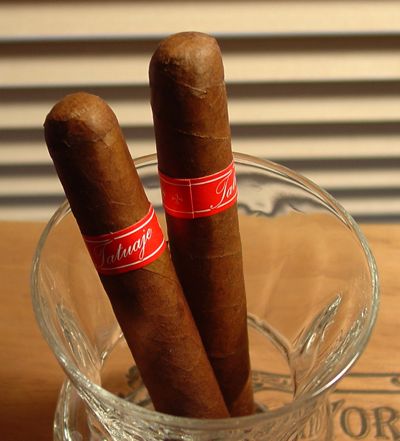
I first reviewed the Tatuaje Havana at the end of 2006, not long after the blend was released as a medium-bodied alternative to the standard Tatuaje line.  Since then I’ve continued to enjoy this line as well as it’s more powerful mutation — the  Havana VI Verocu, which is also a good, but very different smoke.

Since I am routinely exiled to the back yard for my evening smoke and the temperature has been hovering around 105 degrees, I find myself reaching for smaller vitolas. That’s where the Angeles comes in.

There are six models of the Tat VI — the first letter of each size forms an anagram of the name of one of Pete Johnson’s dogs, “Havana.”

  • Hermosos – 5.625 x 46
  • Angeles – 4.625 x 42
  • Victorias – 6 x 38
  • Artistas – 6.125 x 52  (torpedo)
  • Nobles – 5 x 50
  • Almirante – 7 x 47

The Angeles is of course the  petite corona size.  Just the right size cigar for when the mercury drops below the century mark around 8 pm this time of year.

As is the case with most Tatuaje cigars, this one is a Nicaraguan puro and is made in Esteli by Tabacalera Cubana. The wrapper is Pepin’s familiar Corojo 99.

TatVIAngeles2

Construction Notes

Almost every cigar to leave one of Don Pepin or Jaime Garcia’s factories is picture perfect, and this little corona is no exception. The wrapper is a slightly oily colorado maduro, almost rosado in the fading light, and the tight triple cap is the envy of the industry. The only flaw in this cigar is a prominent vein running down the back of the stick, straight as a stocking seam in one of those classic pin-ups.

The draw is good, and the burn is fine. All cigars should made as well as these.

Tasting Notes

The cigar makes its first impression with that trademark Pepin twang. I’d like to think that I could identify this flavor and aroma anywhere, because this Corojo 99 is just that distinct.  The aroma is slightly sweet, somewhat caramel-like, and this is counterbalanced by a mild woody tannic flavor on the palate. The overall effect is earthy at first and gradually becomes more leathery as the stick burns down.

The peppery flavors I associate with Tatuaje are toned down in this blend, and they don’t make an appearance here until the second half of the smoke. This peppery note never really makes a solo appearance, but it does quietly simmer beneath the bitter-sweet melange above.  The last half-inch or so gets a little hot and starts to taste graphitic, but slow down and it can easily be enjoyed to a point well below the band.

Conclusion

Even in the triple-digit heat I find myself nubbing these little guys.  The Tatuaje Havana blend is a nice alternative for medium-bodied smokers, and I think this is my favorite vitola in the line. It’s all killer, no filler, as the kids say.

Once again though, the price is not ideal. These retail for around 5 or 6 dollars a stick. Not bad really, but not fantastic either. Still, if you’re in the market for a medium-bodied petite corona with real distinction, this is one you’ll have to consider.

Final Score: 90

TatVIAngeles3

Other Reviews of Note

Stinkie says the Angeles has it all on Cigar Beat

Rob (from PuffingCigars.com) finds the Angeles a clean, but less spicy smoke than others in the line.

Scott reviews the Almirante for Cigar Command and says EVERYONE should try this cigar at least once.

Patrick S. hedges his bet on the Nobles for The Stogie Guys.

Pinar del Rio Habano Sun Grown

PDRHSG

Pinar del Rio cigars are made in the Dominican Republic at  La Fabrica Don Leoncio, a small but growing factory in Tamboril. The gentlemen responsible for Pinar del Rio cigars have roots in the Dominican tobacco industry that go back generations.

The factory itself is named for the father of Juan Rodriguez. Along with his two brothers, Juan has played an active role in the Dominican cigar industry, including a stint with Davidoff. In addition to Pinar del Rio, Don Leoncio produces cigars for several other companies, including Devil’s Weed, Flor de Cesar, and the Dominican 4000 for Famous Smoke Shop.

Abe Flores comes from a family that has grown just about everything you can grow on the island, including tobacco for Leon Jimenez. (See Walt’s interview with Abe on StogieReview.com for the whole story. It’s a great interview, and Abe’s knowledge and passion for cigars really comes through.)

PDRHSG2

A couple years ago the two got together to develop a new cigar blend that eventually became the Pinar del Rio line. The original blends were the Habano Sun Grown and the Oscuro, but a Connecticut-wrapped Clasico is now available as well. (One other limited edition cigar is available only in the four-pack “Premium Collection” sampler.)

The Habano Sun Grown utilizes a habano seed leaf grown in the Dominican Republic for both filler and binder. The wrapper is, of course, sun grown. The filler is a blend of Nicaraguan leaf and Dominican corojo. As Abe explains in the StogieReview video, both he and Juan are sticklers for leaf quality, and big believers in proper aging. Most of the tobaccos in Pinar del Rio cigars are aged for four years or more.

Construction Notes

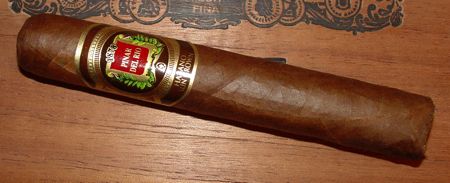
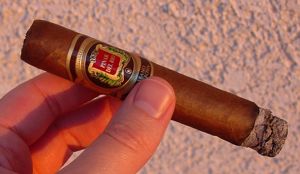
The Habano Sun Grown robusto is a nice looking cigar.PDRpatch The stick has a flat head similar to many Cuban cigars, and the wrapper is a smooth and consistent colorado claro (or maybe a shade darker.) The roll is supple, with a little give to it. Looking at the filler at the foot of the cigar I notice no stems, not even a thick vein.  Unfortunately there were a couple of perforations in the wrapper near the band on one of these. Instead of smoking this like James Galway playing a Mozart concerto, I patched it up with a wrapper scrap from another cigar.
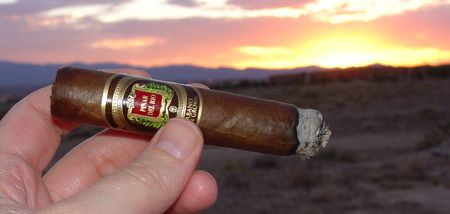
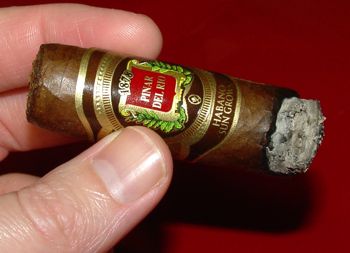
After clipping the cap I encountered a perfect draw. I had a little trouble lighting one of these robustos (the one with the perforations) and had to relight it a couple times to keep the wrapper smoldering in tune with the filler. Once properly ignited both sticks burned evenly, though there may be some combustion issues here. The ash is fairly solid, aside from the flaking that occurred relighting the stubborn one.

Overall good construction.

Tasting Notes

My first impression was that this could be a great candidate for a blind test if it were matched against a Cuban cigar. The flavors are not a perfect match, but the aroma of this cigar is eerily similar to what I get from some Cubans — that musky, earthy scent that at one time I thought was irreproducible. (Maybe it still is, but this one comes very close.) The initial flavors on the palate are a little stronger when compared to a Bolivar Royal Corona or Petite Corona; the Pinar del Rio is a little sharper and less creamy, but still very tasty indeed.

Red pepper in the nasal passages is how I’ll remember this one. What is really interesting about this is that it didn’t have the burning sensation at the back of the throat that I often get with peppery cigars. It’s spicy without the mild irritation that comes from many of the heavier Pepin Garcia blends.

PDRHSG3

I didn’t notice much transition in flavor, but the core characteristic of the PDR HSG is leather. There is also a sweet caramel companion that comes and goes throughout the smoke. All told, with the pepper on the upper palate, the fleeting sweet caramel flavors, and the musky leathery aroma, there is enough complexity in each puff that transition flavors are unnecessary, especially in a robusto size.

Conclusion

Aside from the burn issues that I had with one sample, which I think was a fluke, I thoroughly enjoyed this cigar. The nicotine hit me a little hard at the end, but the flavors were balanced and the aroma was outstanding.  This is one of the few legitimate examples of where the label “Cubanesque” really does apply to a non-Cuban cigar.

The Pinar del Rio Habano SG robusto is in the 5 to 6 USD range, a reasonable price given the quality of this cigar.

PDRHSG4

Final Score: 88

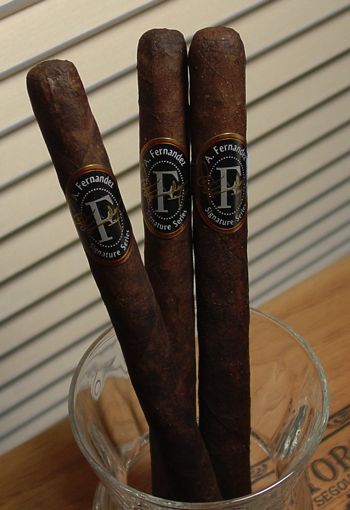
A. Fernandez Signature Maduro Lancero

A

Abdel Fernandez has been hailed as a “rising star” in the cigar world, and judging by the number of established cigar makers who now trust him with their blends, it is safe to assume that his star is still on the upswing. Among a few of his partners are Rocky Patel (RP Signature, Triple Fusion, ITC 10th Anniversary), Ernesto Padilla (Padilla Habano) and Oliva (Sol Cubano Cuban Cabinet.) If you pick up generally unrecognized brands from CI, there’s a good chance that you’ve smoked one of his cigars without knowing it — La Herencia Cubana, La Cuna, Man O’War, and the like. But name recognition is important for obvious reasons, so it’s no surprise that we are now seeing the name A. Fernandez on a cigar band.

Fernandez is based in Esteli, Nicaragua, and grows most of his own tobacco on farms near Esteli, Condega, and the Jalapa Valley. He is relatively new to Nicaragua, having arrived from Cuba only five years ago. Virtually everything ever written about Abdel mentions that he received an education in tobacco from the iconic Alejandro Robaina, so let me join the chorus and reiterate that fact once again.

AFernandezMad2

Construction Notes

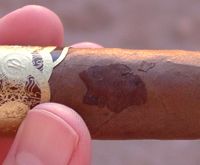
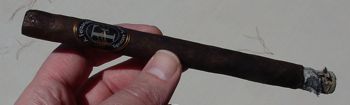
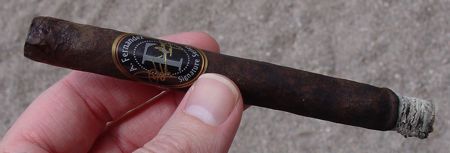
The Fernandez Maduro is a mean looking stick. Maduro wrapper in its natural, unadulterated form is a thick, rustic leaf, so there’s not much to praise here in the way of aesthetics. The equally utilitarian cap is roughly applied, but shears well. The roll is solid. But of course the true test of a lancero with its narrow ring gauge is the draw, and the ones I have sampled have all been perfect in that regard.

The wrapper’s prelight scent is rich and earthy, straight from the barnyard, indicating fine fermentation. Lighting a lancero is easy, and this one fires up without a hitch. The burn wavers a little bit, as maduro leaf tends to do, but it corrects itself eventually. The ash tends to flake during this correction, but otherwise it’s solid and holds fairly well.

AFernandezMad3

Tasting Notes

The aroma from this maduro wrapper takes center stage immediately and doesn’t make an exit until the band is peeled and the butt laid to rest. The wrapper on a lancero is bound to operate in this fashion due to the proportions of the stick, but make it a sweet and rich smelling maduro leaf and it’s guaranteed to be the star of the show. Right up front are the typical flavors of chocolate and char. An inch in and it gets a little spicier. Like a lot of lanceros this one gets a little hot if rushed, but I found that my unfortunate tendency to draw too often was greatly reduced by the prodigious amount of smoke this stick produces.

After the first third the cigar never really transitions to new flavors. There are some lighter woody notes along the way, but the basic theme of chocolate and char continues to the end. The flavors intensify in the last section, but don’t change too much. The finish lengthens and a mild aftertaste of pepper concludes the cigar.

Conclusion

This cigar reminds me a lot of the Padron standard series, in terms of both appearance and taste. It’s not complex, but it’s satisfying: a tasty, straight forward, no-nonsense maduro. The A. Fernandez Signature maduro is a little smoother and doesn’t pack the same punch as a Padron, but for a couple dollars less I think it’s comparable.

I got lucky and picked up these Fernandez lanceros for less than 2 dollars each, but the MSRP is still only 50 USD for a bundle of 20. I believe these are a Cigars International exclusive, and at the moment they appear to be sold out in this size, but hopefully we’ll see them back on the board soon. The bottom line is that this is a quality bargain smoke.

AFernandezMad4

Final Score: 85


Zino Platinum Scepter “Low Rider”

ZinoPlat

Zino Davidoff was an acknowledged master of the cigar business in almost every way: he was a premier tobacconist, the author of The Connoisseur’s Book of the Cigar, and he is reportedly the inventor of the desktop humidor. For forty years he operated Davidoff of Geneva, nurturing the family business from a neighborhood shop to an international enterprise. He is credited with the success of the Hoyo de Monterrey Chateau series of Cuban cigars, as well as his own eponymous line of Cuban cigars. In 1989, disgusted with the low quality and shoddy workmanship of his Cuban suppliers, he publicly incinerated over one hundred thousand of his company’s cigars. From these ashes would rise a new, better Davidoff made in the Dominican Republic. As Lord Buckley might say, Zino stomped on the terra.

But before the famous conflagration was the Zino cigar. It was created in 1975 especially for Americans — due to the embargo, the Cuban Davidoff was of course not sold in the States. The original Zino was made in Honduras, and the Mouton-Cadet and Connoisseur blends were its well known lines. But when Davidoff broke off with Cubatabaco in 1989 the Dominican Davidoff White Label became the prototypical black tie cigar. Subsequently the Zino line stepped back into the shadows.

With all of its rich history and style, Davidoff has garnered a somewhat stodgy reputation. The company is understandably unwilling to part from its well earned reputation, but at the same time with Zino Platinum it wants to appeal to a younger set, to cater to the “modern urban pop culture of today.”

Zino Platinum is comprised of two distinct lines of regal cigars, the Crown and the Scepter. The Crown series is marketed as a super-premium in the 30 to 40 USD price range. (That’s the damage per stick, not box.) The Scepter is a more “affordable”  premium at around 9 to 14 USD. I guess nine bucks for a Davidoff is a cheap date, relatively speaking.

The marketing department evidently spared no expense. The cigars are packaged in 12 or 16 count cans that are elegantly decorated with dogs dressed up in period costume. The Low Rider can features a schnauzer in an Elizabethan collar — the lace kind, not the plastic post-surgery kind most dogs are familiar with.

ZinoPlat2

Seven sizes are in production:

  • Chubby – 4 15/16 x 54  (zeppelin perfecto)
  • Grand Master – 5 1/2 x 52  (robusto)
  • Stout – 7 x 52  (torpedo)
  • Low Rider – 6 x 43  (lonsdale)
  • Shorty – 4 1/2 x 43  (petite corona)
  • Bullet 4 x 48  (zeppelin perfecto)
  • XS  4 x 30  (demitasse)

The Zino Scepter blend starts out with Dominican piloto and two distinct San Vicente leaves, combined with a native Peruvian leaf for filler. That is surrounded by a Connecticut Broadleaf binder and then the whole shebang is wrapped in an Ecuadorian Connecticut leaf that has been matured for two years.

Construction Notes

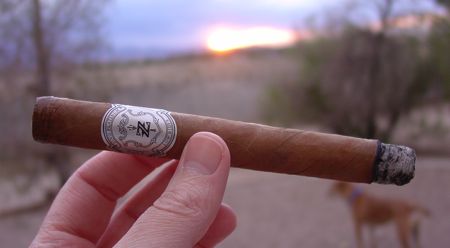
The wrapper on this lonsdale is typical of good Connecticut shade leaf: a nice golden brown color with few inconsistencies. The roll is a little bit soft and the cap is not perfect, but good enough. With the classy silver band, this is a nice looking stick.

The draw is perfect, and very consistent from cigar to cigar. Once clipped and lit, it burns steadily though maybe a bit more rapidly than I expected. The burn is even and the ash is firm but it cracks enough that you’ll want to keep the ashtray handy.  Overall fine construction.

Tasting Notes

The Zino Scepter is a smooth, but still very flavorful smoke. It starts with an earthy introduction and a dry finish which is quickly joined by a light aftertaste of pepper. The texture is buttery smooth, and the aroma is quintessential Ecuadorian Connecticut: creamy, with notes of vanilla and oak.

The pepper downshifts in the middle section for smooth easy smoking. The flavors remain mellow and earthy, and it’s easy to sit back and coast on the rich aroma alone.

That pleasant sweet perfume laced with spice wraps things up in the last section.  The aftertaste stays clean up to the band, but soon after that the flavors start to turn a little papery.

Conclusion

The Zino Platinum Scepter series is a mild bodied cigar that is ultimately quite satisfying due to its complexity. You get what’s expected from a high quality Connecticut Shade wrapper, but beneath that there is a nice layer of pepper and oak that makes the experience a little more interesting than what you’d expect from a plain good cigar. The price is questionable, but you do get a nice can with pictures of dogs dressed up like Louis XIV prancing back to Versailles. If you don’t mind throwing away a few bucks on snazzy (or silly) advertising, you won’t be disappointed.

ZinoPlat3

Final Score: 88

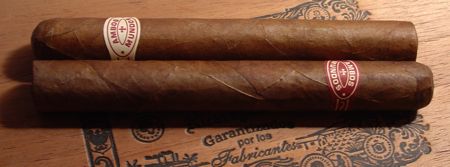
Ambos Mundos by Tatuaje

ambosmundos

There is no cigar cliché that gets under my skin more than the image of the fat cat lighting up his churchill with a hundred dollar bill. Aside from being moronic (rich people don’t get that way by burning money) it justifies in the minds of many non-smokers the marginalization of cigar enthusiasts and the taxing of cigars. The reality is that most of us checking out cigar reviews and eyeballing the auction sites are doing our best to manage a tight budget in a challenging economic environment.  It’s been a while since I saw any fat cats licking their paws around my neighborhood.

It wasn’t due to the stormy economy that Pete Johnson decided to blend a cigar with affordability in mind, but price control was definitely an objective in developing Ambos Mundos. Tatuaje has been a runaway success for “Tattoo” Pete, but like many Miami-rolled cigars, they’re pricey. By producing this cigar in Nicaragua with lower grade (but still high-quality) tobaccos, he is hoping to keep the price down and fill the bargain cigar niche for his label.

As Pete told Cigar Insider,

This value-priced cigar uses B and C – grade tobacco. In other words, it’s tobacco that was not used on Tatuaje, the premium brand,  which uses A – grade. It’s very good tobacco, but just needs more time to be processed and needs more fermentation, taking a little longer to get out all the impurities. These bales don’t cost as much, so it’s a way to pass on the savings using some really good tobacco.

Ambos Mundos differs a bit from Tatuaje’s other budget-priced cigar, the Tatuaje Serie P, in that the latter is a short filler cigar made from the scraps of the standard Tatuaje line. AmbosAdAmbos Mundos is a long filler cigar that uses tobacco that just didn’t make the cut for standard Tatuaje cigars.

Only two sizes are in production so far (a robusto and a toro) but they are available  in two different wrappers: Ecuadorian Sumatra (red label) and  Nicaraguan Habano (white label.)  They are rolled in Jaime Garcia’s Tabacalera Garcia factory in Esteli, Nicaragua.

Construction Notes

I smoked the Habano (white label) Ambos Mundos Toro first and found that it has just the quality construction you’d expect from Tatuaje and Tabacalera Cubana. A toothy wrapper tops off a solid roll, finished with Garcia’s trademark triple cap. Once lit, the Habano set to building a solid white ash. The burn was steady and even from start to finish. The draw was just a little bit firm, but that was the only demerit it received. Aside from that it was perfect.

The Sumatra (red label) version has a leathery looking wrapper, a little smoother and a little oilier than the Habano. The same good construction qualities were in evidence here, though the draw on these seemed to be a little better, while the burn was more erratic and required a couple touchups. The ash on the Sumatra was more variegated in color, but held just as well as the Habano.

ambos3

Tasting Notes

Both of these toro-sized cigars are lighter in body than the standard Tatuaje line, but the Sumatra seems a little bolder than the Habano version. Both cigars score well in terms of aroma — the Habano had a woody spiciness to it, while the Sumatra was a little meatier with notes of leather. Both versions have Pepin’s characteristic tartness, especially in the first inch or so, but also a sharpness and an irritating burn at the back of the throat, with the Sumatra being heavier, more peppery, and more aggressive in this regard. Some aging might temper this quality.

The white label Habano starts up with an earthy flavor and a good dose of tannin. The aroma is a pleasantly spicy, but for the first couple inches this is a simple and straightforward smoke. It transitions to aromas of hardwood with a touch of caramel and about an inch from the band picks up a good pinch of black pepper. The last third gets fairly sharp, but it’s smokeable. The Habano reminds me of some of Pepin’s milder offerings, but with less complexity.

ambos4

The red label Sumatra starts up where the white label leaves off — with lots of pepper. The difference between the two is immediately apparent. The Sumatra is a meaty and leathery smoke while the white label is woody. The tannins still make an appearance, but they seem to be overpowered by the wrapper’s rich flavor and aroma.  It’s slightly sweet with a dry finish. The last third increases in intensity until it unexpectly sours about a half inch from the band.

Conclusion

Both versions of the Ambos Mundos are good, but not great cigars. Personally I’d rather pony up the full price for an “A-grade” Tat than settle for a C-grade alternative that pales by comparison.  If this were a 2 dollar bundle stick I’d  be impressed, but it isn’t, and my opinion of this cigar suffers for it. For nearly the same price you could be smoking a DPG Black or an Illusione, better cigars that are similar in style as well as price.

Ambos Mundos is a long filler cigar set to retail around 5 USD per stick, or around $115 per box of 25. This stretches my definition of “bargain” a little bit, but it’s still a reasonable price for a premium cigar.  Just remember that there is a fair amount of competition in this price range.

Final Scores

Ambos Mundos White Label Habano: 85

Ambos Mundos Red Label Sumatra: 79

ambos5

Other Points of View

Her Humidor approves of Ambos Mundos as an everyday smoke.

The Great Torpedo thinks the Sumatra version is a decent smoke for its price.

Barry gives the Sumatra an edge over the Habano.

Resident Tatuaje expert Matt lets both wrappers have both barrels.

~cigarfan