Carlos Toraño Signature Perfecto

cnv0218.jpg

The Toraño Signature series was introduced in 2000 and has garnered both rave reviews and many new fans since then. This is one of the last Toraño series I had yet to try, and it turns out to be one of the best. I chose the perfecto the other evening because I was looking for something with a lot of flavor in a fairly small package.

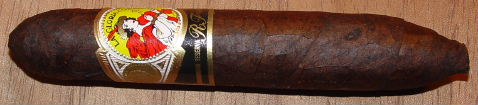
The Signature perfecto is a true torpedo, being tapered at both the head and foot. It measures 5 inches long and weighs in at a 50 ring gauge at its thickest point. Both head and foot are slightly open, but the head still needs a clip to open it up a bit.

The wrapper is a deliciously oily sungrown Brazilian maduro. The binder is Connecticut broadleaf, and the filler is a blend of Nicaraguan and Dominican piloto cubano. The roll is solid all the way and exhibits an open draw even before the foot opens up.

The Signature perfecto opens up with an earthy introduction, similar in flavor to the base flavors in Toraño’s 1916 Cameroon. Here, however, the spice of the Cameroon is replaced by a sweet maduro accented with flavors of Columbian coffee and leather. It starts out with a very light bite, but this quickly mellows out and by mid-point the smoke is smooth; not creamy exactly, but carefree. The flavor continues with an earthy base. Eventually the leather gives way to sweet wood, until the two-thirds point (just past the first band) where it becomes slightly bitter, signalling the end of the cigar for me.

The Toraño Signature perfecto is a dry, earthy cigar with excellent construction that could be enjoyed at any time of the day. If you’re in the mood for an earthy medium-bodied cigar and have a fiver taking up space in your wallet, trade it in at your B&M for this perfecto. I doubt you’ll be disappointed.
Rocky Patel Vintage 1992 Juniors

cnv0216.jpg

Well, Las Vegas wasn’t hot enough for me, so I’m spending a week in Phoenix. I brought a few cigars along with me, but since I’m not smart enough to go someplace with a more temperate climate I’m still smoking the small gars.

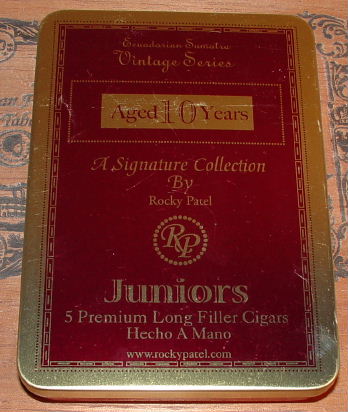
The Rocky Patel Juniors are nice looking small cigars, and they taste very similar to the larger 1992 Vintage smokes. I have developed a preference for the 1990 Vintage because I’ve had some back luck with construction on the 92s. But the Juniors have been perfect so far: they light up easily on a single match, burn straight, and have a firm but easy draw.

Cigarcyclopedia classifies this one as a “short panatela.” At 4 x 38 it’s too big to be a cigarillo, but not fat enough to be a petite corona.

The Ecuadorian wrapper on these is a nice looking rich colorado maduro and has all the great flavor of the larger sized Vintage 92s. There’s a woody flavor throughout most of the stick with a little bit of cinnamon spice upon first light. Along the way there are sweet notes of chocolate and some darker coffee flavors that float above the wood. The flavor is not as pronounced as it is on the larger sizes, for obvious reasons, but it’s a faithful replication on a much smaller scale.

I’ve smoked three of these so far and have found that they last about twenty minutes to the first band. Take that off and you can get another good five minutes out of the stick before it starts to burn a little too hot and sharp for comfort.

I purchased a tin of these for about 9 USD, a pretty good deal considering the price of the regular sizes in this line. The reasonable price and full flavor of these little guys gives them a thumbs up from me. One of the better short smokes I’ve had this summer.

La Gloria Cubana Reserve Felicias Maduro

cnv0211.jpg

La Gloria Cubana Reserve Figurados were introduced by Ernesto Perez-Carrillo in 2004 as a limited edition cigar. Only two master rollers, hand picked by Ernesto for their superior skills, are assigned to the Reserve Figurados. The tobaccos for this line are aged for three months in specially designed cedar bins to impart an extra spiciness — and then they are aged for three months further in the box.

The line was expanded in 2005 to include two maduro wrapped cigars — the Regalias Perfectos, and the Felicias Maduro pictured above. These are the only two sizes wrapped in Connecticut broadleaf maduro, but they are also available in Ecuador grown Sumatra.

The size is 4 5/8 by 49, a small but beautiful figurado reminiscent of Fuente’s Hemingway Short Story. The wrapper on this cigar is rich with oil and smells good enough to eat. So good in fact that I think I’m going to give you a close up:

cnv0213.jpg
The name “Felicia” is a tribute to Ernesto’s mother. You know she has to be proud of her son. It’s a beautiful cigar, and a testament to the fine art of cigar rolling.

Like most LGCs this one is made in the Dominican Republic. The binder is Nicaraguan, and the filler is a Nicaraguan-Dominican blend. The prelight draw is tight due to the perfecto foot — once this burns off the draw is also perfecto.

The initial taste is peppery, sharp but not strong. There is a little bit of a bite. The aroma is of sweet wood — cedar, almost piney. A few minutes later there’s some sweetness from the maduro, and a bit later some sulfur. The aroma remains true to its cedary base.

I picked this cigar tonight because I wanted something fairly short. By 8:30 it had cooled down outside to about 107 degrees from the 114 during the day. It wasn’t a double corona kind of evening, by my standards anyway. Even so, this cigar lasted a good 45 minutes. My only gripe is that it burned a little hot toward the end, but by that time the coal was touching the band anyway and it was time to go in and cool off.

The aftertaste is rich and chocolatey — strangely similar to the scent of the cigar in a pre-lit state. So in this way it comes full circle. A very nice smoke. I’d really like to try the larger Regalias sometime, perhaps in the fall when the desert is a little more cigar friendly.

I received this smoke as part of a sampler trade on Club Stogie. Thanks Bonggoy!

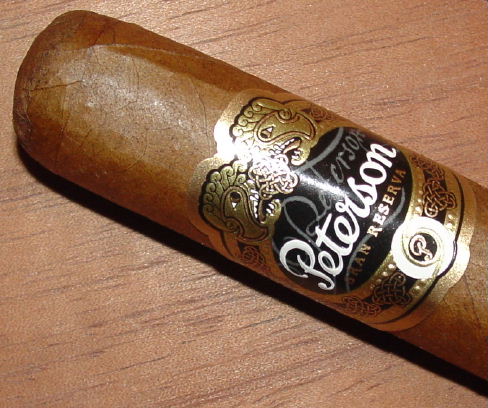
Peterson Gran Reserva Robusto

cnv0209.jpg

Peterson has a long established reputation as an Irish pipe maker. I smoke a pipe on occasion, and two of the three pipes I own are Peterson system pipes. The “system” was invented by Charles Peterson in the late nineteenth century, a few years after he joined the tobaconnist brothers Friedrich and Heinrich Kapp on Grafton Street in Dublin. The Peterson system employs an extra chamber in the pipe that funnels some of the moisture produced by the tobacco and results in a dry carefree smoke. They’re quite popular pipes even today, a hundred and some odd years later.

An exact replica of Charles Peterson’s favorite pipe has been released to celebrate the 140th anniversary of the company. Engraved on the silver band is the phrase “When stolen, please return to 55, Grafton Street. Charles Peterson.” And that is the beauty of pipes — they can be returned after curious thieves have given them a joy ride. Not so with cigars, I’m afraid.

The Peterson Gran Reserva line was introduced at the RTDA trade show in 2004, but it wasn’t Peterson’s first foray into cigar production. In 1995 they came out with the Peterson Hallmark series, but it was washed away by the storm of the boom years.

Peterson pipes are distributed by Ashton here in the U.S., so perhaps it was natural for Peterson to ask Ashton to give the Peterson name another shot at a cigar line. Ashton makes several well known and highly sought after cigars under their own name, so who better to partner with?

Peterson’s Gran Reserva is produced at the Flor de Copan factory in Santa Rosa de Copan, Honduras, and is imported and distributed by Ashton. The filler is a Honduran-Nicaraguan blend, the binder is Nicaraguan, and the wrapper is a smooth but dry Cameroon leaf. Not quite the toothiest Cameroon around, but tasty.

Some of the wrappers have water spots carefully arranged at the back of the cigar. (Clever.) The roll is firm and the prelight draw is very good. The caps are well formed and tight on the head of the stick.

The Gran Reserva fires up with a burst of spice typical of Cameroon wrapper. It’s a little rough at first, but smooths out after a half inch or so. It maintains a medium body throughout the smoke, gathering a little strength toward the end, but not enough to become truly heavy. The base flavor is leather. Combined with the spicy floral aroma from the wrapper this is a tasty smoke.

The samples I tried were fairly dry. I found minor splits in the wrapper after the half-way point, but they didn’t affect the cigar and weren’t large enough to be annoying. They also seemed to burn quickly, which may be another indication that they enjoy more tropical storage conditions. (My humidor has been reading in the 65 – 67% range.)

The Peterson Gran Reserva reminded me a little of the Ashton Heritage Puro Sol, but it didn’t have the same depth. They share the same fine aroma, but the Puro Sol just seems to have a more refined and complex flavor.

Despite this perhaps unfair comparison, the Peterson is a fine cigar, and I will be trying these again in the future after storing them at a higher RH. I’m going to consider these first two just a trial run.

Vega Talanga Tercio

cnv0208.jpg

Vega Talanga debuted in 2002 from the cigar division of US Tobacco, better known as the producers of Skoal and Copenhagen smokeless chew. Since then that part of UST has been transferred to Swisher/General Cigars as part of a settlement in an antitrust suit. The information I have is dated previous to that takeover, so caveat lector.

The term “tercio” at one time referred to a 16th century Spanish military formation, also known as “the Spanish square,” a mixed infantry formation that utilized pikemen and musketeers to capitalize on the brute strength of the pikes and the long-range abilities of the muskets.

In the cigar world, however, a tercio is a bale of cigar tobacco sealed in the bark of the royal palm tree. This reportedly creates a tighter seal than the plastic, burlap, or cardboard materials often used to bale tobacco. This method results in less loss of moisture and forces the recirculation of air throughout the bale, making a more flavorful tobacco. (At least that’s what Manuel Quesada says, and who am I to argue?)

The Talanga Valley is located in the Francisco Morazan province of Honduras about a two hours drive north from Danli. Much of the tobacco is grown encallado — sheltered behind large stands of king grass to protect it from the wind — and is sun grown, resulting in a stronger leaf. Combine this with the deep fermentation the tobacco receives in the tercio, and you have the makings of a rich and powerful smoke.

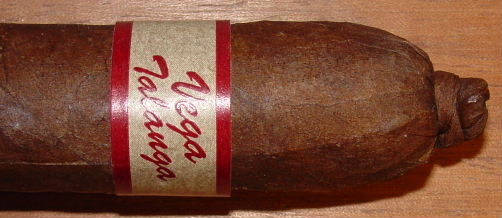
Instead of the standard spanish cedar box, the Vega Talanga Tercio is presented in packages of palm bark just like the ones used to process the raw tobacco. The raw unfinished character of the cigar is emphasized again by its untrimmed foot, and a pig tail cap. The Tercios are produced in Danli using Talanga tobacco for wrapper, binder, and most of the filler, but the filler is supplemented with some Nicaraguan leaf.

Vega Talanga has introduced a new corojo line available in three sizes, but so far the Tercio is only available in one size: a 6 x 54 toro. The roll seems rather soft, and the draw is very easy. The wrapper is rough and leathery with a rich colorado color.

A little effort is required to light this cigar since the foot is flagged and the flaps are folded over onto the foot. But once it gets going, it requires no further maintenance. The burn is a bit uneven at times, but it corrects itself. The softness of this stick is a little weird, but it doesn’t seem to affect the draw or the burn.

The flavor is unusual, and I can’t quite pin it down. The smoke is very smooth, almost creamy in texture, but the flavor is of various shades of earth. At first it tastes of minerals, after a couple inches it turns musky, and the last transition is to a slightly woody flavor. I’m not comfortable with these descriptors, but it’s the closest I can get. It’s an easy smoking cigar, but complex. I can’t compare it to anything — this cigar produces flavors outside the standard spectrum, I think.

The aftertaste is a little bitter, somewhat metallic. A peaty scotch companion comes to the assist here.

All in all a very interesting smoke. I have an Astral Talanga Valley in the humidor that I may have to pounce on soon, because now I want to know if the unusual flavors in the Vega Talanga are coming from the Talanga Valley, or from Vega Talanga…

Dynamite 652

cnv0202.jpg

From Indianhead, makers of American Stogies, comes Dynamite — in corojo and maduro wrappers. At less than two bucks in my B&M they’re so cheap I had to try both.

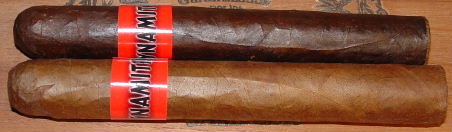
Taking a page from Rocky Patel’s Edge and Camacho’s El Legendario, Dynamite cigars are presented in rough boxes of 24 sticks. Like those cigars the Dynamite was at one time unbanded, but at some point Indianhead began releasing them with very corny orange bands. The wrappers on these cigars are so nice and shiny that the bands are a distraction, in my opinion, but at least they allow me to tell them apart from the Edges and Legendarios in my humidor.

As you can see, even though these are the same size cigar, they are not the same length. We aren’t dealing with Habanos here. And while the wrappers are quite tasty looking the roll in both cases is quite bumpy. Fortunately this does not affect the overall construction, which happens to be excellent.

Corojo

The Corojo version starts out surprisingly smooth for a cigar named after the world’s premier explosive. It has a mellow, slightly nutty, and very muted flavor. It burns slowly with a good volume of smoke. Sitting out on the back porch, watching the sun go down and hoping for a breeze which I did not get, I sort of wished it would burn faster. No such luck– this baby takes its time.

Like most “bargain” type cigars this one peters out at the midway point; unlike some of those same cigars this one doesn’t turn rank. It remains a very smooth, nutty smoke to the end. The aftertaste builds and becomes a little waxy and unpleasant. This combined with a downturn in flavor resulted in my disposing of it about an inch from the band.

Maduro

The maduro version is a very smooth and mellow cigar. It shares the same fine construction as the corojo, with an easy light and an even burn, but without the same robust volume of smoke. It also seems to burn a little more quickly than the corojo.

The maduro 652 does not have a whole lot of complexity, but at this price I wasn’t expecting it. It isn’t quite as sweet as I’d expected– instead there is a licorice like tang over a base of char. Like the corojo it has a somewhat waxy aftertaste, but not as pronounced. There is no bite at all. It’s one of the smoothest cigars I’ve smoked recently. Not the tastiest, but very suave.

Overall, these are good everyday cigars. Factor in the price, and they’re great everyday cigars. Indianhead has done it again with the Dynamite line, though I might quibble a little with the name (and the band.)

Pick up a few for walking the dog or handing out to fishing buddies.

El Legend-Ario by Camacho

cnv0205.jpg

Among the many questions I have about this cigar:

  • El Legend-Ario. Why the hyphen?
  • On the Camacho website the following helpful information is available about the components of this cigar: Wrapper – Shhhh! Binder – Shhhh! Filler – Shhhh! Why the secrecy?
  • Why no band?

I have my theories, but no real answers to these questions. My guess is that it’s for the same reason all new cars look like electric shavers– it’s marketing and hype, fashion even. Like Rocky Patel’s very successful Edge line, the El Legend-Ario has no band and is packed in crates of 100. The hyphen is probably an attention getting gimmick for crazy people like me who think about these details, and the secrecy behind the makeup is traditional marketing sorcery. The bigger the secret, the larger the draw.

But in reality, what really fascinates me about this cigar is simply that it is made by Camacho. The Eiroas have been producing some of the most distinctive cigars on the market in the past few years, and I’d try anything they make, at least once.

The guys at the Stogie Review reviewed the El Legend-Ario on their site and also on the Dogwatch Social Club podcast. After listening to the show and reading their reviews I had to grab a couple.

Cigarcyclopedia has apparently infiltrated the Camacho operation in Danli, and they have come away with the highly classified information that the El Legend-Ario is a Honduran puro, composed entirely of leaf from the Jamastran Valley. The one I’m smoking today is the figurado, which is about 6 inches long and flares to a 54 ring gauge at the foot.

The construction on this stick is good, but not great. Both of the samples I’ve tried were a little soft, and though they burned evenly the loose roll contributed to a fast burn. I’m a fairly slow smoker and I burned through these in about 40 minutes per stick. A little fast for a torpedo.

The El Legend-Ario is mild by Camacho standards. I’m accustomed to the Corojo and Havana lines, which are comparatively strong and peppery. This one is almost bland by comparison. The predominate flavor is mildly bitter coffee, with a nice woody overtone. There isn’t too much of a transition as its burns to the end, just a smidgeon of pepper making an appearance on the finale.

I’d say this is a middle-of-the-road cigar for Camacho, a brand that has a reputation for big Honduran flavor. It’s a good cigar, but I have to say I was mildly disappointed. A nice July 3rd cigar. But not for the 4th.

N.B. The “electric shaver” comment was stolen from the movie Sin City.

La Flor Dominicana Double Ligero Chiselito Maduro

cnv0203.jpg

I liked the last La Flor Dominicana cigar that I reviewed so much that I picked up another one. The last one, the L-400 from the Ligero series, was a straight up no-holds-barred toro with a sweet and toasty personality. The next contender turns it up a notch. Even though it’s a much smaller size, at 5 by 44, it’s a powerhouse.

Like the L-400 the DL Chiselito is composed of Dominican filler and binder. The natural version has an Ecuadorian Sumatra wrapper, but the maduro is Connecticut broadleaf. The chisel is a pyramid, but rolled in a unique way so that the head is flat, like the bit on a clarinet. The preferred way to open a Chisel is with a punch applied to one side of the flat end . This kind of opening provides a conduit similar to the P-lip on some Peterson “system” pipes where the smoke is delivered directly to the palate instead of back into the throat. A fascinating innovation.

The leaves for the Double Ligero cigars are from the “sixth priming” of the plant, the ligero or medio tiempo leaves that are left to ripen and soak up all the nutrients after the lower primings have been picked clean. This must make one ugly looking field of tobacco, but it also makes one hell of a strong cigar.

The chiselito is a little too small for a punch cut, so I opted to simply shear off the tip.

Among refined cigar smokers there is a conventional nomenclature assigned to descriptions of strength. Among these gentlemen (and ladies) of taste it is proper to use the term “full body” or “medium body” but not “strong”. There is a good reason for this, actually, since a cigar may be relatively mild in body but pack a powerful nicotine punch, or vice versa. Such conventions may be thrown out the window with regard to the Double Ligero. This sucker is just strong.

The first taste is of maduro, a rich chocolate sweetness. The next puff brings a little bitterness with the chocolate. And then blammo! And more blammo! This little figurado is full flavored, full bodied, and strong. After the first third I am wondering how far I can go with this stick.

The construction is spot on. No problems whatsoever, which is a feat in and of itself with a shape this unusual. And it’s a little beauty of a cigar. The wrapper is an oily visual treat.

But this little treasure is a little too rich for me. I suspected it would be, even though I favor full bodied cigars. The flavor intensifies into a full bore inferno, super rich tobacco flavor, bittersweet chocolate, and a nice helping of gunpowder. But at last I am defeated. I ended up setting it to rest at the half way point as my stomach began to churn.

This is quite a cigar, but not for everyone. I really like this shape though, so I hope LFD uses it again, perhaps with a less thundering blend.

Punch London Club Maduro

cnv0201.jpg

With the temperatures hovering in the 105 degree range after a weekend that was even hotter, I find myself gravitating toward smaller cigars. If I can manage to sneak out late at night, a larger cigar is still worth contemplating, but during the week that’s not so easy to accomplish. So I’ve been smoking the little guys, or the first half of cheaper cigars like the Pirate’s Gold that are only good for the first half anyway.

The London Club measures 5 x 40 and comes in an Ecuadoran grown wrapper in the EMS or a Connecticut Broadleaf maduro. The binder in both EMS and maduro is Connecticut broadleaf, and the filler is a combination of Honduran, Nicaraguan, and Dominican piloto cubano. Now how they get all that into a cigar with a 40 ring gauge (if in fact they do), I’m not sure.

A pretty cigar it is not — but good looks are not really a priority here. if you’re out on the town trying to impress the crowd with a $1.50 petite corona, you might want to reconsider your choice of cigar.

The roll on this stick is firm to the touch, and the prelight draw is a little tight. It lights up easily on a single match and opens with a strong taste of sweet rich maduro. There’s plenty of smoke here despite its diminutive stature. After a few puffs the taste becomes a little grassy with some earthy tones.

I sometimes find myself pulling a little hard and little too often on smaller cigars. The end result is a hot burn and an inferior taste. Smoked properly, puffing once or twice a minute, this cigar should last a good half hour and taste like it should. The foundation of earth and grass will become bitter and overly tannic if smoked too quickly.

The London Club is made in Cofradia, Honduras in the Honduras American Tobacco S.A. (HATSA/Villazon) factory, as are the other classic Villazon cigars like the Hoyo de Monterrey, Bolivar, et al.

This little guy has all the same flavor as its big brothers, and nearly as good construction. I’ve had a few in the past with very tight draws, but recently they’ve been much better. I prefer the maduro in this size, but both flavors are decent cigars, if just a little bit temperamental. Be kind to them, and they’ll be kind to you.

La Flor Dominicana Ligero L-400

cnv0200.jpg

With a lot of hard work Litto Gomez and his wife, Ines Lorenzo-Gomez, have built La Flor Dominicana into a top-shelf brand worthy of the same respect as Arturo Fuente and Padron. Started in the boom years with a cigar called "Los Libertadores," the company has grown on the principle of total quality control over their cigars– they grow their own leaf, run their own factories, and dictate who will get to stock their cigars.

Both Litto and Ines are first-generation cigar makers. Previously, Litto had been a jeweler, and Ines was educated in international relations. Today, he is in charge of the production of La Flor Dominicana, and she handles the business and marketing side.

I remember back in stone ages (about 1997) when the LDF "El Jocko" came out — it was a very odd shape, kind of a trumpet shaped perfecto — and it was a huge hit even then. One of the things it had going for it was power– back then it seemed like so many of the cigars were geared toward the mild end of the spectrum, and a lot of them had no character. Not so El Jocko– both the shape and the power made it stand out.

So it's no surprise that La Flor Dominicana should anticipate the trend toward heavier bodied cigars with their Ligero and Double Ligero lines.

The Ligero 400 is composed of Dominican filler and binder leaf grown on the Gomez farms and wrapped in an Ecuadorian Sumatra leaf. There are three sizes of the Ligero line: big, bigger and biggest. (No, not literally. The 300 is a 50 ring gauge, the 400 a 54, and the 500 a whoppin' 60. They all measure 5 3/4 inches long.)

The wrapper is smooth with a Cuban-style flat cap. From initial ignition to the band the draw is easy and the burn is even. It forms a solid white ash and the burn needs no attention whatsoever. This is a very well constructed cigar.

The Ligero 400 produces a nicely refined corojo-like aroma, a somewhat sweet, slightly toasty scent. Toward the mid-point it picks up some pepper and it bites down just a little. The flavor is fairly dry with a tinge of astrigency on the tongue.

Overall this is a very nice cigar, toasty with some sweet overtones and a short bitter aftertaste. And the construction is top notch.

It lives up to its "Ligero" name with a good punch to the gut. Make sure there's something in there besides some petit fours. This ain't no tea party smoke.