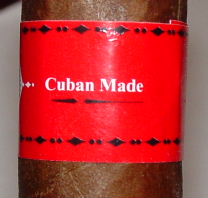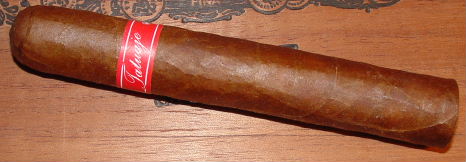
Tatuaje Havana VI Nobles

cnv0287.jpg

Pete Johnson’s Tatuaje brand is known for its strength and full bodied flavor, but this incarnation of Tatuaje — the Havana VI series — is a mellower creation. Unlike the standard line made in Miami, these are blended and rolled at the Tabacalera Cubana factory in Esteli, Nicaragua. This is the new factory operated by Jose “Don Pepin” Garcia where the mixed filler Tatuaje “Serie P” and some of Ernesto Padilla’s cigars are also made.

This is a Nicaraguan puro with Don Pepin’s trademark Corojo 99 wrapper. Well, it’s not trademarked per se, but I’m quickly coming to believe that this wrapper is what defines a Don Pepin creation. There’s nothing like it, and it’s fantastic.

There are six models of the Tat VI — the first letter of each size forms an anagram of the name of one of Pete Johnson’s dogs, “Havana.” The cigar I’m smoking today is the Nobles size, a classic robusto at 5 inches by a 50 ring gauge. The Havana VI series was released in October of this year and is now becoming easier to find in the cigar shops. (Easier than finding the previous Tatuajes anyway.)

The roll on this Nobles is rock solid. I sheared off the triple-cap and found the draw to be kind of tight, a little tougher than I like. But not anticipating any problems I put it to the torch.

The first third is rather sharp tasting. The smoke is fairly light in body, but very flavorful with lots of black pepper and some wood underneath. The wrapper flavor is not as bold as I anticipated — there’s some of the sweet and bready flavors I expect from Pepin’s corojo 99, but it isn’t as pronounced as I expected. The firm roll results in a slow burn and a solid light gray ash.

The second third gets a bit stronger and the peppery taste gives way to a lighter flavor. It’s still tangy though, something along the lines of ginger maybe, with a moderate finish. The last bit becomes smoother and takes on some cocoa flavor. A very nice finale.

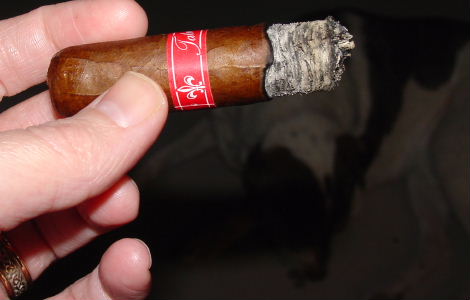
The Havana VI Nobles is a tasty medium bodied cigar with a good deal of complexity. Once again, I am very impressed with the work of Don Pepin and I’m looking forward to sampling more. But apparently my dog is ready to call it a night.
cnv0290.jpg

Hirsh y Garcia Robusto by Don Pepin Garcia

I took a trip to the Phoenix area last summer to visit my folks, and while I was there I thought I’d drop into the Cigar King in Scottsdale because I’d heard they carry a lot of cigars made by Don Pepin Garcia. No sooner had I started browsing through their very extensive humidor when Mitchel Hirsh walked in and introduced himself. He asked if I was looking for anything in particular, so I told him I was interested in Don Pepins. cnv0280.jpgHe said, yes, we have a few, and then turned around and revealed a wall full of them.

The first thing I noticed was I was pronouncing Pepin incorrectly — it’s pronounced Pep – EEN. Mr. Hirsh explained the different blends, as I noted in the post about another Pepin creation, Nacionales W, and tore open a fresh bundle of El Rey de los Habanos to give me a good whiff. If you’ve ever opened a new box of Cuban cigars, you’ll recognize that pungent odor immediately. I then went to business, picking out several cigars to take home with me.

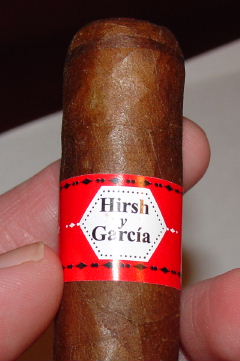
The Hirsh y Garcia cigar is the result of a collaboration between Mitchel Hirsh and Don Pepin, to “commemorate both their business relationship and their personal friendship,” as it says on the Cigar King website. In the spectrum of Cuban comparisons, this one can be roughly compared to the Cohiba line in terms of strength and body. That’s what they tell me anyway.

Like most of Don Pepin’s work, the main ingredient here is rich tobacco from Nicaragua. The wrapper is corojo, and to me this is what gives Pepin cigars their characteristic “cubanesque” aroma. The fillers here lend this cigar body and spice and everything nice, but the wrapper deserves a whole lot of the credit.

This is a very solid looking and solid feeling 5 x 50 robusto. The wrapper has a reddish element, making it a dark colorado maduro. The head is nearly as flat as the foot and is finished with the traditional cuban triple cap. A handsome stogie indeed. The prelight draw is excellent, and the wrapper has a mild scent of hay.

I ignited this cigar with my not-so-trusty Colibri (which will not work with Colibri triple refined butane; it insists on only the cheapest Zippo fluid) and was on my way to a smooth burning smoke. The construction is uniformly excellent — a great draw and an even burn all the way to the end.

The Hirsh y Garcia line is milder than some of Pepin’s other blends — definitely less powerful than his Havana Soul or Habana Leon cigars. But that characteristic sweetness is still there, wrapped around a solid core of pepper. The aroma has some caramel to it, and the flavor tends to leather, but mostly it’s straightforward tobacco. The overall body is medium, but it gets a little heavier at the end. While this is a civilized cigar, there’s a youthful element that I think will even out with time. All of the Pepins I’ve smoked have this in common, and it’s a trait they share with Habanos. I have no doubt that these will only improve with proper aging.

The Hirsh y Garcia is not quite as complex as some of Pepin’s other blends, but if you like the buttery aroma of corojo and the peppery bite of Nicaraguan tobacco without a big punch, the Hirsh y Garcia is definitely worth your time. These are available from Cigar King for around 6 USD per stick.

cnv0281.jpg

Cuban Made… In Miami.


Nacionales W El Mundo by Don Pepin Garcia

cnv0261.jpg

Jose “Don Pepin” Garcia has garnered a lot of attention in the last few years as a manufacturer of cigars like Tatuaje and Padilla 8/11. So much so that El Rey de Los Habanos, his Miami factory in Little Havana, has become too small and he has begun operations in Nicaragua as well. The reviews have been uniformly excellent for all of Don Pepin’s cigars, even though they are admittedly not for everyone.

We are accustomed to hearing the stories of Cuban exiles who along with their families became the stars of cigar production in the Carribbean and Central America — Torano, Fuente, Oliva, Padron, to name only a few. Years later, we have these men to thank for developing a new cigar industry completely removed from the “Island South of Miami.” So it’s a little bewildering to think that Don Pepin has been working outside of Cuba for only four years, even if his experience is extremely considerable. His influence on the major Habanos blends is documented, and over the years he earned numerous accolades for his blending abilities and achieved the highest ranking as a cigar roller in Cuba. But in 2002 he left all that behind to try his hand as an independent operator in the free market, first in Nicaragua and soon after that in Miami.

Don Pepin’s blends are modeled on traditional Cuban cigars and exclusively made with Nicaraguan tobaccos because he feels that these render the flavor closest to the Habanos he has in mind. Mitchel Hirsh at the Cigar King in Scottsdale pointed out to me the various Pepin brands and what their Cuban counterparts might be:

Havana Soul — Montecristo

Habana Leon — Partagas

Nacionales W — Romeo y Julieta

Hirsh y Garcia — Cohiba

Another similarity to Habanos, and a practice I wish all premium cigar makers would follow, is that each box of Don Pepin’s production is date stamped. This is invaluable information for collectors and aficionados since age can be as critical to the quality of a cigar as the condition in which it has been kept.

The “Nation” in the Nacionales W is that of the cigar rollers, because reportedly the flavor and body of this cigar are what Cuban cigar rollers prefer. The smoke of choice among the best cigar rollers of the best cigars in the world… sounds good enough for me!

Nacionales W are made with all Nicaraguan tobacco and are furnished with a Corojo 99 wrapper. The El Mundo size is a long robusto at 5.5 inches by a 52 ring gauge. The head is triple capped in the Cuban fashion and finished off with a very small twist. The prelight draw is generous and the scent somewhat grassy.

The construction of this cigar is very good. It burns well with a good draw and builds a solid but flaky ash.

It starts out with a lot of pepper and a bite that grabs hold and doesn’t let up. The smoke is smooth but assertive. It has a pleasant aroma reminiscent of many other corojo cigars, leathery with some floral accents. The prelight impression carried through to the flavor of the cigar once lit — grassy, woody, and fairly tannic. It’s on the heavy side of medium in body, with a lengthy finish. This tastes like a young cigar that will most probably mature into something even better. It reminds me of a strong but young cabernet sauvignon. It needs some time to even out the tannins and let the true character of the cigar come to light. What I liked most about the Nacionales W is the aroma — the corojo 99 used here is sweet and expressive. And make sure you have something to eat before lighting these up. They pack a good punch, and this is one of Pepin’s lighter smokes.

As I said earlier, these cigars may not be for everyone. All of Don Pepin’s cigars are on the full bodied side, and there is a reason the boxes are dated. Smoke them now if you like a full flavored tannic cigar. Otherwise, put em away and revisit them when they’ve had some time to work out the tannins. Like full bodied Cuban cigars, I think these will be something different altogether after a year or two.