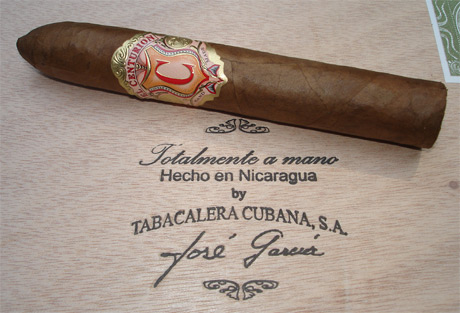
Tatuaje Series P2

cnv0380.jpg

Tatuaje Series P cigars are economy selections from Jose Pepin Garcia’s Tabacalera Cubana in Esteli, Nicaragua. These are “cuban sandwich” cigars made with the same filler blend as Pete Johnson’s Tatuaje Havana VI, presumably with scrap tobacco from the same. These are Nicaraguan puros and are marketed as having 40% long filler and 60% medium filler. The wrapper is Nicaraguan Habano.

Construction is always an issue when it comes to sandwich or mixed filler cigars, and the Series P is not immune. Most of the cigars I’ve sampled in this series have been fine, but a few have had burn problems and a couple have split their wrappers in catastrophic fashion. From the price alone it seems a bit of a gamble — about 4 USD per stick local retail. Not your typical Pepin price mark, but it’s a reasonable wager for this cigar.

The size I chose for this review was the robusto P2. (These are also available in churchill, toro, and corona grande vitolas.) The wrapper is not a looker exactly, so you’ll want to judge this one for its personality rather than its superficial deficiency. The wrapper scent here is straight ahead cedar with a little bit of sweet grass on the prelight pull.

The P2 starts up with no nonsense medium bodied tobacco flavors and maintains that course pretty much to the end. The real attraction here is the sweet spicy aroma from the wrapper. It has a very carmelized kind of smell, almost like roasted marshmellows. After a couple inches some pepper arrives at the party, but for the most part it serves as a mild condiment over that simple sweet woody flavor. There isn’t much transition here, as Jerry noticed in his Stogie Review of this cigar. I have to agree with him that a big development isn’t really necessary here.

Like the Havana VI, this is a relatively mild blend for Tatuaje and Pepin. At times the smoke seems a little bit thin, but it’s flavorful and the wrapper imparts a delicate sweetness that is not easily found among cigars in this price range.

It’s really not fair to compare this cigar to the standard line Tats, so I won’t. Just remember that this is a bargain-oriented cigar made with the leavings from the big boys. The result is a ghostly palimpsest of the original work, but when the original is a Tatuaje, that may be just enough to seal the deal. For 4 bucks, anyway.

Trinidad 100th Anniversary Robusto

cnv0379.jpg

Trinidad is a name that will forever be associated with the legendary “diplomatic” cigar that Fidel Castro bequeathed to lucky statesmen visiting Cuba. It was considered by many to be the most exclusive and presumably the finest cigar of its time. So it came as a surprise when Castro revealed to Marvin Shanken in a Cigar Aficionado interview that he never offered the Trinidad brand to visiting dignitaries — he always presented them Cohibas. In fact, he even denies knowing about the Trinidad brand in that sense.

Perhaps, just perhaps, there is a reason for that.

The Trinidad 100th Anniversary line was created by Altadis USA to celebrate the founding of the brand by Diego and Ramon Trinidad around 1905. The Trinidad brothers were originally hardware traders who bought their wares in the city of Santa Clara, Cuba, and then transported them for sale to the remote villages of the region. One day they were hauling their empty wagons back to Santa Clara to resupply and they noticed the magnificent tobacco crops of the Pinar del Rio around them. It occurred to them that they might as well fill their wagons and try to sell some of this commodity in Santa Clara when they got there. They did this, and subsequently found themselves in the tobacco business. But eventually they noticed that there was an even greater profit to be had in the final product, cigars. They hired a number of cigar rollers and set up shop in the nearby town of Ranchuelo. The Trinidad y Hermano brand was born.

The business continued to grow and the brothers hired more workers and moved to larger factories. The company was thriving until it was beset by what seemed at first to be a disaster: a large crop of tobacco leaf destined for cigars was attacked by the fearsome tobacco beetle. All seemed lost, so Diego ordered that the remains be chopped up and salvaged for cigarettes. But instead of a loss this turned out to be a windfall. They saw their profits double, and the cigar factory quickly became a cigarette factory.

And while they continued to make cigars, the Trinidads were primarily cigarette producers. By the 1950’s, Diego’s American-educated son, Diego Jr., had refitted and modernized the Trinidad factory into what Cuba’s weekly Bohemia called “An Industrial Giant of Cuba.” In 1959 their earnings were in excess of one million U.S. dollars. But within a few years this wealth and power would fall prey to the treachery of Fidel Castro in a very personal way.

Diego Trinidad was opposed to the Batista government which had seized power in 1952. Batista was a dictator of the first order, and Trinidad saw that if he was overthrown democracy might return to Cuba. This would be good for both Cuba, and his business. Fidel Castro’s revolution presented an opportunity for a return to democracy, the progressive constitution of 1940, and a better life. There was no indication at this point that Castro would seize power for himself and socialize the country’s industries. Documents exist that show Trinidad was approached by Castro for funding, and he thereafter made sizable contributions to Castro’s movement. In part this was to promote safe delivery of cigarettes through hostile territory in the countryside, but in part it had to be because he had faith in the movement. If only Trinidad had known that Castro’s victory would destroy private industry and rob him of his livelihood, he would no doubt have done differently.

So one wonders what goes through Castro’s mind when he hears the name Trinidad. Maybe there’s a very good reason why he denies knowledge of the name of this legendary cigar. It’s pure speculation on my part, but perhaps acknowledgement of a friendship betrayed — especially in the name of the world’s finest cigar — just doesn’t sit well with him.

The Trinidad Anniversary cigar celebrates one hundred years of struggles and success on the part of the Trinidad family. Altadis, who now owns the brand, appears to have released very few of these and I feel privileged to happen upon a few. Data on the release date and number of cigars produced is lacking, but we do know the nature of the blend: a Nicaraguan corojo wrapper, Connecticut broadleaf binder, and filler from Nicaragua, Peru and the Dominican Republic.

Upon first examination I thought there was something wrong with the head of this cigar. It looked like there was some stray tobacco caked or pasted on the cap, so I picked at it a little and to my surprise up popped a thin little pig tail! It was crushed down on top the head so completely that I didn’t even see it when I took the photo above. This, along with a quadruple cap, was my first indication that this was a finely constructed cigar.

The wrapper is an oily, darkish natural color with a little bit of tooth. Prelight the scent was a little grassy, but otherwise unremarkable. A somewhat difficult cut and an easy light later I was greeted with the sweet smell of corojo and gobs of smooth cool smoke. The first half of this cigar is perfectly balanced between sweet caramel flavors and a slightly salty cedar. The draw is a little on the tight side, but accommodating enough to bring a nice tasty cloud with each pull. The burn is even and trouble free, while the ash that builds is a solid white trophy that I proudly display to the dog. The dog is not impressed. I am.

Into the second third the body builds from an easy medium to something approaching full. The flavor wanders into the vicinity of cocoa, backtracks to leather, and then reminds me again of the salty cedar from the start. The last third develops a peppery core on the tongue while caramel and cocoa continue their jig in my nose. At this point I am almost ready to call this robusto “Pepinesque,” but it lacks the horsepower. The finish lengthens and the aftertaste grows spicier, while the smoke remains smooth to the end, departing with a sharp tang as it waves goodbye.

Take a look around your B&Ms for this one. It’s not much more expensive than the regular line Trinidads — around 8 or 10 bucks a pop — but in my opinion it’s light years better. It’s not as full bodied as the standard line, so if that’s what you’re expecting look elsewhere. But if you like a solid medium bodied cigar with a lot of complexity and classic corojo flavors, you won’t regret picking up a few. If you can find them.

El Centurion Emperadores by Don Pepin Garcia

El Centurion Emperadores on Box

Cigar Stats
Brand Owner: Tropical Tobacco, Inc. – Miami, FL
Tabacalera: Tabacalera Cubana (TACUBA) – Esteli, Nicaragua

Click here for a short video (about 11 minutes) of the José “Pepín” García factory in Esteli, Nicaragua posted on YouTube by Cigar King. JPG demonstrates application of the famous cuban triple-cap.

Model/Vitola: El Centurion Emperadores (belicoso)
First Limited Edition 2007
Size: 5.50 x 52
Wrapper: Nicaraguan Habano
Binder & Filler: Nicaraguan Criollo 98 and Corojo 99

Other vitola sizes available

  • Guerreros 5.0 x 50 (robusto) MSRP $270/20
  • Gladiadores 6.5 x 52 (toro) MSRP $320/20
El Centurion - Inside Cover Artwork
Inside Box Cover Artwork

Released at RTDA 2007, this is one of several new lines by the famed José “Pepín” García. El Centurion by Don Pepín García and the Don Pepín García Series JJ Maduro were added to the offerings from El Rey de los Habanos. The San Cristobal by Ashton, also released for RTDA, is a JPG creation. Due to the specially selected tobaccos, El Centurion is the first Limited Edition smoke made by Don Pepin Garcia under his own label and it is limited to a production run of 850 boxes per size. El Centurion was sold out by noon on the first day of RTDA.

Jose Pepin Garcia and Jaime Garcia
Jose Pepin Garcia and Jaime Garcia Inspecting Tobacco Plants
(photo courtesy of El Rey de los Habanos, Inc.)

El Centurion is a Nicaraguan puro with filler and binder of Cuban seed Criollo 98 and Corojo 99 carefully selected and matured for 3 years under controlled conditions. The wrapper is a beautiful Nicaraguan Habano also aged for 3 years. At RTDA Pepin is quoted as saying, “El Centurion tastes like ‘old Cohibas’ and they are aromatic.”

Bottom line up front …..
This cigar is a masterpiece in every sense of the word. A medium to full-bodied smoke, it displays all the attributes aficionados look for from pre-light beauty and aroma, to draw, to clean burn, to flavor complexity and balance, to the bit of sweetness on the finish and in the olfactory senses. Only drawback is the price. I think once you try one, you’ll suck it up and shell out the bucks for a box!

El Centurion Cigar Band

Pre-light
A medium brown oily habano wrapper with very few veins surrounds this hefty 52 ring belicoso. The wrap is soft as a baby’s ass. Really! Construction is impeccable as you would expect from JPG and the stick feels solid although it is lighter than I expected. The aroma from the wrap is musky sweet tobacco with a hint of barnyard and earthy tobacco from the foot. Adorned with a very nice band befitting it’s name, the top of the band crests like a roman centurions helmet. As you look at the tobacco bunching at the foot end, there are swirls of two or three different color variations. My mouth was drooling in anticipation! Clip was clean and pre-light draw superb with a slightly sweet taste on the lips.

El Centurion Bunch and Burn Line Bumps

The Smoking Experience
Lighting this cigar is a breeze and I never went back to the torch. The burn line got a little bumpy at times but always self corrected. Draw was effortless through to the nub. The ash was medium gray and held on like gangbusters. First ash was almost at the midway point and the second with only the nub to finish. Smoke production is voluminous. Neighbors must have thought I had the barbeque stoked.

El Centurion Ash

Starts with the typical JPG lite bite for about a half inch then really smoothes out to a creamy core flavor of rich coffee, toasted cedar and nuts with notes of cocoa, caramel and white pepper. A complex full-flavored cigar. It has a long spicy finish and the aroma is out of this world.

I would say this stick starts and maintains medium body until about the two-thirds mark where it begins to build in strength toward full at the nub. Certainly not overpowering in any way but probably good to have something on your stomach.

My take …..
Definitely top of the line JPG. He has out done himself. What a special cigar. This one takes a seat right up there with the Ashton VSG and Rocky Patel Olde World Reserve for me. Along with all those other Pepin greats of course!

MSRP rings in at a whopping $290/20. The online prices are running approximately $234/20 and $$62/5. Definitely going to hurt in the wallet department. Hey, quit your whining, get yourself a beer and an El Centurion, go out on the porch and relax! You will feel much better and you will forget all about your financial woes.

Smoke Til You're Green

Like it … Loved it
Buy it again … Absolutely
Recommend it … Unequivically Yes

What others are saying about
El Centurion by Don “Pepin” Garcia …..

28 August 2007 – Cigar Live – NNexus + others
Don Pepin Garcia El Centurion

28 August 2007 – cira of Cigar Pass
El Centurion Review, Pepin’s OpusX?

On the Cigar Family Forum
From: Aashton
Date: 08/31/07 12:59 PM
I smoked the Emperadores (belicoso) today. If you can find them, they are on the high end pricewise, but IMO unlike the San Cristobal, these are worth the dough. To me they are a bit of a taste departure from most of Pepin’s blends. I’ll leave taste descriptions to the aficionados but I can say it was quite complex and very very smooth. As you would expect, construction and burn was excellent. The wrapper was a Colorado brown with a suede feel to it. After lighting it took a few puffs, but when this thing hit it’s stride, it was nothing but pleasure. I would say upper med to full bodied and I probably won’t smoke these again in the A.M. It took me 34 years, but I finally found THE one!

Publications

March/April 1999
Cigar Aficionado
An Interview With Pedro Martin
President, Tropical Tobacco Inc.

29 June 2007
The Cohiba Club
The Many Faces of Don Pepín García

Wikipedia on José “Don Pepín” García

The El Rey de los Habanos, Inc. Website


… lucky7

“It has always been my rule never to smoke when asleep,
and never to refrain when awake.” (Mark Twain)

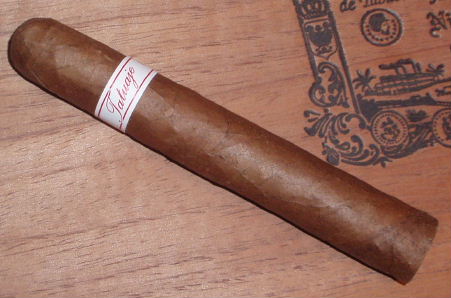
Cienfuegos Engine No. 6

cnv0378.jpg

Cienfuegos is a city and province on the southern coast of Cuba, about 150 miles east of Havana. It has been called “The Pearl of the South” after its magnificent bay, so it must be with some pride that Puros Indios named its new full-bodied blend Cienfuegos in 2003.

Literally, Cienfuegos means “one hundred fires,” which coincidentally was the number of re-lights needed to finish a cigar with an H2000 wrapper a few years back. (I am happy to report that the Ecuadorian H2000 on the Cienfuegos has nothing in common with that notoriously fireproof leaf.)

Puros Indios has a well founded reputation for consistently smooth and nutty mild-to-medium bodied cigars, whether it’s the PI Classic or the relatively newer Cuba Aliados. Cienfuegos is a departure from that. As Carlos Diez told Cigar Aficionado:

We wanted to make the strongest cigar we could without compromising the taste and the aroma. We take pride in our cigar’s aroma.

An argument could be made that aroma is in fact the most important characteristic of a smoldering bunch of tobacco, and it is something that Puros Indios does very well, even in its secondary Roly and Pirate’s Gold bargain smokes. Cienfuegos is no exception in this regard, primarily due to its use of an aged Ecuadorian Habana 2000 wrapper. The blend is balanced out with a binder from Nicaragua and Dominican filler.

The names of the various sizes build on the “100 fires” metaphor, calling up images of fire fighting (please, no more H2000 jokes!) :

  • Blaze (toro)
  • Hot Shot (belicoso)
  • Rookie (torpedo)
  • Engine No. 5 (robusto)
  • Engine No. 6 (Gran corona)
  • Engine No. 7 (Churchill)

After removing their cedar sleeves I found the Engine No. 6 long coronas had a rough and dry colorado maduro wrapper — though admittedly more colorado than maduro. It’s mottled and ruddy, almost rust colored. The construction of both samples was excellent, starting with a clean cut and an easy draw.

The Cienfuegos opens up with a rich cedary flavor with some sweet overtones. The wrapper is a little finicky– these probably need to be stored at 70%, whereas I keep my humidor around 65% — but there are absolutely no burn problems. From start to finish these had a relatively straight burn line and required no special attention.

The middle third introduces a little more heft and a touch of pepper. The base flavor is still very woody and the body grows to a solid medium. It’s satisfying without taking me to the mat. The final segment sticks to the program with a mellow and smooth smoke reminiscent of juniper burning in the fireplace. This would be a great cigar to fire up on a cool autumn evening.

The finish is short with a pleasantly mild aftertaste up to the last third where the finish grows a bit longer and the aftertaste gets a little muddy — earth, paper, and a stranger I can’t identify. Aside from this slightly funky finale, the only thing that would prevent me from running out and grabbing a few boxes right now is the price: $150 per box is the best price I could find, and this is a considerable discount off the retail price. Luckily you can usually get a good deal on these if you want to take a stab at the auction sites. If you can get the price under four or five bucks a stick you’re getting a great cigar for the money.

San Cristobal Fabuloso by Ashton

Cigar Stats
Brand Owner: Holt’s Company
Tabacalera: Tabacalera Cubana (TACUBA)

Click here for a short video (about 11 minutes) of the José “Don Pepín” García factory in Esteli, Nicaragua posted on YouTube by Cigar King.

Model/Vitola: Ashton San Cristobal Fabuloso (torpedo)
Size: 6.125 x 52
Wrapper: Nicaragua
Binder: Nicaragua
Filler: Nicaragua

San Cristobal Open Box

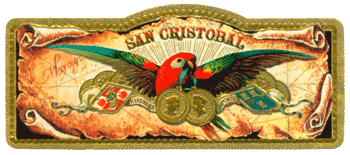
San Cristobal Band


Vitola sizes available (All in boxes of 22)

San Cristobal Vitolas
San Cristobal Vitolas (photos courtesy of www.ashtoncigar.com)

Ashton has held the trademark for the San Cristobal name for over 20 years and thanks to José “Don Pepín” García they now have a cigar suitable for the name. Ashton’s first new brand – since the 2002 launch of La Aroma de Cuba.

Released shortly after RTDA 2007, this is the long awaited new line of cigars Ashton has been working on for 2 years. It has been reported the first years release will total 300,000 cigars but Ashton says they will not be limited like the VSGs, ESGs or even the Aged Maduro (open ordering). It is blended and rolled in José “Don Pepín” García’s TACUBA facility at Esteli, Nicaragua. The San Cristobal is a Nicaraguan puro using a dark Nicaraguan wrapper, slightly veiny and mottled with a rosado hue. The cigar is medium to full-bodied with a hint of that now classic Pepín flavor. He always manages to get very different flavor profiles using all Nicaraguan tobacco. Truly a genius, he is able to produce cigar after cigar with its own unique characteristics.

Some have expressed concern that the new Ashton-JDPG connection may indicate a change in the Ashton-Fuente relationship. This quote from vice president Sathya Levin @ Ashton posted mid-June 2007 on the cigar family forum online:

… Nothing has changed between us and the Fuente family. The Fuentes are our partners, as well as our dear friends. We wish that every cigar we sold was made by Fuente, but their production capacity is currently maxed out. Carlito is not an envious or vindictive person. He knows that in order for us to continue to grow, we need to have cigars manufactured outside of his factory. He gave us his blessing on this project.

The reason we chose Pepin is that we believe he is making some of the finest cigars in the world today. His breadth of knowledge regarding tobaccos and cigar making is truly astounding. You need not worry [about tobacco supply]! Pepin does indeed have oodles and oodles of aged tobaccos all ready to be rolled up …

Bottom line up front …..
A little young but this is another really special cigar from Ashton and José “Don Pepín” García. Perfectly balanced between strength and complexity of flavors. Exquisite construction, burn and a long smooth finish. Like many who waited anxiously for this release, I am ecstatic to finally have a box and can’t wait to try the other sizes.

I heard that Carlito Fuente was quite upset when the initial Ashton Estate Sun Grown (ESG) was released. He felt the cigar was not ready and, having purchased and smoked one right away, I have to agree. They were not ready. Those who spoke with José “Don Pepín” García at RTDA said he was very excited about this release but my IMO the San Cristobal, although a good smoke now, is pretty young and needs another 3-4 months to be really good. With a year or two, these are going to be phenomenal.

Pre-light
A dark brown oily wrapper with a few veins and a reddish hue envelopes this beautiful torpedo. I read that JDPG said the wrapper was maduro during a conversation at RTDA but Ashton doesn’t mention it in their information. Who are you going to believe? Construction is solid and the stick feels very nicely balanced in the hand. An earthy tobacco aroma from the wrap and the foot with just a hint of barnyard and pepper. It actually tingled my nose and drew a sneeze. The band is a work of art and when it’s time, is removed very easily with no effect on the cigar. I used my Xikar and the clip was very clean. Draw was easy with just a slight resistance.

The Smoking Experience
The foot toasted and lit easily. The burn line got a little bumpy at times but always self corrected without the torch. Draw continued to be very good through to the nub. The ash was very light gray and held on well to about two inches each time. This cigar puts out tons of smoke.

San Cristobal Nub

Starts with the typical JDPG bang for about an inch then smoothes out to a core flavor of dark earthy espresso, dark chocolate and toasted cedar with notes of nuts, vanilla and black pepper over the length of the cigar. Definitely what you would call a full-flavored, full-bodied cigar. The finish is long and the aroma is special. During the last third I detected a little caramel on the nose.

I would say this stick starts and holds the medium category until about the halfway mark where it begins to build in strength to full towards the nub. Definitely has a nicotine kick. I had mine with a glass of port which complimented the cigar very nicely.

You can tell when a cigar maker is especially proud of the brand when they adorn the cigar and boxes with ornate bands and box design like the Fuente Fuente OpusX and the Ashton ESG. The band and box artwork for the San Cristobal are exquisite to say the very least.

san-cristobal-inside-box-art.gif
Inside Box Cover
San Cristobal Cedar Cigar Separator
Cedar Cigar Separator
San Cristobal Wax Paper Logo
Wax Paper Logo

My take …..
Although a little young IMHO, I enjoyed this smoke immensely and will be looking to obtain more to age. My problem will be the ability to summon the patience when I get em’.

I am not sure of MSRP for the Fabuloso at this point. The Ashton folks are saying the entire line runs between $7 and $12. The online price has gone up since I ordered mine (pre-release). Right now they run $9.50 per stick if you buy a box ($209.00/22) and $9.75 for a single from Jack Schwartz Importer. Definitely a wallet reducer but I plan to get some more (They are that good!). I would have thought Holt’s would be the first online to carry them (since they own the brand) but they have no listing as of this post.

Smoke Til Your Green

Like it … Very much
Buy it again … Absolutely
Recommend it … Yes, but age em’ for a few months if you can hold out that long

What others are saying about the
San Cristobal by Ashton …..

9 August 2007 – Cigar Aficionado Blog – David Savona
A Preview of Ashton’s New San Cristobal

12 August 2007 – John51277 of CigarLive
Ashton/Pepin San Cristobal “Classico”

25 August 2007 – Jay (aka Altercall) of BOTL Cigar Forums – Brothers of the Leaf
San Cristobal Review

Publications

29 June 2007
The Cohiba Club
The Many Faces of Don Pepín García

Wikipedia on José “Don Pepín” García


… lucky7

“It has always been my rule never to smoke when asleep,
and never to refrain when awake.” (Mark Twain)

VegaFina Robusto

cnv0376.jpg

Over the years there have been several different cigars marketed under the name Vega Fina, mainly because the companies owning the brand name have merged or been acquired or simply changed hands: the brand name appears to have first been owned by Havatampa, an old manufacturer around since the early 1900’s. When Tabalera S.A. de España bought Havatampa in 1997, Vega Fina passed to them and was produced by Benji Menendez in Honduras with an Indonesian wrapper. Two years later, Tabacalera S.A. merged with the French tobacco giant SEITA to form Altadis, S.A. Soon after this, production moved to the Dominican Republic and Vega Fina was produced primarily for the Spanish and Western European market as an affordable Dominican premium (but also as a mass market machine mini cigar very popular in Spain.)

Vega Fina continues to be Spain’s most popular Dominican cigar, so Altadis decided to introduce it to the much larger American market early this year. Today they’re made in La Romana’s Tabacalera de Garcia under the supervision of José Séijas.

The VF robusto is graced by a creamy claro-colored Ecuadorian grown Connecticut Shade wrapper that looks good enough to eat. Beneath this, however, is a binder which causes me a little concern: Indonesian TBN. (I have to remind myself that the wrapper on the Dominican Romeo y Julieta 1875 is also TBN, and it’s not bad stuff.) The VF employs filler from Columbia, the Dominican Republic, and Honduras.

I tend to think of Indonesian TBN as the carpetbagger of cigar tobacco — it seems to turn up only when the “real thing” is no longer available. When Consolidated couldn’t get quality Cameroon in the late 80’s, they turned to TBN. When wrapper leaf of any quality was scarce during the “boom” years, TBN was there. And this is at least partly why it has a such a sullied reputation — it’s often been the alternative, not the prime choice. And unfortunately the alternative, especially during the boom years, was actually bottom-of-barrel tobacco billed as TBN when it may have been something else entirely. So what we were taking in general as “Indonesian” was actually the worst tobacco the region had to offer.

TBN stands for tobaco bawah naungan, which means “tobacco under sheet,” or shade-grown tobacco. Top quality TBN is a cross between native besuki tobacco and Connecticut Shade. It’s a nice looking leaf, so in addition to its blending qualities it can also serve well as a wrapper. Strangely it is also prized for its lack of aroma. I can’t think why this would be appreciated in a wrapper, but used as a binder here perhaps it makes more sense.

The VegaFina robusto is a suave looking cigar. The wrapper is smooth and supple with very few veins. The construction is very good from the start, with a cool even draw and a nearly straight-edge burn. There’s just a hint of pepper at first light. This quickly disappears and is replaced by a very mild bodied smoke with a creamy texture. Up until the half-way point the flavor is mildly woody with some herbal tea accents. The aroma is exceptional — it blends well with the flavor of the cigar and adds a spicy floral component. (Incidentally, there are none of the metallic overtones that I’ve noticed with Indonesian leaf in the past.)

The flavor picks up at the mid-point, not a lot, but enough to be noticed. Another dash of pepper is added to the mix and the finish goes from non-existent to moderately short at this point. The last third stays the course, and finally a discreet bitterness announces that the finish line has been crossed.

Overall the VegaFina robusto is an excellent mild blend: a fine mid-day smoke, great after breakfast. The price is right on these babies as well: I picked up a few for under 3 USD on the reservation, and it looks like boxes can be had for under 75 online. Factoring price into the equation, I think this is my new mild one. (Especially since it’s getting hard to find Nestor Reserve Connecticuts these days…)

–cigarfan

Domaine Avo ’50’

cnv0375.jpg

Avo Uvezian has led a cigar-charmed life. He started out as a jazz pianist and composer, playing and touring as a very young man in Lebanon and the Middle East after World War II. In 1947 he traveled to New York, where he studied at the Juilliard School of Music and eventually was drafted into the Army during the Korean War. (He played piano in the First Army Band.)

After following family members to Puerto Rico and working in the jewelry business for many years he started playing piano at a local resort. He discovered that the guests enjoyed the locally made cigars he kept on the top of his piano, and after giving away one too many of his personal stash, his young daughter Karin suggested that he might as well sell them.

This was the spark that eventually led Uvezian to contact Hendrik Kelner of Davidoff, who had just opened a cigar factory in the Dominican Republic. Avo’s first cigars were called Bolero, but the name was quickly changed to Avo when it was discovered that “Bolero” had already been registered by another manufacturer. The initial production run in 1987 was about five thousand boxes. Today about three million cigars are produced under the Avo brand name and its extensions.

The first Avo cigars – the now Classic line – were released in 1988, but Avo is really more of a song-and-dance man, a self described “PR man,” than a business and paperwork kind of guy, so in 1995 he sold his brand to Davidoff. But he remains, with his trademark Mimbre hat and ice cream suit, the face of Avo Cigars.

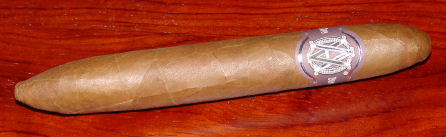
The Domaine Avo was blended to be a stronger version of the original Avo. It was released in 1998 in a robusto size only, but other sizes, including this 6 x 50/54 perfecto, were added in 2001. The filler and binder are a blend of San Vicente and piloto from the Avo farms in the Dominican Republic, and the wrapper is Connecticut shade grown in Ecuador. Production is overseen by the inimitable Henke Kelner in Santiago.

This is a beautiful cigar. For a few months I kept it in the top row of my humidor just so I could admire it during those few moments of indecision when I can’t decide what to smoke. The wrapper is a creamy colorado claro with small veins that are just about evenly spaced. The head and perfecto foot are flawlessly formed. There is an overall sense of proportionality and balance to this cigar that makes me hesitant to commit it to the flame.

The head clips cleanly and the prelight draw is much more generous than I expected, even with a nearly closed foot. After an easy light the draw opens up even more and becomes completely effortless. This cigar exhibits excellent construction all the way around — a great draw and a slow even burn.

The Domaine Avo introduces itself with a handful of sharp peppercorn — a surprise, considering the genteel appearance of the cigar. The finish from the start is quite long, and I found myself thinking “This is an Avo?” The texture of the smoke is smooth and creamy like I would expect from Connecticut wrapper, but the aroma carries all the characteristics of Ecuador, a nice easygoing cedary spice.

After the first inch the pepper fades a bit into a mild woody flavor, balsa-like with a salty element. The spice from the wrapper combines with this flavor very well to create a complex smoky brew. The middle third continues in this vein, with the wrapper stealing the spotlight and the base flavors taking a back seat. Into the last third the pepper kicks in again. I found that I had to smoke slowly to keep the smoke in balance at this point– this is where a slightly tighter draw might be appreciated. But of course the sensible thing is to just slow down a little.

The balanced appearance of this cigar seems to be reflected in the way that it smokes: it ends very much the way it starts, with a lot of spicy drama. In between is a pleasantly pastoral interlude. An extremely classy cigar that falls in the medium body range, maybe stretching to full at the end.

The Domaine Avo “50” is not a cheap date, but you’re not taking this one on the Tilt-a-Whirl at the State Fair. This is an operatic cigar, and in my opinion it’s worth the 8 or 10 dollars it sells for. There are a lot of fantastic cigars in that price range (and less, for that matter) but if price isn’t an object this stick is definitely worth a look.

–cigarfan

Camacho Corojo 11/18

cnv0374.jpg

Camacho’s Corojo Diploma was among the first cigars I reviewed for this blog, so when I cracked the humidor last night and heard that groan from Black Sabbath’s “Iron Man” I knew it was time to revisit one of Camacho’s Special Edition corojo cigars. Sometimes you just want a super heavyweight, and this is one of them.

The 11/18 shares a lot of the same characteristics as the Diploma, but the shape is certainly different. The 11/18 is a bulbous figurado that starts out at the head at around a 48 ring gauge, expands to about a 54 in the center and then narrows again to a 48 at the foot. It’s a rough looking cigar with a ruddy but very oily and thick wrapper, and a cap that looks like it might have been applied by school children. (Obviously it wasn’t, since it cuts perfectly, but aesthetically it leaves something to be desired.)

Like Camacho’s other Corojo cigars, this one is pure unadulterated Honduran leaf from Camacho’s farms in the Jamastran valley. Simplicity itself. The seeds used for this tobacco are descended from the “original” Corojo developed in Cuba, a strain which is no longer in use in Cuba due to its susceptibility to disease and mold. The Special Edition cigars (Diploma, 07/05, and 11/18) are loaded up with extra powerful sun grown ligero from these special corojo plants.

I enjoyed a hearty meal of meat and potatoes in preparation for my after-dinner smoke, and having retired to the porch with a glass of Talisker and this Camacho 11/18 I got right to work. After cutting this cigar with some care I was met with a spicy pre-light flavor with a little salt. The roll is solid and well packed, but it draws really well.

The first third of this beast is full-flavored, but relatively tame. Up front I noticed a sweet cereal taste (as in grain cereal with sweet tobacco overtones, not Fruity Pebbles) which I remember as fairly unique to the Diploma size. I haven’t noticed this with the standard Corojo Monarca, or any other cigar for that matter. There’s also a lot of salt here, and it’s surprisingly smooth. Full flavored, absolutely, but with no harshness. Just the way it should be.

After an inch or so I ran into the problem that everyone speaks of with respect to this cigar: it really does not want to burn evenly. I struggled with the burn throughout the length of this stick and had to correct it every ten minutes, which is usually enough to make me throw out what I’m smoking and head to the humi for another one. But I had this one by the horns, and anything else after this particular cigar would taste like slightly warmish air.

At the mid-point the power of this cigar is at full tilt. The aroma is rich and heady, almost sulfurous, and the flavor is incredibly complex with leather, pepper and sweet tobacco. The aftertaste is earthy and lingering with a very long finish. About half an inch into the two-thirds section, after the bulbous part was nearly consumed, this cigar threw me aside like an old dish rag. At this point the flavor is so overpowering that I think it loses a lot of the subtleties that characterize this smoke. The nicotine content is also very high at this point and if you’re not used to it you really have to take it easy. I walked away with a mild headache and had to go lie down for a while.

The 11/18 is a real work of art I think everyone should try at least once, and if you love full-bodied cigars you’re going to get hooked. The only nagging issue with this cigar is a badly uneven burn. But corojo is rather notorious for having this problem, so this may just be the price you pay for a cigar of this caliber. Well, not the only price. These retail for around 9 to 10 USD per stick.

It’s quite a ride, though not one I’ll be taking everyday.

–cigarfan

H. Upmann Signature Double Eagle

cnv0373.jpg

Like the Por Larrañaga “Cuban Grade,” the H. Upmann Signature is an extension brand created by Cuban Imports in conjuction with Altadis USA. It was introduced earlier this year and looks completely different from the other Upmann lines. As with the PL Cuban Grade, a lot of effort has been expended on the packaging — a striking black box emblazoned with the famous banker’s signature (of course) and a newly designed black and silver band.

Setting this line even further apart is the fact that it is made in Honduras, not the Dominican Republic. The Signature line is blended by Jesus Antonio Pineda Henriquez (about whom I can find nothing on the internets except that he is allegedly a “master blender”) in the Flor de Copan factory.

Available in four sizes, including this lovely 5 x 50 perfecto, the Signature features a Nicaraguan binder, filler from Nicaragua, Honduras and Peru, and a choice of wrappers: either Nicaraguan grown Connecticut Shade, or a San Andres maduro.

The Connecticut Shade Double Eagle is an attractive cigar with a soft roll and a perfectly shaped nipple foot. Easily lit with a single match, the draw opens up almost immediately after the tip is torched. The draw seems a little too easy, but the burn is slow and even. After a couple of inches this stick gets extremely soft, almost mushy between the fingers, so I had to be careful not to crack the smooth golden wrapper.

Like the PL Cuban Grade, the Signature has aroma in spades. A creamy sweet honey-like aroma rises from the foot of this cigar. It’s mild to medium in body, maybe a little more on the mild side, but the flavor grows to a solid medium at the finale. The primary flavor through the first two thirds is toasty, then bready, and it’s nicely accented by the sweet honey and floral hints on the nose. Some gentle pepper makes an entrance at the mid-point and gracefully increases in intensity but never really takes charge.

This is a fine mild cigar with a good amount of complexity. The only detraction is a somewhat dirty aftertaste that is especially noticeable in the first third. Strong coffee might take care of this, since this is really a morning or mid-day smoke anyway.

The H. Upmann Signature line retails in the 5 to 7 dollar range. If you really enjoy mild cigars, this might be worth the asking price. Like the PL Cuban Grade, this is a high quality cigar with a level of complexity unusual for mild bodied smokes. I’m more of a medium to full bodied kind of smoker though, so I’ll probably give this one a pass unless I’m really in the mood for a mild one.

— cigarfan

Joya de Nicaragua Antaño 1970 – Robusto Grande

Cigar Stats
Brand Owner: Tobaccos Puros de Nicaragua, S.A.
Model/Vitola: Joya de Nicaragua Antaño 1970 – Robusto Grande (box-pressed)
Size: 5.50 x 52
Wrapper: Nicaragua Habano Criollo
Binder: Nicaragua Habana
Filler: Nicaragua Habana

Other sizes available

  • Consul 4.50 x 52 (robusto)
  • Machito 4.75 x 42 (petit corona)
  • Gran Consul 4.75 x 60 (torpedo)
  • Belicoso 6.00 x 54 (torpedo)
  • Magnum 6.00 x 60 (toro)
  • Perfecto 6.25 x 58
  • Churchill 6.875 x 48
  • Lancero 7.50 x 38 (long panatela)
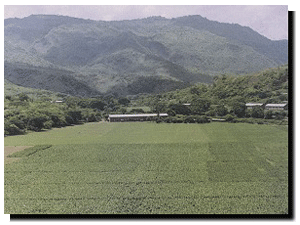
Tobacco Farm at Esteli, Nicaragua
Tobacco farm at Esteli, Nicaragua

Joya de Nicaragua (The Jewel of Nicaragua) was created in Nicaragua’s first cigar factory, which opened in 1964 in the city of Esteli. In the glory days of the 1970s, the brand was arguably the finest in the world, smoked in the White House and prized for its rich flavor. After war decimated Nicaragua and the original factory burned to the ground, Joya de Nicaragua struggled to regain its former glory. Prior to 2000, the brand had taken on a mild, easygoing flavor. Responding to the trend toward full-flavored cigars and looking at its own heritage as a producer of powerful smokes, the brand’s makers created a version called Joya de Nicaragua Antaño 1970. This was one of the first “high octane” powerful cigars to hit the market back in the early 2000’s. It was one of the hits of the Retail Tobacco Dealers of America trade show in 2002. This cigar features an extremely powerful, heavy, thick smoke highlighted by a rich, oily, almost wet-looking Maduro wrapper. This is the type of cigar that the old Cubans use to make for themselves after quitting time in the Cuban factories.

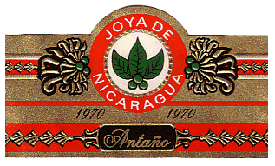
Joya De Nicaragua Antaño 1970 Band

Joya De Nicaragua Antaño 1970

Bottom line up front …..
“All Muscle, all the time,” is the slogan for the Joya de Nicaragua Antaño 1970 and this cigar certainly flexes its muscles. Antaño is the cigar directly responsible for reviving the struggling Joya line, and after smokng one there is no wonder as to why. It has received high ratings, a 91 in Cigar Insider and 92 in Cigar Afficianado, and was in the top 5 of Robb Report’s 2003 annual Best of the Best. Antaño, a Nicaraguan puro, is a powerhouse full of flavor; leathery and slightly earthy, this cigar is rich and spicy. The draw is excellent and the thick, dark wrapper burns well. A true treat for those who enjoy a complex and very full-bodied smoke at a very reasonable price.

Pre-light
A couple large veins on this dark rusty brown colored wrap but no ill effect on the burn. The head is finished with a rounded cap. No tooth is evident over the smooth oily wrap. Construction is solid with no soft spots to the light squeeze. It is well balanced in the hand and the pre-light draw is firm. Although this cigar is advertised as box-pressed, it is barely evident by looking at it. A very subtle aroma of earth and aged tobacco from the wrap. The band is good looking and took a little effort to remove but without effect on the cigar. I used my Xikar cutter for a clean clip.

The Smoking Experience
The foot toasted and lit but with some effort. The wrap is very thick and it took a couple torch blasts to get everything going but, once lit, no burn issues at all. Draw was firm but not too firm and eased just a little over the length of the cigar. Burn line got a little bumpy but always self-corrected. The ash was dark gray with small black striations and held on well to about two inches each time. This cigar puts out allot of smoke and stayed nice and cool all the way to the nub. The smoke seemed to increase in volume past the half way point.

Full bodied and full flavored this cigar leaves nothing to the imagination. Flavors hit the palate like a freight train. Starts with a surge of dark earth and pepper which quickly gives way to a core of sweet earthy flavors with subtle notes of cocoa and espresso. The nose has quite a “twang” to it. The last half ushers in more pepper and spice but not overpowering.

Definitely a strong full-bodied smoke but well balanced. I did not experience any harshness. Not the cigar for morning coffee IMO and should follow something to eat. I had both cigars for this review with McClannan 25 single malt scotch which really complimented the cigar. I’m thinking a nice cold Guiness Stout would work too.

My take …..
Being a fan of stronger cigars, I really enjoyed the Joya De Nicaragua Antaño 1970. I bet these are just fantastic with a year or more to age. I’m curious about the Gran Reserva as well. That’s on my list of cigars to try.

MSRP comes in at $5.00 per stick. I received mine in a trade so I’m not sure exactly what they cost originally but my local B&M has them for $6.25 a stick. Online they run $3.50 per stick if you buy a box (20) and $3.70 if you get a 5ver. Very good price point for a such a flavorful well-made cigar.

Smoke Til Your Green

Like it … Yes
Buy it again … Absolutely, maybe stock some boxes
Recommend it … Yes, to those who like potent cigars

What others are saying about the Joya de Nicaragua Antaño 1970 …..

25 March 2006
Cigarfan of Keepers of the Flame
Joya de Nicaragua Antaño 1970 Robusto Grande

28 August 2006
Patrick A of The Stogie Guys
Joya de Nicaragua Antaño Consul

30 May 2007
Dickie Dingleheimer
Review of Joya de Nicaragua Antano Cigars
Rated 4.60/5

As of 10 August 2007
Top 25 Cigar Ratings (26 reviews)
Joya de Nicaragua Antano 1970 Robusto Grande
Average Rating 8.35 out of 10

Publications

18 May 2007 – Cigar Aficionado
An Interview with Alejandro Martinez Cuenca, Owner of Joya de Nicaragua


… lucky7

“It has always been my rule never to smoke when asleep,
and never to refrain when awake.” (Mark Twain)