La Flor Dominicana Reserva Especial Figurado

cnv0328.jpg

La Flor Dominicana in the past couple of years has earned a reputation for full bodied bombers like the Double Ligero and Litto Gomez Diez cigars. But that’s not all they do. The Reserva Especial is a real sweetheart of a cigar that aims for finesse rather than a crushing blow to the senses.

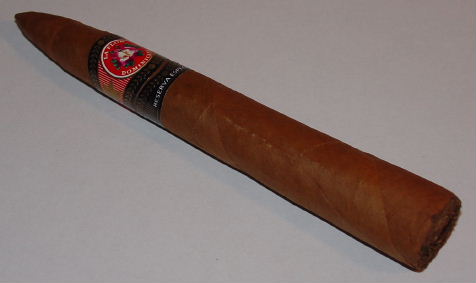
Cigar Insider (as featured on the LFD website) calls the LFD Figurado a belicoso. It isn’t really, because torpedoes and belicosos are like parejos in that they have straight sides. “Torpedo” and “belicoso” are often interchangeable terms, it seems, but they are distinguished from pyramids, which are figurados having non-parallel sides and a slightly conic cylinder. This Figurado, I believe, is actually a pyramid. No doubt somebody will disagree with the way I’ve split these hairs, and that’s okay.

The dimensions of this figurado are 6 1/2 inches by 32 graduating to 52 at the foot. (Don’t ask me where the 32 comes from. I think there’s some theoretical mathematics at work here.) The wrapper is an even and smooth Ecuadorian grown Connecticut seed leaf with a little bit of ripple in the veins. The binder is Nicaraguan, and the filler is piloto cubano from La Flor Dominicana’s farm in the DR.

The aroma from this pretty stick is sweet and elegant. It’s floral like the best Connecticut wrapper often is, but with a dollop of spice as well. The flavor is very mild for the first inch or so, and then gentle flavors of nuts and wood enter into the mix. The smoke is creamy at first and just gets more so until it reaches an almost buttery texture. At the mid point the flavors pick up a little more heft, but stay basically the same, while the rich aroma continues its long-legged strut down the catwalk. There’s a little bump in the octane at this point, but nothing to kick it past medium grade.

The foot unraveled a bit at first, which I’m going to attribute to operator error; aside from this, it burned perfectly and had no construction defects. I’m not sure if there was much age on this particular stick since I received it in a trade, but I’ll be picking up a few more to experiment with. At six dollars apiece, or about $150 a box, it’s not a thoughtless purchase. I might have to sample a few more singles and give them some thought.

This is a gorgeous, if somewhat flamboyant cigar. It’s not huge on flavor, but it’s long on looks and aroma. I’d hand this out to deserving new smokers in a heartbeat, but first I’d put a few in reserve for myself.

Legends Series Yellow – Pepin Garcia

cnv0326.jpg

Jose “Don Pepin” Garcia joins several of the biggest names in the cigar business with the Legends Series Yellow Label. Cigars International made up the rules for the Legends Series, as well they might since they sponsor and distribute them. All the Legends Series cigars must be 5.75 inches by a jaw breaking 54 ring gauge, and they must be affordable as well. CI set an initial MSRP ceiling of 5 bucks a stick, though they gave Graycliff and now Pepin a little cushion at around six dollars per cigar. The actual price — c’mon, who pays MSRP? — is around $70 for a box of 20.

This is a nice looking cigar, solid to the touch and complete with the expected triple cap. The foot reveals a swirl of tobaccos that vary widely in color from tan to black. Upon cutting the cap with a guillotine I was a little concerned to find several stem ends. The draw was very good though, and seeing that this is a Pepin production I didn’t expect any problems.

But problems there were. First off, the foot cracked when I lit it. Never had that happen with a Pepin cigar before, at least one that has been stored at the recommended 63% RH. I ignored the split in the wrapper and kept on puffing, but an uneven burn was the next issue. I ignored that also, until the cigar was burning down one side and a correction became necessary.

The flavors and aroma from the Yellow Label are more on par with what I expect from Pepin. It starts out with the expected blast of pepper (though not as strong as the Achilles or the heavier bodied Cigar King blends) and mellows into a somewhat tannic, woody cigar with overtones of cocoa and a semi-sweet aroma. Despite the split in the wrapper, the fragrance of Pepin’s corojo has yet to disappoint. This cigar has a youngish taste to it, as do most of the cigars from Rey de Los Habanos and Tabacalera Cubana. (I’d be curious to know if boxes of the Yellow Label are being date stamped.)

You’ll probably want to have something to eat before tackling this hefty heifer. It’s not a killer in the nicotine department, but it’s no slacker either. The full bodied smoke and tannic finish calls for a good meal beforehand, and probably a beverage to accompany the cigar.

I didn’t find the same level of complexity here that I find in Pepin’s top shelf blends, but I think the Yellow Label would be an economical way for smokers new to Pepin to sample the flavor that typifies his style. If cigars like Tatuaje and Habana Leon are called “Cubaneque,” then I might venture that the Yellow Label is “Pepinesque.” You’re not going to get the same full throttle experience, but you’ll get the general idea, and at a pretty reasonable price.

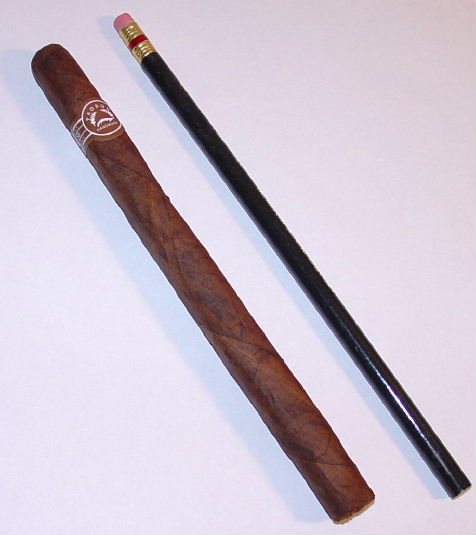
Padron Panatela

cnv0325.jpg

A panatela is a long, thin, and currently unfashionable cigar. The latin root of the term is “pan” which means bread. Panatela is a diminutive form of the word; in Italian it means a small loaf, or a thin biscuit. In Spanish it can also mean pound cake, which might cause some confusion if you’re looking for cigars in a Spanish bakery. In this case you may want to document your experience for a future BBC comedy sketch.

Panatelas can be from about 5 1/2 to 7 inches in length with a ring gauge from 34 to 38, sort of like a thin lonsdale. It is one of the historically “standard” sizes but in recent years it has become increasingly rarer due to the trend toward larger ring gauges. The long thin aspect lends it an elegant appearance which according to some people makes it more attractive to female smokers. That sounds to me like a stereotype, so I’m not going to give it too much weight; on the other hand I’m sure there are guys out there who would feel a little uncomfortable smoking this in the pub. I can hear the Virginia Slim jokes already.

The thin ring gauge makes this a difficult cigar to roll: the most common problem is a tough draw because there are so few leaves to work with. Aside from the annoyance of a bad draw, a tight roll will result in a bitter and tarry smoke. On the other hand, if the roller overcompensates and rolls the cigar too loosely, the burn will be too hot and the flavor unbalanced.

I am happy to report that the Padron panatela suffers from neither of these problems. The cigar is actually quite soft to the touch, which I thought might be an indication of a loose roll, but the roll turned out to be perfect. It had an easy draw and an even and fairly slow burn.

It isn’t the prettiest cigar in the world — the wrapper has a few large veins and a variegated black and brown appearance. The color is similar to the finish on my Gibson 335, now that I think of it.

The Padron panatela is typical of Padron’s Thousand series. It’s full flavored from the first draw with a long finish and a slight bite that mellows after the first inch or so. The flavor is predictably woody with some rich coffee bean flavors, graduating after the mid point to a milder roast.

Despite its delicate size factor this is a full-bodied cigar that means business. It is a little tempting to smoke this one too quickly because the small ring gauge results in a smaller volume of smoke, but don’t. Take your time with it and it won’t get hot or bitter.

There isn’t a whole lot of change or complexity in this cigar, aside from the mellowing effect after the first inch or so. The lack of complexity with smaller ring gauge cigars is often due to the fact that fewer leaves can be incorporated in the blend. And while the flavor here doesn’t span the spectrum, the part that it focuses on is quite tasty.

If you like the Padron Thousand series cigars, and you can appreciate the “panatela experience,” you will most likely enjoy this cigar as well. At two to three dollars a throw, it’s worth a try. And if you’re afraid to be seen smoking an overgrown Virginia Slim, you can always herf it up Cigarfan style: by yourself in the back yard, with the dogs. The dogs may laugh at you, but they won’t tell anyone.

The Amazing Cigar Measuring Device

It’s been a while since I unveiled a new Cigar Site of Interest, and today’s site may be an indication why. Today we journey forth into the thrilling terrain of Intellectual Property Law!

I have to admit I don’t know the first thing about inventions and patents, but after discovering the patent application for this “cigar measuring device” it appears that an integral element of a patent application is a description so tediously meticulous that it brings tears to the patent examiner’s eyes.

A pocket-sized apparatus for determining the length and ring gauge of a cigar comprising an outer case having a front portion and a back portion of rigid material, wherein the front and back portions of said outer case are rotatably mounted on a fastening means, said fastening means having an axis of rotation parallel to the front portion of said outer case, said outer case containing plural leaves of rigid material rotably mounted on said fastening means, whereby each of said plural leaves is rotatable through 180.degree., each of said plural leaves having at least one aperture therethrough, the back portion of said outer case being provided with ruled markings, whereby the back portion of said outer case when rotated through 180.degree. forms a straight edge with the front portion of the outer case, and wherein each of said plural leaves is further provided with indicia indicative of ring gauge, wherein each indicium is adjacent a corresponding one of said at least one apertures.

Unfortunately there are no pictures on the free version of this patent website (and no, I’m not paying for the illustrations) but just in case this description was not precise enough for you, there are several others in the application that provide additional shots of mental lidocaine. But maybe the device is best understood in action.

20. A method for ascertaining the particular type of a cigar comprising the steps of:

a. determining the manufacturer’s name from the cigar band,

b. aligning one end of the cigar with a zero point of a ruled straight edge of a pocket-sized measuring apparatus and determining the length thereof, and

c. passing the cigar through a series of apertures of said pocket-sized measuring apparatus, said apertures having unique diameters and said apparatus having indicia indicative of ring size adjacent said apertures and determining the ring gauge thereof.

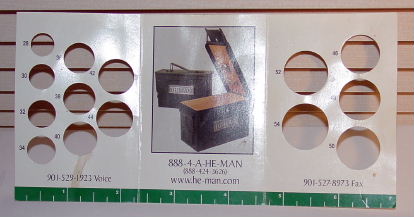
So basically, this is a ruler with plastic ring gauge cards attached thereto. Whereupon one reads the indicia of the ruler and pokes the cards with a cigar to adjudge the ring gauge of the aforesaid cigar. Because otherwise, you’ll never know what you’re smoking. No, really:

While many manufacturers use similar standard sizes for their cigars, they typically assign their own proprietary names for the various sizes of the cigars they make. These proprietary names, however, do not typically appear on the paper band or ring on the cigar itself. Rather, the paper band typically contains only the manufacturer’s name. Table 1 lists examples of sizes and names of various cigars according to The Cigar Companion.

Each manufacturer has its own blend, and each manufacturer generally uses a different blend of tobaccos in each of the sizes of cigars it makes in its product line.

Thus, a cigar smoker who has enjoyed a particular cigar cannot use the manufacturer’s name on the paper band to determine the name or size of the particular cigar. Accordingly, such a cigar smoker has no way to purchase the same cigar.

The application filing date on this extraordinary invention is 1995 and it was published in 1997. Sounds about right. What’s even better is that there’s another patent that cites this one for a gadget called a “Novelty Cigar Gauge and Measuring Apparatus,” or “Cigar-O-Gauge,” made for Cigar Aficionado. The Cigar-O-Gauge is described a bit more succinctly as “A Flat Paper Product Pullout Insert Titled ‘Ring Gauge Guide and Ruler’.”

I bet the Cigar-O-Gauge looks a little like my Cigar Measuring Device, which I have used for years, as you can see by the coffee stain which was carefully applied to distinguish it as my personal property:

cnv0324.jpg

Courtesy freepatentsonline.com, may I present today’s Cigar Site of Interest:

The Cigar Measuring Device

Omar Ortez Originals Toro

cnv0323.jpg

Rocky Patel started it all with his bandless Edge cigars packed in rough-hewn crates. Camacho followed up on the theme with El Legend-ario, and the Cubans have been going nekkid for years. But now that Rocky has responded to the copycats with a joky promotion for Edge “Counterfeits” in the latest CI catalog, I don’t know how much longer the trend can last. Even the Cubans have started banding cigars that have never had bands before… and Rocky is now banding Edges at the foot! Bandless cigars may soon be on the endangered list. Despite all this, Altadis showed up late to the party last year with a bandless Nicaraguan called Omar Ortez Originals.

Omar Ortez is a native Nicaraguan tobacco man who in the past has worked with Philip Wynne in the production of Felipe Gregorio and Felipe II cigars. Ortez established Agroindustrial Nicaraguaense de Tabaco in 1995, and is also the blender of the Exile brand cigar made in the NATSA factory. He oversees a “vertically integrated” production facility (like Padron) where he controls every aspect of the process — from seed to smoke.

Omar Ortez Originals are presented without bands and come packed in unfinished crates of 60. So far three sizes are available: robusto, toro, and torpedo.

The manufacturer is a little tight-fisted with information about the blend, admitting only Nicaraguan wrapper, Nicaraguan binder and –wait for it — Nicaraguan filler. But looking at this cigar I’m really reminded of the Ecuadoran leaf used on Aurora’s Pueblo Dominicano and 5 Vegas Limitada cigars: the smooth sheen and widely spaced veins are eerily similar. It’s a rustic looking cigar, a little rougher than the Auroras, but that goes along with the whole tough guy 60-count crate thing. Like you might pick up a crate of these at the tack store while you’re loading up on alfalfa for the herd.

It opens up with a woody flavor typical of Nicaraguans, accented by a metallic twinge that dissipates after a couple inches. It’s a full flavored smoke, but for the first third the aftertaste is very mild with no spice. There’s a nice aroma here: simple wood at first, followed by some light spice that makes the aroma smell almost like sandalwood. Not what I expect from a Nicaraguan wrapper, but very nice. The flavor moves into bittersweet chocolate territory in the second third and the aftertaste becomes slightly bitter. Towards the end of this cigar the flavor becomes sweeter, almost chocolate liqueur-like. Unusual, unexpected, but not unpleasant.

Omar Ortez Originals are Nicaraguan puros that really don’t smoke like Nicaraguan puros. They’re medium to full bodied cigars with good construction, fine taste, and an unusually sensitive aroma. They’re far less aggressive than I expected, which is probably a good thing. What they lack in power is balanced very nicely by a complexity that belies their appearance.

And get this: they’re affordable. If you play your cards right, you can pick these up for less than three bucks a stick. As Borat would say: “You like! I very excite!”

Padilla Edicion Especial Achilles

cnv0320.jpg

There is a curious term Homer uses to describe Achilles: ainaretes. It isn’t easily translated, but it means something like “terribly excellent” or “darkly brave.” I read classics as an undergrad and now, whenever I hear the name of this powerful and tragic figure, I think of this term. I’m not sure why Ernesto Padilla chose to name his special edition cigar in this manner– maybe Homer has nothing to do with it — but for me there is something dark and brooding and yes, powerful, about this blend which might bring Achilles to mind.

As with his Padilla Miami 8 & 11 and his Signature 1932, this cigar is blended by Ernesto Padilla and executed by Jose “Don Pepin” Garcia. Unlike the other two, which are made in Garcia’s Miami factory, the Achilles is produced in his Tabacalera Cubana in Esteli, Nicaragua. Distribution is exclusive to Cigars International, as far as I know, and the production has been limited to 60,000 cigars in one size only: a 6 x 50 toro.

This is a Nicaraguan puro with a Nicaraguan corojo wrapper. It’s a handsome and solid looking stick. The wrapper is very smooth and slightly glossy, and the head is finished with a beautiful triple cap. From start to finish this cigar has great construction: an easy draw, a fine white ash, and a mostly regular burn. (I let these stabilize for a month in the humidor after receiving them, which is a good practice with any of Don Pepin’s smokes.)

It starts out with pepper on the palate and begins to mellow after the first half inch or so. It gets creamy with leathery undertones for the next couple of inches and then the pepper returns. The aroma from this corojo is fantastic. I think the wrapper is the secret to all of Pepin’s cigars, and this one is no exception. There is a caramel and bread-like aroma here that I have found only in Havanas and in Garcia’s cigars, which is probably what so frequently earns his cigars the title “Cubanesque.” I would mark this one down on just one point: there is a slightly greenish, astringent quality to the tobacco which to my palate indicates some young leaf. It isn’t overpowering, but it is present and persistent. The combination of sweet caramel breadiness and this astringent quality is what makes this cigar smoke “dark,” I think. But again, this is not unusual for a Pepin produced cigar. He seems to be making cigars not just for today, but for years to come.

Padilla’s Achilles is a medium to heavy bodied cigar that packs a decent punch, like the warrior who shares its name. Smoke them slowly with a cool drink after a good meal. These won’t be around forever, so you’d be wise to pick up a few mazos now, try a few, and put the rest to sleep in a deep dark pleasantly humid place where they can mature in peace. A couple years down the road and I bet this will be a classic.

Puros Indios

cnv0319.jpg

Puros Indios by Rolando Reyes, Sr. is made in Danli, Honduras with no Honduran leaf. For some reason Don Rolando just doesn’t like Honduran tobacco. Instead, he uses Ecuadoran wrapper, Ecuadoran binder, and filler leaves from Nicaragua, Brazil and the Dominican Republic. I’ve smoked a lot of these over the years because they’re decent tasting affordable cigars.

Rolando Reyes has a reputation as a hard-nosed tobacco man who watches his factory like a hawk. He reportedly examines every single cigar produced by his company and can tell a bad batch of cigars merely by weighing them in his hand. After the workers have gone home for the night he looks over the day’s production, and if he finds too many mistakes from a roller he turns that worker’s table upside down and leaves a note reading “ojo” to let that unfortunate soul know that the Don has his eye on him.

Puros Indios cigars are mild to medium in body and have a fine woody aroma with a floral element that makes them easy to smoke just about any time of the day. The flavor is leathery with a very soft finish and aftertaste. The only drawback that I’ve found is a slightly metallic flavor that comes and goes. I find that the flavor goes quickly downhill after the two-thirds point, so if you’re a nubber you might want to look elsewhere.

Most of them have good construction as well, with the exception of some of the smaller ring gauges that have, in my experience, been rolled a bit tight. Time to knock over a couple rolling desks, eh Rolando?

You can find these in most places for under four bucks per stick, sometimes under two if you buy them by the box on one of the auction sites. I always have some on hand for the ride home from work or to hand out to moochers. Because even moochers need love.

Habana Leon Torpedo

cnv0314.jpg

The name of this cigar is a tribute to the Habana Leones, the pre-revolutionary Cuban baseball team also known as “Los Rojos” due to their red uniforms. Ever since baseball was introduced to the island in the mid-nineteenth century, it has been enormously popular. The Leones of the Cuban League era have been compared to the New York Yankees — they were celebrated throughout the nation, but hated by fans of their rivals. And for the Leones, the Almendares Scorpions — also known as “The Blues” — were their Brooklyn Dodgers. So far there is no Scorpions cigar from Don Pepin, so we know where his allegiance lies.

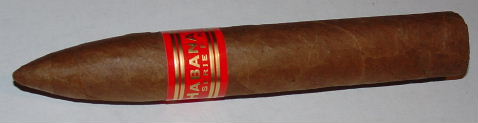
The band on the Habana Leon is an immediate tipoff to its Cuban inspiration: the Partagas Serie D (or P.) And like the PSD this is a powerful cigar. Utilizing a reported 70 percent ligero, this is one of Pepin’s strongest blends. Like most cigars from Rey de Los Habanos, this one uses all Nicaraguan tobaccos.

The torpedo is perfectly proportioned but somewhat shorter than the standard at 5 1/2 inches long. The wrapper is a fairly dry and veiny vintage 2000 corojo, but the roll is rock solid and the cigar feels very well balanced in the hand.

I figured I would need a wide cut for this cigar, so I took about half an inch off the tip with a Palio cutter and fired it up with a torch lighter. The first thing that jumped out at me was a rich skunky odor. Take a typical barnyard kind of tobacco aroma and compound it with rich loam: a nasty dirty lovely smell. The first few puffs were surprisingly smooth, and the rest of the cigar would follow suit.

The draw was a little bit loose, and the stick softened considerably after a few minutes. It burned a little unevenly and required a couple of touchups. The ash is a striated light and dark gray in color, similar to the ash produced by many Cuban cigars. Overall decent, but not great construction.

The Habana Leon is a powerful, but not a hugely spicy cigar. (Another surprise, since almost all the Pepin Garcia cigars I’ve smoked have at least started with a fistful of spice.) The flavors are complex and varied, making this a really interesting experience. It starts out fairly mild in flavor with a short finish and very little aftertaste. What I notice at first is the outstanding aroma rather than the flavor. Within a couple minutes I feel a big buzz coming on and decide to take it slow.

The flavors here evolve slowly and show a lot more subtlety than I expected: some bean flavors, a little papery at times, and some sweetness even. Halfway through the cigar comes the pepper I was expecting at the outset, but it arrives without the expected harshness. The most surprising aspect of this cigar is its smoothness. The finish and aftertaste gain prominence, as expected, but this cigar never gets bitter or sour. By the time I’m ready to put the butt to bed (and my butt into bed) I’m tasting a lot of bright Nicaraguan tobacco flavors typical of Pepin cigars. And to be honest, I almost nubbed this guy, which is unusual for me to do with a strong cigar.

One thing I’ve noticed about all the Pepin cigars I’ve been lucky enough to try is that they benefit greatly from a little humidor time — they seem to mellow out quite a bit in a relatively short amount of time. Maybe traveling makes them grumpy.

This one had been idling in my desktop humidor for about six months and while I had some minor quibbles with the construction, the complexity of the smoke really made up for it. Habana Leon is available from Cigar King for around six or seven dollars. If you like Pepin’s other blends, you’ll love this one. And if you’ve never smoked one of his creations, you’ll get a kick (quite literally) out of this big red brute. Just don’t try it on an empty stomach.

Hoyo de Monterrey Dark Sumatra “Ebano”

cnv0313.jpg

Hoyo de Monterrey literally means “the hole of Monterrey,” which coincidentally is also the final destination of a good part of my paycheck. Not so literally, “Hoyo” means a valley, which is a nice place to grow tobacco because the plants are well protected from high winds. The valley of Monterrey is located in Cuba’s famed Vuelta Abajo, and this is where Jose Gener first grew the tobacco for his Hoyos in the mid nineteenth century.

In 1931 the Gener family sold their holdings to Fernandez, Palicio y Cia., the makers of Punch. They produced Hoyos for a couple decades and finally, after being hounded out of Cuba by the little green men, sold the Hoyo de Monterrey brand to the Villazon family. Today the Villazon outfit is owned by General Cigar, and the brand is still produced in their Cofradia, Honduras factory overseen by Estelo Padron.

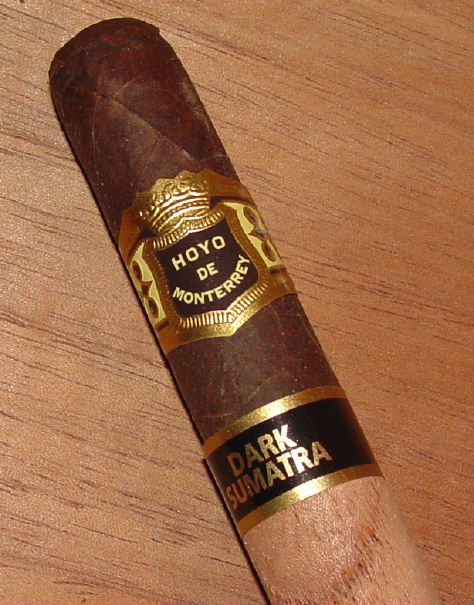
The Dark Sumatra line was introduced in 2002 using an “unusually dark” Ecuadoran wrapper leaf that Estelo Padron found in one of his warehouses. It is certainly the darkest Ecuadoran wrapper I’ve come across — it is at least a maduro in color, if not oscuro. To create a striking and bold blend, Padron utilizes a Connecticut broadleaf binder and a filler combination of Honduran, Nicaraguan, and piloto cubano leaf from the Dominican Republic.

The names of the various sizes in this line all reflect the dark nature of the wrapper — Media Noche, Noche, and Espresso. This is the Ebano, a grand corona measuring 6 x 45.

Beneath the cedar sheath of the Dark Sumatra lies a very dry wrapper that is almost dusty in appearance — the dark hue of the wrapper highlights this effect, resulting in a somewhat rustic appearance.

The Ebano starts up with a hearty flavor of earth and surprised me with a classic Ecuador Sumatran aroma. I was expecting something different due to the unusual treatment of the wrapper leaf, but it turns out to be the aroma typical of ECSU — very autumnal, a scent of burning leaves and hearth smoke.

The smoke itself is fairly big-boned, full bodied but smooth with no initial bite. Overall, this stick is constructed very well: an even burn that leaves a solid dirty gray ash in its wake, and a firm but easy draw that results in nice clouds of smoke.

At the mid-point this cigar picks up some heavier flavors — a charred earthiness that reminds me of maduro without the sweetness. In the final stage it produces a slight burn in the sinuses and back of the throat.

This is a satisfying and straightforward smoke. There isn’t a whole lot of complexity here, but if you enjoy Ecuadoran Sumatra wrapper in a medium to full bodied cigar, the Dark Sumatra is worth a look. Like most premium cigars from General, these are attractively priced at around 3 or 4 USD per stick.

Gurkha Master’s Select Perfecto No. 1

cnv0312.jpg

Kaizad Hansotia, the maker and master marketer of the Gurkha label, claims that his Master’s Select cigars are modeled on the 1957 Bolivar. Evidently a box of preembargo Cuban cigars washed up on the shore at Beach Cigars and they thought they were so good that they would try to replicate the blend. Good idea, because around every corner lurks a cigar rep who will tell you how similar to Cubans his cigars are, and unless you’re intimately familiar with this rare and contraband product, there’s no disproving him. (Of course, a box of 1957 Bolivars would not be contraband in the U.S. But you get the point.)

Readers of this blog are likely aware of how tiresome I find marketing tools, and I could go on about it, but at the end of the day it’s the cigar that speaks for itself. Like any other kind of evaluation, it’s best to recognize the advertising for what it is and move on.

Gurkha’s Master’s Select line includes three zeppelin perfecto sizes: big, bigger, and biggest. (Zeppelin, I have come to learn, refers to a perfecto that has its largest ring gauge in the center of the cigar. Thanks Matt!) The Number One is the biggest size at 6 x 60. The Nicaraguan grown Habana 2000 wrapper is smooth but just slightly toothy. It’s an attractive and impressive looking cigar.

Made in the Dominican Republic (probably in the Navarette Torano factory) with a Dominican binder and filler from the DR and Honduras, this stout cigar is packed full of tasty tobacco. It draws well from both sides before clipping, but I had to assume that the band was on correctly and clipped about half an inch off what the band indicates is the head.

The first thing I noticed was how slowly this cigar burns. It took a good fifteen minutes just to burn through the tip, producing a nice solid white ash. The flavor is earthy with overtones of cedar, which is accompanied by a very heavy aroma of wood. Smoke this cigar in public and it will get you noticed not only for the unusual shape but for the intense room aroma as well.

It is very well constructed, despite a wavering burn line. I don’t smoke perfectos this large on a regular basis, so it was interesting to observe the flavor changes as the cigar grew in ring gauge and then fell. It started out fairly mellow and creamy, an earthy base with nutty notes. Slowly the nuts gave way to a woody flavor, and by the end of the cigar, a little after the mid-point, the flavor gets intensely peppery. The finish is mild and quick to start with and by smoke’s end is sinus tingling with lingering spice.

I’m not sure if this is typical of perfectos, but the smoke gets very intense after reaching the thickest part of the cigar. I enjoyed this particular cigar for maybe an inch beyond this point, where the sheer strength of the smoke began to mask all of the other subtleties and started to burn a little hot. I spent an hour and a half to reach this stage, so I figured I got my money’s worth.

The Master’s Select Perfecto No. 1 is a friendly, but serious cigar. This is a ten dollar cigar that sells for half that, or even less if you keep an eye on the auction sites.

So when you’ve finished your last box of 1957 Bolivar, don’t despair. Reach for a Master’s Select!