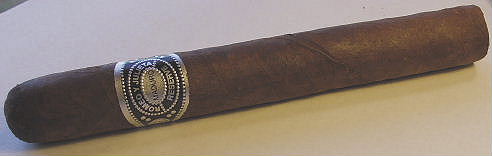
Carlos Toraño Cameroon 1916 Robusto

Cnv0126.jpg

Wrapper: Cameroon

Binder: Nicaragua

Filler: Honduras, Nicaragua

Made in the Toraño factory in Esteli, Nicaragua and introduced in 2003, this is one of the best Cameroon wrapped cigars on the market, in my opinion. When its very reasonable price is factored into the equation, this smoke beats Fuente’s Hemingway line hands down. This is not to disparage the Hemingway in any way, but for the price of half a dozen Hemingway Signatures you can find a box of 1916s. And to tell you the truth, I enjoyed these robustos better than the last Signature I had.

1916 was the year Carlos Toraño Sr. emigrated from Spain to Cuba, and the 1916 moniker marks that occasion. Weighing in at 5 1/2 x 52, this robusto comes fully dressed with two bands and a cedar sleeve. Removing the sleeve reveals a smooth and oily cameroon wrapper with its telltale tooth.

The first few puffs are earthy and smooth, and this is a trait that continues to the end. The ash is white and a bit crumbly. The sweet spice of the cameroon leaf is the next course on the menu, and it doesn’t disappoint. It’s a very slow burning cigar, lasting nearly an hour. The smooth flavor continues throughout, and ends with a woody flavor spiked with a pervasive sweet spice that lingers in the nose. The cameroon leaf burns with a fragrance that smells almost like perfume. Good perfume, not that fruity stuff.

The aftertaste is a little bitter, but that is the only criticism I have of this cigar. (Maybe the aftertaste would be a little less pronounced if I could keep myself from smoking these to the nubbin.)

All Toraño cigars are draw tested, and I’ve never had one that didn’t draw really well. The construction standards applied here are clearly exceptional. Anyone who appreciates cameroon leaf and likes a smooth medium-bodied earthy taste in their smoke should definitely give this one a try.
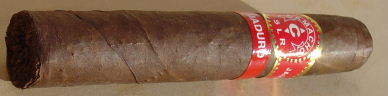
Camacho v. Camacho

Cnv0123.jpg

Camacho SLR Maduro, Plaintiff
Cnv0122.jpg

Camacho Coyolar Puro, Defendant

The parties in this case, after a failed arbitration process, have filed briefs, short fat leafy briefs, seeking final judgment in the court of Cigarfan. The disputed point is one of taste, and applying the law thereof is the task at hand. The applicable statute is embodied in the terse legal maxim “De gustibus non disputandum est.” The parties will now accompany the judge for an evening in chambers with a bottle of Chateau Thames Embankment, after which judgment will be rendered.

Now then… I found a pack of Camachos at my local tribal smoke shop that included four robustos from their several lines: SLR Maduro, Coyolar, Corojo, and a Diploma. (For 13 USD I couldn’t resist.) I’m familiar with the Corojo and Diploma (which in fact is a Corojo) so I thought I’d pit the other two against each other in the court of my opinion.

The SLR maduro is Honduran with a Connecticut broadleaf wrapper. I wasn’t too impressed with the flavor of this stick, but I wasn’t really expecting to be since I don’t care much for the natural version of the SLR either. (Yes, the judge may enjoy a prejudiced disposition. Tough oats.) The dominant flavor seemed to be graphite, a lot of char and just a touch of maduro sweetness. Full flavored, but I just didn’t care for the flavor. On the positive side, it burned perfectly straight with an effortless draw. Fine construction.

The Coyolar is a Honduran puro, named for the farm on which the tobacco is raised. The wrapper is an attractive colorado maduro that is just about the same shade as the maduro SLR. The flavor profile is close to the Camacho Corojo line, but not as well rounded. It tasted to me like a combination of the Corojo monarca and the SLR… Unfortunately, to me this comes across as an adulteration of the Corojo blend. There’s a sharp element to the Coyolar that the Corojo doesn’t have, perhaps comparable to the difference between cloves and cinnamon. Comparing it to the SLR is a little more difficult, but I have to say that the flavor profile of the Coyolar with its spice and leather gets my vote over the SLR. Both had great construction, so no complaint there.

So it comes down to a matter of conflicting flavors, over which this renegade activist judge must preside. Facts are considered, opinions are weighed, evidence submitted. After several moments of smoky reflection, Judge Cigarfan rules in favor of the Coyolar.

Case dismissed pending appeal.

Romeo y Julieta Reserve Maduro Toro

Cnv0121.jpg

Originally slated for release in 2002 the Reserve Maduro series was postponed due a shortage of Connecticut broadleaf. Altadis uses the same leaf on its Onyx reserve and the machine-made Backwoods. It is somewhat amusing to me to think that a Romeo y Julieta project could be sidelined by a bunch of mangy Backwoods… but bidness is bidness.

The Reserve Maduro is a completely different blend from the natural (1875) version, which is all Dominican with an Indonesian TBN wrapper. Fairly often a maduro line of a given brand will have the same blend as the natural line, just with a maduro wrapper. Not in this case. What we got here is a “Blackened” Connecticut broadleaf wrapper surrounding a Nicaraguan binder and a Dominican, Nicaraguan, and Peruvian filler. The wrapper is described on one site as being “triple-fermented,” a phrase I’ve heard before that I suspect is largely window dressing. Maduro wrappers are normally fermented multiple times, so maybe there’s something I don’t understand here.

This fellow measures 50 x 6. Not the prettiest sight in the humidor, but Connecticut broadleaf is not known for its gentility. Prelight it smells like a chicken coop. Snipping off the cap and whiffing the head gives me a premonition of a very rich smoke to come — rich earth in addition to the unfortunate coopiness.

This is an unusual cigar. The barnyard factors high in its flavor profile, along with a sweet char typical of maduros. It’s medium in body, certainly not the powerhouse I was expecting. This is good — despite the imposing appearance of this stick the interesting flavors are fairly subtle. There’s an earthy richness which proves my initial pre-light impression correct. It’s a smelly smoke, with an excremental element that might turn some people off. I can see this being a “love it or hate it” cigar.

The Onyx reserve tastes nothing like this, so if it is in fact the same wrapper, I’d guess that the Peruvian filler is somehow involved in this odd flavor profile. When my father was stationed in Turkey he saw skeins of tobacco stretched out on the ground upon which camels would relieve themselves from time to time. He told me this is why Camel cigarettes taste the way they do. I think he was joking, but maybe there is a similar practice in Peru.

My final opinion is that the R Y J Reserve Maduro is a cigar of interest. Definitely worth a try just for the experience, but I don’t think I’ll add it to my regular rotation.