Saint Luis Rey Cazadore…Mystery Cigar

Cnv0139.jpg

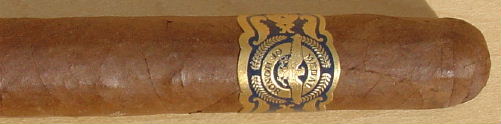
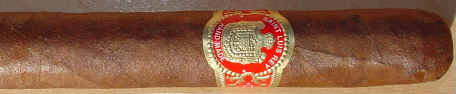
I picked up a box of these for forty bucks during JR's "12 Days of Christmas" promo last year. I can find no description of an SLR Reserva Especial Cazadore anywhere, excepting the Cuban SLR, and the new version which I can find listed only on the JR Cigar website. I can safely trust that this is not Cuban, and the description of the new line differs from this one. So I honestly have no idea what the components of this stick are, but that will not stop me from guessing.

It's a churchill or double corona in size, at 7 x 48. The new SLR double corona is shorter and the churchill is fatter, so "Cazadore" is not an alternative frontmark for either of those. The review descriptions of the "new" SLR double corona are that is mild to medium in body, (though the company publicity says it is "full flavored"); this Cazadore is full bodied from the start.

The new version is a four country blend, while the old version was a Honduran puro. JR Cigars carries a new version of the cazadore that measures 6.75 x 48, and arrives in black semi-boite boxes. These came in a paper-covered flip top box. An enigma wrapped in a mystery… Based on the flavor profile, I'm going to guess this is the old blend.

There is a roundness to Honduran cigars that I really enjoy, and this one has that same quality. It's a woody, spicy smoke with a nice bite to it. The draw is good, and the ash is somewhat flaky. It's certainly a heavyweight cigar. I put it down after the 1/3 point and returned to it a few minutes later after attending to some things in the house and finding a suitable beverage to accompany the last few inches. Re-lit, it burned and tasted like I never put it down.

If you've been following these posts you know I'm a little bit compulsive about knowing the minute details of the cigars I enjoy. My research into the Cazadore has left me dangling. If only Sherlock Holmes were here.

"The writing on the wall was done with a man's forefinger dipped in blood. My glass allowed me to observe that the plaster was slightly scratched in doing it, which would not have been the case if the man's nail had been trimmed. I gathered up some scattered ash from the floor. It was dark in colour and flakey — such an ash as is only made by a Trichinopoly. I have made a special study of cigar ashes — in fact, I have written a monograph upon the subject. I flatter myself that I can distinguish at a glance the ash of any known brand, either of cigar or of tobacco. It is just in such details that the skilled detective differs from the Gregson and Lestrade type."

A Study in Scarlet

Sir Arthur Conan Doyle

Punch Champion

Cnv0138.jpg

This is one of the most unusual shapes I've come across; it's sort of an inflated perfecto. At its largest point it measures nearly an inch in diameter — 60/64ths. The Champion was introduced in 2001, and was promoted by General Cigar with a "Heavyweight" competition judged by smokers who chose by a 58 to 42% margin that this blend was superior to an alternate competing blend.

The Champion is a member of the "original" Honduran Punch family, not to be confused with the Grand Cru, Gran Puro, or other lines. Made in Cofradia, Honduras in the HATSA factory with an Ecuadorian Sumatra seed wrapper, a Connecticut binder, and filler from the Dominican Republic (piloto cubano,) Honduras, and Nicaragua, this is a cigar that took a lot of thought and care in the production.

I picked this one up on an Indian reservation north of Las Vegas, and by the looks of things they weren't doing a whole lot of traffic in the cigar department. They seemed to be selling more fireworks and tourist trinkets than anything else. Plastic paperweights with scorpions in them. That sort of thing. But the cigars seemed to be in good shape, so I picked up a couple Champions because I found the shape intriguing. After about a month in the humidor I unwrapped one and noticed tiny crystals on the wrapper, just the beginning of bloom. Time to fire one up.

This is a tasty little smoke. At 4 1/2 inches it's gone in 30 minutes, but it's a half-hour well spent. It lights up easily and burns well with a solid gray ash. It tastes somewhat woody and has a sweet overtone, something close to cherry. Reminded me a little of the Rocky Patel Vintage 1990, but not quite as smooth.

But once over the hump the flavor declined, and it began to burn a bit hot. At that point my 30 minutes was just about up, and I had to go finish some chores anyway. This is a great short smoke, highly recommended as a medium bodied mid-day cigar.

K. Hansotia “Signature 101” Robusto

Cnv0137.jpg


Information about this line from Kaizad Hansotia is sparse and conflicting. Cigars International says it has a Costa Rican wrapper surrounding a blend of Honduran, Dominican and Jamaican filler. The Ghurka site says its a Connecticut broadleaf wrapper, a Costa Rican binder, and Dominican filler. I guess I'll go with the manufacturer, because this wrapper neither looks nor tastes like the Costa Rican maduros I've sampled.

Hansotia is the maker of the Ghurka line of cigars. He bought the Ghurka brand name for 143 dollars in the late 80's from an obviously struggling company in Goa, India. The brand fought its way to the top through the boom years and today claims many fans who are willing to pay top dollar for Hansotia's boutique stogies.

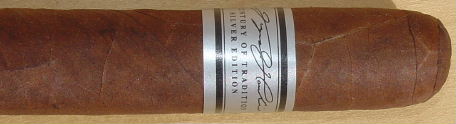
The band says "A Century of Tradition" but it's not a century of cigar making. He comes from a tradition of watch making, which is perhaps why all the Hansotia cigars are packaged so elegantly. The boxes of some of the Gurkhas are works of art all on their own. Even the low to moderately priced cigars have very nicely designed bands that make the cigars appear far more dear than they are.

It isn't clear exactly who makes the Signature 101, but Toraño is a likely suspect. The blend is reportedly Hansotia's personal favorite, hence the "signature" moniker. But this is one of those mysterious cigars that refuses to be categorized, no matter how I try. Even the size is an enigma: at 6 x 50 it's a toro, but it calls itself a robusto. Trust in nothing but your own senses here. The truth is in the smokin'.

Prelight it smells like a well-tended old boot. It starts out with some harshness that lessens and evens out after an inch or so. This is a dry tasting maduro, lip smackingly tart. The wrapper burns unevenly and requires a touch up now and again. The draw is excellent with plenty of spicy smoke. The primary flavors are earth and char; a good smoke to clear a room with. I'd read this was a medium bodied stick, but once again the information is wrong– this is a full bodied cigar, akin to the Romeo y Julieta Reserve Maduro without the funkiness. The ash is flaky, and aside from the uneven burn the construction is good.

All in all, it's a good cigar. Not my favorite flavor profile, but a quality cigar nevertheless.


Joya de Nicaragua Antaño 1970 Robusto Grande

Cnv0135.jpg

Joya de Nicaragua was the first Central American brand to be produced after the Cuban revolution. The company that originally made the brand was started in 1964, and the Joya de Nicaragua name was trademarked in 1970. The Joyas produced around this time were made in the Cuban style to attract American customers who could no longer purchase the Havanas to which they had become accustomed. They were strong, robust cigars, and soon set the standard for Cuban-style cigars in the U.S.

The Somoza government heavily subsidized the tobacco industry in Nicaragua, seeing an economic opportunity to fill the vacuum left by Castro's revolution and the U.S. embargo. With the help of luminaries such as Nestor Plasencia and Jose Padron, the Cuban style cigar found a foothold in Nicaragua. Alas, the Somozas were dictators as well, and when the government was overthrown by the Sandinistas in 1979 the tobacco industry was emasculated in the name of the proletariat. In 1985 another U.S. embargo was levied, this time on Nicaragua. Tobacco production was geared toward the production of cigarettes for the Eastern European market.

But the Sandinistas met their demise as well, and the cigar industry bounced back. But the Joya de Nicaragua of the mid to late 1990's was not the same. It was a mild shadow of its former self. So in 2002 Tobacos Puros de Nicaragua S.A. developed a cigar that would bring back the memories of the early brand: the Antaño 1970.

The Robusto Grande is a sawed-off 10 gauge of a smoke. Measuring 5 1/2 x 52, it's solid in the hand, firmly rolled with a slight box press, and looks like it means business. The pre-light aroma is earthy and rich. It smells like it has only recently been recovered from some underground vault. It has a firm draw and is a little difficult to light. Once fired up it burns with some reluctance, as if it's daring me to draw on it more frequently than I should. C'mon kid… I dare ya.

Without a doubt this is a heavy bodied cigar. It's rich and flavorful, but somewhat bullish, a little single-minded. It reminds me of a Padron 1926 minus the sophistication and complexity. The primary flavor is rich tobacco, with a woody element, accompanied by a metallic twinge which is typical of some Nicaraguans. This cigar begs to be smoked slowly, but it wouldn't let me without going out or burning unevenly. A salty quality also calls out for a strong beverage. Lagavulin met the challenge.
I like this cigar, but I'll be trying other sizes to see if they have better construction. Once I recover, that is.

Cigar Family by Stanford Newman, Part 2

Cnv01301.jpg

In the 50’s the M & N Company was using more Cuban tobacco than ever before, and to facilitate their manufacturing process the company moved to Tampa, Florida. One of J.C. Newman’s dreams was to have a truly “premium” cigar in the M & N stable; Stanford accomplished this with the acquisition of the Cuesta Rey brand from Karl Cuesta. His next problem was how to competitively market his new premium, the Cuesta Rey Palma Supreme, at 26 cents:

A fellow will try a new cigar, like it, and never buy it again. He goes back to the brand he is used to. It’s like a marriage. A man can go out with a girl on the side and think she’s the best woman in the world, spend the whole night with her, but in the morning he’s forgotten her name and he goes right back to Mamma. I often told our salesmen that we were only going to get as many conversions to our brand as there were divorces.

His solution was to market a new line, the Cuesta Rey “Number 95.” The numbered name was distinguished and unlike the competing brands. And he did something else to distinguish it from the others: he raised the price from the standard premium price of 26 cents to 35 cents! (A tactic still in use today by premium cigar makers, if I might add.)

The use of 100 percent high quality Cuban tobacco was also a factor in the success of the new Cuesta Rey. This involved numerous trips to Cuba to inspect the tobacco, and as it turns out, the fertilizer.

My visits to Cuban tobacco plantations always began the same way: The tobacco grower led me straight to the largest pile of cow manure on his farm. “Just look at that nice big pile!” he would say, beaming with pride. As my tour of the plantation continued, the farmer inevitably called my attention to every immense pile we came across.

One of Newman’s primary suppliers in Cuba was Carlos Toraño Sr., who was betrayed by Castro after the revolution and by Newman’s account appeared in person to seize Toraño’s farms. (This was Toraño’s reward for helping Castro finance the revolution, believing Castro’s declaration that he was not a communist to be sincere.) But the revolution had repercussions for Newman as well, especially after Kennedy signed the Cuban Embargo into law.

The Tampa cigar manufacturers stored most of their tobacco in warehouses in Havana and had it sent to them as needed on a ship called The Privateer that traveled between Havana and Tampa twice a week.

One man convinced me to prepare for the day when The Privateer might no longer be allowed to bring Cuban tobacco into the United States: Angel Oliva, one of the most prominent leaf tobacco dealers in Havana and Tampa, and one of the fairest, most honorable businessmen I knew. He was convinced that the Cuban situation was only going to get worse. He believed the U.S. would soon be forced to embargo Cuban tobacco in retaliation for Castro’s increasingly hostile conduct. In July of 1960, Angel invited me to visit a tobacco grower and packer in Quincy, Florida, the same tobacco-growing region I had turned to when Connecticut Shade became prohibitively expensive after World War II.

At first, I declined Angel’s invitation. Why buy Florida tobacco when I could still get it from Cuba? But Angel was persistent. He practically dragged me to Quincy, even paid for my plane ticket. In Quincy, we discussed the possibility of growing candela wrapper. The tobacco dealers did not want to produce the candela tobacco unless someone was prepared to buy it. I agreed to put up the money for an experiment to produce about 100 bales.

When the tobacco was ready, I took fifty bales and encouraged Angel to take the other fifty as samples to show other cigar manufacturers. I wanted to make this wrapper tobacco popular so that it would be accepted by consumers and the industry. Most of the manufacturers wouldn’t even look at it. They quickly changed their tune when, four months later, the embargo Angel had predicted came to fruition. The other Tampa cigar manufacturers then followed my lead, placing orders with Angel Oliva for more than 6,000 bales of Quincy candela wrapper

Eventually Cuban wrapper would be supplanted in the U.S. by Cameroon leaf, which was controlled by a French monopoly. Cameroon leaf was auctioned off at events called “Inscriptions,” and at one of these Stanford had yet another opportunity to display his business acumen.

One year, when the Cameroon tobacco crop was in short supply, I set an Inscription record for the highest bid ever offered in the auction’s history. I joked that if one of my employees had paid that price, I would have fired him. If I had been working as tobacco buyer for someone else, I’m sure they would have fired me too.

I believed that if we had the highest quality tobacco, our cigars would sell; that the bitterness of poor quality remains in a smoker’s mouth long after the sweetness of low price is forgotten. And I was right.

In 1986 Carlos Fuente approached Newman with a proposition. Fuente wanted out of the machine-made cigar business he had in Tampa to concentrate on his hand-made cigars in the Dominican Republic. He asked Newman if he would interested in taking over his Tampa brands. Newman did the math and found that he couldn’t make a profit on this deal. But he said he’d do it anyway, on one condition: that Carlos Fuente make premium hand-made cigars for the Newman outfit. He agreed, and soon Fuente was producing La Unica for Newman, followed soon by Cuesta Rey. As the cigar boom caught fire in the late 90’s the Newman-Fuente combo came up a number of super-premium smokes, among them the Diamond Crown which features tobacco aged for five years and an inspection regimen so stringent that only fifteen of every fifty cigars produced are approved for sale.

Today the Newman family and the Fuente family work side by side as cigar families; in fact their website is just that: http://www.cigarfamily.com/

Cigar Family is a fascinating read for anyone interested in the American cigar industry. And for anyone who enjoys Diamond Crown, Cuesta Rey, La Unica, or any of the other great cigars from the Newmans—it’s required reading.

And a great deal on Newman’s Cuesta Rey Centro Fino cigars is available by joining the Connoisseur Club by J. C. Newman.

Stay tuned for a review of a Diamond Crown Maximus pyramid which has been beckoning to me from the humidor…

Medal of Honor “Intellect”

Cnv0134.jpg

The Medal of Honor brand is an old brand that was resurrected in 2005 by Lew Rothman to celebrate the memories of men who helped JR Cigars become one of the largest, most successful cigar outlets in the U.S. (There was a “Medal of Honor” cigar made in the boom years that was pretty awful; it should have been called “Dishonorable Discharge”. This Medal of Honor is an entirely different animal.)

The Intellect honors Martin Herbst, and this paean is engraved on the inside top of the box:

A History teacher by trade, Martin married into the family that operated the Joseph Jonas cigar company on Nassau St. in New York City. Joseph Jonas & Co. was the largest mail order cigar dealer in the USA specializing in fine Havana cigars at the time of the Cuban Embargo.

In the mid-1960’s Martin formed his own company, International Cigar, and was the creator of the Maria Mancini and La Finca cigar brands. He pioneered many innovative mail order techniques that essentially changed premium cigars from a specialty item available in major metropolitan markets only, to a nationally marketed luxury product.

Medal of Honor cigars are made by master tobacco blender Estelo Padron in Cofradia, Honduras, in the Villazon factory. The Intellect is a five country blend, with an oily Ecuador Sumatran wrapper, a Connecticut broadleaf binder, and filler from Nicaragua, Honduras, and the Dominican Republic. Measuring 6.25 x 45, it is billed as a “grand corona” or a “thick corona.”

Packed in heavy varnished boxes of 35, and priced along the same lines as other Villazon products– not cheap, but not out of reach either. I think I paid around 70 USD about six months ago when JR was running a special. Not bad for 35 sticks.

The Medal of Honor Intellect is a medium-bodied, easy going cigar with fantastic construction. Every single one has burned razor sharp, even in a brisk wind. It has a woody flavor, with a very mild aftertaste. It’s a refined cigar with a very pleasant aroma, but it isn’t terribly complex. There’s no transition; it starts out with a cedary opening and pretty much stays that way to the end. And that’s about the worst I can say about it, so it must be pretty good. I’ve gone through about 20 over the past few months, and I’ve enjoyed every one.

Arturo Fuente Chateau Fuente Sun Grown

Cnv0133.jpg

The Arturo Fuente family of cigars is ubiquitous for a good reason: they’re high quality smokes at a reasonable price. Reviewing a Fuente is almost beside the point, because everyone knows Fuente cigars. Unless you’re brand new to the world of cigars… in which case this review is for you.

The Sun Grown line is the most recent addition to the Gran Reserva line. The wrapper is Ecuadorian “sun grown,” which might lead one to believe that this wrapper was grown in broad daylight. Not necessarily so, because the tobacco region of Ecuador is located in the foothills of the Andes and is cloud-covered for most of the growing season. The clouds form a natural shade cloth. The wrapper for the Fuente sun grown line is grown near Guayaquil by the Olivas.

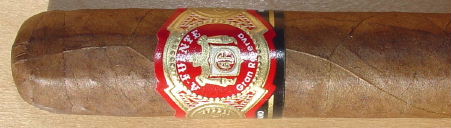
The Chateau Fuente is a robusto measuring 4.5 x 50. The binder and the filler are both from the Fuente family reserves grown and aged in the Dominican Republic. Both the Connecticut wrapped Chateaus and the Sun grown Chateaus come individually wrapped in a cedar sheath; the Connecticut line (natural and maduro) have green ribbon at the foot. The Sungrown has a black ribbon. The lower border on the band matches the color of the ribbon in either case.

This is a medium to full bodied spicy smoke. It starts up with a bite, but mellows while remaining quite spicy. This wrapper is a real treat. There’s a caramel like quality to it which blends with the spice very nicely. My wife came outside to keep me company for a moment and said she really liked the way this cigar smelled — as opposed to the “heavy” cigars she believes are my standard fare. Indeed, this cigar does have a pleasant aroma.

It burns fairly slowly; a good 45 minute smoke, during which I have to consciously slow myself down. Like all the Fuentes I have sampled these have excellent construction. (Pick up a Hemingway Short Story sometime to see how long a superbly crafted small cigar can last.)

At 4 USD this is a steal. The Sun Grown line is not easy to find, so snatch up a couple when you see them. You won’t be disappointed.

Cigar Family by Stanford Newman, Part One

Cnv0130.jpg

Stanford Newman is the chairman of the J.C. Newman Company, makers of Cuesta Rey, La Unica, and Diamond Crown cigars.

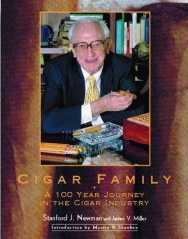
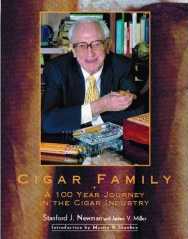
Published in 1999 by Forbes, Cigar Family is both a family history and a portrait of a cigar business that stretches from the late nineteenth century to today.

Newman’s book is a combination of biography, American cigar history, and business advice. He describes in detail the vicissitudes of the cigar business over the years, an industry that has been through numerous booms and busts.

Stanford Newman’s father, Julius "J.C." Newman., started rolling “buckeye” cigars in a barn in Cleveland in 1895. He was an independent contractor, selling his cigars to saloons and grocers. As he garnered more business, he hired assistants to roll cigars, and soon he was managing a small cigar company.

All cigars were hand-made up until the 20’s when machine-made cigars became more prominent. Consumers were far more price conscious at that time, and tended to smoke a lot more than they do now, up to five or six cigars a day. Newman mentions a number of times how raising the price of his cigars by a penny lost his company half its business.

Among the many interesting historical facts noted by Newman is the effect World War I had on the cigar industry:

The financial crisis of 1920 pulled the rug out from under many industries. Inventory values dropped over fifty percent. The most serious problem for the cigar industry was that in the 1920s, cigarettes became more popular than cigars for the first time in history. This happened due to the fact that the Red Cross had supplied millions of cigarettes to American soldiers during World War I. Many a soldier returned from Europe with a new taste for cigarettes.

But the M & N Co. pulled through this crisis with superior marketing and salesmanship. Innovations in technology and the courage to experiment were also reasons for the Newman family’s success. In fact, J.C. Newman was the first one to use cello as a packaging for cigars:

…The Package Machinery Company had introduced a machine in 1918 that encased cigars in a foil wrapper, and this had become a popular method of packaging cigars for several years. However, while foil helped protect cigars, it also prevented consumers from seeing what was inside. Too often, when smokers removed the foil, they discovered damaged or off-colored cigars inside. By 1925, the public had refused to buy cigars encased in foil.

…My father was well aware of the problem. In 1927, a local company that made cellophane bags for peanuts approached him about packaging multiple cigars in cellophane pouches; he immediately recognized the potential in cellophane. It would help protect cigars from drying out, while allowing consumers to see what they were getting. However, he did not like the idea of placing several cigars in a cellophane bag. He felt the best way to protect and present cigars would be to cellophane them individually. Thus, Student Prince became the first cigar in the industry to be individually wrapped in cellophane. Individually cellophaning cigars soon became standard practice throughout the cigar industry.

Newman’s story shows him to be a man who would probably have been successful in any business. He just happened to be born into the cigar business. After serving in the Air Force during World War II, he returned to join his father in the cigar industry, but never having been a smoker he was unfamiliar with the product.

As I contemplated my impeding return to the cigar industry, I decided that my first order of business would be to improve our tobacco blends. To do that, I would have to acquire a taste for cigars. It was time to become a cigar smoker. I wrote to my father and asked him to send me a box of fifty cigars…. Shortly thereafter a box of Student Prince cigars arrived for me at Fort Dix. At the first opportunity, I settled down for my first smoke.. I already had a good palate for food and wine. I expected it would be easy to develop a taste for cigars. I soon discovered just how hard it could be. The cigars were so strong to me that I became extremely nauseated. It took me a full month smoking two cigars a day to become accustomed to them. By the time I finished the box of Student Prince, I was prepared to become a tobacco blender.

He had more preparation than that, however. Just before the war he spent eight months sorting tobacco in Connecticut, during which time he was required to report on what he was learning to his father. Indeed, his father was a taskmaster, but it certainly paid off for the Newman family in the end.

Part Two coming soon…

Fire Maduro Robusto

Cnv0129.jpg

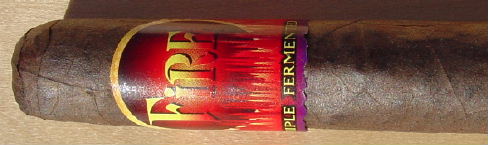
Made by Nestor Plasencia for Rocky Patel’s Indian Tabac in Honduras, Fire is a bargain bundle smoke with “triple fermented” tobaccos. (Though it looks like they’re now available in boxes.) Both the wrapper and the filler are “triple fermented,” but the band is just silly. It looks like it should be the cover art for a Bollywood DVD.

5 x 52

Wrapper: Costa Rica

Binder: Connecticut Broadleaf

Filler: Honduras and Nicaragua

The foot reveals a swirl of different colored tobaccos, and the wrapper is rough but slightly oily. Connecticut Broadleaf is an interesting choice as a binder since in most cases this would serve as the wrapper in a maduro.

But for me the star of the Fire Maduro is the Costa Rican wrapper. It burns unevenly, but with an aroma like this the burn is a minor fault. Toffee is the closest I can come to describing it. The Fire line is on the heavy side of medium bodied smokes, and there is a hint of harshness that comes and goes. With a name like “Fire” a nice bite should be expected. It’s a little one dimensional, but that one dimension is pretty good.

The ash is a mottled gray that held for two inches even while I chased the dogs around the back yard. The roll on all three samples I tried was solid and the draw was firm with plenty of smoke. I smoked about two thirds before the taste began to turn, which in my case made it a 30 minute cigar.

Bottom line: at 2 bucks a pop, you can’t go wrong. Though in the future I will probably opt for the petite corona — they offer a whole lot of flavor in a short smoke.

Punch Gran Puro Libertad

Cnv0128.jpg

5 x 52

Wrapper: Honduras (San Agustin Valley)

Binder: Honduras

Filler: Honduras

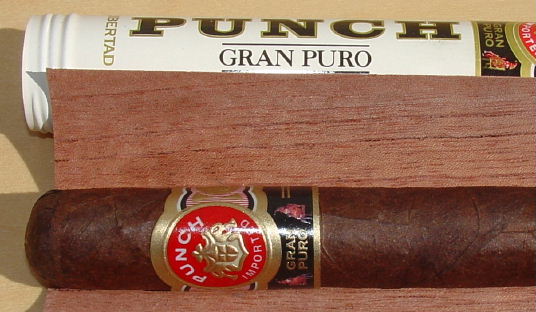
The Gran Puro line was introduced in 2003, but this frontmark arrived only late last year. The Punch brand has been exported to the U.S. since 1969 by the Villazon company. The Gran Puro is manufactured in Cofradia by Honduras American Tabaco SA., but the band pays homage to the original Cuban product with little images of the eponymous puppet.

The Libertad is a cedar lined tubo with an oily sun grown wrapper. Both the wrapper and the binder are sun grown, actually. I had expected this to be a more powerful smoke for this reason, but it seemed to be mellower than the other sizes in the Gran Puro line.

It’s a well balanced cigar that tastes to me like a maduro. A shimmering sweetness floats above the expected Honduran body. It’s robust and meaty, with a woody finish. Never sharp, never biting, and very well constructed. A long white ash accumulates and falls at the two inch mark. Perfect draw and an even burn. At less than 4 USD per stick, I couldn’t ask for anything more. Except more.