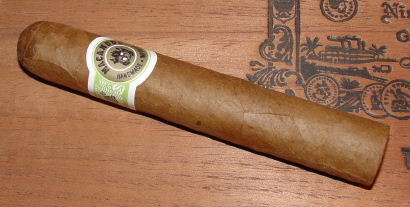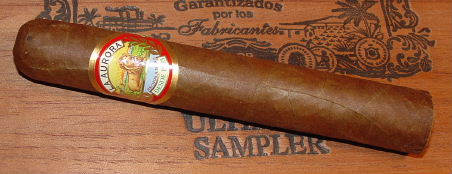
La Aurora Preferidos Robusto

cnv0360.jpg

La Aurora Preferidos were first released in 1998 as a tribute to the first cigars produced by Eduardo Leon Jimenes at the beginning of the twentieth century. They were perfectos called “preferidos,” and indeed almost all of the cigars in the current Preferidos line are perfectos as well. This Cameroon robusto is the one exception. In late 2005 La Aurora saw that there might be a call for a parejo size using the preferidos blend, so they released this robusto in a limited edition of 1200 boxes for the holiday season.

Many of these cigars come in perfecto-shaped aluminum tubes to highlight the premium quality of the Preferidos line. The Cameroon line is the platinum colored one, though they are available nude as well. (I suppose the tube is nice for traveling or if you’re giving the cigar as a gift. Otherwise, it’s an expense I can live without.) There are four other versions available: the Corojo (gold) ; Connecticut Shade (sapphire) ; Connecticut Broadleaf Maduro (ruby) ; and Ecuadorian Sumatra (green.)

The wrapper here is Cameroon, of course; the filler and binder are Dominican, with the binder being piloto cubano. The tobacco for Preferidos is properly aged for two to three years, then aged for several months more in rum barrels. Each cigar is then rolled by a single roller and the finished cigars rest for six months in aging rooms. Finally, the cigars are ready for market.

This is a well rolled cigar with a slightly oily wrapper. The prelight scent is cedar all the way. After clipping the cap I found the draw to be very loose, but after smoking for a few minutes I learned that this did not affect the burn, which was slow and cool. Cameroon is a delicate wrapper and in my climate here in the desert Southwest I find that it almost always cracks as soon as I light up the cigar. This was the case here as well, but it didn’t really affect the performance of the cigar. There was no unraveling, just some unsightly wrapper peels that I was able to ignore by turning the cigar around.

It starts up with the sweet and spicy aroma typical of authentic African Cameroon. Getting a good whiff of this stuff is a sinus surprise, and it kept my nose tingling from start to finish. A very nice Cameroon that is a bit sharper than most, with a little pepper mixed in with the expected baking spices. The initial flavor is woody, somewhat dry, and the smoke texture is creamy smooth.

After an inch or two the sharpness of the Cameroon is blended in with the rest of the cigar and the result is a pleasantly complex smoke. By the mid-point it becomes a little salty and there’s a tartness that vies with the Cameroon sweetness, creating an interesting balance. It reminds me of a really good glass of India Pale Ale — the hoppiness is aromatic, like the wrapper here, while the body of the beer is lip-smackingly astringent. If the proper balance can be achieved, as it is here, this is a killer combination.

The down side to this cigar is the price: about ten bucks a stick or $175 by the box. This is a nice cigar, but my trusty Torano 1916 is comparable in terms of flavor and balance and costs about a hundred bucks less. If a C note is no big deal for you, go for it. The Preferidos robusto is a great cigar, but not for those on a budget.

Sabor Cubano Petite Torpedo

cnv0359.jpg

Sabor Cubano is a product of La Tradicion Cubana, owned and operated by Luis Sanchez in Miami’s Little Havana. Sanchez comes from a family with roots in Cuba’s pre-revolutionary cigar industry, and his tabaqueros are veterans of Havana’s galeras, some with more than twenty years experience rolling cigars in the traditional Cuban fashion.

La Tradicion Cubana got its start in 1995 using blends that were inspired by Sanchez’s grandfather. Sabor Cubano — La Tradicion’s maduro entry — was first released in 1997.

Sanchez is obviously very proud of the maduro used in this blend, repeatedly noting (on La Tradicion’s website and elsewhere) that the wrapper is processed in an entirely natural fashion. (Some of the maduro cigars I’ve smoked recently have made me wonder, like Spinal Tap’s Nigel Tufnel, “How much more black could it be? And the answer is… None. None more black.” And while these cigars haven’t stained my lips or fingers, they have raised some suspicions… but I digress.)

The maduro wrapper employed here is from Mexico’s San Andres valley. By the time it is used in the Sabor Cubano it has been aged for five years, and is accompanied by a binder from Ecuador, and filler from Nicaragua and the Dominican Republic. La Tradicion makes some huge cigars; the standard La Tradicion line includes a gigantic pyramid that comes in at 8 1/2 inches by 80 ring gauge, and they are also the makers of The Big One, perhaps the largest cigar made for non-Guinness breaking purposes. It measures 12 inches long by a whopping 192 ring gauge. Wow.

At only 5 inches by 54, the Petite Torpedo is a veritable dwarf by comparison. The wrapper is not quite oscuro, but most definitely maduro. It has a rough texture, glistens with oil, and prelight the scent is bright and grassy. It smells very much like the few fresh rolled cigars I’ve had the pleasure to smoke. After snipping the tip I found a perfect prelight draw and a touch of pepper on the tongue.

This little guy smokes like a champ. Trails of white smoke wisp from the head of the cigar after every puff. I love that. It doesn’t burn perfectly evenly (what maduro does?) but otherwise I’m very impressed with the construction here. It starts up with a peppery flavor that has a slight bite to it without being truly sharp. The texture of the smoke is smooth and rich, and the aroma is sweet with woody spices.

I’d characterize this cigar as medium in both body and strength. It’s full flavored, but with a short finish and little aftertaste. What really sends me over the edge is the aroma from the wrapper — it’s far more complex than the last two double maduros I’ve reviewed. There’s a bit of char towards the end of the cigar, which is what typified the MX2 and the SLR Serie G, but the Sabor Cubano offers the sweetness of maduro without that carbonized flavor overtaking the softer notes. It’s a more balanced aroma, and in my opinion, a superior smoke overall.

La Tradicion is a boutique brand, but their prices don’t reflect that. Boxes of the Petite Torpedo go for around 75 dollars — well worth it; in fact I’d call that a steal. With a recent expansion to the Dominican Republic the company may be looking to go big, which puts fear into my stogie loving soul. I have a few other blends from the Calle Ocho shop to try, and if they’re as good as the Sabor Cubano I’m going to be eying a certain closet in my house for its humidor potential.

Partagas Black Maximo

cnv0358.jpg

It seems fitting to follow up a review of Macanudo with a review of a Partagas cigar. In a lot of ways Partagas is the rougher tougher sibling of Macanudo, but they share a common heritage. Cuban master Ramon Cifuentes was the man who developed both of these cigars, though he will always be remembered for Partagas in particular because he and his family before him owned the Partagas factory in Havana before the revolution.

Fidel Castro offered Cifuentes command of Cuba’s nationalized cigar industry in 1961, but for obvious reasons he refused. (Let’s see here. You take away my property and my livelihood and then you offer me a job managing it for your government? No thanks.) Instead Cifuentes went to Connecticut where he was soon working for Edgar Cullman and General Cigar. Cullman put him in charge of General’s operations in Jamaica, where Cifuentes would raise Partagas again, like a phoenix from the ashes, in a new Jamaican form.

In the mid-1970’s General released its Cifuentes engineered Partagas with a Cameroon wrapper. But the extra load placed on the Jamaican factory where Macanudos were also being produced resulted in friction with the labor unions there and a move to the Dominican Republic was soon in the works. Today Partagas (as well as Macanudo) in all their various forms are manufactured by hand in the Dominican Republic.

The Partagas Black Label is a relative newcomer to the General family of cigars. Released in 2001 in response to the demand for full-bodied cigars, Cifuentes protege Daniel Nunez blended this cigar to appeal to fans of maduro and spice. The highlight of the cigar is a jet black sun grown medio tiempo Connecticut broadleaf wrapper. Medio tiempo leaves are the highest leaves on the tobacco plant, the last ones to be harvested. Medio tiempo broadleaf is tough stuff, grown to withstand the rigorous fermentation process that renders it this rich dark shade.

Nunez uses a specially sun grown Dominican binder called “La Vega Especial” and the filler is a blend of Nicaraguan ligero and Dominican piloto cubano. Interestingly, La Vega Especial is used as the wrapper on General’s version of Ramon Allones cigars.

Unlike Macanudo, which is known for its rock solid consistency, I have found the flavor of Partagas Black to vary depending on the size and the age. Most bold and spicy cigars will mellow with age, and I have found that to be the case with this one as well. The pair of Maximos I smoked for this review had been aged for about a year, and were several degrees less spicy than other Partagas Blacks I’ve smoked in the past. Whether this is because of the size or the age, I’m not sure, but I was surprised nevertheless.

With Nicaraguan ligero and piloto cubano at the core and a medio tiempo wrapper, this should be a powerful smoke. And while they were tasty, full of sweet char and a pleasant woody base flavor, I didn’t find them all that spicy. A little chocolatey, a little coffee beaney, but not spicy. Actually, they were quite smooth, and to be honest I preferred these Maximos to my previous experiences with the Black Label. A couple years ago I tried the Black Label and found the pepper overwhelming and way out of balance with the rest of the blend. Today these moderately aged Maximos are powerful enough to keep my palate interested, but not so much that I can’t kick back and savor the other flavors and characteristics of the cigar. Additionally, the rich maduro taste is helped out by a leisurely and even burn.

I’m going to have to pick up a few more of these from the B&M in different sizes just to satisfy my curiosity. They’re reasonably priced and despite the varying levels of spice and intensity they’ve all been fine smokes. Maximos come in aluminum tubes, so maybe that has something to do with the relative mildness of the cigar. Who knows? I guess I will just have to commit a few more Black Labels to the fire in the name of research to find out.

Macanudo Cafe Lords

cnv0354.jpg

Don’t laugh. It’s only a Macanudo, the best selling cigar in America. The reasons for this are many — tradition, consistency, perhaps the mediocrity of the common denominator — but the fact of the matter is that if cigars were running for office, you’d be looking at the President. So I thought I better check it out.

Macanudo has a Jamaican history with British roots that today is a paragon of mild Dominican cigars. The first Macanudo was actually a Cuban Punch that was made in Jamaica. During World War II the British wanted to keep as much of their hard currency contained within British holdings as they could, so trading with Cuba was out. As a British possession Jamaica was open for trade, so some Cuban cigar makers went to Jamaica where they made cigars using Havana leaf for the English market. And so the first Macanudo was born as a frontmark for a Fernando Palacios Punch.

Its English roots are also born out in the names for the various sizes of Macanudo — Duke of Wellington, Prince of Wales, Tudor, Hyde Park, etc. In fact it was the Duke of Windsor who is credited with bringing the term “macanudo” back with him from a polo trip to Argentina. The word is Argentine slang for “excellent” or “cool.” It’s a somewhat dated term, but it’s still in use, and from what I can tell it is generally used to describe people, so I think “cool” is probably the closest translation for American English. For the past few years “Macanudo” has also been a very popular comic strip by the cartoonist Liniers that appears in the Argentine newspaper La Nacion.

“Clear Havanas” made with Cuban tobacco already in the U.S. at the time of the embargo were available for sale throughout the early 60’s, but by the late 60’s and 70’s it was getting increasingly more difficult to find premium cigars in the U.S. The few that were around were Jamaican, like Royal Jamaica and Montecruz. So around this time, General Cigar bought the Temple Hall factory in Jamaica and with it the U.S. rights to the Macanudo name. Part of the reason for the success of Macanudo is that they were one of the few premiums in production at the time — they built on the name by producing quality premium smokes and became a standard for the industry as one of the few players in the premium game.

In 1971 General introduced Macaduno to the American public, and for years it held its own as a classic Jamaican cigar. As time went on, however, the Dominican cigar industry began to lure companies away from Jamaica with its quality tobacco and lower cost of labor. Gradually the production of Macanudos was transitioned to the Dominican Republic, with only a few larger sizes being made in Jamaica as recently as 2000, when Jamaican production stopped. Today it is an entirely Dominican made cigar.

The wrapper is key to a Mac: it’s a classic Connecticut Shade, but it undergoes a journey before it crowns the cigar. After harvesting in Connecticut the wrapper leaf is fermented over the winter. Then it is packed up and shipped to the DR where is is fermented a little more. Then it goes back to Connecticut again, for a second “winter sweat.” Finally, it returns to the DR where it is unpacked and mixed with wrapper from the previous year’s harvest and fermented one last time. This must be at least partially the reason for Macanudo’s legendary consistency, as well as the fine taste and aroma of the final product.

At long last the cigar is finally rolled, using a binder from Mexico’s San Andres valley and filler from the DR (piloto cubano) and Mexico. There are over twenty sizes to choose from. This is the 4 3/4 x 49 robusto sized Lords.

I have to say this is a very nice mild cigar. Like many mild-bodied cigars with Connecticut wrappers, I usually admire the aroma more than anything else, and that is the case here as well. It starts up with a toasty, nutty flavor and a beautifully sweet aroma. The flavor is somewhat grassy at times, a little papery at others, but never objectionable. It’s a very clean smoking cigar with very little aftertaste (though some would say, with very little taste either.) The construction was spot on — perfect draw, even burn, the works. It burned a little hot after the mid-point, but I can’t rule out operator error there. I tend to hotbox mild cigars.

I guess there really isn’t too much in a Mac to hold my interest over the long term, but I can see keeping a few of these on hand to give to new smokers. It’s a quality mild-bodied cigar that won’t send neophytes scurrying for the restroom, and at around 3 or 4 bucks a stick they’re reasonably priced as well.

And now that I’ve done my duty as a good cigar citizen and “fair and balanced” stogie analyst, I believe it’s time for something a little stronger.  Lemme see here… that mean looking Partagas Black has my attention. It may get more of my attention here shortly…

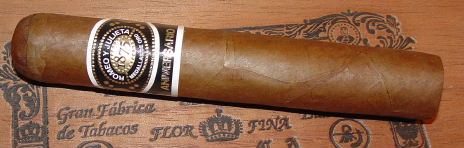
Romeo y Julieta Aniversario Robusto

It seems like only yesterday that Inocencio Alvarez and Mannin Garcia set up shop and started rolling cigars named for a romantic tragedy called Romeo and Juliet. But in fact it has been about 132 years now. My how time flies.

An interesting bit of trivia about the Romeo y Julieta brand is that when the brand was purchased by Jose Fernandez Rodriguez around the turn of the century one of the marketing tricks that he used was to offer personalized bands to his regular clients, creating over 20,000 “vitolas.”

So with 20,000 different brands it seems fitting that Altadis USA would release another one for the 130th Anniversary of the label. Of course, the Romeo y Julieta Aniversario cigar is more than just a different band on the same old Romeo; it’s an entirely new blend.

The Aniversario is available in the five standard sizes, but here we have the 5 x 52 robusto. This line features an attractive and tasty Ecuadorian Sumatra wrapper, a Connecticut binder, and filler from the DR, Nicaragua and Peru.

It’s a handsome and well-made stick. The dark blond wrapper is smooth and the cap is carefully applied. A few veins from the binder are outlined throughout the wrapper, but they aren’t distracting. The roll is rock solid, and it feels fairly heavy. The overall impression is one of weight, gravity, and seriousness.

Despite inital impressions, this turns out to be a darling of a cigar. It opens up with a little pepper and a sweet aroma. The smoke texture is full and creamy smooth. After about an inch the base flavor is revealed as cedar, while gentle spice pours from the wrapper. By the mid point there are still some peppery overtones on the tongue, but they are fairly muted and blend well with the woody aspect of the smoke.

The ash is solid but the outer layer flakes a little: not enough to become a nuisance, just enough to look a bit messy. The burn is straight and the draw is firm. Loosen up the draw just a wee bit and I’d call this perfect construction.

The Romeo y Julieta Aniversario is a really nice medium-bodied cigar, clean tasting and sophisticated. It’s a great example of a cigar that is complex in terms of flavor, but not complicated.

There’s enough here to satisfy the veteran smoker and yet it won’t challenge a neophyte. The creamy texture and spicy overtones really won me over. On top of everything else, this is a great example of Ecuadorian wrapper, and the blend that plays behind it is right on the mark. The robustos run around 5 or 6 bucks a pop– a very reasonable asking price for a cigar of this quality.

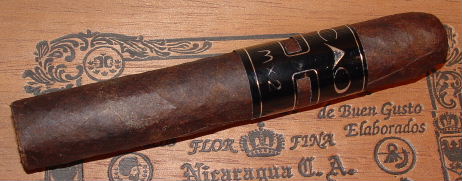
CAO MX2 Robusto

cnv0351.jpg

It’s been a while since I picked up a CAO MX2, but I’ve been in a maduro state of mind lately so I decided to fire one up and see if they’re as good as I remember. The SLR Serie G was a good cigar, but I remembered the MX2 as having a little more complexity. I’m comparing the two because they’re both “double maduros,” meaning they employ maduro leaves for both binder and wrapper.

It’s no surprise that the MX2 is more complex simply because there are no less than six different types of leaf used. The wrapper leaf is the traditional maduro leaf — Connecticut broadleaf. But beneath this is a binder from the Mata Fina region of Brazil. CAO has not been afraid to use Brazilian leaf, having used it with the Brazilia (which has a delicious Arapiraca wrapper) and the Sopranos edition (a more delicate Mata Fina.) For whatever reason, Brazil seems to get a bad rap in the cigar department even though it is South America’s top producer of black tobacco. Maybe the trick is in the blend — here CAO blends the maduro binder and wrapper with leaves from Nicaragua, Honduras, Peru, and the Dominican Republic. Tim Ozgener says there is Italian and Mexican leaf in the blend as well. That’s one smokin’ buffet!

CAO’s MX2 was introduced in 2003 and according to Ozgener it was the first “double maduro” cigar. Previously this term referred to extra-dark maduro colored wrappers (aka oscuro) but the MX2 was the first to use two maduro leaves in the blend. Sometimes “maduro” is used as a color designation but here it refers to the result of a lengthy fermentation process that goes into making a true maduro leaf.

The MX2 is a rough looking cigar: the wrapper is thick and presents an imposingly dark exterior. There was a time when maduro cigars were primarily made from corona or medio tiempo leaves — the strongest, thickest leaves at the top of the plant. The result was a very strong cigar. This isn’t so true any more– there are plenty of mild to medium bodied maduros that use less potent wrappers — but the reputation lives on. But if I were inclined to believe that darker is stronger I would be wary of this cigar.

One of the characteristics of good binder leaf is that it promotes an even burn, so using a thick, oily, heavily fermented maduro binder is a challenge. To the blender’s credit, the MX2 burns beautifully. I had no problem with lighting this stout robusto and it burned perfectly evenly with a very comfortable draw.

It starts up with a touch of spice and some woody flavors. The smoldering layers of maduro produce a sweet and pleasing aroma. As the cigar builds a solid ash the flavor turns from wood to earth but becomes gradually ashy. I enjoyed the fragrance of this smoke more than the flavor, which starts out with some promise but eventually concentrates on a sweet char that tastes kind of like burnt barbeque. It’s something I’d rather smell than taste, to be honest.

What I love about this cigar is the aroma and the fine construction, and now that I think about it that’s what I remember liking about the last one I smoked a few months ago. Unfortunately, I’m not really sold on the flavor. It’s also a very dry, mouth-puckering cigar that doesn’t inspire much salivation. Make sure you have a drink handy if you’re going to try one of these.

As for me, the taste buds have voted. All 10,000 of them. The MX2 is a fine cigar, but when I want a double maduro I’ll stick with my trusty Cusano 18 Paired Maduro.