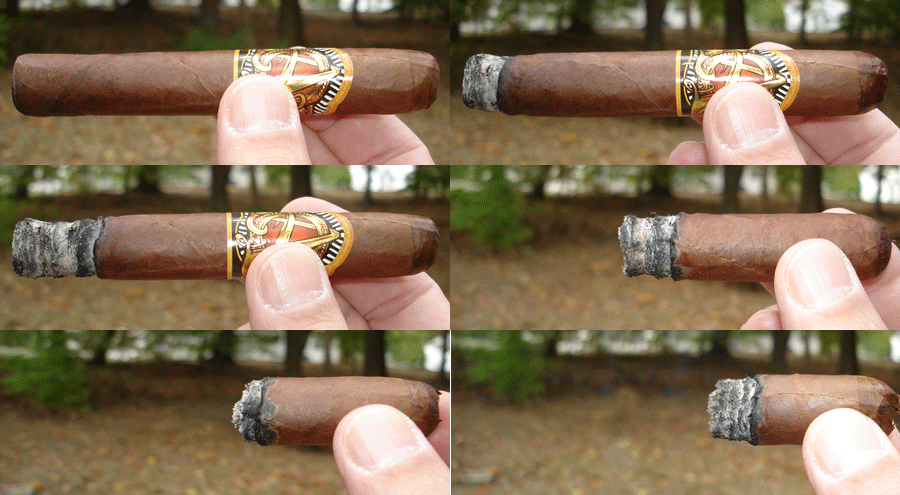
La Aurora Preferidos Corojo

cnv0390.jpg

“Preferidos” are what they were called in 1903, when Eduardo Leon Jimenes first produced these little perfectos for the locals. Today there is a modern preferido, a tribute to the original, produced in two sizes with five different wrappers.

Preferidos are produced by a limited number of rollers who work under the curious gaze of visitors to the Centro Leon — a complex established by the Leon Jimenes Foundation as a museum and center for the promotion of Dominican and Caribbean art and culture. Recently cigar production for La Aurora moved to the town of Guazumal, quite close to where the original factory was established in 1903, but Preferidos production will remain in Santiago at the Centro Leon.

The filler and binder are the same for all the cigars in the Preferidos line: filler from Brazil, Cameroon, and the Dominican, with a Dominican binder. (The Cameroon-wrapped Platinum is an exception– it uses all Dominican filler.) The binder and filler leaves are aged for six months in rum barrels before they are bunched for Preferidos. The Gold version uses a Dominican corojo wrapper from Navarette.

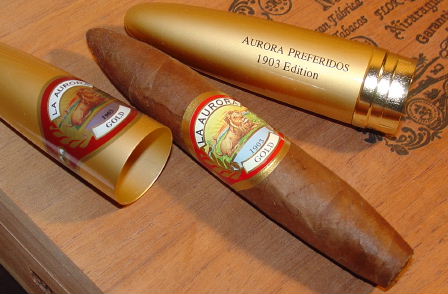
The tubo versions of this cigar are the same size as the No. 2 – 5 x 54. The tube is solid aluminum and executive gift quality… for the guy who has everything, that sort of thing. (Of limited use, but attractive.) I was unable to find these cigars in their unarmored state, so I bid on a couple singles at non-tubo price and won. Now I’m trying to figure out how to turn the empty tubes into Christmas tree ornaments; whether my wife will let me hang them is another matter. They do make rather lurid ornaments.

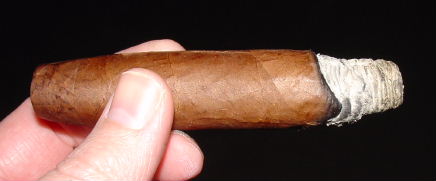
The size of the tubo Preferido is magnified by the packaging — once the tube is set aside and the head is clipped it’s actually a fairly small cigar. The wrapper is a smooth and leathery colorado maduro. The foot is cut down to about a 36 ring gauge and the head is a perfectly finished point. The prelight scent is pleasant but unremarkable, offering some mild tobacco and a little hay.

The draw provides the perfect amount of resistance and the foot fires up without a second thought. The base flavor here is earthy, most strongly pronounced in the first half inch and then again at the conclusion of the smoke. In between lies a perfect balance of earth with a little dry wood and a dash of black pepper.

cnv0392.jpg

This cigar most definitely has a “sweet spot” at the center where the smoke is at its creamiest and most interesting — the caramel and spice in the aroma is delicious, reminding me a little of small Cubans like the Trinidad Reyes. The last stage is intensely earthy but still relatively smooth. Smoking slowly is recommended.

The only negative here, aside from its small stature, is an uneven burn. Oh, and let’s not forget the price — Preferidos Gold tubos run in the 12 to 14 dollar range. (Retail box of 24 for $408. Ouch.) But all told, this is a little gem of a cigar. It’s about medium until the last inch or so when it ramps up to a full body, but at this point you should be sipping slowly anyway. I’m recommending this one to all my rich friends as worthy gifts — to themselves, or to their less fortunate herf-mates… like me!

-cigarfan

MATASA 30th Anniversary Toro

cnv0389.jpg

Manuel Quesada established MATASA (Manufactura de Tabacos, S.A.) in Santiago in 1974, at a time when the Dominican cigar industry catered mainly to domestic consumption. Around this time the Dominican Republic established tax-free export zones which attracted entrepreneurs like Quesada to a country not really known for producing cigars. Baseball players, yes, but not cigars.

MATASA is best known for producing the Fonseca brand (and all its offshoots) but Quesada’s family has been in the tobacco business for generations, going back to pre-revolutionary Cuba where they were primarily leaf growers and brokers. The companies founded by Quesada’s great great grandfather, Sobrinos de A. Gonzales, and his great uncle Constantino Gonzales, were the largest leaf brokerages in the world before the family was forced out of Cuba at gunpoint.

The Quesada family left for Miami, where Manuel Quesada Sr. was able to secure a loan– with no collateral– from a bank the family had done business with since 1907. They invested in warehouses and machinery and soon a fledgling leaf brokerage was started in the Dominican Republic, selling leaf to many of the same customers they had in Cuba. One of those customers was Juan Sosa, whose Miami factory was struggling with labor issues. Based on their previous business relationship, Sosa and Quesada joined forces in Santiago and in 1974 MATASA was born. During the same year, MATASA bought the Fonseca label from Antillian Cigar Co. in Miami.

The MATASA 30th Anniversary by Fonseca, created to celebrate the founding of the company, was introduced in 2005 in only two sizes: a 5 3/4 x 54 perfecto, and this 6 1/2 x 52 toro. The binder and filler were selected from bales of Honduran, Dominican, and Nicaraguan leaf aged over ten years. When this cigar was chosen as the Robb Reports’ “Best of the Best 2006” cigar, Quesada told Richard Carleton Hacker,

…we used the finest of old, noble leaf so that we would have the depth of some of the choicest aged Cuban-seed tobaccos, but without the hardened strength. What we got was a strong yet smooth cigar that reminds one of chocolate pudding.

The wrapper is a high priming Olor Dominicano grown by the Reyes family in the Cibao Valley. The limited number of cigars produced was determined mostly by the amount of wrapper produced. “We said we’d make cigars as the wrapper for the project came about,” Quesada told Smoke Magazine. “You’d like to have 100 percent yield from the wrapper crop, but you never do… If you get 60 percent of usable wrapper out of any given crop, you should go to church and thank God.”

In the end, only 30,000 cigars were produced.

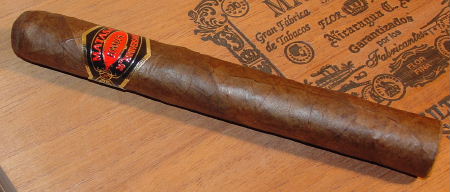
The wrapper on this Anniversary Toro is rich and oily, though as it turns out it is also quite thin and delicate. The roll is solid and the head is finished with a triple cap. The prelight scent is of sweet tobacco and hay.

From the first puff the flavors that pour forth are dark and rich — coffee bean and cocoa, with chocolate making a lasting appearance after an inch or so. Beneath the overarching sweet bean flavor is a grassy or green wood flavor which makes the overall impression something like light-roasted coffee. Meanwhile, the aroma is complex, adding an incense-like quality to the smoke.

The body builds strength after the first half, about 45 minutes into this supersized toro. The flavors gradually veer away from cocoa and enter spicier country, with pepper on the tongue and baking spices on the nose. At one point I thought I detected cinnamon, but after an hour of chasing scents my palate might have been a little fatigued.

Part way into the last third I heard the dreaded crack of wrapper splitting; I looked down and my cigar had suddenly unraveled. Thankfully I was nearly finished with this ten dollar Anni, but I was still a little disappointed. (Sadly, this is the second one that has finished in this fashion for me. Other reports are more favorable, so maybe I just pulled from a bad box.) Otherwise the construction here is very good — a fine draw and a slow cool burn.

If you’re a Fonseca smoker, be aware that the MATASA 30th Anniversary is a much heavier cigar than your standard Fonseca, but don’t let that dissuade you — it’s not a giant killer either. This is a limited edition cigar, but it is still available and doesn’t appear to be selling out anytime soon. Part of that may be due to the price, which is in the 8 to 11 USD range. Not your everyday cigar, but a special treat for maduro lovers. Just be extra careful with that wrapper!

-cigarfan

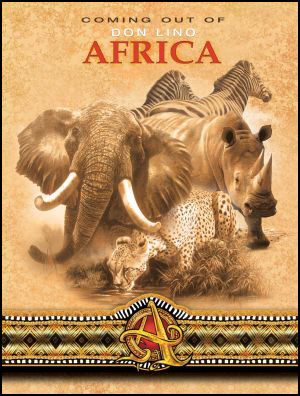
Don Lino Africa — Duma

Don Lino Africa Duma Close-up
— Photo courtesy of Miami Cigar & Company —

Cigar Stats
Brand Owner: Miami Cigar & Company – Miami, FL
Tabacalera: Esteli, Nicaragua (Plasencia)
Model/Vitola: Don Lino Africa Duma (Cheetah)
Size: 5.0 x 50 (robusto)
Wrapper: Nicaraguan Habano (1999)
Binder: Nicaragua
Filler: Cameroon, Dominican Republic, Honduras, Nicaragua

Other vitola sizes available

  • Kuro (Waterbuck) 4.0 x 45 (corona extra)
  • Kifaro (Rhinoceros) 6.125 x 52 (toro)
  • Punda Milia (Zebra) 6.5 x 44 (lonsdale)
  • Kiboko (Hippopotamus) 6.5 x 58 (toro)
  • Tembo (Elephant) 7.5 x 50 (double corona/churchill)

All sizes are offered in beautifully adorned boxes of 25 with the exception of the Kiboko (24) and the Kuro (tin of 4 or box of 40)

 Don Lino Africa Vitola Name Animals

Some background on Miami Cigar & Company

Common traits prevalent among cigar making stars in the industry are unbridled passion coupled with persistent hard work. Nestor Miranda and his family are another example. In the late ’80s, working in the liquor business, Nestor had a chance meeting with a roller working for Guillermo León of La Aurora S.A. Using his skills as a salesman, Nestor made some suggestions on how to expand the La Aurora line and increase business. As he watched their success employing his ideas, he and his wife Miranda decided to launch Miami Cigar & Company in 1989 and distribute cigars. They acquired and launched the Don Lino brand in 1989 which were manufactured by U.S. Tobacco International at their factory in Danli, Honduras. The brand was a huge success. Production in the first year was 80,000 cigars and by 1995 it was up to 3.1 million. In 1995, Miami Cigar began distributing other UST products (Don Tomás and Astral) and in 1996 (during the boom) distribution jumped to a whopping 12 million (75% UST brands). As you may imagine, with those kind of numbers, Nestor retired from the liquor business in 1995 after 25 years and joined his wife full time at Miami Cigar.

What happened next would give anybody nightmares. In November 1996, after Miami Cigar had exceeded all sales projections, UST pulled the plug! They stopped shipping products for distribution and stopped manufacturing Don Lino cigars. The president of UST called and cancelled the contract with Miami Cigar which wasn’t due for renewal until February 1997. UST had decided to distribute their own and manufacturing of the Don Lino brand would take production resources needed elsewhere. Literally overnight, Nestor was faced with closing shop. And right before Christmas! His distribution humidor was empty. Don Lino was back-ordered about 3.5 million cigars. La Aurora/León Jimenes were maxed out and could not produce any more cigars for Nestor to distribute. His retailers were pissed. They couldn’t believe he had no cigars. They thought he was shipping elsewhere and giving them the runaround. And to top it off, he had to lay off most of his warehouse and office staff.

The gory details of this debacle can be found in the Cigar Aficionado interview with Nestor (April 2007) but suffice it to say, there is no quit in this man. He struggled for two years to find quality manufacturing for the Don Lino brand and in 1999 Guillermo León agreed to produce it in the Dominican Republic. Production has since moved again and is now with Plasencia in Esteli, Nicaragua.

Per the Miami Herald, the Miranda’s didn’t consider a lawsuit against UST until Nestor received a deposition in 1999 for a suit filed in Chicago against U.S. Tobacco by cigar distributors Cohabaco. A lawyer approached Nestor with some of U.S. Tobacco’s internal documents, that, according to Miranda, detailed U.S. Tobacco’s plans to obtain Miami Cigar’s distribution network all along, going so far as building a storage facility in Tampa to hold cigars originally intended to go Miami Cigars. In 2002 Nestor won a judgment against UST in the amount of $42.5 million which was appealed and then settled out-of-court. The final amount is undisclosed but I sincerely hope it was big!

Today Miami Cigar & Company distributes a variety of premium name brands, among them Dominican-made La Aurora and Leon Jimenes, Spanish-made Ducados, Wings, and their very own Tatiana line of flavored cigars, Don Lino and Habanitos. The brands owned by the company include Colorado by Don Lino, Don Lino Africa, El Gozo, Havana Reserve Don Lino, Smoke Tatiana – Flavor the Moment and Tatiana.

Miami Cigar & Company Brands

When things had calmed and the company gained its feet again, Nestor decided to fulfill a lifelong dream of his to go on a hunting safari in Africa in 2002. He used to watch Tarzan movies as a child in Cuba and had always wanted to see the land that charged his imagination as a boy. The hunt was a life experience and on the returning plane ride Nestor had an epiphany. Africa was such a great and vast country. Certainly there should be a cigar brand in it’s honor. Why not include some of their tobacco too! He and his son Daniel, who actually runs the operations for Miami Cigar, agreed. A new cigar was in order. Oh, but what to call it. Nestor thought the name of the majestic Kilimanjaro was appropriate but unfortunately someone had already claimed it. Finally, they settled on Don Lino Africa. They designed a elegant box and named the vitolas after select beasts that roam the plains of the Serengeti. But instead of English, they would use native Maasi, the language of the indigenous people of the African Savannah.

Don Lino Africa Plaque

The Don Lino Africa blend was introduced in 2003 and then re-blended for 2004. It is currently manufactured by Nestor Plasencia at his factory in Esteli, Nicaragua. Using 4-year aged tobaccos, the cigars are aged for an additional 5 months after rolling. During the blending experiments, Nestor requested they use a leaf of Cameroon in the blend. No one had done that before and when he tasted it, he said, “This is it!” In the interview referenced above, Nestor claims to use Costa Rican leaf in the blend but no one else refers to it. Early renditions claim some Mexican leaf as well. I think the manufacturing and blending have changed so many times, the old Internet info is blending with the new. The Miami Cigar website currently shows the blend as I have identified it above.

Believe it or not, the name “Lino” comes from the individual at the UST factory that Nestor used to deal with. He says “it was just a name, and it sold so well, why change it?” Wow, that’s deep!

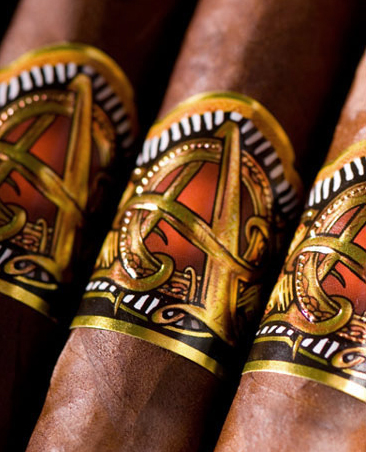
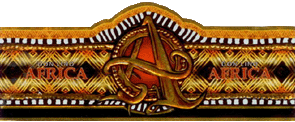
Don Lino Africa Duma - Cigar Band

Bottom line up front …..
Full-bodied and full-flavored as advertised, this is a curious blend of tobaccos. The taste is like nothing I’ve had and if it weren’t for the total distraction of the burn problems, I probably would have enjoyed it. Every stick I tried had burn issues to the point where the experience was a disaster. Nestor better get his rollers together and give them a thrashing! It’s a cryin’ shame to have such extravagance in packaging and quality tobacco wasted on poor rolling technique.

Pre-light
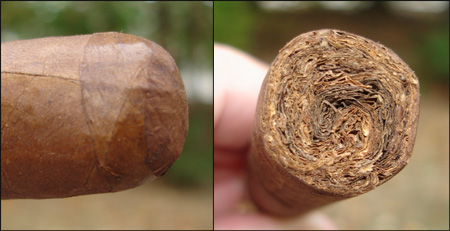
The cigar is stunning to look at. A reddish-brown wrapper oozing with oils and covered in a small tooth cap to foot. I understand the wrapper tobacco was set aside in 1999 with this cigar in mind. The band, like the magnificent box, is truly a work of art. Being the brandophilist I am, this band was definitely tucked away in the archives. Someone did get overzealous with the band glue, but I was able to remove it without damage to the cigar or the band. That was a miracle in itself. The aroma from the wrap was distinctly barnyard and strong tobacco from the foot. The head was nicely finished with a double cap. Pre-light draw was good. The swirls of different color tobacco at the foot were very inviting. I was looking forward to a treat.

Don Lino Africa Duma - Cap & Foot

The Smoking Experience
The Duma begins with a sharp couple puffs, kinda similar to a Pepin cigar with just a touch of pepper on the nose. The flavor quickly settles into a base of dark wood and burnt toast. The pepper subsides for the first third but then re-enters mainly on the tongue and slowly builds to the end. The aroma was rich and deep. Can’t begin to describe it but definitely the best part of the smoke. About halfway, I picked up a few pulls of a caramel like sweetness that disappeared as suddenly as it arrived. Some interesting spice notes along the way including cinnamon and what seemed to be nutmeg and during the final third hints of cocoa and leather. All-in-all a very flavorful complex smoke which I would expect with that many countries represented. The cigar did start to get bitter at the nub but I was ready to lay it down anyway. Finish is long with a leathery aftertaste.

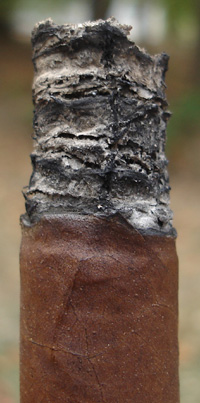
Ash was quite dark and a bit flaky. The burn was horrendous! It looked to me as if the wrap was several layers thick and was downright flame retardant. I was forced to torch the cigar every 1/4 inch to keep the flavors even and burn off the wrap to the next level. Burn maintenance absolutely ruined the experience for me.

Don Lino Africa Duma - Dark Ash


Don Lino Africa Duma - Ash Trail

This cigar is full-bodied, with a balanced well-rounded explosion of smooth, hearty flavor. With full strength to boot, it is not for the faint of heart. Starts out a little less than full but gets there pretty quick. Please have a seat. And by all means, this is not a breakfast cigar!

My take …..
This cigar just would not burn properly and therefore will fall from my radar, at least for a while. I smoke cigars for the pleasure of the experience. Every Duma I tried was so much work in the burn department, the rest of the experience was lost on me. I’ll try them again in a couple years if they are still around and hope the rollers have got their act together!

MSRP on the Duma is $156.00/25 or $6.24 per stick. Best online price I could find is Abners at $94.95/25 or $3.80 per stick. Price point is right if they could only solve the burn.

African Sunset

As in this beautiful scene, for me, the sun has set on Don Lino Africa for now. But as they say, the sun will come up tomorrow!

Smoke Til You're Green

Like it … Flavor Yes, Burn Absolutely not
Buy it again … Not anytime soon
Recommend it … Not right now

What others are saying about Don Lino Africa …..

26 April 2005
LC-Smoker – CigarPass
Don Lino Africa, Vertical Line Tasting and Summary

August 2005 thru June 2006
Various – Famous Smoke Shop
Don Lino Africa Cigars

29 August 2006
Uncle Moneybag$ – Leafy Times
Don Lino Africa Dumas

26 October 2006
Doc – Stogie Fresh
Don Lino Africa Kifaro

1 June 2007
Synquest
Don Lino Africa Kiboko (Hippopotamus)

1 June 2007
World Cigars
Don Lino Africa Kiboko (Hippopotamus)

20 July 2007
bobbyg29 – CigarLive
Don Lino Africa Duma

28 August 2007
AragornElessar86 – Cigar Crew
Don Lino Africa Kiboko

27 September 2007
admin – Cigars and Wine in Grapevine
Don Lino Africa – Duma

Top 25 Cigar – As of 16 October 2007
Don Lino Africa Duma
31 reviews
7.49 out of 10

Publications

1996
Shandana Durrani – Cigar Aficionado
A Mom-And-Pop Shop
In Seven Years, Mariana and Nestor Miranda Have Turned Miami Cigar & Co. into a Force in Cigar Distribution

February/March 2002
Joseph Finova – Smoke Shop Magazine Online
Miami Cigar & Company: Tasting the Flavor of Success

2 April 2007
David Savona – Cigar Aficionado
A Conversation with Nestor Miranda

5 April 2007
Cigar Aficionado Online–>Cigar Aficionado Forums–>Dear Editors–>
Nestor Miranda interview

August 2007
Video – 3:23 minutes
CigarTV.com interviews Nestor Miranda of Miami Cigars who previews the Don Lino Africa line of cigars at the 2007 RTDA trade show in Houston, TX

Miami Cigar & Company – Don Lino Africa


… lucky7

“It has always been my rule never to smoke when asleep,
and never to refrain when awake.” (Mark Twain)

Las Memorias Cubanas Campanas

cnv0387.jpg

Cigars from Little Havana’s La Tradicion have garnered much praise from fans of boutique stogies. I certainly have nothing against huge conglomerates like Altadis or General because they make quality consistent cigars, but there’s something special about a small run handmade from a mom and pop chinchal. But business being what it is, successful small runs turn into bigger ones, and boutique companies become industry juggernauts.

This has not yet happened to La Tradicion — they are still a relatively small company (though not really a chinchal) and they are growing despite setbacks such as the fire that hit their Calle Ocho shop last November. The fire was suspected as arson, one incident in a string of such tragedies that befell the neighborhood last fall. The fire destroyed the strip mall in which La Tradicion was located, along with the celebrated Libreria Cervantes, a Spanish language book shop. The only items to survive the fire in the galera were some records on computer disks and their cigar store indian.

The only fortunate aspect of the fire was that La Tradicion had already begun a transition to the Dominican Republic under Sanchez’s partner, Pablo Romay. Romay is a veteran of Havana’s Romeo y Julieta factory who emigrated to the U.S. in 1994. He began rolling cigars for La Tradicion in 2000 and Sanchez quickly promoted him in recognition of his skills and management abilities. After several years in the Little Havana location Sanchez began to explore a move to the Dominican as a solution to labor difficulties and the rising cost of doing business… expenses like fire insurance, and rebuilding your factory after some asshat burns it down.

La Tradicion still maintains an office in Miami, but the new factory in Santiago — Real Tabacalera Sanchez-Romay— is now the main production facility.

Luis Sanchez succinctly describes La Memorias Cubanas this way: “Light wrapper. Full body.” Sometimes less is more… except when it comes to ring gauge. La Tradicion has set records for some of the largest ring gauges made — and this line follows the trend. “Campanas” is a traditional torpedo-shape production vitola; the Cuban Bolivar Belicoso Fino is one of the more common examples, but at 6 1/2 x 60 the LMC Campanas is a bit larger than the traditional vitola.

The wrapper is a silky claro Ecuadorian Sumatra. The filler is a blend of Dominican and Nicaraguan leaf, bound up in a selection from Honduras. The result is a nice looking, if somewhat unwieldy cigar. Between the fingers it feels like grasping a tree branch. The nice thing about a torpedo is that it allows you to choose the aperture of the opening depending on where you cut it. Otherwise, you’re stuck with a jaw breaker.

Las Memorias Cubanas come equipped with a thin cedar sheath — this imparts a distinctly woody scent to the wrapper and the prelight draw. There is an occasional small green blemish on a couple of these, but nothing to be concerned about.

This torpedo draws well and lights easily, even though it seems like a large area to light. It sort of felt like painting the foot with fire. Once it was lit it burned very well and needed no further attention. All the construction tests were passed with flying colors.

The initial flavor is a little mild, sweet and nutty with a hint of pepper on the nose and in the back of the throat. The weight of the smoke is quite heavy though, and the texture is deliciously creamy. For the first fifteen or twenty minutes this is a very domesticated cigar. At the two-thirds point it revs things up with a spadeful of earth and more generous helpings of pepper. The aroma from the wrapper is really nice — toasty with some delicate semi-floral accents. So far this has balanced really well with the earthier flavors on the tongue.

While I am admiring the solid salt and pepper ash that I’ve built and ashed only once, I become aware of an intensely earthy and quite lengthy finish. The last third of this cigar is quite powerful in terms of flavor, but it loses its sense of balance at this point. The nuances from the wrapper become completely obscured by the dark spice on the tongue, and the flavor itself seems a bit one-dimensional at this point. I found that this cigar is very good up to this point, but I didn’t find it “nubbable.”

I really liked this cigar… up to a point. But that point is where somebody with a taste for heavy earthy cigars might begin to really enjoy it. These will run you around 6 USD a stick, which is quite reasonable. These are very large, very well made cigars. But for me, I think I’ll be sticking to LTC’s Sabor Cubano and La Tradicion Cubana.

-cigarfan

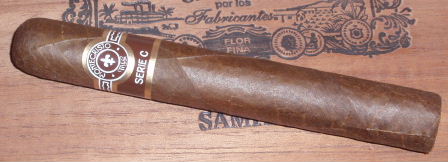
Montecristo Serie C Toro

cnv0386.jpg

Since the Montecristo cigar brand was established as a legal American commodity in 1995, the Dominican brand’s makers have issued an astounding number of blends. The Monte Serie C is the most recent creation in this prolific family of 13. Like the Serie V, the Serie VII, and Santa Clara’s Montecristo Afrique, this cigar is distinguished by a cameroon wrapper, or as Altadis says…

…rare, ultra premium Cameroon tobacco. These leaves – every one hand selected – are carefully stored and patiently aged, and the resulting smoke indulges the aficionado with the subtle complexities of flavor and smoothness of a Cameroon cigar that is destined to become the new benchmark. Is the Serie C the finest Cameroon ever? Quite possibly. After all, it’s a Montecristo.

I’ve always appreciated Montecristo for its consistent quality, though some of their blends I appreciate better than others. And since I’ve been hankering for a good cameroon I thought I’d give the “new benchmark” a test run.

In addition to the toro, this line is available in three other standard sizes: robusto, corona, and belicoso. The filler is a three country blend from Nicaragua, Peru, and the DR, with a binder leaf from Nicaragua. These are produced in the Dominican city of La Romana, home of Altadis’ mammoth Tabacalera de Garcia.

The Montecristo Serie C is presented with a flawless colorado maduro wrapper — a single vein snakes down the length of the stick and extends its tributaries laterally, leaving plains in between that reveal a moderately toothy stippling. The roll is solid and the cap is applied expertly (though without the flair of a triple cap.) The prelight test results are neutral: simple tobacco and a slight tingle on the tongue.

The draw is firm, but functional, and the burn is almost perfectly even. After a few inches the Monte C builds a solid and uniform gray ash. Construction qualities here are top tier.

The initial flavors are very muted and framed mostly by the aroma of the Cameroon — a mild minty flavor with very little finish and no aftertaste at all. Into the second third the mint grows into menthol over a gently woody foundation. The last act brings out some bready elements and a dash of pepper in the back of the throat until the flavor finally declines into bitter papery territory.

The main attractions here are perfect construction and a mild but aromatic Cameroon wrapper. The Monte C is a little too mellow for an after dinner smoke, unless you smoke mild cigars exclusively — but it could be a great little walk in the park cigar. Or in the case of this 54 x 6 toro, a more extensive walk in the park cigar.

Retail prices are around 8 or 9 USD, with online boxes selling for around 110. Not a bad price for consistency in a perfectly rolled handmade.

-cigarfan

Olde World Reserve Torpedo (Maduro) by Rocky Patel

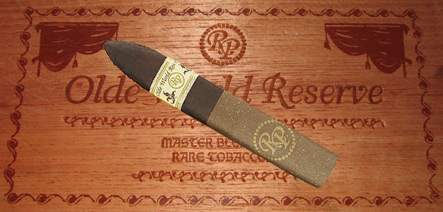
Olde World Reserve Box and Torpedo

Cigar Stats
Brand Owner: Rakesh Patel
Tabacalera: El Paraiso – Danli, Honduras
Model/Vitola: Olde World Reserve Torpedo (Maduro)
Size: 5.0 x 54 (figurado — box-pressed)
Wrapper: Costa Rica (Maduro) — Nicaragua (Corojo)
Binder & Filler: Nicaragua (rumored a little India too)
Cigar Aficionado Rating: 88 —2007 (I think this is way to low)

Other vitola sizes available

  • Robusto 5.5 x 54
  • Toro 6.5 x 52

All sizes are offered in cedar chests of 50 with a choice of Corojo or Maduro wrapper
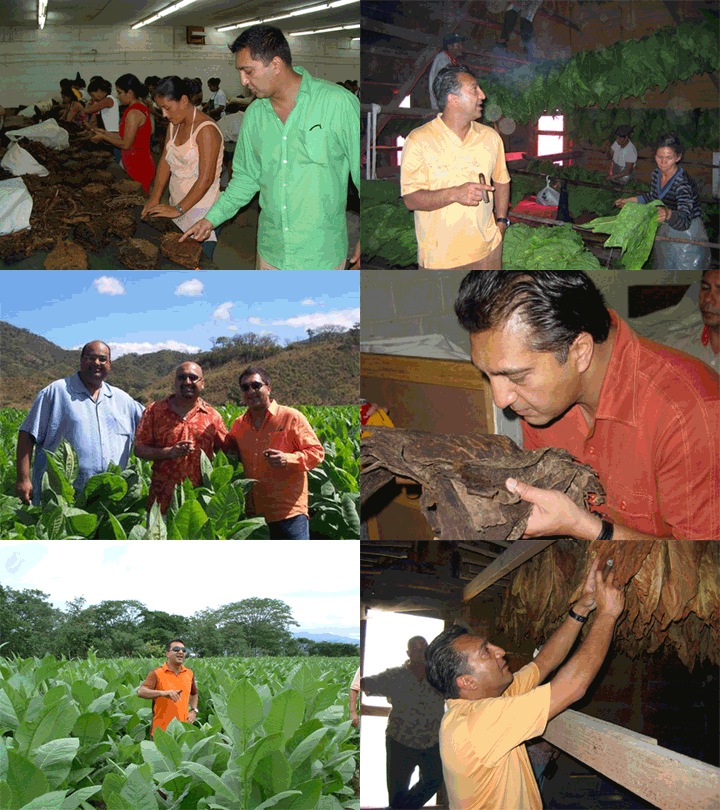
Rocky’s Picture Collage 

Some background on Rocky ….. 

Rocky Patel is a shining example of what passion and hard work can achieve. He uses what he calls the shoe-leather express, his arduous but successful way of getting out the word on his cigars. He started in LA but now home and headquarters for the energetic 45-year-old is in Naples, FL but you rarely find him there. His road shows began in 1998, and they never seem to end: in both 2001 and 2002 he logged more than 300 days on the road. His travel schedule never seems to get any lighter.

Rocky is a natural born salesman. He sold china and cutlery door-to-door in high school, participated in Junior Achievement, sold grapefruit by the case and raised money in college for muscular dystrophy research. He moved to Green Bay, Wisconsin, as a teenager, where he developed a lifelong love of the Packers to rival that of local born Cheeseheads. (In one proud moment he presented members of the team with his cigars.)

Patel, an entertainment and product liability lawyer turned cigar salesman, had a cigar-smoking girlfriend who “made him” join the Grand Havana Room in Beverly Hills. He went to his first cigar trade show in 1996 and was mobbed for business. This was the beginning of his strong relationship with the cigar industry as a major player.
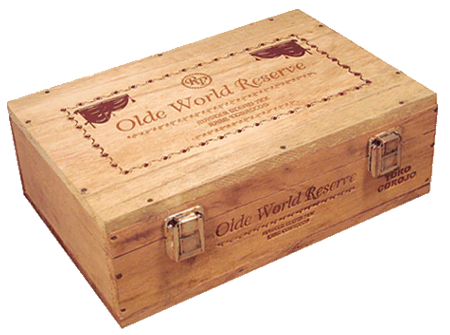
Olde World Reserve Box

Rocky says, “The problem with practicing law was it was like taking a final exam all day long. You’re always stressed. In this business I’m always thinking about cigars and how to make them better — but I’m excited about it. I’m a perfectionist and I live to win, not just play. The cigar business is the same thing: acquiring the best leaf, creating the best packaging — it’s constantly on my mind.”

Per a quote on his website, the Hollywood lawyer turned cigar maker loves the quality of Padron, the construction of Davidoff, and the consistency of Fuentes. Patel wants to incorporate all of these admirable qualities into his cigars and make them affordable. His are definitely great cigars, so it would seem he is succeeding.

Patel’s original Indian Tabac brand has nothing to do with his heritage (he was born in India, and his real first name is Rakesh) but everything to do with the on-again-off-again Indian Motorcycle brand. Patel, who owns the Indian Tabac Cigar Co. with a silent partner, has to pay Indian Motorcycle a licensing fee on the brand. In 2003 he put aside the Indian Tabac brand name he worked so hard to build to create another — Rocky Patel Vintage Series. It was risky, but a huge success.

Company logos

Since both still exist, a point of clarification on the relative importance of the Indian Tabac and Rocky Patel brands to each other. As of the end of 2006, Indian Tabac sales were steady but made up only about a third of their revenue. The Rocky Patel branded lines made up the rest. When Rocky introduced the Vintage 1990 and 1992 Rocky Patel lines at the 2003 RTDA, it was a calculated risk. He wanted to change the direction of the products and marketing but felt it would be too difficult to do with the Indian Tabac brand. His intuition proved correct as the Vintage brands were a run away success. The Vintage 1990 and 1992 cigars are still the company’s flagship lines today. The Rocky Patel lines with their extensions now represent 70+% of company revenues.

Patel’s cigars are currently manufactured in Nestor Plasencia’s El Paraiso factory in Danli, Honduras. Rocky works with Plasencia to develop and refine the blends they want to offer. In fact, Rocky spends 60-70% of his time in Honduras working with the factory. The rest of his time is split up between marketing and running the operations.

Olde World Reserve Maduro Band

The Old World Reserve (“Master Blend 7XX” as it is designated on the box) was introduced at the 2005 RTDA in New Orleans, LA. That initial iteration, Rocky’s first attempt at the OWR, never made it out of New Orleans, and was ‘re-introduced’ at RTDA 2006 in Las Vegas, NV. This uniquely delicious and buttery smooth blend of tobaccos is actually quite mellow yet very deep in flavors. Olde World Reserve is Rocky Patel’s most expensive creation so you would certainly hope it has “the right stuff” and IMHO it definitely does. It is masterfully blended using top-quality tobaccos, extensive fermentation and aging processes, and the highest of quality control standards. Doesn’t matter if you are part of the Rocky Fan Club or not, you should give this cigar a try.
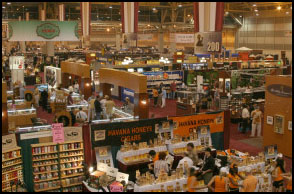
Exhibition Floor - RTDA 2005
Exhibition Floor — RTDA 2005

I have read folks who compare the OWR to the Padron Anniversary blends (1926 and 1964) but I think they are potatoes and grapefruits, with dissimilar profiles and therefore, not really a “better or not” situation. Both brands are top notch!

Some of the hype and buzz claim the OWR to be Rocky’s Vintage and Edge lines on steroids. Although you can pick out some similar characteristics with the other RP lines, I think the flavor depth of the OWR sets it apart.

Please note, the three sizes of the OWR are very different, each offering a unique smoking experience. That is another interesting thing about this line of cigars. The combo of size and wrap makes for a different experience, and variety is the spice of life, right? This review is based on the Torpedo size wrapped in a Maduro leaf.

Bottom line up front …..

I am a big fan of full flavored cigars which is why I like many vitolas Rocky has to offer (Vintage, Sun Grown, Edge jump to mind). Seems crazy to say, but the Olde World Reserve is a cut above. All of Rocky’s magic is realized in this cigar. Overall, an exceptional example of blending that is extremely well-balanced and surprisingly smooth. Don’t let the hype descriptions of power and strength scare you off! Even if you are a mild to medium cigar buff, try this cigar. I think you will be very pleasantly surprised. The Olde World Reserve is an eventful smoke that fully satisfies the palate of even the most discriminating aficionados. A very rich smoking experience!

Olde World Reserve Torpedo Maduro

Pre-light

Although it is a bit of a stump for a torpedo, these sticks are gorgeous to look at. The band is sophisticated and the foot is sleeved in a gold speckled brown tissue paper with the “RP circle-o-dots” logo in gold at the center. The sleeve is easily removed revealing the dark mottled wrap, smooth and oily. In the sunlight, a rosado hue in the background color is evident.  The cap is a little ruddy looking but well constructed nonetheless. Tightly packed, the stick is firm to the touch but fairly light in the hand. The wrap has very subtle sweet tobacco scent and the foot, soft earthy wood. Clip was very clean, no stragglers. Draw was perfect and tasted of strong southern sweet tea. As I toasted the foot the exquisite aroma wafted around my head and I began to salivate. It did take some effort with the torch to get this one lit but once there, no more external fire required.
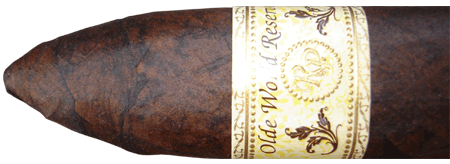
Olde World Reserve Cap Closeup

The Smoking Experience

Right out of the gate, the flavor is spectacular with earthy wood and leather rolling over the palate and a tinge of sweetness on the nose. After a few pulls, a nice thick volume of cool smoke and in between puffs, beautiful curls of blue smoke from the foot. As the blend warms it settles to a creamy smooth base of toasted nuts, leather and wood with notes of sweet fruit on the nose (kind of raisiny). During the last third, an enjoyable espresso and bitter chocolate flavor develops and becomes more definitive toward the nub. Initially, the finish is nutty and rather short but evolves to a longer intense toasty espresso in the second half with a bit of pepper on the tongue. This cigar has an awesome aroma similar to “The Edge” but not quite as sharp and consistently sweet to the nub. Draw remained perfect from light to nub and the burn was clean.
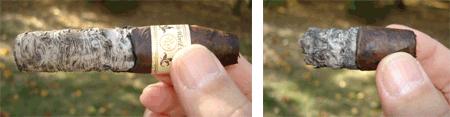
Olde World Reserve Ash Trail

The ash was medium gray and held on well. Curiously, the stack of quarters effect common to most cigar ashes was present but began to swirl. Unusual looking to say the least. I only ashed this cigar once at the band. The nub carried the rest to the ash tray.
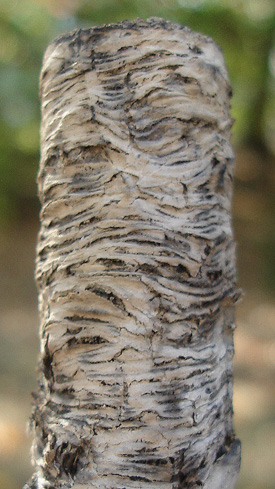
Olde World Reserve Ash Detail

In terms of strength, the first half rests squarely in the medium column and then it begins to intensify. The last inch and a half are definitely full strength. I would say it carries a mild nicotine kick but definitely not overpowering in any way. I suggest you do have something on your stomach for maximum enjoyment.

Short in physical stature but long on smoking time, this gar took me an hour fifteen minutes to smoke. And time well spent I might add!
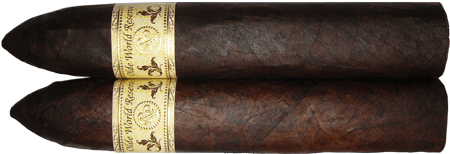
OWR 2006 and OWR 2007 Comparison
2006 OWR (top) and 2007 OWR (bottom)

I have always been curious about where these cigar makers get the volumes of tobacco required to make consistent stogies year after year. Like the Vintage 1990 … where is all that 1990 tobacco stored. It’s certainly gotta be bigger than a warehouse (or 100 warehouses for that matter), the number of those cigars that have hit the street since 2003. Just as an experiment, I retrieved a 2006 OWR Maduro that has been resting in my humi since September 2006 and one I purchased for this review. As you can see above there is a definite color variation in the wrap but I’ll be doggone, I smoked ’em both and couldn’t taste a bit of difference. Rocky is good … I mean real good at what he does.

My take …..

I’ve tried a healthy share of both corojo and maduro wrapped OWR and come to the conclusion that, while both are good, I enjoy the maduro most. IMO it’s richer in flavor and offers a very nice sweetness from the wrapper leaf. The maduro is also very (very) smooth in character with an earthy backbone that’s deep and rich. Overall, this is a great cigar, one worthy of the highest of ratings from those who know cigars best.

MSRP on the Maduro Torpedo is $525.00/50 or $10.50 per stick. Best online price at the moment is Cigar Place at $39.95/5 or $7.99 per stick. My local B&M charges a whopping $11.12 per stick which is outrageous (and I told him so). Expensive, but if you want the finer things in life you have to pay the price. Definitely a exquisite cigar. If I were you I would try at least one and then decide if wallet dipping is in order. For me $8 is an easy decision!

Initially released as a limited edition cigar, the Olde World Reserve was only available in traditional brick and mortar tobacco shops. That is no longer the case as they can be found online just about everywhere. I began compiling a list of online vendors but it became so lengthy, I gave up. Just Google it! It pays to shop around on this one. They are a challenge to find in stock but the hunt is well worth it!
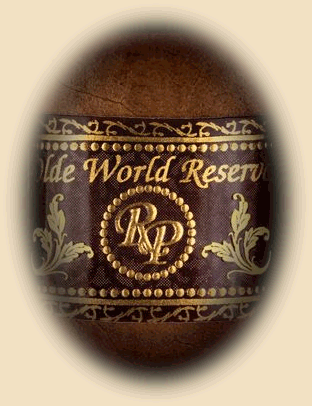
Olde World Reserve Corojo Band 

Smoke Til You're Green

Like it … Yes
Buy it again … Yes
Recommend it … Absolutely

What others are saying about
Olde World Reserve by Rocky Patel …..

15 July 2006
Jerry – Stogie Review
Rocky Patel Olde World Reserve – Corojo (Toro)

17 July 2006
The Stogie Guys
Rocky Patel Olde World Reserve Corojo Toro

19 August 2006
cNote – Cigar Utopia
RP Olde World Reserve Maduro Review

September 2006
Smoke Magazine Taste Test – Volume XI, Issue 4
Rocky Patel Olde World Reserve Toro Maduro
9.25 out of 10 Average Rating

December 2006
Smoke Magazine Taste Test – Volume XII, Issue 1
Rocky Patel Olde World Reserve Torpedo Maduro
9.15 out of 10 Average Rating

28 January 2007
lanshark – Cigarzilla
Rocky Patel – Olde World Reserve

March 2007
Smoke Magazine Taste Test – Volume XII, Issue 1
Rocky Patel Olde World Reserve Robusto Corojo
9.15 out of 10 Average Rating

11 June 2007
CigarMonkey – Cigar Beat
Olde World Series by Rocky Patel

18 June 2007
mongkut – Epinions
Rocky Patel Olde World Reserve Maduro Toro – A Good Cigar, But Not My Favorite

August 2007
Cigar of the Week – Cigar Aficionado
Rocky Patel Olde World Reserve Maduro Torpedo

24 September 2007
Gary Korb – Cigar Advisor
My Weekend Cigar: Rocky Patel Olde World Reserve Toro

Cigar Aficionado Forum Discussion – Olde World Reserve by Rocky Patel

Top 25 Cigar – As of 2 October 2007
Rocky Patel Olde World Reserve Cigars Torpedo Maduro
10 reviews
8.04 out of 10

Publications

1 May 2005
David Savona – Cigar Aficionado
Rocky II
Rocky Patel built his Indian Tabac cigar with endless trips to American tobacconists and Honduran cigar factories. Now he launches a self-named brand.
PDF

March 2006
Thor Nielsen – Cigar.com Magazine
Interview: Rocky Patel – Indian Tabac

September 2006 – Smoke Magazine Online
Rackish “Rocky” Patel of Rocky Patel Cigars
The Long Road

11 January 2007
James Suckling – Cigar Aficionado
Havana Corner: Factories, Pigs and Politicians

2 April 2007
Gregory Mottola – Cigar Aficionado
New Sun Grown Sixty From Rocky Patel

August 2007
Video – CigarTV.com
Rocky Patel at RTDA 2007 talking about his new releases

Official Rocky Patel Website


… lucky7

“It has always been my rule never to smoke when asleep,
and never to refrain when awake.” (Mark Twain)

Gran Habano 3 Siglos Gran Robusto

cnv0385.jpg

Over the years Guillermo Rico has been a tobacco grower, a leaf broker, and an accomplished catador, or cigar taster, who reportedly can distinguish five different leaves in a single blend. He was born to a family of tobacco growers in Cubita, Columbia, and with his son George is currently the owner of GR Tabacaleras Unidas and the Gran Habano line of cigars. The Ricos have farms in several countries, including Columbia, Costa Rica, and most importantly Nicaragua.

The Ricos established their Danli, Honduras factory, “La Perla Hondureña” in 1996, where they produced cigars for private labels such as Alec Bradley. But with all the experience and knowledge at hand it was inevitable that they would soon turn out their own brands.

The Ricos take great pride in the blending and production of their cigars, starting with Habano and Corojo seeds and finishing with draw testing individual cigars for quality control. All of their cigars are bunched using the traditional “entubar” method and are finished with triple caps. These are truly beautiful cigars — I had to get a close up shot of the cap on the 3 Siglos above because it’s really a work of art.

The first three Gran Habano blends — the #1 Connecticut, the #3 Habano, and the #5 Corojo — were introduced in 2003 and gained ground quickly due to their very high quality to price point ratio. These are great cigars regardless of price, but affordability is always attractive. Following on this came the V.L . (Very Limited) line in 2005, and last year the 3 Siglos was finally unveiled.

The Tres Siglos cigars use three types of ligero from three different countries — Nicaragua, Costa Rica, and Columbia (Cubita) — in its filler blend, bound up in a Nicaraguan Habano leaf and capped with a Nicaraguan Corojo Shade Grown wrapper. Cuban style cigars often have a flattened rather than a rounded cap, but this one is almost as level as the foot. The wrapper is deliciously oily and and the stick weighs heavily in the hand.

The Gran Robusto is an imposing and impressive looking cigar with a 54 ring gauge; at six inches long it’s really more of a toro size. Commercial vitolas have always piqued my curiosity — why gran robusto instead of toro? Why double corona rather than churchill? Why 3 Siglos and not 3 Ligeros? (I actually wrote Siglo III earlier and had to go back and correct it. Maybe there’s something subliminal going on here… ) But when it comes down to it, the cigar must speak for itself. Or smoke for itself. With my assistance, of course.

The broad flat cap invites a punch, though carefully shearing off the cap with a cutter might work in a pinch. A pre-light test draw reveals an easy pull — maybe too easy. There is no resistance at all. Checking the barrel for loose fill and soft spots returns a negative, so the frictionless draw appears to be by design.

I subjected the foot of this Gran Robusto to almost 30 seconds of the Blazer’s full-on torch blast until it could finally be weaned from the flame. This would seem to presage burn problems to come, but there were no major issues once it got going.

The initial flavor from the 3 Siglos is a little funky — it reminds me of the Gran Habano #5 with its musty earthiness for the first few pulls. Despite the airy draw this cigar produces nice clouds of medium-bodied smoke and burns very slowly. I budgeted an hour for this cigar but it demanded another 45 minutes after that. I’m glad I brought a book.

In addition to its unusual draw and burn, it leaves a streaky black and gray-brown ash. Very odd coloring. It’s flaky and a little messy, but the cigar burns so slowly that’s it’s nothing to worry about.

As the first musty shot fades into the background it is replaced with a leathery sweet aroma that is almost fruity at times — something like cherries. The smoke is smooth but by the mid-point I am also noticing its potency. This is not a heavy smoke, but it’s big — perhaps it is by virtue of its size that it packs the punch it does.

By the end of the cigar — which requires the peeling of two bands — the flavor is at its height of pepper and spice with a finish that has graduated from negligible to considerable. It isn’t a cigar with dramatic development, but there is enough complexity and idiosyncrasy here to keep my palate interested throughout the course of a very long smoke. And as a final epilogue I noticed it left a residual odor of graham cracker or gingerbread on my finger tips.

The Gran Habano 3 Siglos is in a class of its own and there’s only one way to tell if you’re going to like it — try it. The Gran Robusto is available for around 7 USD and for a great tasting cigar with good performance that lasts almost two hours, this is a pretty reasonable price. I’m not sure I’m ready to snap up a box — not in this size anyway — but I’ll certainly be picking up a few more 3 Siglos at the local shops.

-cigarfan