
Introduction
There is no dearth of information on the internet about how to store and age cigars. Vintage cigar smokers have been hoarding boxes in their climate controlled cellars for a long time now, and they’re the real experts on the subject. Now I’d be happy to pontificate on the 70/70 rule for you (I don’t agree with it.) And I’ll tell you all about the Great Cellophane Debate (it’s air permeable and taking it off doesn’t make a damn bit of difference.) And some will agree with me. Some won’t.
What I can’t tell you is how aging affects cigar flavors and performance, because I don’t know. But I aim to find out.
Up until a few months ago I didn’t even date the singles in my humidor. Now most of them have neat little stickers on them and my humble collection looks like it has smallpox. I do have a few boxes that I had the presence of mind to date stamp, but not many. Smoke ’em if I got ’em is usually what I do, and quite promptly, so there aren’t too many cigars in my humidor that have escaped that pithy credo for long.
But there are a few long-term survivors. Periodically I plan to round up these refugees and put them to the test for a new category here called “Aging Reports.” Most of them will be cigars that I have reviewed here before, so there will be a reference point of comparison.
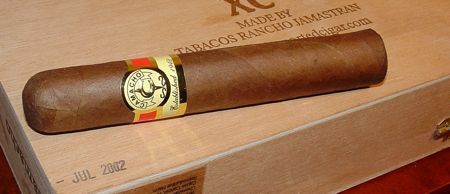
But this Camacho Havana is an unusual case: a box that I purchased already aged. I didn’t know it would be aged when I received it in the mail, but I was happy about it, because an aged cigar is always better… right? The box was stamped 2002 and by all appearances it was kept in great condition. But now that I’ve burned my way through most of the box, I have to say that an aged cigar is not always, without exception, a better cigar.
The Report
The Camacho Havana has been around for a long time. According to cigarcyclopedia it was originally produced in Nicaragua in the 1960’s. Later production was moved to Honduras, where it remains today. Like many Camacho cigars, the Havana is a Honduran puro — in this case a Jamastran criollo wrapper surrounding a corojo blend filler.
This is a great looking and well constructed robusto. The burn on all of these oldsters has been sharp and even, they have a perfect draw, and they form a strong solid light gray ash. Absolutely no complaints there whatsoever.
When I first received these about six months ago I noticed that they seemed incredibly mild when compared with the box of churchills I started in 2006. The Havana line is relatively mild, for a Camacho, but they still have a nice little kick to them when fresh. The flavor, if memory serves, is basically leather with a dash of black pepper. I like the fresh ones quite a bit.
After smoking through most of this 2002 box I have come to the conclusion that they are well past their prime. They still have a nice aroma — it’s almost like fresh sawdust and mild ginger. But the body has been completely sapped out of these poor seniors, and there’s nothing that Richard Simmons can do about it. No Sweatin’ to the Oldies for these guys.
There is almost no flavor left here. They start out super mild, and at the mid-point they take on a slightly unpleasant burnt rubber flavor, like air from an old tire. The wrapper is still putting out good vibrations, but it has no backup from the filler so I have been pitching them at this point, mostly from boredom.
The Camacho Havana line is normally a punchy smoke, and I would expect that a certain amount of age would mellow it a bit, but obviously six years is a few years past the mark. The aroma is still quite nice, though very subtle, and that’s about all that remains of a once admirable cigar.
I am doing a little research about tobacco chemistry and the aging process and if I can make any sense of some very technical papers I will post my findings here in the near future. Meanwhile, check out Stogie Fresh, where the good Doctor compiles reviews and ratings of many premium cigars at different points in the aging process. Definitely worth a gander if you’re at all curious about cigar aging.
 Cigarfan.net
This is really a great topic because I’ve heard opposing views about aging cigars. I’ve come to the conclusion that it depends on the cigar and your own individual preferences. I personally would age a cigar I found too peppery whereas someone else may enjoy that heat. I’m curious as to the obligation of a cigar retailer to provide fresh cigars unless otherwise requested to the consumer. At what point should the retailer sell the cigars as “aged”?
I tend to agree that it really depends on the cigar and individual preference. Just like wine, some cigars are made for long term development, and some aren’t. There seems to be a correlation with strength, in that full bodied cigars mature better than lighter ones. But I’m not sure if that’s true across the board. That’s one of the reasons I’m conducting this experiment. Based on body, I really thought the Camacho Havana would have stood the test of time better. And now I wonder, why not?
As for retailers, full disclosure about the product is always best. The vendor in question here is really good and I’m sure he would have allowed me to return this box had I been unsatisfied, but at the same time it would have been nice to know how “aged” these cigars were when I ordered them.
I’m not sure when a cigar qualifies as “aged.” I suppose it depends on the cigar, but if a box has been sitting in the warehouse for more than a year I think it’s time for the vendor to ‘fess up.
Burnt rubber. Yikes. Thanks for the heads up, because I have about 30 Camacho H2s (exact same blend as yours, as I understand it, but packed in the round instead of the square press) that I should probably start smoking a little faster. They’re a couple of years old. When I last smoked one they were holding up fine, but better safe than sorry. I’m going to step it up.
And yes, I too would have expected the Camacho Havana to age gracefully.
I’ve explored this topic quite a bit and written on it as well, primarily for the Doc at StogieFresh.com. And I still haven’t really reached any iron-clad conclusions. My general sense, though, is that most quality cigars these days are, like most wines, made to be enjoyed when they are produced and not after lengthy aging periods. In many cases, I don’t think aging will make a lot of difference and can, as you discovered, result in losing some flavor. Of course, that’s only my opinion.
Here’s a link to George’s article , a good summary of the current thoughts on cigar aging.
My experience so far has been that you’re right, George. In most cases long-term aging is not beneficial. But keeping in mind the opinions of vintage cigar smokers I’m hesitant to make a general statement to that effect. I’m going to keep at it for a while with my puny little collection of “aged” smokes and see what happens.
As someone who never smokes cigars quick enough I always end up smoking something with a few years age on it. My experience has been the majority of cigars don’t age well. Mild (in flavor) cigars only get milder, but medium to full flavored seem to fair better.
Now I want to find something older in my humidor.
Of all things surrounding this wonderful pastime of ours, cigar aging do’s and don’t are the toughest to figure out. It just takes too long. I think, like many folks, early on I made the assumption prevailing discussion was correct. Age, for cigars, was a great thing … across the board. Like you, I am now of the opinion it is as much personal taste as most other parts of the cigar experience. The evolution of a smoker’s palette over time has a major impact as well.
George E has some interesting tidbits. I found this article titled “Cigar Aging” by Steve Saka interesting as well.
Been thinking about Pepin’s aging opinion since we read that CS thread. I don’t know I can trust the aging opinion of someone so close to the manufacture of cigars. They must evaluate and select freshly fermented tobaccos for their blends and quality control the smokes as they come off the line. They are so used smoking fresh it has become their preference … maybe. Just my opinion.
My oldest stick is one Hoyo De Monterrey Petit Robusto aging since May 2005. This vitola was my first ISOM experience and quite a little powerhouse it was. Had one from the same batch last summer and it still packed quite a punch but was much more balanced. I’m going to try to make my last one the first cigar to reach 5 years within my collection.
Just remember though … if Dion Giolito is right, none of us should be worried about aging anything past December 2012 anyway!
It’s a little discouraging when Min Ron Nee says something like “very nice after five years” and goes on to recommend 20 for full appreciation. Sorry mate, it ain’t happening. I don’t have the facilities or the patience. (Or the wealth to acquire vintage cigars.)
Despite all this, I’m still curious from a theoretical POV. I can exercise a bit of restraint (a bit) and see what happens.
And if Dion is right, it’s going to be a shorter experiment than I anticipated. Can we can expect a really specially limited edition Illusione in 2011?
I just opened a year-old box of Camacho Havana Nacionales. What a disappointment! Bitter and foul, with a finish that could only be described as roofing asphalt. And aging is supposed to improve a good cigar? These may be headed for the garbage bin. . . .
I think it really depends on the cigar… some cigars are great out of the box, some are better with age. I also find when some cigar lines are newly released, they sometimes tend to be a little young and need a little more age on them to really mature into their flavor.
Most cigars outside of the good blends and rolls from Cuba do not age very well at all. Honduran and Dominican tobaccos in general don’t have much of the rich, sweet oils required for the blend to develop with time, and all that happens is they lose strength and flavour over the years, showing up more and more of the bland qualities of those tobaccos. Honduran tends to have a weird powdered potato and pencil graphite taste that I can’t stand. Most Dominican tobacco has very little flavour to speak of in the first place. Nicaraguan tobaccos, again in general, have much more richness and the oils necessary to benefit, but a lot of them are rolled from pre-aged tobaccos. The reason for this is that most Nicaraguan tobacco is far too harsh, bitter and spicy when young – but if you age the leaved in bales before rolling into cigars, you quickly and markedly reduce the oil content and oil qualities necessary for them to develop new kinds of flavour and aroma with age. Padróns will mellow out more, but the good blends will still show some hints of new nuance with a couple of years or so, but beyond that they will just become more and more bland.
Many Cuban cigars may not have been blended well or rolled from inferior batches of tobaccos, especially now with all their gov problems and Habanos SA just profiteering at the expense of caring anymore about the passion for their craft. Great Cuban cigars, however, are renowned for their long-term ageing because the nature of those tobaccos is, even young, being rich in sweet, complex oils. When you store good cigars for many years in the right stable conditions, preferably bunched together with minimal air exchange (a tiny amount is necessary though) then those oils migrate throughout the blend, the strength from the ligero dissipates a bit and then interacts with the seco and volado, enhancing their subtleties and sweetness, and some micro-fermentation continues to take place very very slowly.
Ultimately, ageing cigars beyond a year or two is something that only a select few kinds of cigar can benefit from, and most of those are the really good examples of Havana cigars using tobaccos from Vuelta Abajo. A properly blended and rolled D4, using proper quality harvests doesn’t just improve a bit with 5-10 years, it drastically changes in profile and becomes absolutely mesmerizing and deeply complex with great subtlety which, sorry to say again, you will never find from anything outside of Vuelta Abajo leaves, not to that extent. It simply is the best region, soil and microclimate in the world.
Some NCs will of course also benefit markedly from long-term ageing like this too, but many NC smokers like all that harshness and hot spice, so they won’t want to lose it to age. I specifically age my Padrón 2000s for this very reason though, I can’t stand unbalanced harshness, and find 2-3 years is all they need to mellow that out and thereby show up a little more subtlety. The maduros will often lose their sweetness with age too, however, so you end up with a smoother more woody and earthy cigar. The real issue here is, these cigars are not blended for ageing. You actually have to put enormous craft, experience and care into the leaves you select and how you blend them in order to make cigars good for ageing.
I will also add, at risk of being even more unpopular, that I always find the best cigars have been aged as cigars in blend and not as separate tobacco bales before blending and rolling. The reason being, when you age the tobaccos as a cigar, the full blend melds in ways that it never can if you pre-age the leaves. The oils are richer and interact more, with more micro-fermentation taking place and this produces much more delicate subtleties. I think the NC world spends far too much time trying to dismiss Cuban cigars and hate on them ignorantly when it should put that effort and time into learning about them and learning the craft of creating more cigars with more long-term ageing potential. However, using other soils, seeds and climates will never reproduce the same lush, creamy, rich yet mellow, tangy yet sweet and potentially very complex nuances in flavour and aroma as tobacco grown in Vuelta Abajo.
I know it’s trendy now to latch onto opinions that seem cool in dismissing things that are popular, and that Cuban factories also produce a ton of poor to mediocre cigars to fill out numbers for the global demand, but the fact remains that the best examples of the best vitolas are absolutely enchanting. You know when you try one, and you know when someone else is smoking a truly great cigar too, because they completely shut up and their whole being becomes attentive to the flavours they’re getting. If some loud-mouth blowhard is banging on about their cigar on youtube or wherever else, you can be certain they are not smoking a great cigar. It may be a good cigar, but it’s not truly great. And also be very wary of online trends and opinioneering, because there are now a lot of US owned companies producing fashion sticks with 5 fancy bands and being pushed and marketing like crazy online. You know when a youtuber or blogger is being paid by NC cigar companies to market their products now simply because nobody can make money with tobacco-related content online without background sponsorships like that…
I’m not hating on NCs at all, half of my collection are NC and that’s going to increase drastically as I simply can’t afford CCs anymore, but whenever I occasionally treat myself to buying a new Cuban cigar, I only buy it from a store where I can browse and hand-select myself. I have 20 years experience and find that 9 times out of 10 I can pick a really good to great Havana by the look, box aroma, feel and wrapper shade (depending on the marca and vitola). If all you can do is buy blind online, unfortunately you’re going to get the scrap or maybe some OK examples 9 times out of 10 instead of the great stuff. It sucks, but it doesn’t cancel out the fact that the best Havanas ARE the best cigars in the world. It’s not marketing hype, it’s decades of passionate cigar lovers experience saying this, because they know it. Cuba never really marketed their cigars anyway because they didn’t have to. All the marketing and hype now is these new NC companies using the internet to push their products and take advantage of a sadly declining Cuban industry. If you’ve not actually got much experience smoking a lot of Cuban cigars, then you do not know what you’re talking about. Sorry. You’re merely repeating ignorant opinions you’ve been fed in the internet.