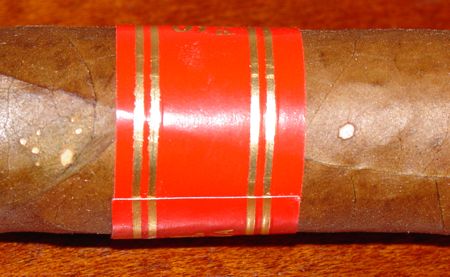
Montecristo Platinum Royale Delacroix

It’s been a while since I fired up a Monte Platinum, and to tell the truth I was a little hesitant about this one. Back in the day they used an Indonesian wrapper that really put me off my oats, but they switched to a San Andrés maduro which has made a big improvement. Even so, this one has been languishing in my humidor for a couple years.

The “Cigare des Artes” line was introduced by Consolidated Cigar in 1998 (before the company was swallowed up by Altadis USA) as a fuller bodied version of the standard Montecristo. The original line had a Nicaragua wrapper, and the packaging was extravagant: cedar-wrapped cigars in aluminum tubes sold in specially decorated boxes or ceramic jars.

The art chosen for the line was unusual for the American cigar market: the paintings of French artist Michel Delacroix, most of which feature cityscapes of Paris and its environs prior to World War II. He paints in the “naif” manner — a simplistic, folksy style that ignores perspective and looks sort of like the art of Grandma Moses. Given the slick, cosmopolitan images used in cigar advertising today, this isn’t what I expect to see on a cigar box.

The painting commissioned for this line is called “Montecristo Royal,” a crisp looking winter scene of the city that includes a huge sign on a building that reads “Montecristo Fine Cigars” with the Montecristo logo. The sign looks out of place, just as the painting does on a box of cigars. It took a while, but eventually I began to see its charm.

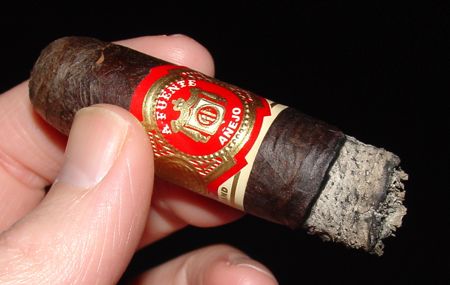
When the original “Cigare des Artes” blend was discontinued in 2002 it was replaced by the Platinum blend, but the commercial vitolas and the artwork still bore the impression of Michel Delacroix. The 7.25 x 52 double corona up for review here is called the “Royale Delacroix.” This size was discontinued in 2004, so this stick has a few years on it. (I received it in a trade about two years ago.)

The wrapper on this slugger is a Habana 2000 grown in the San Andrés Valley of Mexico, normally known as a great producer of maduro wrapper. The binder is Nicaraguan, and the filler is a blend of leaves from the Dominican Republic, Peru and Nicaragua. And like most (if not all) Montecristos, it is rolled in the Tabacalera Garcia factory in La Romana, DR.

The wrapper on this cigar is dark, nearly maduro, with a lot of oil. The overall appearance is rough, but attractive nevertheless. The roll is solid and the draw is just right. It lights up easily and starts to build a solid light gray ash.

The first third is marked by a sweet hickory flavor and a mild body. For the first inch there’s just a hint of bite, but this vanishes as some cocoa flavors make an entrance. Into the second third the finish grows and leaves an earthy aftertaste. The flavors get a little more chocolatey but in a muted rather than a robust way. A good contrast is the RP Olde World, which has similar flavors but articulates them much better. The aroma up to this point is of sweet wood and is generally quite pleasant.

After an hour I find that I’m becoming bored with this cigar. It’s burning well and tastes fine, but it’s lacking in substance. Maybe if I were sitting in a Paris cafe, circa 1895, watching the snow fall on a horse drawn carriage while I sipped my coffee, perhaps then I might find the patience to smoke this big boy to the end. As it is now, in the twenty first century, watching the jets streak across the night sky bound for Nellis AFB, I’m ready to call it quits.

The Montecristo Royale Delacroix is fine cigar, no doubt. Fans of mild to medium bodied cigars will find this double corona very enjoyable, but if you’re looking for a little more flavor, you may want to look elsewhere.

Aging Report: Padilla en Cedro Robusto

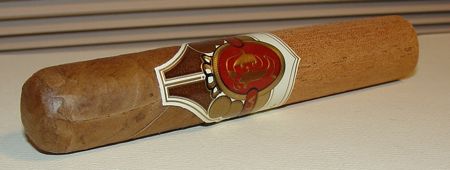
The Padilla en Cedro was a special edition cigar from Ernesto Padilla that was released in 2005. Production ceased sometime in 2006, and to my knowledge these are sold out everywhere at this point in time. It’s a mild Connecticut shade style cigar — an unlikely candidate for aging, to be honest.

When I first received these in early 2006 they were almost bitter. The tannins were puckery strong and not to my liking at all, especially not in a Connecticut shade selection. The blend just seemed all wrong for that.

But when I last checked in with the Padilla en Cedro it had improved remarkably from its fresh state: nine months in the humidor did wonders. The tannins had mellowed quite a bit and the cigar was a much smoother, and enjoyable, smoke.

And now, after two years, this robusto is completely transformed. While still mild, it has grown far more complex and subtly sophisticated than I thought possible. The only way in which it seems to have suffered is in appearance — the wrapper has become slightly faded, more drab and splotchy, though it seems to have retained its sheen.

Remembering this cigar’s original character, I was expecting at least a hint of tannin, but for the first third there’s nothing but nuts and honey sweetness, with a touch of vanilla that was not in the fresh cigar at all. A remnant of tannin is apparent in a generally dry flavor, but it’s nothing that approaches a full blown pucker.

At the half-way point the cedar qualities come to the fore, and a little black pepper sets in. The finish lengthens and there is a more substantial aftertaste, thanks in part to the pepper. As the flavor on the tongue gets stronger, the aroma seems to fade a little, which makes the Cedro a little less profound. A lot of its subtlety is in the nose.

Somewhere around the 3/4 mark it dwindles to a merely average cigar. The flavor bottoms out and veers toward bitterness — a slight disappointment considering how wonderfully the trip started.

Construction values here remain consistently very good on all levels — a perfect burn, a streaky but solid ash, and an effortless draw.

I suspect these robustos are at their peak right now. The highlights of this cigar — the gentle sweetness and vanilla overtones — are subtleties that I can easily see vanishing in a few months to a year. This seems to be the problem with aging mild cigars, though in this case it has really paid off. I may hang on to a couple of Padilla Cedros for “research” purposes, but the rest of them are in my sights right now.

A Worthy Cause

Matt (of Matt’s Cigar Journal) is raising money for the Pediatric Brain Tumor Foundation through this year’s Triangle Ride for Kids, and he’s asking us stogie fanatics for a little help. As a tempting incentive, he’s raffling off some great smokes:

1 box of Fuente Opus X Petit Lanceros from CigarsDirect.com
1 Box of Hoyo de Monterey Dark Sumatra Noches from Tobacconists of Cary, NC
1 Box of Perdomo Habano Corojo Robustos from Tabacalera Perdomo
1 Box of Camacho Corojo Monarcas from Camacho Cigars

The raffle is only ten dollars a throw and so far there aren’t that many contestants. Your chances of winning right now are pretty good, and your chances of making a contribution to a great cause are assured.

And to sweeten the pot a little, the most generous contributor will get a handful of my goto smokes. Just make sure to leave a comment below this post saying that you made a contribution so I can contact you when it’s through.

Go to Matt’s Ride For Kids post to enter NOW! There are only a few weeks left!

I just noticed there are a couple of tying entries right now — $100.00 is the price to beat for my free smokes. In the event of a tie, the winner will be decided by our new puppy, Chip. My wife found Chip abandoned on the Navajo Indian Reservation in Northern Arizona a few weeks ago, and he’s going to be a great dog.

If a tie breaker is necessary, two or more new tennis balls with the contestants’ names written on them will be launched simultaneously in my back yard, and the one Chip retrieves will be the winner. Now what could be more random than that?

Meet the Referee


Arturo Fuente Añejo No. 48

In September 1998 Hurricane Georges ripped through the Carribbean and caused widespread destruction, including crop damage in the Dominican Republic. Among the beseiged plantations was the now famous Chateau de la Fuente, where wrapper leaf for Fuente’s Opus X is grown and harvested.

Two years later the legacy of the storm was borne out in a shortage of Opus X wrapper, but instead of halting production altogether, Carlos Fuente Jr. directed the use of a different wrapper — a hearty maduro broadleaf. In this way improvisation triumphed over adversity and the Arturo Fuente Añejo was created.

The filler blend is said to be a combination of the blends used for Opus X, Don Carlos, and Hemingway cigars, all of which are themselves secret — which makes the Añejo blend an enigma wrapped in a mystery, wrapped in a Connecticut broadleaf that has been aged for three to four years, including six to eight months in cognac barrels. (The original release used wrappers aged for seven years, hence the name Añejo, meaning aged.)

Current sizes in production:

  • No. 46 – 5 5/8 x 46
  • No. 48 – 7 x 48
  • No. 49 – 7 5/8 x 49
  • No. 50 – 5 1/4 x 50
  • No. 55 – 6 x 55
  • No. 77 “Shark” – 5 5/8 x 54

I usually try to smoke several cigars, preferably from different boxes, to prepare for a review, but in this case I was stymied by both the price and the availability of the Añejo. Typically these are released twice a year — in the summer around Father’s Day and again around the winter holidays. And even though they are reasonably priced by the manufacturer, consumer demand pushes the shelf price into the stratosphere. MSRP plus my state tax should place this stick in the $11 – 12 USD range. I paid $18 for one No. 48 last summer. That’s a bit rich for my blood, so I’m reviewing this cigar based on one single experience.

The Arturo Fuente Añejo is presented in a cedar sheath that seems to be more aromatic than most — I’m not sure if it’s by design or by accident, but it lends the wrapper an intense scent of sweet cedar. The wrapper itself is a moderately oily and rich looking oscuro.

In a pre-light pull the draw is firm to tight, and the flavor is of wood and straight sweet tobacco.

I was expecting the Añejo to be a big powerful smoke like its sibling Opus X, but this was not the case with the churchill sized No. 48. Instead what I found was a civilized and genteel cigar with an elegant perfume.

It starts up very smoothly with a good dose of sweet spice — light anise and sweet cedar. The finish is short and the aftertaste evanescent. It draws very well despite my initial pre-light impression — it’s firm, but the volume of smoke is effective and cool. The burn is even and consistent from start to finish.

The 48 doesn’t undergo a lot of transition during the course of the smoke. It grows in intensity, but it’s still playing the same song at a louder volume. Fortunately for me this is a song I really like. It starts out with moderately mild body and soon becomes medium-bodied for the duration. The last third does become a little bit richer, the spices turn from sweet aromatics to smatterings of pepper, and the aftertaste takes on a little more gravity. The finish stays crisp and clean to the band.

And from first light to last ash this cigar puts out a beautifully elegant aroma — it’s floral at times, cedary at others, and really enjoyable throughout. It reminds me a lot of the Fuente Work of Art maduro in this respect, but the Añejo is perhaps more refined. That could be due to the size difference rather than the blend, but I find the similarity unmistakeable.

I can certainly see why Lucky7 made one of the Anejo cigars his best of 2007. So far I think this is the best cigar I’ve smoked this year. But the price… Doh!

REFERENCES

Vitolas.net — a fantastic source for Fuente information and trivia.

Cigar Wrapper Issues: Mold, Bloom, and Spots

bloom1.jpg

We are approaching that time of year when conscientious cigar collectors look to their humidors with concern and trepidation. Well, concern anyway. I’ll reserve the trepidation for myself. Tobacco beetles, mold, the perfect RH and temp for aging my precious smokes — all these worries infect my otherwise pacific pastime.

And I know I’m not alone. I’m always surprised when I look at the hit counts for this blog and see that our All Time Most Popular Post is not a remarkably incisive review of the hottest new release from Pepin. It’s a short throwaway post about mold on cigars. (See this post for pictures of the afflicted.)

“Is it mold or plume?”

That is the question. The cigar is fuzzier than a two week old kitten, but Polonious behind the register is telling you it’s “aging very nicely.” Fuzz factor aside, it normally takes years to develop bloom on a cigar. Unless your shop sells vintage cigars, it is unlikely to be plume.

But it’s not often easy to tell the difference between mold and bloom if you don’t know what to look for. The most common type of cigar mold, in my experience, is the white variety that occurs in small patches on the wrapper. Unfortunately I don’t have as much experience with plume (aka bloom) but the distinguishing characteristic is that plume is not patchy like mold is.

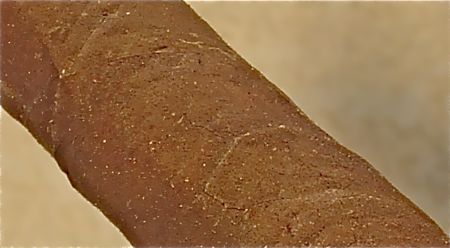
Pictured above is a four year old cigar with a very light dusting of plume. It’s really hard to photograph, but it sparkles if turned at the right angle in the light. I adjusted the saturation in an attempt to highlight the crystals. It is far less dramatic, but oh so much more delightful than patches of mold. Vitolas.net has a much better photo of a blooming ’95 Opus X here.


Plume is a crystallization of oils from the cigar wrapper, and it appears as a fine spray of sugar, more or less evenly distributed across the surface of the stick. Mold, on the other hand, is a living and social creature that likes to gather in colonies. Well, maybe not social, but you get the point — it shows up in discrete separate spots, making your cigar look like a petri dish.

Green patches

green-spots-1.jpg

Getting tobacco to grow is not hard. Tobacco is a weed (and I like it, to quote the verse) and it will grow wild, unsupervised, with heartfelt abandon. But growing attractive, flavorful tobacco, particularly wrapper leaf for cigars, is not easy. It is hard. Very hard.

Something as uneventful as the fall of a tiny pink blossom from the top of the plant onto the leaf below can damage the leaf, resulting in a blemish, or worse, “blossom rot.”

“If you can’t get to the tobacco on time,” explains Lawrence Palombo (of General Cigar) on a tour of the fields, “it starts flowering, the blossoms drop off onto the leaves below and rot, damaging the leaf.”¹

Years and years of breeding and experimentation have gone into the methods used to produce the golden leaf we love, much of it in an effort to dodge the diseases tobacco is heir to and the pests who would like to beat smokers to the Punch. But it isn’t a perfect science. There is one factor that agronomists and vegueros will never be able to control with precision — the weather.

Nearly all the wrapper anomalies that aren’t attributable to mold or plume are caused by water appearing at inopportune times on the leaf. Most leaves that are damaged in this way never make it to the roller’s table, but occasionally they do. Often the resulting cigars are sold as seconds. Or Havanas.

Controlling moisture is essential. If a curing barn is too humid, there is a danger that the tobacco leaf will become mottled or will rot before drying. On the other hand, overly dry air inhibits the chemical transformations that are necessary for the tobacco to dry properly, leaving green traces of cholorophyll on the leaf. For these reasons, the veguero must open or close the casa’s doors accordingly, carefully maintaining a constant temperature and relative humidity inside.²

green-spots-2.jpg

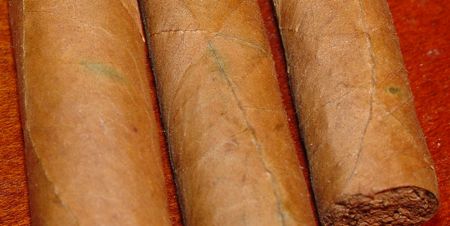
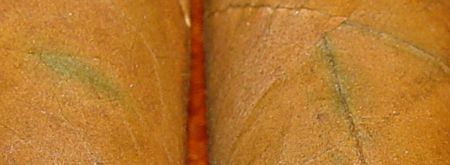
Green patches caused by imperfect curing are most commonly found on the delicate claro shade wrappers of Cuba and the Connecticut River Valley. They’re sometimes called “frog eyes” (not to be confused with the more damaging tobacco fungus called “frog-eye leafspot.”) They usually show up as small, relatively minor blemishes like those pictured here. They are clearly discolorations and not growths like mold.

It isn’t clear to me exactly what causes these green spots, but it appears that excess moisture at some point in the process causes patches or streaks in the leaf to resist curing.

“The rain prevented the tobacco from maturing the way it should,” says David Perez (of ASP in Ecuador.) “We had a lot of green spots, a lot less yield per acre…”

Tobacco grown during the El Niño years is easy to spot. Some is subtly marred, with a few green spots on the wrapper known as frog eyes. These spots usually aren’t detectable in the fields, but the eyes blossom in the curing barn as the moisture is drawn from the tobacco.³

While there doesn’t appear to be a singular cause of green spots, the important thing is that they really are harmless. They detract from the overall appearance of the wrapper, but they don’t affect the flavor or burning quality of an otherwise perfect cigar.

Water Spots

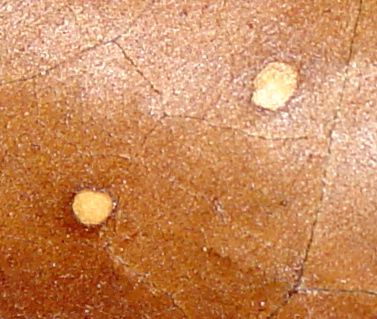
The other common imperfection of the harmless type is the water spot. These usually occur as very light yellowish-white circular patches that stand out against the light brown of a shade grown wrapper.

water-spots-1.jpg

It is commonly believed that drops of rain water sitting on the leaf cause damage to the chlorophyll in the leaf, eventually affecting the curing process so that instead of degrading from green to brown, the pigment in the spot turns lighter than normal.

Spots are about the size of a pinhead, random, and generally lighter than the wrapper. Althrough there has been some debate about what causes the spots, the general concensus is that these are just splashes of water that have marred the leaf.

Remember that wrapper leaf is very delicate, and can be bruised by something as seemingly harmless as a steady pelting of rain. The spots of water then act as lenses to focus sunlight on these points and slightly discolor the leaf.4

water-spots-2.jpg

The causes of wrapper imperfections are varied, and in the final analysis not all that important. What is important is to be able to differentiate between mold and harmless flaws. Mold can destroy a cigar, whereas small leaf spots are almost always harmless. And if you are lucky enough to have a blooming, pluming box of vintage smokes — then, my friend, you have done very well for yourself indeed.

NOTES

  1. Wrapped Up: Some of the World’s Best Cigars Use Connecticut Tobacco Wrapper Leaves” Cigar Aficionado, Winter 1992
  2. The Havana Cigar: Cuba’s Finest, Charles Del Tedesco. Abbeville Press, 1997
  3. Land of Fire: Ecuadoran Cigar Wrapper Tobacco Thrives in a World of Volcanoes and Perpetual Cloud Cover” Cigar Aficionado, March/April 2000
  4. The Complete Idiot’s Guide to Cigars, Ted Gage. Alpha, 1997