Romeo y Julieta Vintage Maduro Corona

ryjvm

Romeo y Julieta is a many-headed beast, with at least seven different blends currently in distribution by Altadis USA. Lest you lay awake at night wondering how many extensions one brand name can possibly support, allow me to enumerate:

  1. Romeo y Julieta 1875. The first Dominican made R y J, originally made by Matasa for Hollco-Rohr in the 1980s.
  2. Romeo y Julieta Vintage. Debuted in 1993. A mainstream “super-premium,” mild and delicious.
  3. Romeo y Julieta Reserva Real. Introduced in 2003 with an Ecuadorian wrapper.
  4. Romeo y Julieta Reserve Maduro. Came out the same year as the Reserva Real. “Blackened” Connecticut broadleaf wrapper over a distinctive Nicaraguan, Peruvian and Dominican filler blend.
  5. Romeo y Julieta Aniversario. Another from the class of 2003. A little heavier than the rest of the family. Released for the brand name’s 130th Anniversary.
  6. Romeo y Julieta Habana Reserve. The Honduran Romeo, full bodied with a Nicaraguan wrapper.
  7. Romeo y Julieta Vintage Maduro.

And then there are strange offspring like Cigar International’s Romeo y Julieta Viejo, as well as more legitimate but rarely seen Cabinet Editions, etc. The elasticity of the name is remarkable.

The Vintage Maduro blend I’m reviewing today is an interesting inversion of the Aniversario: the Ecuadorian Sumatra is used on the inside as a binder, and the broadleaf is the wrapper. Actually, it’s “blackened” broadleaf, whatever that means. The same term is used for the wrapper on the Reserve Maduro, but I’m not exactly sure what this “blackening” process is, or how it differs from the standard maduro process. (Presumably Sir Marksalot was not involved.)

Individual vitolas in the Vintage line are labeled I – VII, with the exception of the tubed cigars, the corona and the toro. The corona is a little bit fatter than normal — a 44 ring gauge rather than the standard 42, but otherwise a typical 5 1/2 inches in length.

The packaging is tasteful. Tubed cigars are always nice to give as gifts, particularly to dissolute friends as you pack them off after the holiday party. A tube will provide stability and a minimal level of defense against the shocks and blows of the journey home, but it won’t preserve the cigar indefinitely, so as your departing partygoers stagger off into the night remind them about proper humidification.

I approach this cigar with some hesitation. It’s been out for a while now but I’ve steered clear of it because it combines one of my favorite Altadis cigars — the RyJ Vintage — with a cigar I wouldn’t give my dog — the Reserve Maduro. I rarely rag on cigars here because it’s just not my style, but back in the early days of this blog I said the Reserve Maduro had an “excremental element.” That’s me being nice.

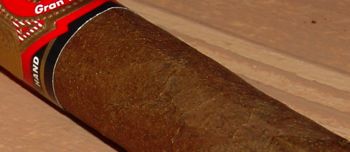
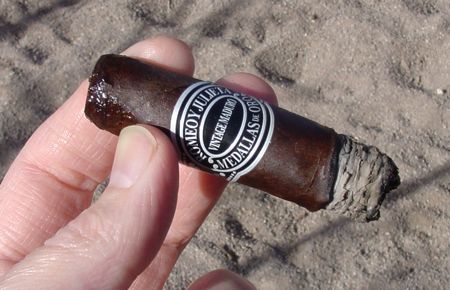
The wrapper is an oily and smooth dark maduro with some inconsistency in color. This is a good thing, since a perfectly uniform color often indicates artificial processing. The roll is firm but the draw is just right. It lights up easily and begins a slow smolder.

The Vintage Maduro is similar to the standard Vintage in body and style — mild and creamy smoke with a pronounced aroma and zero bite. In fact, for the first third there isn’t much taste on the palate at all — it’s all in the nose: sweet cedar and a touch of sugar. The burn is a little off kilter, but for a maduro it’s far above average.

The middle third offers up bittersweet chocolate and coffee flavors and the finish grows considerably. The aftertaste is still rather mild, but the flavors on the palate build as the body grows to a solid medium. The last section returns to the woody flavors with which it opened, but rather than fresh cedar it comes across as a sweet earthy char.

This little maduro turns out to be a fairly complex smoke that charts a course from sweet, mild and aromatic to a final destination of rich earth and charred wood. Ports of call include chocolate and coffee flavors, and the transition is aided by a slow and even burn. All told, this maduro version of the Vintage is worthy of the name, and definitely worth the retail price of 5 to 6 USD per stick. I’ll be on the lookout for more when I’m in the mood for a slow cruise across the dark sea of Maduro.
ryjvm2

Aging Report: Saint Luis Rey Cazadore

slrcaz

This mysterious cigar, first reviewed in April 2006, is from a 2005 box that has an uncertain history.  When I first purchased these from JR Cigars I could find no listing for St. Luis Rey Cazadores anywhere except JR, and nothing has changed since then. (They are unlisted by the manufacturer, Altadis USA, though JR still lists them as “Out of Stock.”) The current SLR is a medium-bodied multinational blend with a Nicaraguan wrapper, while this one is still a full-blooded full-bodied Honduran.

The “Cazadores” is a traditional Cuban production vitola — the Cuban Romeo y Julieta is probably the best known example — but this double corona sized cigar doesn’t even come close to meeting the traditional 6 7/16 x 44 Cuban format.

So why this cigar is called a “Cazadore” is as confounding as the fact that it no longer exists, because it’s a nice full-bodied cigar that so far is aging beautifully.

Aesthetically this old SLR is gorgeous — a smooth leathery colorado wrapper that has few veins and almost no imperfections. The roll is perfectly consistent and the head is flawlessly shaped and wrapped. The one surprise is the lack of a triple cap — with a roll this perfect I’ve come to expect one, even if here it really isn’t necessary.

I was prepared for this cigar to have lost some weight over three years in storage, but it seems to be as brawny as ever. It starts up with the same bullish glower that I remember so well — pepper with a leathery aroma and a good kick from the git-go. The draw is good but the thick juicy wrapper requires a correction almost immediately, within the first inch and half. (Since this was the last correction needed, I’m calling operator error… toast that foot evenly.)

The middle third is meaty and rich — just what I’m looking for from a Honduran cigar. The aroma takes on a woodier aspect at this point with a dash of cinnamon. I didn’t note this in the earlier review, and digging through the cluttered humidor of Smokes Past I’m not finding any memories of such subtleties.

The last third returns to darker peppery flavors and leather, getting stronger by the inch. I was hoping that this cigar would have mellowed a little in this regard, but after three years it’s still in fighting form.

My experience with aging cigars has so far shown that after a year or two the most noticeable change is in potency — I’ve seen this with the Camacho Havana (6 years) and the Angel 100 (2 years) and with several other brands over shorter periods of time. Strength diminishes and subtler qualities emerge. For the most part the Saint Luis Rey Cazadore is an exception to this, at least so far. I still have half a dozen of these put away, so we’ll have to see if the weight of the years can eventually tame down these unruly Hondurans.

Fuente Don Carlos Vertical Review (Pt. 1)

afdoncarlospres

Arturo Fuente Don Carlos Presidente

The Don Carlos line is one of Arturo Fuente’s “super-premium” brands, a step up from the Hemingway Series, but not quite as exalted as the Opus X. The highlight of the blend is an aged Cameroon wrapper, underneath which is a Dominican blend from the Fuente farms.

I’ve always liked this blend, but I don’t smoke it much because of the price (in the $10 -12 range).  The robusto has always been my goto Don Carlos, when my wallet has been sufficiently lined, but our friends at CigarsDirect.com were kind enough to send a sampler pack my way so I could try a few of the sizes I’ve never smoked.

Last year Lucky7 posted what I think is the definitive Arturo Fuente Don Carlos Double Robusto review –check it out for more information about the blend and the story behind it. I’m not going to try to top that review but I’m going to try my hand at a few of the other sizes in a vertical review to see how they compare with each other. First up, the No. 3 corona versus the toro-sized Presidente.

Arturo Fuente Don Carlos No. 3

Arturo Fuente Don Carlos No. 3

The No. 3 is a typical corona: 44 x 5.5 inches long. The wrapper is attractive but marred by a mucilaginous smear, a strangely common defect in the Don Carlos line. The corona cuts cleanly and has a satisfyingly firm draw. It lights up easily, burns evenly, and builds a long and solid light gray ash.

The flavor starts out smooth and full, nutty with a minty veneer typical of Cameroon. Unlike some other Cameroon blends, afdoncarloscamthe wrapper here seems better integrated with the rest of the blend: it adds an element of spice but maintains its neutrality.

The Don Carlos corona definitely has a sweet spot in the middle third where the flavor becomes a little richer, moving from nuts to leather, and the aroma is sweet and mildly spicy. The final third heats up a bit, so you’ll have to slow down to maintain the balance and keep the taste from getting bitter.

This is a great little cigar — one of the best in its size, I think — but there may be some consistency problems, as Lisa found in her review for Her Humidor.

The Presidente, a 6.5 x 50 toro, is the largest (or at least the longest) size in the line. It displays the same construction characteristics as the Corona, including a distinctive glue smear half way down the barrel, and a neat triple cap. It lights easily on a match or two and burns without a hitch.

afdoncarlospres2

AF Don Carlos Presidente

By contrast with the corona, the Presidente has a little more kick and by the end a lot less nuance than the smaller cigar. This toro opens up with a dose of peppery tobacco — piloto cubano, perhaps — and a barely noticeable touch of Cameroon spice.

After an inch the pepper wears off and the flavors glide down into nuts and leather, but it never achieves the same smoothness as the corona. It’s not harsh by any means, but there is a spicy vibrancy here that the corona does not possess. And while the corona is a solidly medium-bodied smoke, the Presidente reaches well into the full range.

The cedary sweetness from the Cameroon rises up when the pepper dies down and stakes its claim in the middle third of the Presidente, followed by a peppery reprise from the final third to the band. In the last couple of inches the pepper gradually builds and eventually overpowers the more subtle spices, leaving a lengthy and powerful finish on the palate.

Obviously there are similarities between the Don Carlos No. 3 and the Presidente — the way the wrapper blends with the core of the cigar, adding an element of spice without being obtrusive, is common to them both. Aside from that, they smoke quite differently and might very well appeal to different kinds of smokers. The No. 3 is smooth and medium bodied with finer notes of leather and mint, whereas the Presidente is medium to full and offers lots of pepper at the start and again at the conclusion of the cigar.

Both are quality cigars, but they are as different as the youngest and oldest brothers in a large family. Sure, they resemble each other, but one might be your best friend. The other might just be your best friend’s brother.

Thanks again to CigarsDirect.com for allowing me to meet the family! Stay tuned for the next installment of the Don Carlos Vertical Review, this time featuring the Robusto and the Double Robusto.

doncarlosband