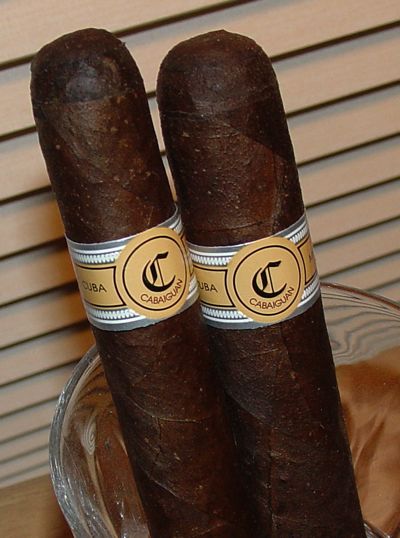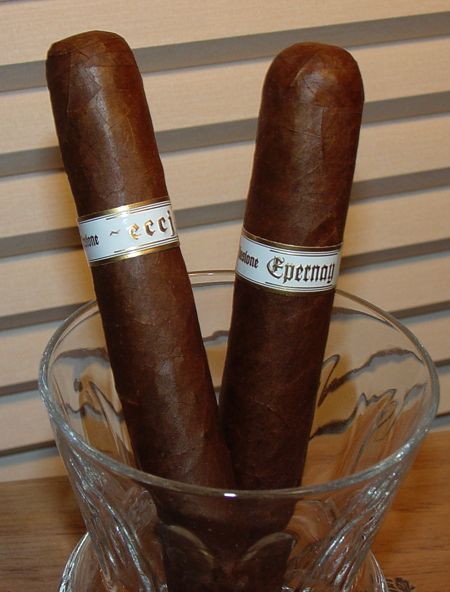
Illusione Epernay

Wine and cigars.  I like them both, but not usually together because the robust flavors of black tobacco almost always conflict with the more delicate qualities of wine. It could be that I’m pairing wines of insufficient strength with full-bodied stogies, but the result in my case has been invariably the same: a wine that tastes like ash.

Dion Giolito wants to convince us that this is not always the case. His Illusione Epernay series, which was blended specifically to complement the flavors of champagne, has its origins in the 15th anniversary cigar commissioned by the European Cigar Cult Journal (ECCJ).  That blend has now been expanded to four sizes and has been christened Epernay.

Since the original blend was created for European cigar aficionados, it makes sense that the Epernay series is blended for what Giolito calls the “European palate.” I’m not precisely sure what that means, but assuming  European cigar enthusiasts are smoking mostly Cuban cigars it would make sense that this is going to be a lighter, more aromatic and elegant cigar than the average Nicaraguan.

The Epernay series is like other Illusione cigars, a corojo-criollo blend of tobaccos from Nicaragua, also made in the Raices Cubanas factory in Honduras. The wrapper is a sun-grown corojo leaf described as “Cafe Rosado.”

Four sizes are available (and it looks like there are still some ECCJs floating around as well) :

  • ECCJ 15th – 5 5/8 x 46
  • Le Petite – 4 1/2 x 44
  • Le Ferme – 5 1/4 x 48
  • Le Elegance – 5 3/4 x 40
  • Le Grande – 6 x 46

Construction Notes

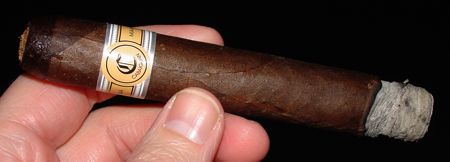
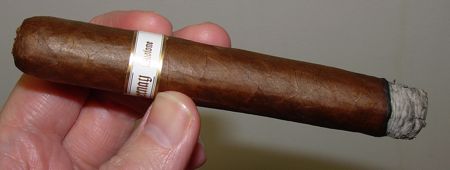
When I finished tallying my scoring sheet for this cigar I found that the Epernay Le Grande achieved nearly perfect marks for construction. This is pretty rare, but this is a rare smoke. The wrapper on this cigar is not flawless, but the mostly fine veins that track through the dark golden leaf aren’t distracting in the least. The cap is wound with nearly seamless precision into a rounded head. The roll is solid and the draw is perfect. It burns slowly and evenly, leaving a solid but slightly streaky gray ash.

Overall superb construction.
Tasting Notes

Since we had opened a bottle of champagne for the Thanksgiving Day festivities, I took the opportunity to smoke the Epernay along with a glass.  I was prepared to be disappointed, making sure that an alternative beverage was readily at hand.

The Epernay Le Grande opens with a mildly acidic zing familiar to those who smoke Nicaraguan corojo-criollo blends. After half a dozen puffs I hesitatingly tipped the glass to my lips and fully expected the wine to taste tainted. But it did not — the zing of the tobacco actually blends with the carbonization and the tannins in the wine! The flavors of the champagne weren’t affected at all, at least not yet.  In the first third the smoke itself is buttery smooth with some cedar and something like toast. The flavor is mild enough to pair well with the champagne, but the smoke texture is closer to medium-bodied.

Some tartness enters in the middle section, but it is nicely balanced by the woody sweetness on the nose —  the smoke leaves an oaky impression, a little tannic with a touch of honey. (I have to wonder how much of this is attributable to the champagne.) The finish is pleasant but has a salty tang.

The final third tastes more like a traditional Illusione blend — the familiar flavors of cocoa bean with a smattering of black pepper. At this point the smoke seems to interfere with the champagne, but the bottle had already been drained by my thirsty guests anyway. I was more than content to finish this cigar with coffee after bidding the oenophiles good night.

Conclusion

The Epernay Le Grande is an even-tempered, medium body cigar with a lot of class and a good deal of refinement. It also had nearly perfect construction — probably the best of any cigar I’ve smoked this year, scoring 49 out of 50 points. The cigar it reminded me of the most was Tatuaje’s Cabaiguan — perhaps because the Epernay stands in the same relation to Illusione’s original line that Cabaiguan stands to Tatuaje — it’s a mellower, more subtle, but equally complex cigar.

And it does in fact complement champagne; I’ll be interested to see if it can pair up with other types of wine as well. This could be the start of a beautiful friendship.

Illusione’s Epernay line is only available cabs of 50, but individual sticks retail for around 8 to 9 USD per stick. A little pricey, but definitely worth the experience.

Final Score: 93

Frank Llaneza 1961 Cuban Corona

Frank Llaneza is a lion of the cigar industry who has been described by the Wall Street Journal as “the last grand old man of the cigar business as it was carried over from Cuba.”

He is best known as the former president of Villazon & Co., which was started by his father and his partners in Tampa in 1920. Young Frank was conscripted into the cigar industry, starting out with janitorial duties in his father’s factory, a job that he would have gladly forsaken to spend more time in school instead. But this was the during the Depression, and his choices were limited. As part of his education in the business he soon left for Cuba, where he learned how to select wrapper leaf under the legendary Angel Oliva, Sr., a man who would become first his mentor and later his collaborator.

Llaneza was on the ground in Cuba “when Fidel Castro came down from the mountains into Havana.”  He saw changes on the horizon, but initially he didn’t see the extent of them. The Castro regime gained strength and finally fomented a revolution, leading eventually to the confiscation of the entire Cuban tobacco industry. Fortunately, Llaneza, along with Angel Oliva, had wisely already begun their first experiments with Cuban-seed tobacco in Central America.

Llaneza took over the reins of Villazon in 1953 and continued the company’s tradition of making clear Havana cigars. That changed over the following decade as his continued success with growing excellent cuban-seed tobaccos in Honduras provided Villazon the opportunity to fill the full-bodied cigar niche left open by the embargo.

Two of those of those cigars would become mainstays on the American cigar scene for the next fifty-plus years: Punch and Hoyo de Monterrey.

In 1996 General Cigar purchased Villazon and with it those famous brands. Theo Folz, recently retired from Altadis USA, saw this as a missed opportunity for his company:

“We’ve always been a net buyer of businesses,” says Folz. He regrets missing one, Villazon & Co., and its renowned cigarmaker, Frank Llaneza. The maker of Punch and Hoyo de Monterrey was acquired by General Cigar in 1997. “The one acquisition that I should have made, that slipped through my fingers, was Villazon. Because not only would you get a great business, but you would get one of the greatest cigarmakers in my lifetime.”  Cigar Aficionado, 3/09/2004

Ironically, Llaneza recently retired from General Cigar and is now blending cigars — for Altadis USA.  The Siglo Limited Reserve was his first, and the Frank Llaneza 1961 is his most recent creation.

The 1961 is made in Nicaragua and features a Criollo 98 wrapper from Ecuador. The binder is Nicaraguan, and the filler is a Nicaraguan-Dominican blend.  Cigar Insider picked the Cuban Corona size as the pick of the litter, rating it 92 and bestowing upon it “Humidor Selection” status.

Six sizes are available:

  • Corona Grande – 6 1/2 x 44
  • Cuban Corona – 5 5/8 x 46
  • Double Corona – 6 3/4 x 48
  • Double Magnum – 6 1/2 x 54
  • Magnum – 4 3/4 x 54
  • Pyramid – 6 1/4 x 54

Construction Notes

The 1961 Cuban Corona is an unassuming stick with its simple band and dark leathery wrapper. This outer leaf is actually maduro in color; with its leathery appearance and slight sheen of oil, it could pass for a maduro cigar. The head of the cigar is well made and one of my specimens exhibited a quadruple cap. The roll is solid, though one cigar had a very minor dent in one side. The draw is just right and the ash is firm, but it does flake just a little. The burn is very slow. I expected to get 45 minutes to an hour from this stick but it smoldered for almost twice that long.

Overall excellent construction.

Tasting Notes

The Cuban Corona is an assertive cigar that announces itself with a leathery bite. There are a lot of flavors here, but they seem to be blended together so well that it’s hard to distinguish between them. In the first third I was a little overwhelmed by the leather and spice, but I was still able to detect a sweet edge to the smoke. The lengthy finish is impressive.

I learned quickly not to retrohale this cigar at all. Unless you enjoy the sting of rich peppery tobacco and the sneezes and sniffles that accompany it, you won’t either. But simply puffing on this cigar releases clouds of rich woody spice. There’s some salt here too, which had my palate begging for a Islay malt companion. I was happy to oblige with a glass of Lagavulin.

The Cuban Corona comes out of the corner swinging and never lets up for a breather. The last round is not much different than the first, but by this point my palate has taken so many blows that it’s a little bit numb. Pepper, leather, and some cinnamon spice are the main contenders, with the ghost of grilled meat hovering over it all.

Conclusion

This cigar carries all the characteristics of the Honduran style, despite the fact that it has no Honduran leaf. It reminds me of a Camacho more than any other cigar, minus Camacho’s signature Corojo overtones. But this should come as no surprise, since Frank Llaneza has been making this style of cigar for most of his life. The 1961 blend is much bolder, I think, than any Punch or Hoyo I have tasted, but it shares the same leathery, meaty quality of those cigars.

I hesitate to use the verboten term “strong,” but there is certainly an edge to this smoke. The nicotine content is not overpowering, but retrohaling left my mucosal passages crying for Mama. I love the flavors of this cigar, but I am really hoping that some aging will sand down the edges a bit. If that happens, this cigar will truly be worthy of being called a “humidor selection.”

The 1961 is a limited release (see the Stogie Guys review for details) and is retailing for around 7 USD per stick.

Final Score: 87

Cabaiguan Maduro

CabaiguanMaduro

I have to wonder if a maduro variation is really necessary for every successful cigar blend. Obviously this is the conventional thing to do, and manufacturers feel no need for discipline when it comes to creating new extensions for reputable brand names, but I still wonder if it doesn’t water down the label a little.

On the other hand, when your forte is making powerful, bold tasting cigars, maybe you do what you can to extend the softer side of your range. Which is what Pete Johnson has done with Cabaiguan Maduro. Cabaiguan is Johnson’s milder alternative to his bold and powerful Tatuaje line. The original Cabaiguan was rolled in Miami with an Ecuadorian Connecticut wrapper and made its debut in 2005. It was followed a couple years later by the Guapo, a slightly larger vitola with a sun grown Ecuadorian wrapper, which was slated to be a limited edition rolled in what was then Pepin Garcia’s new factory in Nicaragua.  Both are excellent cigars —  the Corona Extra is in my opinion one of the very best Connecticut Shade cigars available anywhere.

And now we have a maduro edition to tantalize our tastebuds as well. It should be noted that this wrapper is maduro in color only — it is in fact a natural sun-grown Connecticut broadleaf.  The rest of the blend is the same as the standard Cabaiguan, which is of course Nicaraguan.

Like the Guapo series, the Maduro Cabaiguan is available in only a few sizes. Two, to be precise:

  • Rx (Robusto Extra) – 5 1/4 x 50
  • 46 (Corona Extra) –  5 5/8 x 46

CabaiguanRXMad

Construction Notes

Both the Rx and the 46 are well made cigars with a dark, toothy wrapper. The wrapper is typical of sun grown leaf — it’s rough and weathered with a few chips here and there. Both varieties are rolled perfectly — these are products of Pepin Garcia’s factory, and perfection (or something close to it) is what we’ve come to expect from “My Father“.

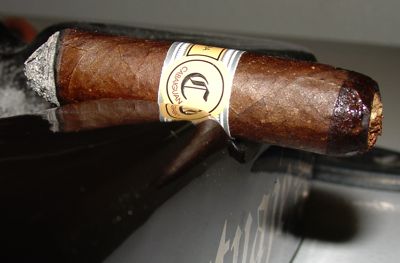
CabaiguanMadAshBoth sizes burn very well, though the robusto was not plumb-line even; it corrected itself over time and needed no assistance from me. The 46 was spot-on all the way. The ash is a solid light gray with a yellowish cast.
Overall excellent construction.

Tasting Notes

These are both smooth smoking cigars, but the 46 is slightly more assertive. In the first third I found the Rx easy going, with bittersweet chocolate, cedar, and a touch of anise. The 46 featured more tannin and pepper, with cocoa rather than chocolate.

The robusto picks up a little more tannin in the middle section, while the corona’s peppery edge softens. Both sizes seem to level out at this point, and agree on cocoa with an interesting malty note.

The Rx finishes up with a touch of woody bitterness on the palate that balances well with the sweet chocolate on the nose.  The 46 goes in an interesting direction at this point, increasing the spice and throwing some floral notes into the mix, something almost like lilac. I was reminded a little bit of La Riqueza at this point — it’s a little unusual to find this flavor in one of Pepin’s blends, but I think it’s there in La Riqueza as well.

Conclusion

The Cabaiguan Maduro is a worthy addition to the line. The sun grown broadleaf brings a lot of balance and a little more complexity to a medium-bodied blend that is exceptional to begin with. The wrapper adds some sweet notes of chocolate and cocoa that work well with the tannins on the palate. Over time the tannins might weaken a bit, resulting in a slightly sweeter cigar, but the blend is still very good right now, as long as you don’t mind a little of that fresh green woody taste on the tongue.

I thought the 46 was a little more expressive than the Rx, but both are excellent cigars. The MSRP is a bit steep, around 8 or 9 USD per stick, but that’s not too surprising given the overall quality on display here.

CabaiguanMaduro2Final Scores

Rx: 89

46: 90

Bargain Arganese Rundown

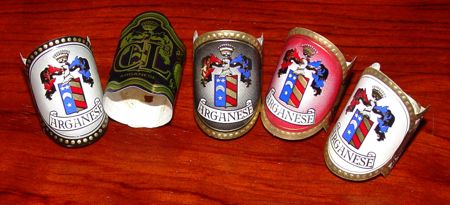
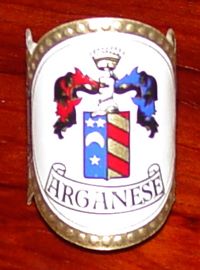
ArganeseBands

I don’t have too much experience with Arganese cigars. I don’t see them in the shops I patronize and I’ve never been curious enough to take a chance on a box online. But when I saw a five-pack sampler of  discontinued blends on sale for less than ten bucks, I bit.

I’m not sure why these are being discontinued, but it’s a great opportunity to pick up some decent smokes for cheap. The last I heard, Arganese was catching flak for some kind of multi-level marketing scheme,  but what I know this company best for are the gloriously cheesy ads that accompanied their entry into the market. The douchebag at a casino table with two made-up blondes draped over his shoulders, or the obese guy on a golf course with the mini-skirted coed caddies… utterly hilarious.

So it’s safe to say that I am not in their marketing demographic.  Which is unfortunate in a way, because these are actually not bad cigars. I only picked up one sampler of these so I can’t in good faith give them a complete review, but I thought I’d offer some short notes this week for the bargain hunters out there.

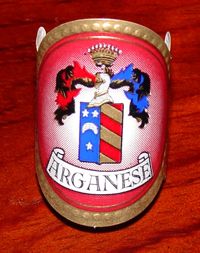
ArgMadThe Maduro doesn’t stray too far from what you’d expect in a Dominican Maduro. The Brazilian wrapper is very toothy, in fact rough to the touch, and the draw is a little tight but it burns well with a straight and solid ash. The flavors are typical, but good: chocolate and nuts, with negligible finish or aftertaste. There is a touch of spice in the last third, but it won’t satisfy the power smoker  — it’s really pretty smooth and mild for the most part. Light to medium in body.  Quite pleasant as an everyday light maduro cigar.
ArgDoubleThe Double Wrap is an impressively built cigar — I think I counted 4 or 5 wraps at the head of this thing. Unfortunately it was unsmokeable. I fought with it for the first inch or so, but the draw was just too tight and what flavors I could get were sharp and metallic. I had to pitch this one and move on to the next.
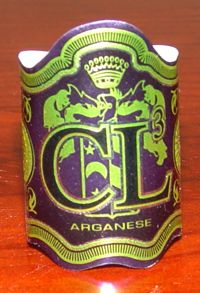
The CL3 ArgCL3 is 100% “first-generation” Cuban-seed Corojo, and it was probably the most interesting smoke in the sampler. It starts up with a peppery bite and a nice caramel accent. The smoke seems a little thin, but the aroma is quite unusual — the only descriptor I could come up with was “gamey.” It burns slowly and is extremely well-behaved for a blend with so much ligero. The only issue I had was the thin smoke body, which is way over-matched by the power of the cigar. This stick has too much nicotine for me, but I did enjoy its distinctive aroma.
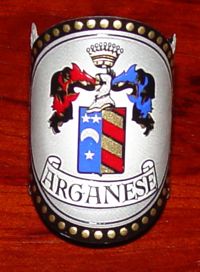
The Nicaraguan smokes like a maduro, but it has more kick to it than the Maduro blend. This is also a nice looking stick, and while the draw is a bit tight at first it opens up after a half-inch or so. ModerArgNicately spiced with black pepper and accompanied by some caramel sweetness on the nose, it’s nicely balanced. Chocolate flavors appear in the second half and it gets a bit rough on the throat. It’s not terribly complex, but there’s enough here to keep my interest for the duration of the cigar. A good medium-full bodied smoke.
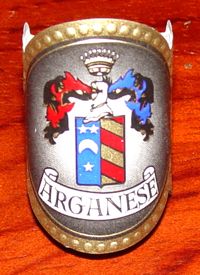
I’d recommend the Connecticut to anyone who appreciates fine shade wrappers. It’s another handsome cigar, and even ArgCTthough the draw was again a little tight it was otherwise well constructed. In most ways it’s typical of Ecuadorian Connecticut — creamy with floral notes, but at one point I thought I could detect apple notes. That was unexpected. In the home stretch it’s mostly nuts and creamy shade-grown goodness. Another really decent smoke.

The Maduro, Nicaraguan, and Connecticut cigars are available in different weights — mild, medium, and full. I honestly don’t know which these were, but I would have to guess they were either medium or full. The Connecticut in particular was quite chewy for this style of cigar.

Conclusion

I wasn’t blown away by any of these cigars, but I wasn’t disappointed either. (It wouldn’t be fair to direct the full force of my derision on the Double Wrap after one bad stick. This time it will merely receive an indifferent shrug.)  For two to three dollars per stick I could see picking up a box or two — probably the Nicaraguan or maybe the Maduro.

These are great value cigars, at least while they’re still around. I had discounted Arganese cigars as a trendy upstart, but I’m happy to report that there is more behind these blends than just a cheesy ad campaign. After smoking all of five cigars from this outfit I’ll be interested to see what’s next on the horizon for them.