Perdomo Habano Corojo

My first thought when I came across the Perdomo Habano in maduro was that it was strangely named. It’s a habano, but it’s also maduro? Well, yes, it is. It’s both. The term “habano” is used so loosely in the industry that there’s bound to be some confusion.

This confusion comes from the fact that some cigar makers issue the same blend in either maduro or “habano” wrappers. The problem here is that in one case the wrapper description refers to the processing (maduro) and in the other case it refers to the seed-type (habano.)

Generally speaking, “habano” is just another word for tobacco grown from cuban seed.  Needless to say, this covers a whole lot of cigar tobacco that isn’t necessarity identified as “habano.”  The Padrón family grows one type of cuban-seed tobacco on their farms in Nicaragua. If asked, they call it habano, but it’s not advertised that way. (As if Padrón needed to advertise.)

This is why Perdomo can issue a single blend with three different wrappers, and call them all Habano. Because in this case “habano” is not just a wrapper type, it’s a seed-type.

Perdomo’s Habano line was introduced in 2007 in two varieties: Corojo and Maduro. Both are cuban-seed (habano) tobaccos grown in Nicaragua. To compound our confusion, Perdomo released the Habano Connecticut (with a non-habano, Connecticut-seed shade wrapper) in 2008. In this case, all but the wrapper is actually habano.

Cuban-seed tobaccos from the three major growing regions of Nicaragua form the heart of the Perdomo Habano. Tobaccos grown in Esteli, Condega, and the Jalapa Valley all have their own distinct qualities, and here they are blended to make the best use of them.

Color-coded foot bands indicate which wrapper type is used — gold for Connecticut, platinum for maduro, and bronze for corojo.

Seven sizes are currently in production:

  • Petite Corona – 4 3/4 x 44
  • Robusto – 5 x 52
  • Toro – 5 1/2 x 54
  • Torpedo – 6 1/2 x 54
  • Gordo – 6 x 60
  • Presidente – 7 x 56
  • Gran Torpedo – 7 x 60

Construction Notes

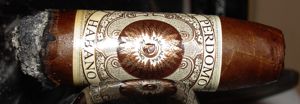
The Perdomo Habano Corojo is an attractive cigar featuring a smooth wrapper with a slight sheen. The torpedo is wrapped very nicely and comes to a sharp point that skews a bit off-center. The robusto has a solid, well-shaped head, but the cap is pasted on without regard for aesthetics. In both cases the roll is somewhat irregular with a soft spot found here and there.

The pre-light draw is excellent, but a few inches into the stick I found it to be a little too loose. Both sticks burn evenly and produce a blooming ash that holds well but doesn’t inspire much confidence. I let the torpedo rest in the ashtray for only a couple minutes and the cinder cooled to the point where I had to relight.

Overall good, but not great, construction.

Tasting Notes

This blend opens boldly with a good belt of spice on the tongue and the upper palate.  After a minute or so it backs down a little and relaxes into leather with soft cocoa notes. The smoke is smooth, but has a sharply acidic aftertaste.

In the middle section the flavors gradually get a little darker, but don’t change too much. The cocoa notes stretch out and take on a mocha-like quality, and the leather stays leathery. I generally expect a caramel sweetness on the nose from corojo, but I’m not getting it here. The aroma is heavy, but pleasant. Unfortunately I don’t find it all that interesting.

The last section is laden with leather and spice and a truckload of nicotine. The smoke texture is medium-bodied, but it’s powerful and biting. The aftertaste is heavy with earth and char and the finish is off the chart. Like many full-flavored cigars, the last third is lacking in subtlety. I lost interest close to the band, and it’s a large band.

Conclusion

I’ve smoked the Habano Maduro in the past, and I have to say I like it quite a bit more than the Corojo. There’s plenty of leather and spice to the Corojo, but it lays it on a little too thick for my taste. That said, it’s still well built premium smoke. It’s just a little outside my preferred flavor profile.

The Perdomo Habano lines average around 5 USD per stick or 100 per box of twenty. If you dig leathery sluggers like the Camacho Corojo or LFD Coronado, you might get a bang out of this one. The price is certainly right.
Final Score: 82

Declaration by Jameson

For my wild Irish friends and relatives the name Jameson has always been associated with one thing and one thing only: uisce beatha. That’s whiskey with an “e.” Fine Irish wine.

But not anymore. A couple years ago Jameson cigars arrived, thereby providing the perfect match for the perfect drink, a combination which by Winston Churchill’s example can be enjoyed even at breakfast. I’m not about to follow that example, but I’m not about to argue with a man who leads his forces to victory behind a bottle of Johnny Walker Black.

Indeed, cigar smokers can look to Churchill as a model of defiance as we fight the powers that would like to snuff us out. It is in that same spirit that Jameson’s new cigar is called Declaration. It is a blend designed to inspire personal liberty, or as the promotional material advises,  “Smoke to be Free.”

The Declaration is a Dominican puro featuring a Habano 98 wrapper and a Criollo 98 binder. They are manufactured by Tabacalera LTC (La Tradicion Cubana) in Santiago, and are available in boxes of 21. There is only one size: the 5.5 x 50 “Iniquity.”

I confess some confusion about the meaning of the name Iniquity, which means something like licentiousness or sin.  I could give in to the urge to discuss the distinctions between liberty and license, and how these might apply to the legislation of morality, but I think I’d rather smoke this cigar instead.

Construction Notes

This cigar is built like a tank but it performs with finesse. The wrapper is a dark and rustic looking colorado maduro. Some sections of the wrapper are more oily than others, which is a little strange, but aesthetic appeal is not this cigar’s forte anyway. The head is formed well with firm shoulders. The cap is pasted on rather than wound.

The roll is solid and the draw is firm without being tight. At times the ash can be a little flaky at the perimeter but when it’s ready to drop it falls like a stone without crumbling. The burn is even and effortless.

Overall excellent construction.

Tasting Notes

The Declaration Iniquity starts up with a flavor of hard wood and a sweet note of maple syrup.  After an inch or so some peppery spice kicks in and the flavors develop more complexity. This cigar seems leathery or meaty on the palate, but it has a sweet and woody aroma that blends well with the other flavors. It’s smooth, but the varied flavors and subdued punch keep it interesting.

The mid section gets a little spicier on the tongue and the finish lengthens. The aroma is still sweet though, woody with a touch of graham cracker.

There are no dramatic changes in the last third, just a deepening meaty spice. The syrupy note transitions to caramel. The aftertaste gets a little charred in the last lap, but aside from that it smokes well to the nub.

Conclusion

Jameson’s Declaration cigar is a tasty and finely rolled medium-bodied smoke that I think almost anyone would enjoy.  The sweet aroma is quite distinct from the palate flavors, lending the smoke a complexity that will interest veterans, but at the same time it’s smooth enough that it won’t frighten off the novices. Overall it’s a very well balanced cigar.

The Declaration Iniquity retails for around $6.00 per stick, which is excellent for any cigar, but for a Dominican puro it’s outstanding.

Final Score: 90

Contest

I want to thank Jameson for offering samples of their Declaration cigar for this review by sharing their generosity with a lucky reader. Just leave a comment about Jameson or La Tradicion Cubana cigars below and I will pick one entry at random to receive a few of these fine smokes for their own enjoyment.  Contest ends January 31, 2010. U.S. residents only please.

And don’t forget to enter the Jameson Humidor contest! All you have to do is sign up for their newsletter and you’re eligible to win a very sweet Vanderburgh Forteleza Humidor stocked with Declaration cigars.

Casa Royale Crown

I love those cheesy ads for no-name cigars that proclaim they are made by “the Number 1 Cigar Maker in Nicaragua,” (or Miami, or the DR.) No names please! That won’t be necessary, because we all KNOW who that cigar maker is. I’m so excited I can barely get my credit card out.

Casa Royale is not advertised that way, but the name Jose “Don Pepín” Garcia is often associated with this “Number One” cigar maker. I haven’t had the opportunity to smoke everything that has rolled off the tables of My Father Cigars, but I wouldn’t balk at the chance. I’d even try that odd mixed-filler cuban sandwich cigar, made with floor sweepings and yesterday’s La Prensa, if the blend was blessed by the Pope of Esteli himself.

And to be honest, there are a few DPG blends I don’t particularly care for. (How Ambos Mundos made it on CA’s top 25 list is a mystery to me.) But a misstep here or there has not yet cooled my ardor for this great blender.  So when I saw that a “Six-Pack” of these Casa Royale Crowns could be found at Holt’s for just over 20 bucks, I took the bait.

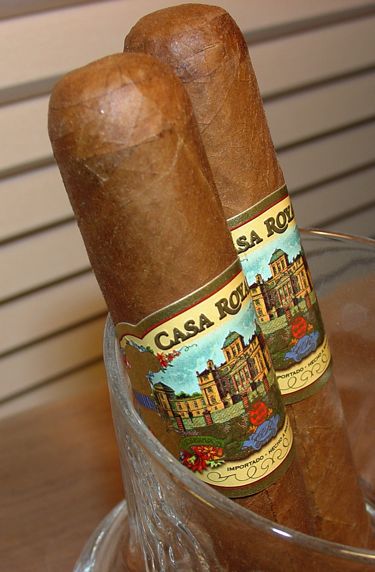
Casa Royale is a Nicaraguan puro with a sungrown Esteli wrapper leaf that supposedly is the same one used on the Tatuaje Black. Whether that is an apology of sorts for the rustic appearance of the wrapper, or just plain hooey, is for you to decide. In any case, this Holt’s exclusive is available in five sizes:

  • Ace – 5.625 x 46
  • Aristocrat – 5.5 x 52
  • Crown – 5 x 50
  • Imperial – 6 x 50
  • Prestige – 7.75 x 49

Construction Notes

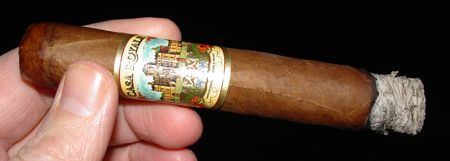
I’m trying to think of what color these cigars might be — colorado amarillo? Amarillo claro? They’re a light to medium shade of brown with a yellowish tinge, similar to some Connecticut Shade wrappers I’ve seen, but much less suave. The wrapper on the Casa Royale is rough, as is to be expected from a sungrown leaf, but it’s much lighter than most sungrown leaf, and it’s quite dry as well.

The head is finished nicely, but not as neatly as many “premium” cigars from the Garcias. The roll is firm with a slight box press, but the cigar feels a little  bit light — this did not affect the burn, however, which was slow, even and consistent.

As I cut one of these robustos my thumb slipped and I really bungled the cut. Despite a relatively fragile wrapper I was able to slick the torn wrapper together with saliva and by some small miracle it held together for the duration of the smoke. That’s quality construction.

Tasting Notes

The first few puffs are typical Pepin — tart on the palate. Gradually I notice notes of sweet cedar on the nose, which makes an interesting companion to the greener flavors on the tongue. There is some vanilla in the aroma as well, with a touch of cinammon.  The smoke is smooth and medium in body.

The middle stage continues in the same direction, smooth and woody with vanilla overtones.

This robusto is suprisingly smooth and mild-mannered up to the final third, where the spice picks up. Some white pepper tingles the sinuses while the cedary base flavor continues to hold. There are some subtler spicy notes as well — the cinnamon from the first third appears again, and brings with it a touch of sandalwood.  It stays smooth and even to the nub.

Conclusion

Casa Royale is one of Pepín’s milder and less complex smokes, but it is still quite flavorful and the construction is excellent, as usual. Tart flavors on the palate are nicely balanced with sweet ones on the nose, and the subtle but exotic aromatics make this an interesting cigar.

Best of all, this cigar is truly affordable. Boxes of 25 retail for 127 USD, and if you run you’ll find six-packs on sale now for 21.95.  Factor in that price and this is a great deal. It sure beats scrambling for the “No. 1 Cigar Maker’s” leftovers .

Final Score: 88

Romeo y Julieta Museum Edition

Altadis has commissioned 3D artist Charles Fazzino to create prints for their “Museum Edition” cigars, of which there are now two: the 6 x 53 Montecristo, and this one, the 6 x 54 Romeo y Julieta. They are special edition cigars, of course, and as such are touted as “super premiums,” which means that the retail price is exorbitant. In this case, around 30 USD per stick. Yikes.

Fortunately there is a shortage of wastrels in today’s economy, and these cigars can usually be found for less than MSRP.  I snagged this one — and one only — for 20 bucks. (The Altadis rep threw in a couple of other top line cigars and a Romeo y Julieta coffee mug gratis, so the net price ended up being about 7 dollars.)

The big draw with this release is the limited edition humidor which houses these big ticket sticks. The humidor includes a signed and numbered giclee print. I’m no art collector, but maybe this will be worth something some day. I hope so anyway, because the price for the whole shebang is $1080.00.

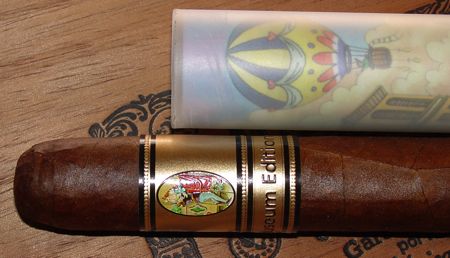
Instead of the pile of gold doubloons that I would expect to find in a box with that price tag there are 36 cigars encased in frosted crystal tubes. A paper thin cedar sheath inside each tube cradles the cigar, along with a Fazzino picture that just barely shows through the frosting on the glass. Me, I’d take the cedar sans the picture, but like I said, I’m no art critic. The gold cap that tops each tube is wedged on pretty tight — I actually crushed the tube in my massive Hellboy-like fist while I was trying to open it in the cigar shop. Be careful with this one, especially if your mechanical skills are as primitive as mine.

This cigar is made in the famous Tabacalera Garcia factory in the Dominican Republic. The wrapper is a San Andres Criollo 98 Rosado (yes, that’s Mexican, but we’re far from Te Amo territory here) with a Connecticut broadleaf binder and a filler blend from Nicaragua and the Dominican. Only one size is made: a 6 x 54 parejo.

Construction Notes

Despite its girth the cigar sits nicely in the hand, and seems to be well rolled. The head is finished nicely with a triple cap but the final piece is jagged and appears a little sloppy. (At $30 per cigar I reserve the right to be picky.)  The wrapper is a real beauty though — a rich, dark colorado maduro leaf that glistens with oil.

Even though the pack seems solid enough, the draw is a bit loose. This caused some problems down the road — I sat the cigar down for just a minute to freshen my drink and it went out. On the positive side, it produced plenty of smoke and never burned hot the way some loosely packed cigars will do.

From the start I had trouble keeping this one burning evenly, but this seems to be the curse of really tasty wrapper leaf. It also burns fairly rapidly for a cigar with such a large ring gauge — smoking time was a little under an hour; I expected a bit more from a cigar this size.

Overall construction good, but not 30 dollars good.

Tasting Notes

Almost immediately the Romeo Museum Edition displays tremendous complexity. It’s extremely smooth, mild to medium in body, and has a delicious and distinct aroma. This is obviously the selling point. The wrapper on this cigar is a wonder.

The first notes are the ones that stay for the duration of the smoke: sweet caramel over an herbal base that has an unusually malty edge to it. After an inch or so the herbal flavor morphs into an sweet earthy taste that at times reminded me of something more musky, something almost like gunpowder. It’s complex but very easy on the palate.

Eventually coffee flavors come to the front, though it’s not standard coffee — it’s one of those poncy latte things with cream and caramel and God knows what else. It’s good though. The sweet malty aroma continues, with an occasional whiff of bread.

The last section is a little more straight forward: earthy and sweet, with the caramel notes getting fruitier toward the end. I was a little frustrated with the burn at this point and might have been puffing a little too hard, forcing the cigar to burn too hot. Some acrid notes muscled their way in after I removed the band, but with a little more patience I might have avoided this.

Conclusion

Despite its flaws, the Romeo y Julieta Museum Edition is a terrific cigar. The flavors here are tremendously varied and interesting, spanning the spectrum from sulfurous earth to caramel-sweet bread. The amazing thing is that these disparate flavors never conflict; instead they combine and follow one another in remarkable harmony.  The blender here is to be congratulated — this is a really fascinating bunch of leaves.

But with the caveat that I have smoked all of ONE of these cigars, the roll could have been tighter and the burn was less than spectacular. Perhaps this is the price you pay for the smorgasbord of subtleties on display here, but I won’t deny that there were a few relatively minor construction issues.

Keep in mind that this is a fairly mild cigar. I know many veterans of the leaf who would be simply bored with the Museum Edition, but I am not one of them. What this is, I think, is the absolutely perfect beginner’s smoke. It’s quite mild, superbly smooth, and marvelously complex. If your taste runs to powerful pepper bombs that leave your mouth scorched with spice, this cigar is not for you. But if you appreciate the subtleties of milder cigars, definitely give it a shot, as long as the price is right for you.  For me, thirty dollars is ridiculous. But if I could snap some of these up for ten, I just might.

Final Score: 90

Best Cigars of 2009

[picapp align=”center” wrap=”false” link=”term=cigar&iid=184802″ src=”0181/c81ef0dd-1abd-47d4-a834-b5fbbe604e7d.jpg?adImageId=8743657&imageId=184802″ width=”366″ height=”466″ /]

As a new decade pounds on the front door I’m presented with my annual quandary: to sort through the pilones and find the ten best cigars of 2009. Early in the year I devised a new cigar rating system, the intended purpose of which was to assist me with this annual roundup. But I encountered two problems as I was ranking the ratings for 2009: there were a lot of tie scores, and there were some scores that, after further review, I might now want to revise.

Which is to say that this year’s list of “best cigars” is just as arbitrary as last year’s… and the years before that. All of these cigars have been reviewed on Keepers of the Flame in 2009, which means that the hundreds of cigars that I didn’t review are not eligible for inclusion here. As much as I’d like to, I can’t smoke everything.

If you are a regular reader here you know the type of cigars I favor: rich, aromatic, medium-bodied smokes, and this list reflects that preference. If you are new to cigars, some of these may be a little too heavy for you. If you’re a veteran who loves full-bodied sluggers, these sticks may seem a bit too light. Caveat lector.

10. Cabaiguan Maduro 46

9. Particulares Robusto

8. Padilla Signature 1932

7. Montecristo Reserva Negra Robusto

6. Arturo Fuente Hemingway Short Story

5. La Tradicion Cubana Deluxe 15th Anniversary

4. Arturo Fuente Don Carlos Double Robusto

3. La Gloria Cubana Reserva Figurados Maduro Flecha

2. Illusione Epernay Le Grande

1. Padron 1964 Anniversary Exclusivo Maduro

This isn’t the first time a Padron Anniversary edition has crowned a Top Ten list, and it will most likely not be the last. There are some great new blends out there, but few can live up to the flavor, balance, and construction of the 1964 Anni. The only question that lingers is… maduro or natural?

While 2009 wasn’t the best of years for the American cigar industry — there was the SCHIP tax, the persistent finger-wagging of local and state nannies, and now the minatory gaze of the FDA — it actually was a decent year for new cigar blends, some of which I look forward to reviewing in the next year. (Yes, I am a bit slow, but with a respectable quarter-million page views last year it looks like some people are still reading.)

Thanks for a great 2009, everyone, and have a wonderful 2010! Happy New Year!

~cigarfan