La Aurora Preferidos Corojo

cnv0390.jpg

“Preferidos” are what they were called in 1903, when Eduardo Leon Jimenes first produced these little perfectos for the locals. Today there is a modern preferido, a tribute to the original, produced in two sizes with five different wrappers.

Preferidos are produced by a limited number of rollers who work under the curious gaze of visitors to the Centro Leon — a complex established by the Leon Jimenes Foundation as a museum and center for the promotion of Dominican and Caribbean art and culture. Recently cigar production for La Aurora moved to the town of Guazumal, quite close to where the original factory was established in 1903, but Preferidos production will remain in Santiago at the Centro Leon.

The filler and binder are the same for all the cigars in the Preferidos line: filler from Brazil, Cameroon, and the Dominican, with a Dominican binder. (The Cameroon-wrapped Platinum is an exception– it uses all Dominican filler.) The binder and filler leaves are aged for six months in rum barrels before they are bunched for Preferidos. The Gold version uses a Dominican corojo wrapper from Navarette.

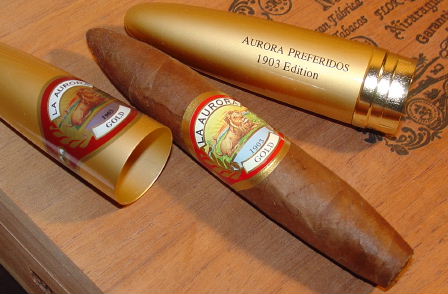
The tubo versions of this cigar are the same size as the No. 2 – 5 x 54. The tube is solid aluminum and executive gift quality… for the guy who has everything, that sort of thing. (Of limited use, but attractive.) I was unable to find these cigars in their unarmored state, so I bid on a couple singles at non-tubo price and won. Now I’m trying to figure out how to turn the empty tubes into Christmas tree ornaments; whether my wife will let me hang them is another matter. They do make rather lurid ornaments.

The size of the tubo Preferido is magnified by the packaging — once the tube is set aside and the head is clipped it’s actually a fairly small cigar. The wrapper is a smooth and leathery colorado maduro. The foot is cut down to about a 36 ring gauge and the head is a perfectly finished point. The prelight scent is pleasant but unremarkable, offering some mild tobacco and a little hay.

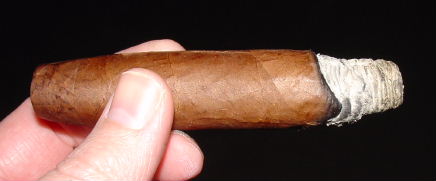
The draw provides the perfect amount of resistance and the foot fires up without a second thought. The base flavor here is earthy, most strongly pronounced in the first half inch and then again at the conclusion of the smoke. In between lies a perfect balance of earth with a little dry wood and a dash of black pepper.
cnv0392.jpg

This cigar most definitely has a “sweet spot” at the center where the smoke is at its creamiest and most interesting — the caramel and spice in the aroma is delicious, reminding me a little of small Cubans like the Trinidad Reyes. The last stage is intensely earthy but still relatively smooth. Smoking slowly is recommended.

The only negative here, aside from its small stature, is an uneven burn. Oh, and let’s not forget the price — Preferidos Gold tubos run in the 12 to 14 dollar range. (Retail box of 24 for $408. Ouch.) But all told, this is a little gem of a cigar. It’s about medium until the last inch or so when it ramps up to a full body, but at this point you should be sipping slowly anyway. I’m recommending this one to all my rich friends as worthy gifts — to themselves, or to their less fortunate herf-mates… like me!

-cigarfan
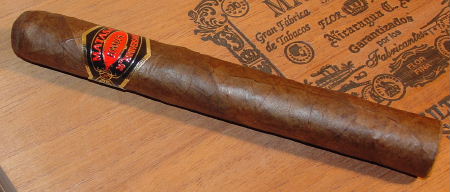
MATASA 30th Anniversary Toro

cnv0389.jpg

Manuel Quesada established MATASA (Manufactura de Tabacos, S.A.) in Santiago in 1974, at a time when the Dominican cigar industry catered mainly to domestic consumption. Around this time the Dominican Republic established tax-free export zones which attracted entrepreneurs like Quesada to a country not really known for producing cigars. Baseball players, yes, but not cigars.

MATASA is best known for producing the Fonseca brand (and all its offshoots) but Quesada’s family has been in the tobacco business for generations, going back to pre-revolutionary Cuba where they were primarily leaf growers and brokers. The companies founded by Quesada’s great great grandfather, Sobrinos de A. Gonzales, and his great uncle Constantino Gonzales, were the largest leaf brokerages in the world before the family was forced out of Cuba at gunpoint.

The Quesada family left for Miami, where Manuel Quesada Sr. was able to secure a loan– with no collateral– from a bank the family had done business with since 1907. They invested in warehouses and machinery and soon a fledgling leaf brokerage was started in the Dominican Republic, selling leaf to many of the same customers they had in Cuba. One of those customers was Juan Sosa, whose Miami factory was struggling with labor issues. Based on their previous business relationship, Sosa and Quesada joined forces in Santiago and in 1974 MATASA was born. During the same year, MATASA bought the Fonseca label from Antillian Cigar Co. in Miami.

The MATASA 30th Anniversary by Fonseca, created to celebrate the founding of the company, was introduced in 2005 in only two sizes: a 5 3/4 x 54 perfecto, and this 6 1/2 x 52 toro. The binder and filler were selected from bales of Honduran, Dominican, and Nicaraguan leaf aged over ten years. When this cigar was chosen as the Robb Reports’ “Best of the Best 2006” cigar, Quesada told Richard Carleton Hacker,

…we used the finest of old, noble leaf so that we would have the depth of some of the choicest aged Cuban-seed tobaccos, but without the hardened strength. What we got was a strong yet smooth cigar that reminds one of chocolate pudding.

The wrapper is a high priming Olor Dominicano grown by the Reyes family in the Cibao Valley. The limited number of cigars produced was determined mostly by the amount of wrapper produced. “We said we’d make cigars as the wrapper for the project came about,” Quesada told Smoke Magazine. “You’d like to have 100 percent yield from the wrapper crop, but you never do… If you get 60 percent of usable wrapper out of any given crop, you should go to church and thank God.”

In the end, only 30,000 cigars were produced.

The wrapper on this Anniversary Toro is rich and oily, though as it turns out it is also quite thin and delicate. The roll is solid and the head is finished with a triple cap. The prelight scent is of sweet tobacco and hay.

From the first puff the flavors that pour forth are dark and rich — coffee bean and cocoa, with chocolate making a lasting appearance after an inch or so. Beneath the overarching sweet bean flavor is a grassy or green wood flavor which makes the overall impression something like light-roasted coffee. Meanwhile, the aroma is complex, adding an incense-like quality to the smoke.

The body builds strength after the first half, about 45 minutes into this supersized toro. The flavors gradually veer away from cocoa and enter spicier country, with pepper on the tongue and baking spices on the nose. At one point I thought I detected cinnamon, but after an hour of chasing scents my palate might have been a little fatigued.

Part way into the last third I heard the dreaded crack of wrapper splitting; I looked down and my cigar had suddenly unraveled. Thankfully I was nearly finished with this ten dollar Anni, but I was still a little disappointed. (Sadly, this is the second one that has finished in this fashion for me. Other reports are more favorable, so maybe I just pulled from a bad box.) Otherwise the construction here is very good — a fine draw and a slow cool burn.

If you’re a Fonseca smoker, be aware that the MATASA 30th Anniversary is a much heavier cigar than your standard Fonseca, but don’t let that dissuade you — it’s not a giant killer either. This is a limited edition cigar, but it is still available and doesn’t appear to be selling out anytime soon. Part of that may be due to the price, which is in the 8 to 11 USD range. Not your everyday cigar, but a special treat for maduro lovers. Just be extra careful with that wrapper!

-cigarfan

Las Memorias Cubanas Campanas

cnv0387.jpg

Cigars from Little Havana’s La Tradicion have garnered much praise from fans of boutique stogies. I certainly have nothing against huge conglomerates like Altadis or General because they make quality consistent cigars, but there’s something special about a small run handmade from a mom and pop chinchal. But business being what it is, successful small runs turn into bigger ones, and boutique companies become industry juggernauts.

This has not yet happened to La Tradicion — they are still a relatively small company (though not really a chinchal) and they are growing despite setbacks such as the fire that hit their Calle Ocho shop last November. The fire was suspected as arson, one incident in a string of such tragedies that befell the neighborhood last fall. The fire destroyed the strip mall in which La Tradicion was located, along with the celebrated Libreria Cervantes, a Spanish language book shop. The only items to survive the fire in the galera were some records on computer disks and their cigar store indian.

The only fortunate aspect of the fire was that La Tradicion had already begun a transition to the Dominican Republic under Sanchez’s partner, Pablo Romay. Romay is a veteran of Havana’s Romeo y Julieta factory who emigrated to the U.S. in 1994. He began rolling cigars for La Tradicion in 2000 and Sanchez quickly promoted him in recognition of his skills and management abilities. After several years in the Little Havana location Sanchez began to explore a move to the Dominican as a solution to labor difficulties and the rising cost of doing business… expenses like fire insurance, and rebuilding your factory after some asshat burns it down.

La Tradicion still maintains an office in Miami, but the new factory in Santiago — Real Tabacalera Sanchez-Romay— is now the main production facility.

Luis Sanchez succinctly describes La Memorias Cubanas this way: “Light wrapper. Full body.” Sometimes less is more… except when it comes to ring gauge. La Tradicion has set records for some of the largest ring gauges made — and this line follows the trend. “Campanas” is a traditional torpedo-shape production vitola; the Cuban Bolivar Belicoso Fino is one of the more common examples, but at 6 1/2 x 60 the LMC Campanas is a bit larger than the traditional vitola.

The wrapper is a silky claro Ecuadorian Sumatra. The filler is a blend of Dominican and Nicaraguan leaf, bound up in a selection from Honduras. The result is a nice looking, if somewhat unwieldy cigar. Between the fingers it feels like grasping a tree branch. The nice thing about a torpedo is that it allows you to choose the aperture of the opening depending on where you cut it. Otherwise, you’re stuck with a jaw breaker.

Las Memorias Cubanas come equipped with a thin cedar sheath — this imparts a distinctly woody scent to the wrapper and the prelight draw. There is an occasional small green blemish on a couple of these, but nothing to be concerned about.

This torpedo draws well and lights easily, even though it seems like a large area to light. It sort of felt like painting the foot with fire. Once it was lit it burned very well and needed no further attention. All the construction tests were passed with flying colors.

The initial flavor is a little mild, sweet and nutty with a hint of pepper on the nose and in the back of the throat. The weight of the smoke is quite heavy though, and the texture is deliciously creamy. For the first fifteen or twenty minutes this is a very domesticated cigar. At the two-thirds point it revs things up with a spadeful of earth and more generous helpings of pepper. The aroma from the wrapper is really nice — toasty with some delicate semi-floral accents. So far this has balanced really well with the earthier flavors on the tongue.

While I am admiring the solid salt and pepper ash that I’ve built and ashed only once, I become aware of an intensely earthy and quite lengthy finish. The last third of this cigar is quite powerful in terms of flavor, but it loses its sense of balance at this point. The nuances from the wrapper become completely obscured by the dark spice on the tongue, and the flavor itself seems a bit one-dimensional at this point. I found that this cigar is very good up to this point, but I didn’t find it “nubbable.”

I really liked this cigar… up to a point. But that point is where somebody with a taste for heavy earthy cigars might begin to really enjoy it. These will run you around 6 USD a stick, which is quite reasonable. These are very large, very well made cigars. But for me, I think I’ll be sticking to LTC’s Sabor Cubano and La Tradicion Cubana.

-cigarfan

Montecristo Serie C Toro

cnv0386.jpg

Since the Montecristo cigar brand was established as a legal American commodity in 1995, the Dominican brand’s makers have issued an astounding number of blends. The Monte Serie C is the most recent creation in this prolific family of 13. Like the Serie V, the Serie VII, and Santa Clara’s Montecristo Afrique, this cigar is distinguished by a cameroon wrapper, or as Altadis says…

…rare, ultra premium Cameroon tobacco. These leaves – every one hand selected – are carefully stored and patiently aged, and the resulting smoke indulges the aficionado with the subtle complexities of flavor and smoothness of a Cameroon cigar that is destined to become the new benchmark. Is the Serie C the finest Cameroon ever? Quite possibly. After all, it’s a Montecristo.

I’ve always appreciated Montecristo for its consistent quality, though some of their blends I appreciate better than others. And since I’ve been hankering for a good cameroon I thought I’d give the “new benchmark” a test run.

In addition to the toro, this line is available in three other standard sizes: robusto, corona, and belicoso. The filler is a three country blend from Nicaragua, Peru, and the DR, with a binder leaf from Nicaragua. These are produced in the Dominican city of La Romana, home of Altadis’ mammoth Tabacalera de Garcia.

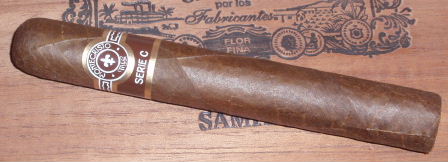
The Montecristo Serie C is presented with a flawless colorado maduro wrapper — a single vein snakes down the length of the stick and extends its tributaries laterally, leaving plains in between that reveal a moderately toothy stippling. The roll is solid and the cap is applied expertly (though without the flair of a triple cap.) The prelight test results are neutral: simple tobacco and a slight tingle on the tongue.

The draw is firm, but functional, and the burn is almost perfectly even. After a few inches the Monte C builds a solid and uniform gray ash. Construction qualities here are top tier.

The initial flavors are very muted and framed mostly by the aroma of the Cameroon — a mild minty flavor with very little finish and no aftertaste at all. Into the second third the mint grows into menthol over a gently woody foundation. The last act brings out some bready elements and a dash of pepper in the back of the throat until the flavor finally declines into bitter papery territory.

The main attractions here are perfect construction and a mild but aromatic Cameroon wrapper. The Monte C is a little too mellow for an after dinner smoke, unless you smoke mild cigars exclusively — but it could be a great little walk in the park cigar. Or in the case of this 54 x 6 toro, a more extensive walk in the park cigar.

Retail prices are around 8 or 9 USD, with online boxes selling for around 110. Not a bad price for consistency in a perfectly rolled handmade.

-cigarfan

Gran Habano 3 Siglos Gran Robusto

cnv0385.jpg

Over the years Guillermo Rico has been a tobacco grower, a leaf broker, and an accomplished catador, or cigar taster, who reportedly can distinguish five different leaves in a single blend. He was born to a family of tobacco growers in Cubita, Columbia, and with his son George is currently the owner of GR Tabacaleras Unidas and the Gran Habano line of cigars. The Ricos have farms in several countries, including Columbia, Costa Rica, and most importantly Nicaragua.

The Ricos established their Danli, Honduras factory, “La Perla Hondureña” in 1996, where they produced cigars for private labels such as Alec Bradley. But with all the experience and knowledge at hand it was inevitable that they would soon turn out their own brands.

The Ricos take great pride in the blending and production of their cigars, starting with Habano and Corojo seeds and finishing with draw testing individual cigars for quality control. All of their cigars are bunched using the traditional “entubar” method and are finished with triple caps. These are truly beautiful cigars — I had to get a close up shot of the cap on the 3 Siglos above because it’s really a work of art.

The first three Gran Habano blends — the #1 Connecticut, the #3 Habano, and the #5 Corojo — were introduced in 2003 and gained ground quickly due to their very high quality to price point ratio. These are great cigars regardless of price, but affordability is always attractive. Following on this came the V.L . (Very Limited) line in 2005, and last year the 3 Siglos was finally unveiled.

The Tres Siglos cigars use three types of ligero from three different countries — Nicaragua, Costa Rica, and Columbia (Cubita) — in its filler blend, bound up in a Nicaraguan Habano leaf and capped with a Nicaraguan Corojo Shade Grown wrapper. Cuban style cigars often have a flattened rather than a rounded cap, but this one is almost as level as the foot. The wrapper is deliciously oily and and the stick weighs heavily in the hand.

The Gran Robusto is an imposing and impressive looking cigar with a 54 ring gauge; at six inches long it’s really more of a toro size. Commercial vitolas have always piqued my curiosity — why gran robusto instead of toro? Why double corona rather than churchill? Why 3 Siglos and not 3 Ligeros? (I actually wrote Siglo III earlier and had to go back and correct it. Maybe there’s something subliminal going on here… ) But when it comes down to it, the cigar must speak for itself. Or smoke for itself. With my assistance, of course.

The broad flat cap invites a punch, though carefully shearing off the cap with a cutter might work in a pinch. A pre-light test draw reveals an easy pull — maybe too easy. There is no resistance at all. Checking the barrel for loose fill and soft spots returns a negative, so the frictionless draw appears to be by design.

I subjected the foot of this Gran Robusto to almost 30 seconds of the Blazer’s full-on torch blast until it could finally be weaned from the flame. This would seem to presage burn problems to come, but there were no major issues once it got going.

The initial flavor from the 3 Siglos is a little funky — it reminds me of the Gran Habano #5 with its musty earthiness for the first few pulls. Despite the airy draw this cigar produces nice clouds of medium-bodied smoke and burns very slowly. I budgeted an hour for this cigar but it demanded another 45 minutes after that. I’m glad I brought a book.

In addition to its unusual draw and burn, it leaves a streaky black and gray-brown ash. Very odd coloring. It’s flaky and a little messy, but the cigar burns so slowly that’s it’s nothing to worry about.

As the first musty shot fades into the background it is replaced with a leathery sweet aroma that is almost fruity at times — something like cherries. The smoke is smooth but by the mid-point I am also noticing its potency. This is not a heavy smoke, but it’s big — perhaps it is by virtue of its size that it packs the punch it does.

By the end of the cigar — which requires the peeling of two bands — the flavor is at its height of pepper and spice with a finish that has graduated from negligible to considerable. It isn’t a cigar with dramatic development, but there is enough complexity and idiosyncrasy here to keep my palate interested throughout the course of a very long smoke. And as a final epilogue I noticed it left a residual odor of graham cracker or gingerbread on my finger tips.

The Gran Habano 3 Siglos is in a class of its own and there’s only one way to tell if you’re going to like it — try it. The Gran Robusto is available for around 7 USD and for a great tasting cigar with good performance that lasts almost two hours, this is a pretty reasonable price. I’m not sure I’m ready to snap up a box — not in this size anyway — but I’ll certainly be picking up a few more 3 Siglos at the local shops.

-cigarfan

Cuba Aliados Anniversary

cnv0381.jpg

Before there was Puros Indios there was Cuba Aliados, the original brand and pride of master cigar maker Rolando Reyes, Sr. Today his cigars are made in Danli, Honduras, but the name “Cuba Aliados” conjures up images of an earlier time when these cigars were rolled in Havana.

Reyes’ experience in the cigar business stretches back seventy years and includes training and employment at the Partagas and H. Upmann factories in Havana. Eventually he opened his own factory — the original Cuba Aliados, named for an old bus line — that was producing six million cigars a year for the Cuban domestic market when it was seized by the Castro regime after the revolution.

The Reyes family moved to the United States in 1970, and after struggling to gain a foothold in Union City, New Jersey, Cuba Aliados was born again. Demand for Reyes’ cigars soon exceeded the supply, so they migrated first to Miami where they increased production, and then to Honduras several years later. They still maintain a presence in both Union City and Miami.

For many years Cuba Aliados had an Ecuadoran Sumatra wrapper similar to the one on the Puros Indios cigar, and was distributed exclusively by JR Cigars. In 2004, distribution rights were reacquired by Reyes and the occasion was marked by a change to distinguish the two brands — a new Nicaraguan corojo wrapper was introduced to the Cuba Aliados line.

So I was thrilled to receive a sampler pack from Puros Indios that included two of their new Cuba Aliados Anniversary cigars — a beautiful Diadema No. 3 with a natural Ecuadoran Sumatra wrapper and a Short in a rich and dark corojo maduro. The press release notes that both of “these unique sizes have come to represent Cuban Master Blender Rolando Reyes Sr. and his 60 years of experience in the tobacco industry.”

These Anniversary cigars celebrate both the century-plus tradition of the Cuba Aliados brand name as well as the seven decades of Don Rolando Reyes’ work in the industry. They will be available in both Nicaraguan corojo and Ecuadoran Sumatra wrappers, with filler from Brazil, Nicaragua, and the Dominican Republic, and Ecuadoran Sumatra binders. All tobaccos are aged for at least six years and total production will be limited to between 200,000 and 300,000 cigars.

The Diadema No. 3 is an example of the cigars maker’s art at its highest. These are made completely by hand and without the use of molds, which takes considerable skill and experience. My sample suffered a little damage in shipping, but I was able to repair it with a little vegetable glue and it smoked fine. The prelight scent is slightly cedary and it cut cleanly to open a free prelight draw. The tapered foot lights as easily as if it were a candle. (In a Cigar Aficionado interview Rolando Sr. joked that some people are intially confused by this unique shape and don’t know which end put in their mouths!)

The first third focuses on cocoa and caramel aromas with a mild taste and almost no finish. It burns slowly and evenly and the ash holds nicely. The flavor builds gradually, bringing at the end a zing of pepper and a sharp aftertaste that sneaks up and wakes me from my reverie as the ash nears my fingertips. This is a very refined cigar with a sweet cubanesque aroma that at times reminded me of maple syrup. It’s an easy going but sophisticated medium-bodied smoke.

cnv0383.jpg

The Short has an altogether different personality, starting with an oily corojo maduro wrapper that makes it look like a thoroughly grilled sausage link. There’s a ton of flavor packed in this 4 x 48 firecracker, but any prelight indication of this is hidden beneath a cedar sheath which imparts a distinctly woody scent to the wrapper. Once lit this little guy pours on a full-bodied sweet and spicy flavor with a rich leathery aroma and some residual cedar. Into the second half, the sweetness from the wrapper predominates. The woody component reminds me of PI’s Cienfuegos, but the Aliados is stouter, with more bittersweet chocolate and coffee notes. This is the heaviest cigar I’ve smoked from Puros Indios, and the rich flavor is best enjoyed slowly, sipped like a smoky cognac. My only criticism is that the thick and oily wrapper tends to burn erratically and needs an occasional touchup.

These are outstanding cigars, the best of the best from Cuba Aliados, and a fitting tribute to the master who started it all so many years ago. Suggested retail prices are $12.00 for the Diadema and $8.00 for the Short.

Thanks to the fine folks at Puros Indios for allowing me to preview these cigars. Stay tuned for the official announcement of interesting developments at PI for 2008: a new company name, a new logo, a new website and — most importantly — new blends, including their first cigar with a Cameroon wrapper!

–cigarfan

Tatuaje Series P2

cnv0380.jpg

Tatuaje Series P cigars are economy selections from Jose Pepin Garcia’s Tabacalera Cubana in Esteli, Nicaragua. These are “cuban sandwich” cigars made with the same filler blend as Pete Johnson’s Tatuaje Havana VI, presumably with scrap tobacco from the same. These are Nicaraguan puros and are marketed as having 40% long filler and 60% medium filler. The wrapper is Nicaraguan Habano.

Construction is always an issue when it comes to sandwich or mixed filler cigars, and the Series P is not immune. Most of the cigars I’ve sampled in this series have been fine, but a few have had burn problems and a couple have split their wrappers in catastrophic fashion. From the price alone it seems a bit of a gamble — about 4 USD per stick local retail. Not your typical Pepin price mark, but it’s a reasonable wager for this cigar.

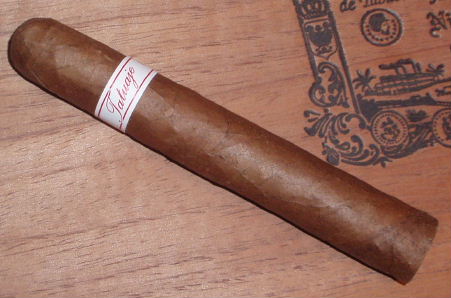
The size I chose for this review was the robusto P2. (These are also available in churchill, toro, and corona grande vitolas.) The wrapper is not a looker exactly, so you’ll want to judge this one for its personality rather than its superficial deficiency. The wrapper scent here is straight ahead cedar with a little bit of sweet grass on the prelight pull.

The P2 starts up with no nonsense medium bodied tobacco flavors and maintains that course pretty much to the end. The real attraction here is the sweet spicy aroma from the wrapper. It has a very carmelized kind of smell, almost like roasted marshmellows. After a couple inches some pepper arrives at the party, but for the most part it serves as a mild condiment over that simple sweet woody flavor. There isn’t much transition here, as Jerry noticed in his Stogie Review of this cigar. I have to agree with him that a big development isn’t really necessary here.

Like the Havana VI, this is a relatively mild blend for Tatuaje and Pepin. At times the smoke seems a little bit thin, but it’s flavorful and the wrapper imparts a delicate sweetness that is not easily found among cigars in this price range.

It’s really not fair to compare this cigar to the standard line Tats, so I won’t. Just remember that this is a bargain-oriented cigar made with the leavings from the big boys. The result is a ghostly palimpsest of the original work, but when the original is a Tatuaje, that may be just enough to seal the deal. For 4 bucks, anyway.

Trinidad 100th Anniversary Robusto

cnv0379.jpg

Trinidad is a name that will forever be associated with the legendary “diplomatic” cigar that Fidel Castro bequeathed to lucky statesmen visiting Cuba. It was considered by many to be the most exclusive and presumably the finest cigar of its time. So it came as a surprise when Castro revealed to Marvin Shanken in a Cigar Aficionado interview that he never offered the Trinidad brand to visiting dignitaries — he always presented them Cohibas. In fact, he even denies knowing about the Trinidad brand in that sense.

Perhaps, just perhaps, there is a reason for that.

The Trinidad 100th Anniversary line was created by Altadis USA to celebrate the founding of the brand by Diego and Ramon Trinidad around 1905. The Trinidad brothers were originally hardware traders who bought their wares in the city of Santa Clara, Cuba, and then transported them for sale to the remote villages of the region. One day they were hauling their empty wagons back to Santa Clara to resupply and they noticed the magnificent tobacco crops of the Pinar del Rio around them. It occurred to them that they might as well fill their wagons and try to sell some of this commodity in Santa Clara when they got there. They did this, and subsequently found themselves in the tobacco business. But eventually they noticed that there was an even greater profit to be had in the final product, cigars. They hired a number of cigar rollers and set up shop in the nearby town of Ranchuelo. The Trinidad y Hermano brand was born.

The business continued to grow and the brothers hired more workers and moved to larger factories. The company was thriving until it was beset by what seemed at first to be a disaster: a large crop of tobacco leaf destined for cigars was attacked by the fearsome tobacco beetle. All seemed lost, so Diego ordered that the remains be chopped up and salvaged for cigarettes. But instead of a loss this turned out to be a windfall. They saw their profits double, and the cigar factory quickly became a cigarette factory.

And while they continued to make cigars, the Trinidads were primarily cigarette producers. By the 1950’s, Diego’s American-educated son, Diego Jr., had refitted and modernized the Trinidad factory into what Cuba’s weekly Bohemia called “An Industrial Giant of Cuba.” In 1959 their earnings were in excess of one million U.S. dollars. But within a few years this wealth and power would fall prey to the treachery of Fidel Castro in a very personal way.

Diego Trinidad was opposed to the Batista government which had seized power in 1952. Batista was a dictator of the first order, and Trinidad saw that if he was overthrown democracy might return to Cuba. This would be good for both Cuba, and his business. Fidel Castro’s revolution presented an opportunity for a return to democracy, the progressive constitution of 1940, and a better life. There was no indication at this point that Castro would seize power for himself and socialize the country’s industries. Documents exist that show Trinidad was approached by Castro for funding, and he thereafter made sizable contributions to Castro’s movement. In part this was to promote safe delivery of cigarettes through hostile territory in the countryside, but in part it had to be because he had faith in the movement. If only Trinidad had known that Castro’s victory would destroy private industry and rob him of his livelihood, he would no doubt have done differently.

So one wonders what goes through Castro’s mind when he hears the name Trinidad. Maybe there’s a very good reason why he denies knowledge of the name of this legendary cigar. It’s pure speculation on my part, but perhaps acknowledgement of a friendship betrayed — especially in the name of the world’s finest cigar — just doesn’t sit well with him.

The Trinidad Anniversary cigar celebrates one hundred years of struggles and success on the part of the Trinidad family. Altadis, who now owns the brand, appears to have released very few of these and I feel privileged to happen upon a few. Data on the release date and number of cigars produced is lacking, but we do know the nature of the blend: a Nicaraguan corojo wrapper, Connecticut broadleaf binder, and filler from Nicaragua, Peru and the Dominican Republic.

Upon first examination I thought there was something wrong with the head of this cigar. It looked like there was some stray tobacco caked or pasted on the cap, so I picked at it a little and to my surprise up popped a thin little pig tail! It was crushed down on top the head so completely that I didn’t even see it when I took the photo above. This, along with a quadruple cap, was my first indication that this was a finely constructed cigar.

The wrapper is an oily, darkish natural color with a little bit of tooth. Prelight the scent was a little grassy, but otherwise unremarkable. A somewhat difficult cut and an easy light later I was greeted with the sweet smell of corojo and gobs of smooth cool smoke. The first half of this cigar is perfectly balanced between sweet caramel flavors and a slightly salty cedar. The draw is a little on the tight side, but accommodating enough to bring a nice tasty cloud with each pull. The burn is even and trouble free, while the ash that builds is a solid white trophy that I proudly display to the dog. The dog is not impressed. I am.

Into the second third the body builds from an easy medium to something approaching full. The flavor wanders into the vicinity of cocoa, backtracks to leather, and then reminds me again of the salty cedar from the start. The last third develops a peppery core on the tongue while caramel and cocoa continue their jig in my nose. At this point I am almost ready to call this robusto “Pepinesque,” but it lacks the horsepower. The finish lengthens and the aftertaste grows spicier, while the smoke remains smooth to the end, departing with a sharp tang as it waves goodbye.

Take a look around your B&Ms for this one. It’s not much more expensive than the regular line Trinidads — around 8 or 10 bucks a pop — but in my opinion it’s light years better. It’s not as full bodied as the standard line, so if that’s what you’re expecting look elsewhere. But if you like a solid medium bodied cigar with a lot of complexity and classic corojo flavors, you won’t regret picking up a few. If you can find them.

Cienfuegos Engine No. 6

cnv0378.jpg

Cienfuegos is a city and province on the southern coast of Cuba, about 150 miles east of Havana. It has been called “The Pearl of the South” after its magnificent bay, so it must be with some pride that Puros Indios named its new full-bodied blend Cienfuegos in 2003.

Literally, Cienfuegos means “one hundred fires,” which coincidentally was the number of re-lights needed to finish a cigar with an H2000 wrapper a few years back. (I am happy to report that the Ecuadorian H2000 on the Cienfuegos has nothing in common with that notoriously fireproof leaf.)

Puros Indios has a well founded reputation for consistently smooth and nutty mild-to-medium bodied cigars, whether it’s the PI Classic or the relatively newer Cuba Aliados. Cienfuegos is a departure from that. As Carlos Diez told Cigar Aficionado:

We wanted to make the strongest cigar we could without compromising the taste and the aroma. We take pride in our cigar’s aroma.

An argument could be made that aroma is in fact the most important characteristic of a smoldering bunch of tobacco, and it is something that Puros Indios does very well, even in its secondary Roly and Pirate’s Gold bargain smokes. Cienfuegos is no exception in this regard, primarily due to its use of an aged Ecuadorian Habana 2000 wrapper. The blend is balanced out with a binder from Nicaragua and Dominican filler.

The names of the various sizes build on the “100 fires” metaphor, calling up images of fire fighting (please, no more H2000 jokes!) :

  • Blaze (toro)
  • Hot Shot (belicoso)
  • Rookie (torpedo)
  • Engine No. 5 (robusto)
  • Engine No. 6 (Gran corona)
  • Engine No. 7 (Churchill)

After removing their cedar sleeves I found the Engine No. 6 long coronas had a rough and dry colorado maduro wrapper — though admittedly more colorado than maduro. It’s mottled and ruddy, almost rust colored. The construction of both samples was excellent, starting with a clean cut and an easy draw.

The Cienfuegos opens up with a rich cedary flavor with some sweet overtones. The wrapper is a little finicky– these probably need to be stored at 70%, whereas I keep my humidor around 65% — but there are absolutely no burn problems. From start to finish these had a relatively straight burn line and required no special attention.

The middle third introduces a little more heft and a touch of pepper. The base flavor is still very woody and the body grows to a solid medium. It’s satisfying without taking me to the mat. The final segment sticks to the program with a mellow and smooth smoke reminiscent of juniper burning in the fireplace. This would be a great cigar to fire up on a cool autumn evening.

The finish is short with a pleasantly mild aftertaste up to the last third where the finish grows a bit longer and the aftertaste gets a little muddy — earth, paper, and a stranger I can’t identify. Aside from this slightly funky finale, the only thing that would prevent me from running out and grabbing a few boxes right now is the price: $150 per box is the best price I could find, and this is a considerable discount off the retail price. Luckily you can usually get a good deal on these if you want to take a stab at the auction sites. If you can get the price under four or five bucks a stick you’re getting a great cigar for the money.

VegaFina Robusto

cnv0376.jpg

Over the years there have been several different cigars marketed under the name Vega Fina, mainly because the companies owning the brand name have merged or been acquired or simply changed hands: the brand name appears to have first been owned by Havatampa, an old manufacturer around since the early 1900’s. When Tabalera S.A. de España bought Havatampa in 1997, Vega Fina passed to them and was produced by Benji Menendez in Honduras with an Indonesian wrapper. Two years later, Tabacalera S.A. merged with the French tobacco giant SEITA to form Altadis, S.A. Soon after this, production moved to the Dominican Republic and Vega Fina was produced primarily for the Spanish and Western European market as an affordable Dominican premium (but also as a mass market machine mini cigar very popular in Spain.)

Vega Fina continues to be Spain’s most popular Dominican cigar, so Altadis decided to introduce it to the much larger American market early this year. Today they’re made in La Romana’s Tabacalera de Garcia under the supervision of José Séijas.

The VF robusto is graced by a creamy claro-colored Ecuadorian grown Connecticut Shade wrapper that looks good enough to eat. Beneath this, however, is a binder which causes me a little concern: Indonesian TBN. (I have to remind myself that the wrapper on the Dominican Romeo y Julieta 1875 is also TBN, and it’s not bad stuff.) The VF employs filler from Columbia, the Dominican Republic, and Honduras.

I tend to think of Indonesian TBN as the carpetbagger of cigar tobacco — it seems to turn up only when the “real thing” is no longer available. When Consolidated couldn’t get quality Cameroon in the late 80’s, they turned to TBN. When wrapper leaf of any quality was scarce during the “boom” years, TBN was there. And this is at least partly why it has a such a sullied reputation — it’s often been the alternative, not the prime choice. And unfortunately the alternative, especially during the boom years, was actually bottom-of-barrel tobacco billed as TBN when it may have been something else entirely. So what we were taking in general as “Indonesian” was actually the worst tobacco the region had to offer.

TBN stands for tobaco bawah naungan, which means “tobacco under sheet,” or shade-grown tobacco. Top quality TBN is a cross between native besuki tobacco and Connecticut Shade. It’s a nice looking leaf, so in addition to its blending qualities it can also serve well as a wrapper. Strangely it is also prized for its lack of aroma. I can’t think why this would be appreciated in a wrapper, but used as a binder here perhaps it makes more sense.

The VegaFina robusto is a suave looking cigar. The wrapper is smooth and supple with very few veins. The construction is very good from the start, with a cool even draw and a nearly straight-edge burn. There’s just a hint of pepper at first light. This quickly disappears and is replaced by a very mild bodied smoke with a creamy texture. Up until the half-way point the flavor is mildly woody with some herbal tea accents. The aroma is exceptional — it blends well with the flavor of the cigar and adds a spicy floral component. (Incidentally, there are none of the metallic overtones that I’ve noticed with Indonesian leaf in the past.)

The flavor picks up at the mid-point, not a lot, but enough to be noticed. Another dash of pepper is added to the mix and the finish goes from non-existent to moderately short at this point. The last third stays the course, and finally a discreet bitterness announces that the finish line has been crossed.

Overall the VegaFina robusto is an excellent mild blend: a fine mid-day smoke, great after breakfast. The price is right on these babies as well: I picked up a few for under 3 USD on the reservation, and it looks like boxes can be had for under 75 online. Factoring price into the equation, I think this is my new mild one. (Especially since it’s getting hard to find Nestor Reserve Connecticuts these days…)

–cigarfan