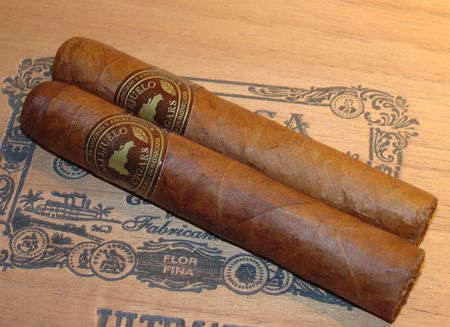
Vallejuelo Robusto

Vallejuelo is best known for its nomination as one of Cigar Aficionado’s Best Bargain cigars of 2010. The Robusto Gordo scored 93 points, along with CAO’s La Traviata Divino and La Aroma de Cuba Robusto. I do not subscribe wholeheartedly to CA’s opinion, but I respect it like any other opinion, and I’m always interested in a bargain. So I began my quest for Vallejuelo.

So I searched and searched in my local shops, made inquiries, but finally came up empty handed. Eventually I got distracted by other developments in the cigar world and the brand fell off my horizon.

A few weeks ago I was reminded by a reader about the Vallejuelo brand and while placing an order for some other things saw that Atlantic Cigar now carries them. They’re not expensive, and they fit in my shopping basket nicely.

Vallejuelo is made by Intercigar, a Dominican company established by Dutch cigar impresario Maurice Antonius Koks. Intercigar also makes a budget brand called Antonius, and judging from their website they also make private label cigars for independent retailers. Vallejuelo was originally designed for the Swiss market as a less expensive alternative to Cuban cigars. They are certainly less expensive. In other respects it’s setting the bar very high, but we’ll just have to see if they stand up to the Behike.

Vallejuelo features a Nicaraguan and Dominican blend of fillers, a Dominican binder, and an Habano wrapper grown in Ecuador. There appear to be four sizes in production:

  • Robusto – 5 x 50
  • Robusto Gordo – 5 x 54
  • Gran Toro – 6 x 54
  • Gordo – 6 x 60

The name “Vallejuelo” means small valley.

Construction Notes

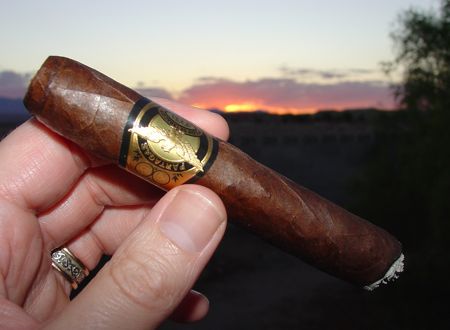
Take the band off a Vallejuelo robusto and it might be confused for half a dozen other high-quality smokes featuring triple-wrapped heads. The wrapper is a dark golden brown with a nice sheen. Pressing the cigar reveals a hard pack with almost no give, but the draw is open and the cigar burns at a leisurely pace. The ash is slightly flaky, but it holds.

Overall very good construction.

Tasting Notes

This is a very much a Nicaraguan style cigar. It opens with a brash dose of black pepper and then mellows into an earthy, but somewhat sharp smoke.

After the initial spice of the Vallejuelo wears away, the mid-section slides into a potent mixture of earth and wood. The wrapper adds a note of cocoa and a touch of sweetness to the mix.

The finale of the cigar is a return to the first third as the pepper makes a brief comeback and the smoke gets down and dirty. I’d classify this cigar as medium in body but full in strength. It’s one of those cigars that throws me back in my chair like the guy in that old Maxell ad. Just sub in a lawn chair and put him in the back yard.

Conclusion

Vallejuelo is a tasty Nicaraguan-style cigar with a good thump. The robusto is a strong and earthy smoke with a subtle aroma, and that’s not easy to find in this price range. Its only flaw is some harshness that might fade a bit with age.

Is Vallejuelo a reasonable alternative to Cuban cigars? Not exactly. But at $4.00 a stick it’s a less expensive alternative to many of the high-end cigars coming out of Nicaragua these days. I’ll be looking for this one in a couple other sizes to see if I can get the same flavor at a slightly lower voltage level.

Final Score: 89
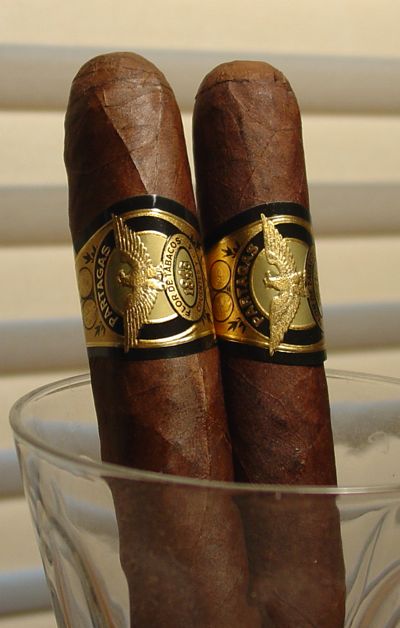
Partagas 1845

I have been eagerly awaiting the second coming of the Benji Menendez Partagas Master Series, but my patience has yet to be rewarded. While my vigil continues, General has kept Benji busy on another Partagas project, one with a view to the future. Benji’s role in the creation of the Partagas 1845 was more as a mentor than a blender, but this may be even more important than the creation of a new cigar.

The fine art of cigar blending is not exactly endangered, but with all of the dark forces arrayed against the cigar industry I am happy to see the elder craftsmen passing the torch lighter. Benji puts it simply: the goal is “to help the next generation of cigar masters create new cigars and grow in the business. If I can plant a seed in their minds so they can grow a tree, I am happy.”

The Partagas 1845 was designed to sit in between the classic Partagas blend with the Cameroon wrapper and the full-bodied Partagas Black. Not too soft, not too hard. It’s the Goldilocks blend. (…cigarfan is available for brand name and marketing advice. Also children’s parties.)

The blend is sophisticated and unusual. Starting with the core of the cigar, there is Dominican piloto cubano and tobaccos from three different areas of Nicaragua. Some of these leaves have been aged in Dominican rum barrels, and about half-way through the cigar I found this really shows. The binder is a Habano strain grown in Connecticut, and the cigar is topped off with another Habano leaf, a Viso grade leaf grown in Ecuador.

The 1845 made its debut a couple months ago in the following sizes:

  •  Corona Extra  – 4.5” x 46
  •  Robusto – 5.5” x 49
  •  Gigante – 6” x 60
  •  Double Corona 7.25” x 54
Construction Notes

The Ecuadorian wrapper on the 1845 is dark, veiny, and somewhat ruddy, but it’s oily enough to give it a rich rather than a rustic appearance.  The wrapper is also quite thin, revealing the binder and giving the stick a bumpy appearance. The roll is a bit soft, but the draw is excellent and the burn is even for the most part. I had to touch up the burn occasionally for cosmetic reasons, but that probably wasn’t necessary. The head is finished with an eye to functionality, as is generally the case with General Cigars. The ash is dark but solid.

Overall construction very good.

Tasting Notes

I sampled this blend in all four sizes and found the smaller ones to be more concentrated in flavor, though not quite as smooth as the larger ones. The core flavors were the same, though they seemed to emerge at different stages depending on the size of the cigar.

The primary flavor of the Partagas 1845 is of sweet tangy wood, a flavor that reminded me at times of barbeque. This flavor becomes evident almost immediately in the Corona Extra, but it is a later development in the larger formats.

The larger sizes open with a mildly earthy, grass-like sweetness, whereas the smaller ones began with a woodier flavor. The smoke is somewhat dry and carries an acidic quality that I associate with Nicaraguan tobaccos. There is a touch of pepper, but it is employed here the way spices should be — as accents rather than entrees.

By the mid-point the 1845 picks up some leathery hints but the sweetness lingers on the nose. At this point there is a mildly liqeuer-ish, fruity quality to the flavor that might be a result of the the rum-barrel aging. I noticed this flavor in all four sizes (though at different stages) so it’s either a very consistent figment of my imagination or it’s there by the blender’s design.

The flavors darken a bit in the last third, charring at the band. The body remains in the medium range and even at the end the cigar is only moderately powerful. It has more heft than the Cameroon-wrapped “yellow box” Partagas, but it is also lighter (and much better, in my opinion) than the Partagas Black. But the flavor and style of the 1845 bear no similarity to its brand brothers, so the comparison is rather fruitless.

Conclusion

The Partagas 1845 is a fine medium-bodied cigar with a delicious aroma, but it suffers a bit from a lack of complexity. I preferred the runt of the litter here — the Corona Extra — for its concentration of flavors, even if it did get slightly abrasive in the last third.

Standard retail price for this line runs from $6.00 for the corona up to $7.50 for the double corona. If that’s in your everyday price range, this could be your everyday smoke.

Final Score: 88

Special thanks to General Cigar for providing samples. 

My Father Cedros Deluxe Cervantes

My Father Cigars reports that they have 700 employees, but there is nary a typist among them. Okay, I’m speculating about that last bit. Perhaps there is another reason why their website is so attractive and yet barren of content, but I’m fond of the notion that it is due to a paucity of secretarial skills in the workforce.

Those 7000 dextrous digits are kept away from all keyboards and directed instead to the rolling gallery of the Garcia Family Industrial Park, where they are producing some of Nicaragua’s finest smokes.

Soon after the My Father line of cigars was introduced in 2008, the Cedros Deluxe line was added in the lonsdale and corona gorda sizes, called Cervantes and Eminentes respectively. At first glance it’s difficult to see why the cedar is necessary because the regular My Father line is an impressively rich cigar to begin with. I guess cedar is like cowbell — more is better.

Due to the lack of information on this cigar I’m going to hazard a guess that the composition is the same as the standard My Father line — a blend of Nicaraguan fillers and binder (grown on the Garcias’ La Estrella farm in Esteli) and a Habano-Criollo hybrid wrapper from the Oliva Tobacco company in Ecuador.

Construction Notes

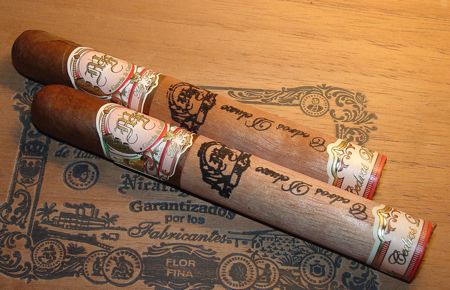
The stamped cedar sleeve on the My Father Cedros is an attractive aesthetic feature as well as a flavor enhancer, and the fact that it slides off so easily is pleasing as well. The wrapper is a ruddy colorado maduro with some fine veins and a touch of oil. As expected, the roll and the finishing touches at the head of the cigar are precise and refined.

The Cedros version seemed to burn a little bit faster than the No. 1, but it also seemed lighter to me, so maybe the proportion of ligero to lighter more combustible leaf is a bit different here. The Cervantes burned beautifully and exhibited in all other respects excellent construction, even exceeding the high quality of the the No. 1.

Overall construction excellent.

Tasting Notes

Anticipating my experience with the My Father No. 1, I was expecting the Cedros Deluxe to open with lashings of black pepper, but the Cervantes turns out to be a much more congenial cigar. Pepper is still front and center, but it’s balanced by other flavors and takes a civilized approach (as opposed to the hooligan mentality of the DPG Blue or the like.)

The cedar lends a sweet character to the smoke that blends well with an earthy and tannic flavor on the palate. A caramel-like quality shows up after an inch or two as the pepper relaxes.

The second half of the cigar develops more complexity as leathery flavors overtake the earthy ones. The smoke remains quite smooth and easy going, about medium in body and strength. The sweet cedary notes turn a bit darker. At one point I detected coconut, which might be attributed to environmental factors, like smoking in the waning hours of a summer day that pushed the mercury to 114 degrees. At the band the flavors start to char a bit and I’m ready to seek psychiatric assistance, or at least to go inside and cool off.

Conclusion

The My Father Cedros Cervantes is a slightly milder and more aromatic version of the My Father blend. I’m not sure if that is due to the size or if the blend has been tweaked for the Cedros Deluxe, but either way it suits me fine. It’s smooth and laden with cedar sweetness in balance with leather and earth.

Though perhaps not quite as complex as the No. 1, it’s well worth smoking as a medium-bodied alternative. Pricing is about the same, unfortunately — around $8-9 per stick. But in this case it’s worth the expense.

Final Score: 91

Aging Report: Oliva Serie V Lancero 2008

A few years ago I went to my one and only cigar event, a Cigar Aficionado Big Smoke evening at the Venetian Resort on the Las Vegas strip. I waited in the lines, met a few cigar stars, and went home with my swag. It was a good time, but not anything I’d go out of my way to do again. Crowds and noise are just not my thing.

But I do have one outstanding memory from that nicotine-powered, liquor-soaked evening: in the stygian gloom created by hundreds of cigar smokers a stout gentleman walked by me as I was waiting in line (a mob, really) at the La Aurora booth. He was smoking something so distinct and powerful that the aroma found a way through the thick cloud in the room to my nose, which was tickled and might have even twitched. I followed him around the corner and when he stopped to chat with someone I discreetly peered at the cigar in his left hand: an Oliva Serie V.

And I thought, Wow. That’s one I’m going to have to try.

In the four years or five years since then, the Oliva Serie V has become a staple in my humidor. I’m wary of its potency, which is a little outside my comfort zone, but I’m willing to smoke them slowly and carefully in exchange for the intensity of their flavor.

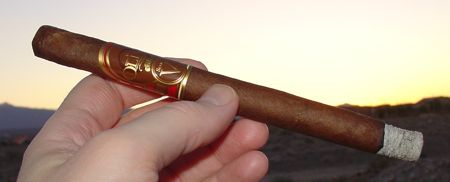
One way to mellow a powerful cigar is to stash it away. And though I have come to the conclusion that most cigars do not benefit greatly from aging, there are a few exceptions, and those exceptional sticks are all fairly strong blends. So when I opened the humidor and spotted an Oliva V Lancero with yellow cello and a 2008 sticker on it, I had to give it a go.

Construction Notes

We found some problems with cracking wrappers in our original review of the Serie V, but I have never experienced that with the lancero. In fact, I have experienced no construction issues with the lancero at any time, not even the occasional tight draw to which cigars with narrow ring gauges are prone. And this one was no different.

Overall excellent construction.

Tasting Notes

Four years in hibernation have mellowed this cigar to an appreciable degree, but the blend is robust enough by design that it is  “mellow” only by comparison with the original article. It begins with a cool and creamy demeanor, gradually heating up as the familiar flavors start rolling in: sweet smoky hardwood and leather in balanced proportions.

The mid-section adds a dose of cocoa which slowly turns darker and more roasted in flavor, eventually coming to resemble espresso or dark roasted coffee.

The last stage is peppery, but it’s not quite as explosive as it once was. There is also an unusual aftertaste to this cigar that I always enjoy — it’s earthy, but slightly herbal, almost like basil.

Conclusion

This slight-looking parejo still makes me a little weak in the knees when the cinder meets the band. The years have slowed the Oliva Serie V lancero down a bit, but not all that much. It’s still a brilliant cigar, and a great candidate for aging.

By an odd coincidence, Oliva just announced a new extension of the Oliva Serie V — the Oliva Serie V Melanio, which will feature a Sumatra seed wrapper grown by the Olivas in Ecuador. The only thing I’m not looking forward to is the price — $8 to 14, their most expensive offering to date. Time to raid the piggy bank again.

Final Score: 90

La Tradicion Cubana Chulo

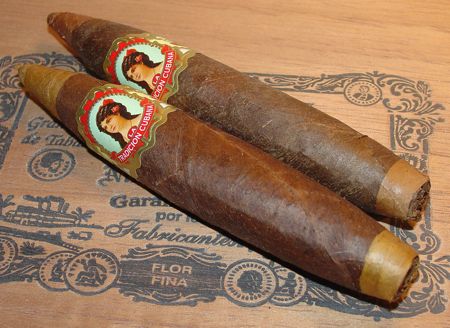
La Tradicion Cubana’s Chulo cigar is the perfecto in their figurado series. Other formats in the series are a Culebras, a huge 8 1/2 by 96 Great Pyramid, and the Reed, a toro-sized cigar with a head shaped like the bit on a clarinet (similar to La Flor Dominicana’s Chisel.) There is also a limited box pressed cigar called Teclas which comes packaged in a box shaped like a piano.

Talk about showmanship! With its two-toned appearance and shapely figure, it’s almost a shame to put the Chulo to the flame, and I find myself torn… To smoke or not to smoke, that is the question. Whether ’tis nobler in the mind to keep a cigar as a museum piece, or to take up matches, and by smoking, ash it… But there’s nothing rotten in Denmark here, or in the Dominican Republic for that matter. In addition to its exotic appearance, the Chulo is also a fine tasting smoke.

The 5 x 54 Chulo (which means something like “cutie”) is available in two wrappers — a natural Ecuadorian and a Brazilian maduro, but the extremities of the cigars are wrapped in the opposite shade. I found that I had to clip most of the natural wrapper off the tip of the maduros I smoked, but the flavor of the Ecuadorian leaf at the foot was detectable for a few brief moments after lighting the cigar.

Construction Notes

The craftsmanship that goes into creating this little zeppelin is apparent at first glance. The dry but dark maduro wrapper creates a striking contrast against the natural leaf at the foot and head of the cigar. Both ends of the Chulo are finely finished.

The roll is solid and the draw is good, though to achieve this it is sometimes necessary to cut a little further down — all the way to the boundary of the maduro leaf — than seems optimal. They burn evenly and need to be ashed only once or twice.

My only criticism is that the cigar gets a bit hot in the last third, but that is probably just a natural hazard of a cigar shaped like this. Despite its advertised ring gauge, the Chulo is a fairly small cigar.

Overall construction very good.

Tasting Notes

The first flavors to come wafting from this little guy are smooth and nutty, due in part to the Ecuadorian wrapper which gets the ball rolling. The smoke is creamy and medium in body.

It doesn’t take long before the natural wrapper gives way to the bittersweet chocolate aroma of Brazilian maduro. The smoke is still smooth, but its character changes dramatically. The sweetness on the nose remains but is soon overpowered by earthiness on the palate, and this becomes the primary theme of the cigar.

In the final section some peppery elements enter to complement the earthiness, and the cigar starts to heat up a little. I found it best to slow my pace at the mid-point of the cigar to keep the smoke cool and to keep the earthy flavors in proportion to the sweetness.

Conclusion

La Tradicion Cubana has a reputation for virtuoso cigar making, and this is exemplified by all of the cigars in the Figurado series, including the Chulo. But I was happy to discover that the cigar is more than mere eye candy — it’s a dandy little smoke with lots of smooth and earthy maduro flavors. It’s also pretty obvious that the chef who whipped up Sabor Cubano was supervising the design of the Chulo as well.

I’ll be looking forward to trying the natural version one of these days, but for now I can vouch for the maduro: it’s good. Boxes of ten sell for around $60 USD, which is a fantastic price considering the craftsmanship required to make these two-toned perfectos.

Final Score: 89

Alec Bradley Black Market Robusto

In the wake of critical hits like Prensado and the Family Blend, the folks at Alec Bradley might be expected to kick back and bask in the glow of their well-deserved success. But that’s not what they’re doing. They’re back at work, inventing new cigars like the Fine and Rare (a blend of 10 different tobacco leaves) and this one, the Black Market.

“New” is a relative term, of course. These cigars were released last year, before Prensado took home the gold in the Cigar Aficionado rankings at the beginning of this year. Even so, I don’t think these guys are going to be sitting around on their laurels too long.

The Black Market is an unusual looking cigar from the start: it doesn’t appear to have a band. A gray sleeve covers the lower part of the cigar. When removed it reveals a standard size cigar band positioned in the middle of the stick. This is distinctive and appealing, but it raises fears that it might not be  easily removed. I was pleased to find that the wrapper is smooth enough and the band is glued with enough care that it slides easily toward the head of the cigar.

The Black Market is also a little unusual under the hood: this cigar is composed entirely of viso and ligero leaves. Usually a blend contains at least some seco leaf for balance and aroma, but not this one.

The wrapper is from the Jalapa Valley in Nicaragua, the binder is Sumatran, and the filler is from Panama and Honduras. The cigar is manufactured in Honduras in five sizes:

  • Robusto 5 1/4 x 52
  • Toro 6 x 50
  • Churchill 7 x 50
  • Torpedo 6 1/8 x 54
  • Gordo 6 x 60

Construction Notes

Slipping the sleeve from the shank of the cigar reveals a glossy dark colorado wrapper, so dark that it is almost maduro in shade. The leaf is a little veiny, but the oiliness of the leaf compensates for this minor detraction. The head is round and finished with a triple cap.

The roll is quite firm but the draw is good, and it burns evenly from first light to last ash. Which is smooth and solid, by the way.

Overall excellent construction.

Tasting Notes

The first flavors to emerge from the Black Market Robusto are the sweet woody notes of Aganorsa tobacco. I don’t know if that’s what this wrapper is, but if I had to guess, that’s what I’d say. What differentiates this cigar from the many other cigars utilizing this ever popular leaf is the lack of pepper. There is very little sharpness here. I wouldn’t go so far as to call the taste “round,” but the flavors are smooth, balanced, and distinguished enough that the pepper is not missed.

Mild coffee and chocolate flavors add to the mix after half an inch or so. The cigar’s body is decidedly in the medium range, remaining smooth and quite easy to smoke. The chocolate flavors are tempered a bit in the mid-section, leveling out to cocoa, with a touch of earthiness edging its way in. The aftertaste is clean and light.

The final section is a little more concentrated as the cocoa veers toward caramel and the earth becomes more pronounced. The aroma remains sweet and woody, and the cigar winds down with just a touch of char.

Conclusion

Alec Bradley’s Black Market Robusto is an unusual and intriguing blend because it offers many of the flavors associated with popular Nicaraguan-style cigars without the aggressive bite and acidity that affects so many of them. I’m curious if the seco-less composition has anything to do with this, or if it’s the Panamanian wild card.  Whatever it is, this is a smooth and flavorful cigar.

The flavors don’t transition too much, but the cigar is perfectly charming the way it is. The complex blend of sweet wood, coffee, and earthiness is enough to sustain the medium-bodied cigar smoker’s interest for 45 to 60 very pleasurable minutes. The MSRP is around $6-7 USD for the robusto, a pretty reasonable deal all around.

Final Score: 91

Macanudo Cafe & Maduro Gigantes

Macanudo is reportedly the best-selling premium cigar brand in the United States; it therefore needs no introduction. Just about everyone who has smoked a cigar has smoked a Mac — it’s a mild cigar with a classic Connecticut shade wrapper, and it’s a great one to give to a virgin smoker who is curious about the lure of the leaf.

There are well over two dozen frontmarks of the Cafe blend alone, not to mention the several other blends that fall under the Macanudo umbrella. Recent blends such as the Macanudo 1968 and the Vintage 1997 have surprised grizzled veterans with their flavor and strength, showing us that Macanudo is not always synonymous with mild.

These are the original mild-mannered cigars that so many know so well, but in a new format. (Yet another frontmark. It occurs to me that an average-sized cigar shop housing all of the Macanudo blends and sizes would have no room left for any other brand.) Super large ring gauges are finding followers and selling well, so it’s no surprise that General Cigar is responding to the demand with the new Gigante frontmark.

The Cafe blend is the classic Mac, possibly the most consistently made cigar on the planet — a Connecticut Shade wrapper, a Mexican binder from San Andres, and filler from the DR and Mexico. The Maduro substitutes a Connecticut Broadleaf wrapper for the Shade.

Construction Notes

Both cigars are well made with rounded Cullman heads. (Edgar Cullman, Sr, who died last year at the age of 93, was the man who made Macanudo into the best-selling brand it is. He and some investors bought General Cigar in 1961, and a few years later they acquired a small Jamaican factory called Temple Hall where an unknown cigar called Macanudo was made. The rounded head on the Macanudo, and now many other cigars, is named for Mr. Cullman.)

The draw, burn, and consistency of the Macanudo Cafe and maduro brands is beyond reproach. If you’ve ever smoked one that didn’t burn well, leave a comment, because I have yet to hear from anyone of a construction defect in this cigar. It must have happened some time — it’s a hand made product, but it’s remarkably consistent.

Overall excellent construction.

Tasting Notes

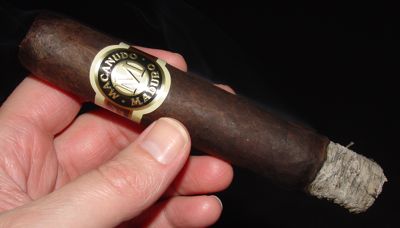
The Macanudo Cafe is a mild cigar with flavors that are typical of Dominican and Mexican tobacco — the base flavor is nutty with a little bit of astringency, just enough to work the salivary glands a bit. The Maduro version is somewhat sweeter. The broadleaf wrapper disguises the tartness a little more effectively than the shade wrapper does.

There isn’t much transition from the beginning of this smoke to the end, but this is normal for very mild cigars. The Cafe does get a little more tart at the end, and the Maduro picks up some char, but mostly what you get out of this cigar is a mild-mannered vehicle for a couple of great wrapper leaves. The aroma is what makes this cigar noteworthy — the soft floral creaminess of the Cafe, and bittersweet chocolate from the Maduro.

Though I’m not a regular smoker of this brand, the Gigante appears to be a little more flavorful than the robusto size. I’m not a big fan of the chunkster cigar trend either, but the amplified flavors in these Mac biggies were a welcome surprise. (My thanks to General Cigar for the samples, by the way.)

Conclusion

These are the same Macanudos that a lot of us started on, just in bigger sizes. And because they are so mild, the bigger size seems to be less of an extravagance than it does in many other blends.  Mild cigar aficionados will definitely want to try these out, but don’t look for any big surprises. These are the same consistent smokes that they’ve been for many years now. MSRP is in the $6-7 USD range.

Final Score: 86

La Casita Criolla

The wrapper leaf on a cigar is like the sear on a carefully cooked piece of beef — it’s often what makes the difference between a bland piece of protein and a sizzling dinner centerpiece. But the sear must be done right — overdo it and your dinner guest will send that Porterhouse right back to the kitchen. Like most of the fine things in life, flavors need balance.

So it’s a puzzle to me when a cigar maker decides to focus on one ingredient in the recipe to the exclusion of the other components, the ones that usually give a cigar balance. We’ve seen cigars that are almost exclusively ligero like Oliva’s Cain, and we’ve seen cigars that are 100% maduro, like Camacho’s Triple Maduro. I don’t care for either of them, and lack of balance is one of the reasons why.

So what possessed Pete Johnson of Tatuaje Cigars to create a cigar made entirely of Connecticut Broadleaf?

I’m not sure, but I was curious to find out. Connecticut broadleaf is prized by manufacturers of everything from machine-made Toppers to Fuente Anejos. It’s thick, it’s ugly, and it’s one of the most expensive tobaccos for blenders to use. But heavens, it’s tasty. (My apologies to Garrison Keillor.)

La Casita Criolla, an old Cuban brand name acquired by Johnson for this blend, means something like “the little native house.” That’s one brand name that is better left untranslated. I’m as puzzled by the name as I am by the idea of a broadleaf puro, but it does conjure up an image of rusticity which is reflected in the cigar’s appearance.

La Casita Criolla is made for Tatuaje by My Father Cigars in Esteli, Nicaragua, and was released last year in three sizes, all comfortably under a 50 ring gauge:

HCB Corona – 5 1/8 x 42
HCBC Corona Gorda – 5 5/8 x 46
HCBF Short Churchill – 6 1/2 x 48

Construction Notes

The HCB Corona is rough and marred with imperfections, which is typical of broadleaf. It’s maduro in color tone, a little bit oily, and has a rustic but rich appearance. The roll is firm, but staring down the barrel it appears to be loose due to the thickness of the leaf. Rolling broadleaf in the bunch must take some getting used to, but the torcedors have apparently made the appropriate adjustments.

Both samples drew very well — not too loose, despite initial visual impressions — and they burned almost evenly, much better than I expected. My only complaint is that the cigar burns a little too hot after the mid-point. Draw frequency should be limited to about once per minute in the last part of the smoke. Discipline is required.

Overall construction: Very good.

Tasting Notes

The Casita Criolla corona offers initial flavors of leather, minerals, and a whiff of black pepper, though there is far less pepper here than in many other Tatuaje blends. The aroma is what you’d expect from broadleaf — it’s rich and sweet with roasted coffee and chocolate.

The middle section doesn’t stray too far from the palate of flavors it starts with, but I notice that the smoke is surprisingly light in texture. The flavors are balanced, the strength is no greater than medium, but the body of the cigar is much lighter than I expected. An aftertaste of graham crackers is a nice touch.

The aroma in the last section turns from leather to wood, but the sweet chocolate notes remain as long as the draw frequency is kept to a minimum. A bitter taste appears if the cigar gets too hot, which it seems to do quite easily in the final stretch.

Conclusion

Contrary to my expectations, La Casita Criolla is a very well balanced cigar. Despite this, it seems to be lacking something. Maybe a different leaf thrown into the mix might give the smoke a little more weight and add to the overall experience. That said, the overall experience is still pretty good, and broadleaf lovers will get a thrill out of this stick.

The coronas are in the 5 to 6 USD range. For the experience of smoking a pure broadleaf cigar, it’s well worth the scratch. I’m not sure I’m ready to run out and buy a box, but I’m glad I had the chance to try them, and I expect I’ll be picking them up from time to time in the shop.

Final Score: 89

Jameson Red Label and Rockstone Coffee

The Jameson Cigar Company was founded in 2008 and the Red and Black Labels were the company’s  inaugural releases. The well-known (and well-reviewed) Declaration and Santos de Miami lines were soon to follow, but I like to think that the first blends from a cigar maker are what makes or breaks the brand’s reputation. So it’s about time that I got around to smoking a few of them.

The Red Label was initially released with a Sumatra wrapper, but the line was reblended in 2009 with an Ecuadorian Connecticut cover leaf.  A binder from Honduras and aged Dominican filler form the core of  Jameson’s mildest blend.

Five sizes are in production:

  • Corona – 5 x 44
  • Perfecto – 5 x 54
  • Torpedo – 6 x 54
  • Robusto – 5 x 50
  • Toro – 6 x 52

One of the flavors that I love to discover in a cigar is coffee — sometimes it presents itself as cocoa, or chocolate — but the bean is the thing that rings my bell. So coffee is a frequent companion to my daily cigar, and I know I’m not alone.

Rockstone "Good Day Sunshine"

It makes sense for this reason that Brad Mayo, the founder of Jameson Cigars, is now also in the coffee business. Rockstone Coffee was established in 2009 as an adjunct to the cigar side of Mayo’s business, and he was kind enough to send along some samples for me to taste. (The Red Label robustos were on my own dime.)

Construction Notes

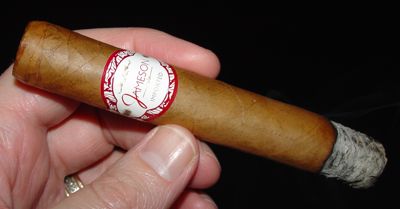
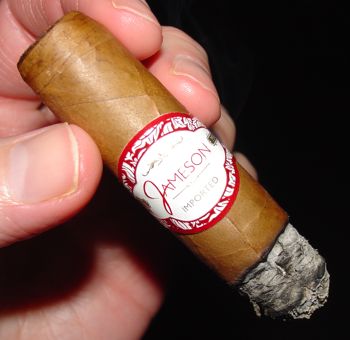
The shade wrapper on the Jameson Red Label robusto is so light it’s almost amarillo — it’s the color of freshly baked bread, and it has the soft texture typical of Connecticut seed shade leaf. The roll is firm but draws well, and the cap is finely executed with a triple wrap and a flat head.

Most cigars with shade wrappers produce an ash with a very consistent color, usually a smooth light gray. The Red Label, on the other hand, produces a light-colored ash with striations of darker gray and black. The ash is solid, but more importantly, the cigar burns evenly.

Overall construction: excellent.

Tasting Notes

I like a mild smoke every once in a while, and Connecticut Shade, whether the genuine article or grown elsewhere, is a deliciously aromatic leaf. But take the band off the cigar and one mild shade stick usually tastes just like any other. Not so with Jameson’s Red Label.

A tannic tartness lets the smoker know up front that this cigar is going to be a little bit different. The qualities typical of mild shade cigars are also there — a creamy texture (though not as buttery as some), a sweetly floral aroma, and a subtle aftertaste that starts the cigar off gently. There is a woody undertone to the flavor in the first half, and a tiny pinch of pepper on the retrohale.

The second half of the cigar becomes increasingly earthy, and the aroma seems more caramelized than floral. What is surprising at this point is the spice on the palate. The strength of the cigar remains fairly mild, but the flavor is on full. The tannic notes that initially characterize the smoke become increasingly difficult to detect through the earth and pepper.

Rockstone Coffee

Rockstone Guatemala Candelaria

The “Good Day Sunshine” Blend is quite mild, tasty, and easy to drink. The dark-roasted flavors that are so popular with mainstream java junkies are in attendance, but the beans are not over-roasted, which is the problem with the mainstream stuff. The roasty flavors are really well balanced here.

Both of the Rockstone coffee blends work well with the Red Label, and they’re both nice roasts, but I preferred the Guatemalan. There is an acidic spring to this coffee that pairs with the tannin in the cigar as if they were made for each other. The roast is light, maybe a city-plus at most, and this allows the region character to express itself freely. It’s a bold, bright cup with a nice body. The notes of lemon would make me think it was an Ethiopian Yirgacheffe rather than Guatemalan, but then I would be wrong. In that case I would be happy to be wrong as long as I could still grind up a handful of these beans for my breakfast brew.

Conclusion

Pairing the Jameson Red Label with Rockstone coffee was a most enjoyable experiment for me, and my taste buds are still thanking me. (I wasn’t expecting such a long finish on a mild cigar…) And my wallet isn’t complaining too loudly either: the Red Label robusto sells for around $4-5, and the coffee runs around $16 per pound. Both the cigar and the coffee have more character than others in their class, and both are definitely worth tracking down.

http://www.rockstonecoffee.com/

https://www.jamesoncigars.com/

Final Score: 88

Alec Bradley American Classic Robusto

A few months ago I had the opportunity to review La Gloria Cubana’s new “Artesanos Retro” cigar, and what I liked most about it was the Honduran Connecticut seed wrapper.  It’s a tasty leaf, so it’s easy to see why Alec Bradley has gone the same route with the American Classic Blend.

Alec Bradley has some experience with Honduran tobacco. Their big hits in the past couple of years (including an impressive No. 1 for the Prensado in Cigar Aficionado’s 2011 lineup) have been from the Raices Cubanas factory in Honduras, so it’s not a huge surprise to see an unusual Honduran strain on the American Classic.

This blend was reportedly designed to mimic the style and evoke the flavors of cigars favored by Americans in the early part of the 20th century, when Tampa was King and cigars with double claro or candela wrappers were labeled “American Market Selection.” Wrapper shades darker than this were called “English Market Selection,” and the darkest cigars were called “Spanish Market Selection.” World markets and the tastes of smokers worldwide have obviously changed, but the American Classic Blend takes a step back in time.

Underneath the Honduran grown, Connecticut-seed wrapper lies a binder from Nicaragua and Nicaraguan filler leaves from both Esteli and Condega. Six sizes are in production:

  • Corona: 5 1/2 x 42
  • Robusto: 5 x 50
  • Toro: 6 x 50
  • Churchill: 7 x 48
  • Torpedo: 6 1/8 x 52
  • Gordo: 6 x 60

Construction Notes

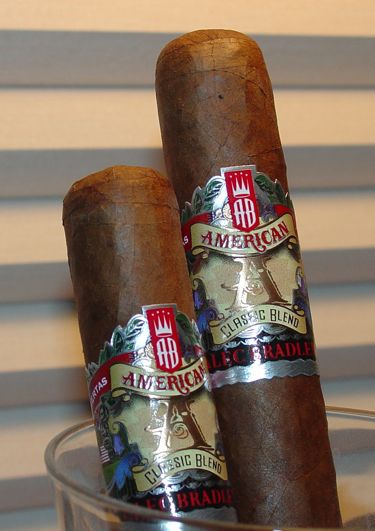
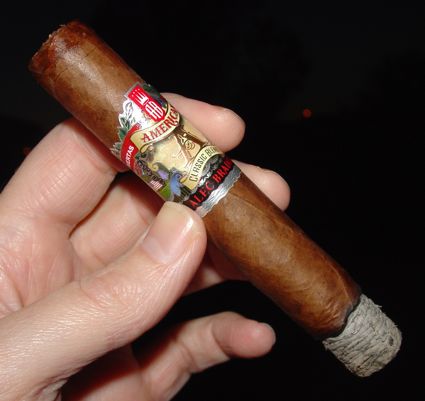
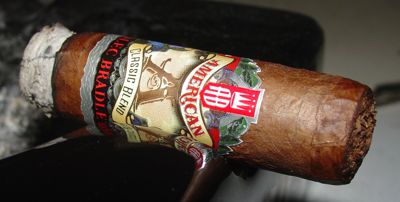
The wrapper on the American Classic is somewhat dry and papery. It’s darker and more weathered in appearance than Connecticut Shade, and it seems a bit thinner. The rough texture of the binder shows through, giving the stick a slightly bumpy appearance. The cigar is finished in Cuban flat-head style with a triple wrapped cap.

Staring down the business end of this cigar I notice that the bunch appears to be partially booked. The draw was fine, however, and the cigar burned perfectly, so perhaps the evils of booked filler leaves are exaggerated. And like many other cigars using Connecticut Shade, this one left a solid light gray ash.

Overall construction excellent.

Tasting Notes

The Alec Bradley American Classic starts up with a toasty flavor common to many mild-to-medium bodied cigars, but the spice on the nose sets this one apart from run-of-the-mill Connecticut Shade smokes. It has the perfume of Connecticut Shade, but it’s sharper and less flowery. It blends extremely well with the toasty and woody foundation flavors.

The mid-section brings a bready note as the spice on the nose dies down. The sweet spot here is almost exactly at the half-way point of the cigar, where the  cedar and bread flavors are delicately balanced and the result is delectable. Unfortunately these flavors dissipate around the two-thirds point and the smoke becomes a bit hot and burnt tasting. Maybe in my zeal for that bready note I was pulling a little too hard, but I deliberately slowed my pace while smoking the second cigar and had the same experience.

Conclusion

The American Classic has the mild and floral sweetness of a high quality Connecticut Shade cigar, but an added complexity that I found quite enjoyable. The combination of toast and bread and soft spicy cedar make it a great smoke to pair with a morning cup of coffee.

Most of us weren’t around for the days of “classic” American cigars, the days of Thomas Riley Marshall’s “good five cent cigar.”  (I shudder to think about what my grandfather would say about  a 15 dollar stogie.)  At around $4 USD this one is a bit pricier than Marshall’s budget smoke, but by today’s standards it is still a relatively good value. Give it a shot one of these sunny spring mornings.

Final Score: 87