Vega Talanga Tercio

cnv0208.jpg

Vega Talanga debuted in 2002 from the cigar division of US Tobacco, better known as the producers of Skoal and Copenhagen smokeless chew. Since then that part of UST has been transferred to Swisher/General Cigars as part of a settlement in an antitrust suit. The information I have is dated previous to that takeover, so caveat lector.

The term “tercio” at one time referred to a 16th century Spanish military formation, also known as “the Spanish square,” a mixed infantry formation that utilized pikemen and musketeers to capitalize on the brute strength of the pikes and the long-range abilities of the muskets.

In the cigar world, however, a tercio is a bale of cigar tobacco sealed in the bark of the royal palm tree. This reportedly creates a tighter seal than the plastic, burlap, or cardboard materials often used to bale tobacco. This method results in less loss of moisture and forces the recirculation of air throughout the bale, making a more flavorful tobacco. (At least that’s what Manuel Quesada says, and who am I to argue?)

The Talanga Valley is located in the Francisco Morazan province of Honduras about a two hours drive north from Danli. Much of the tobacco is grown encallado — sheltered behind large stands of king grass to protect it from the wind — and is sun grown, resulting in a stronger leaf. Combine this with the deep fermentation the tobacco receives in the tercio, and you have the makings of a rich and powerful smoke.

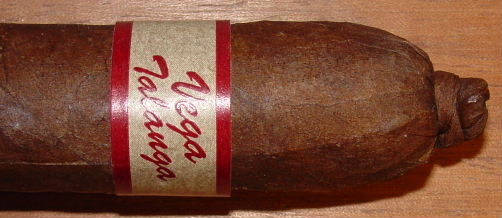
Instead of the standard spanish cedar box, the Vega Talanga Tercio is presented in packages of palm bark just like the ones used to process the raw tobacco. The raw unfinished character of the cigar is emphasized again by its untrimmed foot, and a pig tail cap. The Tercios are produced in Danli using Talanga tobacco for wrapper, binder, and most of the filler, but the filler is supplemented with some Nicaraguan leaf.

Vega Talanga has introduced a new corojo line available in three sizes, but so far the Tercio is only available in one size: a 6 x 54 toro. The roll seems rather soft, and the draw is very easy. The wrapper is rough and leathery with a rich colorado color.

A little effort is required to light this cigar since the foot is flagged and the flaps are folded over onto the foot. But once it gets going, it requires no further maintenance. The burn is a bit uneven at times, but it corrects itself. The softness of this stick is a little weird, but it doesn’t seem to affect the draw or the burn.

The flavor is unusual, and I can’t quite pin it down. The smoke is very smooth, almost creamy in texture, but the flavor is of various shades of earth. At first it tastes of minerals, after a couple inches it turns musky, and the last transition is to a slightly woody flavor. I’m not comfortable with these descriptors, but it’s the closest I can get. It’s an easy smoking cigar, but complex. I can’t compare it to anything — this cigar produces flavors outside the standard spectrum, I think.

The aftertaste is a little bitter, somewhat metallic. A peaty scotch companion comes to the assist here.

All in all a very interesting smoke. I have an Astral Talanga Valley in the humidor that I may have to pounce on soon, because now I want to know if the unusual flavors in the Vega Talanga are coming from the Talanga Valley, or from Vega Talanga…

La Flor Dominicana Ligero L-400

cnv0200.jpg

With a lot of hard work Litto Gomez and his wife, Ines Lorenzo-Gomez, have built La Flor Dominicana into a top-shelf brand worthy of the same respect as Arturo Fuente and Padron. Started in the boom years with a cigar called "Los Libertadores," the company has grown on the principle of total quality control over their cigars– they grow their own leaf, run their own factories, and dictate who will get to stock their cigars.

Both Litto and Ines are first-generation cigar makers. Previously, Litto had been a jeweler, and Ines was educated in international relations. Today, he is in charge of the production of La Flor Dominicana, and she handles the business and marketing side.

I remember back in stone ages (about 1997) when the LDF "El Jocko" came out — it was a very odd shape, kind of a trumpet shaped perfecto — and it was a huge hit even then. One of the things it had going for it was power– back then it seemed like so many of the cigars were geared toward the mild end of the spectrum, and a lot of them had no character. Not so El Jocko– both the shape and the power made it stand out.

So it's no surprise that La Flor Dominicana should anticipate the trend toward heavier bodied cigars with their Ligero and Double Ligero lines.

The Ligero 400 is composed of Dominican filler and binder leaf grown on the Gomez farms and wrapped in an Ecuadorian Sumatra leaf. There are three sizes of the Ligero line: big, bigger and biggest. (No, not literally. The 300 is a 50 ring gauge, the 400 a 54, and the 500 a whoppin' 60. They all measure 5 3/4 inches long.)

The wrapper is smooth with a Cuban-style flat cap. From initial ignition to the band the draw is easy and the burn is even. It forms a solid white ash and the burn needs no attention whatsoever. This is a very well constructed cigar.

The Ligero 400 produces a nicely refined corojo-like aroma, a somewhat sweet, slightly toasty scent. Toward the mid-point it picks up some pepper and it bites down just a little. The flavor is fairly dry with a tinge of astrigency on the tongue.

Overall this is a very nice cigar, toasty with some sweet overtones and a short bitter aftertaste. And the construction is top notch.

It lives up to its "Ligero" name with a good punch to the gut. Make sure there's something in there besides some petit fours. This ain't no tea party smoke.

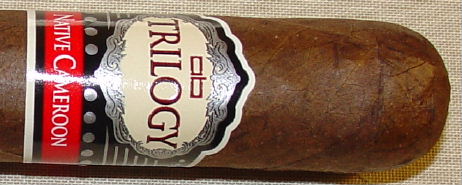
Trilogy Cameroon Robusto by Alec Bradley

Cnv0190.jpg

A couple months ago I was bidding on boxes of Toraño 1916 Cameroons and having no luck at all. The 1916 is probably my favorite Cameroon, but being the frugal and wise consumer that I am (i.e. cheap bastard) I started looking around for alternatives. I read somewhere that Toraño makes the Trilogy Cameroon for Alec Bradley, so I thought it might come close to the 1916. I've liked all the other AB cigars I've tried, so why not give the Trilogy Cam a shot? The price was right –not cheap, but reasonable.

The Alec Bradley company is named after the sons of Alan Rubin, the chief of the Alec Bradley company. Rubin started the company at the height of the cigar boom, in 1996, and when the boom went bust he somehow survived a market flooded with cigars. (Perhaps the secret to his success is that many of these cigars were garbage and he was simply offering a superior brand.) One of those brands was the Occidental Reserve, blended by Henke Kelner of Davidoff, which helped to establish the company.

The Trilogy is named such because from 2002 to 2004 it was "tri-pressed," meaning it was three-sided. An interesting gimmick that some smokers appreciated for the way the cigar fit in the hand. The roll was changed in 2005 and is now round.

An interesting blend is used for the Trilogy Cameroon:

  • Wrapper from Cameroon (Native Cameroon, as opposed to Central African?)
  • Binder from Honduras
  • Filler from Italy and Nicaragua

It's a nice looking cigar with a mildly toothy wrapper that is nearly maduro in color.

The initial burn is even and soon I have an inch of solid light gray ash to admire. The spice from the cameroon is an accent flavor, the way I like it. It's a nice complement to a medium bodied blend that has a woody, slightly leathery base. No particular flavor jumps out at me, just a well blended tobacco flavor that results in a nice smooth smoke.

The Trilogy is not as earthy or distinctive as my benchmark Cameroon, the 1916. The last third of the Trilogy is a little finicky– it burns hot, and pulling too often results in a bitter taste. Aside from that, it's a well made, balanced cigar with great spicy cameroon overtones that don't overpower the rest of the cigar.

And they're available for just under 3 USD. Close, but not quite a "bargain cigar."

CAO CX2 Robusto

Cnv0183.jpg
The CAO cigar company was founded in 1968 by Cano A. Ozgener, a Turkish immigrant who started the company as a vehicle for the distribution of humidors and pipes. Not until the 80’s did he venture into the cigar business, with a cigar called Casa de Manuel. Unfortunately, it did not succeed.

Several years later Ozgener tried again, this time catching the wave of the “cigar boom” in the mid 1990’s. The CAO Black was released, but it too failed make a splash in a market full of newcomers. Later on, the CAO Gold would garner the attention needed to put CAO on the map.
Soon Michael Jordan would be seen smoking a CAO churchill after winning the NBA championship. Now there’s an endorsement!

The first CAO cigars were produced in part by Nestor Plasencia, and later Carlos Toraño and Jose Blanco (of La Aurora) would have a hand in CAO production. Today the company is controlled more directly by the Ozgener family, with factories in Nicaragua and Honduras.

Double wrapped cigars seem to be a bit of a trend these days, with double maduros produced by both CAO and Cusano; a double Connecticut is also made by Cusano, and Oliveros is making a double Corojo. (And by “double” I mean both the wrapper and binder are the same type of leaf.)

If this double Cameroon is as good as CAO’s MX2 double maduro, this should be a real treat.

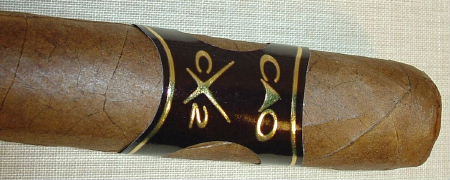
The CAO CX2 Robusto is round, as opposed to the box-pressed CAO L’Anniversaire Cameroon. It measures a standard 5 x 52. The wrapper is “first grade” Cameroon and the binder is of course Cameroon leaf as well. The filler is an unusual combination of Columbian and Nicaraguan (Jalapa) leaf. I can’t think of another cigar that uses Columbian tobacco. This should be interesting.

The wrapper is a medium colorado maduro color with relatively little tooth for a cameroon. Prelight the scent of the wrapper is a little gamey. I guillotined the cap and found the draw to be firm and the prelight taste grassy.

The outer leaf is quite fragile and is prone to splitting. I’ve been storing these at around 65% RH, and they probably need to be at 70 or more. The split allowed me to look at the cameroon binder. I’ve always thought of cameroon as exclusively a wrapper, but the roughness of this binder clearly shows its grittier side.

The burn is uneven, requiring two or three touchups. On the plus side, the draw is perfect. It’s a firmly packed cigar and burns slowly.

If you love the taste of cameroon, this one has it… but in my opinion it has a little too much. The aroma is overwhelmingly sweet and spicy. Like a fine perfume, cameroon doesn’t require a massive application. The CX2 is a medium bodied cigar, with a bit of a kick at the end, and maintains a balanced woody flavor with a little salt. The last third gets somewhat bitter.

A must try for cameroon lovers, but be prepared for an onslaught of spice. In my book, a little cameroon goes a long way.

American Stogies Cuban Corojo Toro

Cnv0170.jpg

Nestor Plasencia makes so many cigars for so many people it’s hard to keep straight, but this is one of them, made for Indianhead in Esteli, Nicaragua. Plasencia’s father Sixto was one of the pioneers of the cigar industry in Nicaragua. In the mid-60’s Sixto recognized the similarity of the valleys of northwestern Nicaragua to the Pinar del Rio area and decided it would be a good place to experiment. The test was a rousing success, and since then the Plasencia family has been huge in both the Esteli area and the Danli, Honduras tobacco zone. To date, Plasencia grows tobacco for Rocky Patel, Mayorga, OneOff, Evelio, Maria Mancini, other Indianhead cigars, and numerous other private customers. He also has his own line, which includes the Plasencia Organica, one of the first cigars rolled with certified organic tobacco.

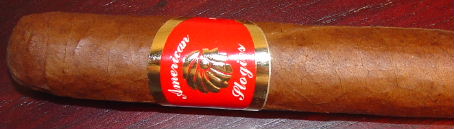
This is the “Classic Cuban Corojo,” introduced in 2003 as a fuller bodied addition to the American Stogies line. It normally sells for under three dollars– like the Mayorga cigar it could very well be considered a “bargain cigar,” even though it could probably sell for more. It’s a Nicaraguan puro according to he venerable Cigarcyclopedia…but I must admit I did not know they were growing corojo in Nicaragua. Unless, of course, this is like the Punch rare corojo, and corojo in name only.

But judging by taste, I think this wrapper leaf is indeed corojo. It has the same aroma as the Puros Indios Corojo and the Camacho Corojo, but I can’t say the cigar as a whole is quite as good as either of those. It has a nutty, somewhat vegetal taste, with very little spice. It packs a good punch, however. Definitely not an empty-stomach smoke.

It burns well, evenly and not too quick, though the stick does get soft after a couple inches. I grew a bit tired of it at about the half-way point, where the power began to kick in without any added flavor dividends.

For the price, I’d say give this one a shot. Don’t expect too much, and you’ll get a little more than you had expected.

TTT Trinidad Corona

Cnv0151.jpg

The Trinidad family emigrated to Cuba from Seville, Spain in the late eighteenth century and by the early 1900's began making cigars. The business grew steadily until one day disaster struck: Diego Trinidad had purchased a larger than usual crop of tobacco, a significant investment, only to discover that half of it was infested with worms. It might have spelled the company's end, but they salvaged the crop by chopping the tobacco for cigarettes. To their surprise they doubled their profits by the end of the year, and accordingly they shifted their manufacturing operation to making cigarettes instead of cigars.

In 1958 the family registered the brand name "TTT Trinidad La Habana Cuba" with the Cuban trademark office. At that time the Trinidad family operated one of the largest cigarette and cigar firms in Cuba. The Castro government took the company over in 1960 and "nationalized" it in 1961. The Trinidad family migrated to the U.S., where they formed the Black Tobacco Company, manufacturing Cuban style cigarettes mainly for Cuban exiles. The brand name Trinidad y Hermano was registered for their cigars.

The first Trinidad cigars manufactured in the United States were made by the Arturo Fuente company in Tampa around 1968. Production seems to have stopped when the Fuente company moved to the Dominican Republic.

In 1994, the Cuban government sought to register the brand name "TTT Trinidad, La Habana Cuba" with the U.S. Patent and Trademark Office. This registration was granted in 1996. At the same time the Trinidad family revived their brand– using the exact same name– with Tabacalera Fuente once again producing the cigars, this time using a Cameroon wrapper. The Trinidad family requested that the Cuban tradmark be revoked, and in 2001 the USPTO ruled in Trinidad's favor. Shortly after this, the Trinidad company was taken over by Altadis USA, and the cigar I have before me is now a totally different creation from either the original or the subsequent Fuente blend.

So what's the big deal with this brand anyway? It sounds like a bunch of legal mess… Well, part of the big deal is that Fidel Castro originally created the Trinidad brand for his exclusive use as diplomatic gifts… A mystique arose around the brand as the "best of the best." Except for one minor problem. In an interview with Marvin Shanken, Fidel said he wasn't familiar with the brand. And when he was a smoking man, he said, he was partial to Cohibas. So communists have marketing strategies too, hmmm?

The current incarnation of the cigar bears an Ecuadorian Sumatra wrapper, a Connecticut broadleaf binder, and filler from the DR, Nicaragua and Peru. And they slap this thing together down in the Dominican Republic somewhere.

I scored a tin of four of these in a package deal last fall, so I didn't pay retail — good thing. This is a decent smoke, but I wouldn't pay 8 bucks a pop for em. It fires up with a good dose of pepper, then mellows out a bit. There's a nice overlay of leather, and the smoke maintains a medium body which gathers strength toward the end. One of the four had a tight draw, but otherwise they burned well. I preferred the corona to the robusto — the corona was a little less aggressive, allowing for more complexity. The robusto is a real powerhouse, a real redneck knock-em-down bar fighter of a cigar. The corona is full flavored, but not as bullish. All in all the corona is a good cigar, but there are far better choices at this price point.

El Rey del Mundo — Old and New

Cnv0144.jpg

El Rey del Mundo is one of the many Cuban cigar trademarks that have a post-embargo incarnation. The original Cuban line was launched in 1882. By the 1950's the Havana factory was in the hands of Karl Cuesta of Cuesta Rey fame. He had arrangements to sell the factory but when the purchaser made a few unilateral adjustments to the contract, Cuesta angrily cancelled the deal. This opened up an opportunity for Frank Llaneza's Villazon company to buy the factory, and with it came the rights to the El Rey del Mundo and Flor de A. Allones trademarks.

But soon Castro would come down from the mountains with his bandits and take everything for the government. By sheer coincidence, Llaneza happened to be in Honduras examining the very first test crop of Cuban seed tobacco when the U.S. embargo was declared. Eventually a Villazon factory was established in Danli, Honduras. By the early 70's Villazon was experiencing labor pains, the kind induced by unions and communism. They decided to open a new factory in Cofradia where the climate was a little less inclined to this sort of disruption. But their experienced manager was moving with the operation to Cofradia and they needed someone new to run the plant in Danli.

By another stroke of good fortune, Llaneza ran into Estelo Padron, who had been working with his brother in Nicaragua; he and his brother had a bitter falling out and he was looking to leave the Padron company in Nicaragua. Estelo was offered and accepted the job of running the Villazon factory in Danli. Like his brother, Estelo is an incredibly talented and hard-working tobacco man. But unlike his brother, he keeps a low profile. You don't hear too much about him, even though he is the man behind the blends in Punch, Hoyo Excalibur, Sancho Panza, and of course El Rey del Mundo. And yet there is no star over Estelo Padron's door, no spotlights in Cigar Aficionado magazine. To this he responds, "A cigarmaker belongs in his factory making cigars."

Padron's special expertise lies with maduro wrapper. And in examining the oily oscuro that covers these robustos, all I can say is, "Damn. That's a smoke." I've been enjoying my El Rey del Mundos for years, and while organizing my desktop humidor the other day I noticed that I had one from a box I picked up about a year ago. I just received a new box about three weeks ago, so I thought it would be fun to contrast and compare, see if a year's age on this one made any difference in taste or combustion properties.

It may not be a fair comparison, because the old sample I have turned out to have a very tight draw. It was still smokable, but the tight roll gave it a graphite tinge that is normally not there with these smokes. But otherwise I noted that it was much smoother than the new ones, which have a gamier taste and a slight bite. The old sample had no bite whatsoever, and very little aftertaste. Age has definitely mellowed this cigar; in addition to this, or perhaps because of this, a really nice floral element appears after the first half inch or so. I think of the ERDM as the prototypical Honduran cigar– full bodied, rich with leather and wood, and in the case of maduros, a sweet char rising above the other flavors. In the case of the newer ones, there's also pepper at the outset– but aging has an attenuating effect on this element.

The robustos in this line all have a large ring gauge at 54/64ths, and the Connecticut Broadleaf maduro is their hallmark. They're a great example of how a cigar can have a full bodied taste and texture without being "strong." Even though I had some bad luck with the aged one, I plan on putting half of this new box away for a year or so.

Diamond Crown Maximus Pyramid No. 3

Cnv0140.jpg

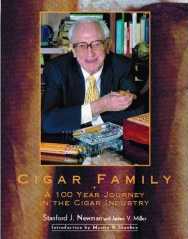
The first Diamond Crown line was developed by Stanford Newman and the Fuente family to celebrate the 100th anniversary of the Newman cigar company. As he tells it in Cigar Family, Stanford’s father first began rolling “buckeye” cigars in Cleveland for direct sale to grocery stores. He stored the tobacco in his mother’s cellar. And this was the humble beginning to a family legacy that would survive for the next century and beyond.

The Newmans first got involved with the Fuentes when Carlos Fuente approached Newman to take over his machine-made business in Tampa. Fuente wanted to concentrate on his hand made cigars in the Dominican Republic, but he didn’t want to totally abandon his machine made business in Tampa. Newman balked at first, but realizing the talent of Fuente he finally agreed, with the condition that Fuente make hand made cigars for the Newman company. An agreement was forged, and cigar fans are all the better for it.

The Diamond Crown line and the Opux X line were released at about the same time, in 1996. I remember at the time the clamor that arose over the Opus X, in part because it wasn’t available on the west coast. Part of the Newman and Fuente marketing plan was to release the Opus X on the east coast exclusively, and to release the Diamond Crown on the west coast exclusively. Very smart…and aggravating! I can just see Carlos and Stanford snickering over this, like Boris and Natasha Badenoff. But as far as a publicity generator, it was brilliant idea.

The Diamond Crown Maximus came as a response to the trend toward heavier bodied cigars. The original line is a fairly mild blend with a Connecticut wrapper, while the Maximus is heavier and employs an Oliva grown Ecuadorian sun-grown wrapper from the El Bajo region. The Maximus was released at the 2003 RTDA convention.

All of the DC cigars have large ring gauges so they can incorporate five or six different leaves to give the smoke complexity. The Pyramid No. 3 rings in at 6 5/8 x 50. The head of this cigar is something to marvel at. The wrap is perfect, the work of a true artist. The color is an unusual colorado maduro, an almost drab shade of maduro…I can’t find another cigar in my humidor that shares the same shade.

The wrapper on this cigar is the star of the show. I found the blend to be smooth and spicy, but the aroma from the wrapper steals the show. It starts up with a hint of cedar that grows and grows, over a steady smooth beat that heats up in intensity as the cigar burns. Almost like a piece of music, a jazz quartet that starts out cool and easy but breaks out when the players take their solos. But again, the principle player here is the Ecuadorian wrapper. Between puffs it was nice just to revel in the aroma from the smoldering stick.

Certainly a class act. But now for the letdown. As the band packs up its instruments and the crowd finishes their drinks, the bill arrives. Gulp. At 15 to 20 USD, this is still a damn fine cigar. But at this price… I’ll have to let my wife buy me more, like this one, for Christmas.

Joya de Nicaragua Antaño 1970 Robusto Grande

Cnv0135.jpg

Joya de Nicaragua was the first Central American brand to be produced after the Cuban revolution. The company that originally made the brand was started in 1964, and the Joya de Nicaragua name was trademarked in 1970. The Joyas produced around this time were made in the Cuban style to attract American customers who could no longer purchase the Havanas to which they had become accustomed. They were strong, robust cigars, and soon set the standard for Cuban-style cigars in the U.S.

The Somoza government heavily subsidized the tobacco industry in Nicaragua, seeing an economic opportunity to fill the vacuum left by Castro's revolution and the U.S. embargo. With the help of luminaries such as Nestor Plasencia and Jose Padron, the Cuban style cigar found a foothold in Nicaragua. Alas, the Somozas were dictators as well, and when the government was overthrown by the Sandinistas in 1979 the tobacco industry was emasculated in the name of the proletariat. In 1985 another U.S. embargo was levied, this time on Nicaragua. Tobacco production was geared toward the production of cigarettes for the Eastern European market.

But the Sandinistas met their demise as well, and the cigar industry bounced back. But the Joya de Nicaragua of the mid to late 1990's was not the same. It was a mild shadow of its former self. So in 2002 Tobacos Puros de Nicaragua S.A. developed a cigar that would bring back the memories of the early brand: the Antaño 1970.

The Robusto Grande is a sawed-off 10 gauge of a smoke. Measuring 5 1/2 x 52, it's solid in the hand, firmly rolled with a slight box press, and looks like it means business. The pre-light aroma is earthy and rich. It smells like it has only recently been recovered from some underground vault. It has a firm draw and is a little difficult to light. Once fired up it burns with some reluctance, as if it's daring me to draw on it more frequently than I should. C'mon kid… I dare ya.

Without a doubt this is a heavy bodied cigar. It's rich and flavorful, but somewhat bullish, a little single-minded. It reminds me of a Padron 1926 minus the sophistication and complexity. The primary flavor is rich tobacco, with a woody element, accompanied by a metallic twinge which is typical of some Nicaraguans. This cigar begs to be smoked slowly, but it wouldn't let me without going out or burning unevenly. A salty quality also calls out for a strong beverage. Lagavulin met the challenge.
I like this cigar, but I'll be trying other sizes to see if they have better construction. Once I recover, that is.

Cigar Family by Stanford Newman, Part 2

Cnv01301.jpg

In the 50’s the M & N Company was using more Cuban tobacco than ever before, and to facilitate their manufacturing process the company moved to Tampa, Florida. One of J.C. Newman’s dreams was to have a truly “premium” cigar in the M & N stable; Stanford accomplished this with the acquisition of the Cuesta Rey brand from Karl Cuesta. His next problem was how to competitively market his new premium, the Cuesta Rey Palma Supreme, at 26 cents:

A fellow will try a new cigar, like it, and never buy it again. He goes back to the brand he is used to. It’s like a marriage. A man can go out with a girl on the side and think she’s the best woman in the world, spend the whole night with her, but in the morning he’s forgotten her name and he goes right back to Mamma. I often told our salesmen that we were only going to get as many conversions to our brand as there were divorces.

His solution was to market a new line, the Cuesta Rey “Number 95.” The numbered name was distinguished and unlike the competing brands. And he did something else to distinguish it from the others: he raised the price from the standard premium price of 26 cents to 35 cents! (A tactic still in use today by premium cigar makers, if I might add.)

The use of 100 percent high quality Cuban tobacco was also a factor in the success of the new Cuesta Rey. This involved numerous trips to Cuba to inspect the tobacco, and as it turns out, the fertilizer.

My visits to Cuban tobacco plantations always began the same way: The tobacco grower led me straight to the largest pile of cow manure on his farm. “Just look at that nice big pile!” he would say, beaming with pride. As my tour of the plantation continued, the farmer inevitably called my attention to every immense pile we came across.

One of Newman’s primary suppliers in Cuba was Carlos Toraño Sr., who was betrayed by Castro after the revolution and by Newman’s account appeared in person to seize Toraño’s farms. (This was Toraño’s reward for helping Castro finance the revolution, believing Castro’s declaration that he was not a communist to be sincere.) But the revolution had repercussions for Newman as well, especially after Kennedy signed the Cuban Embargo into law.

The Tampa cigar manufacturers stored most of their tobacco in warehouses in Havana and had it sent to them as needed on a ship called The Privateer that traveled between Havana and Tampa twice a week.

One man convinced me to prepare for the day when The Privateer might no longer be allowed to bring Cuban tobacco into the United States: Angel Oliva, one of the most prominent leaf tobacco dealers in Havana and Tampa, and one of the fairest, most honorable businessmen I knew. He was convinced that the Cuban situation was only going to get worse. He believed the U.S. would soon be forced to embargo Cuban tobacco in retaliation for Castro’s increasingly hostile conduct. In July of 1960, Angel invited me to visit a tobacco grower and packer in Quincy, Florida, the same tobacco-growing region I had turned to when Connecticut Shade became prohibitively expensive after World War II.

At first, I declined Angel’s invitation. Why buy Florida tobacco when I could still get it from Cuba? But Angel was persistent. He practically dragged me to Quincy, even paid for my plane ticket. In Quincy, we discussed the possibility of growing candela wrapper. The tobacco dealers did not want to produce the candela tobacco unless someone was prepared to buy it. I agreed to put up the money for an experiment to produce about 100 bales.

When the tobacco was ready, I took fifty bales and encouraged Angel to take the other fifty as samples to show other cigar manufacturers. I wanted to make this wrapper tobacco popular so that it would be accepted by consumers and the industry. Most of the manufacturers wouldn’t even look at it. They quickly changed their tune when, four months later, the embargo Angel had predicted came to fruition. The other Tampa cigar manufacturers then followed my lead, placing orders with Angel Oliva for more than 6,000 bales of Quincy candela wrapper

Eventually Cuban wrapper would be supplanted in the U.S. by Cameroon leaf, which was controlled by a French monopoly. Cameroon leaf was auctioned off at events called “Inscriptions,” and at one of these Stanford had yet another opportunity to display his business acumen.

One year, when the Cameroon tobacco crop was in short supply, I set an Inscription record for the highest bid ever offered in the auction’s history. I joked that if one of my employees had paid that price, I would have fired him. If I had been working as tobacco buyer for someone else, I’m sure they would have fired me too.

I believed that if we had the highest quality tobacco, our cigars would sell; that the bitterness of poor quality remains in a smoker’s mouth long after the sweetness of low price is forgotten. And I was right.

In 1986 Carlos Fuente approached Newman with a proposition. Fuente wanted out of the machine-made cigar business he had in Tampa to concentrate on his hand-made cigars in the Dominican Republic. He asked Newman if he would interested in taking over his Tampa brands. Newman did the math and found that he couldn’t make a profit on this deal. But he said he’d do it anyway, on one condition: that Carlos Fuente make premium hand-made cigars for the Newman outfit. He agreed, and soon Fuente was producing La Unica for Newman, followed soon by Cuesta Rey. As the cigar boom caught fire in the late 90’s the Newman-Fuente combo came up a number of super-premium smokes, among them the Diamond Crown which features tobacco aged for five years and an inspection regimen so stringent that only fifteen of every fifty cigars produced are approved for sale.

Today the Newman family and the Fuente family work side by side as cigar families; in fact their website is just that: http://www.cigarfamily.com/

Cigar Family is a fascinating read for anyone interested in the American cigar industry. And for anyone who enjoys Diamond Crown, Cuesta Rey, La Unica, or any of the other great cigars from the Newmans—it’s required reading.

And a great deal on Newman’s Cuesta Rey Centro Fino cigars is available by joining the Connoisseur Club by J. C. Newman.

Stay tuned for a review of a Diamond Crown Maximus pyramid which has been beckoning to me from the humidor…