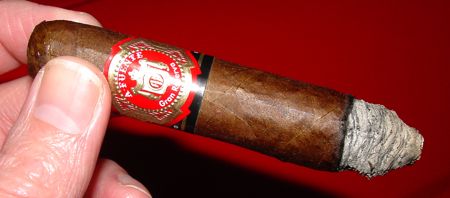
National Nestor Miranda Cigar Day

NESTOR MIRANDA THIRD PR 004

It’s the 20th Anniversary of Miami Cigar and Co., and they’re celebrating by declaring Friday, June 12th National Nestor Miranda Cigar Day.

As we’ve noticed here previously, the Nestor Miranda Special Selection is one tasty smoke, and to honor Nestor Miranda as well as the cigar smoking community at large, Miami Cigar is making a gift of one Nestor Miranda Special Aniversario cigar (in the whopping 7 x 56 “Danno” size) to anyone who buys a cigar — any cigar, by any cigar maker — at one of the 500 Nestor Miranda Special Selection Authorized Dealers on Friday, June 12.

That’s right. Support your B&M by making a single purchase on Friday, June 12, and you get a Nestor Miranda Special Selection Aniversario as a gift. What a deal.

From the press release:

“All I ask,” said Nestor Miranda, “is that they smoke the ‘Danno’ that afternoon. Anyone who wishes to comment on the cigar, after smoking it, can e-mail me at Nestor@NestorMirandaCigars.com . I am very interested in hearing those comments.”

To locate your Authorized Dealer, go to http://www.nestormirandacigars.com and follow the instructions on the site.

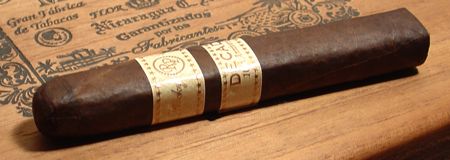
Rocky Patel Decade Robusto

Decade

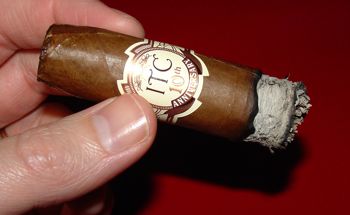
For a cigar maker as prolific as Rocky Patel, one anniversary celebration is simply not sufficient. Last week I looked the ITC Anniversary; this week I’m checking out the Decade, Rocky’s other Anniversary cigar. (And if that isn’t enough for you, Rocky just announced that he’s working on a blend for his fifteenth anniversary coming up in a year or two.)

Inside each box of Rocky Patel Decade cigars is printed a phrase that sums up the RP story: “Against All Odds.”  Of the hundreds of companies that started up during the cigar boom of the mid ’90’s, Rocky Patel’s is one of the few survivors. Hard work and a knack for creating tasty blends has paid off.

And it hasn’t hurt that he has friends like Nestor Plasencia. The Decade is made in Plasencia’s El Paraiso factory in Danli, Honduras, where they also make one of my other favorite cigars, the RP Sungrown.

As I explained (or tried to explain) in the ITC Anniversary post, the Decade blend is actually the blend originally created for the ITC. Rocky thought that blend was a little better than the one created for the Decade, so he switched labels.

The Decade has a dark Ecuadorian Sumatra wrapper and an undisclosed binder-filler blend (labeled “secret” on the Rocky Patel website) but in other places it is said to be Nicaraguan. Based on the flavor, I’d say Nicaraguan is a safe bet.

Four sizes are in production:

  • Robusto  5 x 50
  • Lonsdale  6 1/2 x 44
  • Toro  6 1/2 x 52
  • Torpedo  6 1/2 x 52
  • Emperor 6 x 60

Decade2

Construction Notes

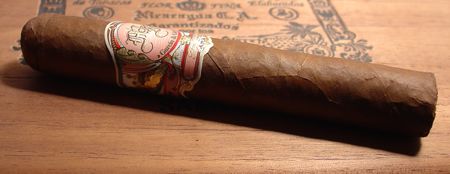
The Decade robusto has a smooth dark wrapper that is best described as maduro in color. The cigar is square pressed and is packed well. The cap is nothing special to look at, but it’s applied well and takes a guillotine slicing without complaint.  Remove the bands and you have what might look like a Padron 1926.

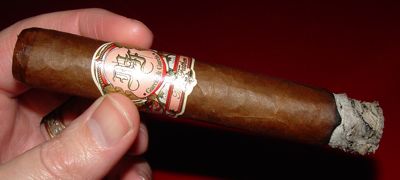
The draw on both samples I smoked was spot on perfect. It burned steadily but not too quickly, creating a medium-gray ash that had the temerity to drop off just as I was about to snap a picture.  Overall very good construction.

Tasting Notes

The Decade robusto starts up with a maduro-like char and a prominent bite. There are some cherry notes mingling with the char, and a bittersweet chocolate aftertaste. At this point it is reminiscent of some other Placencia-made cigars — the Mayorga “High Octane” and even the cheapo Nestor Reserve Maduro, but the Decade by comparison becomes much bolder and grows much more complex.

The center section features an acidic tang that I always associate with Nicaraguan tobacco. At this point I’m starting to feel the potency of this cigar and have to slow down a little, but the chocolate and cocoa flavors remind me a lot of the Olde World Reserve. As the stick burns down, the body grows heavier but smoother at the same time. The aroma is sweet and woody.

The last third continues along the same trajectory, rich and rife with bean flavors: chocolate, cocoa, and coffee. The bands are easily removed to give this robusto a thorough nubbing, though the nub itself does get a bit mushy by the end. The cigar ends with a last gasp of earthy char and some of the bite with which it started.

Conclusion

I don’t know if I can say that this is a better cigar than the ITC 10th Anniversary — they’re so constitutionally different. The ITC is milder, but a little more sophisticated, at least in the Salomon size that I’ve tried. The Decade is a more robust, full-figured cigar, more easily compared to the Olde World Reserve than the ITC 10th (though I think the OWR Maduro would take the edge in a pitched battle.) The Decade robusto is an excellent smoke in any case.

Priced at around 9 USD per stick, the Decade is not going to bankrupt anyone, but it won’t be an everyday smoke for most of us. I think in this price range I’d opt for an Olde World Reserve instead.

Final Score: 89

Decade3

~cigarfan

ITC 10th Anniversary Salomon

ITC10th

Rocky Patel is known as the hardest working man in the cigar business — he’s constantly on the road, hobnobbing with cigar execs and enthusiasts alike — and he still manages to find the time to create numerous new blends. The Indian Tabac label was his first (the Rocky Patel label wasn’t launched until 2002) and it is this, his entry into the world of cigar making, that he is celebrating with the ITC 10th Anniversary. Granted, I’m a little late to the party. Indian Tabac debuted in 1996, placing the 10th Anniversary in 2006. But since the cigar itself was late (it wasn’t released until 2007) and the Salomon is a recent addition, I’m going to make my late entrance without apology.

Rocky actually developed two “anniversary” cigars: this one, and the Rocky Patel Decade. Like the Indian Tabac label, the ITC Anni blend was developed first, though at the time it was supposed to be for the Decade. The blend for the ITC, in Rocky’s opinion, turned out to be more elegant and refined, so he switched labels. The original ITC blend became the Decade, and the later blend became the ITC. So what we have here is the original Decade, which is now the ITC 10th Anni. Got it?

The Salomon vitola is a large and unusual figurado that flares at the foot and tapers in the other direction to a torpedo head. The format is similar to Fuente’s Work of Art or Short Story, but much bigger — this one measures 7 1/8 inches in length and has a 58 ring gauge at its thickest point. Usually only a couple of rollers in each factory know how to roll a cigar with proportions as strange as these; in Cuba they are frequently rolled without molds, making the process even more challenging. Like most vitolas this one has a Cuban genealogy, though Salomones have recently become more popular in the Non-Cuban world.

The ITC 10th Anniversary is made in a small Esteli (Nicaragua) factory that Rocky describes as once being “an upstart factory that was making inexpensive bundle cigars.” That factory has obviously come a long way, in terms of skill as well as tobacco quality. In addition to the ITC 10th they also produce the Rocky Patel Summer Collection and other “very special limited projects.”

The Salomon is not easy to find, but the other sizes are readily available:

  • Lonsdale: 6.5 x 44
  • Robusto: 5 x 50
  • Toro: 6.5 x 52
  • Torpedo: 6.5 x 52

I was surprised to learn this is a Nicaraguan puro, because it doesn’t smoke like one. The wrapper is Nicaraguan corojo, and the filler and binder is a blend of tobaccos from Nicaragua’s premier growing regions: Esteli, Condega and the Jalapa Valley.

ITC10th2

Construction Notes

This is an impressive looking cigar. It takes a large leaf to wrap a cigar of this size, and this one is a smooth and even claro. The foot is nicely finished, though I noticed one small flaw, and the head is tightly wound. The cigar feels light in the hand, but the roll is solid with no soft spots. After clipping about half an inch from the point at the head I found the draw had just the right amount of resistance.

The burn was neither too slow nor too fast, and despite some inconsequential flaking the ash proved to be solid enough. The volume of smoke produced was nicely balanced with the body of the cigar.ITC10thAsh

Tasting Notes

The perfecto “nipple” at the foot of the 10th Anniversary Salamon fires up nicely on a single match and for the first few puffs produces a creamy sweet aroma. The steadily growing cinder quickly reaches the main shank of the stick and the flavor shifts to a light wood with mild tannins and a touch of black pepper.  The texture is very creamy and there are subtle spices of balsa or sandalwood on the nose. The finish is fleeting and there is a slightly dry aftertaste.

The middle section continues the woody theme, but is a little heavier than previously — think oak instead of balsa. The aroma continues to please, bringing an accent of honey and fresh cedar saw dust. The nicotine content here is very moderate; this could be a morning cigar for many (if you have an hour and half to spare after breakfast.)

The last third grows a little more somber. Wood gives way to roasted nuts for a few minutes, and then around the secondary band the flavors pick up some char and become earthier. The finish lengthens and the aftertaste gets dirty. Maybe I was smoking this one a little too fast, but it seemed to go downhill pretty quickly. (It’s easy to see why when you consider that the business end of this stick has been filtering smoke for almost an hour and a half. Some cigars are able to this better than others.)

Conclusion

The biggest surprise about this cigar is how smooth and mellow it is. From other reviews I was prepared for a harsher, more “Nicaraguan” experience. Not so with the Salomon — in fact it’s hard to believe that the wrapper here is really Nicaraguan corojo. I would guess Ecuadorian instead, but multiple reference sources point to Nicaragua.

The ITC 10th Anniversary Salomon scores high for construction and smoothness, though it does lack a certain complexity. That said, there was still enough mild woody spice here to keep me interested over the 90 minute haul.

I haven’t found a source for the Salomon online, but my B&M had these on the shelf for around 8 dollars each. Not a bad price for a cigar of this stature.

Final Score: 90

ITC10th3

Other Reviews of Note:

Jeff reviews the Robusto for Cigar Jack.

Barry gives the Toro an 86 for A Cigar Smoker’s Journal.

George from the Stogie Guys awards the Robusto 3 out of 5 stars.

Walt suspends judgement on the Robusto for the Stogie Review.

Lisa checks out the Toro for Her Humidor.

~cigarfan

Industry Announcement From General Cigar

partagas-black-label

Partagas Cigar Cave Contest

(Maybe this means I can finally get out of the garage… )

Richmond, VA—Beginning at high noon on May 26, 2009, Partagas®, the legendary brand of handcrafted Dominican cigars will team up with pro football defensive tackle and network TV football analyst Tony Siragusa to find the cigar smoker who demonstrates the greatest need for a place of their own to enjoy the pleasure of a fine cigar and award him or her with $10,000 to create the ultimate Partagas Cigar Cave right in their home.   

 In the contest’s website, Siragusa reaches out to cigar smokers who are relegated to enjoying their cigar in dark, dingy basements or forced out in the cold garage and makes them an offer they can’t refuse. In his call to entry, Siragusa connects with cigar smoking brethren by appealing to their need for their very own, in-home cigar cave.

Consumers of legal smoking age who purchase a special four-pack of best selling, full bodied Partagas Black Label cigars at cigar shops throughout the U.S. between May 26 and July 31, 2009 will receive a redemption code detailing how they can enter videos, photos and written descriptions of their domestic cigar smoking predicament to win the $10,000 prize allowing them to create a customized Partagas Cigar Cave for their home. Consumers can also enter by visiting http://www.partagascigarcave.com. The winner will be selected on or before August 21, 2009.

Consumers will be encouraged to vote on contest entries which will be posted on partagascigarcave.com.

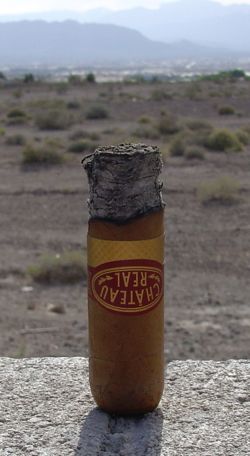
Chateau Real Lord Tennyson

ChateauReal

Once upon a time I smoked an ACID Cigar called “Extraordinary Larry,” and that was the beginning and the end of my dangerous liaison with Drew Estate cigars. It wasn’t such a bad cigar, for what it was, but I knew immediately that “infused” cigars were definitely not for me.

A few years passed and I saw an ad in one of the cigar mags for Drew Estate’s new “Natural” blend. But when I saw the Drew Estate  logo I had a strange kind of synesthetic reaction and could taste the ACID welling up in my mouth. For relief, I turned the page.

And then I received the Summer issue of Cigar Magazine in the mail the other day. I was sitting in the smallest room of my house, where I am wont to read cigar magazines and such, and discovered a nicely written article about Jonathan Drew and the other folks who run Drew Estate. I passed over it, whistling past the graveyard, and read a couple other things. But something caught my eye. A sidebar page had a really interesting story about a bonchero in the Drew Estate factory whose arms were blown off in a pyrotechnics accident. Sad to say, this is what drew me in (so to speak) to the rest of the article, and then I remembered that I was given a Chateau Real cigar a few months ago. I thought it might  be time to try it.

For the history of Drew Estate, I recommend giving the Cigar Magazine article a once over. In brief: Jonathan Drew and Marvin Samel started selling cigars from a 16 square foot cart in the World Trade Center in 1995, in the middle of the cigar boom. It wasn’t easy to acquire quality cigars during the boom, so they started selling a house brand made by a local Dominican roller, calling it La Vieja Habana. Eventually the boom went bust and the company withered. Drew moved to Nicaragua and remade the company from scratch, inventing ACID cigars along the way. By 2007, Steve Saka was on board as company president and a new 96,000 square foot factory was open for business in Esteli. Around the same time, the company was about to introduce two new blends that would get plenty of attention: the Liga Privada No. 9 and the Chateau Real.

ChateauReal2

Construction Notes

This 7 x 50 double corona is called “Lord Tennyson” for reasons I cannot divine. Maybe it’s the Tennyson quote about there not being any good cigars in Venice and his having to leave in disgust? That would not be an auspicious way to name a cigar, but I can’t think of any other likely reason.

The wrapper on this cigar is a smooth even colored claro. Apparently the first run of this line turned out blotchy because the Mexican binder was showing through the Ecuadorian Connecticut — they fixed it by choosing a slightly darker shade of wrapper.  (And on the subject of Mexican leaf… it’s interesting that this detail is often left out in the promo material. The reality is that Mexican leaf has a place in cigar blending, but its reputation is wanting. Unfortunately the result has been a wholesale discounting of the entire country’s tobacco production.) The filler is a Nicaraguan and Dominican blend.

The single cap is clean and attractive. The roll is solid, but the cigar feels light in the hand. The draw has more resistance than I like, but it isn’t problematic, and the burn is slow and almost perfectly even. The ash is firm and holds well.  Overall this cigar has excellent construction.

Tasting Notes

The pre-light flavor is grassy and hay-like, but once lit the Lord Tennyson offers plenty of traditional Connecticut Shade appeal: the first third is toasty with a touch of roasted nuts. The gently floral aroma is in balance with the flavors on the palate. The only unusual characteristic is a smattering of black pepper on the back of the tongue. ChateauReal3

The middle section is earthier and tastes a little sweeter than the first third. The smoke texture takes on a little more body and builds to about a medium, but remains creamy smooth and light in nicotine. This would be a morning or mid-day cigar for most smokers.

The last third presents some citric notes and gets a little dusty (that would be earthy and dry) but is otherwise still mild and smooth. Some very light tannins show up at the end, but not enough to ever get bitter.

Conclusion

The Chateau Real Lord Tennyson is a stately smoke that most fans of mild Connecticut Shade will enjoy. (Macanudo lovers take note.) There are no dramatic transitions and not much complexity, but those are hard to come by in mild bodied cigars anyway. The construction is damn near perfect, allowing the smoker to puff away and sip his or her latte with the Woe Street Journal worry-free.  The price is not bad either: around 6 or 7 US greenbacks per stick.

Final Score: 85

~cigarfan

Casa Magna Colorado Corona

casa-magna

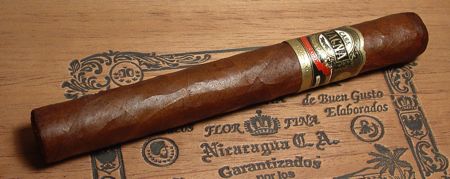
Like any other publication that purports to recommend or dismiss consumer products,  Cigar Aficionado magazine is sometimes accused of bias in favor of companies that advertise in its pages. This is an argument the premier publisher of cigar news and views can win only by refusing to favorably review its advertisers’ products. If this were even possible, given the wide range of cigars they review, it would probably be financial suicide.  The wisest response is probably no response at all, and that seems to be the magazine’s stance.

My beef with the magazine is not that it’s biased — it’s that only a quarter of the coverage is devoted to cigars. I don’t golf, and I am currently one yacht and one Audi short of living the “good life…for men,” so I have to content myself with a microbrew and a decent smoke every now and again.

But the fact that the magazine is geared toward the stereotypical man of wealth and taste made their selection for 2008’s “Best Cigar of the Year” even more surprising.  It wasn’t a 25 dollar Cuban, a 20 dollar Padron Anniversary, or a Fuente rarity. It was a 5 dollar Nicaraguan cigar made by guys who usually make cigars for regular blokes.

Casa Magna Colorado is the result of a joint endeavor between Manuel Quesada, maker of Fonseca and the founder of MATASA, and Nestor Plasencia, who is possibly Central America’s largest cigar tobacco producer and produces dozens of affordable blends.

Apparently when the maker of Joya de Nicaragua pulled its line from Quesada’s SAG Imports (the U.S. distribution wing of MATASA) it left an opening for a star player. Casa Magna made the tryout, impressed at the call back, and won the part.

Quesada and Plasencia’s newly crowned creation is a Nicaraguan puro utilizing tobaccos from Esteli and the Jalapa Valley regions. Six sizes are currently produced by Plasencia’s Segovia factory in Esteli:

  • Corona – 5 5/8 x 42
  • Gran Toro – 6 x 58
  • Robusto – 5 x 50
  • Torito – 4 3/4 x 60
  • Belicoso – 6.25 x 54
  • Pikito – 4 3/4 x 42

casa-magna-2

Construction Notes

The Casa Magna corona makes a significant first impression: the colorado wrapper on this stick is saturated with oil. It quite literally glistens, enhancing the rich ruddy color of the cigar.  The cap is somewhat flattened, and while not as perfect as a Cuban or Pepin made stick, it is quite presentable. The overall appearance of this cigar is superb. The roll is quite solid and regular.

After clipping the cap I discovered that the draw was a bit tight — in both samples, which were from the same box. Both cigars smoked well enough, but I had to work my buccinators a little more than usual to get a good puff. I work hard to buy good cigars so that I don’t have to work so hard to smoke them, ya know?

The slow burn went a little off kilter from time to time, but never needed correction. The ash was solid but flaked a little.

Tasting Notes

Like many top notch Nicaraguans, this one opens up with a peppery blast that attenuates gradually but doesn’t entirely vanish. The aroma from this outstanding wrapper leaf is sweet and hickory-like. The first couple inches of this cigar reminded me of the Illusione blend, but it’s not quite as sharp tasting or as clean, and it’s not as full bodied. Casa Magna by comparison seems about medium-bodied and it stays that way for the duration.

The cigar transitions through several distinct flavors in the middle section — leather, some woody spice, and a touch of caramel. I really enjoyed the range of different flavors this cigar serves up. The is one of the more complex smokes I’ve reviewed this year.

The last third enters beany territory — coffee primarily — but turns up the caramel accents a tad before it dives back to earth with a peppery flourish. The finish grows substantially and leaves an aftertaste of earth, char, and pepper.

Conclusion

Starting up with that trademark Nicaraguan pepper and marching though leather and spicy wood to a smooth earthy finale, I wasn’t bored for a minute. The sweet hickory-caramel aroma popped up from time to time, adding yet another voice to the conversation. I was really impressed by the complexity of this cigar, though somewhat disappointed with a tight draw. All things considered, I enjoyed this cigar a lot.

The obvious question is whether the Casa Magna is deserving of Cigar Aficionado‘s “Best Cigar of the Year.” I think it’s certainly deserving of a place on the top ten list, though I would be hard pressed to say it was the King of the Hill.

Factor in the price, however, and it could definitely be a contender. For around 5 to 6 USD per stick retail this is a most excellent smoke.  The distributor is discouraging online or catalog sales, so definitely give them a shot if you can snag a few at your local tobacconist. They might not be your Numero Uno, but they may just make your fab five.

Final Score: 89

casa-magna-3

~cigarfan

Isabela Miami

isabel

First of all, thanks to the folks at Isabela cigars who were kind enough to send me a sampler pack of their Isabela Miami blend in robusto and esplendido sizes.  According to the promotional material, Isabela was designated the “Best of Miami 2008” by Ocean Drive Magazine and has recieved 4-star ratings from both Smoke Magazine and Cigar! Cigar! Magazine, so I was looking forward to testing them out myself.

Isabela cigars are blended by Vicente Ortiz, who was born in Cuba and reportedly had a hand in the original Cuban Cohiba blend (hence the “homage” to that famous brand in the Isabela design.) This brand should not be confused with the Phillipine made “Flor de la Isabela;” this cigar is made in Miami by Ortiz and was named for Vicente’s daughter Isabela. With a total of only three experienced cigar makers, including Vicente himself, this is definitely a “boutique” operation.

One of the interesting details about this blend is that each size has a slightly different composition. Four sizes are currently made:

  • Robusto – Honduran wrapper and filler
  • Esplendido – (churchill) Dominican wrapper with Hon/Nic filler  blend
  • Belicoso Fino – Honduran wrapper with Hon/Nic filler blend
  • Torpedo – Connecticut wrapper with DR/Hon filler blend

I had the opportunity to smoke both the Robusto and the Esplendido sizes, and while they seemed to be roughly similar, they each smoked just a little bit differently.

isabelrobusto

Robusto

The robusto is a nicely packed cigar with a fine semi-glossy wrapper.  Examining the foot of the cigar, the bunch appears to be solid and consistent with no evidence of stems.  The cap is applied well (though the Esplendido’s triple cap was a little more attractive) and after clipping I found the draw to be spot on perfect.

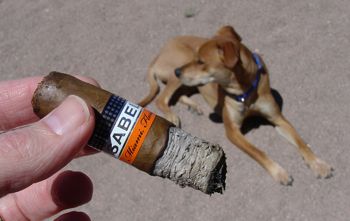
Up0n taking an initial pre-light draw I was struck by the sweetness of the cap. Evidently the rollers use a sugar cane-based gum rather than a neutral tasting adhesive to finish the heads on these cigars.  It’s been a while since I smoked a cigar like this — not since I unwittingly picked one up in a small Vegas tourist joint on the strip many moons ago. It’s generally not what I prefer, but I decided to keep an open mind about that aspect while I sampled these Isabelas.

The robusto is a very mild flavored, easy smoking cigar. Its starts up a little grassy and gradually takes on a nutty profile. The aroma is quite pleasant, adding a distinctly floral quality to the smoke. I would have guessed this to be a Connecticut Shade or Ecuadorian wrapper, but I’m told it is fact Honduran.

The middle section of the robusto continues on the same road, with herbal and nutty flavors on the palate and a sweet aroma on the nose.  Perhaps it’s due to the mildness of the smoke, but the sweet cap started to get on my nerves. I tried to ignore it, but it proved to be a bigger distraction than I thought it would  be.  So I thought of a solution: this ring gauge, I figured, would fit perfectly in the bowl of one of my pipes. That way I could enjoy the rest of the smoke without the sugar on the cap contaminating my palate.

isabelpipe

Unfortunately that solution was not entirely successful. The cigar smoked well enough, but I was losing the aroma. And that last bowl of Penzance probably didn’t help any.

In any case, I finished this cigar –and a couple more– the old fashioned way, and enjoyed its transition in the last third to an earthier flavor with a touch of pepper on the nose. The sweetness let up a little in the last third, which was welcome.

Esplendido

The Esplendido size shares many of the robusto’s fine qualities, with a couple exceptions. The wrapper is a little drier, more papery looking than the robusto, and the roll is not quite as solid. On the other hand, the caps on these sticks are gorgeous. They have the same excellent draw and burn as the robusto size.

The Esplendido is likewise a fairly mild smoke, with a very smooth and approachable flavor. By contrast with the robusto the flavor is earthier and instead of the robusto’s sweet, floral aroma the Esplendido is musky.  Once again, however, I was distracted by the sweetness of the cap. I thought this time I would try to simply remove the offending extremity by clipping off an inch from the head of the cigar, just to see what would happen.

isabelesplendido

Alas, this was not very effective either. The gum that the rollers use must extend up the shank of  the cigar. On the other hand, my stogie surgery afforded me an opportunity to observe how well crafted these cigars are — I was still able to smoke this stick to the band without it uravelling or coming apart.

The middle section of the Esplendido is smooth with a medium-bodied smoke texture; from the initial earthy flavors it develops some cedar. This cigar has no bite whatsoever, and very little aftertaste. It is what I’d characterize as light in flavor, but it still has a little kick to it.

The last third becomes increasingly earthy and I found I had to smoke it carefully at this point to avoid a bitter aftertaste. The finish grows substantially, but never gets oppressive. There is an interesting licorice or anise quality in the last couple inches.

Conclusion

More than anything I was impressed by the construction of these sticks, and were it not for the sweetened tips I think I would have enjoyed them much more. Aside from my personal preference, I think the sugar masked or obscured some of the more delicate qualities of the tobacco. Overlooking that detail, I think the aroma and easy going nature of these cigars would make them great morning or mid-day smokes. I think this blend has potential.

Isabela Cigars are available for purchase from their website. The robustos run around 6.50 USD and the Esplendidos about a buck more.

Final Scores:

Isabela Robusto: 84

Isabela Esplendido: 82
isabel4

~cigarfan

My Father No. 1 by Garcia & Garcia

myfather

Jose “Don Pepin” Garcia has two cigar factories — the original El Rey de Los Habanos in Miami, and the much larger Tabacalera Cubana in Esteli, Nicaragua. Garcia’s son Jaime operates the Nicaragua factory, and apparently while his father is away he likes to conduct experiments on his own.

According to Cigar Aficionado’s David Savona, Jaime developed the blend for the “My Father” cigar in secret, and it was only after someone in the factory leaked “classified” information that Don Pepin discovered what was going on behind his back.  He proceeded to investigate, and having reduced the resulting evidence to ash he approved of his son’s surreptitious activities. He was also honored by the name Jaime decided to give the cigar: “My Father.”

The Garcias have till now quite effectively used tobacco grown in Nicaragua by other producers, but “My Father” is the first to use leaf grown by Garcia himself, in this case for the filler and binder. (The word on the street is that their wrapper leaf is in still in development.) For the wrapper on this cigar Jaime is using an interesting Habano – Criollo hybrid grown by the Oliva Tobacco Company in Ecuador.

“My Father” cigars are available in four sizes:

  • No. 1 – 5.5 x 52  Robusto
  • No. 2 – 5.5 x 54  Belicoso
  • No. 3 – 6 x 49  Crema
  • No. 4 – 7.5 x 38  Lancero

myfather2

Construction Notes

The wrapper on this cigar is a smooth and creamy looking colorado claro leaf with a few subtle veins. The roll is perfectly regular, with no lumps or soft spots, and the cap is typical Pepin workmanship. The caps on Garcia cigars are probably the finest in the world.

After clipping I found the pre-light draw to be grassy,  hay-like with some spice. The draw is surprisingly loose, but this didn’t affect the cigar’s performance. The burn was slow and mostly even to the end. My only complaint is very minor: the ash had a tendency to crack every inch or so. It never fell off in my lap, but it took no more than a light tap for it to fall into the ashtray.

Tasting Notes

My initial reaction to this cigar was two-fold: first, the tannic flavor simply bursts from this cigar. If you’ve smoked cigars from El Rey de Los Habanos or Tabacalera Cubana, you know what I’m talking about. It’s woody, but lip-smackingly tart. The second thing was that the aroma from this robusto is delicious. I would almost swear it’s DPG’s old Corojo 99, but it’s creamier and a little more fragrant. That trademark peppery taste is in evidence as well, but it seems to be toned down in comparison to other Pepin blends.

Working into the center of the cigar brings cocoa and caramel flavors reminscent of some of Pepin’s lighter cigars: the Red Label and Vegas Cubanas. This cigar is definitely more complex than either of those, with base notes of earth and leather, a mildly spicy but sweet aroma (sort of like sandalwood) and those intermingling cocoa or coffee bean flavors. The finish is lengthy and the aftertaste becomes increasingly peppery.

As I coast into the last section of this “My Father” cigar I’m feeling a pretty good nicotine hit — a breakfast smoke this is not — but it’s not overwhelming. The body of this cigar is a solid medium, maybe leaning towards full. It culminates with an earthy flavor, a long peppery finish and sweet caramel on the nose.

Conclusion

“My Father” is one of the more complex creations coming from the Pepin family. It probably fits in with the more medium-bodied cigars that Pepin makes, but it’s at the head of the class in terms of finesse. The tannic flavor that marks some young Cubans is the highlight of this smoke, and while Habanos enthusiasts age their stock to reduce this effect, it is in fact one of the great qualities of this blend. This is also why Don Pepin reportedly does not believe in aging his product.

This smoke runs around ten dollars per stick from Cigars Direct, which is a few dollars more than the middle-of-the-road blends from DPG that I’m used to smoking, but for the complexity and quality that you’re getting, it’s worth it.

This might be the best cigar coming out of Tabacalera Cubana right now, so I can see why Jose would be proud of his son with this blend. Clearly the acorn has not fallen far from the tree.

myfather3

Final Score: 89

~cigarfan

Other Reviews of Note

Barry gives the No. 2 Belicoso an 88 for A Cigar Smoker’s Journal

Lisa smokes the No. 3 Cremas and finds it “dry as French champagne.”

The Cohiba Club gives the No. 1 Robusto an 86

Siglo Limited Reserve

siglo

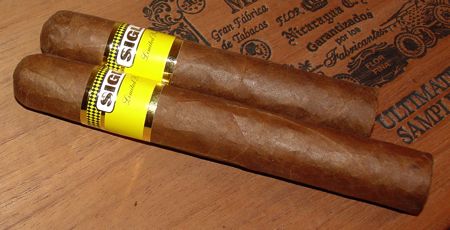
Sometimes a new cigar makes more smoke before it’s even released than it does when you finally get a chance to light one up. The Nicaraguan made Siglo Limited Reserve has done just that with its blatant and obvious play on the Cuban Cohiba image. The gold and yellow band with the checkerboard above the name and the italic logo below it is the first giveaway.

This mimicry extends to the flimsy box design. The only detail it seems to be missing is the diagonal Habanos strip across the corner. Altadis USA appears to be engaging in some advertising chicanery here, and veterans of the leaf are letting them know about it on the blogs and boards.  (Ironically those of us who are informed enough to be offended by these practices are not the consumers Altadis is targeting, so it probably doesn’t matter much to them… but that doesn’t mean we’re going to keep our pieholes shut.)

And as long as they’re borrowing frontmarks from the Cohiba “Linea 1492” range, they might as well just take “Siglo” as a brand name as well:

  • Siglo I – 4 1/4 x 44  petite corona
  • Siglo II – 5 5/8 x 45  grand corona
  • Siglo III – 6 1/2 x 44  lonsdale
  • Siglo IV – 5 x 54  robusto
  • Siglo VI – 6 x 54  toro
  • Siglo VII – 7 x 48  churchill
  • Siglo X – 6 x 54  torpedo

To my knowledge, General Cigar owns the rights to the Cohiba name and all its trappings in the United States, so I would presume that either Altadis (or its parent Imperial) has brokered a deal with General (or its parent Swedish Match) to put on this masquerade, or they are currently being sued over it. (And it wouldn’t be the first time. This stuff gets messy.)

In addition to all these design allusions Altadis borrowed one other crucial production factor: the blender. Frank Llaneza had a long history with Villazon before it was bought by General, and now Altadis is using his name quite prominently in their promotion as the master behind the Siglo Limited Reserve. I always did like Villazon cigars though, so I think I’ll just wade through all this merchandising smoke and get to the cigar itself.

The wrapper for the Siglo Limited is an Ecuadorian Habano leaf, beneath which is a Nicaraguan broadleaf binder. The filler is a Dominican/Nicaraguan combo.

siglo2

Construction Notes

It’s not a bad looking cigar, overlooking the devious band design. The wrapper is a light colorado claro, consistent in color with a slightly sandy texture and a few veins that give it a rustic appearance. The roll is solid, and the Cullman style round cap is applied well enough that it’s hard to see any seams above the shoulder of the stick.

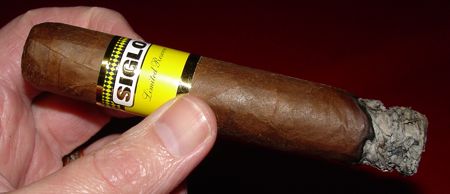
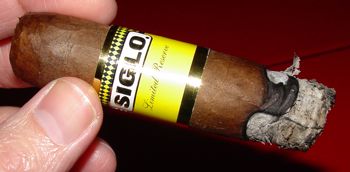
Both the toro and the robusto drew very well. Complain all you want about Altadis, but it’s extremely rare that I’ve had a plugged or tight cigar from this company. The burn is quite slow due to the large ring gauge but it is a little uneven at times — one cigar required a single correction. The flaky salt-and-pepper ash holds for as long as I need it to, but it crumbles a bit in the ashtray.

Tasting Notes

The Siglo starts up with a woody, straightforward tobacco flavor. Almost immediately the wrapper contributes a pleasantly floral aroma, similar to but a little heavier and sweeter than Connecticut Shade. There isn’t a great deal of complexity here, but it’s certainly smooth and enjoyable.

The aroma just gets sweeter as the cigar burns down, so much that it’s almost sugary at times. The flavor gets a little spicier, but by Nicaraguan standards remains quite mild. The body and strength of this smoke seem to level out around a solid medium.

The last section brings some cocoa to the fore while the aroma takes a back seat. The slightly salty finish lengthens into an earthy aftertaste which finally gets a bit dirty near the band.

I didn’t notice much of a difference between the robusto and toro sizes, aside from smoking time: they’re both slow smoking, solid sticks, with the robusto clocking in at around 45 minutes, and the toro about an hour.

What this is, I think, is a nice boring cigar. There’s nothing wrong with it, and I think a lot of newer smokers will genuinely enjoy it. On the other hand, it doesn’t offer the veteran cigar fiend anything new to crow about. It reminds me a little of the El Rey del Mundo Real — a decent medium bodied smoke with a fine wrapper that just bores the hell out of me. Which doesn’t mean that it’s bad… just boring.

The Siglo Limited Reserve is priced reasonably at around 5 bucks a pop.

Final Score: 84

siglo3

~cigarfan

Arturo Fuente Hemingway Short Story

afshortstory

Brought to you by our friends at Cigars Direct.

While Ernest Hemingway certainly had a connection to the cigar Shangri-La that is Cuba, he wasn’t known to be a huge fan of the cigar. Apart from his literary oeuvre that would earn him a Nobel Prize, he was known more for his prodigious appetite for alcohol than for smoking cigars. But for cigar fanatics the name “Hemingway” brings to mind something other than the writer — the Fuente made cigar named in his honor. The figurado shaped cigar with a tapered head and perfecto foot is known to most as the “Hemingway” style.

But this shape did not originate with the Arturo Fuente Hemingway series — according to Carlos Fuente, Jr., this shape is a classic Cuban perfecto that was popular from the 1920’s through the 50’s. Its popularity declined thereafter, and most of the Cuban masters who knew how to make this difficult figurado either retired or passed away. But then around 1980, Carlos Fuente Sr. recovered the “Hemingway” molds his father had stored in their Ybor City factory and recreated these cuban perfectos.

At first the Fuentes made these new perfectos exclusively for their own enjoyment. But in 1983 they introduced the first Hemingway to the market:  the 6 x 47 Signature. Five years later came the Classic and the Masterpiece,  which in a 1997 interview Carlos Jr. said was one of the rarest and most challenging cigars they make:

the Hemingway Masterpiece is without question one of the rarest sizes of all Arturo Fuente cigars. Since the day it was first introduced, it has been blended and rolled by the same two brothers, who work together to make this unusual and challenging shape (perfecto, 9 1/4 by 52). The Cameroon wrapper for the Masterpiece is so difficult to obtain that we literally have to go through bales until we are able to select a few precious leaves that have both the size and the quality to be used on a Hemingway cigar. When the wrapper is not available, the brothers make Hemingway Classics. In a good year, we consider ourselves lucky if we’re able to produce as many as 10,000 Masterpieces.

The Short Story was created some time after that because it was “getting difficult to smoke in certain areas.” Yes, it was, and things have not improved since then. And even though this unusual looking figurado is one of the most difficult shapes for a roller to make, it was thereafter widely copied and imitated by other cigar manufacturers.

afshortstory2

The wrappers used for natural  Hemingway cigars are African Cameroon; the maduros are much more rare but are really exquisite. The Dominican filler and binder are together simply known as “the Hemingway blend.”

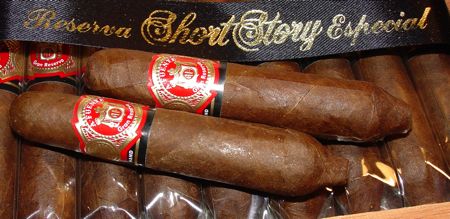
Three of the figurados in the Hemingway series — the Work of Art, Best Seller, and Short Story — have pyramidal cylinders, while the original Signature, Classic and Masterpiece are modified parejos. The Short Story is the smallest of the lot, measuring only four inches long with a ring gauge of 49 at its widest point, narrowing to 46. It’s an exotic looking cigar.

Construction Notes

The Cameroon wrapper on this cigar looks a little drab at first, but I’ve noticed that it changes quite a bit once lit — this wrapper must be really sensitive to heat. A minute or two after lighting oils come to the surface and the wrapper shines.

The color is consistent and there is the occasional glue smear.  The roll is firm and regular, and the draw is just right. Occasionally a cigar with this type of foot will offer resistance until the burn reaches the main body of the stick, but I haven’t encountered this problem with the Short Story.

The perfecto “nipple” makes this an extremely easy cigar to light. One match is usually all it takes. The burn can be a little uneven until the cinder has reached the main shank of the cigar, but from that point it evens out.  The ash is firm — with any luck you won’t need to ash this cigar but once, if at all.

afshortstory3

Tasting Notes

The Short Story is surprisingly complex for such a small cigar. It opens up with a strong sweet cedar flavor and a touch of mint, the hallmark of Cameroon wrapper. The smoke is medium to full in texture with a spicy tang.

After a few more puffs the flavor gets earthier and there is a touch of black pepper on the tongue. This is a medium bodied cigar in terms of both smoke density and power, but it has a lot of character. The aroma is a bit piney — sweet and spicy.

The finish grows a little bit toward the end, the aroma weakens somewhat, and the flavors muddy slightly. And then it’s done. That’s the only problem with this cigar — it’s over way too soon. But that’s the power of the short story, literally. I’ve always preferred “The Snows of Kilimanjaro” to The Sun Also Rises — the economy required seems to concentrate and magnify the power of Hemingway’s style. You could say the same thing of Fuente’s Short Story.

Conclusion

So this is a really wonderful little cigar. Even if you’ve smoked the larger sizes, I’d urge everyone to try the Short Story as well. I can’t think of a better 20 -30 minute smoke in its class.

Be sure to check Cigars Direct for availability and competitive pricing on Hemingways and other rare Fuente cigars.

Final Score: 91

afshortstory4

~cigarfan