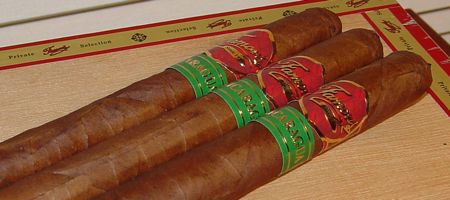
Augusto Reyes Criollo Corona

A few months back I gave the Augusto Reyes Nativo corona a walk around the block and found it to be a tasty — if a little bit quirky — cigar. Around the same time I pick up a couple of their cousins, the Augusto Reyes Criollo coronas. Having consigned my Nativos to the flames with fine results, I thought it was time for the Criollos to have their day of reckoning as well.

The robusto size in the AR Criollo line earned an accolade from the Robb Report as the “Best of the Best 2007.” I’m not sure how many cigars are entered into their evaluation, or what their technique is, but I would expect that they’re not testing too many Consuegras. Cruising in your Audi R8 with a Connie just ain’t happening.

The information I have on the blend is pretty basic: the binder and filler are Dominican, and the wrapper is Ecuadorian grown Connecticut Shade. One of the few articles I could find about this cigar is from a Dominican social news site, which relates that it was “designed for smokers who enjoy a blend a little smoother than the Nativo, but with a lot of aroma and flavor.” Having smoked this cigar, I have to disagree that it’s smoother, but it certainly does have plenty of flavor and a nice aroma.

I had forgotten that this cigar had a Connecticut wrapper when I first lit it up — because the name of the cigar is Criollo, I assumed that the wrapper was as well. So I was surprised by the first few puffs, which were smooth and nutty. Hmmm, I thought. It’s almost like Connecticut Shade. After half an inch or so I changed my mind because a touch of cayenne kicks in; too spicy to be Connecticut, I thought.

My first impression was correct, of course. The Connecticut wrapper itself is a smooth claro in shade, with a very light sheen of oil and miniscule veins. The draw is excellent, and these little coronas burn perfectly to a solid light gray ash.

Into the second third the Criollo turns up the intensity. The flavor turns from nuts with a bit of pepper to earth with even more pepper, and the finish lengthens considerably. The aroma contrasts with the changes in the flavor of the cigar in an interesting way — as the flavor takes on more minerals and becomes richer, the aroma seems sweeter.

The last third is positively punchy. This is basically a medium-bodied cigar, but the nicotine content is nothing to sneeze at. The flavor is intensely earthy, almost ashy at times, and the aftertaste is overpowering. Some might call this “harsh,” but I find it just very intense. On the other hand, if earthy is not your thing, you’ll want to avoid this smoke.

The “criollo” in this smoke is obviously not from the wrapper — it’s from the blend itself, which has a lot in common with the flavors of Creole food — charbroiled seafood, paprika, and cayenne. Topped off with a little sweet nuttiness from that wrapper and a good dose of nicotine.

The Augusto Reyes Criollo line runs a little less than the Nativo, but not by much. Expect to see these for around 7 USD, if at all. They’re still in production, but not exactly ubiquitous. Consuegras they’re not. Just ask the folks at the Robb Report.

–cigarfan

La Flor Dominicana El Jocko

In 1997 as the cigar boom began to wane, La Flor Dominicana blessed us with a funky little figurado called El Jocko. There were relatively few decent cigars to be found at that time —the few reputable manufacturers were struggling to keep up with demand and maintain quality amid severe tobacco shortages, while some retailers were limiting purchases of standards like Fuente 858s. El Jocko was exactly what seasoned smokers needed — a full flavored and consistent cigar with a strange shape that would confuse and repel the amateurs.

It only took a few years for the industry to recover from the boom. Quality improved dramatically, and the diversity of blends and brands expanded. In the late 90’s El Jocko crested in a sea of mild cigars, but within only a few years the full-bodied trend let it silently drift away. It’s been a long time since I’ve tried one of these, and my experience of them today is bound to be a lot different from what it was in the era of the “Don Nobodies.”

This small cigar is immediately identifiable by its bowling pin shape. It’s basically a “bouquet” perfecto, similar to a Fuente Short Story, but with more gradual proportions. It was named for a cigar retailer named Jacko Headblade who visited the Flor Dominicana farms and for some reason attempted to ride one of the farm’s donkeys (not very successfully, I presume.) The spectacle inspired Litto Gomez to name both the donkey and his new cigar “El Jocko.”

El Jocko comes in two styles: an Ecuadorian Connecticut, and a Mexican maduro. At one time there were two sizes as well, but it appears that now there is only one, which measures 4 1/2 inches long and has a 54 ring gauge at it’s thickest point. (The other size was a larger version of this one.) The binder is Nicaraguan, and the filler is Dominican piloto cubano.

The Connecticut and Maduro versions of this cigar have similar construction values. This shape is challenging and would seem to invite construction defects, but for the most part it avoids these. I smoked two of each for this review, and they all drew very well and burned with a slow determination. Minor burn problems had me reaching for the lighter a couple times, but the corrections I made were not entirely necessary.

Both species start out a tad harsh, but in different ways: the Connecticut is noticeably tannic, while the Maduro bursts with peppercorn. In both blends this dies away as the ring gauge expands.

The Connecticut is typical of medium to full-bodied Dominicans — the piloto gives it a respectably spicy spine, while the wrapper imparts a softer touch: nuts, and a sweet clover honey-like fragrance. As the bulbous section burns to a solid light gray ash the pepper returns, and the flavors grow more aggressive. Smoking slowly is highly recommended at this point to avoid overheating. The flavors remind me a little of the 601 Connecticut, but considerably toned down.

The Maduro displays a little more character. It comes out of the gate with a dose of black pepper and can initially be a bit harsh on the throat. It mellows after the first half-inch or so and the smoke takes on a creamier texture. The first section tastes of burnt coffee or bitter chocolate. As the cinder burns through the waist of the stick it gradually becomes sweeter and develops a leathery aspect. It’s slow burning with a lengthy finish and leaves an aftertaste of char. Into the final stretch the flavors turn darker and sharper once again, reminding me of La Flor Dominicana’s popular Double Ligero series. Again, not as bold as the DL, but similar in taste. Unfortunately, it’s not a taste I really enjoy. The middle section was quite nice — smooth and flavorful without the carbonized sugar taste that I didn’t care for in the last third.

These are both very good cigars, but when compared with the incredible array of fantastic smokes available right now, they pale a little bit. My memory of El Jocko is that it was much better ten years ago than it is now, but taste must be taken in context and memories fade. Trying to compare today’s cigar to a ten year old memory is probably no more than an interesting experiment. It’s a much better world for cigars now, and ten years of tasting many different blends has honed my palate a little… for the better I hope.

El Jockos sell for around $5 to $6 individually, or around $100 a box. That seems reasonable to me, especially considering the craftsmanship required to make this unique looking cigar. It may seem a bit much for such a small cigar, but take it slow and this little perfecto will spin an interesting yarn for up to 45 minutes.

Famous Nicaraguan Corojo Corona

Well, Don “Pepin” Garcia has finally dropped the bomb. We knew it was coming, like the End of Days, but we didn’t know when. First Pepin announced he would no longer take on new clients. Soon after that, Ernesto Padilla announced that Pepin would no longer manufacture Padilla cigars. Then there was a public airing of grievances at Stogieguys.com regarding Pepin dropping Black Cat as a client. And at some point during all this, the prices on Pepin blends at Cigar King went through the roof. The time is nigh!

For lovers of full bodied Nicaraguan puros this may sound like a death knell, but of course it isn’t. Pepin will still make plenty of cigars (though a rumored 20% across the board price increase is entirely credible) but it’s not like he’s going away. Like he says, “The day I stop making cigars will be the day I die.” Furthermore, there are plenty of other fine Nicaraguan puros out there, many for a much more affordable price. The Famous Nicaraguan Corojo is one of them.

Now these coronas are not Pepin replicas or seconds, or what have you, but there is a connection. They’re made for Famous Smoke Shop by Tabacalera Tropical, where Pepin was once employed as a blender. The principal backer for Pepin’s solo venture was the owner of Tropical, Eduardo Fernandez, and Fernandez reportedly grows many of the tobaccos Pepin uses in his Rey de los Habanos blends.

I like small full-flavored cigars as “fixers.” Sometimes I’ll start a cigar that turns out to be plugged, or won’t burn right, or just rubs me the wrong way for some reason. Instead of struggling though the cigar and having a miserable experience, I’ll toss it and grab a fixer instead. The corona size in this line is a great fixer.

I bought a box of these about a year ago and have observed them mellow from sharp pungent smokes to smooth, but still quite bold cigars. They’re billed as having a 42 ring gauge, but they seem a little narrower to me — closer to a 40 I think. At 5 1/2 inches long they’re still well within the corona range.

The corojo wrapper is an oily colorado maduro and makes an attractive casing for the intensity of the ligero binder and filler within. The roll is firm, and like most corojo blends this one does best at a lower humidity — in the low 60s at most. The draw tends toward the firm side and can be difficult if these are kept at 70%.

The opening is classic Nicaraguan spice — lots of black pepper held in check by a leathery underpinning. After an inch or so the pepper subsides, but it never entirely disappears. The burn is a little erratic and needs an occasional touch up.

At the midway point the corona stretches its legs a little and becomes a smoother, more relaxing smoke. It’s not the most nuanced cigar on the planet, but at this point the spice melds with the leathery aspect and if taken slowly it’s quite enjoyable. It continues in this fashion as it glides in for a landing. My only advice here is to take it slow. Hotbox this one, especially in the last third, and it will get a little mean.

The Famous Nicaraguan Corojo blend is a solid blend of spice and leather that is reminiscent of the recent Nicaraguan corojo blends, but is available at a much more reasonable price. A box of 20 will set you back only 50 clams. It’s not the most subtle or sophisticated cigar on the market, but for the price it’s most definitely worth checking out, either as an everyday smoke for the medium to heavy bodied palate, or in my case, as a “fixer.”

Montecristo Platinum Royale Delacroix

It’s been a while since I fired up a Monte Platinum, and to tell the truth I was a little hesitant about this one. Back in the day they used an Indonesian wrapper that really put me off my oats, but they switched to a San Andrés maduro which has made a big improvement. Even so, this one has been languishing in my humidor for a couple years.

The “Cigare des Artes” line was introduced by Consolidated Cigar in 1998 (before the company was swallowed up by Altadis USA) as a fuller bodied version of the standard Montecristo. The original line had a Nicaragua wrapper, and the packaging was extravagant: cedar-wrapped cigars in aluminum tubes sold in specially decorated boxes or ceramic jars.

The art chosen for the line was unusual for the American cigar market: the paintings of French artist Michel Delacroix, most of which feature cityscapes of Paris and its environs prior to World War II. He paints in the “naif” manner — a simplistic, folksy style that ignores perspective and looks sort of like the art of Grandma Moses. Given the slick, cosmopolitan images used in cigar advertising today, this isn’t what I expect to see on a cigar box.

The painting commissioned for this line is called “Montecristo Royal,” a crisp looking winter scene of the city that includes a huge sign on a building that reads “Montecristo Fine Cigars” with the Montecristo logo. The sign looks out of place, just as the painting does on a box of cigars. It took a while, but eventually I began to see its charm.

When the original “Cigare des Artes” blend was discontinued in 2002 it was replaced by the Platinum blend, but the commercial vitolas and the artwork still bore the impression of Michel Delacroix. The 7.25 x 52 double corona up for review here is called the “Royale Delacroix.” This size was discontinued in 2004, so this stick has a few years on it. (I received it in a trade about two years ago.)

The wrapper on this slugger is a Habana 2000 grown in the San Andrés Valley of Mexico, normally known as a great producer of maduro wrapper. The binder is Nicaraguan, and the filler is a blend of leaves from the Dominican Republic, Peru and Nicaragua. And like most (if not all) Montecristos, it is rolled in the Tabacalera Garcia factory in La Romana, DR.

The wrapper on this cigar is dark, nearly maduro, with a lot of oil. The overall appearance is rough, but attractive nevertheless. The roll is solid and the draw is just right. It lights up easily and starts to build a solid light gray ash.

The first third is marked by a sweet hickory flavor and a mild body. For the first inch there’s just a hint of bite, but this vanishes as some cocoa flavors make an entrance. Into the second third the finish grows and leaves an earthy aftertaste. The flavors get a little more chocolatey but in a muted rather than a robust way. A good contrast is the RP Olde World, which has similar flavors but articulates them much better. The aroma up to this point is of sweet wood and is generally quite pleasant.

After an hour I find that I’m becoming bored with this cigar. It’s burning well and tastes fine, but it’s lacking in substance. Maybe if I were sitting in a Paris cafe, circa 1895, watching the snow fall on a horse drawn carriage while I sipped my coffee, perhaps then I might find the patience to smoke this big boy to the end. As it is now, in the twenty first century, watching the jets streak across the night sky bound for Nellis AFB, I’m ready to call it quits.

The Montecristo Royale Delacroix is fine cigar, no doubt. Fans of mild to medium bodied cigars will find this double corona very enjoyable, but if you’re looking for a little more flavor, you may want to look elsewhere.

Aging Report: Padilla en Cedro Robusto

The Padilla en Cedro was a special edition cigar from Ernesto Padilla that was released in 2005. Production ceased sometime in 2006, and to my knowledge these are sold out everywhere at this point in time. It’s a mild Connecticut shade style cigar — an unlikely candidate for aging, to be honest.

When I first received these in early 2006 they were almost bitter. The tannins were puckery strong and not to my liking at all, especially not in a Connecticut shade selection. The blend just seemed all wrong for that.

But when I last checked in with the Padilla en Cedro it had improved remarkably from its fresh state: nine months in the humidor did wonders. The tannins had mellowed quite a bit and the cigar was a much smoother, and enjoyable, smoke.

And now, after two years, this robusto is completely transformed. While still mild, it has grown far more complex and subtly sophisticated than I thought possible. The only way in which it seems to have suffered is in appearance — the wrapper has become slightly faded, more drab and splotchy, though it seems to have retained its sheen.

Remembering this cigar’s original character, I was expecting at least a hint of tannin, but for the first third there’s nothing but nuts and honey sweetness, with a touch of vanilla that was not in the fresh cigar at all. A remnant of tannin is apparent in a generally dry flavor, but it’s nothing that approaches a full blown pucker.

At the half-way point the cedar qualities come to the fore, and a little black pepper sets in. The finish lengthens and there is a more substantial aftertaste, thanks in part to the pepper. As the flavor on the tongue gets stronger, the aroma seems to fade a little, which makes the Cedro a little less profound. A lot of its subtlety is in the nose.

Somewhere around the 3/4 mark it dwindles to a merely average cigar. The flavor bottoms out and veers toward bitterness — a slight disappointment considering how wonderfully the trip started.

Construction values here remain consistently very good on all levels — a perfect burn, a streaky but solid ash, and an effortless draw.

I suspect these robustos are at their peak right now. The highlights of this cigar — the gentle sweetness and vanilla overtones — are subtleties that I can easily see vanishing in a few months to a year. This seems to be the problem with aging mild cigars, though in this case it has really paid off. I may hang on to a couple of Padilla Cedros for “research” purposes, but the rest of them are in my sights right now.

Arturo Fuente Añejo No. 48

In September 1998 Hurricane Georges ripped through the Carribbean and caused widespread destruction, including crop damage in the Dominican Republic. Among the beseiged plantations was the now famous Chateau de la Fuente, where wrapper leaf for Fuente’s Opus X is grown and harvested.

Two years later the legacy of the storm was borne out in a shortage of Opus X wrapper, but instead of halting production altogether, Carlos Fuente Jr. directed the use of a different wrapper — a hearty maduro broadleaf. In this way improvisation triumphed over adversity and the Arturo Fuente Añejo was created.

The filler blend is said to be a combination of the blends used for Opus X, Don Carlos, and Hemingway cigars, all of which are themselves secret — which makes the Añejo blend an enigma wrapped in a mystery, wrapped in a Connecticut broadleaf that has been aged for three to four years, including six to eight months in cognac barrels. (The original release used wrappers aged for seven years, hence the name Añejo, meaning aged.)

Current sizes in production:

  • No. 46 – 5 5/8 x 46
  • No. 48 – 7 x 48
  • No. 49 – 7 5/8 x 49
  • No. 50 – 5 1/4 x 50
  • No. 55 – 6 x 55
  • No. 77 “Shark” – 5 5/8 x 54

I usually try to smoke several cigars, preferably from different boxes, to prepare for a review, but in this case I was stymied by both the price and the availability of the Añejo. Typically these are released twice a year — in the summer around Father’s Day and again around the winter holidays. And even though they are reasonably priced by the manufacturer, consumer demand pushes the shelf price into the stratosphere. MSRP plus my state tax should place this stick in the $11 – 12 USD range. I paid $18 for one No. 48 last summer. That’s a bit rich for my blood, so I’m reviewing this cigar based on one single experience.

The Arturo Fuente Añejo is presented in a cedar sheath that seems to be more aromatic than most — I’m not sure if it’s by design or by accident, but it lends the wrapper an intense scent of sweet cedar. The wrapper itself is a moderately oily and rich looking oscuro.

In a pre-light pull the draw is firm to tight, and the flavor is of wood and straight sweet tobacco.

I was expecting the Añejo to be a big powerful smoke like its sibling Opus X, but this was not the case with the churchill sized No. 48. Instead what I found was a civilized and genteel cigar with an elegant perfume.

It starts up very smoothly with a good dose of sweet spice — light anise and sweet cedar. The finish is short and the aftertaste evanescent. It draws very well despite my initial pre-light impression — it’s firm, but the volume of smoke is effective and cool. The burn is even and consistent from start to finish.

The 48 doesn’t undergo a lot of transition during the course of the smoke. It grows in intensity, but it’s still playing the same song at a louder volume. Fortunately for me this is a song I really like. It starts out with moderately mild body and soon becomes medium-bodied for the duration. The last third does become a little bit richer, the spices turn from sweet aromatics to smatterings of pepper, and the aftertaste takes on a little more gravity. The finish stays crisp and clean to the band.

And from first light to last ash this cigar puts out a beautifully elegant aroma — it’s floral at times, cedary at others, and really enjoyable throughout. It reminds me a lot of the Fuente Work of Art maduro in this respect, but the Añejo is perhaps more refined. That could be due to the size difference rather than the blend, but I find the similarity unmistakeable.

I can certainly see why Lucky7 made one of the Anejo cigars his best of 2007. So far I think this is the best cigar I’ve smoked this year. But the price… Doh!

REFERENCES

Vitolas.net — a fantastic source for Fuente information and trivia.

Nestor Miranda Special Selection Robusto Grande

miranda1.jpg

————–

UPDATE FOR 2009: This cigar has been reblended by Pepin Garcia and is  now produced in Nicaragua at Garcia’s Tabacalera Cubana.

————–

Nestor Miranda is the maker of the Don Lino line of cigars, and his Miami Cigar Company is the U.S. distributor for La Aurora. (Please see Lucky7’s background about Nestor in his review of the Don Lino Africa for a good overview of the company and the man.)

Nestor Miranda’s “Special Selection” is a new line so I was hoping to provide a little more detail on the blend, but scouring the internet and interrogating cigar shop personnel was not particularly effective this time. What I ended up with was a hodge podge of conflicting information.

Putting this information on the Miami Cigar Company website would just be too easy. So I found myself in the data mine, digging with some sharpened kitchen cutlery by the light of a Prince Blazer. (While the Blazer burns hot enough to weld metal, it isn’t reknowned for its luminosity. My search results reflect that.)

The unsubstantiated results of my foray into the darkness:

  • This is Nestor’s “personal cigar,” the one he hands out to friends and colleagues, etc.
  • It is available in two sizes, a 5 1/2 x 54 robusto grande, and a 6 x 60 toro grande.
  • It comes in a choice of two Nicaraguan wrappers, oscuro or rosado.
  • One retail site says this cigar is “predominately Honduran.” Another says the binder is Nicaraguan, and the filler is Nicaraguan ligero.
  • In a 2007 Cigar Aficionado interview, Nestor Miranda announced that a special Don Lino edition would be released with his signature “next year.” This is not marketed as a Don Lino cigar, but the box does indeed bear the signature of Nestor Miranda.

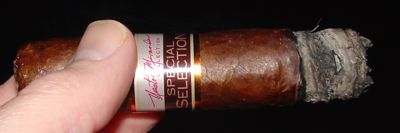
Aesthetically, this is a nice looking stick. The wrapper is a swirl of dark brown to nearly black, and it glistens with oil. The tobaccos for this stick have been aged for three years (at least according to one vendor site) and judging by thenmss3.jpg appearance of the wrapper, I don’t doubt it. There are some prominent veins and the head is a little lopsided, but I don’t really mind that in a rustic maduro cigar. I also like the band — a feature I usually try to ignore — for its simplicity.

The very best and the very worst qualities of the Special Selection are apparent as soon as flame meets foot. The best is an aroma of sweet hickory char that rises with the first thick puff. The worst is a burn that slacks off like a high school senior in May.

There isn’t a whole lot of transition from start to finish, but what it starts with it carries to the finish line and personally I never got tired of it. It’s a medium to full bodied blend with a medium length finish that has no sharpness at all. After a couple inches the smoke becomes a little creamier in texture, but the flavors remain consistent — it’s basically what you expect from a maduro, sweet char, but with an aroma like grilled meat and maple syrup. Scrumptious!

Construction values are high with regard to the roll and the draw, but the wrapper is as ornery as it is tasty. It burns unevenly, with difficulty, and requires frequent correction. Threats of tunneling have to be kept in constant check and detract from an enjoyment of the rich flavor this cigar has to offer.

nmss2.jpg

It also produces one of the darkest, most crumbly and generally unpleasant ashes I’ve ever seen. It’s so ugly it’s actually interesting to look at. So I guess in a way that adds to its entertainment value, but not in a way that enhances the experience exactly.

Overall, I really found this to be a cigar of distinction, in more ways than one. I really enjoyed the flavor but the burn was alternately annoying and fascinating in its perversity. Ultimately I think the outstanding flavor outweighs its problems, and in terms of flavor it’s one of the better maduro cigars out there. Unfortunately when I went back to the B&M where I initially found these they were sold out, with no expectation of resupply.

They are still available from a few online vendors at a reasonable price — around $100 a box. I can’t recommend this cigar completely without reservation, but if you don’t mind tending the burn in exchange for a rich woodsy flavor and a heady aroma, go for it.

nmss4.jpg

Camacho 1962 Robusto

cam62.jpg

After a somewhat unfortunate, but educational trip down memory lane with the Camacho Havana, I thought it would be nice to fire up a few Camachos of more recent vintage. Like the Havana, the 1962 is a medium bodied blend with a criollo wrapper, so I snagged a fiver on C-bid a couple months ago hoping that I would like it as much as the Havana. The fresh Havana blend, I should say.

The big word on Camacho has lately been their 10th Anniversary Limitada (a triple corojo which should be hitting the shelves any day now) and the Triple Maduro, which has gotten mixed reviews. The 1962 was released sometime last year, but has existed in relative obscurity, perhaps because it is a Cigars International exclusive.

Some cigars are rock stars, some are the guys next door. More often than not I’d rather have a beer and a smoke with the guy next door. Lose the ad glamor and give me a break on the price, please. (CAO is ridiculous with this sort of thing — nightclub glitz, Flavorettes, but I’m giving them a break because the samurai parody is friggin hilarious… if you haven’t seen it and you have a few minutes to spare, check it out.)

The only serious marketing the Camacho 1962 is getting is a fancy label and some nice pricing at CI, and that’s just fine by me. A funny ad and hot chicks are nice, in moderation, but the bottom line is that if it smokes well, the cigar will sell itself.

The 1962 shares the double band conceit that is becoming more common of late. Ignoring this, a close examination of the wrapper shows a moderately dry wrapper, smooth with just the beginnings of plume — very fine but sparse crystals light up the wrapper if you hold the cigar at the right angle to the light. The cap is a little sloppy, but it shears off nicely and a quick prelight draw shows just the right amount of resistance.

The first third is dominated by a dry, mildly tart, almost citric flavor. A dash of pepper here and there spices it up a little. The middle section stays on the same path, but adds a touch of sweetness to the dry wood flavors. The aroma is compelling though — an interesting musky smell combined with cedary sweetness. The burn wavers a little, but is self-correcting. The ash is a solid dirty gray and only requires two trips to the ashtray if you’re a long-asher.

The ’62 robusto saves the best for last: a bittersweet chocolate flavor overtakes the dry woodiness for a last minute comeback. The aroma slides from musk into coffee punctuated by clove. The finish stays very dry to the end, and serves up a good dose of black pepper as a coda.

This is an interesting and fairly complex cigar with great construction, but it is very dry tasting. As strange as it sounds, I think lemonade might actually work with this smoke. It reminds me a little of Ethiopian Yirgacheffe coffees, and like Yirg it might take some getting used to. It’s an intriguing medium-bodied cigar.

Retail prices are around 4 USD, but you can usually snag them for far less on Cbid. The 1962 does not have a typical Camacho flavor, so if that’s what you’re after you might want to sample a few before bidding on a box. But for an everyday, sitting-around-the-garage (and thinking about getting rid of that old PC monitor and cleaning things up but not really) kind-of-cigar… it’s not bad.

Aging Report: Camacho Havana Monarca

camhav1.jpg

Introduction
There is no dearth of information on the internet about how to store and age cigars. Vintage cigar smokers have been hoarding boxes in their climate controlled cellars for a long time now, and they’re the real experts on the subject. Now I’d be happy to pontificate on the 70/70 rule for you (I don’t agree with it.) And I’ll tell you all about the Great Cellophane Debate (it’s air permeable and taking it off doesn’t make a damn bit of difference.) And some will agree with me. Some won’t.

What I can’t tell you is how aging affects cigar flavors and performance, because I don’t know. But I aim to find out.

Up until a few months ago I didn’t even date the singles in my humidor. Now most of them have neat little stickers on them and my humble collection looks like it has smallpox. I do have a few boxes that I had the presence of mind to date stamp, but not many. Smoke ’em if I got ’em is usually what I do, and quite promptly, so there aren’t too many cigars in my humidor that have escaped that pithy credo for long.

But there are a few long-term survivors. Periodically I plan to round up these refugees and put them to the test for a new category here called “Aging Reports.” Most of them will be cigars that I have reviewed here before, so there will be a reference point of comparison.

But this Camacho Havana is an unusual case: a box that I purchased already aged. I didn’t know it would be aged when I received it in the mail, but I was happy about it, because an aged cigar is always better… right? The box was stamped 2002 and by all appearances it was kept in great condition. But now that I’ve burned my way through most of the box, I have to say that an aged cigar is not always, without exception, a better cigar.

The Report

The Camacho Havana has been around for a long time. According to cigarcyclopedia it was originally produced in Nicaragua in the 1960’s. Later production was moved to Honduras, where it remains today. Like many Camacho cigars, the Havana is a Honduran puro — in this case a Jamastran criollo wrapper surrounding a corojo blend filler.

This is a great looking and well constructed robusto. The burn on all of these oldsters has been sharp and even, they have a perfect draw, and they form a strong solid light gray ash. Absolutely no complaints there whatsoever.

When I first received these about six months ago I noticed that they seemed incredibly mild when compared with the box of churchills I started in 2006. The Havana line is relatively mild, for a Camacho, but they still have a nice little kick to them when fresh. The flavor, if memory serves, is basically leather with a dash of black pepper. I like the fresh ones quite a bit.

After smoking through most of this 2002 box I have come to the conclusion that they are well past their prime. They still have a nice aroma — it’s almost like fresh sawdust and mild ginger. But the body has been completely sapped out of these poor seniors, and there’s nothing that Richard Simmons can do about it. No Sweatin’ to the Oldies for these guys.

There is almost no flavor left here. They start out super mild, and at the mid-point they take on a slightly unpleasant burnt rubber flavor, like air from an old tire. The wrapper is still putting out good vibrations, but it has no backup from the filler so I have been pitching them at this point, mostly from boredom.

The Camacho Havana line is normally a punchy smoke, and I would expect that a certain amount of age would mellow it a bit, but obviously six years is a few years past the mark. The aroma is still quite nice, though very subtle, and that’s about all that remains of a once admirable cigar.

I am doing a little research about tobacco chemistry and the aging process and if I can make any sense of some very technical papers I will post my findings here in the near future. Meanwhile, check out Stogie Fresh, where the good Doctor compiles reviews and ratings of many premium cigars at different points in the aging process. Definitely worth a gander if you’re at all curious about cigar aging.

El Rey del Mundo Olvidados Robusto

The phenomenon of brand extension is in evidence once again with El Rey del Mundo Olvidados. The original “King of the World” is a Cuban marca, but in the U.S. we are more familiar with the Villazon version blended by Estelo Padrón in Honduras. I don’t know how many boxes of oscuros I’ve consumed over the years, but for a long time it was my “go to” smoke.

In 2006 Padrón developed El Rey del Mundo Real with a Honduran wrapper from San Agustin, but in my opinion it fails to live up the “original” broadleaf maduro ERDM.erdmo1.jpg

The newest blend was created by protegés of Estelo Padrón for Cuban Imports, who are themselves no strangers to brand extensions: in 2006 they unveiled their Por Larrañaga “Cuban Grade” and last year the H. Upmann “Signature,” both Altadis owned brands. With ERDM Olvidados they add a player from General Cigar to their team.

They came up with a diverse blend for this cigar. The filler includes ligero from Nicaragua, viso from Honduras, and seco leaf from the Dominican Republic. The binder is a Connecticut broadleaf, and the star of the show is a dark Ecuadorian grown Sumatra wrapper.

Big ring gauges are another theme for this line. The Chateau E Epicure is the smallest at 52, and they only go up from there. The full rundown:

  • Chateaux R Robusto – 5 x 54
  • Chateaux E Epicure – 6 x 52
  • Chateaux T Torpedo – 6 1/8 x 54
  • Chateaux X “X” – 6 x 60
  • Chateaux D Double Corona – 7 1/4 x 54

Normally I don’t find a ring gauge over 52 very comfortable, but for this review I picked up a couple of the 54 ring gauge robustos (because this was the only size the shop had in stock.) My Palio sliced off the cap nicely, though it was a little cumbersome in the cutter. A prelight pull revealed a nice draw but not much else to enlighten me.

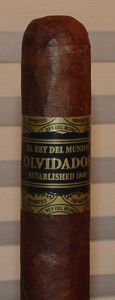
The wrapper on this cigar is rough and maduro in color, much darker than you’d expect from Ecuadorian Sumatra. It reminds me a little of the wrapper on the standard ERDM — it’s a little bit chipped at points and looks weathered. The antique style of the black and bronze band fits in perfectly with this look. The roll is solid and despite the large footprint it takes a light with ease.

What is most impressive about this cigar is how smooth it is. Maybe I’m getting used to all these Nicaraguan cigars that start out with a blast to the palate, but this one was a nice change from that. There’s nary a scratch or burn anywhere here. Just a very easy going, medium bodied full flavored smoke from start to finish.

The predominating flavor here is a sweet woody char very similar to what I find in another Villazon cigar — Flor de A. Allones. The first half of the Olvidados is also characterized by a salty element that went in and out of balance with the sweetness of the smoke. It certainly wasn’t overpowering, but at times I thought it could be a little overbearing.

The middle part of the cigar achieves a better equilibrium. The aroma is almost syrupy, and the flavor is balanced and round. The saltiness is no longer in the smoke as much as it is in the aftertaste. A cool drink is helpful at this point.

But unfortunately the last section was not really to my liking. The flavors become more one-dimensional, focusing on charcoal, and the aftertaste gets a bit sour. I found on both attempts that I couldn’t quite finish the cigar. Up to this point I thought it was pretty good, though overall this cigar is a little too salty for me.

El Rey del Mundo Olvidados scores very well on construction, and would score fairly well on taste — especially in the middle section — were it not for the last third where the aftertaste turns a little sour. The flavors here are very similar to what I find in Flor de A. Allones — which is fitting in a way, since Antonio Allones was one of the founders of the Cuban El Rey del Mundo. But if you like the currently available Allones blend from Villazon, you’ll probably like this one as well. As for me, it’s time to light up something else.

Prices run in the 7 USD range.