La Tradicion Cubana Chulo

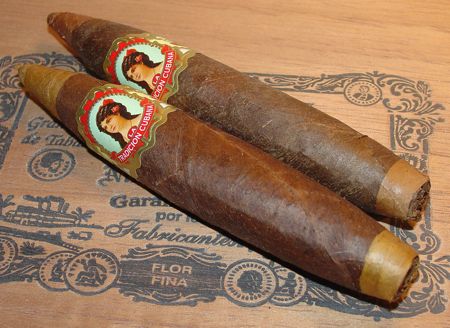
La Tradicion Cubana’s Chulo cigar is the perfecto in their figurado series. Other formats in the series are a Culebras, a huge 8 1/2 by 96 Great Pyramid, and the Reed, a toro-sized cigar with a head shaped like the bit on a clarinet (similar to La Flor Dominicana’s Chisel.) There is also a limited box pressed cigar called Teclas which comes packaged in a box shaped like a piano.

Talk about showmanship! With its two-toned appearance and shapely figure, it’s almost a shame to put the Chulo to the flame, and I find myself torn… To smoke or not to smoke, that is the question. Whether ’tis nobler in the mind to keep a cigar as a museum piece, or to take up matches, and by smoking, ash it… But there’s nothing rotten in Denmark here, or in the Dominican Republic for that matter. In addition to its exotic appearance, the Chulo is also a fine tasting smoke.

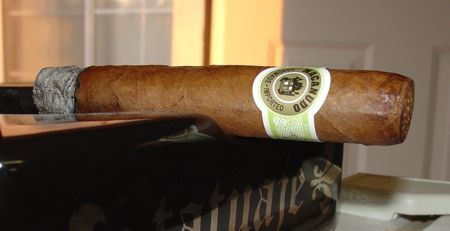
The 5 x 54 Chulo (which means something like “cutie”) is available in two wrappers — a natural Ecuadorian and a Brazilian maduro, but the extremities of the cigars are wrapped in the opposite shade. I found that I had to clip most of the natural wrapper off the tip of the maduros I smoked, but the flavor of the Ecuadorian leaf at the foot was detectable for a few brief moments after lighting the cigar.

Construction Notes

The craftsmanship that goes into creating this little zeppelin is apparent at first glance. The dry but dark maduro wrapper creates a striking contrast against the natural leaf at the foot and head of the cigar. Both ends of the Chulo are finely finished.

The roll is solid and the draw is good, though to achieve this it is sometimes necessary to cut a little further down — all the way to the boundary of the maduro leaf — than seems optimal. They burn evenly and need to be ashed only once or twice.

My only criticism is that the cigar gets a bit hot in the last third, but that is probably just a natural hazard of a cigar shaped like this. Despite its advertised ring gauge, the Chulo is a fairly small cigar.

Overall construction very good.

Tasting Notes

The first flavors to come wafting from this little guy are smooth and nutty, due in part to the Ecuadorian wrapper which gets the ball rolling. The smoke is creamy and medium in body.

It doesn’t take long before the natural wrapper gives way to the bittersweet chocolate aroma of Brazilian maduro. The smoke is still smooth, but its character changes dramatically. The sweetness on the nose remains but is soon overpowered by earthiness on the palate, and this becomes the primary theme of the cigar.

In the final section some peppery elements enter to complement the earthiness, and the cigar starts to heat up a little. I found it best to slow my pace at the mid-point of the cigar to keep the smoke cool and to keep the earthy flavors in proportion to the sweetness.

Conclusion

La Tradicion Cubana has a reputation for virtuoso cigar making, and this is exemplified by all of the cigars in the Figurado series, including the Chulo. But I was happy to discover that the cigar is more than mere eye candy — it’s a dandy little smoke with lots of smooth and earthy maduro flavors. It’s also pretty obvious that the chef who whipped up Sabor Cubano was supervising the design of the Chulo as well.

I’ll be looking forward to trying the natural version one of these days, but for now I can vouch for the maduro: it’s good. Boxes of ten sell for around $60 USD, which is a fantastic price considering the craftsmanship required to make these two-toned perfectos.

Final Score: 89

Alec Bradley Black Market Robusto

In the wake of critical hits like Prensado and the Family Blend, the folks at Alec Bradley might be expected to kick back and bask in the glow of their well-deserved success. But that’s not what they’re doing. They’re back at work, inventing new cigars like the Fine and Rare (a blend of 10 different tobacco leaves) and this one, the Black Market.

“New” is a relative term, of course. These cigars were released last year, before Prensado took home the gold in the Cigar Aficionado rankings at the beginning of this year. Even so, I don’t think these guys are going to be sitting around on their laurels too long.

The Black Market is an unusual looking cigar from the start: it doesn’t appear to have a band. A gray sleeve covers the lower part of the cigar. When removed it reveals a standard size cigar band positioned in the middle of the stick. This is distinctive and appealing, but it raises fears that it might not be  easily removed. I was pleased to find that the wrapper is smooth enough and the band is glued with enough care that it slides easily toward the head of the cigar.

The Black Market is also a little unusual under the hood: this cigar is composed entirely of viso and ligero leaves. Usually a blend contains at least some seco leaf for balance and aroma, but not this one.

The wrapper is from the Jalapa Valley in Nicaragua, the binder is Sumatran, and the filler is from Panama and Honduras. The cigar is manufactured in Honduras in five sizes:

  • Robusto 5 1/4 x 52
  • Toro 6 x 50
  • Churchill 7 x 50
  • Torpedo 6 1/8 x 54
  • Gordo 6 x 60

Construction Notes

Slipping the sleeve from the shank of the cigar reveals a glossy dark colorado wrapper, so dark that it is almost maduro in shade. The leaf is a little veiny, but the oiliness of the leaf compensates for this minor detraction. The head is round and finished with a triple cap.

The roll is quite firm but the draw is good, and it burns evenly from first light to last ash. Which is smooth and solid, by the way.

Overall excellent construction.

Tasting Notes

The first flavors to emerge from the Black Market Robusto are the sweet woody notes of Aganorsa tobacco. I don’t know if that’s what this wrapper is, but if I had to guess, that’s what I’d say. What differentiates this cigar from the many other cigars utilizing this ever popular leaf is the lack of pepper. There is very little sharpness here. I wouldn’t go so far as to call the taste “round,” but the flavors are smooth, balanced, and distinguished enough that the pepper is not missed.

Mild coffee and chocolate flavors add to the mix after half an inch or so. The cigar’s body is decidedly in the medium range, remaining smooth and quite easy to smoke. The chocolate flavors are tempered a bit in the mid-section, leveling out to cocoa, with a touch of earthiness edging its way in. The aftertaste is clean and light.

The final section is a little more concentrated as the cocoa veers toward caramel and the earth becomes more pronounced. The aroma remains sweet and woody, and the cigar winds down with just a touch of char.

Conclusion

Alec Bradley’s Black Market Robusto is an unusual and intriguing blend because it offers many of the flavors associated with popular Nicaraguan-style cigars without the aggressive bite and acidity that affects so many of them. I’m curious if the seco-less composition has anything to do with this, or if it’s the Panamanian wild card.  Whatever it is, this is a smooth and flavorful cigar.

The flavors don’t transition too much, but the cigar is perfectly charming the way it is. The complex blend of sweet wood, coffee, and earthiness is enough to sustain the medium-bodied cigar smoker’s interest for 45 to 60 very pleasurable minutes. The MSRP is around $6-7 USD for the robusto, a pretty reasonable deal all around.

Final Score: 91

Macanudo Cafe & Maduro Gigantes

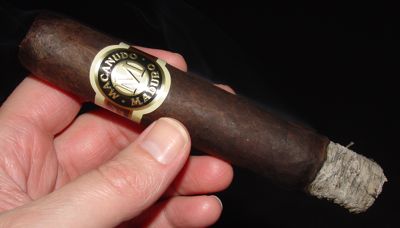
Macanudo is reportedly the best-selling premium cigar brand in the United States; it therefore needs no introduction. Just about everyone who has smoked a cigar has smoked a Mac — it’s a mild cigar with a classic Connecticut shade wrapper, and it’s a great one to give to a virgin smoker who is curious about the lure of the leaf.

There are well over two dozen frontmarks of the Cafe blend alone, not to mention the several other blends that fall under the Macanudo umbrella. Recent blends such as the Macanudo 1968 and the Vintage 1997 have surprised grizzled veterans with their flavor and strength, showing us that Macanudo is not always synonymous with mild.

These are the original mild-mannered cigars that so many know so well, but in a new format. (Yet another frontmark. It occurs to me that an average-sized cigar shop housing all of the Macanudo blends and sizes would have no room left for any other brand.) Super large ring gauges are finding followers and selling well, so it’s no surprise that General Cigar is responding to the demand with the new Gigante frontmark.

The Cafe blend is the classic Mac, possibly the most consistently made cigar on the planet — a Connecticut Shade wrapper, a Mexican binder from San Andres, and filler from the DR and Mexico. The Maduro substitutes a Connecticut Broadleaf wrapper for the Shade.

Construction Notes

Both cigars are well made with rounded Cullman heads. (Edgar Cullman, Sr, who died last year at the age of 93, was the man who made Macanudo into the best-selling brand it is. He and some investors bought General Cigar in 1961, and a few years later they acquired a small Jamaican factory called Temple Hall where an unknown cigar called Macanudo was made. The rounded head on the Macanudo, and now many other cigars, is named for Mr. Cullman.)

The draw, burn, and consistency of the Macanudo Cafe and maduro brands is beyond reproach. If you’ve ever smoked one that didn’t burn well, leave a comment, because I have yet to hear from anyone of a construction defect in this cigar. It must have happened some time — it’s a hand made product, but it’s remarkably consistent.

Overall excellent construction.

Tasting Notes

The Macanudo Cafe is a mild cigar with flavors that are typical of Dominican and Mexican tobacco — the base flavor is nutty with a little bit of astringency, just enough to work the salivary glands a bit. The Maduro version is somewhat sweeter. The broadleaf wrapper disguises the tartness a little more effectively than the shade wrapper does.

There isn’t much transition from the beginning of this smoke to the end, but this is normal for very mild cigars. The Cafe does get a little more tart at the end, and the Maduro picks up some char, but mostly what you get out of this cigar is a mild-mannered vehicle for a couple of great wrapper leaves. The aroma is what makes this cigar noteworthy — the soft floral creaminess of the Cafe, and bittersweet chocolate from the Maduro.

Though I’m not a regular smoker of this brand, the Gigante appears to be a little more flavorful than the robusto size. I’m not a big fan of the chunkster cigar trend either, but the amplified flavors in these Mac biggies were a welcome surprise. (My thanks to General Cigar for the samples, by the way.)

Conclusion

These are the same Macanudos that a lot of us started on, just in bigger sizes. And because they are so mild, the bigger size seems to be less of an extravagance than it does in many other blends.  Mild cigar aficionados will definitely want to try these out, but don’t look for any big surprises. These are the same consistent smokes that they’ve been for many years now. MSRP is in the $6-7 USD range.

Final Score: 86

La Casita Criolla

The wrapper leaf on a cigar is like the sear on a carefully cooked piece of beef — it’s often what makes the difference between a bland piece of protein and a sizzling dinner centerpiece. But the sear must be done right — overdo it and your dinner guest will send that Porterhouse right back to the kitchen. Like most of the fine things in life, flavors need balance.

So it’s a puzzle to me when a cigar maker decides to focus on one ingredient in the recipe to the exclusion of the other components, the ones that usually give a cigar balance. We’ve seen cigars that are almost exclusively ligero like Oliva’s Cain, and we’ve seen cigars that are 100% maduro, like Camacho’s Triple Maduro. I don’t care for either of them, and lack of balance is one of the reasons why.

So what possessed Pete Johnson of Tatuaje Cigars to create a cigar made entirely of Connecticut Broadleaf?

I’m not sure, but I was curious to find out. Connecticut broadleaf is prized by manufacturers of everything from machine-made Toppers to Fuente Anejos. It’s thick, it’s ugly, and it’s one of the most expensive tobaccos for blenders to use. But heavens, it’s tasty. (My apologies to Garrison Keillor.)

La Casita Criolla, an old Cuban brand name acquired by Johnson for this blend, means something like “the little native house.” That’s one brand name that is better left untranslated. I’m as puzzled by the name as I am by the idea of a broadleaf puro, but it does conjure up an image of rusticity which is reflected in the cigar’s appearance.

La Casita Criolla is made for Tatuaje by My Father Cigars in Esteli, Nicaragua, and was released last year in three sizes, all comfortably under a 50 ring gauge:

HCB Corona – 5 1/8 x 42
HCBC Corona Gorda – 5 5/8 x 46
HCBF Short Churchill – 6 1/2 x 48

Construction Notes

The HCB Corona is rough and marred with imperfections, which is typical of broadleaf. It’s maduro in color tone, a little bit oily, and has a rustic but rich appearance. The roll is firm, but staring down the barrel it appears to be loose due to the thickness of the leaf. Rolling broadleaf in the bunch must take some getting used to, but the torcedors have apparently made the appropriate adjustments.

Both samples drew very well — not too loose, despite initial visual impressions — and they burned almost evenly, much better than I expected. My only complaint is that the cigar burns a little too hot after the mid-point. Draw frequency should be limited to about once per minute in the last part of the smoke. Discipline is required.

Overall construction: Very good.

Tasting Notes

The Casita Criolla corona offers initial flavors of leather, minerals, and a whiff of black pepper, though there is far less pepper here than in many other Tatuaje blends. The aroma is what you’d expect from broadleaf — it’s rich and sweet with roasted coffee and chocolate.

The middle section doesn’t stray too far from the palate of flavors it starts with, but I notice that the smoke is surprisingly light in texture. The flavors are balanced, the strength is no greater than medium, but the body of the cigar is much lighter than I expected. An aftertaste of graham crackers is a nice touch.

The aroma in the last section turns from leather to wood, but the sweet chocolate notes remain as long as the draw frequency is kept to a minimum. A bitter taste appears if the cigar gets too hot, which it seems to do quite easily in the final stretch.

Conclusion

Contrary to my expectations, La Casita Criolla is a very well balanced cigar. Despite this, it seems to be lacking something. Maybe a different leaf thrown into the mix might give the smoke a little more weight and add to the overall experience. That said, the overall experience is still pretty good, and broadleaf lovers will get a thrill out of this stick.

The coronas are in the 5 to 6 USD range. For the experience of smoking a pure broadleaf cigar, it’s well worth the scratch. I’m not sure I’m ready to run out and buy a box, but I’m glad I had the chance to try them, and I expect I’ll be picking them up from time to time in the shop.

Final Score: 89
Jameson Red Label and Rockstone Coffee

The Jameson Cigar Company was founded in 2008 and the Red and Black Labels were the company’s  inaugural releases. The well-known (and well-reviewed) Declaration and Santos de Miami lines were soon to follow, but I like to think that the first blends from a cigar maker are what makes or breaks the brand’s reputation. So it’s about time that I got around to smoking a few of them.

The Red Label was initially released with a Sumatra wrapper, but the line was reblended in 2009 with an Ecuadorian Connecticut cover leaf.  A binder from Honduras and aged Dominican filler form the core of  Jameson’s mildest blend.

Five sizes are in production:

  • Corona – 5 x 44
  • Perfecto – 5 x 54
  • Torpedo – 6 x 54
  • Robusto – 5 x 50
  • Toro – 6 x 52

One of the flavors that I love to discover in a cigar is coffee — sometimes it presents itself as cocoa, or chocolate — but the bean is the thing that rings my bell. So coffee is a frequent companion to my daily cigar, and I know I’m not alone.

Rockstone "Good Day Sunshine"

It makes sense for this reason that Brad Mayo, the founder of Jameson Cigars, is now also in the coffee business. Rockstone Coffee was established in 2009 as an adjunct to the cigar side of Mayo’s business, and he was kind enough to send along some samples for me to taste. (The Red Label robustos were on my own dime.)

Construction Notes

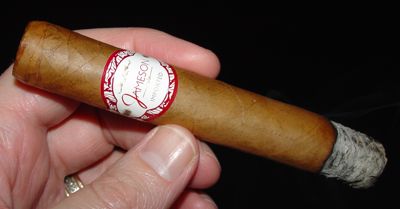
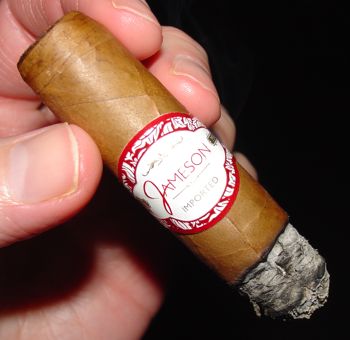
The shade wrapper on the Jameson Red Label robusto is so light it’s almost amarillo — it’s the color of freshly baked bread, and it has the soft texture typical of Connecticut seed shade leaf. The roll is firm but draws well, and the cap is finely executed with a triple wrap and a flat head.

Most cigars with shade wrappers produce an ash with a very consistent color, usually a smooth light gray. The Red Label, on the other hand, produces a light-colored ash with striations of darker gray and black. The ash is solid, but more importantly, the cigar burns evenly.

Overall construction: excellent.

Tasting Notes

I like a mild smoke every once in a while, and Connecticut Shade, whether the genuine article or grown elsewhere, is a deliciously aromatic leaf. But take the band off the cigar and one mild shade stick usually tastes just like any other. Not so with Jameson’s Red Label.

A tannic tartness lets the smoker know up front that this cigar is going to be a little bit different. The qualities typical of mild shade cigars are also there — a creamy texture (though not as buttery as some), a sweetly floral aroma, and a subtle aftertaste that starts the cigar off gently. There is a woody undertone to the flavor in the first half, and a tiny pinch of pepper on the retrohale.

The second half of the cigar becomes increasingly earthy, and the aroma seems more caramelized than floral. What is surprising at this point is the spice on the palate. The strength of the cigar remains fairly mild, but the flavor is on full. The tannic notes that initially characterize the smoke become increasingly difficult to detect through the earth and pepper.

Rockstone Coffee

Rockstone Guatemala Candelaria

The “Good Day Sunshine” Blend is quite mild, tasty, and easy to drink. The dark-roasted flavors that are so popular with mainstream java junkies are in attendance, but the beans are not over-roasted, which is the problem with the mainstream stuff. The roasty flavors are really well balanced here.

Both of the Rockstone coffee blends work well with the Red Label, and they’re both nice roasts, but I preferred the Guatemalan. There is an acidic spring to this coffee that pairs with the tannin in the cigar as if they were made for each other. The roast is light, maybe a city-plus at most, and this allows the region character to express itself freely. It’s a bold, bright cup with a nice body. The notes of lemon would make me think it was an Ethiopian Yirgacheffe rather than Guatemalan, but then I would be wrong. In that case I would be happy to be wrong as long as I could still grind up a handful of these beans for my breakfast brew.

Conclusion

Pairing the Jameson Red Label with Rockstone coffee was a most enjoyable experiment for me, and my taste buds are still thanking me. (I wasn’t expecting such a long finish on a mild cigar…) And my wallet isn’t complaining too loudly either: the Red Label robusto sells for around $4-5, and the coffee runs around $16 per pound. Both the cigar and the coffee have more character than others in their class, and both are definitely worth tracking down.

http://www.rockstonecoffee.com/

https://www.jamesoncigars.com/

Final Score: 88

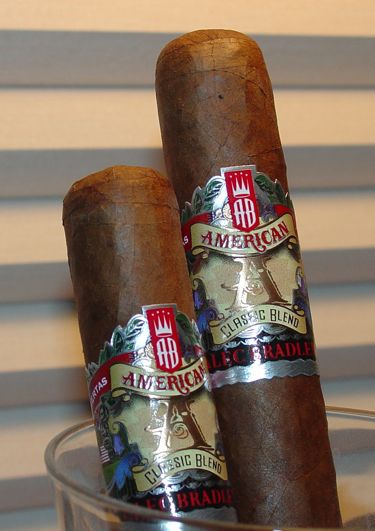
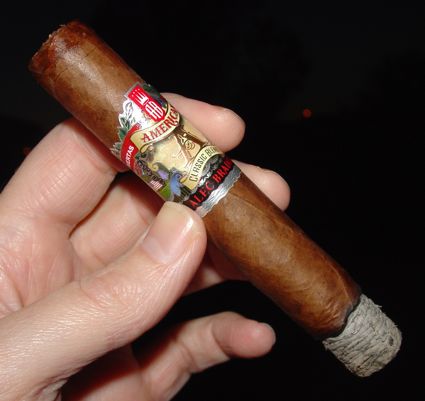
Alec Bradley American Classic Robusto

A few months ago I had the opportunity to review La Gloria Cubana’s new “Artesanos Retro” cigar, and what I liked most about it was the Honduran Connecticut seed wrapper.  It’s a tasty leaf, so it’s easy to see why Alec Bradley has gone the same route with the American Classic Blend.

Alec Bradley has some experience with Honduran tobacco. Their big hits in the past couple of years (including an impressive No. 1 for the Prensado in Cigar Aficionado’s 2011 lineup) have been from the Raices Cubanas factory in Honduras, so it’s not a huge surprise to see an unusual Honduran strain on the American Classic.

This blend was reportedly designed to mimic the style and evoke the flavors of cigars favored by Americans in the early part of the 20th century, when Tampa was King and cigars with double claro or candela wrappers were labeled “American Market Selection.” Wrapper shades darker than this were called “English Market Selection,” and the darkest cigars were called “Spanish Market Selection.” World markets and the tastes of smokers worldwide have obviously changed, but the American Classic Blend takes a step back in time.

Underneath the Honduran grown, Connecticut-seed wrapper lies a binder from Nicaragua and Nicaraguan filler leaves from both Esteli and Condega. Six sizes are in production:

  • Corona: 5 1/2 x 42
  • Robusto: 5 x 50
  • Toro: 6 x 50
  • Churchill: 7 x 48
  • Torpedo: 6 1/8 x 52
  • Gordo: 6 x 60

Construction Notes

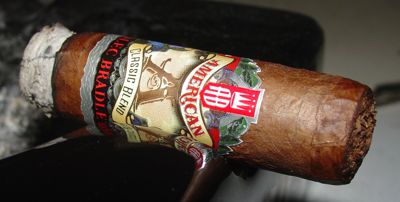
The wrapper on the American Classic is somewhat dry and papery. It’s darker and more weathered in appearance than Connecticut Shade, and it seems a bit thinner. The rough texture of the binder shows through, giving the stick a slightly bumpy appearance. The cigar is finished in Cuban flat-head style with a triple wrapped cap.

Staring down the business end of this cigar I notice that the bunch appears to be partially booked. The draw was fine, however, and the cigar burned perfectly, so perhaps the evils of booked filler leaves are exaggerated. And like many other cigars using Connecticut Shade, this one left a solid light gray ash.

Overall construction excellent.

Tasting Notes

The Alec Bradley American Classic starts up with a toasty flavor common to many mild-to-medium bodied cigars, but the spice on the nose sets this one apart from run-of-the-mill Connecticut Shade smokes. It has the perfume of Connecticut Shade, but it’s sharper and less flowery. It blends extremely well with the toasty and woody foundation flavors.

The mid-section brings a bready note as the spice on the nose dies down. The sweet spot here is almost exactly at the half-way point of the cigar, where the  cedar and bread flavors are delicately balanced and the result is delectable. Unfortunately these flavors dissipate around the two-thirds point and the smoke becomes a bit hot and burnt tasting. Maybe in my zeal for that bready note I was pulling a little too hard, but I deliberately slowed my pace while smoking the second cigar and had the same experience.

Conclusion

The American Classic has the mild and floral sweetness of a high quality Connecticut Shade cigar, but an added complexity that I found quite enjoyable. The combination of toast and bread and soft spicy cedar make it a great smoke to pair with a morning cup of coffee.

Most of us weren’t around for the days of “classic” American cigars, the days of Thomas Riley Marshall’s “good five cent cigar.”  (I shudder to think about what my grandfather would say about  a 15 dollar stogie.)  At around $4 USD this one is a bit pricier than Marshall’s budget smoke, but by today’s standards it is still a relatively good value. Give it a shot one of these sunny spring mornings.

Final Score: 87

Padilla Artemis

Padilla’s Artemis series is the first box pressed cigar for Padilla, but just about everything else about it is quite familiar — it’s a Nicaraguan puro utilizing Aganorsa tobacco, and it’s made at the Raices Cubanas factory in Honduras. Those are enticing details, and enough to get my salivary glands going.

Artemis uses Cuban-seed criollo and corojo from Nicaragua’s now-famous Aganorsa company, a tobacco grower affiliated with Casa Fernandez cigars. The line was originally released in 2011 as a brick-and-mortar exclusive, but it now appears to be available online as well.

It looks like the lion from the Dominus line has clawed its way to the top of the advertising department and has been declared the company’s icon. It now appears on the bands for Padilla’s Miami and 1932 lines as well, bringing some needed consistency to the brand’s presentation. (I was always fond of the fountain pen nib on the bands of some of the older blends, but there is something to be said for a single and recognizable emblem.)

Padilla’s Artemis is available in four sizes:

  • Robusto: 5 x 54
  • Torpedo: 6 1/4 x 52
  • Toro: 6 x 54
  • Double torpedo: 6 3/4 x 56

Construction Notes

I’m glad I smoked the Artemis in two sizes, the robusto and the double torpedo, because one was simply superior to the other. Both are nice looking sticks, especially the double torpedo. In reality this is a zepellin perfecto, and a big one, with a finely finished head and foot. (The head and the foot are distinguishable only by the placement of the band.)

The wrapper is a dark colorado maduro with a moderate amount of oil. Both sizes had an accessible draw, and the box press didn’t seem to have much of an effect on the performance of the cigar. But I experienced a burn problem with the double torpedo that I didn’t with the robusto, and it wasn’t the irregular burn that is the hallmark of many box-pressed cigars.  This was a more serious problem that affected the taste of the cigar — the wrapper would not burn in sync with the binder and filler, resulting in a flavor that was at first merely tepid, but quickly made it hot, bitter, and unbalanced.

For this reason I’m going to focus on the robusto and not the double torp.

Overall construction: Very good for the robusto; Needs improvement for the double torpedo.

Tasting Notes

If you’re familiar with the Padilla 1932 or some of the cigars from Casa Fernandez you’ll recognize the flavor of Aganorsa tobacco. It’s a little different in the Artemis, but it’s there. The first notes are of leather with some sweetness and a little bite. The aroma is slightly fruity, but also reminiscent of hardwood smoke — something like hickory, perhaps. After a minute or two the pepper begins to build on the palate.

The mid-section is earthy but a little sharp. The flavor isn’t quite as clean as Illusione’s “original document” line, but it has that crisp minerally tang which is Aganorsa’s trademark.

The final inch and a half is rich and powerful in flavor, though the cigar is still medium-to-heavy in both body and strength. The last section bottoms out a little as the spice takes over and edges out the subtle notes on the nose.

Conclusion

Fans of Padilla and Aganorsa leaf will probably enjoy the Artemis, though perhaps not as much as some other blends that employ that particular leaf. The flavors are quite pronounced, and in the robusto were well balanced up to the last third of the cigar.

I was more than a little disappointed in the double torpedo, but I would probably pick up the robusto again at the right price. The right price for me is a little south of the MSRP, which is in the 9 to 10 USD range. To be honest, Padilla has already provided this cigar’s competition in the Padilla 1932, and in that contest the winner goes to the elder blend.

Final Score: 86

Due to a memory error in my camera I lost my cigar-in-progress photos. I know you only come here for the articles, but my apologies anyway. 

Gurkha Cellar Reserve Prisoner

This year marks the quasquicentennial anniversary (that’s 125 years) of the Gurkha brand name, and Beach Cigar Group, the maker of Gurkha cigars, has marked the occasion by changing its name. The manufacturer of “the world’s most expensive cigar” is now the Gurkha Cigar Group. It’s a sensible name change, and for a company well versed in the subtle art of branding it seems a long time coming.

A few other changes have occurred at Gurkha in the past year — a new president and CEO is at the helm (Gary Hyams, formerly of CAO), and a new subsidiary brand was launched: East India Trading Company. And while the company still produces very high end “luxury” cigars like the cognac-infused His Majesty’s Reserve, they have renewed efforts to engage the unwashed masses, represented here by yours truly.

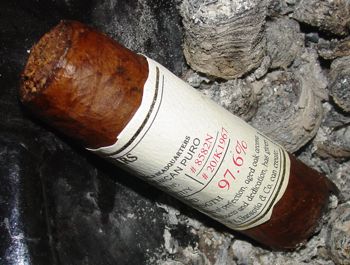
Three new blends released last year at the 2011 IPCPR were geared toward the retail market, and for the moment this one appears to still be a brick-and-mortar exclusive. The Gurkha Cellar Reserve utilizes a Criollo 98 wrapper, a Dominican Olor binder, and filler which includes 15 year-old Nicaraguan Criollo.

In line with the “cellar” theme, this cigar arrives in a box that is ribbed like a wine barrel. (I don’t always like Gurkha blends, but Hansotia’s baroque boxes are the best in the business.) The bands are just as odd and beautiful, though in this case the information is a little bit confusing.

The “blend strength” is labeled on the band as 97.6%. This inevitably prompts the question: 97.6% of what? I also have to admit some confusion at the “Dominican Puro” statement. The cigar is made in the Cuevas factory in the Dominican Republic, but according to Gurkha’s press release it is not a Dominican puro. Maybe it’s best to see the band as graphic art rather than a source of salient information. In any case, the Cellar Reserve is produced in five sizes:

Perfecto “Koi” – 4 x 58
Doble Robusto “Solaro” – 5 x 58
Gran Rothschild “Hedonism” – 6 x 58
Churchill “Prisoner” – 7 x 54
XO “Kraken” – 6 x 60

Construction Notes

The Prisoner is, to my mind, more of a double corona than a churchill. This is a cannon of a cigar, and with its somewhat veiny and dark colorado maduro wrapper it’s a serious looking stick. The head is nicely formed. The cap is not a work of art but shears cleanly and does its job. The large band has the effect of minimizing the size of the cigar, or putting it into a different perspective somehow. Optical illusions aside, this is a good 1.5 to 2 hour smoke.

I’ve smoked five or six of these now and each one has shown excellent construction. The cigar feels a bit light in the hand, but that is no indication of its burning characteristics, which are generally slow, even, and cool. Each time I ashed this cigar it fell into the ashtray like a fat piece of chalk.

Overall construction: excellent.

Tasting Notes

The Prisoner starts up with a sweet grassy flavor but after a puff or two the oaky-vanilla aroma begins to remind me of the wine cellar theme of this cigar. The smoke is smooth but somewhat dry on the palate. After a minute or two the base flavor turns from sweet and grassy to roasted nuts.

After about twenty or thirty minutes the flavors begin to deepen without venturing into any new territory. The aftertaste grows slightly peppery, and the strength becomes more evident. The oaky-vanilla aroma is still the highlight of the cigar.

Into the third section the Prisoner is a consistent and straight-forward cigar without a lot of complexity. The aroma is very pleasant, and by the last third it delivers a pretty good kick. It starts to char near the band and after that becomes a little too sharp to smoke. But after 90 minutes I am ready to call it a night anyway.

Conclusion

Gurkha’s Cellar Reserve is an enjoyable cigar but it lacks the kind of complexity I was hoping for. I might smoke this one again in a smaller size because the flavors are good, but 90 minutes of plain ol’ good can still get a bit monotonous. The price is a little bit high for me as well — MSRP runs from $8 to $10 for this line. I was fortunate enough to recieve these samples from Gurkha, so I won’t complain about the price… but if I had to shell out the retail I might hesitate a little.

Final Score: 87

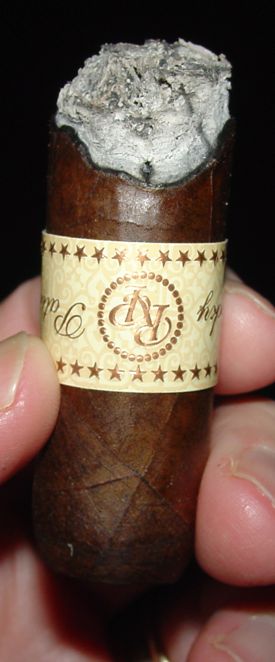
Rocky Patel Edicion Unica 2011

No one will ever accuse Rocky Patel of missing a special occasion for a limited edition cigar release. This one comes courtesy the Humo Jaguar International Tobacco Festival celebrated last year in Tegucigalpa and Danli, Honduras. The purpose of the Festival is to promote the Honduran cigar industry, which lags a bit behind that of Nicaragua. But if this cigar is any indication of the strides that Honduras is making, it may be catching up with its neighbor to the south quite soon.

The festival was named Humo Jaguar after the 12th ruler of Copan, who ruled from 628 to 695 A.D.  Humo Jaguar (Chan Imix K’awiil) was sort of like the Caesar Augustus of ancient Mayan culture — his reign was long and marked by stability and progress. The archaeological record he left behind includes monuments and stelae now preserved in the Copan Archaeological Park. Archaeologists assigned names to the rulers based on the hieroglyphs found on these stelae — hence names like Moon, Macaw, and Jaguar. Evidently smoke is depicted in the carvings as well; the Mayans were among the first cultures in the world to use tobacco, and presumably the King’s humidor was well stocked.

I’d like to think that Humo Jaguar would be quite pleased with the progress that the cigar industry has made in the last 1300 years, and that the Honduran puro that Rocky Patel created for the first festival in his name would have been a big hit with him. The dark wrapper that graces this toro is from the Jamastran valley, beneath which lies an unspecified Honduran binder. The filler is from Talanga and Jamastran. Only one size was created — a 6 x 52 toro. The initial release was limited to 500 boxes, but it seems likely that more were produced afterwards.

Construction Notes

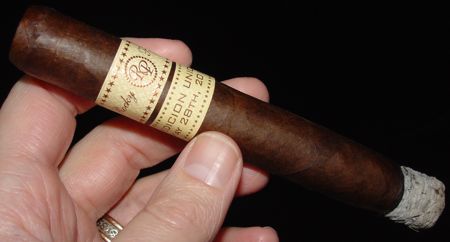
The wrapper on the Edicion Unica is dark and somewhat dry — it reminds me a little of the San Andres wrapper that is showing up on so many high-end maduro cigars these days. The roll is firm, as is the draw. The head of the cigar is well formed. The cap seams are a bit ragged, but the cigar cuts cleanly and takes an easy light. Even though the draw is on the tight side, the smoke volume is more than adequate. The ash holds together and the burn is trouble free.

Overall excellent construction.

Tasting Notes

I am initially reminded of Rocky Patel’s Decade line, which for the last couple of years has gradually been supplanting the Olde World Reserves in my humidor. (I attribute the decline of the OWR — or what I perceive as such — to the prodigious number of blends in the RP portfolio. Maintaining consistency over that many lines for years on end has to be a considerable challenge.)

The first flavors to emerge from the Unica are dark chocolate or unsweetened cocoa, layered over the spicy sweetness of Spanish cedar. It’s a great combination that so far I haven’t been able to find at Ethel M. The aroma is strong but sweet.

After an inch or two the cigar showcases coffee and an acidity that I usually associate with Nicaraguan tobacco. The aroma is rich but slightly fruity, like an Ethiopian Sidamo style coffee. The smoke texture is smooth and full without being too powerful. At this point the woody underpinning gives way and becomes more leathery.

The last third picks up some black pepper on the tongue to add to the acidic zing, and the sweet maduro-style aroma lingers on the nose. The cigar remains balanced and smooth to the very end. It’s pretty rare for me to nub any cigar, but this one I didn’t want to put down.

Conclusion

The RP Edicion Unica is sold in boxes of 100, which makes it more suitable for retail distribution than for online sales, but even so the price is right — around $6.50 per stick. Rich flavors in a balanced and medium-bodied package don’t often come with such an economical price tag.

This is a limited run, so snap up a few if you have the chance. I recommend them highly for fans of Rocky’s other maduro offerings like the Decade or the OWR maduro. I just hope there a few left at the shop where I picked up this pair.

Final Score: 92

Casa Magna Domus Magnus Limitada

Casa Magna won the critics’ hearts in 2008 with its original release, the Casa Magna Colorado. It won my heart as well, and its modest price has kept me coming back for more. So it’s no surprise that the team of Quesada and Plasencia have extended the brand twice now, and as far as I’m concerned it’s just getting better.

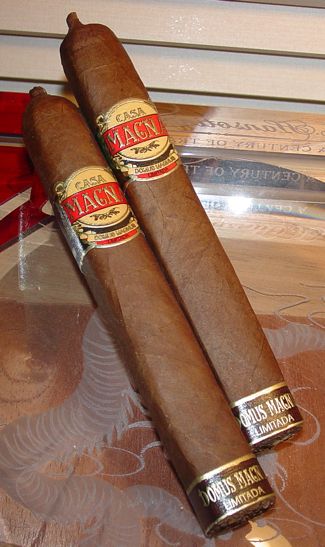
Domus Magnus is a Nicaraguan puro utilizing a sun grown wrapper leaf from Jalapa. The blenders do not disclose too much detail about the rest of the cigar’s composition, merely noting that the binder and filler are Nicaraguan. Only two sizes are made, a  5 3/4 x 52 size called “Optimus” and a slightly larger 6 1/2 x 55 parejo called “Primus.” The cigars are presented in 10-count boxes in a limited release.

SAG Imports states that the Domus Magnus

…is a full bodied cigar that should be enjoyed after a steak dinner and paired with a single malt Scotch from the Speyside sub-region of the Scotland Highlands.

 So I naturally smoked mine after a burger and paired it with a Sierra Nevada pale ale from the sub-region of my refrigerator’s bottom shelf.

Construction Notes

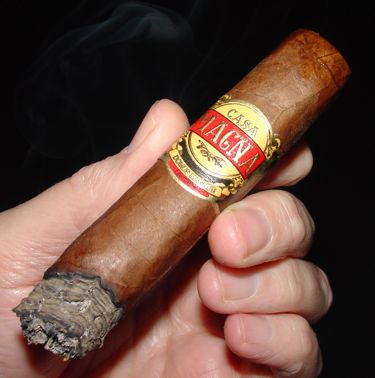
The Casa Magna Domus Magnus is a box-pressed cigar presented in boxes of 10.  The wrapper is a soft ruddy color, somewhat dry but smooth with a few fine veins. The cap is well constructed and terminates in a pig-tail which has been clipped instead of tied in the traditional knot.

I really dislike foot bands, but this one is easy to remove and discard. The draw is firm and the roll is solid. I would have preferred the draw to be slightly looser, but the few reservations I had about the draw were compensated by a rock-solid ash. The burn was mostly even, above average for a pressed stick, and required no correction.

Overall excellent construction.

Tasting Notes

My first impression was that this is a much smoother cigar than the Casa Magna Colorado. The smoke texture is mild to medium, but the flavors are quite complex, especially on the nose. Woody aromas predominate — cedary spice and softer notes of sandalwood, while the palate flavor is understated, at least for the first half of the cigar.

In the second half the smoke picks up a little more body and palate structure as flavors of nuts and earth emerge. The scents on the nose continue to complement these new flavors, but the increasing richness of the earthy component tends to overpower those more delicate subtleties. Some black pepper appears in the last inch of the cigar, just to verify the blend’s Nicaraguan birthright.

Conclusion

I was pleased but not thrilled by the Domus Magnus’ opening act, but the dramatic transition in the second half was truly impressive. A little more body in the first part of the smoke and this could easily be a Top Ten cigar for me. As it is, it’s still a very fine cigar.

At around 8 to 9 USD this incarnation of the Casa Magna is not a cheap thrill, but for fans of complex and medium-bodied cigars, I think it’s well worth the expense. This is a limited edition blend, so be sure to snap up a few of these if you can.

Final Score: 90