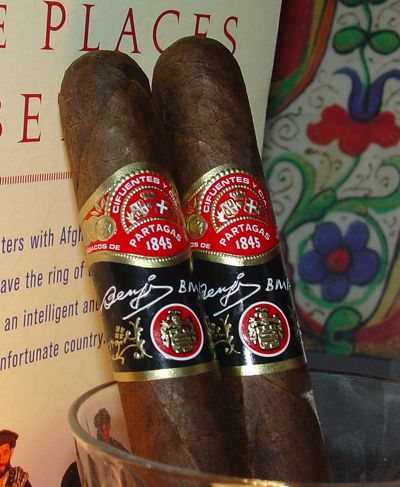
Benji Menendez Partagas Master Series

Benji Menendez is one of those living legends of the cigar business, a cigar maker who is still blending tobaccos and passing on the tradition years after most mere mortals would be enjoying their retirement. Menendez has an entire lifetime of experience to draw on. In fact, when you see the M & G insignia on a Montecristo cigar band, that M stands for Menendez.

As an heir to Cuba’s largest cigar factory, H. Upmann, and the Menendez y Garcia tobacco concern, young Benjamin had a lot to look forward to as he grew up in an upper-class Havana neighborhood. Despite his privileged position as the son of the company’s majority owner, he still had to learn the industry from the bottom up, starting with packing cigars, and then working his way through the departments to a management position.

In 1960 the factory was seized and from there the Menendez story takes an all too familiar turn. A new start in America was about to begin, starting in Miami and soon moving to the Canary Islands, where Mendendez created the blockbuster Montecruz brand. Many years later he became the head of premium cigar operations for General Cigar. Fifteen years after that, during the cigar boom of the late 90’s, Menendez joined the Spanish giant Tabacalera, which eventually merged with SEITA to form Altadis. Now he is back again with General, where the powers that be have in all their wisdom tasked him with the creation of this limited edition Partagas.

Only 5000 boxes of the Partagas Master Series were made, and in only one size, a 6 x 46 Grand Corona dubbed Majestuoso. Like the Montecruz of the 60’s, this one has an attractive Cameroon wrapper. The rest of the blend is more unusual: a Habano binder grown in Connecticut, filler from the Dominican Republic (piloto cubano) and two different regions in Nicaragua (Esteli ligero and Ometepe.) On paper this sounds like a thunderous cigar. In practice it’s actually quite smooth, but very expressive at the same time.

Construction Notes

The roll is rock solid, but it draws with even and easy tension. The wrapper is dark with fine veins and appears slightly toothy. The head is rounded with a cap that is so well integrated the seams are difficult to detect. It burns evenly and builds a solid, firm, and neat long ash.

Overall excellent — near perfect — construction.

Tasting Notes

The Partagas Master Series Majestuoso is a medium to full bodied cigar with lots of flavor. Taken slowly it’s smooth and easy to smoke, but it can develop a bite if rushed.

From the first pull it’s evident that this blend is heavier than the standard (Non-Cuban) Partagas line. The flavor is a complex of cedar, spice, leather and coffee in varying combination as the stick burns through the first third. There is a touch of black pepper which will return again in the last section.

An acidic edge cuts through the chocolate and cinnamon in the middle third, leaving a tea-like tang on the tongue. The body of the cigar is light enough not to overpower this subtle touch, but heavy enough to coat the palate with an array of flavors. The aroma is rich with cedar and coffee, while leather spiked with pepper lingers on the finish.

The strength of the cigar comes through at the finale, hitting me in the gut but not knocking me over. The aroma becomes piney and the aftertaste grows a little bit salty. Some char appears near the band.

Conclusion

Benji Menendez’s Master Series blend is an accomplishment worthy of a man who has dedicated his entire life to the art of the cigar.  It’s flavorful, complex, smooth, and balanced. It’s expressive without being aggressive. It’s just a really fine cigar on all fronts.

It’s also priced within reason, especially for a limited edition release of such high quality. Ten American greenbacks is about all this one will set you back. But get them while they’re still around, because they won’t be for long.
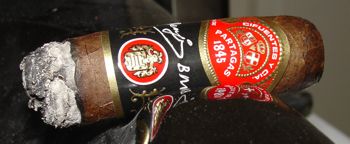
Final Score: 91
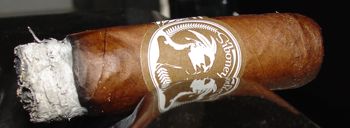
Siboney Reserve Robusto

The original Siboney was a pre-revolution Cuban cigar, named for the small  town east of Santiago de Cuba. Interestingly, Siboney is where U.S. forces landed in the first days of the Spanish-American war. Decades later it was also the site where Castro gathered with his men before their attack on the Moncada Barracks, generally considered the start of the Cuban Revolution.

The original Cuban Siboney cigar is no longer in production, but that of course bars no one from riding its illustrious coattails to marketing bliss. (Illustrious may be overstating it. So may bliss.) Famous Smoke appears to have the rights to the brand name (these people notwithstanding) and they market two different blends under the Siboney name.

The “traditional” Siboney is a Honduran bundle cigar made by Alec Bradley. The Siboney Reserve is a Nicaraguan near-puro made at Pepin Garcia’s Nicaraguan factory, My Father, in Esteli. The Reserve is packed in boxes, but it’s still designed to be an economy cigar.

The Reserve version’s best feature, in my opinion, is its wrapper — an aromatic Nicaraguan Habano Rosado leaf. The filler is Nicaraguan corojo, and it appears to have a double binder: Nicaraguan Criollo ’98 and Honduran Habano.

Only three sizes are currently in production:

  • Churchill – 7 x 50
  • Robusto – 5 x 50
  • Torpedo – 6 a/2 x 54

Construction Notes

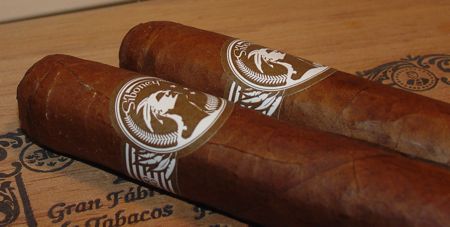
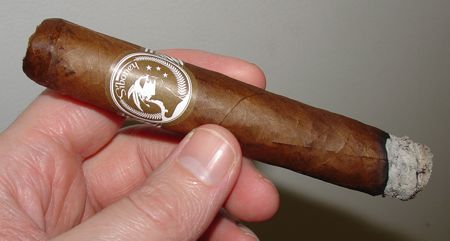
The Siboney Reserve Robusto is a nice looking stick, but it doesn’t really compare to higher-end cigars coming out of the My Father factory. The wrapper is a slightly mottled colorado maduro that is a little less ruddy than what I would expect from the “Rosado” billing.  It’s somewhat dry and veiny, but otherwise attractive enough.

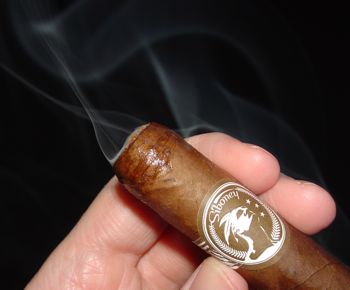
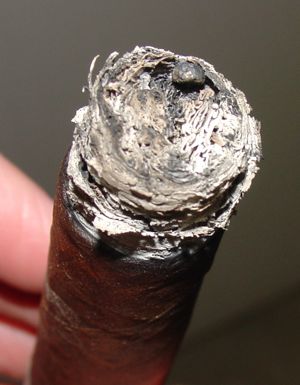
The trademark Pepin triple-cap is present, but it’s not as nicely finished as other Pepin smokes. The head is rounded with a patch on top. The draw is on the loose side, and one of these was seriously underfilled.  The burn is too quick, but it manages to keep the heat under control. The ash is crumbly, loose, and flaky.

Overall fair construction. This is a long-filler cigar, but without prior knowledge of this I’d guess it was a well-built Cuban sandwich. A little disappointing.

Tasting Notes

The Siboney Reserve Robusto is a fairly straightforward, medium-bodied, woody Nicaraguan style cigar. It opens up a little grassy with an oaky aroma and a whiff of vanilla. Some light pepper notes crop up after half an inch or so, but it is quite mild for a Pepin blend.

The middle section is woody with some light spice, but mostly it tastes of simple tobacco. The aroma is the centerpiece here, maintaining a steady flavor of wood with continuing hints of vanilla. The smoke is rough on the tongue at times.

The last third is dry and peppery, but the oaky aroma shines through. Half an inch before the band it develops a papery aftertaste and quickly turns ashy .

Conclusion

The Siboney Reserve is not a bad cigar, but it’s not a great one either, especially coming from a factory that produces some of the best cigars in Nicaragua. This one reminded me a bit of the Tatuaje Series P, the broke man’s Tatuaje. I recommend to all broke men (and women) being one myself (broke, not a woman) that smoking one or two really worthy cigars a week is far better than to smoke garbage all week long. Not that this cigar is garbage exactly, but it’s not a DPG Black either.

Boxes of the robusto are priced well at around 80 USD, which makes it a near-bargain cigar, but you can probably do much better without looking too far.

Final Score: 75

Cigar Wrappers and the Aurora 1495 Connoisseur Selection

How much influence does the outer wrapper leaf of a cigar have on its taste overall?  The wrapper comprises only about 10 percent of the tobacco in a cigar, give or take, but it seems to have a disproportionate effect on the blend. The question is how much of an effect, and the debate is perennial.

Some seasoned aficionados say that the wrapper accounts for 60 percent of a cigar’s flavor. Others say less, some say more. But almost everyone agrees that the wrapper is a cigar’s most valuable player. The reason that wrapper leaf makes such a disproportionate impact isn’t exactly clear, but the fact that it does so is easy to prove.

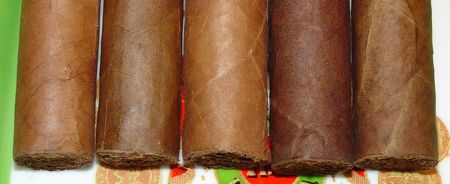
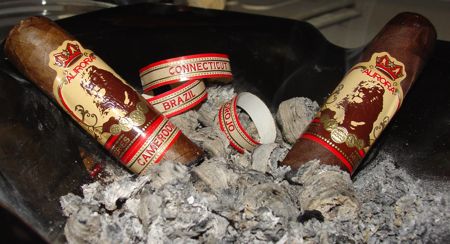
In 2007, Jose Blanco of Aurora cigars presented the Aurora 1495 Connoisseur Selection, a series of four cigars with exactly the same filler and binder, but each with a different wrapper. The standard 1495 cigar has an Ecuadorian Sumatra wrapper, but for the Connoisseur Selection the usual wrapper was replaced by four other familiar varieties: Corojo, Connecticut, Brazilian, and Cameroon.

That these five robustos are not all the same is obvious from looking at them. The Connecticut and Corojo are claro in complexion, while the Cameroon and Ecuadorian are swarthier. And the rough dark hue of the Brazil stands completely apart.

But under the hood they are all the same: a Dominican corojo binder which holds in place a blend of Dominican piloto cubano, Nicaraguan and Peruvian filler leaves.  The core flavors of the binder and filler shine through in the Connoisseur Selection, but the wrapper lends each cigar a singular distinction; in effect, changing the wrapper makes each cigar an entirely different blend.

Here are my brief impressions of each cigar in the Connoisseur Selection:

Corojo

  • Tart, somewhat papery with black pepper. Dry.
  • Sweet and nutty aroma, caramel and vanilla overtones.
  • Creamy texture
  • Acidic/Citric. Gets a bit sharp after the mid-point.
  • Becomes more leathery in the second half, but marked by black pepper.

Connecticut

  • A little tannic and dry, but soft and creamy.
  • Mild at first; smooth and simple with a touch of pepper on the tongue
  • Bready aroma with floral notes.
  • Mild, dry aftertaste.
  • Citric in the mid-section, then sharper with more pepper.

Cameroon

  • Soft spice with some tannins, dry but not as dry as the others.
  • A touch of pepper, but by comparison much more mellow.
  • Minty note on the tip of the tongue.
  • The mid-section is woody with toasty overtones.
  • The last third is tart/dry with pleasant soft spices typical of Cameroon.

Brazil

  • Full-bodied maduro style — sweet and chocolatey.
  • Some pepper on the the palate and gums.
  • Woody flavors with some dryness after an inch or so.
  • It doesn’t burn as evenly as the other blends — thick wrapper.
  • The spice dies away in the mid-section, but returns in the last third.
  • Fairly mellow and sweet, with a note of leather or musk.

Ecuadorian Sun Grown Sumatra (Standard 1495 Blend)

  • Earthy start, tart on the tongue. Dry.
  • Sweet cedary aroma, becoming leathery.
  • Black pepper in the sinuses, salty on the tongue.
  • Becomes woodier in the mid-section. Complex with lots of changes.
  • Muskier in the mid-section.
  • Potent with a lengthy finish and peppery/tannic aftertaste.

Aurora 1495 Brazil

The common denominators here are a tannic, woody dryness and black pepper. But considering that the only difference between each of these five cigars is the wrapper, the differences are staggering. The Connecticut is smooth and creamy, as you would expect, while the Corojo is spicier. The Brazil is sweet with chocolate and coffee-like notes, and the Cameroon has the run of the spice cabinet. It’s just what I would expect from these types of wrappers, but when combined with the rest of the 1495 blends, they create completely different cigars.

I reviewed the 1495 corona a few years back, and since then I’ve found that I like the larger ring gauges in this line better — they’re a little bit smoother and not quite as concentrated as the corona.  But of all the cigars in this collection I am most impressed by the standard 1495, the one with the Ecuadorian Sumatra wrapper. I can’t say it’s the finest wrapper of the bunch, but in combination with the rest of the 1495 blend, I believe it makes the finest, most complex smoke.

Conclusion

The 1495 Connoisseur Selection is a brilliant hands-on way of seeing for yourself the role that a wrapper leaf plays in the flavor of a blend. I don’t know if it’s 60 percent, but it’s damn important. This is a crucial experiment to perform if you really want to understand the art of cigar blending, or if you just want to sharpen your cigar acumen. It doesn’t have to be done with this particular cigar, but why not? The 1495 is a great smoke in its own right.

And to further your education even more, don’t miss the Stogie Review’s blind tasting of the Cameroon and Connecticut 1495, and a blending seminar with Jose Blanco.

Cuba Aliados Miami Edition

A man doesn’t get to be 85 years old in the cigar industry without seeing a lot of changes, and Rolando Reyes, Sr. has seen a thing or two. He currently presides over a thriving facility in Danli, Honduras, where most of the Reyes Family cigars are made, but a couple years ago he made a trip to Miami to interview cigar rollers for a special project.

It certainly wasn’t Reyes’  first experience in Miami — for four or five years in the ’80s he made Miami his home, until the move to Danli in 1989. And while Don Rolando remains in Honduras to supervise the factory there, his grandson and president of the company, Carlos Diez, has been revitalizing the company in Miami.

In 2009 the company inaugurated the Reyes Family line of cigars, a sign that the company might be headed in a new direction. At the time I thought that the old blends — Puros Indios, Cienfuegos, and Cuba Aliados — would be subsumed under the new name, but it didn’t turn out that way.  Which is good, because Cuba Aliados must hold a special place in Don Rolando’s heart — it’s been  his brand ever since the the ’70’s when he emigrated to the U.S. from Cuba.

With only six rollers, the Miami shop is very small, especially by comparison with the hundreds of Hondurans employed in the Danli factory. The rollers in Miami are Cubans who come to the table with experience in the Cuban cigar industry, as opposed to the folks in Honduras who had to learn the trade from scratch. Give one of these Miami cigars a gentle squeeze and you’ll see the difference is palpable. Each roller rolls one and only one specific size, which improves consistency. And the blend is quite a bit bolder than is typical for Reyes.

The Aliados Miami uses a Nicaraguan Habano wrapper, binder from the Dominican Republic, and filler leaf from Nicaragua. Only three sizes are made, but they’re all big smokes:

  • Robusto – 5 x 50
  • Toro Viejo – 6 x 53
  • Valentino – 7 x 49

Construction Notes

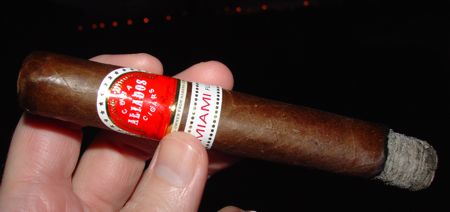
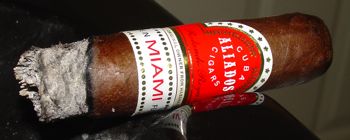
What I noticed first about the Cuba Aliados Miami (after removing the cedar sleeve) is how densely rolled it is. This is a really solid cigar, and this is made clear by the slow and regular burn as well as the pre-light characteristics. The Habano wrapper is dark and grainy with plenty of oil. The head of the cigar is shaped well, and even though it isn’t perfectly triple-wrapped it cuts cleanly and looks fine.

The grain from the wrapper is evident in the dark gray ash, which holds for a good inch and a half before it starts to bend a little precariously.  These are slow burning, luxurious cigars, so make time for them. I spent about an hour with the robusto, and close to 90 minutes smoking the toro and churchill sizes.

Overall excellent construction.

Tasting Notes

The Aliados Miami opens with a combination of black pepper and a dry woody flavor that I think of as quintessentially Nicaraguan. After half an inch or so the wrapper kicks in a sweet cedary aroma that blends really well with the spicier notes on the palate.

The mid-section turns to another flavor on the Nicaraguan palette — cocoa. The spice mellows but remains assertive. The cedar and cocoa meld nicely and produce a sweet sensation on the tongue that at times almost reminded me of mint.

The last third turns a little darker. The cocoa turns to a semi-sweet chocolate taste with tannic overtones, and the nicotine kicks in. The smoke texture is full in body, leading me to think it would be matched by this in power, but it’s a little more moderate in that regard. It starts out in medium-strength territory and sneaks up to full strength only at the finale. The burn gets a bit hot at the band, but the flavor and aroma are still fresh for the nubbin’.

Conclusion

Cuba Aliados Miami is a crisp, well-balanced cigar that exhibits what I think of as Nicaraguan flair, but it does so without losing its composure. (Or making me lose mine.) It’s assertive, not aggressive, and that is a quality that I wish more upper echelon cigar makers would emulate.

The construction qualities of this cigar were top notch. I had to double check my math after scoring one of these cigars — the Toro Viejo — at a 47 out of 50 construction points. That’s the high water mark for the year so far, and judging by last year’s entries it might be the one to beat for 2010.

Considering the quality of the blend and the limited nature of the release, it’s surprising to see how reasonably the Miami edition is priced —  around 6 or 7 USD per stick.

The modest price tag is about the only thing it has in common with Reyes’ other cigars. For fans of Puros Indios or the classic Cuba Aliados, the Miami Limited will be a bold new experience, but a very enjoyable one.

Final Score: 90

Upper Cut by Punch


Upper Cut is the newest cigar blend to fall from the Punch family tree. It is in part the result of the “Punch Election” conducted by General Cigar: they offered different prototype cigars to willing participants and tweaked the final blend based on the feedback they received.

The promotional material for this cigar focuses on the inclusion of tobacco from the volcanic island Ometepe. This island is actually two volcanoes called Concepción and Madera which rise out of Lake Nicaragua. The name comes from the Nahuatl Ome, meaning two, and tepetl, meaning island. Concepcion is the tallest of the two and is still active, whicle Madera is considered to be extinct. It is on Madera where the rich volcanic soil and tropical conditions allow for the cultivation of a unique type of tobacco.

The Plasencias have been growing cigar tobacco on Madera for years now, and Ometepe leaf can be found in cigars like Bolivar and Partagas Decadas. I don’t know if the filler tobacco in the Upper Cut is from a Plasencia farm, but it wouldn’t surprise me if it is.

Photo by Adrian Sampson

One of the beautiful things about volcanic soil is that is tends to be so rich in minerals that little fertilizer is needed, and at the same time it offers excellent drainage.  The soil in some parts of Ometepe is too sulfuric, but much of it is perfect for growing crops.  (Throughout history people have chosen to live near active volcanoes, despite the risk. The reason is the soil, and how well it supports the crops necessary for life. Like tobacco.)

Ometepe leaf is described as sweet and earthy, and the Upper Cut certainly exhibits those traits. The filler is composed of this and other Nicaraguan tobaccos, which is held in place by a Nicaraguan binder leaf and finished off with a dark Ecuadoran Sumatra capa. Only three sizes are currently in production:

  • Grand Corona – 6 x 45
  • Robusto – 5 1/4 x 50
  • Toro – 6 5/8 x 54

Construction Notes

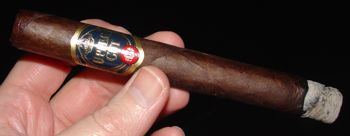
The Grand Corona in this line is a solid, well-built cigar. The wrapper is leathery in appearance with a fine sheen of oil. It’s solidly packed and draws quite well. It burns relatively slowly, needs no maintenance (despite a slightly uneven burn) and produces a righteous ash.

Tasting Notes

The Upper Cut Grand Corona opens with a sweet woody flavor which quickly reveals a pleasingly complex aroma. I couldn’t put my finger on it at first, but it’s a strange combination of sandalwood sweetness and sulfuric earthiness. Combined with a carmelized brown sugar sweetness on the palate, the taste is unusual and rather beguiling.

The cigar gradually builds in body and loses some of its subtlety at the mid-point, becoming a little more dry. The sweet wood turns more tannic, and the sugars take on a charred aspect. This is a medium bodied cigar at best, but it isn’t light on the palate.

The flavors start to wash out a bit in the last third as the grilled flavors bully the subtle ones off the block. There is some residual sweetness in the aroma though, an earthy, toasted wood scent that is still quite pleasant. Unfortunately, I found these returns diminishing an inch from the band, which was a little disappointing considering how well it started out.

Conclusion

I almost want to give the Upper Cut Grand Corona a split review — an A- for a great first half, and a C+ for a sputtering finale. It comes out of the gate with lots of promise, and for the most part it delivers, but the last third suffers by comparison with the first. But excellent construction gives this cigar a boost, and a reasonable retail price of $6.50 per stick makes this blend worth trying. Besides, some people like that charred flavor. If you’re one of them, and you’re in a medium-bodied frame of mind, I bet you’ll enjoy this cigar.

Final Score: 85

A special thanks to General Cigar for providing these review samples.

Cigar Chemistry: Know Your Carotenoids

Of the thousands of chemical elements that compose a typical tobacco leaf there are a few that take primary responsibility for the taste and aroma of your smoldering stogie. Some of the more important elements have been identified as members of the carotenoid family.  

Carotenoids

Carotenoids are the pigments which give many vegetables and flowers their color. The obvious example is that belicoso-shaped delicacy known as the carrot, from which the word carotenoid derives. Carotenoids give that root its orange color. In other cases the carotenoid content is masked by green chlorophylls, but as the fruit ripens and the chlorophyll content decreases, the colorful carotenoids emerge. This is what happens when a green tomato turns red on the vine.

The process of ripening is really just the early stages of decay — the constituent elements of the fruit, or in this case the leaf, are breaking down and releasing new and more organoleptically interesting compounds. Carotenoids are highly sensitive to oxygen, light, and temperature, and all of these things are carefully controlled by the tobacco grower as the crop is grown, harvested, and particularly during the curing and fermenting stages.

The major carotenoid pigments in tobacco are lutein, beta-carotene, moxanthin and violaxanthin. As these carotenoids break down via oxidation, aromatic derivatives are formed which are crucial and distinctive to the crop. For the sake of example, we can take one of these pigments, lutein, and look at some of its derivatives.

Lutein

Lutein is found in leafy green vegetables, most prominently in spinach and kale.  (And yes, tobacco too.) It is important nutritionally, but for our purposes here we are most interested in what happens when it degrades. Lutein breaks down during the air-curing process to several ionones and their derivatives, such as Beta Damascenone and Megastigmatrienones, two of the carotenoid derivatives which are most responsible for the smell of tobacco.

Beta Damascenone

Beta Damascenone is one of the rose ketones and is considered to be the marker for quality rose oil, even though it is present in extremely small quantities. For whatever reason, the human nose is very sensitive to this smell and very little is needed to detect it. Interestingly, it is found in beer, and is responsible for some of the floral notes in red wine (especially merlot.) In addition to its floral nature, beta damascenone is also associated with the smell of baked apples. It is not present in fresh apples, only baked. Other descriptors:

  • honey
  • plum
  • tobacco
  • blackcurrant

Closely related to the damascenenones (and damascones) are the ionones; in fact, they’re all part of the rose ketone group. Ionones are present in almost every type of perfume, and are almost always described as woody with strong violet accents.  Both alpha and beta ionones have been identified in cured tobacco leaf.

Megastigmatrienones

Don’t ask me how to pronounce it, but megastigmatrienones is arguably the smell of cured tobacco. Its four isomers have been isolated or synthesized and used in commercial applications to impart or “improve” the smell of tobacco and to cover up other unwanted odors. (It is available commercially as “tobacco cyclohexenone”.) It is sometimes held responsible for the note of tobacco that is often detected in full-bodied red wines. Most frequently the aroma of megastigmatrienones is associated with the following:

  • sweet tobacco
  • dried fruit
  • honey

Other interesting carotenoid derivatives found in cured tobacco are theaspirone, an ingredient in black tea and a component of tea essential oil, and beta-cyclocitral, which is described as green, grassy or hay-like.

Conclusion

Many cigar enthusiasts have detected flavors like these at one point or another. Floral, honey and tea-like notes I find most often in milder cigars, usually with shade wrappers.  And while these are just a few of the elements from only one group of the many compounds that contribute to the flavor and aroma of cigar tobacco, I hope it shows that notes of tea or grass or violet are not out of the range of possibility for some experienced cigar enthusiasts.

So if you find yourself musing over the soft wood and floral notes of that ’02 Choix Supreme and suddenly detect a hint of honey, consider yourself fortunate… not crazy.

Cigar Chemistry

I’ve done it. You’ve probably done it as well. At one point or another, most cigar and wine enthusiasts have gotten a little carried away with their flavor descriptors. The aroma of a premium cigar or the bouquet of good wine cries out for comparison to the other fragrances we encounter in our daily lives, but the subjective nature of this comparison often mystifies those who are less sensitive to the subtleties involved.

So we take the occasional lump for detecting notes of caramelized sugar or violets or vanilla beans in our stogies. Everyone will acknowledge that taste is subjective, and the fact that you smell cedar where I detect mint does not mean that either of us has faulty olfactory organs — but few cigar smokers recognize the physical reality, the purely chemical nature of the combustion taking place beneath their noses.  To some extent this process has been studied, and this series of occasional articles will attempt to shed some light on it.

But first, a caveat. I am not a scientist, and I am certainly not a chemist. All I’ve done here is layman’s level research, and I can’t pretend to understand the chemistry in detail. If I mislead or mistate something, I hope someone with expertise will correct me, and accept my thanks for doing so.

Introduction

Much of the aroma and flavor of cigar tobacco arises from careful curing and fermentation. As the leaves dry and undergo a natural but controlled process of degradation, chemical compounds break down and create other compounds. Many of these compounds are responsible for the flavor and aroma of cigar tobacco.

Leaves from different stalk levels vary in their chemical properties — the highest leaves on the plant  (ligero) have higher nicotine levels, tannins and resins. As most of us have experienced at one time or another, a ligero-heavy cigar is frequently powerful and highly aromatic, but doesn’t burn very well . Middle and lower leaves (seco and volado) tend to have lower levels of nicotine, less resins, higher soluble ash, and better burning properties.  The importance of careful blending of leaves from different parts of the plant is easy to see here.

In general, the strength of a cigar tobacco leaf is associated with nitrogen compounds. Aromaticity is thought to come from tannins and resins. Sugars and starches are are associated with mildness.

Curing

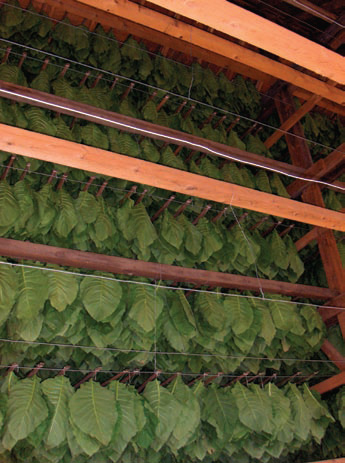
As soon as a leaf is separated from the stalk during the harvesting process it begins the process of curing.  In cigar production the newly primed leaves are removed to a curing barn where the tobacco is hung for curing in the open air. As the leaves turn from green to brown, the following physical and chemical transformations occur:

  • Dehydration
  • The percentage of starch in the leaf is greatly reduced while sugars increase
  • Tannins are reduced
  • Proteins hydrolize to amino acids
  • Alkaloids (including nicotine) decrease
  • Carotenoids begin to degrade into important aroma constituents

Fermentation

Cigar tobacco that has been properly cured is not quite ready to be bunched and rolled — it must be fermented first. Stacks of tobacco called pilones are created and allowed to heat up. The combination of heat and water (from the leaves themselves and also applied by workers) causes further chemical decomposition. The main processes that occur during this stage are the following:

  • A further reduction in tobacco alkaloids (especially nicotine)
  • Production of ammonia
  • An increase in amide and α-amino nitrogen levels
  • pH increase due to elimination of organic acids through oxidation and decarboxylation

Oxidation is the primary activity occuring in the pilones during fermentation, and this is chiefly responsible for the flavor and aroma of cigar tobacco.  During this process the cured tobacco releases carbon dioxide and significant quantities of ammonia.

Basic Chemical Constituents

For social and health reasons, tobacco is  the most exhaustively studied natural product on earth. Around 5000 different chemical compounds have been identified, and studies continue. But the primary constiuents responsible for taste, flavor, and burning properties are the following:

  • Carbohydrates, which account for 40 to 50% of tobacco weight. These include starches and sugars, sugar esters, cellulose, and pectin.
  • Alkaloids, including nicotine
  • Plastid Pigments: chlorophylls and carotenoid pigments
  • Isoprenoids, which are important aroma and flavor contributors. This class includes degraded carotenoids, acyclic isoprenoids, carbocyclic diterpenoids, cembranoids, and labdanoids
  • Carboxylic Acids. Cigar tobacco is particularly high in citric and malic acids.
  • Phenolics, including polyphenols and lignin, which are also important aroma compounds
  • Inorganics like calcium, magnesium, and potassium. These affect burning and ash-holding characteristics.

In future articles I will be looking at the compounds most responsible for taste and aroma, the isoprenoids and phenolics. And if I can pin down the compound responsible for that elusive vanilla note, I will be sure to let you know.

References

Tso, T.C. (1999) “Seed to Smoke.” Tobacco: Production, Chemistry and Technology

Leffingwell, J.C. (1999) “Basic Chemical Constituents of tobacco Leaf and Differences among Tobacco Types.” Tobacco: Production, Chemistry and Technology

LGC Serie R Lotus Giveaway

[picapp align=”center” wrap=”false” link=”term=lotus+elise&iid=7524694″ src=”7/c/0/b/Detroit_Hosts_Flagship_f267.jpg?adImageId=11537246&imageId=7524694″ width=”380″ height=”275″ /]

I’m down for the count this week with an exquisitely sadistic flu bug, so instead of a cigar review I will pass along this bit of nifty news: General Cigar is giving away a Lotus. And that’s not a lighter, folks. That’s a 2010 Lotus Elise sports car, and it could be yours if you’re one of the five winners of a three-day, two-night stay in Las Vegas. Of those five lucky first-prize winners, one will get the key that starts the engine.

From the press release:

Richmond, VA – Serie R cigars invites its loyal legion of fans to celebrate their enjoyment of strength, refinement and performance through an exciting sweepstakes culminating in the giveaway in Las Vegas of a 2010 Lotus Elise sports car valued at more than $52,000.

Consumers of legal smoking age who make an online box purchase of Serie R cigars from Best Cigar Prices, Holt’s Cigar Company, JR Cigars, Mike’s Cigars, or Thompson Cigars between now and May 15, 2010 are automatically entered in to a drawing to win a trip to the Serie R Performance Driving School which will be held on 9/17 to 9/19, 2010 in Las Vegas. No purchase necessary. For complete official rules, visit www.cigarworld.com/lotus.

Strangely enough, the La Gloria Cubana Serie R Robusto was one of the first cigars I ever reviewed for this blog. (Long long ago, when I was young and laconic.) And having gone for a week now without a good cigar, a Serie R sounds really really good. This is what I thought of this stick in 2006:

The Serie R maduros I’ve sampled are indeed rich, hearty cigars. I was prepared to be blown away, but was pleasantly surprised by their smoothness. There is a solid woody element with a touch of sweetness on the nose. The construction and burn were perfect, which is not an easy feat with a maduro wrapper as luscious as this one. For some reason Connecticut broadleaf fermented to this hue with all its oils does not want to burn as readily as the rest of the cigar, but in this case that proved to not be true.

Slow down at the midway point to avoid a tarry aftertaste. This one does not want to be rushed. A great 30 to 45 minute smoke, and in my opinion the best LGC yet.

It’s been a while since I fired up a fat Serie R, but as soon as I get the green light from my immune system I have one clipped and ready… unless I find one of the new LGC Artesanos de Tabaqueros first. ( Read the CA blog entry for details. Sounds like a great experiment, and hopefully more than a gimmick.)

~cigarfan


Brick House Robusto

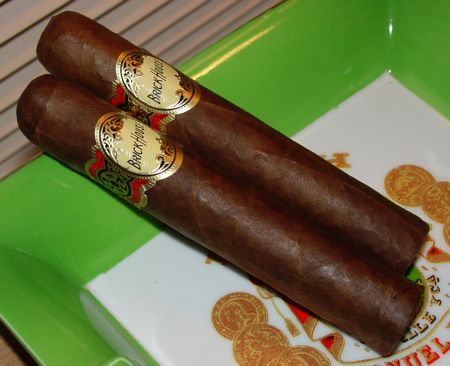
The latest trend for cigar manufacturers is to resurrect extinct Cuban brand names, no matter how unusual, and slap them on their latest blend. (CAO’s La Traviata, for example.) The Newman family, on the other hand, has been sitting on an old Cuban brand name of their own for half a dozen decades. And instead of being unusual, it’s pretty mundane: Brick House. The original Brick House brand honored patriarch J.C. Newman’s Hungarian heritage by depicting his home in the old country, a home that reportedly doubled as the town’s tavern. Sounds like a rockin’ place.

The first incarnation of Brick House was released in 1937 as a “clear Havana,” a cigar made in the United States from imported Cuban leaf. The new blend released in 2009 is a Nicaraguan cigar with what I assume is a proprietary wrapper leaf called “Havana Subido,” ™ a sun grown Ecuadorian Habano. Like the Newmans’ El Baton, Brick House is made by Tabacos San Rafael in Totogalpa, Nicaragua. (On the map it looks like Totogalpa is right next door to Esteli, which mitigates the surprise.)

Four sizes are currently in production:

  • Churchill – 7.25 x 50
  • Robusto – 5 x 54
  • Corona Larga – 6.25 x 46
  • Toro – 6 x 52

Construction Notes

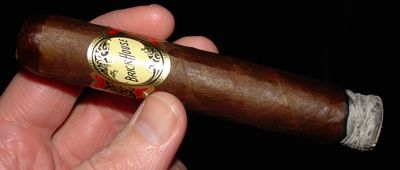
The Brick House Robusto is a nice looking stick with a ruddy colorado maduro wrapper. It doesn’t glisten exactly, but it exhibits more shine than is typical on sun-grown wrapper leaf. The cigar is well built with a nicely finished cap. One sample was visibly underfilled at the foot, causing a very loose draw. I was surprised to find that this did not promote a fast burn — the burn wasn’t slow either, but it didn’t burn fast and hot the way I feared. The burn was a little uneven, but it corrected itself, and the ash was long and firm.

Overall good construction.

Tasting Notes

The Brick House Robusto smokes like a classic medium-bodied Nicaraguan — woody with a sweet spicy aroma. The smoke is smooth from the start as it opens with mildly spicy cedar and a dash of salt. After half an inch or so a cocoa flavor presents itself, but without the bite that often accompanies heavier Nicaraguan blends.

Some black pepper shows up on the palate in the middle section, but it’s fairly mild. The smoke is still medium-bodied and the texture is smooth. The finish is slightly dry.

The last third is meatier and has more zing. It edges into the full side of medium at this point, but remains well balanced. The aroma is sweet and cedary, blending well with the darker grilled flavors on the tongue. The cocoa fades a bit at this point and disappears as the spice takes over at the band.

Conclusion

The Brick House is far more approachable than many brawnier Nicaraguans, but it shares the flavor palette that has made Nicaraguan cigar tobacco so popular in the last few years — cocoa, black pepper, and cedary spice in a balanced combination.

The other significant difference between Brick House and the competing array of bigger-boned Nicaraguan cigars is the price. The Newmans have priced this cigar economically at around 5 USD retail, and have instituted price protection to prevent Internet discounters from undercutting local brick-and-mortar shops. This is great news for both smokers and tobacconists, because this is a really decent smoke for a very reasonable price. And these days you can’t ask for much more than that.

Final Score: 88

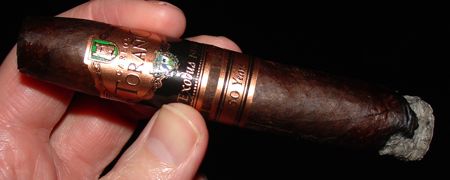
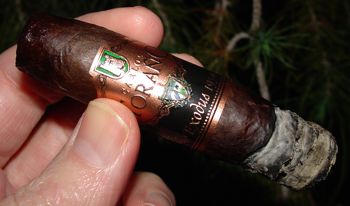
Torano Exodus 1959 50 Years

Like many cigar makers, the Toraños celebrate anniversaries with new cigars, but unlike most anniversaries, this one has a bittersweet flavor. 1959 was not a magical year for the Toraño family, but it is the year that made them what they are today. Hence the 1959 Exodus line of cigars, which includes this recent addition, the “50 Years” blend.

In the words of Charlie Toraño, the Exodus 50 years blend was created “to remind smokers of the hardship inflicted by Cuba’s Marxist communist regime, especially its exile of the world renowned tobacco and cigar families, including ours.”

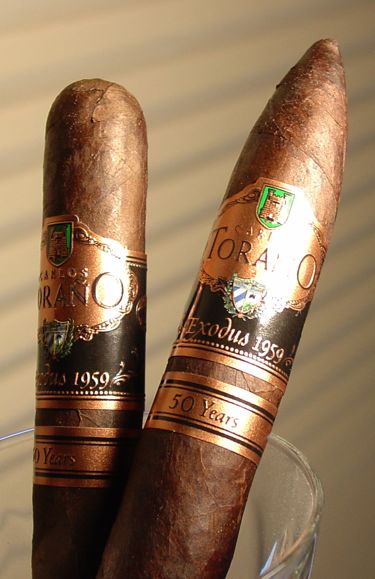
The 50 Years blend, released last year, is an addition to the familiar Silver and Gold Exodus 1959 labels. The new blend features a dark Brazilian Arapiraca wrapper, a nice contrast to the Silver label’s Honduran and the Gold’s Nicaraguan covers.  The ornate copper-colored label has some people referring to the 50 years cigar as the “Exodus Copper.”

The “50 Years” 1959 is rolled in Toraño’s Nicaraguan factory, while the other Exodus cigars are made in Honduras. Currently only three sizes are in production:

  • Robusto – 5 x 50
  • Short Churchill – 6 x 48
  • Torpedo – 5 1/2 x 52

Beneath the Brazilian wrapper is a binder from Honduras, and the filler is a combination from two areas of Nicaragua: Esteli, and Pueblo Nuevo.

The Toraños introduced the new line with their “Roots Run Deep” tour that traveled across the U.S. during the spring and summer of 2009, and it looks like they plan to keep the show running in 2010. Carlos and Charlie travel with a veteran torcedor who rolls special “Tour Blend” cigars that were so popular with event attendees that the blend is now available by the box at events. So check out the tour when it swings by your town.

Construction Notes

The 1959 “50 Years” is not advertised as a maduro cigar, but in appearance (as well as in performance) that is what it is. The wrapper is dark and oily with the slight chipping that maduro leaf is prone to. The roll is solid and the draw is firm, just the way I like it. The burn is a little uneven due to the oil-drenched wrapper leaf, but it corrects itself and builds a solid ash.

Overall very good construction.

Tasting Notes

This blend has been prescribed for dessert by some aficionados, and after smoking a few I can see why. The “50 Years” smokes like chocolate pie, the Mexican kind, with plenty of cinnamon and a splash of coffee liqueur.

The first slice is served up with a nice dose of pepper, not too strong, but assertive.  There is a woody base flavor, cedary with a touch of cinnamon. It starts out medium to full in body and stays in that range for the duration of the cigar.

These are fairly short cigars, so the flavor transitions aren’t dramatic. It does seem to get a little smoother in the mid-section though, with the pepper dropping off a bit and dark roasted coffee flavors coming to the fore. The flavor remains rich and semi-sweet.

In the final inches the wood gives way to leather, but the overall flavor is still soundly in that coffee-cocoa-chocolate territory, especially in the aroma. The sweetness coming off the wrapper has a distinctly liqueur-like quality, something almost like Kahlua.

Conclusion

I think most maduro lovers will get a bang out of this cigar. It’s balanced and well-blended, but on the heavy side with a lengthy finish and a little bite.  Overall, this is an excellent smoke that would go really well with a glass of tawny or vintage port after dinner.

Prices are in the medium range at 7 USD for the robusto and short churchill, and a dollar more for the torpedo.

Final Score: 88

Other Reviews of Note

(There are quite a few reviews of the Salomon, which is unfortunately not a regular production size. The following are reviews of cigars on retailers’ shelves now.)

Cigar Jack calls the Short Churchill his favorite cigar of 2009.

The Stogie Guys give the Torpedo a favorable Quick Smoke.

Barry rewards the Robusto with a 93 for A Cigar Smoker’s Journal.

A balanced review of the Robusto from the Cigarnut.