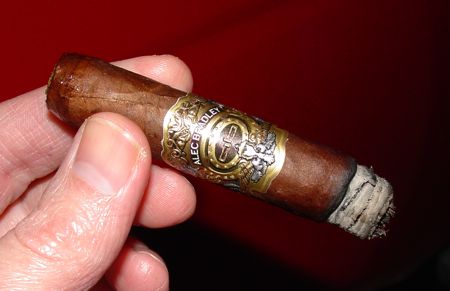
Arturo Fuente Don Carlos Vertical Review Pt. 2

afdoncarlosband

While sitting on the patio with the Don Carlos robusto last night I had a flashback to the first Don Carlos I ever smoked. It was about four or five years ago, and I was really looking forward to it as a “super-premium” special occasion kind of cigar. Prepared for a glorious experience I blazed it up on a star-lit summer night and sat back, waiting to be enthralled.

It didn’t happen. I thought it was a fine Cameroon style cigar, but not leagues beyond the Hemingway, or even the Chateau Fuente. The additional expense just didn’t translate into additional enjoyment that night, probably because my expectations were too high. I couldn’t complain, because it was an excellent cigar, but still I felt let down.

Now, several years later,  my approach is a little different. I’ve read the reviews, sucked up the hype, smoked the cigars, and snatched the pebble from the torcedor’s hand.

Most importantly, I’ve learned not to let price interfere with my expectation or cloud my judgment of a cigar. It’s not that price doesn’t matter — of course it does, especially in these uncertain economic times — but it doesn’t bear a direct relationship to the quality of a cigar. If you don’t believe me, get yourself a $30 Stradivarius and let ‘er rip.

So forget that the Arturo Fuente Don Carlos costs ten or twelve bucks a stick.

For the story of the cigar and biographical info on the Fuente enterprise, click here: Lucky7’s review of the double robusto. The long and short of it is that this is a special blend created by Carlos Fuente Sr. that incorporates Dominican tobaccos from the Fuente farms, capped by an exquisite Cameroon wrapper.
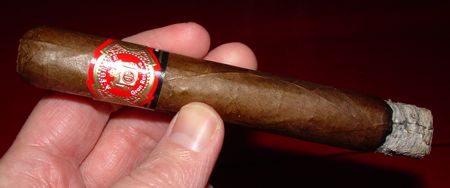
afdoncarlosdr

Double Robusto

At 5.75 x 52, the Don Carlos Double Robusto is a slightly longer, slightly fatter version of the standard Robusto. It doesn’t differ in appearance from others in the line — a sandy textured Cameroon wrapper surrounding a well rolled parejo, topped off with the customary Don Carlos glue smears.

It starts off a little bland, but after a half inch or so this cigar really warms up and gets to work with a soft cedary aroma and a toasty demeanor. Core flavors are nuts and cedar and the finish is dry. The sweet spice from the Cameroon wrapper contributes a minty element that at times tastes almost like anise.

By the mid-point of the cigar the smoke is creamy and has built up a more solidly woody flavor — more like oak than cedar, complemented by a cherry vanilla accent. The sweet spice from the wrapper continues, creating a complex brew of tastes and aromas.

While the Don Carlos is by no means a bruiser like Fuente’s Opus X cigars, the final section is fairly serious, kicking in a heavier dose of leather with black pepper. The sweetness begins to fade and the woody flavors become increasingly earthy. The finish grows longer and starts to muddy a bit near the band.
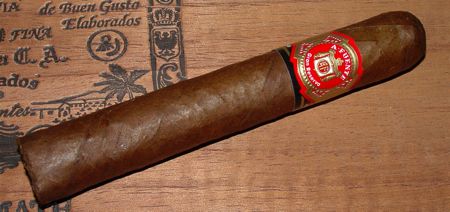
afdoncarlosrobusto

Robusto

Despite the fact that the 5 x 50 robusto is only a bit smaller than the Double Robusto, it seems to have a very different personality. The flavors are generally the same, but the robusto is a little feistier than the double.

It picks up where the double robusto leaves off — with a spoonful of black pepper dropped on the back of the palate. The aroma is a little less subtle as well; it’s not quite as soft but is still minty in nature, like crushed eucalyptus leaves. Not quite that strong, but more potent than most Cameroon wrappers.

Unfortunately this particular cigar decided to challenge me with some construction issues after an inch or so. When the burn went sideways almost immediately I thought that I hadn’t lit it correctly. A good blast from the torch and a stern reprimand and I figured we’d be back on track. But no.

After an inch or so I noticed that the stick seemed to be burning hot, and the flavor was getting a little ashy. I looked at the cinder and noticed that the wrapper was no longer burning, while the filler smoldered on. Despite my best efforts to rehabilitate this delinquent it appeared that my robusto was headed for reform school.

There’s only one way to deal with a tunnel if you hope to salvage an errant stick: shut it down. I put the cigar in the ashtray and let it extinguish itself. Ten or fifteen minutes later I clipped the cigar about a quarter inch below the ash line. I expected to find a hole, but the filler looked like it was solid and just slightly charred, so I relit it, hoping for the best. The first few puffs were positively acrid but after a minute or two the flavors began to clean up and become recognizable. The wrapper was burning in synch. Things were looking up.

The remainder of my now half-robusto was actually pretty decent, if short lived. Oak barrel smooth with a smattering of black pepper. The sweet spicy aroma was the highlight of this sad amputee as it turned prematurely dirty tasting close to the band, probably due to the rough treatment it received.

afdoncarlosrobusto2

Conclusion

Of the five vitolas in this line that I was able to sample thanks to Cigarsdirect.com, I have to award the laurels to the Double Robusto. The Number 3 was very good as well, and the others were fine cigars too. Even the robusto had its moments, despite what I think was a rare construction defect.

All told, this is one of the great Cameroon cigars, but is it worth the price? Yes, I think so, if your cigar budget can handle it.

As I think back to my initial impression of the Don Carlos robusto, lo these many years ago, I think my expectations were indeed a little too high. Sometimes a Don Carlos is just a Don Carlos, and for Cameroon lovers, it’s a must try.

Final Scores

Don Carlos Double Robusto: 91

Don Carlos Robusto: Incomplete

~ cigarfan

With thanks to Cigars Direct
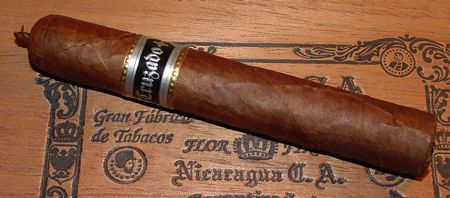
Cruzado Dantes

cruzado1

Cruzado cigars were introduced to the world in an unorthodox fashion last summer when the cigar’s creator, Dion Giolito of Illusione fame, decorated his booth at the IPCPR with pictures of the cult leader Jim Jones. There were those in attendance who immediately condemned this as offensive and in poor taste, which of course it was. But it was more than that, I think. Instead of drawing customers in with the treacle of bikini girls and tv celebrities, he seemed to be challenging us with a twisted kind of advertising archetype, an image of charismatic evil. Instead of hawking his new product (which is what the show is for)  he was offering a crowd of starry-eyed cigar fans an opportunity for self reflection, if not outright criticism. At the very least it was unexpected.

Ultimately it was more of a comment on the cigar industry (and perhaps the show itself) than anything else. If it showed disrespect for anyone it was the ad execs who drive the cigar business, or whoever the guys are who mix the industry’s Kool Aid. And while I can see his point (without taking it quite so seriously) I think letting Jim Jones to do the talking was a somewhat sideways approach. Provocative, yes, but maybe more dramatic than necessary.  Gutsy though, definitely gutsy.

Later in the show a sign appeared plastered over the multiple faces of Jim Jones : SOLD OUT. I found this ironic on about seven different levels, but I’ll spare you the post-modern mumbo jumbo.

Since then the controversy has subsided and the reviews of Cruzado have been almost uniformly excellent — the cigar has scored very well with the mainstream press, the blogs, and the guy in the shop who told me I was really going to like it.  (Okay, maybe the last guy was selling me a little Kool Aid. But it did win the Zennie for 2008, which carries more weight with me than a retail pitch.)

Illusione is a pretty punchy cigar. Cruzado was designed by Giolito and Arsenio Ramos of Raices Cubanas to be a little less potent  than Illusione by substituting viso for ligero in the filler and by easing up on the corojo content in the blend. As Giolito told Blog of the Leaf:

Whereas Illusione is a corojo blend with one component of criollo, Cruzado is a criollo blend with one component of corojo. Illusione exhibits an earthy sweetness in the olfactory sense. The profile of Cruzado is more forward on the palate with leather and spice.

Six vitolas are available, all of which have relatively narrow ring gauges:

  • Avalitos: 4 x 46 (petit robusto)
  • Dantes: 5 x 48 (robusto)
  • Domenicos: 5 5/8 x 46 (corona gorda)
  • Elitas: 6 1/4 x 44 (corona larga)
  • Marios: 7 x 47 (churchill)
  • Marelas: 5 5/6 x 46 (perfecto)

They are produced at the Raices Cubanas factory in Honduras using Nicaraguan criollo wrapper, a Nicaraguan binder, and filler from both Nicaragua and Honduras.

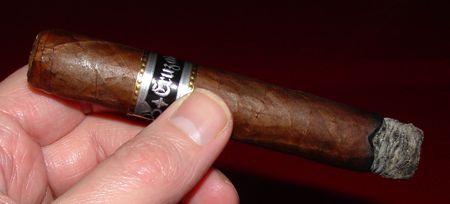
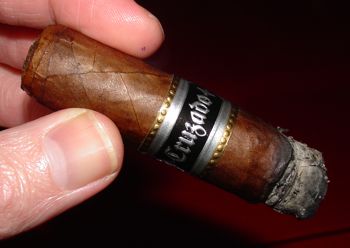
The Dantes is Cruzado’s robusto entry, though the 48 ring makes it seem almost like a short churchill. The wrapper is rustic, a little rough, and the bumpy texture of the binder beneath is easily seen on the surface. The head is triple capped with an attractive pig tail.

cruzado2

The pre-light characteristics are unremarkable, but the draw is spot on perfect. It lights up easily and gets things started with a bang — I was expecting a milder entry compared to the Illusione line, but the peppery overture with which this cigar starts is every bit as bold.

After half an inch or so the Dantes eases up a little and the differences between this and Illusione become evident. Cruzado lacks the same hickory/hazelnut flavor that makes Illusione so distinct. Instead I pick up freshly cut hardwood with an elusive sweetness on the edge. I’m not sure what it is…caramelized sugar maybe? Occasionally I’ll pass a little smoke through my sinuses to aid in my investigation, but I found the Cruzado to be a little too strong to do this comfortably.

The aftertaste is long and earthy, and it stays that way for the duration. The Dantes burns slowly and evenly, wavering only a little here and there, and builds a solid dirty gray ash.

The mid-section brings out some cocoa/chocolate flavors and continued earthiness on the palate. The last third is almost Honduran tasting — thick lashings of leather and pepper, almost like a Camacho Corojo, but lighter and more refined. And finally, as the band approaches, there are some hickory notes on the nose that are reminiscent of Illusione.

My expectation was that Cruzado would be a much lighter cigar than Illusione, but that was not my experience. It may be a tad lighter, but not by much, and it’s certainly not a lighter formulation of the Illusione blend. (For that, I might recommend the Illusione ~mk~, which is a brilliant cigar in its own right.)

The Cruzado Dantes wins big points for complexity and style — there are some distinctly unusual flavors here, and they’re all balanced very well. Keep in mind that this is still a very Nicaraguan cigar and it comes with the bite — and the buzz — typical of the breed. Like Illusione, Cruzados are not easily found, but at around 8 dollars per stick they should be in the sights of medium to full-bodied cigar fans everywhere.

cruzado3

Final Score: 88

~cigarfan


Other Reviews

Matt gives the Elitas an A+ but has some trouble with the Marelas

Barry awards the Marelas a whopping 96 points

A nice guest review of the Marelas at Stogie Review

Doc give the Dantes a thorough physical for the Stogie Fresh 5

Camacho Havana Monarca

camhavana

I make no apologies for being a cigar fiend, but I’m aware of the impact that fiendish behavior has on the cigar market. If it were just me and a handful of fanatics, it wouldn’t be such a problem, but it’s not. It’s you. And you. And you. The root of the problem is that cigar fiends like us are always on the prowl for a new blend, regardless of the number of sweet smokes already available. Hence old companies with reputations that have stood the test of time must needlessly reinvent themselves, trowel vanishing cream over well-earned wrinkles, test out new crops, whip up new blends, and conjure up flashy new ad campaigns.

Or sometimes, they just repackage the brand and get a new band design.

It’s hard to believe, but the Camacho Havana cigar has been around for over forty years.  I would guess that the blend has changed somewhat over that span of time, but from talking to old timers it sounds like it hasn’t changed that much. Back then it was considered more of a full than a medium-bodied cigar, but that was before the heyday of the heavyweights. By comparison with Camacho’s Corojo and Coyolar (and Triple Maduro and so on) the Havana is a sweetheart. But it’s still fairly steely when compared to the mainstream blends popular a few decades ago.

Like the majority of Camacho’s blends, this is a Honduran puro– the wrapper is a Criollo leaf from Jamastran and the innards are Honduran corojo. Available in twelve (count ’em) twelve sizes, there is a stick to match any desired duration. Today’s target is the 5 x 50 Monarca.

In 2007 the boxes were reengineered to display better on retailer’s shelves, but I’m not sure why the bands were changed. Perhaps to appeal to the short attention span of your average cigar fiend? Lookie! It’s NEW!

The new gold band surmounts a mediocre looking cigar — the wrapper is lackluster and the roll a bit lumpy, but the cap is triple wrapped and tight. After slicing off the cap with a guillotine cutter I notice the draw is free and easy. Maybe a little too much so.

camhavana2

The first flavors out the gate are earth with a touch of pepper. Compared to the Camacho Corojo toro I smoked last weekend, the Havana is positively friendly. There’s no fight to this guy at all — just an easy cruise down the boulevard with the top down.

To accompany the loose draw is a fast burn, but it never overheats or gets bitter. It’s just a little too quick for my liking. The ash also has a tendency to blossom — the wrapper ash curls out and either breaks off or blows away.

Midway through the cigar I notice a creamy texture to the smoke — a little unusual for this brand. The flavors are still earthy — mineral and salty notes — and the aroma is slightly sweet. I noticed this with the aged Camacho Havanas I had last year — the aroma is of mild ginger and wood. A more powerful filler blend would overwhelm these delicate elements, but there’s a fine balance here.

I wouldn’t call the Camacho Havana a terribly complex cigar, but it has enough weight and spice to keep my interest for the 30 minutes it takes to smoke one — my only complaint is that 30 minutes seems unduly short for a robusto sized cigar (for me, anyway.) I think the Corojo will remain my mainstay blend from Camacho, but the Havana is a worthy medium-bodied alternative.

Prices vary, but it looks like a box of 25 is running around 100 bucks. Eminently reasonable, and a steal at any lower price.

camhavana3

Final Score: 83

~cigarfan

Cabaiguan Petite Cabaiguan

cabaiguanpetite

I’ll admit it. I’m no Shackleton. With a little nip in the air this week I’ve been reaching for the small stuff — RP Sungrown PCs, AF Hemingway Short Stories, and these Petite Cabaiguans — in an effort to grab a quick smoke without freezing my phalanges off.  I mean, seriously, it’s been in the low 40’s. It may be a cliche, but it’s true about the desert: it’s not the cold, it’s the aridity.

shack1

Not Pete Johnson

And even though I miss having my long leisurely apres dinner smoke, I’m happy to say that all of the small sticks I’ve had this week have hit the spot, including this Petite Cabaiguan.

Most folks are familiar with this line by now — it’s made by Pepin Garcia’s crew for Pete Johnson, best known for his Tatuaje cigars. It’s usually characterized as a milder version of Tatuaje, but I think the blend really stands on its own without that comparison.

The filler and binder are Nicaraguan, though I have to wonder how much of each is required for a cigar this thin. The wrapper is a gorgeous Ecuadorian Connecticut leaf that ultimately steals the show.

The only problem that I’ve ever experienced with Cabaiguan is the occasional tight roll. I’ve had no such trouble with these unbanded 4 1/2 x 32 Petites. Every one has drawn perfectly. They’re rolled firmly with the expected triple cap (even on this tiny vitola they cut no corners) and are as attractive in miniature as my preferred Corona Extras.cabaiguanpetite2

The Petite Cabaiguan has a crisp flavor that will be familiar to anyone who has smoked the full size cigars in this line — it starts out cedary with a citric accent and a delicately floral aroma. The smoke is creamy and about medium in body, though less so in strength. The smoke production is limited by the ring gauge, but there is still plenty of flavor to go around.

For a small cigar, the Petite is quite complex — cedar, earth, citrus and floral qualities all emerge at different points in its 20-minute career. Despite the lack of a transition in flavors it’s a far more interesting smoking experience than anyone has the right to expect from such a little guy.

Aside from its role as my inclement weather friend, the Petite Cabaiguan would be perfect for a coffee break smoke. At 150 USD for a box of 50 it’s not exactly a budget quick smoke, but given the quality of this cigar the asking price is within reason.

cabaiguanpetite3

Final Score: 88

~cigarfan

Troya X-Tra Cetro

troyaxtra

When Britain’s Imperial Tobacco swallowed up California’s tiny Lignum-2 last summer for a paltry $22 million they were primarily interested in Lignum’s budget cigarette line called “Rave.” I’d never heard of Rave, nor have I any interest whatsoever in cheap cigarettes, but I was momentarily alarmed by the news because Lignum-2 owns one of my favorite premium cigars: Troya Clasico.

Imperial’s acquisition means that Altadis USA will take over distribution. When I saw an Altadis sales rep in the B&M the other day I had to ask him about the fate of Troya Clasico. He said “I think that’s the one they’re keeping,” and that the other lines would most likely be re-blended, or dropped and replaced with other lines.

Which makes sense — if they are going to keep any of the lines it has to be the one Don Pepin Garcia makes. It’s the only DPG blend Altadis owns. Even if it isn’t their best seller, it might be their best cigar.

So it was no surprise when I began to see Troya X-tra Cetros for under 2 dollars a stick in clearance sales and on the auction sites.  A premium cigar for under two bucks? Hell, I’ll try it, even if the line is on the endangered species list.

The traditional Troya is a mild-mannered Dominican blend that was unveiled way back in 1985. The X-Tra was released in 2004 in response to the demand for fuller bodied cigars — it’s a Nicaraguan puro featuring a Corojo 99 wrapper and binder surrounding a criollo filler in the core.  Sound familiar? According to the manufacturer, Pepin had a hand in the early development of the X-Tra, though he was not the sole blender.

The X-Tra line is available (for now) in five sizes which are numbered, as all Troya cigars are, in rather mysterious fashion:

  • No. 18 – Robusto
  • No. 54 – Toro
  • No. 63 – Churchill
  • No. 81 – Torpedo
  • No. 45 – Cetro

The first four are standard size vitolas, but the Cetro is a little unusual. At 6.2 x 45 it’s basically a gran corona.

The wrapper is a rich dark colorado maduro with a few veins and a grainy texture. It’s not the prettiest wrapper around, and the cap is nothing to look at either — just a single flap slapped on tight. But the roll is solid and the cap shears off nicely. The prelight scent is horsey.

troyaxtra2

I’ve tried these in batches of five from three different boxes and have found the draw to be a little inconsistent. Some of them had a perfect draw, some were a little tight. The tight ones were still smokeable, if a little annoying.

First light impressions were that this is a nice medium-bodied Nicaraguan style cigar — lots of corojo sweetness over a base of leather. The coffee and caramel notes that are typical of Nicaraguan corojo are the primary players here.

Aside from the minor draw issues that some of these exhibited, construction values are good: most of them burned plumb-line straight, and the resulting ash is strong and tight.

The mid section seems to me a little juicier than the first, almost fruity at times. As it winds down to the close there isn’t too much of a transition and the cigar doesn’t get much more complex: just continued caramel-tinged coffee that combines with the leathery aroma to create a satisfyingly simple package. It’s somewhat similar to an aged Famous Nicaraguan Corojo.

If there’s anything “extra” as this cigar burns past the secondary band it’s a slight burn at the back of the throat — this is typical of  mid-range Nicaraguan cigars, and is quickly cured with a swig of iced tea or cold beer. That’s really the only fault I could find with this cigar.

The Troya X-Tra is a pretty decent smoke at its regular price, but at closeout prices around 50 USD for bundles of 24 it’s fantastic. If you’re looking for a deal on medium-bodied Nicaraguan corojos, this is a nice pickup. Better be quick about it though.

troyaxtra3

Final Score: 88

~cigarfan

Cigar Wrapper Colors

wrapper-colors

Cigar Wrappers from Light to Dark

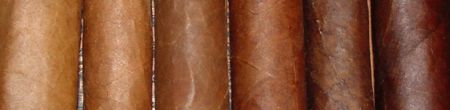
The old saying about being able to judge a book by its cover is dead on when it comes to cigars. Forget about the box, forget about the band; the outside of a cigar—its wrapper—will tell you more about how it will smoke than anything else will. You won’t find a full-bodied, spicy cigar cloaked in light green. And a mild smoke in an inky-brown, oily wrap is a rare thing indeed.

Cigar manufacturers have identified some hundred or so different wrapper colors and names over the years, but they basically boil down to eight basic categories. There are some variations in each—what one company will call a Colorado Claro might be classified as a plain Claro by another—but typically not enough to result in a discernable difference in strength and flavor.

In general, the darker the wrapper the fuller-bodied and sweeter the smoke, thanks to the greater concentrations of sugars and oils from longer sun exposure and curing.

Double Claro—Also called Candela, or Jade, ranging from very light green to light greenish brown. Very mild and bland; the leaves for these wrappers are picked before they’re fully developed and quickly heat-cured to develop their distinctive color. This wrapper was very popular in the U.S. in the 1950s, so it’s sometimes also called American Market Selection, or AMS.

Claro—Shade-grown, light tan to yellow tan in color. Neutral in flavor and a mild, smooth smoke. The color of many Connecticut Shade wrappers.

Natural—Also called English Market Select (EMS), grown in the sun and ranging from medium tan to brown. More oil than Claro; still a mild, smooth smoke.

Colorado Claro—Natural with a reddish tint (Colorado means red in Spanish).

Colorado—Also called Rosado. Medium to medium dark red-brown. Wrappers grown in Cameroon and the Dominican Republic often sport this color.

Colorado Maduro—Dark brown with a reddish hue. Often seen on cigars from Honduras, Nicaragua and Cameroon.

Maduro—Dark brown to very dark brown, heavier textured and typically with more visible veins. Often somewhat oily-looking, but not necessarily so. Sometimes called Spanish Market Select (SMS). Maduro is also a type of leaf processing that involves intense fermentation — here the term refers to color only.  (A wrapper leaf processed as a maduro is usually maduro in color as well, but not always.)

Oscuro—The darkest of the dark, very dark brown to almost black. Like Maduros, some manufacturers use the SMS designation for Oscuros.

Just remember: these terms refer to the color of the leaf only. One of the cigars pictured below is a maduro; the other two are dark corojos. Can you tell which is which?

maddie-or-corojo

~sponsored by our friends at Cigars Direct


JFR vs. JFC

jfr-jfc

A while back I reviewed a cigar that I thought was a real find: the JFR by Tabacalera Tropical. The reputation of this cigar has spread without the benefit of advertising and it has earned a nice following.

The “Just for Retailers” cigar is produced by Tabacalera Tropical for sale by authorized purveyors of fine tobacco products — for retail sales only. Now this makes good sense. Tropical is doing brick and mortar establishments a service by providing a quality product that is available only in stores. You and I have to peel ourselves off the couch and roll our ponderous selves over to the shop to get our JFRs. While we’re there we’ll probably pick up a few other goodies — and this is great for the stores. So far so good.

Now why would the same manufacturer turn around and offer the same great blend to a well-known cigar supergiant for internet sales — doesn’t this defeat the purpose of the retailer-only concept? If I were a retailer I’d be spitting bricks, unless… they were actually different cigars. If the retail version were of considerably better quality, that might make some sense. A little, anyway. Let the B&Ms sell the real deal, pawn the seconds off on the internet. Hmmm…jfr-jfc-caps1

So the question remains: is there any real difference between the “Just For Retailers” cigar and the “Just for Catalogs” version? I picked up a few of each and pitted them against each other on successive nights this week.

They are virtually indistinguishable except by the flagged foot of the JFR. Both score highly in the aesthetic department — rich looking oily wrappers that bear tight triple-wrapped pig tailed caps. In terms of appearance these babies could compete with anything coming out of El Rey de Los Habanos. Very nice.

JFR Super Toro

The pre-light characteristics of both the JFR and  the JFC were similar — horsey with a touch of leather. Nothing to complain about there. Good draw, easy light.

As I’ve mentioned before, the JFR has a sweet nutty flavor that reminds a lot of Illusione cigars. It’s almost like candied hazelnuts. The aroma is leathery — combined with the sweet flavors that later pick up some coffee notes, the overall sensation is quite complex. Add some oak and a touch of vanilla. There’s a lot going on here.

After the mid-point the JFR gets much heavier, earthier, spicier, and aggressive. While the first half of the cigar is relatively smooth, the second is pretty rough. My previous experience with this smoke has been that I can’t smoke it much past the half-way point, but lovers of heavy Nicaraguans will probably feel differently.

Some of the JFRs didn’t burn as well as I’d hoped: a few corrections were necessary to keep the burn even, and the draw felt a little bit loose at times. On the other hand, they all burn with a slow determination. This is at least a 90 minute smoke for me.

jfc

JFC Super Toro

The JFC is a much less boisterous cigar. It starts out with a mild woodiness and just a hint of the sweet nutty flavor that the JFR brings to the fore. The JFC is not as sweet and doesn’t have the JFR’s oak-and-vanilla component, but the aroma is somewhat similar — leathery, but at a reduced volume. There simply isn’t as much flavor here.

On the other hand, it’s a much easier cigar to smoke. The first half is smooth going and though it picks up speed in the second half it never gets truly aggressive. The construction is also a little better — it burns evenly without needing touchups and the draw is more consistent.

What the JFC lacks that the JFR has in spades is complexity. Both are fine cigars, but they seems to have different temperaments entirely — the JFC is smooth and simple; the JFR is bruising and complex. Both good cigars, but not the same.

jfash

Even the ash looks different: the JFR (left) produces a dark ash akin to some Cuban cigars, while the JFC’s is lighter, like what you’d expect from more completely fermented tobacco.

Bottom Line

The” Just For Retailers” and the “Just for Catalogs” cigars are not the same blend. Both are good cigars, but the JFR is a much fuller bodied, more complex cigar with some minor construction issues. The JFC is a smooth smoking, flavorful but not very complex smoke that exhibits much better construction than its brother. I give them both passing grades, but the JFR gets the nod for its more robust flavor.

Final Scores

JFR: 86

JFC: 84

~cigarfan

Postscript: I just went back to the cigar supergiant website to see what the going price is for JFCs, and they appear to be out of production. So much for that…

Tempus Genesis by Alec Bradley

tempus

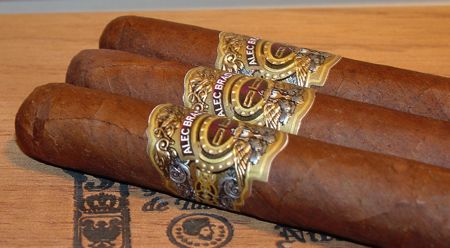
What initially lured me to the Tempus line of cigars was not the company behind the smoke — Alec Bradley — even though AB rolls out some really nice affordable blends. Nor was it the flashy yet tasteful band. What got me was the factory — Raices Cubanas in Honduras, where they also roll Illusione and Cruzado cigars for Dion Giolito.

So needless to say I was pretty excited to get my hands on a few of these a couple months ago.  By the time I finally acquired them I’d read many favorable reviews and my appetite was whetted. I ripped open the five-pack, put four in the humidor, and reached for my cutter. But wouldn’t you know it. After all that pent up anticipation the first cigar I try is plugged. GAHR!

I tried to smoke it anyway, but after half an hour of fruitless struggle I gave up. With one down and four to go I decided to let the new arrivals unwind for a bit in the humidor. Fast forward a couple months and their performance is either very much improved, or that tight one was an anomaly.

The Genesis is the corona entry in the Tempus lineup. They were originally released (to much acclaim) in May of 2008, along with the standard robusto, torpedo and churchill formats, in addition to a lancero. Recently a large perfecto has been added. In line with the Latin theme (tempus is Latin for time) the vitolas have very Roman sounding frontmarks:

  • Centuria (7 x 49 churchill)
  • Imperator (6.1 x 52 torpedo)
  • Terra Nova (5 x 50 robusto)
  • Creo (7.5 x 41 lancero)
  • Magistri (6.5 x 53 perfecto)
  • Genesis (5.5 x 42 corona)

Alan Rubin, the man behind Alec Bradley, says that the Tempus has been in development since 2001. It has taken that long to work the blend, hence the name Tempus (I presume.) The cigar was built around the wrapper leaf — a rich and bold Honduran Criollo 98.  Beneath the hood there is an Indonesian binder and a blend of corojo and criollo tobaccos from Honduras and Nicaragua.

The rough and veiny wrapper is lacking in aesthetic appeal, but the complexity of flavor and aroma of the cigar proves once again that looks can be deceiving. The caps on some of these sticks are bumpy and irregular, but they are nicely mounted, some with triple and others quadruple seams.tempus2

I would classify this as a fairly aggressive medium-full bodied cigar. It starts up with a zingy sweet char and a leathery aroma. The flavor is earthy with a good dash of pepper. There is a mild bite on the tongue, but it mellows after about half an inch. At this point the smoke takes on a somewhat musky quality.

Two thirds of the way in and I’m picking up more woody notes — that sweet char remains, but it is augmented by a sweeter, woodier aroma.  The burn is very good, but the ash has a tendency to crack and fall off.  The draw problems I had with that first Genesis are all but a distant memory — the rest of them were just about perfect in that department.

Forty five minutes later and I’m entering the last leg of this corona — the woody core is still beating strong, accompanied now by a return of that initial peppery spice. The aroma retains that musky element that cropped up early on, but now there’s a sweet corojo-like caramel edge to it.

This cigar is best approached slowly — smoking it quickly, or pulling on it too forcefully, results in a smoke that is both more aggressive and less complex than it should be. There’s a decent kick to this smoke as well, but nothing that warrants concern. My only complaint was that it wasn’t quite as smooth as I had hoped, but smoking slowly helped to minimize the bite.

Overall I’d say the Tempus Genesis offers a lot of complexity in a small package, but it lacks gentility, and there may be some consistency issues in construction.

And who knows? Maybe the rough edges on this cigar will be tempered by time… so to speak. In any case, with its very reasonable price (in the 6 to 10 USD range) and fantastic aroma I will most definitely be trying some other sizes in the line.

tempus3

Final score: 87

cigarfan

Other Reviews of Note:

Her Humidor reviews the Genesis

Brian’s take on the Terra Nova for the Stogie Review

Jamie endangers his designer cut-off t-shirt with the Genesis

Cigar Bastard objects and Cigar Monkey sustains.


Taboo Twist

taboo

If you’ve heard of Taboo cigars you’re probably from the DFW (Texas) area or you’re a member of one of the online cigar forums. They haven’t received wide distribution yet, but this brand’s reputation has spread by word of mouth, backed up by great customer service.

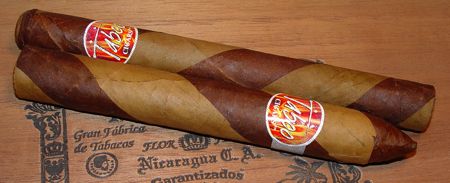
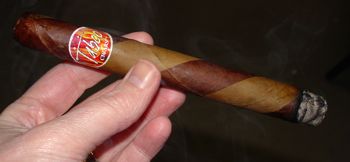
The Taboo line currently comprises several different blends that span the spectrum from mild-medium to full in body, but over time the one that has gotten the most attention is this one: the Taboo Twist. This is an easy smoking anytime-of-day sort of cigar that plays on the “barber pole” or dos capas theme — a two-toned wrapper composed of a claro shade wrapper and an alternating maduro. Ergo, Twist.  The cigar is all Nicaraguan, with the exception of the claro wrapper which is Ecuadorian Connecticut.

Town and Country Cigars (the storefront for Taboo) offers several different samplers of the various blends, so after reading some good reviews on Club Stogie a couple months ago I picked up a Twist sampler. In my experience the barber pole cigar is one of two things: exactly the gimmick you thought it would be, or an intelligent blend of maduro sweetness and Connecticut creaminess. I’m happy to report that the Taboo Twist falls into the latter category.

taboo21

The Twist is an attractive cigar — both wrapper leaves are top shelf. The roll is solid and the claro cap is integrated well. A pre-light draw is a little bit grassy but the draw resistance is just right.

It takes a half-inch or so for this smoke to get down to business — it’s a little grassy to start with, but it warms up to a nice earthy glow. The smoke starts out smooth and easy and stays that way for the duration.  A smooth customer.

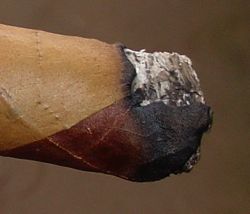
The next stage remains in earthy territory but gains some sweetness and a touch of spice.taboo3 The flavors are nicely balanced, but I’m finding that I have to correct the burn occasionally. The maduro leaf sometimes resists the burn, and if both sides are not burning in tandem the balance is lost. (This was the case with the churchill, but strangely not with some of the other sizes.) Keep your torch handy just in case.
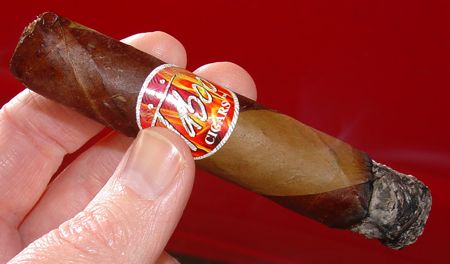
The last third is nutty and creamy with a bigger dollop of spice — the overarching effect is like a peanut butter cup with sprinklings of cinnamon and white pepper (but not quite as sweet, of course.) The earthiness makes a return appearance near the nub, but the main theme of this cigar is smooth creamy spice with touch of sugar. If you can imagine how the sweet char of maduro might combine with the mild spice and creaminess of Ecuador Connecticut — that’s pretty much how it smokes.  Flavorful and aromatic, but never overwhelming.

Retail prices run around 5 dollars a stick — the sampler is available for $24.99, but keep your eyes peeled for special deals and coupons offered on the cigar forums — the newly amalgamated puff.com or cigarasylum.com.

taboo4

Final Score: 87

-cigarfan

Fun with Numbers

cigar-score

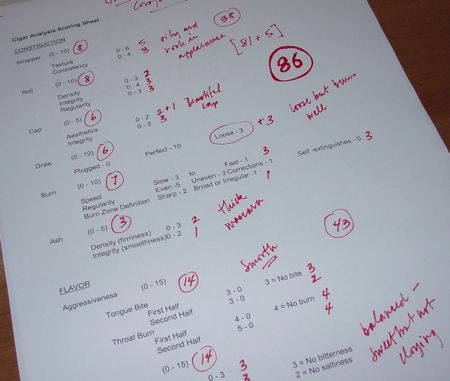
After careful consideration (actually about three years of hand-wringing) I’ve decided to start publishing the Almighty Numeral with my reviews.  After writing this year’s “Best Of 2008” post I had second thoughts about my resistance to rating and ranking: I had about 25 cigars that I thought were worthy of being “Bests” and found the selection and ordering process excruciating. A numerical score might have helped me to rank them.

And while a numerical rating is no more objective for this purpose, using a consistent method of evaluation levels the playing field, making qualitative comparisons between blends a little less arbitrary. I hope.

Quantifying quality is a complex matter. Perhaps it shouldn’t be done at all. I will never feel totally comfortable with either my rationale or my evalution method, but I’m going to publish the rating numbers anyway with the understanding that they are not to be taken all that seriously. I have considered moving to a standard format as well, but unlike the White Queen I can only have one impossible thought before breakfast.

To describe my rating system a little:

I subscribe to the notion that the construction of a cigar is just as important as its flavor — for me a Flor de Oliva bundle cigar that burns well and tastes good is going to win over a plugged Cohiba Esplendido. So in my scheme construction and flavor are assigned equal weights.

Construction

Within the category of Construction, equal weights are assigned to four factors:

  • Wrapper (evaluated for appearance, texture and consistency)
  • Roll or Bunch (Density and uniformity)
  • Draw
  • Burn (Speed, regularity/evenness and burn zone definition)

Lesser weight is given to cap quality (evaluated for appearance and integrity) and ash (density and integrity.)

Flavor

My scoring sheet is a modified version of the one used by John Vogel’s Tabacos de la Cordillera — over the years I’ve looked at  several different evaluation methods and this one impressed me the most in terms of its detail. For one thing, it places the smoothness (or in his terms, aggressiveness) of a blend in a position of great importance, and I agree with this wholeheartedly. For me it is equally as important as taste, which is why in my scheme they share equal weight.

  • Agressiveness (smoothness) defined as tongue bite and/or throat burn, or preferably lack thereof, in the first and second halves of the cigar, with more leniency given for bite in the second half.
  • Taste: Greatest weight is placed on balance. Points are deducted for excessive sweetness, bitterness, saltiness, or sharpness (metallic flavors.)

Lesser but substantial weight is given to aromatic qualities (judged for complexity) and aftertaste:

  • Complexity (evaluated for distinctive aromas/flavors and transitions in flavor from start to finish.)
  • Aftertaste (simply agreeable… or not, during the first half and then again in the second half of the cigar.)

The picture above is an example — if it can be seen clearly enough — of the first sheet for an evaluation of the Gran Habano No. 5 rothschild. Typically I would try to do at least two, preferably three of these and then average the numbers before publishing a review. The total points awarded the Gran Habano Corojo was 81 — a five point correction is added to the total, otherwise I would almost never rate a cigar over 90 points — giving the Gran Habano rothschild an 86 in this instance. That seems about right to me.

A numerical rating is never going to take the place of a considered review — with angelic flights of questionable description and history lessons where available — so my blathering will continue in its customarily undisciplined fashion. But now with an easily ignored numerical rating pinned to the donkey’s ass.

Caveat lector.

-cigarfan