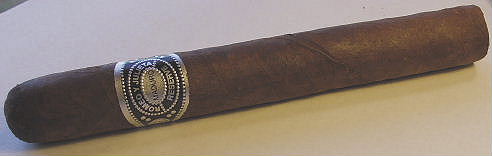
Rocky Patel Vintage 1990 Toro

Cnv0127.jpg

Rocky Patel is one of the few survivors of the “Boom” years of the mid to late 90’s. With help from Nestor Plasencia his Indian Tabac brand gained a reputation as a solid “boutique” cigar, and it’s still a grand smoke. I had a Super Fuerte maduro the other day that really made my day.

Richard over at Blankmindblog reviewed an RP Vintage 1992 Robusto and it put me in mind of the 1990 version that I’ve enjoyed in the past. After rooting around in the humidor I found a couple that I couldn’t wait to fire up to see if my opinion or the cigar has changed over the past few months.

Both the 90 and the 92 Vintages are made in Danli, Honduras with tobacco that was meant for Astral cigars. In the mid nineties U.S. Cigar thought Astral would become the next Montecristo and stockpiled bales of wrapper leaf in its warehouses. A large quantity of this never made it to market, and sat quietly ignored, gracefully aging and awaiting its fate. Patel came across it and snapped it up after discovering its quality. There were two types of leaf in the stockpile: Ecuadoran Sumatra from 1992 and Honduran broadleaf from 1990.

The 1990 toro measures 6 1/2 by 52, is box pressed, and looks pretty rough. Broadleaf won’t win any beauty pageants, but it can be extremely tasty.

Richard noticed a construction issue with the 92, and I’ve noticed it as well. I’ve never encountered this with the 90 though. The 90 burns a little uneven, but it corrects itself, and the draw is quite good. It’s a medium bodied smoke that I find extremely smooth up to the finish when it gets a bit heavier and the taste turns slightly tarry. The predominating flavors are wood and cherry. The broadleaf is very aromatic and worth the price of admission alone. All in all a very refined medium-bodied cigar. A great mid-day smoke.

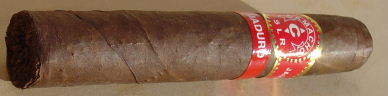
Carlos Toraño Cameroon 1916 Robusto

Cnv0126.jpg

Wrapper: Cameroon

Binder: Nicaragua

Filler: Honduras, Nicaragua

Made in the Toraño factory in Esteli, Nicaragua and introduced in 2003, this is one of the best Cameroon wrapped cigars on the market, in my opinion. When its very reasonable price is factored into the equation, this smoke beats Fuente’s Hemingway line hands down. This is not to disparage the Hemingway in any way, but for the price of half a dozen Hemingway Signatures you can find a box of 1916s. And to tell you the truth, I enjoyed these robustos better than the last Signature I had.

1916 was the year Carlos Toraño Sr. emigrated from Spain to Cuba, and the 1916 moniker marks that occasion. Weighing in at 5 1/2 x 52, this robusto comes fully dressed with two bands and a cedar sleeve. Removing the sleeve reveals a smooth and oily cameroon wrapper with its telltale tooth.

The first few puffs are earthy and smooth, and this is a trait that continues to the end. The ash is white and a bit crumbly. The sweet spice of the cameroon leaf is the next course on the menu, and it doesn’t disappoint. It’s a very slow burning cigar, lasting nearly an hour. The smooth flavor continues throughout, and ends with a woody flavor spiked with a pervasive sweet spice that lingers in the nose. The cameroon leaf burns with a fragrance that smells almost like perfume. Good perfume, not that fruity stuff.

The aftertaste is a little bitter, but that is the only criticism I have of this cigar. (Maybe the aftertaste would be a little less pronounced if I could keep myself from smoking these to the nubbin.)

All Toraño cigars are draw tested, and I’ve never had one that didn’t draw really well. The construction standards applied here are clearly exceptional. Anyone who appreciates cameroon leaf and likes a smooth medium-bodied earthy taste in their smoke should definitely give this one a try.

Camacho v. Camacho

Cnv0123.jpg

Camacho SLR Maduro, Plaintiff
Cnv0122.jpg

Camacho Coyolar Puro, Defendant

The parties in this case, after a failed arbitration process, have filed briefs, short fat leafy briefs, seeking final judgment in the court of Cigarfan. The disputed point is one of taste, and applying the law thereof is the task at hand. The applicable statute is embodied in the terse legal maxim “De gustibus non disputandum est.” The parties will now accompany the judge for an evening in chambers with a bottle of Chateau Thames Embankment, after which judgment will be rendered.

Now then… I found a pack of Camachos at my local tribal smoke shop that included four robustos from their several lines: SLR Maduro, Coyolar, Corojo, and a Diploma. (For 13 USD I couldn’t resist.) I’m familiar with the Corojo and Diploma (which in fact is a Corojo) so I thought I’d pit the other two against each other in the court of my opinion.

The SLR maduro is Honduran with a Connecticut broadleaf wrapper. I wasn’t too impressed with the flavor of this stick, but I wasn’t really expecting to be since I don’t care much for the natural version of the SLR either. (Yes, the judge may enjoy a prejudiced disposition. Tough oats.) The dominant flavor seemed to be graphite, a lot of char and just a touch of maduro sweetness. Full flavored, but I just didn’t care for the flavor. On the positive side, it burned perfectly straight with an effortless draw. Fine construction.

The Coyolar is a Honduran puro, named for the farm on which the tobacco is raised. The wrapper is an attractive colorado maduro that is just about the same shade as the maduro SLR. The flavor profile is close to the Camacho Corojo line, but not as well rounded. It tasted to me like a combination of the Corojo monarca and the SLR… Unfortunately, to me this comes across as an adulteration of the Corojo blend. There’s a sharp element to the Coyolar that the Corojo doesn’t have, perhaps comparable to the difference between cloves and cinnamon. Comparing it to the SLR is a little more difficult, but I have to say that the flavor profile of the Coyolar with its spice and leather gets my vote over the SLR. Both had great construction, so no complaint there.

So it comes down to a matter of conflicting flavors, over which this renegade activist judge must preside. Facts are considered, opinions are weighed, evidence submitted. After several moments of smoky reflection, Judge Cigarfan rules in favor of the Coyolar.

Case dismissed pending appeal.

Romeo y Julieta Reserve Maduro Toro

Cnv0121.jpg

Originally slated for release in 2002 the Reserve Maduro series was postponed due a shortage of Connecticut broadleaf. Altadis uses the same leaf on its Onyx reserve and the machine-made Backwoods. It is somewhat amusing to me to think that a Romeo y Julieta project could be sidelined by a bunch of mangy Backwoods… but bidness is bidness.

The Reserve Maduro is a completely different blend from the natural (1875) version, which is all Dominican with an Indonesian TBN wrapper. Fairly often a maduro line of a given brand will have the same blend as the natural line, just with a maduro wrapper. Not in this case. What we got here is a “Blackened” Connecticut broadleaf wrapper surrounding a Nicaraguan binder and a Dominican, Nicaraguan, and Peruvian filler. The wrapper is described on one site as being “triple-fermented,” a phrase I’ve heard before that I suspect is largely window dressing. Maduro wrappers are normally fermented multiple times, so maybe there’s something I don’t understand here.

This fellow measures 50 x 6. Not the prettiest sight in the humidor, but Connecticut broadleaf is not known for its gentility. Prelight it smells like a chicken coop. Snipping off the cap and whiffing the head gives me a premonition of a very rich smoke to come — rich earth in addition to the unfortunate coopiness.

This is an unusual cigar. The barnyard factors high in its flavor profile, along with a sweet char typical of maduros. It’s medium in body, certainly not the powerhouse I was expecting. This is good — despite the imposing appearance of this stick the interesting flavors are fairly subtle. There’s an earthy richness which proves my initial pre-light impression correct. It’s a smelly smoke, with an excremental element that might turn some people off. I can see this being a “love it or hate it” cigar.

The Onyx reserve tastes nothing like this, so if it is in fact the same wrapper, I’d guess that the Peruvian filler is somehow involved in this odd flavor profile. When my father was stationed in Turkey he saw skeins of tobacco stretched out on the ground upon which camels would relieve themselves from time to time. He told me this is why Camel cigarettes taste the way they do. I think he was joking, but maybe there is a similar practice in Peru.

My final opinion is that the R Y J Reserve Maduro is a cigar of interest. Definitely worth a try just for the experience, but I don’t think I’ll add it to my regular rotation.

Juan Lopez Belicoso

Cnv0119.jpg

In which the author, having spent the previous several days recovering from a head cold by ingesting large quantities of vitamin C and reading Tom Jones, attempts to satisfy his craving for a good Nicaraguan cigar…

Altadis acquired the U.S. rights to the Juan Lopez trademark and released this Nicaraguan puro in 2004. The brand was originally registered in Cuba in 1876, and is still in production as a quality medium-bodied smoke.

The Altadis USA cigar is a Nicaraguan puro which tends more toward the heavy end of the spectrum. Made in Esteli by NATSA, it’s square pressed with a mottled, pretty colorado maduro wrapper.

The Belicoso measures 6 1/8 x 52 with a sharply pointed head which I promptly sheared with a double-bladed guillotine. It fired up with a little reluctance, but once going it burned well. The draw is effortless with a nice volume of smoke.

It’s a nice cigar, but not all that complex. I wandered over to the back of the yard to see what my neighbor’s horses were up to, and they were about as interested in me as I was in this cigar. They came over to say hello and then went about their business.

But it’s not a bad cigar by any means. Medium to heavy in body, a little woody, a pleasant fragrance and slightly spicy on the finish. But overall just a decent straight forward cigar. The only problem is a thick wrapper that requires touching up periodically. Not a Padron, but a decent Nicaraguan.

Cigar — Taste of Men

I've been fighting a cold for the past four or five days so my forays into the humidor have been mostly of the virtual variety. I picked up a K. Hansotia sampler from Cigarbid, lost a bid on some 5 Vegas Series A, and have been poking around for interesting cigar sites.

Among the more interesting I found is a Chinese site for The Landgent International Apartment complex in Beijing. Under the Life Style tab are listed: Coffee Life, Grape Wine Culture, and most intriguingly, Tasting Cigar.

This essay on the history and culture of cigar smoking is worth looking at, if only for the inventive use of English employed by the translator, who may or may not be electronic in nature. Might be a combination of the two.

What I like about this page is the author's passion for cigars. His command of English is a little shaky, but he knows whereof he smokes.

Each bottle of fine grape wine is marked with the producing areas, species of the grapes and the year of production. But not every European knows this. They can drink grape wine everyday, just like most Chinese people drink tea. At least people who go to the restaurant drink tea there, but not everybody knows the nuance between Bi Luochun of Suzhou and of Wuxi. Cigars are of the same. Good cigars are marked with their brands, producing areas and year of production. Thus if you buy a cigar only for the purpose of the price of 300 yuan RMB per cigar, it is more piquant to burn the money directly.

Damn straight.

While some of the advice offered here is a little bit suspect — "you shall first knead the cigar body to see whether the cigar clothes have got neck and crop" — the author has all due respect for the holy smoke.

Just remember:

Smoking cigars, just like drinking the pure afternoon tea in British system, is a fussy and rigid ritual. There are rigid requirements from the implement to the tie-in refreshments and to the topics discussed by the invited people, and even to the rest room in the house. Besides, the British Queen will absolutely not invite people to drink the sacking Lipton black tea, and people who smoke cigars will never hand over a machine-made small cigar and say, “Smoke a cigar, please.”

And also, lest you fall into this all too familiar trap: no cigar smoking while playing mah-jong. Check it: The Landgent

Carlos Torano Nicaraguan Selection Perfecto

Cnv0116.jpg

The Torano family has been in the tobacco business since the first part of the 20th century, starting when Don Santiago Torano moved from Spain to Cuba in 1916. Santiago and later his sons were primarily involved in the leaf trade and tobacco cultivation rather than cigar production, but this would change. After the communists nationalized the tobacco industries in Cuba, Santiago’s son Carlos fled to the Dominican Republic, taking with him a prized possession: Cuban seed, what would eventually become known as “piloto cubano.”

The Toranos would later focus on cigar making, and today the family makes tens of thousands of cigars in their three factories under the Torano name, as well as making cigars for C.A.O., Alec Bradley, and Gurkha.

This line, introduced in 1997, is made in their Nicaraguan factory located in Esteli. (Torano has factories in the Dominican Republic and Honduras as well.) It is no longer listed on the Torano website, so perhaps they are phasing it out. The Exodus line has been enormously popular and well reviewed, and following the trend for heavier-bodied smokes they have just unveiled the Virtuoso line, so maybe the Nicaraguan Selection is getting the heave-ho. In the meantime, I’ve got a couple left and I’ve seen em in stores at a pretty decent price (3 to 4 dollar range), so they’re not gone yet.

Wrapper: Ecuador Sumatran

Binder: Nicaragua

Filler: Nicaragua

5 3/4 x 50

I was expecting some nice spicy Nicaraguan smoke from this box-pressed perfecto, but it turned out to be less than I had hoped for. The construction is admirable, slow burning with an effortless draw. The foot alone burned for a good ten minutes before meeting the barrel. I found I had to take this one slowly to avoid a metallic twinge. And while it does mellow a bit with time, it is still a fairly harsh smoke. It does offer some spice, but it is unsophisticated. There is a woody element on the nose, but on the palate there’s not too much to recommend this one. Torano’s 1916 Cameroon is one of my favorite smokes, but the next time I think Nicaraguan I’ll be reaching for something else.

Royal Jamaica Gold Belicoso

Cnv0101.jpg

The original Royal Jamaica is a strange agent because the tobacco is cased with something called "bethune." I haven't quite figured out what that is, but supposedly it's a secret sauce composed of rum, native Jamaican herbs, and some other unmentionables. Not being a fan of flavored smokes, I can't say I've tried it.

This belicoso is not the original. Introduced by Altadis in 2004, the Oro Rojo line is a new deal.

The story behind Royal Jamaica is interesting. Cigar tobacco cultivation was started in Jamaica during World War II because the UK did not want its investments made outside the commonwealth. So its currency trade with Cuba was curtailed and for the most part transferred to operations in Jamaica, where cigar tobacco was not normally grown. While tobacco does grow wild there, (as some other intoxicants do) it was not cigar quality. Cuban growers moved to Jamaica with their seed and expertise and started the Jamaican industry to supply the UK during the war. An article in Cigar Aficionado states that during 1940 to 1953 Havana cigars were "totally absent" from the UK. I would guess that Winston Churchill's supply was a notable exception.

The Oro Rojo Belicoso is square pressed, I'm told. This one is not. In all other respects it matches the catalog and Altadis descriptions:

6 1/8 x 52

Wrapper: Nicaragua

Binder: Nicaragua

Filler: Jamaica, Honduras, and Nicaragua

After Hurricane Gilbert wrecked the vegas and tobacco barns in Jamaica, operations were transferred to the Dominican Republic. Royal Jamaica is once again doing some work in Jamaica, but this particular line is listed as still being made in La Romana.

The belicoso is a mild, easy smoking stick with excellent construction. Unpeeling the gold foil reveals an oily colorado wrapper which could probably do without the shiny packaging. The draw feels loose, but once ignited the smoke flows cool and easy. The flavor profile is nutty, with a dusty overtone — earthy, but very light. A flaky but not messy ash. I chose a Red Lion beer from New Zealand as an accompaniment, but tea would go just as well. This would make an excellent afternoon smoke on the porch with a book or a baseball game in the background. An all around good mild, maybe mild-to-medium cigar.

Tobacconist Advertising (1910)

I had some idle time at work the other day and ran across an interesting old book: Tobacconist Advertising : A Collection of Selling Phrases, Descriptions, and Illustrated Advertisements as used by Successful Advertisers by William Borsodi. Published in 1910.

I could find few ads for anything other than Havanas, either imported or clear. Most of the ad copy was as cheesy as ad copy today, but there were a couple gems I’d like to share with you.

It’s no puzzle to pick out the man who smokes our special 5 cent cigar. Signs of nervous prostration are not depicted on his countenance, but rather self-satisfaction and content, for he knows a good thing when he sees it. Our Bachelor 5 center is all right every way; but if you like something even better, nothing can fill the bill better than our Lancaster at 10 cents. –J.E. Tyler & Co., Pueblo CO

The only name brand I recognized among the ads was Cuesta Rey. The rest:

  • Kook’s Templar
  • Taco
  • Samuel Smiles
  • Little Opera
  • Uncle Oscar
  • Turf
  • Anna Held
  • First Consul

Here’s a sentiment I can agree with. I have never cared for Sumatra/Indonesian wrappers, generally speaking. But evidently they’ve been using them for some time:

There’s many a bad cigar on the inside of a Sumatra wrapper. There’s many a good cigar that never saw a Sumatra wrapper. Sumatra wrappers cost a great deal–don’t add one iota to the smoking qualities of the cigar–simply make the cigar look pretty. –Shryock-Johnson Mfg. Co., St. Louis Mo.

And finally, a suggestion that I will bet a few people have tried. I haven’t yet used this method, but according to Herbert it’s the only way:

Ever smoke two cigars at one time? It’s the only way to judge cigars. Smoke one you know, and the one you want to compare with it, at the same time. That’s the way experts judge tobacco. –Herbert D. Shivers, Philadelphia PA

Now, if I could just find a couple five cent cigars to experiment with…

El Rico Habano Rico Club

Cnv0098.jpg

5 1/2 x 54

Wrapper: Connecticut Broadleaf

Binder: Nicaragua

Filler: Nicaragua

This version of El Rico Habano was introduced by Ernesto Perez-Carrillo’s El Credito Cigar Co. in 2001. It shares some of the same characteristics of the La Gloria Cubana Serie R line — medium to heavy in body and rich in flavor.

One look at the oily oscuro wrapper and I thought this was going to be a winner. The wrapper smells sweet even before firing it up, and the foot of the cigar smells of newly turned black loam. I was expecting a real powerhouse from the git go.

It turns out that this is a surprisingly smooth smoke. What really makes this a world class cigar is the perfect construction. I received this as part of a grab bag deal, so I’m basing this judgment on one sample, but with that caveat I will say this is one of the best constructed cigars I’ve ever smoked. The pack is firm and full but the draw is effortless and brings a considerable volume of smoke. After each puff tendrils of smoke waft from the head. The burn is even and needs no caretaking.

It starts out sweet and rich, and within half an inch the spice picks up. It seems to peak at the two-thirds point, after which it settles down and maintains a consistently sweet and spicy smoothness to the finish. A mild and pleasant aftertaste seals the bargain. It’s not as powerful as the LGC Serie R, but every bit as complex.

I used to think the El Rico Habano was LGC’s kid brother, a knock off of some sort. Not so. Based on this one sample, I’ll definitely be looking for more.