Gran Habano Pyramide Habano #3

Cnv0178.jpg

While not exactly a "bargain" cigar, STC Cigar has been successful in marketing the very affordable Gran Habano line since 2003. The Gran Habanos are offered in only four sizes, but each size is available in three different blends to choose from.

The sizes are fairly predictable, since they are also the most popular: churchill, pyramid, toro and robusto. The blends cover the spectrum from mild to full body: The #1 has a Connecticut shade wrapper and is the mildest of the three. The #3 has a Nicaraguan wrapper and is blended to suit the tastes of medium-bodied cigar smokers. The #5 has a Nicaraguan corojo wrapper for fans of full-bodied smokes.

The #3 "Habano" before me here is a four country blend, with filler from Costa Rica, Mexico, and Nicaragua, an Ecuadorian binder, and a colorado maduro wrapper from Nicararagua. The Pyramide measures 6 1/8 by 52, and is made by Guillermo Rico's G.R. Tabacaleras Unidas in Danli, Honduras.

It's a nice looking wrapper with plenty of oil and a slightly sweet smell. I snipped the tip and the draw feels just right.

It lights up with some reluctance and required a couple of touch ups throughout the smoke. This cigar is packed well and burns slowly with plenty of smooth smoke. It has a sweet and woody flavor, and despite the burn problems with the wrapper it's quite aromatic.

As advertised, it does have a medium body, but along with this is considerable strength. I wasn't expecting quite this much nicotine in a "medium" bodied cigar, but once again this shows that "body" does not always correlate with strength. In this regard it lives up to it's "Habano" name. About halfway down the shank it picks up a bit of spice and starts to burn a little more consistently. And at the conclusion a pleasant and lingering aftertaste seals the deal.

At 3 to 4 USD per stick this is a great value cigar. Pair it with a good Highland malt or a strong ale. It completely blew away my can of Miller…I'll know better next time.
Oliva Master Blends 2 Churchill

Cnv0016.jpg

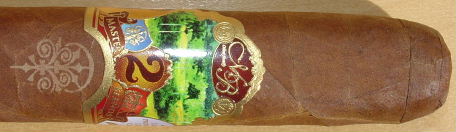
This is the second generation of the Master Blends, this time with an Ecuadorian grown Sumatra wrapper. (The Master Blends 1 was a Nicaraguan puro.) Oliva's farms in Ecuador have been producing wrapper leaf of tremendous quality in recent years, as evidenced by their use in Ashton's Virgin Sun Grown brand and Diamond Crown's Maximus cigars.

The Master Blends are limited edition cigars, with only 120,000 of the MB 2 churchill produced. The churchill measures 7 by 50, and is made in Esteli, Nicaragua. An interesting design flourish is the insignia below the band– etched into the wrapper with a laser, I'm told, to thwart counterfeiters. It also makes this cigar a little difficult to use in a blind taste test…

It's square pressed, and the cap is a little rough. Prelight the smell of the wrapper is fairly strong, and the draw is perfect.

It lights up easily and burns evenly. This is a medium bodied cigar that doesn't waver too much; though it does grow in strength, it never achieves a truly full body. The flavor profile is not extraordinary; no particular taste really jumps out at me. The aroma of the smoke is pleasant, but I can't really put my finger on any particular descriptor. There is an astringent, mouth puckering quality that I find with many Nicaraguan cigars, and the one distinguishing element I can identify is a semi-bitter aftertaste, like Columbian coffee. I'm not a fan of this taste, so I can't say I found it all that pleasurable.

The Oliva Master Blends 2 Churchill is a very well made cigar, and it commands a premium price. I would recommend it for fans of other Nicaraguans, but I would also advise prospective buyers to taste a few before purchasing a full box.

Cigar Almanac, 1980

Cnv0171.jpg
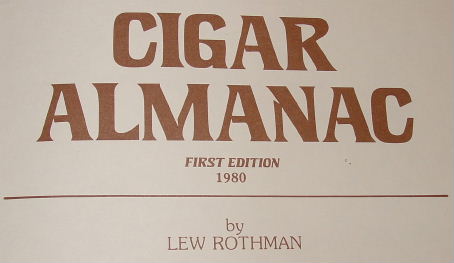
I've always enjoyed reading Lew Rothman, whether it's ad copy in the JR Cigars catalog, or the occasional article in the cigar magazines. In addition to being a power player in the American cigar industry, he's got a hell of a sense of humor.

The Cigar Almanac is basically a catalog of cigars popular in the late 70s, most of which are no longer in production. And most of those that are still being made, like Arturo Fuente cigars, have changed quite substantially. Rothman says about Fuente:

Excellent machine made cigars from the top of the line to the bottom. Their hand made cigars are just O.K. Very good value throughout this cigar line, don't let their tasteless packaging turn you off this brand.

So it was, 26 years ago.

The first forty pages of the book consists of introductory material, including "The Cigar Industry Today," "Keeping Your Cigars Fresh," "How Much Should You Spend for a Box of Cigars?" and the like. A pictorial tour of the Partagas factory (Dominican Republic) concludes the introduction.

While this book is basically a nostalgic trip to a time when cigar smoking was the domain of old fogeys who chomped on drugstore Phillies, Rothman's writing is as funny as ever, even if his advice is somewhat out of date. Here, for example, he explains how to keep your newly purchased box of cigars fresh:

A. First take out enough cigars for the day. You don't want to spend your day unwinding wrappings off of mummified cigars six or eight times a day.

B. Take the home humidor you spent 50 Bucks for, and throw it in the garbage can.

C. Put your cigars (in, or out of the box) in a zip lock baggie, or whatever you call those plastic bags you can seal over and over again. Mush out the excess air before you close it up.

D. Throw the bag in the bottom of your refrigerator or in a plastic vegetable box, or both.

Before the advent of frost-free refrigeration, keeping cigars in the ice box was a fairly common practice. (FYI: Today's refrigerators will dessicate and destroy your smokes. Don't do it.)

And later, in the "Question and Answer" section:

Q: Does a long ash mean a cigar is good?

A: Do cattle with long tails make tastier steaks than those with short tails?

Q: Is it good to have a long ash on a cigar?

A: NO! NO! NO! NO! NO! A long ash hinders the passage of air to the cigar, makes it burn unevenly, and usually gives the cigar smoker a stiff neck from trying to balance it on the end of his cigar. Long ashes make people cross-eyed, get clothes, carpets, and sofas dirty, and if allowed to get long enough, become, for a period of time, the cigar smoker's only reason for living.

Q: My little hand made cigar man still makes me an all Havana cigar from tobaccos he bought before the embargo. What do you say to that?

A: You are an idiot.

Rothman includes for the sake of "completeness" an appendix of Cuban cigars, while maintaining that cigars made outside of Cuba are often just as good. But that statement might be best taken in conjunction with his admission in a recent Cigar magazine article: "The one and only thing I ever really, really excelled at was lying! I was the best liar there ever was."

Lew Rothman's Cigar Almanac has of course been out of print for many years. I borrowed this copy from a library in Cookesville, Tennessee that was willing to loan it long distance.

It's an interesting blast from the past, and still a fun book to page through. Just don't believe a word of it.

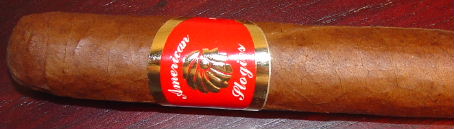
American Stogies Cuban Corojo Toro

Cnv0170.jpg

Nestor Plasencia makes so many cigars for so many people it’s hard to keep straight, but this is one of them, made for Indianhead in Esteli, Nicaragua. Plasencia’s father Sixto was one of the pioneers of the cigar industry in Nicaragua. In the mid-60’s Sixto recognized the similarity of the valleys of northwestern Nicaragua to the Pinar del Rio area and decided it would be a good place to experiment. The test was a rousing success, and since then the Plasencia family has been huge in both the Esteli area and the Danli, Honduras tobacco zone. To date, Plasencia grows tobacco for Rocky Patel, Mayorga, OneOff, Evelio, Maria Mancini, other Indianhead cigars, and numerous other private customers. He also has his own line, which includes the Plasencia Organica, one of the first cigars rolled with certified organic tobacco.

This is the “Classic Cuban Corojo,” introduced in 2003 as a fuller bodied addition to the American Stogies line. It normally sells for under three dollars– like the Mayorga cigar it could very well be considered a “bargain cigar,” even though it could probably sell for more. It’s a Nicaraguan puro according to he venerable Cigarcyclopedia…but I must admit I did not know they were growing corojo in Nicaragua. Unless, of course, this is like the Punch rare corojo, and corojo in name only.

But judging by taste, I think this wrapper leaf is indeed corojo. It has the same aroma as the Puros Indios Corojo and the Camacho Corojo, but I can’t say the cigar as a whole is quite as good as either of those. It has a nutty, somewhat vegetal taste, with very little spice. It packs a good punch, however. Definitely not an empty-stomach smoke.

It burns well, evenly and not too quick, though the stick does get soft after a couple inches. I grew a bit tired of it at about the half-way point, where the power began to kick in without any added flavor dividends.

For the price, I’d say give this one a shot. Don’t expect too much, and you’ll get a little more than you had expected.

Bad Habits Robusto

Cnv0169.jpg

Every once in a while I like to hit the local cigar shops to see what's kicking. This robusto is from a downtown Las Vegas shop called Bad Habits. They have some interesting and unusual sticks, including a Costa Rican puro called Eureka which I will be reviewing here at some point. They're located on 4th Street near the Fremont Street Experience. Their prices are a bit high, but that's understandable due to the location. But you're better off buying some nice cigars from these folks than throwing your money away on the tables, believe me. (Here comes the pit boss. Time to light up this robusto and look tough.)

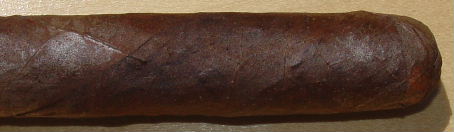
I was told in the shop that this is a Dominican puro, but that's about all I can tell you about the makeup of this cigar. The maduro wrapper is rough with a few prominent veins, but it feels solid enough. Prelight it has a fairly typical herbal smell with a tinge of ammonia. I thought it might need some additional aging for this reason, but I decided to fire it up anyway.

It lit up well, forming a flaky gray ash. The burn was even and consistent throughout the smoke. I didn't expect a whole lot from this cigar, because it hasn't been rated 95 in Cigar Aficionado and there aren't full page ads splashed all over the cigar magazines. Hell, it doesn't even have a homepage! What's a cigar without a homepage anyway?

In this case, it's a pretty good cigar. It's medium in body, reaching towards full. It starts out with an herbal body and a little pepper. Notes of chocolate and cocoa are the main feature. These finer flavors are drowned out as the cigar grows in strength and the pepper comes and goes. I smoked this a little past the band, at which point it turned a little bitter.

I can't remember what I paid for this, but it was under five dollars, and at this price I'd call it a bargain. I've paid way more for far lesser cigars. If you're ever downtown and hankering for a good smoke while you're paying the devil his due, check out Bad Habits. I plan to make another trip soon myself.

Carlos Toraño Tribute 2004 Maduro Churchill

Cnv0168.jpg

A tribute to Carlos Toraño, Sr., the man who brought Cuban seed tobacco to the Dominican Republic for what was probably the first time, and with the cultivation of Piloto Cubano spawned the Dominican cigar as we know it today. There have actually been two “Tributes” thus far: the 2003, which had a natural wrapper, and this one, the 2004 maduro.

As is fitting with a special cigar, this is a limited edition of 1000 boxes only. The Costa Rican maduro wrapper is gorgeous, dripping with oil and redolent of earth and cedar. Within lies Nicaraguan and Dominican filler held by a Nicaraguan binder, all of which have been aged five or more years. The Tribute is rolled in Toraño’s Esteli, Nicaragua factory.

It fires up with a powerful earthy taste, very similar to the 1916 Cameroon, but without the spice of the Cameroon. There is a sharp element that quickly mellows.

But Houston, we have a problem. The draw is very loose, and for the first inch or so the cigar tunnels. The tunneling stops, but the burn remains very hot. I smoked this one very slowly, allowing the burn to correct itself. It does, but remains hot. I rarely do this with a cigar, but I decided to let it extinguish itself and return to it later. It’s such a pretty stick, and the flavor is so rich and lovely that I hate to can it because of a construction flaw. (Not to mention that it’s friggin expensive.)

Unfortunately, letting this cigar die in the hopes of a later resurrection was not such a good idea. Upon relighting it the same rich flavor was there, but the burn was still hot and I got sick of it pretty quickly.

At about 10 USD a pop, I’m not going to give this one another chance. I hope this was just a bad single, since other reviews indicate this is a great cigar. Keep in mind that this review is based on a single experience, but all in all I have to say I was disappointed.

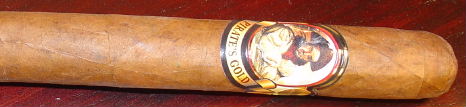
Pirate’s Gold No. 2

Cnv0167.jpg
This will be a short review to inaugurate a new category: bargain or budget cigars. Normally these are going to be bundled cigars that sell for less than two USD. In most cases they will not require much attention to subtleties, because they will have none and aren't expected to. They're not going to get points for bouquet or an even burn — if they draw well and don't taste like crap, they'll get a passing grade.

This is a Rolando Reyes long filler second, or at least I assume it's a second… or why else would it sell for a buck? Supposedly they are the "old" Honduran variety, as opposed to a Dominican variety that was farmed out to Emilio Reyes, or the newer version made in Nicaragua for Cuban Crafters. At this price, (about a buck a stick) I really don't care if they were made in La Habana or in Detroit. There is only one question for cigars of this caliber: Do they suck?

In this case, they don't. They're fine yard gars. The Number Twos are long coronas, and smoke fine up to about the half way point, which coincidentally is about when I run out of time during a week as busy as this one has been. They taste fairly similar to the standard Puros Indios, nutty with a little sweetness, up to that half-way point when they turn a little rancid. They're about on the same level as "Rolys" from the same company; perhaps a mite better even.

A good draw, an even burn, and they don't taste like crap, at least for the first half. Bargain Smoke Grade: PASS.

Legends Series Blue — Matasa

Cnv0166.jpg

A while back I reviewed the White Label in this series from Camacho. Since then a few more legends have been added to the line– Orange (Rocky Patel), Purple (Graycliff) and Black (La Aurora). This is one of the original four, the Blue Label from Matasa, maker of Fonseca and Cubita.

Manuel Quesada, along with his brother Alvaro and father Manuel Sr., started the Manufactura de Tabacos S.A. (MATASA) factory in Santiago, D.R. in 1974. It was one of the first cigar factories established in the Dominican Republic– started, as Quesada said in an interview with Cigar Aficionado, with "one hundred dollars, a chair, and a phone."

Starting with the Fonseca and Sosa brands, MATASA grew to "Legendary" status, at least according to Cigars International who sponsors and distributes this series. Which brings me to tonight's smoke.

Like all of the Legends Series cigars, this is a toro size at 5 5/8 x 54. The first thing I recommend you do with this cigar is to carefully take off the label. The Ecuadorian wrapper on this baby is an oily delight, and the label is, well, a little large and garish for my taste. Best to smoke this one naked. The cigar, that is. (Unless you have very free spirited neighbors, in which case I don't want to live in your neighborhood.)

It's a tightly rolled stick with no soft spots, and examining the foot I noticed right in the center a perfectly black leaf that contrasts with the rest of the blend. The draw is firm, but not difficult. It lights easily and burns well, if somewhat unevenly. The first taste is of light wood, with something like coconut. That's sounds crazy, and maybe it is. But that's the information from Olfactory Central. The Camacho Legend tasted slightly of vanilla…now coconut? It's not like smoking a macaroon. I haven't completely lost my marbles. But there's definitely an usual flavor there…

It's a mild to medium smoke without too much complexity. Toward the end it takes on a little graphite, and it starts to burn a bit hot, but the enticing aroma stays to the end. This is one of those cigars that I enjoy more for the aroma than the taste, though there was nothing objectionable about the taste; it's just a little milder than my usual fare.

Now I'm going to have to pick up some Fonsecas, just to compare. The Legends Series Blue has me interested in what MATASA is up to…

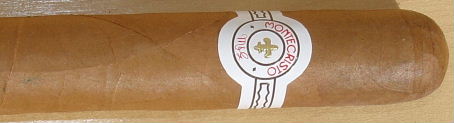
Montecristo White Toro

Cnv0163.jpg

This handsome cigar can be seen delicately balanced between the finely manicured fingers of only the most genteel gentlemen in the pages of Cigar Aficionado. Because, as the ad says, “White goes with everything.” If that’s so, why is the gent wearing a white suit? Lack of imagination?

I decided to test this sartorial statement by wearing only my finest dungarees and a stained t-shirt and taking this toro into the backyard for a test drive. It’s certainly a pretty cigar– the Connecticut shade wrapper is nearly perfect, silky smooth and sporting a perfectly integrated cap. A real looker.

Inside this expensive Connecticut suit is a Nicaraguan binder and a Nicaraguan/Dominican filler. It’s a rather fat toro with a 54 ring gauge. It’s billed as being heavier bodied than the “classic” Montecristo, but I had to test it for myself after reading one review that called it “mild to medium” and another that said it was “medium to full.”

The Montecristo White is a finely constructed mild cigar. I don’t remember who said it was “medium to full” but that is, I must say, flat wrong. It fires up with classic Connecticut Shade flavors of nuts and kitchen spices, ginger maybe, and flattens out into a nice toasty mild smoke. Enjoyable, but definitely a morning or afternoon smoke.

At 8 to 10 USD I probably won’t be buying any more of these, but I don’t really have any complaints about it either. On the other hand, there are more flavorful mild smokes out there for far less– the Gispert natural and the Felipe Dominicana come to mind. Even the brilliant Romeo y Julieta Vintage line, while still pricey, has more to offer… Which doesn’t mean the Monte White is a bad cigar at all. If you favor mild cigars and have a liberal tobacco budget, this is definitely one to try.

Legal Cubans!

Cnv0162.jpg

There's a sign in a cigar shop window in downtown Las Vegas that screams "Legal Cubans!" (If you're an American then this is meant to generate astonishment that Cuban cigars might be sold in a civilized manner.) I pass this sign almost everyday on my daily sojourn to work in downtown Las Vegas, but I've always passed on the cigars as well, until one day I noticed the "Legal Cubans" were all gone. (These were the Pinar brand.) Still the sign remains, in the hopes that the seemingly endless last crop of 1959 will spawn yet another source.

I'm reminded of the passage in Stanford Newman's Cigar Family where he talks about the single bale of 1959 Cuban tobacco he kept in his factory's storage so that in spite of the embargo he could say "Yes, we still have Havana." Bits and pieces of the final 1959 crop seem to be miraculously discovered on a frequent basis, as if bales of tobacco were like antique heirlooms your aunt might forget about in the attic.

But on the subject of the Cuban embargo I'm with Kinky Friedman : we're not supporting their economy; we're burning their fields. But Kinky ain't governor of Texas yet, let alone President. And W's got many many bigger problems at the moment, so I think we're going to be stuck with "Legal Cubans" for a while yet.

This one is from M&R. Never heard of it? Well, you would have if you were a roll yer own cigarette kind of feller. As far as I know they're not big in the cigar business, except when they come across one of those magic bales of pre-embargo tobacco. But I speak too soon: Cigarcylopedia shows they make two other brands– a Dominican puro and a Brazilian puro, both sold in "economical bundles". But I can't say I've ever laid eyes on either one.

Officially, this is the M&R Pre-Embargo Limited Edition Churchill. Made in Santiago, Dominican Republic, with a Brazilian wrapper, Indonesian binder, and Dominican filler. Oh, wait– Cuban, I almost forgot, Cuban filler as well. The exact proportion of Dominican to Cuban tobacco is not known. This is evidently a proprietary secret. I picked this one up at my local tribal smokeshop on a whim. I had planned on reviewing this for April Fool's Day but forgot about it.

It comes in a flimsy plastic tube, and upon opening it there's a smell that reminds me of nothing more than air let out of an old tire. Not a good omen, I'm afraid. It's lumpy and bumpy and it looks like someone got busy with the Elmer's when they wrapped it.

But much to my surprise, this is a smooth and tasty smoke. With really good construction to boot. I can't believe a cigar that quite honestly looks like something my dog would leave in the back yard smoked this well, but it did. It didn't blow my socks off, but it definitely blew my expectations out of the water.

The flavor profile is woody, veering towards earthy, with a light spice, and the smoke is very smooth, almost creamy. It peters out at the half way point, but stays pleasant to the end. The wrapper is a bit sticky and slightly bitter, but the flavor of the cigar makes up for that. I'd qualify this as a really decent bundle smoke, Cuban or no. With better presentation and a flashy band this cigar could probably pass for premium. No kidding. What a surprise!