Tatuaje Series P2

cnv0380.jpg

Tatuaje Series P cigars are economy selections from Jose Pepin Garcia’s Tabacalera Cubana in Esteli, Nicaragua. These are “cuban sandwich” cigars made with the same filler blend as Pete Johnson’s Tatuaje Havana VI, presumably with scrap tobacco from the same. These are Nicaraguan puros and are marketed as having 40% long filler and 60% medium filler. The wrapper is Nicaraguan Habano.

Construction is always an issue when it comes to sandwich or mixed filler cigars, and the Series P is not immune. Most of the cigars I’ve sampled in this series have been fine, but a few have had burn problems and a couple have split their wrappers in catastrophic fashion. From the price alone it seems a bit of a gamble — about 4 USD per stick local retail. Not your typical Pepin price mark, but it’s a reasonable wager for this cigar.

The size I chose for this review was the robusto P2. (These are also available in churchill, toro, and corona grande vitolas.) The wrapper is not a looker exactly, so you’ll want to judge this one for its personality rather than its superficial deficiency. The wrapper scent here is straight ahead cedar with a little bit of sweet grass on the prelight pull.

The P2 starts up with no nonsense medium bodied tobacco flavors and maintains that course pretty much to the end. The real attraction here is the sweet spicy aroma from the wrapper. It has a very carmelized kind of smell, almost like roasted marshmellows. After a couple inches some pepper arrives at the party, but for the most part it serves as a mild condiment over that simple sweet woody flavor. There isn’t much transition here, as Jerry noticed in his Stogie Review of this cigar. I have to agree with him that a big development isn’t really necessary here.

Like the Havana VI, this is a relatively mild blend for Tatuaje and Pepin. At times the smoke seems a little bit thin, but it’s flavorful and the wrapper imparts a delicate sweetness that is not easily found among cigars in this price range.

It’s really not fair to compare this cigar to the standard line Tats, so I won’t. Just remember that this is a bargain-oriented cigar made with the leavings from the big boys. The result is a ghostly palimpsest of the original work, but when the original is a Tatuaje, that may be just enough to seal the deal. For 4 bucks, anyway.

VegaFina Robusto

cnv0376.jpg

Over the years there have been several different cigars marketed under the name Vega Fina, mainly because the companies owning the brand name have merged or been acquired or simply changed hands: the brand name appears to have first been owned by Havatampa, an old manufacturer around since the early 1900’s. When Tabalera S.A. de España bought Havatampa in 1997, Vega Fina passed to them and was produced by Benji Menendez in Honduras with an Indonesian wrapper. Two years later, Tabacalera S.A. merged with the French tobacco giant SEITA to form Altadis, S.A. Soon after this, production moved to the Dominican Republic and Vega Fina was produced primarily for the Spanish and Western European market as an affordable Dominican premium (but also as a mass market machine mini cigar very popular in Spain.)

Vega Fina continues to be Spain’s most popular Dominican cigar, so Altadis decided to introduce it to the much larger American market early this year. Today they’re made in La Romana’s Tabacalera de Garcia under the supervision of José Séijas.

The VF robusto is graced by a creamy claro-colored Ecuadorian grown Connecticut Shade wrapper that looks good enough to eat. Beneath this, however, is a binder which causes me a little concern: Indonesian TBN. (I have to remind myself that the wrapper on the Dominican Romeo y Julieta 1875 is also TBN, and it’s not bad stuff.) The VF employs filler from Columbia, the Dominican Republic, and Honduras.

I tend to think of Indonesian TBN as the carpetbagger of cigar tobacco — it seems to turn up only when the “real thing” is no longer available. When Consolidated couldn’t get quality Cameroon in the late 80’s, they turned to TBN. When wrapper leaf of any quality was scarce during the “boom” years, TBN was there. And this is at least partly why it has a such a sullied reputation — it’s often been the alternative, not the prime choice. And unfortunately the alternative, especially during the boom years, was actually bottom-of-barrel tobacco billed as TBN when it may have been something else entirely. So what we were taking in general as “Indonesian” was actually the worst tobacco the region had to offer.

TBN stands for tobaco bawah naungan, which means “tobacco under sheet,” or shade-grown tobacco. Top quality TBN is a cross between native besuki tobacco and Connecticut Shade. It’s a nice looking leaf, so in addition to its blending qualities it can also serve well as a wrapper. Strangely it is also prized for its lack of aroma. I can’t think why this would be appreciated in a wrapper, but used as a binder here perhaps it makes more sense.

The VegaFina robusto is a suave looking cigar. The wrapper is smooth and supple with very few veins. The construction is very good from the start, with a cool even draw and a nearly straight-edge burn. There’s just a hint of pepper at first light. This quickly disappears and is replaced by a very mild bodied smoke with a creamy texture. Up until the half-way point the flavor is mildly woody with some herbal tea accents. The aroma is exceptional — it blends well with the flavor of the cigar and adds a spicy floral component. (Incidentally, there are none of the metallic overtones that I’ve noticed with Indonesian leaf in the past.)

The flavor picks up at the mid-point, not a lot, but enough to be noticed. Another dash of pepper is added to the mix and the finish goes from non-existent to moderately short at this point. The last third stays the course, and finally a discreet bitterness announces that the finish line has been crossed.

Overall the VegaFina robusto is an excellent mild blend: a fine mid-day smoke, great after breakfast. The price is right on these babies as well: I picked up a few for under 3 USD on the reservation, and it looks like boxes can be had for under 75 online. Factoring price into the equation, I think this is my new mild one. (Especially since it’s getting hard to find Nestor Reserve Connecticuts these days…)

–cigarfan

Joya de Nicaragua Antaño 1970 – Robusto Grande

Cigar Stats
Brand Owner: Tobaccos Puros de Nicaragua, S.A.
Model/Vitola: Joya de Nicaragua Antaño 1970 – Robusto Grande (box-pressed)
Size: 5.50 x 52
Wrapper: Nicaragua Habano Criollo
Binder: Nicaragua Habana
Filler: Nicaragua Habana

Other sizes available

  • Consul 4.50 x 52 (robusto)
  • Machito 4.75 x 42 (petit corona)
  • Gran Consul 4.75 x 60 (torpedo)
  • Belicoso 6.00 x 54 (torpedo)
  • Magnum 6.00 x 60 (toro)
  • Perfecto 6.25 x 58
  • Churchill 6.875 x 48
  • Lancero 7.50 x 38 (long panatela)
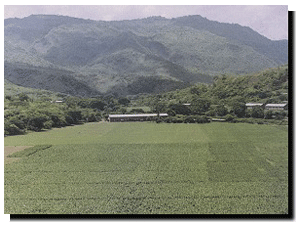
Tobacco Farm at Esteli, Nicaragua
Tobacco farm at Esteli, Nicaragua

Joya de Nicaragua (The Jewel of Nicaragua) was created in Nicaragua’s first cigar factory, which opened in 1964 in the city of Esteli. In the glory days of the 1970s, the brand was arguably the finest in the world, smoked in the White House and prized for its rich flavor. After war decimated Nicaragua and the original factory burned to the ground, Joya de Nicaragua struggled to regain its former glory. Prior to 2000, the brand had taken on a mild, easygoing flavor. Responding to the trend toward full-flavored cigars and looking at its own heritage as a producer of powerful smokes, the brand’s makers created a version called Joya de Nicaragua Antaño 1970. This was one of the first “high octane” powerful cigars to hit the market back in the early 2000’s. It was one of the hits of the Retail Tobacco Dealers of America trade show in 2002. This cigar features an extremely powerful, heavy, thick smoke highlighted by a rich, oily, almost wet-looking Maduro wrapper. This is the type of cigar that the old Cubans use to make for themselves after quitting time in the Cuban factories.
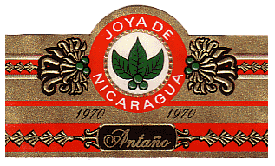

Joya De Nicaragua Antaño 1970 Band

Joya De Nicaragua Antaño 1970

Bottom line up front …..
“All Muscle, all the time,” is the slogan for the Joya de Nicaragua Antaño 1970 and this cigar certainly flexes its muscles. Antaño is the cigar directly responsible for reviving the struggling Joya line, and after smokng one there is no wonder as to why. It has received high ratings, a 91 in Cigar Insider and 92 in Cigar Afficianado, and was in the top 5 of Robb Report’s 2003 annual Best of the Best. Antaño, a Nicaraguan puro, is a powerhouse full of flavor; leathery and slightly earthy, this cigar is rich and spicy. The draw is excellent and the thick, dark wrapper burns well. A true treat for those who enjoy a complex and very full-bodied smoke at a very reasonable price.

Pre-light
A couple large veins on this dark rusty brown colored wrap but no ill effect on the burn. The head is finished with a rounded cap. No tooth is evident over the smooth oily wrap. Construction is solid with no soft spots to the light squeeze. It is well balanced in the hand and the pre-light draw is firm. Although this cigar is advertised as box-pressed, it is barely evident by looking at it. A very subtle aroma of earth and aged tobacco from the wrap. The band is good looking and took a little effort to remove but without effect on the cigar. I used my Xikar cutter for a clean clip.

The Smoking Experience
The foot toasted and lit but with some effort. The wrap is very thick and it took a couple torch blasts to get everything going but, once lit, no burn issues at all. Draw was firm but not too firm and eased just a little over the length of the cigar. Burn line got a little bumpy but always self-corrected. The ash was dark gray with small black striations and held on well to about two inches each time. This cigar puts out allot of smoke and stayed nice and cool all the way to the nub. The smoke seemed to increase in volume past the half way point.

Full bodied and full flavored this cigar leaves nothing to the imagination. Flavors hit the palate like a freight train. Starts with a surge of dark earth and pepper which quickly gives way to a core of sweet earthy flavors with subtle notes of cocoa and espresso. The nose has quite a “twang” to it. The last half ushers in more pepper and spice but not overpowering.

Definitely a strong full-bodied smoke but well balanced. I did not experience any harshness. Not the cigar for morning coffee IMO and should follow something to eat. I had both cigars for this review with McClannan 25 single malt scotch which really complimented the cigar. I’m thinking a nice cold Guiness Stout would work too.

My take …..
Being a fan of stronger cigars, I really enjoyed the Joya De Nicaragua Antaño 1970. I bet these are just fantastic with a year or more to age. I’m curious about the Gran Reserva as well. That’s on my list of cigars to try.

MSRP comes in at $5.00 per stick. I received mine in a trade so I’m not sure exactly what they cost originally but my local B&M has them for $6.25 a stick. Online they run $3.50 per stick if you buy a box (20) and $3.70 if you get a 5ver. Very good price point for a such a flavorful well-made cigar.

Smoke Til Your Green

Like it … Yes
Buy it again … Absolutely, maybe stock some boxes
Recommend it … Yes, to those who like potent cigars

What others are saying about the Joya de Nicaragua Antaño 1970 …..

25 March 2006
Cigarfan of Keepers of the Flame
Joya de Nicaragua Antaño 1970 Robusto Grande

28 August 2006
Patrick A of The Stogie Guys
Joya de Nicaragua Antaño Consul

30 May 2007
Dickie Dingleheimer
Review of Joya de Nicaragua Antano Cigars
Rated 4.60/5

As of 10 August 2007
Top 25 Cigar Ratings (26 reviews)
Joya de Nicaragua Antano 1970 Robusto Grande
Average Rating 8.35 out of 10

Publications

18 May 2007 – Cigar Aficionado
An Interview with Alejandro Martinez Cuenca, Owner of Joya de Nicaragua


… lucky7

“It has always been my rule never to smoke when asleep,
and never to refrain when awake.” (Mark Twain)

FP Habano 98

cnv0370.jpg

I smoke a lot of bundle and “bargain” cigars this time of year because I don’t have the luxury of a man cave, an air-conditioned garage, or a wife who doesn’t give a damn. She does, so I don’t smoke inside the house. And around the time I emerge from the domicile to sneak an evening cigar the thermometer is just dipping below 100 degrees, so it’s either something short, or something cheap that I can toss after half an hour. Either that or I go back into the house looking like Fred Biletnikoff after the Super Bowl. (Sorry to get old school on you youngsters out there, but if you’re old enough to smoke you’re old enough to watch ESPN Classic.)

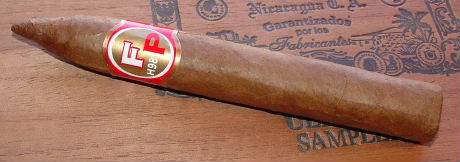
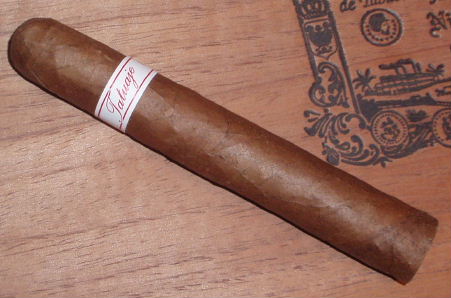
That is not to suggest that the FP Habano 98 is a second class citizen. It is in fact a bundle cigar made by La Tradicion Cubana for Fuller’s Pullers in Madison, Wisconsin, and it’s available for about two bucks a stick. The torpedoes are 6 1/2 inches long and the barrel of the cigar is a 52 ring gauge. The wrapper is a Nicaraguan Habano 98, which I think is a criollo leaf, and the filler is a Nicaraguan and Dominican blend.

This is a decent looking torpedo with a moderately dry wrapper and a somewhat odd looking head. It’s well constructed, and when the tip is clipped it draws perfectly, but the head is sort of lumpy and crooked, like the crown of a crumpled wizard’s hat.

But it burns straight and tastes pretty good, which in the bargain category makes it a winner from the start. It’s a mild cigar which builds at the mid-point to a medium body. The wrapper imparts a pleasant aroma of cedar and spice which hints at what the LTC robusto offers, but the FP H98 doesn’t have the same depth or complexity. (Nor would I expect it to.) The flavor is straightforward mild tobacco with a woody character up to the half-way point where it takes on a tinge of soot. At the two-thirds point the flavor gets muddier and it’s pretty much downhill from there. Like most bundle cigars I find this one is best smoked to the 50 yard line. Beyond that point and you’re on your own.

This is a pretty good cigar for a couple bucks. If you’re in the market for a high quality mild econo smoke it’s worth a look. If there’s another cigar with a wrapper this good selling for under two bucks it would definitely pique my interest.

Nestor Reserve Connecticut Robusto

cnv0332.jpg

Several years ago Nestor Plasencia was quoted as saying, “Anyone who tells you they know everything there is to know about tobacco is either a liar or a fool.” This is worth remembering, coming as it does from one of the premier tobacco men on the planet. Plasencia has been working tobacco throughout Central America for years now, and has made cigars for companies as diverse as CAO, Indian Tabac, Alec Bradley, and many more, including his own brand names.

The Nestor Reserve label is probably better known for its maduro entry, which I haven’t reviewed yet but I can tell you right now that the couple of maduro torpedos I’ve sampled were fantastic, especially when the price is factored into the equation. (Another thing, but you’re not allowed to tell anyone: Plasencia makes really good econo smokes. Shhhh…)

The Connecticut Reserve is supposedly the same blend as the Nestor Reserve Maduro, with the obvious difference of a CT shade wrapper instead of the maduro. Unsurprisingly though, the information released by the big name online outlets is not convincing. The Maduro is advertised as having Honduran and Nicaraguan filler, with a Cameroon binder. Sounds tasty… IS tasty. The Connecticut, on the other hand, is presented as “a complex mixture of Costa Rican, Nicaraguan and Honduran tobaccos.” How do you get the same filler blend when one includes Cameroon, and the other Costa Rican leaf? Yet another mystery to ponder as the ash grows long…

I tend to hold mild cigars to a high standard when it comes to construction and aroma and give them more leniency when it comes to flavor. This standard worked out well for the Nestor Connecticut.

First off, I was impressed with the physical appearance of this cigar. The wrapper is smooth and almost veinless, and the cap is applied very well; in fact, one of them was neatly triple capped with a Cuban style flat head. That was interesting, especially for a cigar that cost me a little over a buck.

The flavor is mild, as expected, and by the end approaches a medium body without quite getting there. The smoke has a smooth creamy texture with a papery or balsa-like finish. Nothing to get excited about there, but the aroma is quite nice. A delicate mild spice rises from the smoldering ash and insinuates itself in the sinuses without no irritation. There’s something kind of oaky to it, but mingled with a dash of cinnamon. Maybe it’s a smell only a cigar smoker could love, but I am a cigar smoker and I love it.

There wasn’t too much of a development, and it doesn’t get too many points for complexity, but it’s a nice solid stick that burns well, smells great, and is really easy on the wallet. It may not be the best cigar I’ve smoked in the past couple months, but it’s definitely the best cigar under three or four dollars.

There’s absolutely no reason not to try this cigar, unless you hate mild cigars, Connecticut shade wrappers, or saving lots of money.

Bering Corona Royale

cnv0304.jpg

There was a time when an American cigar smoker didn’t experiment with new brands and blends. He chose a brand that he liked and he pretty much stuck with that for as long as he chose to smoke cigars. This was a time when the cigar factories of Ybor City flourished and produced thousands of “clear havana” cigars made with tobacco imported from Cuba. The “premium” market of that day was for authentic Havana rolled cigars, but the average American working stiff was quite content with “two for a nickel” King Edward cigars or the like.

Today, most cigar enthusiasts cast a wary eye on King Edward and his drugstore brethren, but it’s worth remembering that Swisher International, the maker of King Edward, La Primadora, and of course Swisher Sweets, is the world’s second largest cigar company by revenue (trailing only Altadis.)

A Swisher executive once said, “There are two kinds of cigars in the world: those that sell and those that don’t.” While that explains Swisher’s business philosophy (and perhaps the secret to their success) it doesn’t explain why they entered the premium cigar market with Bering, a long filler hand-rolled that sells for around 2 dollars. A blue-collar two-dollar cigar.

Bering cigars were at first a long-filler machine-made cigar manufactured by Corral, Wodiska y Ca., starting in 1905. Their Ybor City factory no longer produces cigars (in fact this historic building has been converted to an office complex) but the Bering brand lives on, having been purchased by Swisher in 1985. Swisher eventually moved Bering production to Honduras and made it a 100% handmade cigar, a turning point for Swisher and the Bering line.

The Bering Corona Royale is a tubo, as pictured above. On the other side of the tube it reads “Very Mild Exquisite Cigar.” This is a long corona at 6 inches with a 41 ring gauge and comes equipped with a Connecticut seed wrapper shade grown in Honduras, a binder from Honduras, and filler from Honduras, Mexico, Nicaragua and the Dominican Republic.

This particular specimen has been lounging in my cheapodor for about four months, which I think is probably longer than necessary. I fired it up in the garage and roasted some coffee just to give the cigar some competition in the aroma arena. It starts up with a nice even burn and a straightforward tobacco flavor. I wouldn’t say it was either exquisite or excessively mild at this point, but it certainly wasn’t objectionable.

The aroma is probably the nicest thing about this cigar — a mildly sweet, slightly woody fragrance that blended very well with the Sumatra smoking in the I-Roast. The flavor is simple, everyday cigar tobacco. By the midway point the flavor intensifies somewhat and becomes a little tart. It’s still fairly mild in body, but stronger in flavor.

As it continues the flavor takes on a little cardboard, and then takes a shortcut to bitter paper bag. I wasn’t sure if this was an accurate description, so I cut up some Trader Joe’s paper bags and had a chew… I’m a professional, kids. Do not try this at home.

A cigar that reduces me to chewing on grocery sacks might not have much to recommend itself, but to be honest the cigar was actually better than the bags. Faint praise, I know. If you’re into that astringent flavor that Mexican and some Indonesian cigars have, this one might float your boat. Mine sank.

Bottom Line: This isn’t a half bad yard gar, but I can think of half a dozen yard gars for around the same price that I’d rather smoke.

Don Kiki Limited Reserve Brown Label “Botella”

cnv0236.jpg

The starting point for some cigars, the detail you notice first, is the wrapper. For others it’s the construction. For the Don Kiki Brown Label, the first thing you notice is the price. This is a bargain cigar: at 36.99 for a box of 25, or about 1.50 each, this is a decent smoke.

According to the Cuban Crafters website, the leaves for this cigar are aged for three years, and after the cigars are rolled they are aged for an additional three years. The wrapper is a fairly dry colorado maduro, Nicaraguan sun-grown criollo. The binder is Nicaraguan corojo (which gives the Brown Label some strength) and the filler is also Nicaraguan.

Kiki Berger developed the original blend, this one, in 2003. The following year he released two other less powerful lines, the Green (medium body) and the Red (mild to medium.)

The “Botella” is true to its name and is shaped like a bottle, the kind you might expect a genie to pop out of. It’s short at only 4 and half inches long, and flares to a 48 ring gauge at its thickest point. The foot of this perfecto is finished with a cap-like construction, a narrow piece of leaf wrapped around the foot. I thought this might present some construction problems — it looks like it might easily unravel, but it never did.

The head narrows to about a 32 ring gauge, but it still feels fairly well balanced. This cigar is pressed, so even with its unusual shape it’s still sort of boxy. It’s also a bit spongy with an occasional soft spot. It lights easily with a good draw and burns slowly with a nice volume of smoke.

The main flavor is straight forward tobacco, a little bit earthy, but mostly tobacco. Almost like Virginia pipe tobacco or untreated cigarette tobacco, but stronger. On top of this is a distinctive flavor of chocolate or cocoa. It’s a fairly heavy smoke and at times can be harsh. There’s another flavor in there that is somewhat cloying, a bit waxy, and not exactly my cup of tea. I can’t identify it precisely, but I’ve tasted it before… One of these days I will be able to identify and name all the tastes and aromas of a cigar and where they come from. Alas, that day is not today.

I found I had to touch this one up at least once during the smoke, and none of them burned straight. Not down the side, not problematically, but not straight either.

Overall, I think this is not the best cigar from the Cuban Crafters stable. It burns a little lopsided, it’s a little inconsistent, and it’s a little harsh. But when you take the price into consideration, it’s a full flavored stick that you can toss after twenty minutes with no regrets.

In keeping with my original Pass/Fail system for Bargain Cigars : PASS.

Dynamite 652

cnv0202.jpg

From Indianhead, makers of American Stogies, comes Dynamite — in corojo and maduro wrappers. At less than two bucks in my B&M they’re so cheap I had to try both.

Taking a page from Rocky Patel’s Edge and Camacho’s El Legendario, Dynamite cigars are presented in rough boxes of 24 sticks. Like those cigars the Dynamite was at one time unbanded, but at some point Indianhead began releasing them with very corny orange bands. The wrappers on these cigars are so nice and shiny that the bands are a distraction, in my opinion, but at least they allow me to tell them apart from the Edges and Legendarios in my humidor.

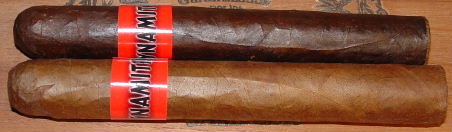
As you can see, even though these are the same size cigar, they are not the same length. We aren’t dealing with Habanos here. And while the wrappers are quite tasty looking the roll in both cases is quite bumpy. Fortunately this does not affect the overall construction, which happens to be excellent.

Corojo

The Corojo version starts out surprisingly smooth for a cigar named after the world’s premier explosive. It has a mellow, slightly nutty, and very muted flavor. It burns slowly with a good volume of smoke. Sitting out on the back porch, watching the sun go down and hoping for a breeze which I did not get, I sort of wished it would burn faster. No such luck– this baby takes its time.

Like most “bargain” type cigars this one peters out at the midway point; unlike some of those same cigars this one doesn’t turn rank. It remains a very smooth, nutty smoke to the end. The aftertaste builds and becomes a little waxy and unpleasant. This combined with a downturn in flavor resulted in my disposing of it about an inch from the band.

Maduro

The maduro version is a very smooth and mellow cigar. It shares the same fine construction as the corojo, with an easy light and an even burn, but without the same robust volume of smoke. It also seems to burn a little more quickly than the corojo.

The maduro 652 does not have a whole lot of complexity, but at this price I wasn’t expecting it. It isn’t quite as sweet as I’d expected– instead there is a licorice like tang over a base of char. Like the corojo it has a somewhat waxy aftertaste, but not as pronounced. There is no bite at all. It’s one of the smoothest cigars I’ve smoked recently. Not the tastiest, but very suave.

Overall, these are good everyday cigars. Factor in the price, and they’re great everyday cigars. Indianhead has done it again with the Dynamite line, though I might quibble a little with the name (and the band.)

Pick up a few for walking the dog or handing out to fishing buddies.

Mayorga Robusto Maduro

Cnv0179.jpg
Mayorga cigars were originally produced by Martin Mayorga and made by Nestor Plasencia in Nicaragua, starting around 1997. Today they are distributed by Cigars by Santa Clara (JR Cigars), but they are still blended by the ubiquitous Plasencia. And this is a good thing.

These are solid little box-pressed babies with dark chocolate colored wrappers from Costa Rica. The binder and filler are Nicaraguan, and the package is put together in Esteli. They're a little bit smaller in size than standard robustos, at 4 3/4 x 50, but every bit as large in flavor.

This robusto starts out with a burst of earthy flavor that has a sharp edge to it. Once it settles, the smoke turns softer until at the end it is almost creamy (though not quite.) The flavor profile is somewhat woody, with a bit of charcoal, and to my surprise it lacks the sweetness typical of maduros. It burns fairly well, correcting itself when the burn becomes uneven.

From first light to band this cigar lasted a good half hour, smoking at a leisurely pace while I watched the bats flit around the back yard around twilight. (One of these days I fully expect a bat to take a swing at my cigar, but it hasn't happened yet. Maybe they read the Attorney General's warning.)

The Mayorga Maduro is a good cigar, and when the price is factored in it becomes a great everyday smoke. At around 2 USD per stick it's a great bargain smoke.

American Stogies Cuban Corojo Toro

Cnv0170.jpg

Nestor Plasencia makes so many cigars for so many people it’s hard to keep straight, but this is one of them, made for Indianhead in Esteli, Nicaragua. Plasencia’s father Sixto was one of the pioneers of the cigar industry in Nicaragua. In the mid-60’s Sixto recognized the similarity of the valleys of northwestern Nicaragua to the Pinar del Rio area and decided it would be a good place to experiment. The test was a rousing success, and since then the Plasencia family has been huge in both the Esteli area and the Danli, Honduras tobacco zone. To date, Plasencia grows tobacco for Rocky Patel, Mayorga, OneOff, Evelio, Maria Mancini, other Indianhead cigars, and numerous other private customers. He also has his own line, which includes the Plasencia Organica, one of the first cigars rolled with certified organic tobacco.

This is the “Classic Cuban Corojo,” introduced in 2003 as a fuller bodied addition to the American Stogies line. It normally sells for under three dollars– like the Mayorga cigar it could very well be considered a “bargain cigar,” even though it could probably sell for more. It’s a Nicaraguan puro according to he venerable Cigarcyclopedia…but I must admit I did not know they were growing corojo in Nicaragua. Unless, of course, this is like the Punch rare corojo, and corojo in name only.

But judging by taste, I think this wrapper leaf is indeed corojo. It has the same aroma as the Puros Indios Corojo and the Camacho Corojo, but I can’t say the cigar as a whole is quite as good as either of those. It has a nutty, somewhat vegetal taste, with very little spice. It packs a good punch, however. Definitely not an empty-stomach smoke.

It burns well, evenly and not too quick, though the stick does get soft after a couple inches. I grew a bit tired of it at about the half-way point, where the power began to kick in without any added flavor dividends.

For the price, I’d say give this one a shot. Don’t expect too much, and you’ll get a little more than you had expected.