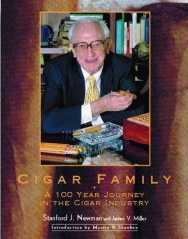
Cigar Family by Stanford Newman, Part One

Cnv0130.jpg

Stanford Newman is the chairman of the J.C. Newman Company, makers of Cuesta Rey, La Unica, and Diamond Crown cigars.

Published in 1999 by Forbes, Cigar Family is both a family history and a portrait of a cigar business that stretches from the late nineteenth century to today.

Newman’s book is a combination of biography, American cigar history, and business advice. He describes in detail the vicissitudes of the cigar business over the years, an industry that has been through numerous booms and busts.

Stanford Newman’s father, Julius "J.C." Newman., started rolling “buckeye” cigars in a barn in Cleveland in 1895. He was an independent contractor, selling his cigars to saloons and grocers. As he garnered more business, he hired assistants to roll cigars, and soon he was managing a small cigar company.

All cigars were hand-made up until the 20’s when machine-made cigars became more prominent. Consumers were far more price conscious at that time, and tended to smoke a lot more than they do now, up to five or six cigars a day. Newman mentions a number of times how raising the price of his cigars by a penny lost his company half its business.

Among the many interesting historical facts noted by Newman is the effect World War I had on the cigar industry:

The financial crisis of 1920 pulled the rug out from under many industries. Inventory values dropped over fifty percent. The most serious problem for the cigar industry was that in the 1920s, cigarettes became more popular than cigars for the first time in history. This happened due to the fact that the Red Cross had supplied millions of cigarettes to American soldiers during World War I. Many a soldier returned from Europe with a new taste for cigarettes.

But the M & N Co. pulled through this crisis with superior marketing and salesmanship. Innovations in technology and the courage to experiment were also reasons for the Newman family’s success. In fact, J.C. Newman was the first one to use cello as a packaging for cigars:

…The Package Machinery Company had introduced a machine in 1918 that encased cigars in a foil wrapper, and this had become a popular method of packaging cigars for several years. However, while foil helped protect cigars, it also prevented consumers from seeing what was inside. Too often, when smokers removed the foil, they discovered damaged or off-colored cigars inside. By 1925, the public had refused to buy cigars encased in foil.

…My father was well aware of the problem. In 1927, a local company that made cellophane bags for peanuts approached him about packaging multiple cigars in cellophane pouches; he immediately recognized the potential in cellophane. It would help protect cigars from drying out, while allowing consumers to see what they were getting. However, he did not like the idea of placing several cigars in a cellophane bag. He felt the best way to protect and present cigars would be to cellophane them individually. Thus, Student Prince became the first cigar in the industry to be individually wrapped in cellophane. Individually cellophaning cigars soon became standard practice throughout the cigar industry.

Newman’s story shows him to be a man who would probably have been successful in any business. He just happened to be born into the cigar business. After serving in the Air Force during World War II, he returned to join his father in the cigar industry, but never having been a smoker he was unfamiliar with the product.

As I contemplated my impeding return to the cigar industry, I decided that my first order of business would be to improve our tobacco blends. To do that, I would have to acquire a taste for cigars. It was time to become a cigar smoker. I wrote to my father and asked him to send me a box of fifty cigars…. Shortly thereafter a box of Student Prince cigars arrived for me at Fort Dix. At the first opportunity, I settled down for my first smoke.. I already had a good palate for food and wine. I expected it would be easy to develop a taste for cigars. I soon discovered just how hard it could be. The cigars were so strong to me that I became extremely nauseated. It took me a full month smoking two cigars a day to become accustomed to them. By the time I finished the box of Student Prince, I was prepared to become a tobacco blender.

He had more preparation than that, however. Just before the war he spent eight months sorting tobacco in Connecticut, during which time he was required to report on what he was learning to his father. Indeed, his father was a taskmaster, but it certainly paid off for the Newman family in the end.

Part Two coming soon…

Royal Jamaica Gold Belicoso

Cnv0101.jpg

The original Royal Jamaica is a strange agent because the tobacco is cased with something called "bethune." I haven't quite figured out what that is, but supposedly it's a secret sauce composed of rum, native Jamaican herbs, and some other unmentionables. Not being a fan of flavored smokes, I can't say I've tried it.

This belicoso is not the original. Introduced by Altadis in 2004, the Oro Rojo line is a new deal.

The story behind Royal Jamaica is interesting. Cigar tobacco cultivation was started in Jamaica during World War II because the UK did not want its investments made outside the commonwealth. So its currency trade with Cuba was curtailed and for the most part transferred to operations in Jamaica, where cigar tobacco was not normally grown. While tobacco does grow wild there, (as some other intoxicants do) it was not cigar quality. Cuban growers moved to Jamaica with their seed and expertise and started the Jamaican industry to supply the UK during the war. An article in Cigar Aficionado states that during 1940 to 1953 Havana cigars were "totally absent" from the UK. I would guess that Winston Churchill's supply was a notable exception.

The Oro Rojo Belicoso is square pressed, I'm told. This one is not. In all other respects it matches the catalog and Altadis descriptions:

6 1/8 x 52

Wrapper: Nicaragua

Binder: Nicaragua

Filler: Jamaica, Honduras, and Nicaragua

After Hurricane Gilbert wrecked the vegas and tobacco barns in Jamaica, operations were transferred to the Dominican Republic. Royal Jamaica is once again doing some work in Jamaica, but this particular line is listed as still being made in La Romana.

The belicoso is a mild, easy smoking stick with excellent construction. Unpeeling the gold foil reveals an oily colorado wrapper which could probably do without the shiny packaging. The draw feels loose, but once ignited the smoke flows cool and easy. The flavor profile is nutty, with a dusty overtone — earthy, but very light. A flaky but not messy ash. I chose a Red Lion beer from New Zealand as an accompaniment, but tea would go just as well. This would make an excellent afternoon smoke on the porch with a book or a baseball game in the background. An all around good mild, maybe mild-to-medium cigar.

La Gloria Cubana Serie R Maduro No. 4

Cnv0067.jpg

4 7/8 x 52

Wrapper: CT Broadleaf

Binder: Nicaragua

Filler: Nicaragua and Dominican

The La Gloria Cubana brand has been around for a long time. (The original Cuban brand was established in 1885.) Ernesto Perez-Carrillo, Sr. began making cigars in Cuba in 1948. Like so many other great cigar makers, he had to leave Cuba in the late fifties. He settled in Miami, owned a bar for a while, worked for other cigar makers, and finally bought El Credito cigar factory in 1968. The company's first long-filler cigar was El Rico Habano, a brand which has since been revived.

Perez-Carrillo's son, an aspiring jazz musician, took over the business at the last minute as his father was about to sell the company. Ernesto Perez-Carrillo, Jr. then began work on La Gloria Cubana. He changed the box lithography and cigar band to closely resemble the original Cuban brand's artwork, and modeled a new blend on the Cuban Davidoff of 1982. (I think this was the original Cohiba blend distributed by Davidoff, before Cubatabaco put the Cohiba brand directly on the market in 1983.)

In 1996 the El Credito factory moved to the Dominican Republic, though some LGCs are still made in Miami. By the late 90's Perez-Carrillo Jr. began developing another line of La Gloria Cubana with a heavier body. The line he came up with became the Serie R — R for robusto, since they all have large ring gauges.

The Serie R maduros I've sampled are indeed rich, hearty cigars. I was prepared to be blown away, but was pleasantly surprised by their smoothness. There is a solid woody element with a touch of sweetness on the nose. The construction and burn were perfect, which is not an easy feat with a maduro wrapper as luscious as this one. For some reason Connecticut broadleaf fermented to this hue with all its oils does not want to burn as readily as the rest of the cigar, but in this case that proved to not be true.

Slow down at the midway point to avoid a tarry aftertaste. This one does not want to be rushed. A great 30 to 45 minute smoke, and in my opinion the best LGC yet.

Felipe Dominicana Serie Especial T

Cnv0060.jpg

Special T — for Torpedo, obviously.

Philip G. Wynne went from selling helicopters in the Middle East to making cigars in Honduras and Nicaragua, under the tutelage of Don Jorge Bueso and Don Julio Eiroa. Somewhere along the way he was asked to make a signature cigar for Frank Sinatra. And who could refuse the Chairman?

The requirement for Sinatra was that the cigar had to be made in the Dominican Republic. When Wynne said he had no factory in the DR, Sinatra's people told him to build one. So he did, and the Sinatra My Way cigar was born. After Sinatra died some legal issues came up with his estate and the My Way went His Way, but the factory remained. (Though apparently there is a very mild cigar still made by Felipe Gregorio called "Felipe My Way.")

This a mild and relaxing smoke with a really nice Ecuador Connecticut shade wrapper. The binder and filler are both Havana seed — piloto cubano — and lend this cigar some body. It's a creamy, toasty smoke with an earthy aftertaste, and the light spice typical of a high quality Connecticut shade wrapper.

I won a box at auction and when it arrived I eagerly opened the box and lit one up. It burned down the side, tasted rank, and needless to say I was disappointed. I put them in the humidor for three weeks, hoping they just needed to settle. I guessed right — they were transformed — no construction issues. Fine mild smokes.