

The legend of Avo Uvezian, jazz pianist, composer of “Strangers in the Night,” and cigar celebrity, is well known. If you’re in the dark about Avo, it’s quite a story — a brief version can be found in our review of the Avo Domaine, and Zen and the Art of the Cigar has a manufacturer spotlight of Avo that includes a complete rundown of the various Avo blends.
Avo cigars are blended by master ligador Hendrik Kelner of Davidoff, which since 1995 has also owned the brand.
Avo’s Maduro line utilizes the same Dominican binder and filler as the Classic line — the only difference, of course, is the Connecticut Broadleaf wrapper. The Classic line is known for its mild sophistication, exactly what you’d expect from a firm like Davidoff, not to mention the suave character in the Mimbres hat. The Maduro wrapper changes the blend’s profile significantly, adding a little strength and a dose of sweetness.
Six sizes are currently available in the Maduro line:
- Robusto – 5 x 50
- #2 – 6 x 50 (toro)
- #3 – 7.5 x 50 (presidente)
- #9 – 4.75 x 48 (corona extra)
- Belicoso – 6 x 48
- Piramides – 7 x 36/54
The binder and filler leaves are Dominican, mostly from the Cibao valley.
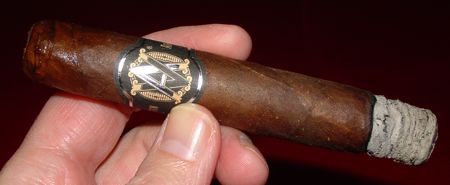
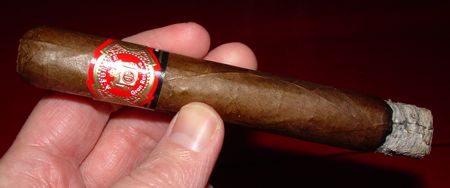
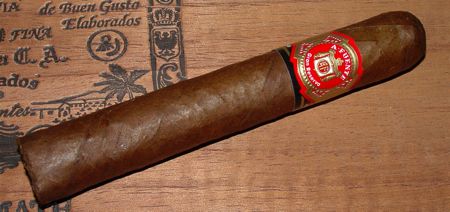
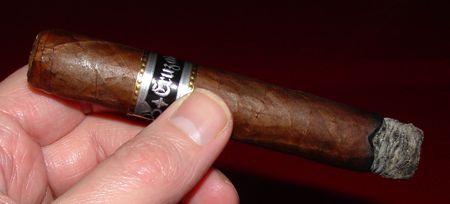
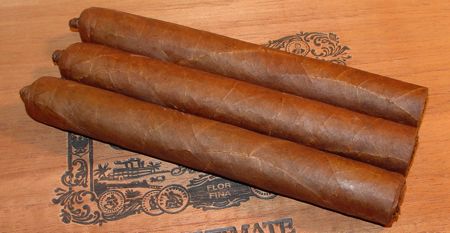
The wrapper on this robusto is typical of genuine maduro — thick, rough, and a bit chipped in places. It looks a lot more serious than it smokes. The prelight scent is of sweet tobacco with a whiff of compost on the wrapper. The roll is solid and the cap clips cleanly.
The first flavors to emerge from the Avo Maduro are grassy and sweet. The aroma is rich and chocolaty. The smoke is mild to medium in body and extremely smooth. There is almost no finish and the aftertaste is negligible.
By the mid-point the flavor continues to be mild and straightforward, though it gradually becomes earthier and less grassy. The sweet chocolate on the nose steals the show here while the finish and aftertaste seem to be waiting in the wings.
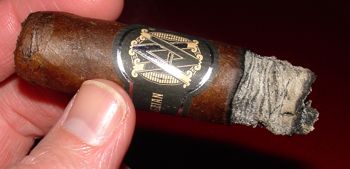
The last third brings out some toastier cereal-like flavors which combine on the palate with the sweet aroma to create something like oatmeal with maple syrup. It’s an interesting effect, though very mellow in intensity.
The Avo maduro smokes very much like the Classic line — it’s an easy smoking cigar with a very clean flavor profile. Construction qualities here were almost perfect: an easy draw and a perfectly even burn. My only complaint was an ash that had a tendency to crack every inch or so.
This is a cigar I would smoke for its aromatic qualities more than anything else. Paired with a Classic Avo with its Ecuadorian Connecticut wrapper this would be a perfect way to teach a new cigar smoker the difference between natural and maduro flavors. It’s also a great example of how a rough looking, manly maduro can be incredibly clean and mild.
The robusto in this line runs around 5 to 6 USD before tax. A great price for the quality you’re getting.
Final Score: 86
~cigarfan
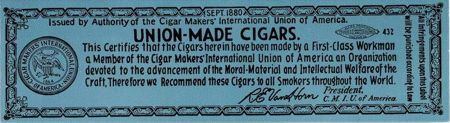
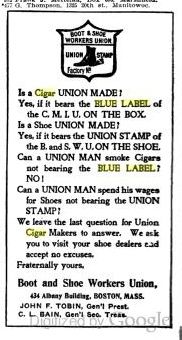 Within other cigar unions the label had more insidious uses: when Chinese immigrants flooded the country in the late 1860’s, many of them found employment in cigar factories. Displaced or disgruntled white workers formed the Cigar Makers’ Association of the Pacific which subsequently issued cigar box labels reading, “The cigars contained in this box are made by WHITE MEN.”
 I’m sure if we were to scry deeply enough into the crystal ball of Pepinolatry that some clarity could be found — maybe in the fact that the provinces of Villa Clara and Sancti Spiritus are contiguous and were at one time two separate parts of one province called Las Villas, and Cabaiguan is a city within Sancti Spiritus. Or perhaps we’d see that Pepin is a quasi-religious figure in these lands and thus his birthplace is claimed by competing bands of disciples — or we could just forget the magic carpet ride and smoke a cigar.
 Altadis USA is engaging in extension frenzy once again with its Montecristo Reserva Negra, increasing the number of Montecristo blends currently available to seven. Introduced last summer, this is the first “official” Montecristo to arrive dressed in a maduro wrapper, and it’s a dandy.
 Several types of tobacco are grown here, including the leaf for Mexican puros like Te Amo and A. Turrent cigars, but what I’m primarily interested in are the crops destined to become maduro — what is usually called San Andres Negro or San Andres Marrón. (I’ve seen it spelled Morrón and even Moron, but since Marrón means “chestnut brown,” Morón is a hill, and Morrón isn’t in mi dictionario — I’m going with Marrón.)










 Cigarfan.net