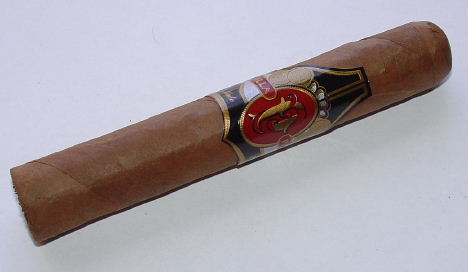
CAO MX2 Robusto

cnv0351.jpg

It’s been a while since I picked up a CAO MX2, but I’ve been in a maduro state of mind lately so I decided to fire one up and see if they’re as good as I remember. The SLR Serie G was a good cigar, but I remembered the MX2 as having a little more complexity. I’m comparing the two because they’re both “double maduros,” meaning they employ maduro leaves for both binder and wrapper.

It’s no surprise that the MX2 is more complex simply because there are no less than six different types of leaf used. The wrapper leaf is the traditional maduro leaf — Connecticut broadleaf. But beneath this is a binder from the Mata Fina region of Brazil. CAO has not been afraid to use Brazilian leaf, having used it with the Brazilia (which has a delicious Arapiraca wrapper) and the Sopranos edition (a more delicate Mata Fina.) For whatever reason, Brazil seems to get a bad rap in the cigar department even though it is South America’s top producer of black tobacco. Maybe the trick is in the blend — here CAO blends the maduro binder and wrapper with leaves from Nicaragua, Honduras, Peru, and the Dominican Republic. Tim Ozgener says there is Italian and Mexican leaf in the blend as well. That’s one smokin’ buffet!

CAO’s MX2 was introduced in 2003 and according to Ozgener it was the first “double maduro” cigar. Previously this term referred to extra-dark maduro colored wrappers (aka oscuro) but the MX2 was the first to use two maduro leaves in the blend. Sometimes “maduro” is used as a color designation but here it refers to the result of a lengthy fermentation process that goes into making a true maduro leaf.

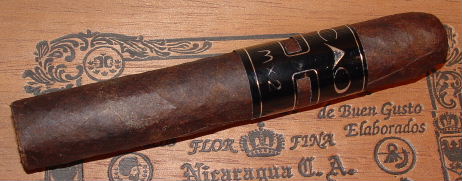
The MX2 is a rough looking cigar: the wrapper is thick and presents an imposingly dark exterior. There was a time when maduro cigars were primarily made from corona or medio tiempo leaves — the strongest, thickest leaves at the top of the plant. The result was a very strong cigar. This isn’t so true any more– there are plenty of mild to medium bodied maduros that use less potent wrappers — but the reputation lives on. But if I were inclined to believe that darker is stronger I would be wary of this cigar.

One of the characteristics of good binder leaf is that it promotes an even burn, so using a thick, oily, heavily fermented maduro binder is a challenge. To the blender’s credit, the MX2 burns beautifully. I had no problem with lighting this stout robusto and it burned perfectly evenly with a very comfortable draw.

It starts up with a touch of spice and some woody flavors. The smoldering layers of maduro produce a sweet and pleasing aroma. As the cigar builds a solid ash the flavor turns from wood to earth but becomes gradually ashy. I enjoyed the fragrance of this smoke more than the flavor, which starts out with some promise but eventually concentrates on a sweet char that tastes kind of like burnt barbeque. It’s something I’d rather smell than taste, to be honest.

What I love about this cigar is the aroma and the fine construction, and now that I think about it that’s what I remember liking about the last one I smoked a few months ago. Unfortunately, I’m not really sold on the flavor. It’s also a very dry, mouth-puckering cigar that doesn’t inspire much salivation. Make sure you have a drink handy if you’re going to try one of these.

As for me, the taste buds have voted. All 10,000 of them. The MX2 is a fine cigar, but when I want a double maduro I’ll stick with my trusty Cusano 18 Paired Maduro.

Saint Luis Rey Serie G Rothchilde

cnv0350.jpg

The Saint Luis Rey Serie G is a new double maduro cigar from Altadis USA. Traditionally the serie associated with this frontmark is the “Serie A,” the classic Cuban cigar, so maybe borrowing the theme and adding another serie to the line is a good marketing play. Or maybe it’s just plain larceny. After all, what Cuban brands don’t have non-Cuban versions available for legal U.S. consumption? Vegueros? Guantanamera? It’s safe to say that at least the big names are spoken for — sometimes more than once — in the strange world of the cigar trade.

I always thought that the name of the brand came from Thornton Wilder’s The Bridge of San Luis Rey, the classic novel about the collapse of a Peruvian bridge and the Francisan missionary who tries to make sense of the senseless suffering that results. Now why one would name a cigar after a book as ponderous as this, I don’t know, but that’s why I was pleased to hear an alternative story: the original vegas that produced the tobacco for Saint Luis Rey were located in San Luis, in Cuba’s Vuelta Abajo, and somehow Rey got tacked on at the end as an honorific.

The whole “double maduro” thing has become a bit of a trend as well. CAO has done it with the MX2 (a cigar I plan to review soon as a companion piece to this one) and Cusano’s paired maduro is a very fine smoke as well. So I was looking forward to trying Altadis’s crack at the formula.

The Serie G cigars are all large ring gauge smokes — the Rothchilde is a large robusto at 5 x 56; the Churchill measures 7 x 58; and the “No. 6” is 6 x 60. So I guess we have a combination of trends here — double maduro, plus super huge ring gauge. The wrapper and binder are both Connecticut broadleaf maduro, and the filler is Nicaraguan.

This SLR double maduro is a solid log of a cigar with a dry dark maduro wrapper. The pre-light scent is earthy and redolent of good old fermented tobacco leaf. Due to the large ring gauge it takes some time to set this one alight, but once going it burns with a slow and even determination.

Given all this, it’s somewhat surprising that the volume of smoke produced isn’t larger — the smoke seems a little thin bodied to start out with, but it gradually grows to about medium at smoke’s end. What it lacks in body it makes up for in smoothness though. Neither bark nor bite come anywhere near this cigar.

The flavor is woody and when combined with the sweet char coming from the wrapper the overall impression I get is that it’s like being next to a warm camp fire on a crisp autumn night. It’s not a complex, symphonic kind of cigar, but the simple tune it carries is honest and sincere. The last third adds a heartier earthy component to the mix until it slowly declines and signals its demise with a final dash of tar. (I might have smoked it a little too far at that point, but it’s hard to know when to stop when you’re enjoying a good cigar.)

If you’re a maduro guy you’ll definitely want to sample a couple of Serie Gs, and if you’re new to maduros I think this one is a great example of the breed. Just keep in mind that it’s not a powerhouse cigar, and there isn’t a whole lot of complexity. It’s just a good old cigar.

(Afterthought: I smoked one of these in the garage last night and didn’t air the place out as well as I could have when I was done. When I went to get in the truck to go to work this morning it smelled great in there! It reminded me of what my grandfather’s tool shed smelled like when I was a kid: old leather and pine tar and gunpowder. What a smell. My wife doesn’t agree, but that’s why guys like us spend so much time in places like tool sheds and garages smoking stinky cigars. Long live the stink!)

Padilla Hybrid Robusto

cnv0348.jpg

One of the interesting things about tobacco, aside from the pleasure we derive from its taste and aroma as it burns, is its use in genetic engineering. Nicotiana Tabacum is extremely susceptible to hybridization, to the point that tobacco farmers have to constantly defend against cross-pollination in order to keep their strains pure. It has been said that the reason why Cuban tobacco no longer tastes the same as it did years ago is because of uncontrolled hybridization. I’m not sure how true that is, but that’s the line you’ll hear from the folks in Honduras or Nicaragua who claim their corojo is from the “original” Cuban seed.

Tobacco is an often used plant in biological experiments, because it has many advantages: It is a self-pollinating crop with up to one million seeds per plant, it can produce a large amount of biomass (more than 40 t fresh leaf weight/acre), it has no known wild or cultivated relatives in North America and it is easy to enhance through genetic engineering. By harvesting tobacco leaves before the onset of flowering, the possible flow of genetic material via pollen or seed is eliminated and the contamination of food crops is prevented. In addition, there exists a large-scale processing infrastructure.

Source: http://www.monsanto.co.uk/news/ukshowlib.phtml?uid=8474

Bioengineering is somewhat controversial, and sometimes just plain weird. How about a luminescent tobacco plant?

Or tobacco crossed with carrot? Cigarrot, anyone?

The wrapper for the Padilla Hybrid is a carefully engineered cross between “cuban seed” tobacco and Connecticut Shade, but more importantly (I think) is the fact that it’s grown in Ecuador. I’m sure that has as much to with the fine taste of this cigar as the genetic blend does.Out of the box the first thing you’ll notice is a very smooth shade wrapper of uniform color with small discreet veins. The cigar is a little bit dry, but rolled well with a Cuban style flat head.

The construction here is right on the money. It lights up easily and burns absolutely even with an effortless draw. The aroma from the wrapper is most typically Connecticut shade — creamy, buttery, like Chardonnay. But it’s spiked with some more unusual, but still gentle spices. A touch of cinnamon or nutmeg maybe with a bready overtone. The flavor is nutty but otherwise unremarkable. The aroma is the focal point here.

It starts to burn a little hot at the middle of the cigar and by the two-thirds point the flavor is getting a little ashy. It’s a mild cigar in terms of strength, but about medium in smoke density and mouthfeel.

The flavor and aroma of this cigar reminds me a little of what happens when you blend two single-origin coffees, or two single malt whiskies. While the high points of both elements are present and complementary, if you’re a diehard fan of one or the other the blend might come off as an adulteration.

But I think Padilla has something here. Overall I think this is a great blend of aromas and definitely worth the very reasonable price. If you like Connecticut shade and cigars on the mild to medium side, definitely give this Hybrid a shot.

Do it soon though because they’re going out of production. If you’ve tried one and you like it, be sure to pick up a few boxes now while they’re still available. At 60 dollars for a box of 20 this is a no brainer.

Carlos Torano Noventa “La Esperanza”

cnv0346.jpg

When Daniel Ortega was elected President of Nicaragua last November, cigar makers and aficionados everywhere had to step back a moment and remember what happened the last time Ortega’s party was in power. When the Sandinistas assumed control in 1979, tobacco farms and factories were seized by the government and the Nicaraguan cigar industry was essentially decimated; cigar manufacturers took what tobacco they could and ran for the border to Honduras or other more hospitable countries. Tobacco production in Nicaragua was eventually retooled for cigarettes to be marketed in Eastern Bloc countries.

So when Ortega came back like a bad penny last November, Philip Wynne of Felipe Gregorio cigars did what seems the sensible thing — he got out of Dodge and moved his operation to the Dominican Republic. But the Toraño family evidently has no fear. Instead of leaving, or even hedging his bets, Charlie Toraño decided that they would go ahead with plans for a new facility four times the size of their current one in Esteli. The new factory will be set on a 30 acre campus complete with areas for social events and tourist attractions; in fact, Toraño says they want the new factory to have the air of a winery where people can relax and learn about the history of Toraño’s four generations in the business.

And if this weren’t enough, there’s the name of the new facility: Esperanza, which was the name of the Toraño farm in Cuba. It was confiscated by the Castro government in 1959 and led to Carlos Torano’s famous escape to the Dominican Republic with the seeds that would become known as piloto cubano, one of the great stories and historical milestones in the history of cigars. Esperanza is Spanish for hope, and hope is certainly alive in Nicaragua.

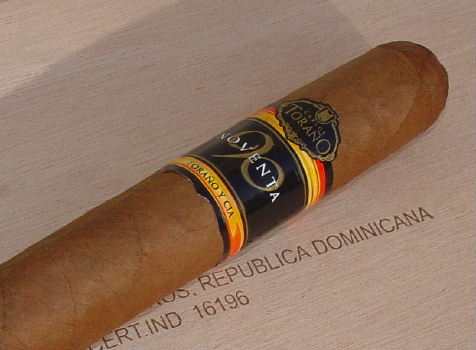
To celebrate the 90th anniversary of the founding of the company (dated from 1916, the year Santiago Toraño emigrated from Spain to Cuba,) Toraño Cigars released the Noventa. After five years of aging, the final product was released late last year. Noventa is a Nicaraguan puro utilizing a nearly flawless habano wrapper, a habano binder, and a complex blend of fillers from Jalapa, Esteli, Condega and Pueblo Nuevo. The names of the three available sizes are reflections of Toraño’s heritage: Santiago, a 5 x 50 robusto named after the patriarch of the family; La Esperanza, a 6 x 52 toro named for the original farm in Cuba; and Latin, a 6 1/4 x 54 torpedo named after the current business moniker.

The toro size Esperanza has a smooth shade-grown appearance with a slight sheen to the wrapper. A couple of discreet veins pop up toward the head from under the band. The foot reveals some dark leaf, and the pre-light scent is mildly spicy. The cap is smooth and shiny and applied in the flat Cuban style. A very attractive cigar.

I was expecting a bold spicy start typical of Nicaraguan puros, but what I got instead was a very smooth, nearly creamy smoke. The base flavor here is wood with a touch of cedary spice. The draw is perfect, and the burn is as close to razor straight as I’ve had in a long while. The flavors and aroma remind me of a Padron 1964 natural, though perhaps not as bold. The same smoothness and woody profile is there though, with maybe a little more sweetness on the nose.

There wasn’t too much development here, just a very relaxing spritely cigar with gentle spices jumping all over the palate — cedar, juniper, maybe a little vanilla bean. Never overbearing, perfectly balanced, and smooth as silk. I’d rate it a solid medium in body, though the smoke texture itself is a little bit heavier than that. It’s not heavy the way highly spiced Nicaraguan cigars can be — it’s substantial, but refined. I enjoyed this smoke for a good hour and fifteen minutes, pausing once to remove the band and wonder where the time went.

The Noventa is a great cigar worthy of the Anniversary status conferred upon it. The bad news is that it’s very expensive. At around 11 USD this isn’t going to be an everyday smoke for most people, and it probably shouldn’t be. Since Noventa means 90, I would prescribe one every 90 days. Even if you need to scrimp a little the rest of the week — have a Mayorga or a Maria Mancini instead of that Ashton –I think it’s worth the sacrifice.

Coronado by La Flor Double Corona

cnv0342.jpg

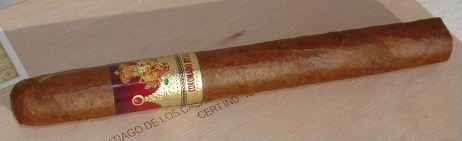
By now most cigar smokers are familiar with La Flor Dominicana cigars, but in the past few years Tabacalera La Flor has released a few “special” cigars like the Litto Gomez Diez line, the Limitados I and II, and the extremely limited Factory Press cigars. The Coronado entry is a departure from the standard LFD production as well, with only about 65,000 cigars made last year. And while the production run for the Coronado isn’t as limited as those “special” smokes, the fact that the double corona rated a 93 and won “Second Best Cigar of 2006” in Cigar Aficionado put in the spotlight for a while.

The heart of the Coronado is the filler and binder grown on Litto Gomez’s farm in the Dominican Republic. The binder is corojo, (Dominican corojo is always sure to get my attention) and the filler is from Sumatran seed.

The wrapper on this cigar is a very mottled colorado maduro with fine veins. It’s a gorgeous example of sun-grown wrapper, and in this case it’s easy to see why Litto opted for a non-Dominican leaf — it’s grown by Nestor Plasencia in Jalapa, Nicaragua, and in addition to the visual element it adds several levels of complexity to the smoke. It’s rough looking and oily, but beautiful.

The draw on this stick is just about perfect — an easy pull with just the right amount of resistance. The burn is not perfect, and the ash from the wrapper tends to peel away and look a little messy, but these are minor matters. Overall I found great construction here.

La Flor makes some great milder bodied cigars, but the ones that have gotten the most attention lately are the full bodied sluggers like the Double Ligero and the Litto Gomez Diez. As soon as I lit the Coronado I realized it was probably in the same class. The first few puffs are very peppery and the first half inch or so unleashes a serious tongue bite. The pepper I like, especially since it dissipates and develops much more complex flavors after that first blast. The tongue bite I could live without.

Eventually what I’m getting is a solid base of leathery flavors with overtones of black pepper and later on some woody elements. The finish is long and peppery, and the texture of the smoke is excellent — creamy, full flavored, almost chewy. Strength aside, this is a truly heavy bodied cigar just in terms of the weight of the smoke, and the aroma is powerful and pervasive.

But to be honest, this stick kicked my ass. I managed to get through the first two thirds, really enjoying the cigar, until the last third when my head started spinning and I had to weigh my options — keep smoking because the flavor was too good to abandon, or put it down and try to regain my equilibrium. I was struggling with this decision until I started feeling a little queasy and recognized the signs, the ones that say “Stop now or find a nice quiet place to be sick for a while.” So for once I listened to my body and let the Coronado extinguish itself.

This is a great cigar for full-bodied cigar lovers. It was a bit much for me, but what I could handle of it I quite enjoyed. I’ll be picking up a few of these for my friends who like Joya de Nicaragua Antanos and LFD Double Ligeros — the price point is a little high at around 8.00 USD retail, but for complexity, performance, and all around flavor this is money well spent.

La Aroma de Cuba Corona Minor

cnv0339.jpg

On November 30, 1895, Winston Churchill was fired upon by Cuban insurgents as he traveled with the Spanish Army as a military observer. It was his 21st birthday and his first experience under fire.

As a recent graduate of the Sandhurst Military Academy, Churchill’s eagerness for active service drew him to Cuba. But he left with a taste for something else — the Havana cigars he would treasure and continue to enjoy for the rest of his life. At this time he was loyal to two brands in particular: the famous Romeo y Julieta, and a lesser known label called La Aroma de Cuba.

Romeo y Julieta has been in continual production since that time, but at some point La Aroma de Cuba fell by the wayside. In the late 1990’s, Robert Levin of Ashton Cigars read an article in Cigar Aficionado about Churchill’s exploits in Cuba and after doing a little research he discovered the brand name “La Aroma de Cuba” had been abandoned. He registered the name for future use.

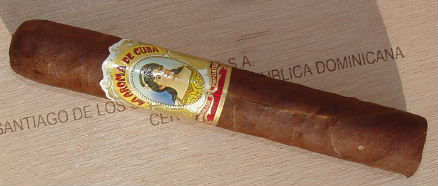
In 2002 Ashton introduced La Aroma de Cuba with a Honduran wrapper (grown by Nestor Plasencia), a Honduran binder, and filler from Honduras and Nicaragua. The cigar is manufactured in the small colonial town of Santa Rosa de Copan in Honduras, most probably in the Flor de Copan factory. The artwork on the band and box is based on the original lithography. It certainly has that old timey look about it.

I read a review of this cigar somewhere that compared it the Cuban Bolivar petite corona. A far fetched claim, I thought. I had sampled La Aroma de Cuba a few years ago and wasn’t too impressed, but the review insisted that it was this particular size in the line that was the jewel in La Aroma’s crown. So I thought I’d give it a go.

The wrapper has a rough but robust appearance, slightly toothy with lighter colored veins. The cap is applied well and the roll is solid. The prelight draw is clear and we’re ready for takeoff.

The basic flavor of this little stick is leather and its highlight is spice. It produces a nice volume of medium bodied smoke which has a slightly sweet tinge to it. It’s not sweet like a habano though; it’s more of a sun-grown sweetness than the caramel and bread of a Bolivar. The smoke has a nice smooth texture, and while the finish is spicy it’s not biting. As a point of comparison, I’m thinking Camacho, but a sensitive Camacho, which I realize is an oxymoron. La Aroma de Cuba seems to me a more nuanced but still full bodied Honduran cigar.

This Corona Minor is a fine 20 to 30 minute smoke, but when I want this flavor profile I will probably reach for a Camacho instead. When you want to take a bull by the horns, you want some horns to hang on to.

Padilla Miami Corona

cnv0338.jpg

Originally this line was called “Padilla Miami 8/11” but at some point it seems to have lost the cross streets. These are made in Pepin Garcia’s Rey de Los Habanos operation in Little Havana, which of course is located near the intersection of 8th street and 11th Ave. This line has gotten a lot of positive feedback in the last couple years, making it one of the best known and most sought after boutique cigars on the market.

Padilla Miami cigars are Nicarguan puros, bunched by hand and rolled by only ten experienced torcedors. The tobaccos used are first-generation cuban seed corojo and criollo grown in Nicaragua. The wrapper is corojo, and the filler is a blend of the two. As noted elsewhere, these particular varieties of tobacco are even more hygroscopic than your average black tobacco — they absorb the humidity more readily and in an excessively humid environment will not draw as well as they should. For this reason these cigars are best stored at a lower relative humidity than the typical 70-75%. The low 60’s is usually recommended.

These are not easy cigars to find. I finally managed to snag a five-pack on an auction site for a reasonable, though still substantial price. It’s a nice looking cigar and I noticed right away how well balanced it feels in the hand. The wrapper is a smooth dry natural color with maybe a touch of colorado. The prelight scent is not as spicy as I expected — simple sweet tobacco with an overtone of cedar.

Construction on these is a little bit questionable, just because they all seem to be rolled pretty tight. Two of the five I had to toss halfway through the cigar because it had become more labor than pleasure. The rest were better, but if held to the highest standard these are going to take a hit in the construction department.

On the other hand, these are some of the best tasting, most flavorful and complex cigars I’ve experienced from Don Pepin. They start out with Pepin’s trademark peppery prelude and slowly grow into a powerful smoke with a woody foundation. The aroma is the best that corojo has to offer — a sweet, lightly spiced caramel that starts out with some edges but then mellows after an inch or so and shows up some cocoa and coffee bean.

After a couple inches I’m ready to buckle up and settle in for the ride. Despite its size, this is a powerful cigar. In strength I’d rate it with the Opus X petite corona, though I think this is a superior smoke in terms of flavor. More than anything the flavor reminded me of a Montecristo No. 4 I was gifted a few weeks back, though not as smooth.

Construction problems aside, this is probably the best cigar I’ve smoked this year. I enjoyed the hell out of these, and even though I ended up paying around 6 dollars a stick (which is a pretty good deal, actually) I’d say they’re worth the standard retail 8 to 10 bucks a stick. It’s not an everyday cigar, but when you want to really concentrate on an intense and complex smoking experience, a Padilla Miami will not disappoint.

Rocky Patel Cuban Blend

cnv0337.jpg

It seems that Rocky can’t make a bad cigar. With a lot of talent and hard work he has given us some great smokes already, but Rocky is not satisfied with mere success. Rest on his laurels he will not. He must create even more blends to satisfy his army of hungry Patelians. So far there is a new American Market Selection, a Rosado, the RP Connecticut, the Edge Lite, and probably a bunch more out just in the last year or so. This one, the Cuban Blend, and the Honduran Blend are available exclusively from Famous Smoke Shop.

Famous advertises this one thusly:

Available ONLY at Famous Smoke Shop, these cigars present a bold, heady and well-balanced blend of long-aged Honduran Ligero longfiller tobaccos deftly rolled into scrumptious Corojo or Maduro wrappers. The smoke is ultra-smooth, complex, and brimming with dark, spicy flavors. It’s almost like getting a fine Cuban cigar without the Cuban price! Try a box and taste for yourself.

OK. I’m sold. Not on a box though. I like to test the waters with a five pack before setting sail for Box Land.

There are two versions of the Cuban Blend, corojo and maduro. This is the corojo version, with a shiny golden brown wrapper that is truly enticing. The head is finished without a flaw. It’s almost a shame to cut this one, but sacrifices must be made for the betterment of mankind and our burning desires. The roll is solid, almost hard to the touch, but after a clip of the Palio I found the draw just fine.

This Cuban Blend toro starts up with a touch of spice and soon mellows into a smooth Honduran leather. There’s a whiff of sweetness here as well, but just barely. The aroma is not as pronounced as I would expect from corojo, but it serves as a nice complement to the leathery core.

This is a fairly straightforward cigar without a whole lot of development or complexity. It levels off at a solid medium body, veering at the end toward full. At the midpoint the caramel-like sweetness of the corojo is kicked up a notch, and the flavor becomes a little bolder, but calling this “Cuban” is a stretch. It’s a smooth and tasty high-quality smoke from Rocky Patel, and that’s advertising enough right there.

Famous is hawking these for around 90 dollars for a box of 20, or $16 for a fiver. Not a bad price for this cigar.

EO 601 Habano Robusto

cnv0336.jpg

I was checking out the EO Cigars Website a few days ago, and after escaping the clutches of the sirens who grace the front page I discovered their “blog” section, which is really more of a place to post comments and questions. Eddie Ortega was kind enough to answer a question I posed about the origin of the “601” name for this series of cigars. I was thinking maybe it was a birthdate, or part of an meaningful address, something like that, but it turns out that 601 was the date that Eddie and Erik first went to visit Pepin’s factory in Nicaragua.

There are now three 601 cigars created by Don Pepin Garcia for EO Cigars — the 601 Connect I reviewed a few days back, a newly released box-pressed maduro, and this one: the Red Label with a Nicaraguan Habano wrapper.

The wrapper on the Red Label is a dark oily rosado that could easily be mistaken for maduro. It has a leathery look to it and is heavily stippled with prominent “teeth” that are much coarser than than the toothiness of most Cameroon wrappers. The head is nicely finished with a classic Cuban cap, of course. This is a Don Pepin production, after all. The final result is a real winner in the looks department.

So with all those teeth it’s appropriate that this smoke should start up with a bite. It’s similar to the 601 Connect in this regard, but overall I think it’s comparatively tame for a full bore Pepin. The base flavor here is leathery, with the wrapper contributing some subtler spices. Cinnamon, maybe. After the mid-point the flavor gets sweeter, taking on a molasses like tang, and the pepper enters for a reprise. It’s similar, but not the same pepper as the Connecticut version — I tasted a lot of black pepper in that one and it had me sneezing pretty good for a while. The Habano is a sweeter rendition — instead of peppercorns I’m thinking hot northern New Mexico chiles.

The construction was good, but not perfect. This one suffered a little from an uneven burn and at one point the wrapper unraveled a little. But neither of these things really affected the performance of the stick.

The 601 Habano is a powerful little puro with a lot of sweet spicy flavor. At around 6 US greenbacks it’s not a cheap date, but ya gotta live a little sometimes. If you’re in the mood for a well-balanced but brawny cigar, check it out. Fill up at the dinner table first though. A big plate of chile rellenos, some black beans and rice, and a couple of Tecates would be a great prelude to this tough guy.

Nestor Reserve Connecticut Robusto

cnv0332.jpg

Several years ago Nestor Plasencia was quoted as saying, “Anyone who tells you they know everything there is to know about tobacco is either a liar or a fool.” This is worth remembering, coming as it does from one of the premier tobacco men on the planet. Plasencia has been working tobacco throughout Central America for years now, and has made cigars for companies as diverse as CAO, Indian Tabac, Alec Bradley, and many more, including his own brand names.

The Nestor Reserve label is probably better known for its maduro entry, which I haven’t reviewed yet but I can tell you right now that the couple of maduro torpedos I’ve sampled were fantastic, especially when the price is factored into the equation. (Another thing, but you’re not allowed to tell anyone: Plasencia makes really good econo smokes. Shhhh…)

The Connecticut Reserve is supposedly the same blend as the Nestor Reserve Maduro, with the obvious difference of a CT shade wrapper instead of the maduro. Unsurprisingly though, the information released by the big name online outlets is not convincing. The Maduro is advertised as having Honduran and Nicaraguan filler, with a Cameroon binder. Sounds tasty… IS tasty. The Connecticut, on the other hand, is presented as “a complex mixture of Costa Rican, Nicaraguan and Honduran tobaccos.” How do you get the same filler blend when one includes Cameroon, and the other Costa Rican leaf? Yet another mystery to ponder as the ash grows long…

I tend to hold mild cigars to a high standard when it comes to construction and aroma and give them more leniency when it comes to flavor. This standard worked out well for the Nestor Connecticut.

First off, I was impressed with the physical appearance of this cigar. The wrapper is smooth and almost veinless, and the cap is applied very well; in fact, one of them was neatly triple capped with a Cuban style flat head. That was interesting, especially for a cigar that cost me a little over a buck.

The flavor is mild, as expected, and by the end approaches a medium body without quite getting there. The smoke has a smooth creamy texture with a papery or balsa-like finish. Nothing to get excited about there, but the aroma is quite nice. A delicate mild spice rises from the smoldering ash and insinuates itself in the sinuses without no irritation. There’s something kind of oaky to it, but mingled with a dash of cinnamon. Maybe it’s a smell only a cigar smoker could love, but I am a cigar smoker and I love it.

There wasn’t too much of a development, and it doesn’t get too many points for complexity, but it’s a nice solid stick that burns well, smells great, and is really easy on the wallet. It may not be the best cigar I’ve smoked in the past couple months, but it’s definitely the best cigar under three or four dollars.

There’s absolutely no reason not to try this cigar, unless you hate mild cigars, Connecticut shade wrappers, or saving lots of money.