1502 Ruby Toro

OLYMPUS DIGITAL CAMERA1502 cigars are named for the year that Christopher Columbus first explored Nicaragua and claimed the territory from Honduras to Costa Rica for Spain. Within a few years of Columbus’s “discovery,” most of present-day Mexico and Central America would be subsumed under the formal title Viceroyalty of New Spain. At its greatest expanse, in the late 18th century, this territory would include most of western North America as well. It’s a little ironic then that it’s hard to find the 1502 cigar anywhere in this area (unless you are lucky enough to be in Esteli, Nicaragua where the 1502 is made.)

But that is the nature of boutique cigars. If you can find one in every corner smoke shop, it ain’t boutique.

The brand is owned by Enrique Sanchez Icaza of Global Premium cigars, and while distribution seems to be restricted to the Eastern U.S., the company entered into a distribution agreement with Emilio Cigars late last year, and that may improve availability.

Precise data on this cigar is also hard to come by. What is known is that there are three blends of 1502 — Emerald, the lightest of the bunch; Ruby, with an Ecuadorian wrapper; and Black Gold, the heaviest blend, with a sun-grown maduro wrapper. Three sizes appear to be made: Robusto, Toro, and Torpedo, though I don’t have measurements on those either.

As Columbus once said, “Nevermind the details. Anchors aweigh!”

1502 Ruby

Construction Notes

The 1502 Ruby Toro is a box pressed parejo with an attractive colorado maduro wrapper. There are some fine veins, but the wrapper is smooth and the roll is supple. There are a few small irregularities in the bunch, a couple of barely noticeable dents, but nothing that would turn up in a casual inspection. The cap is integrated well and shears away nicely.

The Ruby burns very well, especially for a box pressed cigar, and the ash is firm. The draw is easy and the smoke volume generous.

Overall construction: Excellent.

Tasting Notes

The Ruby Toro has all the characteristics of a good Nicaraguan cigar — there is some pepper up front and an acidic, mouth-watering quality that is typical of Nicaraguan tobacco. The aroma is sweet and woody. As the cigar develops, a fruity note rises up that is somewhat like cherry. To me it’s reminiscent of Tatuaje’s La Riqueza blend, which is surprising because La Riqueza uses a completely different kind of wrapper (Connecticut broadleaf).

In the middle section of the cigar there are notes of coffee and cocoa and the spicier aspects of the cigar tone down a bit, only to return in the last third. The smoke is medium in body, and about medium in strength as well. The woody notes become earthier as the cigar winds down, but the cherry note in the aroma lingers. I frequently find that by the end of a cigar the palate flavors overwhelm the aroma, but the 1502 Ruby is really well balanced in that respect.

Conclusion

The 1502 Ruby shows restraint and finesse, which is usually not Nicaragua’s strong suit. A lot of Nicaraguan cigars emphasize the explosive factor of that nation’s tobacco, and it often results in an unbalanced flavor spectrum and a shell-shocked palate. The Ruby showcases the classic Nicaraguan cigar flavors — wood, pepper, and citric acidity — in a less boisterous, but still flavorful way. And I especially like the cherry note in the aroma.

It looks like the going price for these is in the $6 USD range, which is quite reasonable given the quality of the cigar. The only problem for me, as a denizen of the desert southwest, will be sourcing them locally. With any luck we’ll see wider distribution soon.

1502 Ruby

Final Score: 90

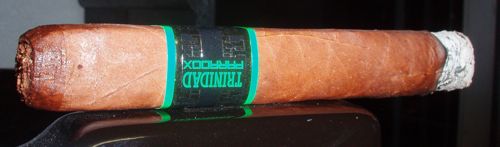
Trinidad Paradox Toro

Trinidad Paradox Toro

Cigar giant Altadis USA managed to sneak in this extension to the well respected Trinidad line last year: Trinidad Paradox, a medium to full bodied blend with a Mexican Criollo 98 wrapper. I tend to shy away from Mexican tobacco, but I will usually make an exception for leaf grown in the San Andres area, and this is one of those instances.

The binder is a Dominican piloto leaf, with filler from Nicaragua, and — gulp — more of the dreaded Mexican. The cigar is box pressed and presented in odd, but attractively lacquered rhomboid boxes of 16. I guess that fits in with the Paradox allusion.

According to a very short blurb in Cigar Insider, the “paradox” is the “combination of modern tastes and traditional cigar-making.” But is that really a paradox? I thought that was just the way cigars are made today. Then again, I am perpetually mystified by cigar companies’ marketing strategies, so maybe “paradox” is more revealing than it appears at first glance.

Trinidad Paradox is made in the colossal Tabacalera de Garcia factory in the Dominican Republic, and it is available in four sizes:

  • Churchill – 7 x 57
  • Toro – 6 x 54
  • Robusto – 5 x 54
  • Belicoso – 6 1/8 x 52

Construction Notes

The Criollo wrapper on the Paradox is a dry colorado claro, but the leaf is consistent in color and not overly rustic. The stick is finished with the typical Altadis “Cullman” style rounded head and a functional cap. This cigar is box pressed, but even so it is a little soft to the touch. This hardly matters, since the draw is consistently good and it burns evenly.

Overall construction: Excellent.

Paradox cigar

Tasting Notes

Trinidad Paradox is billed as a medium-to-full bodied cigar, but I think it is probably more in the middle of the range. It starts up with a mild cocoa and brown sugar flavor. In the first part of the cigar there is an underlying earthy flavor that grows slightly musty, but in a pleasant way.

The cigar picks up some black pepper as the ash grows longer, but compared to some of the cigars coming out of Esteli these days it can hardly be called “spicy.” The pepper blends nicely with the other flavors, which continue to provide depth and complexity. The aroma remains sweet and slightly pungent, despite the continuing notes of cocoa and coffee.

The toro seems to wind up a bit prematurely, a half-inch above the band, but my enthusiasm for the cigar might have inspired me to puff a little too frequently. It starts to char at this point, and that is my signal to put the butt to bed.

Conclusion

Serious cigar enthusiasts often pass over cigars from huge cigar conglomerates like Altadis USA. I guess those of us in search of the perfect cigar experience expect mediocrity from the mainstream, and that expectation is frequently warranted. Nor is this phenomenon unique to cigar smokers — haute cuisine, fine wine, and nearly every other specialized subset of aficionado has its share of snobs. I’ve been guilty of snobbery, I admit. But I try to be fair.

I’m glad I gave this cigar a chance. Even though it uses Mexican leaf, and even though it is made in the world’s largest cigar factory, Trinidad Paradox is a very respectable smoke. The flavors are nicely balanced and complex for a medium-bodied cigar. MSRP is in the $6-7 USD range. Bigger is not often better, but this Altadis USA blend rates a look.

Paradox

Final Score: 89

Asylum 13 Fifty

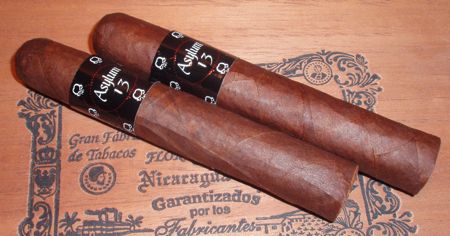
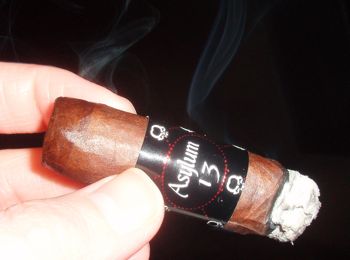
Asylum 13

It’s hard to believe that it has been five years since Camacho was acquired by Davidoff, but it’s true. And while Davidoff has managed to keep the sticks rolling out of the factory in an almost seamless manner, the intervening years have provided new opportunities for Christian Eiroa. Asylum and Asylum 13 are some of the results.

Asylum Cigars are a joint venture of Kevin Baxter and Tom Lazuka, who were later joined by Christian Eiroa. Eiroa formed Tabacaleras Unidas last year as the parent company for several brands including his own CLE and CLE Cuarenta brands, and it appears that Baxter and Lazuka have, well, taken Asylum there.

Asylum Cigars are rolled in the old Tabacos Rancho Jamastran factory in Honduras, a familiar name to Camacho fans. The Asylum 13 is a Nicaraguan puro featuring a dark habano wrapper. The cigar is made in four gobstopping sizes, with the 50-ring Fifty being the runt of the litter.

  • Fifty – 5 x 50
  • Sixty (double toro) – 6 x 60
  • Seventy (double churchill) – 7 x 70
  • Ogre (barber pole) – 7 x 70

Asylum 13

Construction Notes

The Asylum 13 has a slighly oily maduro wrapper that appears quite smooth despite a few prominent veins. The cigar is solidly packed but draws very easily. The burn is even and the ash holds well.

Overall construction excellent.

Tasting Notes

This is a fairly boisterous cigar from the first few puffs to the last. It introduces itself with a potent dose of red pepper and a strong, almost stinging, woody aroma. After an inch or so the spiciness wanes enough to detect more subtle flavors — some earthiness comes through to complement the woody flavors, and there is coffee or cocoa on the nose. A touch of anise appears at times, but fleetingly.

The smoke texture is medium to full in body, but this full-flavored cigar is a brawler from the start. I’ve read a few reviews that state the larger sizes are even stronger, so I think I’ll be sticking with the 50.

Conclusion

One of my favorite cigars from the old Camacho days was the Diploma, but I rarely smoked it because it would invariably leave me on the floor. The Asylum 13 isn’t quite that heavy (nor is it quite as complex) but it’s still a tasty cigar with excellent construction. I hope to find similar flavors in the non-13 Asylum, perhaps with a little less power and a little more complexity.

Judging by the box counts, Asylum 13 is geared for brick-and-mortar sales. The Fifty and Sixty are sold in boxes of 50 cigars, and the Seventy and Ogre are available in boxes of 30. I picked up the Fifty for around $5.00 a stick, which is pretty economical for a boutique smoke.

Asylum 13

Final Score: 88

Ezra Zion Jamais Vu (Inception)

jamais vu

Up until a few weeks ago this cigar was known to the world as Ezra Zion Inception. But it turns out there is another company making cigars under the Inception name, and rather than engage in the legal grappling that often occurs with trademark disputes, Ezra Zion made the honorable decision to simply change the name of their blend. Jamais Vu is not the next big wing chun master. It is a French phrase meaning something like “deja vu,” but turned on its head. From the Ezra Zion website:

JAMAIS VU is defined as “…a sense of eeriness and the observer’s impression of seeing the situation for the first time, despite rationally knowing that he or she has been in the situation before.”

It’s an interesting choice of names, considering the situation which led to the name change. But a rose by any other name would smell just as sweet, to quote the Bard. Of course the Bard also says that men of few words are the best men, so I’ll get down to business.

Jamais Vu is a Nicaraguan puro with a 2007 corojo wrapper. Two different binders — corojo and criollo — from two different years hold in place a blend of viso, ligero, and medio tiempo tobaccos, all aged five to six years. The blend was released in 2012 (under its former name, Inception) in three sizes:

  • Corona Gorda – 6 1/2 x 54
  • Exquisito – 6 1/4 x 52
  • Gran Robusto – 5 1/4 x 50

Construction Notes
Upon picking up my first Inception/Jamais Vu Gran Robusto I wondered if I should discard the foot band, as is my customary practice, or if I should preserve it as an item of historical interest. I put the band aside for further consideration, but I really like the fact that it comes off so easily.

The wrapper on the Jamais Vu is an attractive and oily colorado maduro. Some fine veins run down and across the cigar. It looks leathery but not weathered. The bunch is solid, though there are interesting seams that are detectable beneath the wrapper. I’m not sure if this is the result of using two binders, or if it has to do with the bunching process. The seams are not obvious, and would not be noticed by most normal cigar smokers. (By the way, if you’re reading this, you’re probably not normal. We count that a good thing.)

The cap is beautiful and the draw is perfect. The burn was a little uneven, but not problematic.

Overall construction: Very good.

OLYMPUS DIGITAL CAMERA

Tasting Notes

The first flavors out of the gate are quintessentially Nicaraguan, and the best kind of Nicaraguan. The first few puffs are spicy without the sting, and notes of hardwood and caramel soon follow. The flavors are clean and bright with an acidic tang familiar to fans of Illusione’s Original Document and some of Padilla’s cigars (the Aganorsa years).

The smoke texture is medium to full in body, and the cigar becomes considerably potent in the last third.

The cigar develops a mild bite, but the combination of wood and earth on the palate with caramel and cocoa on the nose is an adequate distraction from a little burn on the tongue. This cigar is an engine that keeps the flavors pumping and jumping from beginning to end.

Conclusion

Jamais Vu reminds me of a number of other premium Nicaraguan smokes, which I sort of lump into a flavor bin I call “Aganorsa” (whether it is actually Aganorsa leaf or not.) Los Blancos Nine comes to mind, as do a number of Casa Fernandez cigars (but in my estimation this Ezra Zion blend is smoother). There is a bright and sweet quality to this tobacco which is really distinctive, and the caramel and cocoa from the corojo wrapper combines with the spice in the core to create a beautiful smoke.

Retail price looks to be around $9 USD. This is a cigar worth going out of your way to find and enjoy.

Jamais Vu

Final Score: 92

Foundry “Wells”

OLYMPUS DIGITAL CAMERA

The cigar industry is generally not given to radical creativity. There is a market for adventure seekers, folks who like flavored stuff and cigars with multiple wrappers, but for the most part staid and conservative tradition sells more cigars than hip new trends. Just ask Padron.

Style and substance must be carefully balanced. I myself am not particularly interested in a haute couture cigar, no matter how interesting it looks, if it doesn’t smoke well and taste good. And I know I’m not alone.

And so there are a lot of smokers who will be suspicious of a cigar composed of “non-traditional” tobaccos, particularly when it comes with an unwieldy brass gear where a band should be. That is what the Foundry cigar is. I find the cigar’s “steampunk” cachet somewhat distracting, but putting that aside, the cigar itself is still striking in a conventional way. My first impression is that this stick might be able to pull it off.

The wrapper is a proprietary Connecticut leaf called H-47 Pleno Sol. It looks like Connecticut Shade, but darker and more oily. The rest of the cigar is simply “non-traditional,” meaning not Nicaraguan, not Dominican, and not Honduran. We are awash in mystery here.

Foundry cigars are made in four sizes. (The frontmarks are named for the literary heroes of the “steampunk” movement, an anachronistic fashion and art lifestyle inspired by the science and science fiction of the Victorian Age.)

  • No. 1 Wells – 6 x 50 (H. G. Wells)
  • No. 2 – Lovelace 6 1/4 x 54 (Ada Lovelace)
  • No. 3 – Talbot 5 x 60 (Bryan Talbot)
  • No. 4 Cayley 6 1/2 x 60 (Sir George Cayley)

Construction Notes

The gear slips off the Foundry toro (Wells) with only a little resistance, leaving in its wake a less mechanically endowed but still attractive cigar. The wrapper is a dark golden brown, oily nearly to the point of gloss. There are a few veins, but they don’t distract from the overall appearance of the stick.

The roll is solid, maybe a touch too firm on one of the samples, but the draw is still quite serviceable and the burn is even.

Overall construction: Very good.

OLYMPUS DIGITAL CAMERA

Tasting Notes

It is immediately apparent that this is a unique blend. The Foundry is a mild tasting cigar, but it is distinctive and aromatically very rich.

The aroma makes an initial impact with sweet notes of malt and honey. The flavor on the palate is earthy, perhaps a bit musty, and has a slightly bitter tang. There is very little aftertaste in the first half of the cigar, but the tannic bitterness on the tongue is pronounced and blends in an interesting way with the sweetness of the aroma.

The smoke is full-bodied in texture despite its mild strength. There isn’t much development in the second half of the cigar, which I found a little disappointing in a cigar of this size, but its aromatic qualities continue to impress. There is a sweet bready quality to the smoke which is quite pleasant.

Unfortunately, the bitterness on the tongue continues as well. This flavor is a fairly common component of milder cigars, and blenders must include it by design, but I can’t say I’m a fan of it.

Conclusion

I really enjoyed the idiosyncrasy of the Foundry, from the way it is designed and presented to the way it smokes. It’s built well and it’s aromatically delicious. But I had some difficulty with the bitterness on the tongue, and found it to be a bit too musty for my taste. It could be a fine beginner’s cigar, though, and smokers who venture into flavored cigar territory might want to give it a whirl.

Standard retail price is around $8 USD per stick. And hang on to your gears! They will reportedly serve a purpose later on… Perhaps there is a steampunk convention in your future!

Flying machine

Special thanks to General Cigar for providing samples of the Foundry Wells. 

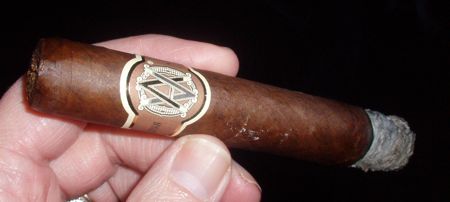
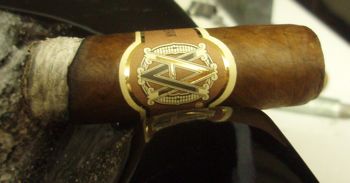
Avo Heritage Robusto

OLYMPUS DIGITAL CAMERA

When the limited edition Avo Compañero was released in 2009, iconic spokesman Avo Uvezian declared it “the best blend ever released under my name from the Occidental Kelner Cigars factory in the Dominican Republic.” Avo lovers look forward to Uvezian’s annual limited edition releases, and the Companero seemed to garner more praise and excitement than many previous years’ entries. Most Avo cigars tend to be like Davidoff blends: milder, more subtle, and a little more “exclusive” than what is generally found in my humidor. But the Compañero stands out, with many calling it the strongest, if not the best Avo yet.

The Avo Heritage is based on the Compañero blend, perhaps inspired by the popularity of its proud progenitor, or perhaps to fill out the Avo portfolio with a heavier cigar. It uses the same wrapper leaf, a dark Ecuadorian Habano, and for punch the filler includes three different Dominican ligero leaves. The core of the cigar is buttressed with seco leaves from the Dominican Republic as well as Peru, and the bunch is bound with a San Vicente leaf, also from the DR. The cigar was released in the summer of 2010, and is available in four sizes:

  • Churchill: 6 3/4 x 48
  • Robusto: 4 7/8 x 50
  • Short Robusto: 4 x 56
  • Toro: 6 x 50

OLYMPUS DIGITAL CAMERA

Construction Notes

It’s safe to assume quality construction from this factory, and the Avo Heritage Robusto holds no surprises in that regard. The wrapper is a dark and smooth colorado maduro with a touch of oil. The head is finished with a simple but elegant single cap.  The roll is firm, the draw is effortless, and it burns with a slow and even disposition.

A well made cigar draws no attention to its behavior. In that respect this one is practically invisible.

Overall construction: Excellent.

Tasting Notes

The Heritage robusto starts up with an herbal, grassy flavor overlaid with oak. There is a peppery aftertaste, and the finish is dry. A complex aroma with notes of vanilla, or even coconut, blends well with the earthier flavors on the palate.

As the cigar develops it picks up some maduro-like flavors: chocolate notes pop up amidst the grassy, mustier flavors. From the ad copy I was expecting a heavier cigar, but I found it to be medium in body and only slightly punchier than the Domaine Avo.

The last stage gives the pepper mill a few more cranks, but even with the spice and the char it remains balanced and smooth.

Conclusion

Avo’s Heritage Robusto is a fine cigar, though a little too dry and grassy for me. It’s smooth, it offers a complex aroma, and is rather affordable, for an Avo anyway — MSRP ranges around $7.00 USD per cigar.

The Heritage Robusto earned a nearly perfect construction score, and if you’re a fan of peppery Dominican cigars (and have exceptional taste) you’ll want to try this one. But given my dilatory posting habits, you probably already have.

OLYMPUS DIGITAL CAMERA

Final Score: 88

La Musa Mοῦσα

OLYMPUS DIGITAL CAMERA

ἄνδρα μοι ἔννεπε, μοῦσα, πολύτροπον

“Tell me, Muse, of the man of many ways.”

The invocation that serves as Homer’s introduction to the Odyssey is a fitting way to introduce Emilio Cigars’ rebranding of Grimalkin, now called La Musa. I studied Ancient Greek as an undergraduate and enjoy reading it still, so I applaud the name choice. I’m not sure if Gary Griffith was thinking of Homer when he chose this name for this blend, but it’s hard for an old classics major not to think of him in association with the word Mοῦσα. The other interesting word in the line is polutropon, an adjective which has no exact equivalent in English. A translator has no choice but to compromise. It’s like describing the aroma of a complex cigar: the result is always  a frail approximation, and the description is never an adequate substitute for the experience of smoking the cigar itself. Polutropon literally means “many ways.”  It  encapsulates the spirit of Odysseus — his craftiness, intelligence, and sophistication. Homer calls on the Muse to help him describe this ineffable man. Perhaps I should do the same before I try to describe this cigar.

Rumor has it that La Musa Mousa is a Nicaraguan puro, and more reliable information indicates that it is made in Esteli. Evidently the plan for La Musa is to release three lines, one for each of the three Plutarchian Muses, plus the original Mousa. (There are several different accounts of the Muses, so there are more of them available for expansion if necessary. With all those lovely ladies it could end up being the most popular booth at the trade show.)

The blend is available in four sizes, with a limited lancero release not listed:

  • Corona – 5 1/2 x 46
  • Robusto – 5 x 52
  • Toro – 6 x 52
  • Torpedo – 6 1/2 x 52

OLYMPUS DIGITAL CAMERA

Construction Notes

The cover leaf on La Musa Mousa appears maduro in shade, with a rough texture almost like broadleaf. The cigar is rolled perfectly, terminating in a sharp torpedo tip. The draw has just the right amount of resistance, and it burns beautifully.

Overall construction: Excellent

Tasting Notes

La Musa Mousa is an essentially Nicaraguan smoke, but it doesn’t start out that way. The first few puffs are much creamier than what I expect from a Nicaraguan cigar (and of course, I’m not completely sure that this cigar is entirely Nicaraguan) and the pepper gradually builds from there. Notes of coffee and cocoa appear in the aromatics, and there is an intermittent sugary sweetness on the tongue.

The complexity of the smoke is demonstrated in the middle section as woody flavors appear alongside the tobacco sweetness on the palate. The peppery intensity gets cranked up a notch as well.

The last part of this torpedo features bittersweet chocolate and tannic wood until it begins to char. It becomes quite powerful by the end (though others have characterized the cigar as “medium-bodied”) and the spice doesn’t let up. It had me tearing up and sneezing at points. In the best way, of course. There’s nothing like a good tobacco sneeze.

Conclusion

There are rumors that this cigar is made at the My Father factory, but it’s almost the inverse of a Pepin blend — it starts out smooth and saves the pepper blast for the finale. But if you gave me this cigar blind, I’d probably guess Pepin anyway: partly for its impeccable construction, and partly for the combination and complexity of flavors — wood and cocoa and pepper in a balanced and well-planned blend. It’s very much a full-flavored and spicy cigar, but it’s also quite creamy.

La Musa Mousa in the torpedo size sells for around $8.75 USD. Given the complexity of flavors and the superb construction of the cigar, that’s not a bad asking price. Seek it out if you’re a fan of big Nicaraguan blends, and let me know what the Muse tells you.

OLYMPUS DIGITAL CAMERAFinal Score: 91

7-20-4 Lancero

7 20 4  lancero

Kurt Kendall’s 7-20-4 cigar has a colorful history, one that began in 1874 when R.G. Sullivan began making cigars in Manchester, New Hampshire. Starting with a single cigar roller, the company grew to employ over 1500 people by 1924 and at that time was producing 80 million cigars a year. Sullivan was known as America’s largest manufacturer of “ten cent” cigars. As the company grew, the factory changed locations several times, as did the brand name. Gold Dust Ten Cent Cigars, as they were known, became 7-20-4, derived from the factory’s address: 724 Elm Street.

Sullivan’s factory continued on for many years thereafter, but it finally closed in 1963 as yet another casualty of the U.S.-Cuban trade embargo. The building itself still stands, and has evidently been rehabilitated for use as office space. (But before you sign that lease, know there are rumors that the building is haunted.)

The brand name 7-20-4 was revived when cigar maker Kurt Kendall secured the trademark in 2008. Today 7-20-4 cigars are made in the Tabacos de Oriente factory in Honduras, utilizing leaf from five countries: filler from Nicaragua, Honduras, Mexico and Colombia, a Costa Rican binder, and a Brazilian Mata Fina wrapper. The cigars are rolled using the entubado method to ensure a consistently even draw. With the recently added lancero, there are now six sizes in production:

  • Corona – 5.625 x 46
  • Churchill – 7 x 48
  • Gran Toro – 6.5 x 56
  • Robusto – 5 x 50
  • Torpedo – 6.125 x 52
  • Lancero – 7.5 x 38

Construction Notes

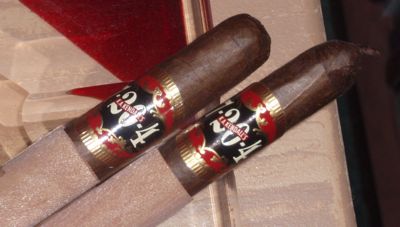
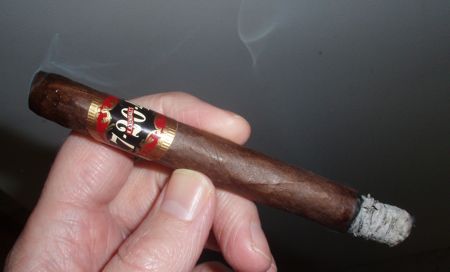
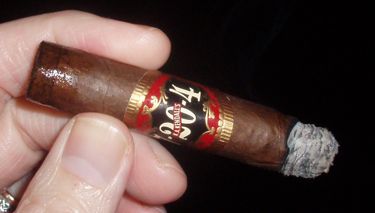
With its pigtail cap the 7-20-4 lancero does in fact look a bit like a lance. All it lacks is a bell guard and a tiny knight errant. The Brazilian wrapper is a uniform maduro in color, rich in appearance, and a little bit dry. A potential pitfall of the lancero size is a difficult draw, but utilizing the entubado rolling method seems to have eliminated the chance of that happening here. Just one of the three I smoked for review offered more resistance than I prefer, and the other two were perfect. The burn was dead even in each case and the narrow ash held longer than I expected it to.7-20-4 lancero

Overall construction: excellent.

Tasting Notes

The flavors and aroma of this cigar are pleasantly complex, and it wastes no time in presenting them. It introduces itself with pepper on the tongue and palate, in moderation, and the smoke is cool and surprisingly creamy. The foundation flavor is crisp and woody, similar to Illusione’s Original Document blend but without the sharpness. The aroma is rich and syrupy with chocolate and cedar spices.

I was expecting the cigar to exhibit a transition at some point, but it doesn’t change too much, aside from a general darkening from wood to char. Not every smoke needs a second and third act, however. The overall complexity of the 7-20-4 makes up for its lack of evolution, so there’s no room for complaint. Maybe it’s just human nature to ask for improvement when it’s already good to start with. Like raking your kid over the coals for that A- in AP Calculus.

Conclusion

Complexity and smoothness are what I really prize in my favorite smokes, and the 7-20-4 lancero has both. I shy away from lanceros because of the construction problems endemic to the size, but that’s not a concern at all with the 7-20-4. Entubado rolling and quality control have quelled those worries.

The lanceros run in the $8 USD range. Treat yourself for the holidays and pick up a few.

7 20 4 lanceroFinal Score: 90
Flor de las Antillas Robusto

Flor de las Antillas

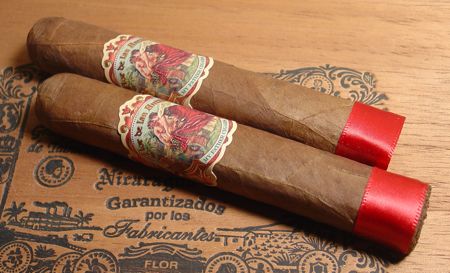
New for 2012 from My Family Cigars in Esteli, Nicaragua, is Flor de las Antillas. The “flower” of the Antilles is the island from which the Garcia family hails: Cuba itself. The brand name was in fact an old Havana trademark, and My Family Cigars has resurrected the name and rejuvenated the artwork for this new release.

Flor de las Antillas is a Nicaraguan puro featuring a sun-grown wrapper and several different Cuban-seed tobaccos. The cigar is box pressed and produced in four sizes:

  • Robusto: 5 x 50
  • Belicoso: 5 1/2 x 52
  • Toro: 6 x 52
  • Toro Gordo: 6 1/2 x 56
Construction Notes
The Flor de las Antillas robusto is a pressed cigar with a dry colorado claro wrapper. The cover leaf has a few veins, but it doesn’t look quite as weather-beaten as some sun grown wrappers. The head terminates in a flat triple-wrapped cap, and the draw is effortless. It burns evenly, and the ash it generates is almost as strong as the original cigar.

Overall construction: Superb. (No surprise, coming from My Father.)

Flor de las Antillas 2Tasting Notes

This is a somewhat unusual entry from the Garcias; it’s one of the smoothest and creamiest cigars I can recall from a cigar maker reknowned for big flavors and an explosion of pepper up front. A little bit of pepper creeps up in the sinuses for the first minute or two, but there is no bite on the tongue at all. Some leathery scents emerge which balance nicely with mild cedary spices, but for the most part this is just a very smooth medium-bodied cigar with a creamy smoke texture.

The middle section continues along the same trajectory, with some caramel sweetness added into the mix. This aroma doesn’t seem quite as robust as the Corojo 99 that I love on medium-bodied Garcia cigars like Vegas Cubanas, but it’s a little more complex and similarly balanced with mild spice.

The last third is increasingly peppery, but compared to many of My Father’s full-bodied blends (like Le Bijou, for instance) it’s really quite tame. Most of the spice tingles in the sinuses with only a fleeting nip on the tongue.

Conclusion

La Flor de las Antillas fills a spot in the medium-bodied lineup for My Father Cigars, perhaps to fill vacancies left by blends like El Rey de Los Habanos and El Centurion. It’s a nicely balanced cigar with hints of leather and cedar topped off with some caramel sweetness, and only a shadow of the pepper that is the hallmark of this Nicaraguan family. It’s also priced well. At around $6.00 it’s well within the median price range for premium smokes.

It didn’t blow me into the stratosphere, but smokers who like medium-bodied Nicaraguan blends — like Vegas Cubana or the old Padilla 1948 — should definitely check this one out.
Flor de las Antillas 3
Final Score: 89

T. L. Johnson Tempio Extreme Box Press

I hadn’t heard of T. L. Johnson Cigars before, but I have heard of one of their brands — Jose Dominguez. In addition to this one, Johnson produces Palma cigars as well as three distinct lines under the T. L. Johnson brand name: the Legend Reserve Reserve 63, and the Signature line in Connecticut and Maduro. The company is located in Colorado, and it looks like their cigars are distributed primarily in-state.

Tempio is, I believe, their newest line, and since it is produced by one of my favorite boutique manufacturers — La Tradicion Cubana — I was itching to give it a go.

Tempio utilizes a Pennsylvania wrapper leaf (like the JML 1902) in conjunction with an habano binder and Dominican filler. The cigar is made in four sizes:

No. 50 (Robusto) — 5 x 50
No. 52 (Torpedo) — 5 1/2 x 52
No. 56 (Toro) — 5 1/4 x 56
No. 54 (Churchill) — 6 3/4 x 54

Construction Notes

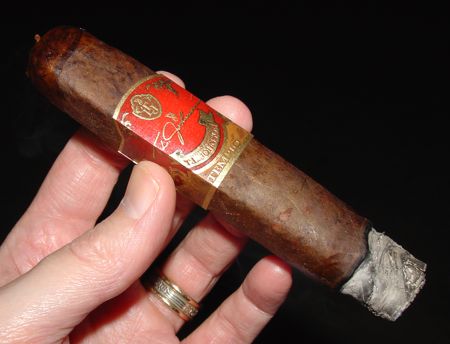
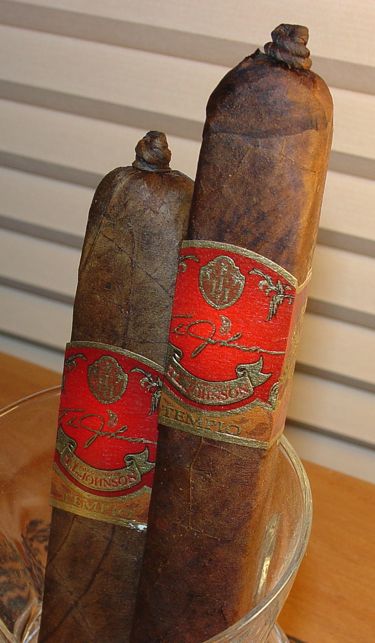
If it weren’t for the sloping shoulders and tightly wound pig-tail cap of the Tempio, I’d say this cigar looks like a carpenter’s pencil. A big one. Maybe the right size for Shaq if he adds cabinetry to his career profile. The corners are clean and form tight right angles that relax a little as the cigar burns.

The colorado maduro wrapper is smooth but leathery in appearance. The veins appear to have been pressed into the leaf, so it looks rustic but doesn’t feel that way to the touch. The draw offers the right amount of resistance, and the burn is surprisingly even for a square pressed stick. The ash is a little bit flaky on the perimeter but holds strong.

Overall Construction: Excellent.

Tasting Notes

The Tempio focuses on a cedar flavor throughout the smoke, but it starts up with some unusual scents that are hard to place. There is a peppery spiciness on the tongue that fades pretty quickly, but the most interesting aspect of the first third are the fleeting sweet spicy notes in the aroma. There seems to be something vaguely fruity about the aroma, but not in a light way — it’s a spicy fruitiness that reminds me a little of the scent of mulled wine.

The spice loses some of that interesting sweetness in the mid-section, but it remains sweet in a more conventional way. There is less of a cedar flavor and the smoke becomes a little smoother. The smoke is medium in body, and probably a touch heavier than that in strength. There is a dry papery tartness in the aftertaste.

The last third reintroduces the pepperiness as the flavors begin to char, but even in the last few puffs some sweetness lingers.

Conclusion

I love the complexity of flavors that the Pennsylvania wrapper contributes to the Tempio, and the overall performance of the cigar is very good as well. It’s a balanced with just the right amount of spice, and it’s never boring.  In fact it’s a little bit edgy, which I think gives it some aging potential.

The MSRP on this cigar is about as bold as its flavors — around $11.00. I’d like to see that price drop a bit, but there’s no arguing with the quality of the stick. The biggest challenge will be locating a Tempio for purchase. It looks like there is at least one online vendor, or if you are lucky enough to live in Colorado, check out the T. L. Johnson website for retail locations.

Final Score: 90