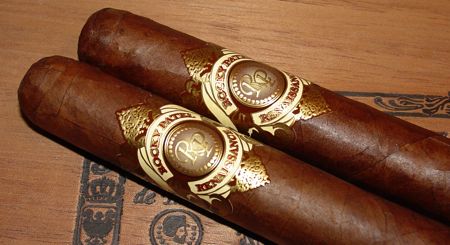
Rocky Patel Renaissance Robusto

It’s not Frankenstein. It’s not even the Frank. But it’s alive! Rocky Patel’s Renaissance cigar is born again, resurrected from the scuttled remains of the Edge Sumatra.

But it’s not that simple. It never is. Reanimation is not for amateurs. So a little more detail.

Rocky Patel’s Decade, Edge Sumatra and Renaissance cigars are all different blends but they bear a passing resemblance because they share the same, or nearly the same, wrapper leaf.  The wrapper used for all these cigars is, (or was, in the case of the Edge)  a very nice Sumatra leaf grown by the Oliva Tobacco Company in Ecuador. The only problem is that there is a finite amount of this splendid weed, which means that Rocky had to make some hard decisions  about how to allocate it.

The Decade, an Anniversary cigar with an excellent reputation, was assigned the best of the higher primings. This put the squeeze on the Edge Sumatra, which at the time was using the same leaf. Because there wasn’t enough wrapper to go around, the Edge Sumatra was discontinued. But it was still a nice (and popular) blend, so Rocky brought it back using a lower priming wrapper leaf from the same plant and called it Renaissance. It was understood that the Renaissance was the new Edge Sumatra, but it didn’t taste quite the same due to the lower priming wrapper. It just wasn’t “edgy” enough.

To satisfy the ravening crowd, Rocky brought back the original Edge wrapper with the same filler blend, but he kept the new brand name and released it as a limited edition. And that is how the Edge Sumatra became the Renaissance. Which is why it is a renaissance, quite literally.
Construction Notes

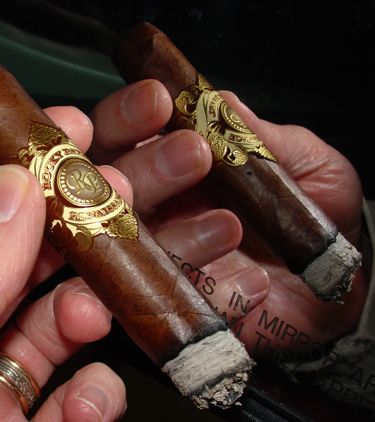
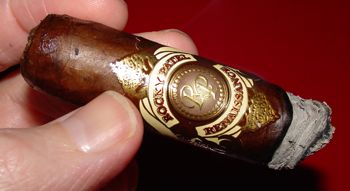
The most impressive aspect of this robusto is the oiliness of its dark colorado maduro wrapper. It feels a bit narrow for a robusto, but the roll is solid and the draw is spot on. The head is formed well, but the cap is not picture perfect. I solved that by shearing it off.  The stick burns evenly and builds a solid ash.

The Drop Test

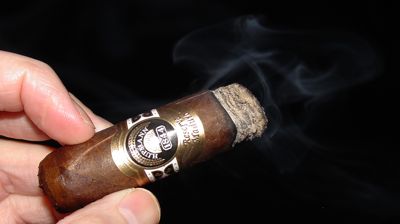
After smoking this cigar for about ten minutes I managed to fumble it. While reaching for the ashtray I somehow lost finger traction and watched in horror as the cigar slipped away and smacked on the concrete of my garage floor. I was sure my poor robusto was going to be battered and bruised beyond all hope of recovery. I brushed off the ash and dirt and to my huge surprise I found it totally intact. Not a crack. Not even a chip.

The drop test is not an officially sanctioned element of the KOTF reviewing methodology, but in this case the Renaissance robusto passed with flying colors.

Overall excellent construction, with bonus points.

Tasting Notes

I almost want to call this cigar “Decade Lite.” The wrapper provides a piney aroma with fruity notes; the cherry that comes through reminds me a lot of the Decade. There is a touch of chocolate and a sweet spice — not pepper — that is easy on the palate. It’s not as rich as the Decade, but it seems similar. The aftertaste is pleasant and mild.

At the half-way point the smoke is still smooth and genteel with an excellent aroma and no bite.  The smoke is medium in body, with moderate nicotine.

In the last section I noticed a more herbal base flavor. It combines nicely with the aroma, which is still bright and piney. The combined effect is rich and complex without being overbearing.

Conclusion

As a descendent of the Edge (if not an actual Edge in disguise) I was expecting a heavier cigar with bolder flavors, but it turns out this cigar is a middleweight, an elegant and accomplished middleweight. I guess the other Edge blends aren’t as heavy as they profess to be either. Either way, I think the Renaissance could take ’em on points.

The robustos in this line retail in the 7 to 8 USD range, which is a fair price given the quality. It’s a little less than the Decade, and about the same as the Olde World Reserve, both of which I think are slightly superior cigars, but I like the fact that the Renaissance has been flying under the radar. The Renaissance is a fine cigar in any case. And it passed the Drop Test.
Final Score: 90
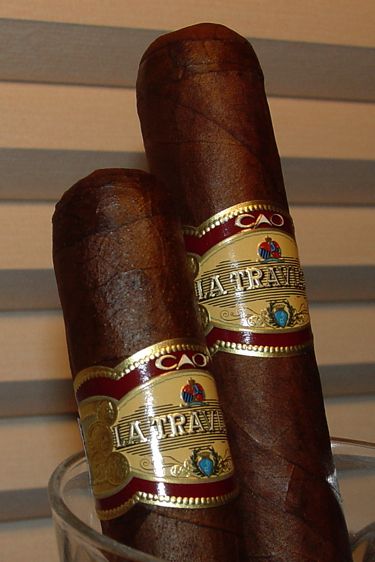
La Traviata by CAO

La Traviata is the Top 25 cigar that didn’t make the cut. So many people noticed that this cigar wasn’t on Cigar Aficionado’s “best of” roster for 2009 that it was thought to be an oversight. The objections were so widespread that CA issued an explanation: the new CAO blend was released too late in the year to be eligible for inclusion in their list. This is how you get attention by being overlooked.

So it’s safe to say that a whole lot of people have been digging this cigar. I finally found a couple boxes at the tribal smoke shop and grabbed a handful for “analysis.”

La Traviata is an old Cuban brand name and an even older Italian opera by Giuseppe Verdi. The opera tells the tragic tale of a consumptive courtesan (la traviata literally means a “strayed woman”) who falls in love, with somewhat predictable consequences.  The first production of the opera was a failure in part because the woman playing the courtesan was hardly consumptive — she was in fact obese — and a close examination of the woman on an old box of Cuban La Traviata reveals a similar misconception. It would appear that the cigar and the opera share little aside from the name.

But the folks at CAO wanted to “harken back” to the era of pre-nationalization Cuba with this blend, so the name fits. On the other hand, I’m a little skeptical that it’s possible to replicate the flavor profile of a late 19th century cigar. (Maybe they have some seriously aged cigar blenders swimming in the factory’s Cocoon pool.)

The cigar features an oily Ecuadorian Habano leaf wrapped around a Cameroon binder and filler comprised of ligero from both Nicaragua and the Dominican Republic. The blend was released late last year in three parejo sizes, and two more have just been announced: a corona gorda and the first figurado for the line, a petite belicoso.

  • Divino – 5 x 50
  • Radiante – 6 x 52
  • Intrepido – 7 x 54
  • Animado – 5 5/8 x 46
  • Favorito – 5 1/2 x 52  (belicoso)

For this review I smoked the robusto-sized Divino, with samples drawn from two different boxes.

Construction Notes

The wrappers on these sticks are thick and oily, though the texture seems to vary from smooth to quite grainy. The color is a very dark colorado maduro, or perhaps even straight maduro. Veins are prominent but not unsightly, and the head is a little irregular but solid. The cap is pasted on, not wound, but shears away nicely.

The roll is rock solid to the touch but the draw is excellent. The ash is solid and the burn is even. All this cigar lacks is the perfect Cuban-style triple cap. Other than that, there’s really nothing to complain about here.

Overall excellent construction.

Tasting Notes

A hard woody flavor combined with a peppery overtone opens this cigar. The smoke is smooth, but a tad tannic on the palate. The sweet spicy aroma reminds me a little of hickory, similar to what I find in Illusione Original Document and other cigars that utilize Aganorsa Nicaraguan tobaccos. The flavor here is not quite as clean as that, but it’s bright and tasty.

The tannins even out in the middle section but never disappear entirely. The foundation flavor remains woody, at times veering to leather. Light caramel-coffee flavors and notes of malt show up in the aroma.

Up to this point I found little to substantiate the Cubanesque aspirations of La Traviata, but in the last third I did find a fleeting muskiness reminiscent of cuban cigars. It didn’t last long, but for those last few puffs about half an inch from the band I could have been fooled. Unfortunately the flavor becomes a little dirty after this point, somewhat carbonized and burnt tasting, but this is after a very eventful three quarters.

Conclusion

Now I understand what the rumpus is all about. This is a dandy smoke. La Traviata is medium to full in body with a rich and complex woody flavor that finishes up with leather and a momentary glimpse of the forbidden isle. All of the cigars I’ve smoked from this line have had rock solid construction and burn beautifully.

But wait! There’s more! CAO has set the price point for La Traviata alluringly low, right around 5 USD per stick for the Divino. I can think of many cigars in the 10 dollar range that pale by comparison to this smoke.  This could be the best buy of the year, and for what it’s worth, I think it’s the best blend CAO is making right now.

Final Score: 90

H. Upmann Reserve Maduro

Altadis USA introduced the H. Upmann Reserve Maduro in 2008, around the same time that they also unleashed the Montecristo Reserva Negra (which is a spankin’ good cigar.)  I liked that Montecristo so much that it made my top ten for the year, but I have to say that I made the choice with some hesitation.

Last year Imperial Tobacco hoovered up Altadis like a dust bunny, making it not only the owner of major brands like Montecristo and Romeo y Julieta, but also 50% owner of Habanos S.A.  And as much as I’d like to say that the size and power of the company — and its reputation as the neighborhood bully —  has proved a detriment to the quality of its cigars, I can’t.

The fact is that I don’t like a lot of Altadis cigars. A gargantuan international conglomerate can be expected to produce a homogenized product with mass-market appeal, and they do. But occasionally they also produce something special, like the Reserva Negra and the RyJ Museum Edition.

So I was looking forward to seeing if the Upmann Reserve Maduro could live up to the Reserva Negra. They use the same wrapper, a San Andres Morron from Mexico, which I have come to believe is the tastiest maduro wrapper in use.  The filler is a Nicaraguan and Honduran blend, and the binder is from Nicaragua.

Six sizes are in production:

  • Sir Winston – 7 x 50
  • Belicoso – 6 1/8 x 52
  • Titan – 6 x 60
  • Toro – 6 x 54
  • Robusto – 5 x 54
  • Corona – 5 x 44

I smoked this in both the Belicoso and the Robusto sizes and found no significant difference in flavor between sizes.

Construction Notes

Like most Altadis cigars, the H. Upmann Reserve Maduro is built pretty consistently — the roll is solid and it’s a nice looking stick. The dark brown maduro wrapper does not look over-processed, the way some oily black maduro wrappers can be, and is finely toothed. Some moderate veining does not detract too much from its overall appearance.

Both the robusto and the belicoso burned evenly and produced a solid light gray ash. Both sizes draw very well, almost too well at times — the final third of the belicoso was a little too loose and I had to ease up on the throttle to avoid a hot burn.

Overall very good construction.

Tasting Notes

The Reserve Maduro is a mild to medium-bodied cigar that is framed by the aroma of its wrapper. The base flavor for the first couple of inches is grassy with soft bittersweet chocolate accents.

The herbal foundation of the cigar gradually gives way to a woodier flavor with a slightly tannic finish. It remains mild and mellow but the aroma intensifies, adding a shot of espresso to the sweetening chocolate.

Without much drama the cigar gently transitions to a nutty flavor and the chocolate overtones dissipate, leaving a slightly bitter aftertaste that is easily masked by a few swigs of black coffee.

Conclusion

If the Montecristo Reserva Negra is like a rich Godiva chocolate, then the H. Upmann Reserve Maduro is a handful of peanut M&Ms. The chocolatey aroma characteristic of San Andres maduro is utilized to great effect in both cases, but the Upmann is by far a milder bodied, less serious cigar.

My only complaint about the Upmann Reserve Maduro is the lack of transition — from start to finish this is a somewhat montonous smoke. Its one tune is sweet and easy listening, but after thirty minutes I wanted to change the station.

The Reserve Maduros are packed 27 to the box and retail for around 5 or 6 dollars per stick. If you’re a sucker for mild and sweet maduros, you’ll want to put this one on your sampling menu.

Final Score: 86

Perdomo Habano Corojo

My first thought when I came across the Perdomo Habano in maduro was that it was strangely named. It’s a habano, but it’s also maduro? Well, yes, it is. It’s both. The term “habano” is used so loosely in the industry that there’s bound to be some confusion.

This confusion comes from the fact that some cigar makers issue the same blend in either maduro or “habano” wrappers. The problem here is that in one case the wrapper description refers to the processing (maduro) and in the other case it refers to the seed-type (habano.)

Generally speaking, “habano” is just another word for tobacco grown from cuban seed.  Needless to say, this covers a whole lot of cigar tobacco that isn’t necessarity identified as “habano.”  The Padrón family grows one type of cuban-seed tobacco on their farms in Nicaragua. If asked, they call it habano, but it’s not advertised that way. (As if Padrón needed to advertise.)

This is why Perdomo can issue a single blend with three different wrappers, and call them all Habano. Because in this case “habano” is not just a wrapper type, it’s a seed-type.

Perdomo’s Habano line was introduced in 2007 in two varieties: Corojo and Maduro. Both are cuban-seed (habano) tobaccos grown in Nicaragua. To compound our confusion, Perdomo released the Habano Connecticut (with a non-habano, Connecticut-seed shade wrapper) in 2008. In this case, all but the wrapper is actually habano.

Cuban-seed tobaccos from the three major growing regions of Nicaragua form the heart of the Perdomo Habano. Tobaccos grown in Esteli, Condega, and the Jalapa Valley all have their own distinct qualities, and here they are blended to make the best use of them.

Color-coded foot bands indicate which wrapper type is used — gold for Connecticut, platinum for maduro, and bronze for corojo.

Seven sizes are currently in production:

  • Petite Corona – 4 3/4 x 44
  • Robusto – 5 x 52
  • Toro – 5 1/2 x 54
  • Torpedo – 6 1/2 x 54
  • Gordo – 6 x 60
  • Presidente – 7 x 56
  • Gran Torpedo – 7 x 60

Construction Notes

The Perdomo Habano Corojo is an attractive cigar featuring a smooth wrapper with a slight sheen. The torpedo is wrapped very nicely and comes to a sharp point that skews a bit off-center. The robusto has a solid, well-shaped head, but the cap is pasted on without regard for aesthetics. In both cases the roll is somewhat irregular with a soft spot found here and there.

The pre-light draw is excellent, but a few inches into the stick I found it to be a little too loose. Both sticks burn evenly and produce a blooming ash that holds well but doesn’t inspire much confidence. I let the torpedo rest in the ashtray for only a couple minutes and the cinder cooled to the point where I had to relight.

Overall good, but not great, construction.

Tasting Notes

This blend opens boldly with a good belt of spice on the tongue and the upper palate.  After a minute or so it backs down a little and relaxes into leather with soft cocoa notes. The smoke is smooth, but has a sharply acidic aftertaste.

In the middle section the flavors gradually get a little darker, but don’t change too much. The cocoa notes stretch out and take on a mocha-like quality, and the leather stays leathery. I generally expect a caramel sweetness on the nose from corojo, but I’m not getting it here. The aroma is heavy, but pleasant. Unfortunately I don’t find it all that interesting.

The last section is laden with leather and spice and a truckload of nicotine. The smoke texture is medium-bodied, but it’s powerful and biting. The aftertaste is heavy with earth and char and the finish is off the chart. Like many full-flavored cigars, the last third is lacking in subtlety. I lost interest close to the band, and it’s a large band.

Conclusion

I’ve smoked the Habano Maduro in the past, and I have to say I like it quite a bit more than the Corojo. There’s plenty of leather and spice to the Corojo, but it lays it on a little too thick for my taste. That said, it’s still well built premium smoke. It’s just a little outside my preferred flavor profile.

The Perdomo Habano lines average around 5 USD per stick or 100 per box of twenty. If you dig leathery sluggers like the Camacho Corojo or LFD Coronado, you might get a bang out of this one. The price is certainly right.

Final Score: 82

Declaration by Jameson

For my wild Irish friends and relatives the name Jameson has always been associated with one thing and one thing only: uisce beatha. That’s whiskey with an “e.” Fine Irish wine.

But not anymore. A couple years ago Jameson cigars arrived, thereby providing the perfect match for the perfect drink, a combination which by Winston Churchill’s example can be enjoyed even at breakfast. I’m not about to follow that example, but I’m not about to argue with a man who leads his forces to victory behind a bottle of Johnny Walker Black.

Indeed, cigar smokers can look to Churchill as a model of defiance as we fight the powers that would like to snuff us out. It is in that same spirit that Jameson’s new cigar is called Declaration. It is a blend designed to inspire personal liberty, or as the promotional material advises,  “Smoke to be Free.”

The Declaration is a Dominican puro featuring a Habano 98 wrapper and a Criollo 98 binder. They are manufactured by Tabacalera LTC (La Tradicion Cubana) in Santiago, and are available in boxes of 21. There is only one size: the 5.5 x 50 “Iniquity.”

I confess some confusion about the meaning of the name Iniquity, which means something like licentiousness or sin.  I could give in to the urge to discuss the distinctions between liberty and license, and how these might apply to the legislation of morality, but I think I’d rather smoke this cigar instead.

Construction Notes

This cigar is built like a tank but it performs with finesse. The wrapper is a dark and rustic looking colorado maduro. Some sections of the wrapper are more oily than others, which is a little strange, but aesthetic appeal is not this cigar’s forte anyway. The head is formed well with firm shoulders. The cap is pasted on rather than wound.

The roll is solid and the draw is firm without being tight. At times the ash can be a little flaky at the perimeter but when it’s ready to drop it falls like a stone without crumbling. The burn is even and effortless.

Overall excellent construction.

Tasting Notes

The Declaration Iniquity starts up with a flavor of hard wood and a sweet note of maple syrup.  After an inch or so some peppery spice kicks in and the flavors develop more complexity. This cigar seems leathery or meaty on the palate, but it has a sweet and woody aroma that blends well with the other flavors. It’s smooth, but the varied flavors and subdued punch keep it interesting.

The mid section gets a little spicier on the tongue and the finish lengthens. The aroma is still sweet though, woody with a touch of graham cracker.

There are no dramatic changes in the last third, just a deepening meaty spice. The syrupy note transitions to caramel. The aftertaste gets a little charred in the last lap, but aside from that it smokes well to the nub.

Conclusion

Jameson’s Declaration cigar is a tasty and finely rolled medium-bodied smoke that I think almost anyone would enjoy.  The sweet aroma is quite distinct from the palate flavors, lending the smoke a complexity that will interest veterans, but at the same time it’s smooth enough that it won’t frighten off the novices. Overall it’s a very well balanced cigar.

The Declaration Iniquity retails for around $6.00 per stick, which is excellent for any cigar, but for a Dominican puro it’s outstanding.

Final Score: 90
Contest

I want to thank Jameson for offering samples of their Declaration cigar for this review by sharing their generosity with a lucky reader. Just leave a comment about Jameson or La Tradicion Cubana cigars below and I will pick one entry at random to receive a few of these fine smokes for their own enjoyment.  Contest ends January 31, 2010. U.S. residents only please.

And don’t forget to enter the Jameson Humidor contest! All you have to do is sign up for their newsletter and you’re eligible to win a very sweet Vanderburgh Forteleza Humidor stocked with Declaration cigars.

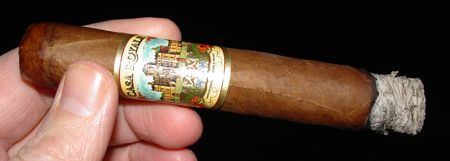
Casa Royale Crown

I love those cheesy ads for no-name cigars that proclaim they are made by “the Number 1 Cigar Maker in Nicaragua,” (or Miami, or the DR.) No names please! That won’t be necessary, because we all KNOW who that cigar maker is. I’m so excited I can barely get my credit card out.

Casa Royale is not advertised that way, but the name Jose “Don Pepín” Garcia is often associated with this “Number One” cigar maker. I haven’t had the opportunity to smoke everything that has rolled off the tables of My Father Cigars, but I wouldn’t balk at the chance. I’d even try that odd mixed-filler cuban sandwich cigar, made with floor sweepings and yesterday’s La Prensa, if the blend was blessed by the Pope of Esteli himself.

And to be honest, there are a few DPG blends I don’t particularly care for. (How Ambos Mundos made it on CA’s top 25 list is a mystery to me.) But a misstep here or there has not yet cooled my ardor for this great blender.  So when I saw that a “Six-Pack” of these Casa Royale Crowns could be found at Holt’s for just over 20 bucks, I took the bait.

Casa Royale is a Nicaraguan puro with a sungrown Esteli wrapper leaf that supposedly is the same one used on the Tatuaje Black. Whether that is an apology of sorts for the rustic appearance of the wrapper, or just plain hooey, is for you to decide. In any case, this Holt’s exclusive is available in five sizes:

  • Ace – 5.625 x 46
  • Aristocrat – 5.5 x 52
  • Crown – 5 x 50
  • Imperial – 6 x 50
  • Prestige – 7.75 x 49

Construction Notes

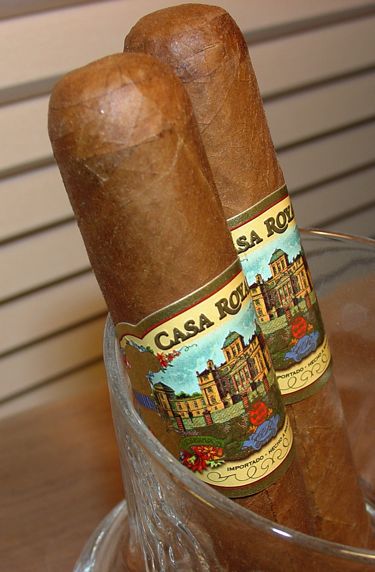
I’m trying to think of what color these cigars might be — colorado amarillo? Amarillo claro? They’re a light to medium shade of brown with a yellowish tinge, similar to some Connecticut Shade wrappers I’ve seen, but much less suave. The wrapper on the Casa Royale is rough, as is to be expected from a sungrown leaf, but it’s much lighter than most sungrown leaf, and it’s quite dry as well.

The head is finished nicely, but not as neatly as many “premium” cigars from the Garcias. The roll is firm with a slight box press, but the cigar feels a little  bit light — this did not affect the burn, however, which was slow, even and consistent.

As I cut one of these robustos my thumb slipped and I really bungled the cut. Despite a relatively fragile wrapper I was able to slick the torn wrapper together with saliva and by some small miracle it held together for the duration of the smoke. That’s quality construction.

Tasting Notes

The first few puffs are typical Pepin — tart on the palate. Gradually I notice notes of sweet cedar on the nose, which makes an interesting companion to the greener flavors on the tongue. There is some vanilla in the aroma as well, with a touch of cinammon.  The smoke is smooth and medium in body.

The middle stage continues in the same direction, smooth and woody with vanilla overtones.

This robusto is suprisingly smooth and mild-mannered up to the final third, where the spice picks up. Some white pepper tingles the sinuses while the cedary base flavor continues to hold. There are some subtler spicy notes as well — the cinnamon from the first third appears again, and brings with it a touch of sandalwood.  It stays smooth and even to the nub.

Conclusion

Casa Royale is one of Pepín’s milder and less complex smokes, but it is still quite flavorful and the construction is excellent, as usual. Tart flavors on the palate are nicely balanced with sweet ones on the nose, and the subtle but exotic aromatics make this an interesting cigar.

Best of all, this cigar is truly affordable. Boxes of 25 retail for 127 USD, and if you run you’ll find six-packs on sale now for 21.95.  Factor in that price and this is a great deal. It sure beats scrambling for the “No. 1 Cigar Maker’s” leftovers .

Final Score: 88

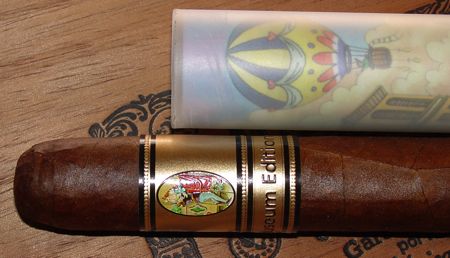
Romeo y Julieta Museum Edition

Altadis has commissioned 3D artist Charles Fazzino to create prints for their “Museum Edition” cigars, of which there are now two: the 6 x 53 Montecristo, and this one, the 6 x 54 Romeo y Julieta. They are special edition cigars, of course, and as such are touted as “super premiums,” which means that the retail price is exorbitant. In this case, around 30 USD per stick. Yikes.

Fortunately there is a shortage of wastrels in today’s economy, and these cigars can usually be found for less than MSRP.  I snagged this one — and one only — for 20 bucks. (The Altadis rep threw in a couple of other top line cigars and a Romeo y Julieta coffee mug gratis, so the net price ended up being about 7 dollars.)

The big draw with this release is the limited edition humidor which houses these big ticket sticks. The humidor includes a signed and numbered giclee print. I’m no art collector, but maybe this will be worth something some day. I hope so anyway, because the price for the whole shebang is $1080.00.

Instead of the pile of gold doubloons that I would expect to find in a box with that price tag there are 36 cigars encased in frosted crystal tubes. A paper thin cedar sheath inside each tube cradles the cigar, along with a Fazzino picture that just barely shows through the frosting on the glass. Me, I’d take the cedar sans the picture, but like I said, I’m no art critic. The gold cap that tops each tube is wedged on pretty tight — I actually crushed the tube in my massive Hellboy-like fist while I was trying to open it in the cigar shop. Be careful with this one, especially if your mechanical skills are as primitive as mine.

This cigar is made in the famous Tabacalera Garcia factory in the Dominican Republic. The wrapper is a San Andres Criollo 98 Rosado (yes, that’s Mexican, but we’re far from Te Amo territory here) with a Connecticut broadleaf binder and a filler blend from Nicaragua and the Dominican. Only one size is made: a 6 x 54 parejo.

Construction Notes

Despite its girth the cigar sits nicely in the hand, and seems to be well rolled. The head is finished nicely with a triple cap but the final piece is jagged and appears a little sloppy. (At $30 per cigar I reserve the right to be picky.)  The wrapper is a real beauty though — a rich, dark colorado maduro leaf that glistens with oil.

Even though the pack seems solid enough, the draw is a bit loose. This caused some problems down the road — I sat the cigar down for just a minute to freshen my drink and it went out. On the positive side, it produced plenty of smoke and never burned hot the way some loosely packed cigars will do.

From the start I had trouble keeping this one burning evenly, but this seems to be the curse of really tasty wrapper leaf. It also burns fairly rapidly for a cigar with such a large ring gauge — smoking time was a little under an hour; I expected a bit more from a cigar this size.

Overall construction good, but not 30 dollars good.

Tasting Notes

Almost immediately the Romeo Museum Edition displays tremendous complexity. It’s extremely smooth, mild to medium in body, and has a delicious and distinct aroma. This is obviously the selling point. The wrapper on this cigar is a wonder.

The first notes are the ones that stay for the duration of the smoke: sweet caramel over an herbal base that has an unusually malty edge to it. After an inch or so the herbal flavor morphs into an sweet earthy taste that at times reminded me of something more musky, something almost like gunpowder. It’s complex but very easy on the palate.

Eventually coffee flavors come to the front, though it’s not standard coffee — it’s one of those poncy latte things with cream and caramel and God knows what else. It’s good though. The sweet malty aroma continues, with an occasional whiff of bread.

The last section is a little more straight forward: earthy and sweet, with the caramel notes getting fruitier toward the end. I was a little frustrated with the burn at this point and might have been puffing a little too hard, forcing the cigar to burn too hot. Some acrid notes muscled their way in after I removed the band, but with a little more patience I might have avoided this.

Conclusion

Despite its flaws, the Romeo y Julieta Museum Edition is a terrific cigar. The flavors here are tremendously varied and interesting, spanning the spectrum from sulfurous earth to caramel-sweet bread. The amazing thing is that these disparate flavors never conflict; instead they combine and follow one another in remarkable harmony.  The blender here is to be congratulated — this is a really fascinating bunch of leaves.

But with the caveat that I have smoked all of ONE of these cigars, the roll could have been tighter and the burn was less than spectacular. Perhaps this is the price you pay for the smorgasbord of subtleties on display here, but I won’t deny that there were a few relatively minor construction issues.

Keep in mind that this is a fairly mild cigar. I know many veterans of the leaf who would be simply bored with the Museum Edition, but I am not one of them. What this is, I think, is the absolutely perfect beginner’s smoke. It’s quite mild, superbly smooth, and marvelously complex. If your taste runs to powerful pepper bombs that leave your mouth scorched with spice, this cigar is not for you. But if you appreciate the subtleties of milder cigars, definitely give it a shot, as long as the price is right for you.  For me, thirty dollars is ridiculous. But if I could snap some of these up for ten, I just might.

Final Score: 90

Best Cigars of 2009

[picapp align=”center” wrap=”false” link=”term=cigar&iid=184802″ src=”0181/c81ef0dd-1abd-47d4-a834-b5fbbe604e7d.jpg?adImageId=8743657&imageId=184802″ width=”366″ height=”466″ /]

As a new decade pounds on the front door I’m presented with my annual quandary: to sort through the pilones and find the ten best cigars of 2009. Early in the year I devised a new cigar rating system, the intended purpose of which was to assist me with this annual roundup. But I encountered two problems as I was ranking the ratings for 2009: there were a lot of tie scores, and there were some scores that, after further review, I might now want to revise.

Which is to say that this year’s list of “best cigars” is just as arbitrary as last year’s… and the years before that. All of these cigars have been reviewed on Keepers of the Flame in 2009, which means that the hundreds of cigars that I didn’t review are not eligible for inclusion here. As much as I’d like to, I can’t smoke everything.

If you are a regular reader here you know the type of cigars I favor: rich, aromatic, medium-bodied smokes, and this list reflects that preference. If you are new to cigars, some of these may be a little too heavy for you. If you’re a veteran who loves full-bodied sluggers, these sticks may seem a bit too light. Caveat lector.

10. Cabaiguan Maduro 46

9. Particulares Robusto

8. Padilla Signature 1932

7. Montecristo Reserva Negra Robusto

6. Arturo Fuente Hemingway Short Story

5. La Tradicion Cubana Deluxe 15th Anniversary

4. Arturo Fuente Don Carlos Double Robusto

3. La Gloria Cubana Reserva Figurados Maduro Flecha

2. Illusione Epernay Le Grande

1. Padron 1964 Anniversary Exclusivo Maduro

This isn’t the first time a Padron Anniversary edition has crowned a Top Ten list, and it will most likely not be the last. There are some great new blends out there, but few can live up to the flavor, balance, and construction of the 1964 Anni. The only question that lingers is… maduro or natural?

While 2009 wasn’t the best of years for the American cigar industry — there was the SCHIP tax, the persistent finger-wagging of local and state nannies, and now the minatory gaze of the FDA — it actually was a decent year for new cigar blends, some of which I look forward to reviewing in the next year. (Yes, I am a bit slow, but with a respectable quarter-million page views last year it looks like some people are still reading.)

Thanks for a great 2009, everyone, and have a wonderful 2010! Happy New Year!

~cigarfan


San Cristobal Seleccion del Sol by Ashton

When José “Don Pepín” García first started making cigars for Ashton in 2007 a few of us speculated that his commercial success would change him. I guess we’re used to seeing our small-town heroes ruined by large-scale success. And as some of Pepin’s smaller clients were shed for blue chip partners like Ashton, we anticipated that the unique flavor and superb construction of cigars like Padilla’s 1932 would become a distant memory.

Instead it appears that Pepin and family are using their well-earned capital to invest in infrastructure, and the quality of their cigars has not diminished a bit. Equally inspiring is the fact that some of Pepin’s former clients, like Padilla, are forging new paths and doing very well on their own as well.

Pepin now produces five blends under three different brands for Ashton —  San Cristobal,  La Aroma de Cuba, and Benchmade (an economy mixed-filler cigar.)  The original La Aroma de Cuba has been phased out and was replaced this year by Pepin’s new blend, which is in addition to the Edicion Especial line which was introduced in 2008. The San Cristobal Selección del Sol is new for 2009 and adds another member to the San Cristobal family.

The Garcias have long aspired to sow what they reap, and as a natural development of their previous success they are now cultivating tobacco on their Estrella farm in Esteli. The San Cristobal Seleccion del Sol features one of the first fruits of this new endeavor: the sun-grown wrapper that graces this cigar.

Like the first San Cristobal, the Seleccion del Sol is a Nicaraguan puro, but it is in fact an entirely new blend.  Only three sizes are currently in production:

  • Robusto – 5 x 52
  • Belicoso – 5.5 x 52
  • Toro – 6 x 52

Construction Notes

The Estrella Farms wrapper on the Seleccion del Sol is not much to look at — it’s dry and drab, and much lighter in appearance than the standard San Cristobal. The foot band slips off easily, which is very much appreciated. The roll is excellent, as expected, and the cap is wound to a blunt tip. The draw is fine.

I rarely find anything negative to note about the construction of any Pepin-made smokes, but I had issues with the burn on these. The foot of the cigar did not want to light evenly (even with a torch) and thence forward the burn was uneven, required correction several times, and went out a couple times when I wasn’t paying close attention. What we have here, ladies and gentleman, is a cigar with a crappy burn. And the ash is flaky to boot.

Overall construction: only fair.

Tasting Notes

The Selección del Sol exhibits a lot of the flair associated with sun-grown wrappers, and while it compares favorably in this regard to Ashton’s VSG and Rocky Patel’s Sun Grown cigars, it doesn’t quite live up to those standard bearers.

The first third is dry but sweet with a tingle on the tongue. The aroma is of sweet wood, which blends nicely with the minty note on the palate. There is a hint of a bite and just a dash of pepper, which seems unusually understated for a DPG blend. The smoke is smooth though, and the nicotine is moderate.

The middle section continues in the same vein, doling out lots of woody smoke with a sweet, fresh finish. There is some spice on the palate, but the woody flavors and the sun-grown zing take center stage. The resting smoke is very pleasant, even for the non-smokers in the vicinity who for once are not glaring at me.

The final stage is earthier on the palate, with continued sweet wood on the nose. The sensation on the tongue is interesting — almost like the effect of carbonation, and the overall effect is spirituous. Like champagne, if a champagne could taste like humus and sweet wood. The last half-inch into the band area gets a little harsh on the throat, but other than that this is a smooth tasting smoke.

Conclusion

This is a really unusual cigar from DPG. The burn is sub-standard by comparison with his other lines, and while the flavors are certainly interesting, they’re not what the typical Pepin fan is after. There is little here of the cocoa and black peppery bang that his cigars are best known for. This doesn’t make it a bad cigar by any means, but in my opinion it’s not really what he does best.

I think that if it were made by anyone else I would have rated the Selección del Sol more highly, but I expect more from The Great One. Maybe it isn’t fair, but when the man hits home runs every game, to get a double and a base hit are a little disappointing.

Final Score: 84


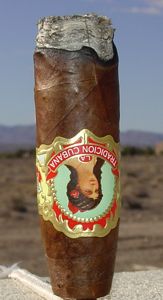
La Tradicion Cubana Deluxe 15th Anniversary

La Tradicion Cubana has been in business for fifteen years, and to celebrate this they have released their 15th Anniversary Deluxe edition. Their last anniversary edition, the tenth, was excellent — they were some of the best cigars in my collection before they mysteriously went up in smoke a couple years ago.

LTC remains one of my favorite boutique cigar companies because they produce a quality premium cigar at a really reasonable price. Anyone who has been reading the cigar press and smoking the latest and greatest knows that an exorbitant price does not always mean high quality — sometimes it just means more hype. Fifteen-dollar limited edition cigars are great for the industry, and fun for those who can afford them, but it’s nice that LTC is looking out for the rest of us.

I was expecting the 15th Anniversary blend to be similar to the 10th, a blend from several countries with an Ecuadorian wrapper, but it’s a different story this time. The 15th Anniversary Deluxe is a Dominican puro. Wrapper, binder, filler — all from the Dominican Republic, where LTC cigars are made in Santiago.

La Tradicion Cubana is known for producing cigars with large ring gauges, including one of the largest commercially available cigars produced anywhere, the 12 x 192 LTC “Big One.” The new Deluxe line is no where close to to that, thank God, but all three sizes are still big in the barrel:

  • Robusto: 5 x 56
  • Churchill: 6 x 52
  • Torpedo: 5 3/4 x 54

They might have come up with a better frontmark for the churchill (which is more like a fat toro) but as Juliet once asked, “what’s in a name?” At least they didn’t call it Montague.

Construction Notes

The wrapper on this 15th Anniversary is gorgeous. This looks like a sun grown wrapper — it’s dark and a little bit rough, and the color is not perfectly consistent, but it has clearly been fermented and processed very carefully. It’s oily enough right out of the cello, but as soon as the cigar is lit and the wrapper warms up, the oils just ooze out. Beautiful. The roll is firm with an easy draw. The large ring gauge and skillful blending result in a slow, cool burn. The robusto and the torpedo smoke for a good hour or more, and the toro (em… the churchill, I mean) went into 90 minute territory.

The only construction issue I had with these was a somewhat erratic burn. They didn’t need correction, but the jagged burn line was a touch irksome. More and more it seems that the better the wrapper leaf is, the more eccentric the burn. It must be the prima donna factor.

Overall construction very good.

Tasting Notes

The sustaining note for this blend is coffee, but it’s a note that goes through some interesting modulations. The first third is marked by coffee (of course) and mildly sweet milk chocolate. Beneath this I detected something like roasted nuts. The smoke is medium bodied in texture and very smooth. There is a slightly acidic touch on the tongue and the finish is mild, but dry.

The base flavor of coffee and roasted nuts takes on a sweeter edge in the second stage, as caramel comes to the fore and some spicier notes drop on the palate. The finish lengthens a little, bit by bit, but the smoke is still smooth and the aftertaste clean.

In the last third the flavors become more concentrated and the coffee-caramel combination starts to taste like a coffee liqueur. There’s also a flavor that mystified me — I couldn’t identify it until I had smoked three or four of these cigars in various shapes, but it finally came to me as I finished off a churchill the other night — I might be crazy, but I think it’s coconut.

Toward the band the flavor turns a little charred, as expected, and the nicotine sneaks up. La Tradicion Cubana isn’t known for powerhouse smokes, but they are certainly capable of producing them. Smoke these past the band and you might get a pretty good buzz, depending on your tolerance. This was surprising because they start out so mild and debonair.

Conclusion

I’m not sure if i like these better than the 10th Anniversary — it’s such a different blend — but without question the Deluxe 15th is worthy of carrying the Anniversary flag for LTC. If I could have my wish there would be an offering with a smaller ring gauge, but the blend has obviously been very well thought out in these larger sizes.

These are slated for release this month, and as I mentioned before, one of the remarkable things about this cigar is its price: boxes of 24 range from 100 USD for the robusto, $110 for the churchill, and $115 for the torpedo. The quality is unbeatable at that price if you like this style of cigar: medium-bodied, smooth, and delicious. Great with coffee. Bring the thermos.

Thanks to LTC for giving me a sneak preview of this fantastic smoke!

Final Score: 91

La Tradicion Cubana cigars can be difficult to find in neighborhood cigar shops. The 15th Anniversary is now available from these internet retailers:

The Cuban Shop

Fuller’s Pullers