Padron 5000

Cnv0152.jpg

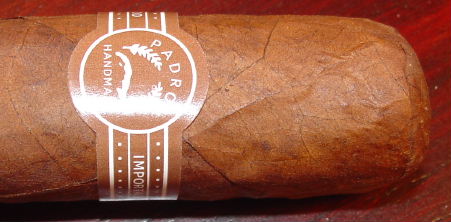
This is a fat robusto from Padron; with a ring gauge of 56 it’s a mouthful. The wrapper is rough and the cap especially so. As much as I hate to say anything negative about a Padron, I have to admit that it’s not an attractive cigar. Prelight it has a definite barnyard aroma, more so on the foot than the wrapper; a harbinger of things to come…

The draw on this one is very loose, but at the same time the burn is very slow. After each puff tendrils of smoke waft from the head of the cigar. There’s a huge volume of flavorful smoke from the first draw to the last.

It’s a very well balanced cigar. It starts up with a slight bite and lots of pepper. Soon it drops down a notch and presents a woody profile, with cedar in the spotlight. This is what I love about Padron cigars– they always make me think of the first days of fall when the folks around here start using their fireplaces. Juniper seems to be the log of choice, and while this Padron tends more toward cedar, it’s so aromatic that it could almost be juniper. It smells like a humidor on fire… though that isn’t such a pleasant image, I agree.

After well over an hour I had burned this to the band with only two taps of the ash. There’s a good nicotine kick with this stick, so I had to let it go at that point. But on a different day after a bigger meal I would have probably nubbed it.

The standard Padron series, of which this is one, has been called “a good everyday cigar.” I would go further than that– it’s a great everyday cigar. Maybe not as profound or complex as the Anniversary series, but a well balanced tasty smoke that’s better than most of the Altadis cigars I’ve sampled in the past couple of months. At 5 or 6 USD it’s a little pricier than my average “everyday” cigar, but it’s worth the extra couple bucks.

TTT Trinidad Corona

Cnv0151.jpg

The Trinidad family emigrated to Cuba from Seville, Spain in the late eighteenth century and by the early 1900's began making cigars. The business grew steadily until one day disaster struck: Diego Trinidad had purchased a larger than usual crop of tobacco, a significant investment, only to discover that half of it was infested with worms. It might have spelled the company's end, but they salvaged the crop by chopping the tobacco for cigarettes. To their surprise they doubled their profits by the end of the year, and accordingly they shifted their manufacturing operation to making cigarettes instead of cigars.

In 1958 the family registered the brand name "TTT Trinidad La Habana Cuba" with the Cuban trademark office. At that time the Trinidad family operated one of the largest cigarette and cigar firms in Cuba. The Castro government took the company over in 1960 and "nationalized" it in 1961. The Trinidad family migrated to the U.S., where they formed the Black Tobacco Company, manufacturing Cuban style cigarettes mainly for Cuban exiles. The brand name Trinidad y Hermano was registered for their cigars.

The first Trinidad cigars manufactured in the United States were made by the Arturo Fuente company in Tampa around 1968. Production seems to have stopped when the Fuente company moved to the Dominican Republic.

In 1994, the Cuban government sought to register the brand name "TTT Trinidad, La Habana Cuba" with the U.S. Patent and Trademark Office. This registration was granted in 1996. At the same time the Trinidad family revived their brand– using the exact same name– with Tabacalera Fuente once again producing the cigars, this time using a Cameroon wrapper. The Trinidad family requested that the Cuban tradmark be revoked, and in 2001 the USPTO ruled in Trinidad's favor. Shortly after this, the Trinidad company was taken over by Altadis USA, and the cigar I have before me is now a totally different creation from either the original or the subsequent Fuente blend.

So what's the big deal with this brand anyway? It sounds like a bunch of legal mess… Well, part of the big deal is that Fidel Castro originally created the Trinidad brand for his exclusive use as diplomatic gifts… A mystique arose around the brand as the "best of the best." Except for one minor problem. In an interview with Marvin Shanken, Fidel said he wasn't familiar with the brand. And when he was a smoking man, he said, he was partial to Cohibas. So communists have marketing strategies too, hmmm?

The current incarnation of the cigar bears an Ecuadorian Sumatra wrapper, a Connecticut broadleaf binder, and filler from the DR, Nicaragua and Peru. And they slap this thing together down in the Dominican Republic somewhere.

I scored a tin of four of these in a package deal last fall, so I didn't pay retail — good thing. This is a decent smoke, but I wouldn't pay 8 bucks a pop for em. It fires up with a good dose of pepper, then mellows out a bit. There's a nice overlay of leather, and the smoke maintains a medium body which gathers strength toward the end. One of the four had a tight draw, but otherwise they burned well. I preferred the corona to the robusto — the corona was a little less aggressive, allowing for more complexity. The robusto is a real powerhouse, a real redneck knock-em-down bar fighter of a cigar. The corona is full flavored, but not as bullish. All in all the corona is a good cigar, but there are far better choices at this price point.

Te Amo Figurado (RIP)

Cnv0150.jpg

This rather sad looking fish of a cigar is a Mexican puro from Altadis called Te Amo. Frequently cigars sporting the Te Amo band can be seen hanging precariously from the lips of large men chasing a small white ball around well tended lawns. At least that's what I see in the cigar ads. Maybe they taste better with golf, or maybe they're better tolerated when accompanied by a frustrating distraction.

Te Amo has been around for eons, or at least since the mid-60's, and has a dedicated following. Many Te Amo vitolas have been rolled and marketed over the years, but many of them have also been retired, and this is one of them. Figurados are difficult to roll, and this is an unusual one– it's tapered at both ends, like the cigars those fat cats in political cartoons from the early 20th century are seen smoking.

This one is a little lopsided, and the wrapper is dry and papery. Made in San Andres Tuxtla, measuring 6 5/8 x 50, it smells a bit like wet cardboard. Not particularly appetizing, but it didn't keep me from lighting it up.

Despite the name ("I Love You" en español) a lot of people don't care for this brand; at the same time a lot of people swear by it. It's a love it or hate it kind of cigar. Based on previous experience I didn't expect to like this cigar, but the first half is actually not bad.

It lit up easily and the construction was good. It burns a little hot, but evenly despite the occasional gust of wind on the back nine. (That would be the nine holes dug by my squirrel terrier in the back yard.) The bittersweet taste that is the Te Amo trademark was muted at first, much to my approval. Up to the mid-point I was about to change my mind about Te Amo.

But then the classic Te Amo arose and turned from bittersweet chocolate to acrid; the astringency that is typical of this brand turned on the nasty and I couldn't get past the two thirds mark. The shape of this cigar probably accelerated this effect — as the gauge decreases the flavor becomes concentrated, and in this case that isn't a good thing.

I've never been a fan of Te Amo, and I guess I never will be, especially of the figurado now that its passing has been marked. But I have to admit I sort of liked the first half of this cigar. Resquiat in Pacem.

Carlos Toraño Virtuoso Crescendo

Cnv0149.jpg

6 1/2 x 54

Wrapper: Nicaragua

Binder: Nicaragua

Filler: Honduras, Nicaragua, and Panama

If cigar magazines are to be believed, there is a widespread consumer demand for heavier bodied cigars. Meanwhile, the best selling cigars are still relatively mild, or at most medium bodied. My opinion, for what it’s worth, is that a well balanced and nuanced mild cigar is every bit as worthy as a full bodied one. Sometimes you want a cigar like a Chopin nocturne; sometimes you feel like channeling Jimi Hendrix through a funnel of tobacco. Either experience has its place, its season, its mood.

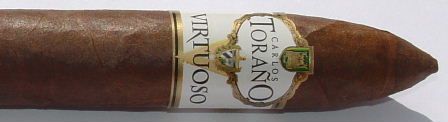
The Virtuoso line is touted as a full bodied, bulldozer of a cigar. But it really isn’t. It’s a well balanced cigar that starts out medium bodied and does gradually build up to a full bodied smoke. It’s a gorgeous stick with good construction. Sungrown on Toraño’s Pueblo Nuevo farm in Condega, Nicaragua, the colorado maduro wrapper is smooth, slightly oily and very attractive. It burns unevenly at times, needing one correction in its journey to the nub.

The predominating flavor is earth and at times is quite pungent. A nice solid white ash forms and holds with determination. Midway the strength begins to kick in — somewhat unexpectedly because the smoke remains consistent, while the nicotine quietly sneaks up and pins a “Kick Me” sign on my back. And it did, or someone did… I had to put it down for a while and find a Cooper’s Stout to steady my stomach for the rest of the cigar.

All told, this is a very well balanced medium to full bodied cigar. It’s nice looking, well constructed, and blended for a smooth ride to the finish. For me it’s a little too earthy, if that’s the word — this cigar has a composty kind of aroma that just isn’t to my liking. But still it’s a high quality smoke that I will recommend to those who like… that sort of thing.

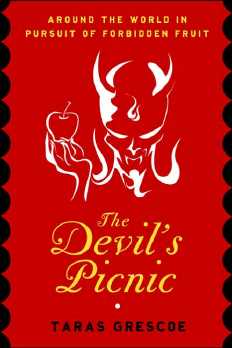
The Devil’s Picnic

Cnv0148.jpg

The Devil’s Picnic : Around the World in Pursuit of Forbidden Fruit by Taras Grescoe

Grescoe’s irreverent examination of the world’s prohibited products is a flighty read covering several continents and nine censured substances. The main subject is prohibition, but nothing can be prohibited without engendering a black market for just that thing, so smuggling is addressed, as well as the hypocrisy at the heart of nearly every effort to ban anything. Grescoe's prose style is bombastic at times, but it's also humorous and quite entertaining.

Among the several deleterious items Grescoe goes in search of are Norwegian moonshine, unpasteurized French cheese, absinthe, and Cuban cigars, the last of which piqued my interest in particular.

Unfortunately, Grescoe is not a cigar aficionado. He approaches the subject as a former cigarette smoker, and by the end of the chapter he finds that he is still a cigarette smoker, and doesn’t care much for cigars. After working up to a pack of Nat Sherman cigarettes per day in a misguided attempt to “prepare” himself for a Cuban cigar, he’s suffering from a reawakened nicotine addiction. Accordingly, his focus on smoking restrictions in the U.S. turns out to be largely cigarette oriented.

And while cigarette smoking is severely restricted in the cities he visits – New York and San Francisco – sales of Cuban cigars are forbidden by federal law everywhere in the states. So Grescoe purchases three Habanos while in Montreal before his trip and then smuggles them into the U.S. Among them is a Cohiba Esplendido which he describes with pornographic glee:

Ramrod straight, cross hatched with veins beneath a membranous, batwinglike wrapper, the Esplendido felt firm but spongiform—indeed, almost sweaty—as I grasped its seven-inch-long shaft. It was as if some powerful shaman had sculpted vegetable matter into living tissue, pumped it into tumescence, and fettered it with a cock ring in the form of a paper band.

In New York he finds that smoking is prohibited even in bars, and a pack of cigarettes sells for $7.50. Upon seeing someone light up, bar proprietors come running to prevent the evildoer from violating Mayor Bloomberg’s edict. But Grescoe sees cigar smoking as a plutocrat’s domain, and notes that Bloomberg declined to comment when at a fancy dinner several wealthy financiers lit up cigars in violation of his own law. He mentions other examples of hypocrisy as well, such as Governor Arnold Schwarzenegger’s smoking tent outside his California capitol office, in a state where smoking is prohibited in all public buildings.

Grescoe finds things a little looser in California, but not much. There he finds a culture of “smoke easies” akin to the speak-easies of the Prohibition era. Some bars have found ways around the law by having no official employees; instead all employees are part owners. Other places have found that the police will turn a blind eye, such as the “IRA Bar” where they “don’t give a shit about American smoking laws.”

But at the end we find Grescoe with his Esplendido on Mission Street at 2 a.m., chased away from the Odeon by a bartender worried about the police. He shares it with a woman he met in the bar.

After about fifteen minutes, with only minimal progress down the shaft, we agreed the process was feeling like a bit of a chore.

I stubbed out the $65 Esplendido and said to Linda, “You know, what I really want is another cigarette.”

“Yeah, “ she said, as we walked down Mission, continuing our smirtation. “You want to feel that smoke in your lungs, not your mouth.” She lit my Nat Sherman for me.

I was definitely hooked.

What a waste!

5 Vegas Series “A” Anomaly

Cnv0146.jpg

The 5 Vegas brand (supposedly pronounced “Cinco Vegas”) has an interesting history even though it hasn’t been around very long. It was created in the boom years by World Cigars, Inc., and produced by Kiki Berger in Esteli, Nicaragua. The name evidently came from a story about 5 tobacco growers who came together to produce a single blend.

But like many of the Boom cigars it did not survive into the 21st century. Like Cupido, another of Berger’s blends I was fond of, 5 Vegas was eventually closed out. Keith Meier of Cigars International bought up the rest of the 5 Vegas inventory and scooped up the trademark while he was at it.

Today it is one of CI’s best selling brands, and the full bodied “Series A” line is getting a lot of attention. The old Nicaraguans are now gone, and I hear the new ones are now made by Nestor Plasencia in Honduras.

The information from CI is that this is a three-country blend, though it does not say which three countries, with the exception of the wrapper which is a Costa Rican maduro. It goes on to say that the tobaccos are aged for four years, and the cigars are aged six months further after they are rolled. They are then dressed up nicely in gold and black bands and wrapped in a sheath of cedar.

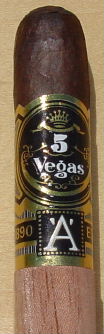
The various sizes in the Series “A” line are given names beginning with the letter A, as if they were children in a cute little family. The petite corona is called “Anomaly,” as if there were something abnormal about this particular child. Aside from the fact that it is a bit runty at 4 1/2 x 44, this anomaly is just abnormally rich and tasty. This kid may be small, but he’s feisty.

There’s a whole lot of nose-tingling spice in this little corona. It starts up fairly mellow with a rich full flavor– Costa Rican maduro is tough to beat — but soon the spice takes over and really makes a move. It does get a bit harsh toward the end and it has a fairly short finish at 25 minutes into the smoke. But at this point I must say I was thoroughly satisfied. Good construction and a great price at less than 3 USD makes this a must try. Maduro fans take note!

El Rey del Mundo — Old and New

Cnv0144.jpg

El Rey del Mundo is one of the many Cuban cigar trademarks that have a post-embargo incarnation. The original Cuban line was launched in 1882. By the 1950's the Havana factory was in the hands of Karl Cuesta of Cuesta Rey fame. He had arrangements to sell the factory but when the purchaser made a few unilateral adjustments to the contract, Cuesta angrily cancelled the deal. This opened up an opportunity for Frank Llaneza's Villazon company to buy the factory, and with it came the rights to the El Rey del Mundo and Flor de A. Allones trademarks.

But soon Castro would come down from the mountains with his bandits and take everything for the government. By sheer coincidence, Llaneza happened to be in Honduras examining the very first test crop of Cuban seed tobacco when the U.S. embargo was declared. Eventually a Villazon factory was established in Danli, Honduras. By the early 70's Villazon was experiencing labor pains, the kind induced by unions and communism. They decided to open a new factory in Cofradia where the climate was a little less inclined to this sort of disruption. But their experienced manager was moving with the operation to Cofradia and they needed someone new to run the plant in Danli.

By another stroke of good fortune, Llaneza ran into Estelo Padron, who had been working with his brother in Nicaragua; he and his brother had a bitter falling out and he was looking to leave the Padron company in Nicaragua. Estelo was offered and accepted the job of running the Villazon factory in Danli. Like his brother, Estelo is an incredibly talented and hard-working tobacco man. But unlike his brother, he keeps a low profile. You don't hear too much about him, even though he is the man behind the blends in Punch, Hoyo Excalibur, Sancho Panza, and of course El Rey del Mundo. And yet there is no star over Estelo Padron's door, no spotlights in Cigar Aficionado magazine. To this he responds, "A cigarmaker belongs in his factory making cigars."

Padron's special expertise lies with maduro wrapper. And in examining the oily oscuro that covers these robustos, all I can say is, "Damn. That's a smoke." I've been enjoying my El Rey del Mundos for years, and while organizing my desktop humidor the other day I noticed that I had one from a box I picked up about a year ago. I just received a new box about three weeks ago, so I thought it would be fun to contrast and compare, see if a year's age on this one made any difference in taste or combustion properties.

It may not be a fair comparison, because the old sample I have turned out to have a very tight draw. It was still smokable, but the tight roll gave it a graphite tinge that is normally not there with these smokes. But otherwise I noted that it was much smoother than the new ones, which have a gamier taste and a slight bite. The old sample had no bite whatsoever, and very little aftertaste. Age has definitely mellowed this cigar; in addition to this, or perhaps because of this, a really nice floral element appears after the first half inch or so. I think of the ERDM as the prototypical Honduran cigar– full bodied, rich with leather and wood, and in the case of maduros, a sweet char rising above the other flavors. In the case of the newer ones, there's also pepper at the outset– but aging has an attenuating effect on this element.

The robustos in this line all have a large ring gauge at 54/64ths, and the Connecticut Broadleaf maduro is their hallmark. They're a great example of how a cigar can have a full bodied taste and texture without being "strong." Even though I had some bad luck with the aged one, I plan on putting half of this new box away for a year or so.

Jack’s Brain…Better with Coke

I was searching for information about a particular cigar the other day and ran across an interesting website with reviews for hundreds of cigars. "Review" might be an overstatement, since Jack's assessments are extremely terse summaries, including price, how much of the cigar he smoked, and oddly, how well the cigar tastes with Coke. Sometimes he surprises us and has a Dr. Pepper instead, but mostly it's Coke. This fellow really enjoys his Coke. Often we learn how the cigar affected the taste of his Coke, as well as how the Coke interacted with his cigar. I find this highly entertaining, for some reason.

He's far more prolix on the subject of food, so if you live in or travel to the Phoenix area his restaurant reviews are definitely worth a look.

And while his cigar reviews are not particularly helpful, the Cigar-Coke Nexus makes Jack's Brain today's Cigar Site of Interest.

Indian Tabac Cuban Corojo Arrow

Cnv0143.jpg

Indian Tabac is Rocky Patel’s original brand made in Danli, Honduras by Nestor Plasencia. The Corojo line is somewhat newer, however, having been introduced in 2003. The Cigars International catalog calls this line “Cuban Corojo” while Cigarcyclopedia calls it the “Classic Corojo.”

(Ah, the confusion that rains down upon the unsuspecting 5-pack consumer. Witness his befuddlement…)

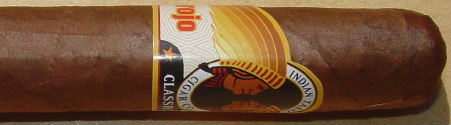
The “Arrow” designation is also a bit confusing, since Top25Cigar says it’s a slim panatela; this is obviously a robusto. The “Boxer” listed on the Indian Tabac website is also labeled a robusto at 4 1/2 inches long. This one measures 5 x 50. And to top it all off, the Indian Tabac website does not even mention this line. (The Classics listed there have Habana 2000 wrappers.)

The most reliable source of information at this time appears to be the Cigars International website, where there is pictured an actual BOX of these puppies. The size is clearly robusto, and the name on the box is ARROW.

(The witless 5-pack consumer emerges into the peerless sunlight, blinking and looking for his Xikar.)

To the best of my knowledge, the wrapper on this cigar is indeed corojo. It certainly tastes like it. There’s a sweet spice to corojo that is almost unmistakable, and this stick has it in spades. It’s similar to Cameroon, but lighter, a little more complex, a little more refined; yet it makes sense that after the embargo U.S. manufacturers would turn to Cameroon as an alternative.

The wrapper competes nicely with the Nicaraguan binder and the Honduran and Nicaraguan filler. It’s a medium bodied smoke that builds, but never reaches full blast. The construction is uniformly excellent, and the aftertaste minimal. The sweet caramel aroma really sells this one for me, and sells it at a fantastic everyday price of two dollars a stick.

(The bewildered five-pack consumer revels in his good luck and goes in search of yet more five-packs to confuse him…)

Diamond Crown Maximus Pyramid No. 3

Cnv0140.jpg

The first Diamond Crown line was developed by Stanford Newman and the Fuente family to celebrate the 100th anniversary of the Newman cigar company. As he tells it in Cigar Family, Stanford’s father first began rolling “buckeye” cigars in Cleveland for direct sale to grocery stores. He stored the tobacco in his mother’s cellar. And this was the humble beginning to a family legacy that would survive for the next century and beyond.

The Newmans first got involved with the Fuentes when Carlos Fuente approached Newman to take over his machine-made business in Tampa. Fuente wanted to concentrate on his hand made cigars in the Dominican Republic, but he didn’t want to totally abandon his machine made business in Tampa. Newman balked at first, but realizing the talent of Fuente he finally agreed, with the condition that Fuente make hand made cigars for the Newman company. An agreement was forged, and cigar fans are all the better for it.

The Diamond Crown line and the Opux X line were released at about the same time, in 1996. I remember at the time the clamor that arose over the Opus X, in part because it wasn’t available on the west coast. Part of the Newman and Fuente marketing plan was to release the Opus X on the east coast exclusively, and to release the Diamond Crown on the west coast exclusively. Very smart…and aggravating! I can just see Carlos and Stanford snickering over this, like Boris and Natasha Badenoff. But as far as a publicity generator, it was brilliant idea.

The Diamond Crown Maximus came as a response to the trend toward heavier bodied cigars. The original line is a fairly mild blend with a Connecticut wrapper, while the Maximus is heavier and employs an Oliva grown Ecuadorian sun-grown wrapper from the El Bajo region. The Maximus was released at the 2003 RTDA convention.

All of the DC cigars have large ring gauges so they can incorporate five or six different leaves to give the smoke complexity. The Pyramid No. 3 rings in at 6 5/8 x 50. The head of this cigar is something to marvel at. The wrap is perfect, the work of a true artist. The color is an unusual colorado maduro, an almost drab shade of maduro…I can’t find another cigar in my humidor that shares the same shade.

The wrapper on this cigar is the star of the show. I found the blend to be smooth and spicy, but the aroma from the wrapper steals the show. It starts up with a hint of cedar that grows and grows, over a steady smooth beat that heats up in intensity as the cigar burns. Almost like a piece of music, a jazz quartet that starts out cool and easy but breaks out when the players take their solos. But again, the principle player here is the Ecuadorian wrapper. Between puffs it was nice just to revel in the aroma from the smoldering stick.

Certainly a class act. But now for the letdown. As the band packs up its instruments and the crowd finishes their drinks, the bill arrives. Gulp. At 15 to 20 USD, this is still a damn fine cigar. But at this price… I’ll have to let my wife buy me more, like this one, for Christmas.