Bolivar Robusto Crystal

Cnv0184.jpg

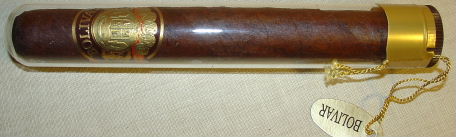
Yet another cigar brand name that has Cuban roots: Bolivar. This is the "2005 blend" made in Santiago, Dominican Republic by General Cigar. It's an interesting blend of leaves, with a Honduran wrapper, a Connecticut binder, and filler from the D.R. as well as Nicaraguan leaf from both Esteli and the volcanic island of Ometepe.

The wrapper is from the small valley of San Agustin, Honduras, which is also the source for the wrapper on the Punch Gran Puro — a rich and powerful leaf that is rightfully gaining a solid reputation. The binder is "Havana Medio Tiempo" from the corona part of the plant, a step above ligero at the very top. And the higher you go, the more powerful the leaf becomes. This leaf is used as a wrapper on the Partagas Black label. Ometepe is an island in the middle of lake Nicaragua where the Plasencias have been experimenting with tobacco cultivation. I would expect the volcanic soil to have a profound effect on the flavor and quality of the leaf. (The current issue of Cigar Aficionado has an article about Ometepe, but I haven't picked up a copy yet.)

The "2005 blend" was created by master cigar maker Daniel Nuñez, with advice from such luminaries as Estelo Padron, Benji Menendez, and Ernesto Perez-Carrillo. It was developed with the original Cuban Bolivar in mind, intended to be a "flavorful powerhouse of a cigar, and worthy of its pedigree."

The wrapper on this solid cigar is fantastic in every way, a dark oily delight. The aroma from the wrapper is the best part of this smoke– rich with leather and something like coffee or strong cocoa. It's not a powerhouse, in my opinion. I'd call it medium at best, but a flavorful and smooth medium.

I can't render a final opinion on this cigar however, because the sample I tried was really tight. It burned very well, but the draw was laborious. I was really enjoying the flavor of the smoke, but I tossed it at the halfway point because the draw was so annoying. I will have to pick up a few more of these to see if I just got a bad stick this time.

For the moment, I'd say go with the Punch Gran Puro for a similar taste (but definitely more powerful) and better construction.

“Little Cigars” Clarification

After further review, it appears that the Alcohol Tax and Trade Bureau has not officially proposed the changes referred to in an earlier post.

TTB has received numerous inquiries about when it will publish proposed regulatory amendments regarding the classification of little cigars for Federal excise tax purposes.

TTB is currently drafting its proposed changes to the tobacco regulations. The proposed changes would add specific criteria to our regulations to differentiate between little cigars and cigarettes. We plan to publish the proposal for public comment by this summer.

Furthermore, the recommendations by the Attorneys General are aimed at a specific tobacco product that is not remotely related to the cigars found on Keepers of the Flame. And in reality, the recommendations have little to do with size; they have much more to do with the composition of the stick and how it is marketed to the public.

A “cigar” would be defined as a roll of tobacco that is wrapped in 100% natural leaf tobacco, or a substance that contains 75% or more tobacco which retains its original qualities, i.e. does not taste like a pineapple.

A “cigarette” would be defined as a roll of tobacco wrapped in paper (or other non-tobacco substance), or wrapped in a substance containing tobacco but is “likely to be offered to, or purchased by, consumers as a cigarette.” The new definition would cast a shadow of suspicion over cigars that are either sweetened, or are sold in packaging similar to that of cigarettes.

It appears that the AGs are after cigarettes that pass themselves off as cigars, such as “Primetime” cigars and other filtered tobacco products, sometimes called “brown cigarettes.” Personally, I have no interest in these, and I won’t touch cheap machine made cigars that use HTL (homogenized tobacco leaf.) So I’m not too worried.

However, the definitions seem to cast a net broad enough that fans of Acid cigars or other hand made flavored cigars may have cause for concern. Without a doubt the makers of genuine cigars that utilize cased tobacco or contain sucrose in any fashion will have their say before the final regulations are passed.

The AG recommendations have been published online by the California Attorney General.

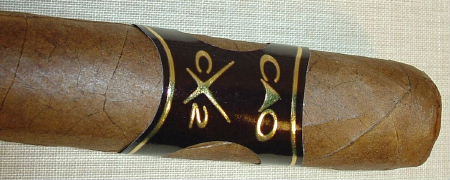
CAO CX2 Robusto

Cnv0183.jpg
The CAO cigar company was founded in 1968 by Cano A. Ozgener, a Turkish immigrant who started the company as a vehicle for the distribution of humidors and pipes. Not until the 80’s did he venture into the cigar business, with a cigar called Casa de Manuel. Unfortunately, it did not succeed.

Several years later Ozgener tried again, this time catching the wave of the “cigar boom” in the mid 1990’s. The CAO Black was released, but it too failed make a splash in a market full of newcomers. Later on, the CAO Gold would garner the attention needed to put CAO on the map.
Soon Michael Jordan would be seen smoking a CAO churchill after winning the NBA championship. Now there’s an endorsement!

The first CAO cigars were produced in part by Nestor Plasencia, and later Carlos Toraño and Jose Blanco (of La Aurora) would have a hand in CAO production. Today the company is controlled more directly by the Ozgener family, with factories in Nicaragua and Honduras.

Double wrapped cigars seem to be a bit of a trend these days, with double maduros produced by both CAO and Cusano; a double Connecticut is also made by Cusano, and Oliveros is making a double Corojo. (And by “double” I mean both the wrapper and binder are the same type of leaf.)

If this double Cameroon is as good as CAO’s MX2 double maduro, this should be a real treat.

The CAO CX2 Robusto is round, as opposed to the box-pressed CAO L’Anniversaire Cameroon. It measures a standard 5 x 52. The wrapper is “first grade” Cameroon and the binder is of course Cameroon leaf as well. The filler is an unusual combination of Columbian and Nicaraguan (Jalapa) leaf. I can’t think of another cigar that uses Columbian tobacco. This should be interesting.

The wrapper is a medium colorado maduro color with relatively little tooth for a cameroon. Prelight the scent of the wrapper is a little gamey. I guillotined the cap and found the draw to be firm and the prelight taste grassy.

The outer leaf is quite fragile and is prone to splitting. I’ve been storing these at around 65% RH, and they probably need to be at 70 or more. The split allowed me to look at the cameroon binder. I’ve always thought of cameroon as exclusively a wrapper, but the roughness of this binder clearly shows its grittier side.

The burn is uneven, requiring two or three touchups. On the plus side, the draw is perfect. It’s a firmly packed cigar and burns slowly.

If you love the taste of cameroon, this one has it… but in my opinion it has a little too much. The aroma is overwhelmingly sweet and spicy. Like a fine perfume, cameroon doesn’t require a massive application. The CX2 is a medium bodied cigar, with a bit of a kick at the end, and maintains a balanced woody flavor with a little salt. The last third gets somewhat bitter.

A must try for cameroon lovers, but be prepared for an onslaught of spice. In my book, a little cameroon goes a long way.

Mayorga Robusto Maduro

Cnv0179.jpg
Mayorga cigars were originally produced by Martin Mayorga and made by Nestor Plasencia in Nicaragua, starting around 1997. Today they are distributed by Cigars by Santa Clara (JR Cigars), but they are still blended by the ubiquitous Plasencia. And this is a good thing.

These are solid little box-pressed babies with dark chocolate colored wrappers from Costa Rica. The binder and filler are Nicaraguan, and the package is put together in Esteli. They're a little bit smaller in size than standard robustos, at 4 3/4 x 50, but every bit as large in flavor.

This robusto starts out with a burst of earthy flavor that has a sharp edge to it. Once it settles, the smoke turns softer until at the end it is almost creamy (though not quite.) The flavor profile is somewhat woody, with a bit of charcoal, and to my surprise it lacks the sweetness typical of maduros. It burns fairly well, correcting itself when the burn becomes uneven.

From first light to band this cigar lasted a good half hour, smoking at a leisurely pace while I watched the bats flit around the back yard around twilight. (One of these days I fully expect a bat to take a swing at my cigar, but it hasn't happened yet. Maybe they read the Attorney General's warning.)

The Mayorga Maduro is a good cigar, and when the price is factored in it becomes a great everyday smoke. At around 2 USD per stick it's a great bargain smoke.

“Little Cigars” are Cigarettes, Attorneys General Say

I don’t normally post cigar news, or anti-cigar news as it usually turns out to be, but this one caught my eye. The attorneys general of 39 states and Guam have decided that “little cigars” are actually cigarettes, and should be controlled and taxed accordingly.

From the AP wire:

By NANCY ZUCKERBROD, Associated Press Writer Thu May 18, 6:30 PM ET

WASHINGTON – If it looks like a cigarette, feels like a cigarette and smokes like a cigarette — it must be a cigarette. At least that’s what 39 states and Guam are saying about “little cigars.”

Many little cigars should be reclassified as cigarettes, the officials said Thursday, meaning they would have to carry health-warning labels and be subject to higher taxes and marketing restrictions that are imposed on cigarettes, but not on cigars.

“Call a cigarette a cigarette. I’ve got them in front of me. There isn’t any question these are cigarettes,” Montana Attorney General Mike Mcgrath said Thursday in a telephone interview. “It’s peach flavored. Now who would want a peach flavored cigar? Maybe a high school girl.”

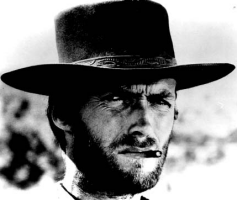
High school girls, eh? Tell that to this guy, Mr Attorney Man:

eastwood.gif

Go ahead. Make his day.

And when he’s done with you, there’s some ladies in the hall that would like a word. They call themselves the “Flavourettes,” and they look a little…desperate.

Gran Habano Pyramide Habano #3

Cnv0178.jpg

While not exactly a "bargain" cigar, STC Cigar has been successful in marketing the very affordable Gran Habano line since 2003. The Gran Habanos are offered in only four sizes, but each size is available in three different blends to choose from.

The sizes are fairly predictable, since they are also the most popular: churchill, pyramid, toro and robusto. The blends cover the spectrum from mild to full body: The #1 has a Connecticut shade wrapper and is the mildest of the three. The #3 has a Nicaraguan wrapper and is blended to suit the tastes of medium-bodied cigar smokers. The #5 has a Nicaraguan corojo wrapper for fans of full-bodied smokes.

The #3 "Habano" before me here is a four country blend, with filler from Costa Rica, Mexico, and Nicaragua, an Ecuadorian binder, and a colorado maduro wrapper from Nicararagua. The Pyramide measures 6 1/8 by 52, and is made by Guillermo Rico's G.R. Tabacaleras Unidas in Danli, Honduras.

It's a nice looking wrapper with plenty of oil and a slightly sweet smell. I snipped the tip and the draw feels just right.

It lights up with some reluctance and required a couple of touch ups throughout the smoke. This cigar is packed well and burns slowly with plenty of smooth smoke. It has a sweet and woody flavor, and despite the burn problems with the wrapper it's quite aromatic.

As advertised, it does have a medium body, but along with this is considerable strength. I wasn't expecting quite this much nicotine in a "medium" bodied cigar, but once again this shows that "body" does not always correlate with strength. In this regard it lives up to it's "Habano" name. About halfway down the shank it picks up a bit of spice and starts to burn a little more consistently. And at the conclusion a pleasant and lingering aftertaste seals the deal.

At 3 to 4 USD per stick this is a great value cigar. Pair it with a good Highland malt or a strong ale. It completely blew away my can of Miller…I'll know better next time.

Oliva Master Blends 2 Churchill

Cnv0016.jpg

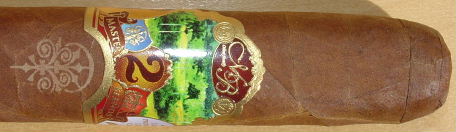
This is the second generation of the Master Blends, this time with an Ecuadorian grown Sumatra wrapper. (The Master Blends 1 was a Nicaraguan puro.) Oliva's farms in Ecuador have been producing wrapper leaf of tremendous quality in recent years, as evidenced by their use in Ashton's Virgin Sun Grown brand and Diamond Crown's Maximus cigars.

The Master Blends are limited edition cigars, with only 120,000 of the MB 2 churchill produced. The churchill measures 7 by 50, and is made in Esteli, Nicaragua. An interesting design flourish is the insignia below the band– etched into the wrapper with a laser, I'm told, to thwart counterfeiters. It also makes this cigar a little difficult to use in a blind taste test…

It's square pressed, and the cap is a little rough. Prelight the smell of the wrapper is fairly strong, and the draw is perfect.

It lights up easily and burns evenly. This is a medium bodied cigar that doesn't waver too much; though it does grow in strength, it never achieves a truly full body. The flavor profile is not extraordinary; no particular taste really jumps out at me. The aroma of the smoke is pleasant, but I can't really put my finger on any particular descriptor. There is an astringent, mouth puckering quality that I find with many Nicaraguan cigars, and the one distinguishing element I can identify is a semi-bitter aftertaste, like Columbian coffee. I'm not a fan of this taste, so I can't say I found it all that pleasurable.

The Oliva Master Blends 2 Churchill is a very well made cigar, and it commands a premium price. I would recommend it for fans of other Nicaraguans, but I would also advise prospective buyers to taste a few before purchasing a full box.

American Stogies Cuban Corojo Toro

Cnv0170.jpg

Nestor Plasencia makes so many cigars for so many people it’s hard to keep straight, but this is one of them, made for Indianhead in Esteli, Nicaragua. Plasencia’s father Sixto was one of the pioneers of the cigar industry in Nicaragua. In the mid-60’s Sixto recognized the similarity of the valleys of northwestern Nicaragua to the Pinar del Rio area and decided it would be a good place to experiment. The test was a rousing success, and since then the Plasencia family has been huge in both the Esteli area and the Danli, Honduras tobacco zone. To date, Plasencia grows tobacco for Rocky Patel, Mayorga, OneOff, Evelio, Maria Mancini, other Indianhead cigars, and numerous other private customers. He also has his own line, which includes the Plasencia Organica, one of the first cigars rolled with certified organic tobacco.

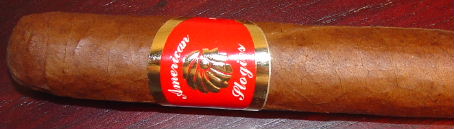
This is the “Classic Cuban Corojo,” introduced in 2003 as a fuller bodied addition to the American Stogies line. It normally sells for under three dollars– like the Mayorga cigar it could very well be considered a “bargain cigar,” even though it could probably sell for more. It’s a Nicaraguan puro according to he venerable Cigarcyclopedia…but I must admit I did not know they were growing corojo in Nicaragua. Unless, of course, this is like the Punch rare corojo, and corojo in name only.

But judging by taste, I think this wrapper leaf is indeed corojo. It has the same aroma as the Puros Indios Corojo and the Camacho Corojo, but I can’t say the cigar as a whole is quite as good as either of those. It has a nutty, somewhat vegetal taste, with very little spice. It packs a good punch, however. Definitely not an empty-stomach smoke.

It burns well, evenly and not too quick, though the stick does get soft after a couple inches. I grew a bit tired of it at about the half-way point, where the power began to kick in without any added flavor dividends.

For the price, I’d say give this one a shot. Don’t expect too much, and you’ll get a little more than you had expected.

Bad Habits Robusto

Cnv0169.jpg

Every once in a while I like to hit the local cigar shops to see what's kicking. This robusto is from a downtown Las Vegas shop called Bad Habits. They have some interesting and unusual sticks, including a Costa Rican puro called Eureka which I will be reviewing here at some point. They're located on 4th Street near the Fremont Street Experience. Their prices are a bit high, but that's understandable due to the location. But you're better off buying some nice cigars from these folks than throwing your money away on the tables, believe me. (Here comes the pit boss. Time to light up this robusto and look tough.)

I was told in the shop that this is a Dominican puro, but that's about all I can tell you about the makeup of this cigar. The maduro wrapper is rough with a few prominent veins, but it feels solid enough. Prelight it has a fairly typical herbal smell with a tinge of ammonia. I thought it might need some additional aging for this reason, but I decided to fire it up anyway.

It lit up well, forming a flaky gray ash. The burn was even and consistent throughout the smoke. I didn't expect a whole lot from this cigar, because it hasn't been rated 95 in Cigar Aficionado and there aren't full page ads splashed all over the cigar magazines. Hell, it doesn't even have a homepage! What's a cigar without a homepage anyway?

In this case, it's a pretty good cigar. It's medium in body, reaching towards full. It starts out with an herbal body and a little pepper. Notes of chocolate and cocoa are the main feature. These finer flavors are drowned out as the cigar grows in strength and the pepper comes and goes. I smoked this a little past the band, at which point it turned a little bitter.

I can't remember what I paid for this, but it was under five dollars, and at this price I'd call it a bargain. I've paid way more for far lesser cigars. If you're ever downtown and hankering for a good smoke while you're paying the devil his due, check out Bad Habits. I plan to make another trip soon myself.

Carlos Toraño Tribute 2004 Maduro Churchill

Cnv0168.jpg

A tribute to Carlos Toraño, Sr., the man who brought Cuban seed tobacco to the Dominican Republic for what was probably the first time, and with the cultivation of Piloto Cubano spawned the Dominican cigar as we know it today. There have actually been two “Tributes” thus far: the 2003, which had a natural wrapper, and this one, the 2004 maduro.

As is fitting with a special cigar, this is a limited edition of 1000 boxes only. The Costa Rican maduro wrapper is gorgeous, dripping with oil and redolent of earth and cedar. Within lies Nicaraguan and Dominican filler held by a Nicaraguan binder, all of which have been aged five or more years. The Tribute is rolled in Toraño’s Esteli, Nicaragua factory.

It fires up with a powerful earthy taste, very similar to the 1916 Cameroon, but without the spice of the Cameroon. There is a sharp element that quickly mellows.

But Houston, we have a problem. The draw is very loose, and for the first inch or so the cigar tunnels. The tunneling stops, but the burn remains very hot. I smoked this one very slowly, allowing the burn to correct itself. It does, but remains hot. I rarely do this with a cigar, but I decided to let it extinguish itself and return to it later. It’s such a pretty stick, and the flavor is so rich and lovely that I hate to can it because of a construction flaw. (Not to mention that it’s friggin expensive.)

Unfortunately, letting this cigar die in the hopes of a later resurrection was not such a good idea. Upon relighting it the same rich flavor was there, but the burn was still hot and I got sick of it pretty quickly.

At about 10 USD a pop, I’m not going to give this one another chance. I hope this was just a bad single, since other reviews indicate this is a great cigar. Keep in mind that this review is based on a single experience, but all in all I have to say I was disappointed.