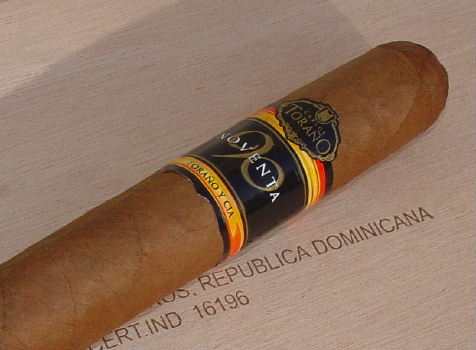
Carlos Torano Noventa “La Esperanza”

cnv0346.jpg

When Daniel Ortega was elected President of Nicaragua last November, cigar makers and aficionados everywhere had to step back a moment and remember what happened the last time Ortega’s party was in power. When the Sandinistas assumed control in 1979, tobacco farms and factories were seized by the government and the Nicaraguan cigar industry was essentially decimated; cigar manufacturers took what tobacco they could and ran for the border to Honduras or other more hospitable countries. Tobacco production in Nicaragua was eventually retooled for cigarettes to be marketed in Eastern Bloc countries.

So when Ortega came back like a bad penny last November, Philip Wynne of Felipe Gregorio cigars did what seems the sensible thing — he got out of Dodge and moved his operation to the Dominican Republic. But the Toraño family evidently has no fear. Instead of leaving, or even hedging his bets, Charlie Toraño decided that they would go ahead with plans for a new facility four times the size of their current one in Esteli. The new factory will be set on a 30 acre campus complete with areas for social events and tourist attractions; in fact, Toraño says they want the new factory to have the air of a winery where people can relax and learn about the history of Toraño’s four generations in the business.

And if this weren’t enough, there’s the name of the new facility: Esperanza, which was the name of the Toraño farm in Cuba. It was confiscated by the Castro government in 1959 and led to Carlos Torano’s famous escape to the Dominican Republic with the seeds that would become known as piloto cubano, one of the great stories and historical milestones in the history of cigars. Esperanza is Spanish for hope, and hope is certainly alive in Nicaragua.

To celebrate the 90th anniversary of the founding of the company (dated from 1916, the year Santiago Toraño emigrated from Spain to Cuba,) Toraño Cigars released the Noventa. After five years of aging, the final product was released late last year. Noventa is a Nicaraguan puro utilizing a nearly flawless habano wrapper, a habano binder, and a complex blend of fillers from Jalapa, Esteli, Condega and Pueblo Nuevo. The names of the three available sizes are reflections of Toraño’s heritage: Santiago, a 5 x 50 robusto named after the patriarch of the family; La Esperanza, a 6 x 52 toro named for the original farm in Cuba; and Latin, a 6 1/4 x 54 torpedo named after the current business moniker.

The toro size Esperanza has a smooth shade-grown appearance with a slight sheen to the wrapper. A couple of discreet veins pop up toward the head from under the band. The foot reveals some dark leaf, and the pre-light scent is mildly spicy. The cap is smooth and shiny and applied in the flat Cuban style. A very attractive cigar.

I was expecting a bold spicy start typical of Nicaraguan puros, but what I got instead was a very smooth, nearly creamy smoke. The base flavor here is wood with a touch of cedary spice. The draw is perfect, and the burn is as close to razor straight as I’ve had in a long while. The flavors and aroma remind me of a Padron 1964 natural, though perhaps not as bold. The same smoothness and woody profile is there though, with maybe a little more sweetness on the nose.

There wasn’t too much development here, just a very relaxing spritely cigar with gentle spices jumping all over the palate — cedar, juniper, maybe a little vanilla bean. Never overbearing, perfectly balanced, and smooth as silk. I’d rate it a solid medium in body, though the smoke texture itself is a little bit heavier than that. It’s not heavy the way highly spiced Nicaraguan cigars can be — it’s substantial, but refined. I enjoyed this smoke for a good hour and fifteen minutes, pausing once to remove the band and wonder where the time went.

The Noventa is a great cigar worthy of the Anniversary status conferred upon it. The bad news is that it’s very expensive. At around 11 USD this isn’t going to be an everyday smoke for most people, and it probably shouldn’t be. Since Noventa means 90, I would prescribe one every 90 days. Even if you need to scrimp a little the rest of the week — have a Mayorga or a Maria Mancini instead of that Ashton –I think it’s worth the sacrifice.

Dominican Colors and Swirls

cnv0343.jpg

I was browsing through the Daedalus Books catalog the other day and found a couple of titles that I’ve had my eye on for some time. (Daedalus is a purveyor of fine but commercially neglected books, also known as “remainders.”) In the catalog I also saw this venerable looking fellow with the stogie clamped in his craw and thought maybe, just maybe, this book would have some interesting cigar lore for me to ponder. It was only $4.98 so I threw it in the basket.

The copyright date is 2003 by Parkstone Books in New York. The author is Jean-Pierre Alaux, and though there is no biographical information about him I would guess he is French. The text has been translated into English by Arthur Borges, and the book is bound in Slovenia. This seems to be a truly international effort. Unfortunately the text suffers somewhat from an unwieldy translation, resulting in things like, ” For a firsthand experience of the sensitive gestures that go into the manufacture of a puro…” and “Before being commercialised, each cigar undergoes a combustibility test…” Pre-smoked stogie, anyone? They’ve been thoroughly tested, I can assure you.

cnv0345.jpg

The highlight of this thin volume is the photography. The first half of the book focuses on the Dominican cigar industry, and then it moves on to more general cultural topics. The cigar-related content here is pretty basic, centering on Tabacalera de Garcia and Altadis. A few words from Jose Seijas and short two-sentence profiles of four cigars — Don Diego Belicosos, Davidoff Double R, Santa Damiana “Rothschild Churchill” (??) and Pleiades Orion — completes the section on cigars.

cnv0344.jpg

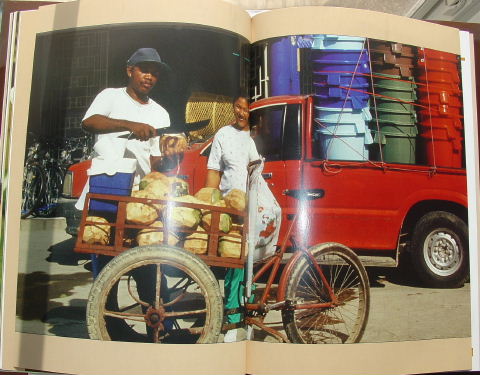
The landscape photography is quite nice, and the detail in the pictures of the galeras is worth the bargain price. (My pictures of the pictures don’t really do them justice.) The book is quite short at only 96 pages. It’s really more of a novelty item than a serious look at the island or the cigars made there, but not a bad impulse buy for 5 simoleons.

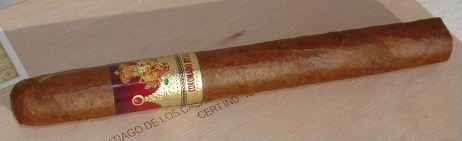
Coronado by La Flor Double Corona

cnv0342.jpg

By now most cigar smokers are familiar with La Flor Dominicana cigars, but in the past few years Tabacalera La Flor has released a few “special” cigars like the Litto Gomez Diez line, the Limitados I and II, and the extremely limited Factory Press cigars. The Coronado entry is a departure from the standard LFD production as well, with only about 65,000 cigars made last year. And while the production run for the Coronado isn’t as limited as those “special” smokes, the fact that the double corona rated a 93 and won “Second Best Cigar of 2006” in Cigar Aficionado put in the spotlight for a while.

The heart of the Coronado is the filler and binder grown on Litto Gomez’s farm in the Dominican Republic. The binder is corojo, (Dominican corojo is always sure to get my attention) and the filler is from Sumatran seed.

The wrapper on this cigar is a very mottled colorado maduro with fine veins. It’s a gorgeous example of sun-grown wrapper, and in this case it’s easy to see why Litto opted for a non-Dominican leaf — it’s grown by Nestor Plasencia in Jalapa, Nicaragua, and in addition to the visual element it adds several levels of complexity to the smoke. It’s rough looking and oily, but beautiful.

The draw on this stick is just about perfect — an easy pull with just the right amount of resistance. The burn is not perfect, and the ash from the wrapper tends to peel away and look a little messy, but these are minor matters. Overall I found great construction here.

La Flor makes some great milder bodied cigars, but the ones that have gotten the most attention lately are the full bodied sluggers like the Double Ligero and the Litto Gomez Diez. As soon as I lit the Coronado I realized it was probably in the same class. The first few puffs are very peppery and the first half inch or so unleashes a serious tongue bite. The pepper I like, especially since it dissipates and develops much more complex flavors after that first blast. The tongue bite I could live without.

Eventually what I’m getting is a solid base of leathery flavors with overtones of black pepper and later on some woody elements. The finish is long and peppery, and the texture of the smoke is excellent — creamy, full flavored, almost chewy. Strength aside, this is a truly heavy bodied cigar just in terms of the weight of the smoke, and the aroma is powerful and pervasive.

But to be honest, this stick kicked my ass. I managed to get through the first two thirds, really enjoying the cigar, until the last third when my head started spinning and I had to weigh my options — keep smoking because the flavor was too good to abandon, or put it down and try to regain my equilibrium. I was struggling with this decision until I started feeling a little queasy and recognized the signs, the ones that say “Stop now or find a nice quiet place to be sick for a while.” So for once I listened to my body and let the Coronado extinguish itself.

This is a great cigar for full-bodied cigar lovers. It was a bit much for me, but what I could handle of it I quite enjoyed. I’ll be picking up a few of these for my friends who like Joya de Nicaragua Antanos and LFD Double Ligeros — the price point is a little high at around 8.00 USD retail, but for complexity, performance, and all around flavor this is money well spent.

La Aroma de Cuba Corona Minor

cnv0339.jpg

On November 30, 1895, Winston Churchill was fired upon by Cuban insurgents as he traveled with the Spanish Army as a military observer. It was his 21st birthday and his first experience under fire.

As a recent graduate of the Sandhurst Military Academy, Churchill’s eagerness for active service drew him to Cuba. But he left with a taste for something else — the Havana cigars he would treasure and continue to enjoy for the rest of his life. At this time he was loyal to two brands in particular: the famous Romeo y Julieta, and a lesser known label called La Aroma de Cuba.

Romeo y Julieta has been in continual production since that time, but at some point La Aroma de Cuba fell by the wayside. In the late 1990’s, Robert Levin of Ashton Cigars read an article in Cigar Aficionado about Churchill’s exploits in Cuba and after doing a little research he discovered the brand name “La Aroma de Cuba” had been abandoned. He registered the name for future use.

In 2002 Ashton introduced La Aroma de Cuba with a Honduran wrapper (grown by Nestor Plasencia), a Honduran binder, and filler from Honduras and Nicaragua. The cigar is manufactured in the small colonial town of Santa Rosa de Copan in Honduras, most probably in the Flor de Copan factory. The artwork on the band and box is based on the original lithography. It certainly has that old timey look about it.

I read a review of this cigar somewhere that compared it the Cuban Bolivar petite corona. A far fetched claim, I thought. I had sampled La Aroma de Cuba a few years ago and wasn’t too impressed, but the review insisted that it was this particular size in the line that was the jewel in La Aroma’s crown. So I thought I’d give it a go.

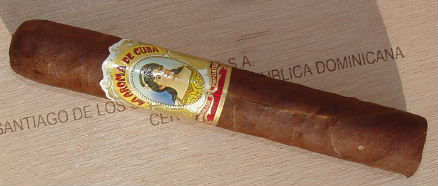
The wrapper has a rough but robust appearance, slightly toothy with lighter colored veins. The cap is applied well and the roll is solid. The prelight draw is clear and we’re ready for takeoff.

The basic flavor of this little stick is leather and its highlight is spice. It produces a nice volume of medium bodied smoke which has a slightly sweet tinge to it. It’s not sweet like a habano though; it’s more of a sun-grown sweetness than the caramel and bread of a Bolivar. The smoke has a nice smooth texture, and while the finish is spicy it’s not biting. As a point of comparison, I’m thinking Camacho, but a sensitive Camacho, which I realize is an oxymoron. La Aroma de Cuba seems to me a more nuanced but still full bodied Honduran cigar.

This Corona Minor is a fine 20 to 30 minute smoke, but when I want this flavor profile I will probably reach for a Camacho instead. When you want to take a bull by the horns, you want some horns to hang on to.

Padilla Miami Corona

cnv0338.jpg

Originally this line was called “Padilla Miami 8/11” but at some point it seems to have lost the cross streets. These are made in Pepin Garcia’s Rey de Los Habanos operation in Little Havana, which of course is located near the intersection of 8th street and 11th Ave. This line has gotten a lot of positive feedback in the last couple years, making it one of the best known and most sought after boutique cigars on the market.

Padilla Miami cigars are Nicarguan puros, bunched by hand and rolled by only ten experienced torcedors. The tobaccos used are first-generation cuban seed corojo and criollo grown in Nicaragua. The wrapper is corojo, and the filler is a blend of the two. As noted elsewhere, these particular varieties of tobacco are even more hygroscopic than your average black tobacco — they absorb the humidity more readily and in an excessively humid environment will not draw as well as they should. For this reason these cigars are best stored at a lower relative humidity than the typical 70-75%. The low 60’s is usually recommended.

These are not easy cigars to find. I finally managed to snag a five-pack on an auction site for a reasonable, though still substantial price. It’s a nice looking cigar and I noticed right away how well balanced it feels in the hand. The wrapper is a smooth dry natural color with maybe a touch of colorado. The prelight scent is not as spicy as I expected — simple sweet tobacco with an overtone of cedar.

Construction on these is a little bit questionable, just because they all seem to be rolled pretty tight. Two of the five I had to toss halfway through the cigar because it had become more labor than pleasure. The rest were better, but if held to the highest standard these are going to take a hit in the construction department.

On the other hand, these are some of the best tasting, most flavorful and complex cigars I’ve experienced from Don Pepin. They start out with Pepin’s trademark peppery prelude and slowly grow into a powerful smoke with a woody foundation. The aroma is the best that corojo has to offer — a sweet, lightly spiced caramel that starts out with some edges but then mellows after an inch or so and shows up some cocoa and coffee bean.

After a couple inches I’m ready to buckle up and settle in for the ride. Despite its size, this is a powerful cigar. In strength I’d rate it with the Opus X petite corona, though I think this is a superior smoke in terms of flavor. More than anything the flavor reminded me of a Montecristo No. 4 I was gifted a few weeks back, though not as smooth.

Construction problems aside, this is probably the best cigar I’ve smoked this year. I enjoyed the hell out of these, and even though I ended up paying around 6 dollars a stick (which is a pretty good deal, actually) I’d say they’re worth the standard retail 8 to 10 bucks a stick. It’s not an everyday cigar, but when you want to really concentrate on an intense and complex smoking experience, a Padilla Miami will not disappoint.

Rocky Patel Cuban Blend

cnv0337.jpg

It seems that Rocky can’t make a bad cigar. With a lot of talent and hard work he has given us some great smokes already, but Rocky is not satisfied with mere success. Rest on his laurels he will not. He must create even more blends to satisfy his army of hungry Patelians. So far there is a new American Market Selection, a Rosado, the RP Connecticut, the Edge Lite, and probably a bunch more out just in the last year or so. This one, the Cuban Blend, and the Honduran Blend are available exclusively from Famous Smoke Shop.

Famous advertises this one thusly:

Available ONLY at Famous Smoke Shop, these cigars present a bold, heady and well-balanced blend of long-aged Honduran Ligero longfiller tobaccos deftly rolled into scrumptious Corojo or Maduro wrappers. The smoke is ultra-smooth, complex, and brimming with dark, spicy flavors. It’s almost like getting a fine Cuban cigar without the Cuban price! Try a box and taste for yourself.

OK. I’m sold. Not on a box though. I like to test the waters with a five pack before setting sail for Box Land.

There are two versions of the Cuban Blend, corojo and maduro. This is the corojo version, with a shiny golden brown wrapper that is truly enticing. The head is finished without a flaw. It’s almost a shame to cut this one, but sacrifices must be made for the betterment of mankind and our burning desires. The roll is solid, almost hard to the touch, but after a clip of the Palio I found the draw just fine.

This Cuban Blend toro starts up with a touch of spice and soon mellows into a smooth Honduran leather. There’s a whiff of sweetness here as well, but just barely. The aroma is not as pronounced as I would expect from corojo, but it serves as a nice complement to the leathery core.

This is a fairly straightforward cigar without a whole lot of development or complexity. It levels off at a solid medium body, veering at the end toward full. At the midpoint the caramel-like sweetness of the corojo is kicked up a notch, and the flavor becomes a little bolder, but calling this “Cuban” is a stretch. It’s a smooth and tasty high-quality smoke from Rocky Patel, and that’s advertising enough right there.

Famous is hawking these for around 90 dollars for a box of 20, or $16 for a fiver. Not a bad price for this cigar.

EO 601 Habano Robusto

cnv0336.jpg

I was checking out the EO Cigars Website a few days ago, and after escaping the clutches of the sirens who grace the front page I discovered their “blog” section, which is really more of a place to post comments and questions. Eddie Ortega was kind enough to answer a question I posed about the origin of the “601” name for this series of cigars. I was thinking maybe it was a birthdate, or part of an meaningful address, something like that, but it turns out that 601 was the date that Eddie and Erik first went to visit Pepin’s factory in Nicaragua.

There are now three 601 cigars created by Don Pepin Garcia for EO Cigars — the 601 Connect I reviewed a few days back, a newly released box-pressed maduro, and this one: the Red Label with a Nicaraguan Habano wrapper.

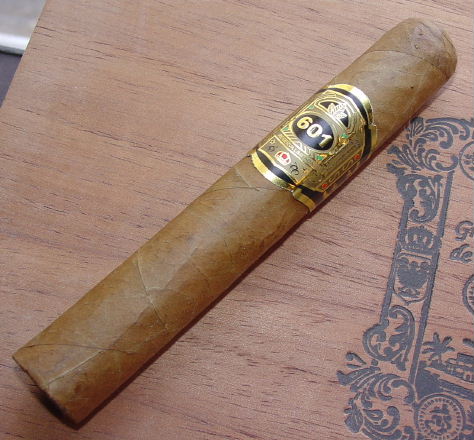
The wrapper on the Red Label is a dark oily rosado that could easily be mistaken for maduro. It has a leathery look to it and is heavily stippled with prominent “teeth” that are much coarser than than the toothiness of most Cameroon wrappers. The head is nicely finished with a classic Cuban cap, of course. This is a Don Pepin production, after all. The final result is a real winner in the looks department.

So with all those teeth it’s appropriate that this smoke should start up with a bite. It’s similar to the 601 Connect in this regard, but overall I think it’s comparatively tame for a full bore Pepin. The base flavor here is leathery, with the wrapper contributing some subtler spices. Cinnamon, maybe. After the mid-point the flavor gets sweeter, taking on a molasses like tang, and the pepper enters for a reprise. It’s similar, but not the same pepper as the Connecticut version — I tasted a lot of black pepper in that one and it had me sneezing pretty good for a while. The Habano is a sweeter rendition — instead of peppercorns I’m thinking hot northern New Mexico chiles.

The construction was good, but not perfect. This one suffered a little from an uneven burn and at one point the wrapper unraveled a little. But neither of these things really affected the performance of the stick.

The 601 Habano is a powerful little puro with a lot of sweet spicy flavor. At around 6 US greenbacks it’s not a cheap date, but ya gotta live a little sometimes. If you’re in the mood for a well-balanced but brawny cigar, check it out. Fill up at the dinner table first though. A big plate of chile rellenos, some black beans and rice, and a couple of Tecates would be a great prelude to this tough guy.

Nestor Reserve Connecticut Robusto

cnv0332.jpg

Several years ago Nestor Plasencia was quoted as saying, “Anyone who tells you they know everything there is to know about tobacco is either a liar or a fool.” This is worth remembering, coming as it does from one of the premier tobacco men on the planet. Plasencia has been working tobacco throughout Central America for years now, and has made cigars for companies as diverse as CAO, Indian Tabac, Alec Bradley, and many more, including his own brand names.

The Nestor Reserve label is probably better known for its maduro entry, which I haven’t reviewed yet but I can tell you right now that the couple of maduro torpedos I’ve sampled were fantastic, especially when the price is factored into the equation. (Another thing, but you’re not allowed to tell anyone: Plasencia makes really good econo smokes. Shhhh…)

The Connecticut Reserve is supposedly the same blend as the Nestor Reserve Maduro, with the obvious difference of a CT shade wrapper instead of the maduro. Unsurprisingly though, the information released by the big name online outlets is not convincing. The Maduro is advertised as having Honduran and Nicaraguan filler, with a Cameroon binder. Sounds tasty… IS tasty. The Connecticut, on the other hand, is presented as “a complex mixture of Costa Rican, Nicaraguan and Honduran tobaccos.” How do you get the same filler blend when one includes Cameroon, and the other Costa Rican leaf? Yet another mystery to ponder as the ash grows long…

I tend to hold mild cigars to a high standard when it comes to construction and aroma and give them more leniency when it comes to flavor. This standard worked out well for the Nestor Connecticut.

First off, I was impressed with the physical appearance of this cigar. The wrapper is smooth and almost veinless, and the cap is applied very well; in fact, one of them was neatly triple capped with a Cuban style flat head. That was interesting, especially for a cigar that cost me a little over a buck.

The flavor is mild, as expected, and by the end approaches a medium body without quite getting there. The smoke has a smooth creamy texture with a papery or balsa-like finish. Nothing to get excited about there, but the aroma is quite nice. A delicate mild spice rises from the smoldering ash and insinuates itself in the sinuses without no irritation. There’s something kind of oaky to it, but mingled with a dash of cinnamon. Maybe it’s a smell only a cigar smoker could love, but I am a cigar smoker and I love it.

There wasn’t too much of a development, and it doesn’t get too many points for complexity, but it’s a nice solid stick that burns well, smells great, and is really easy on the wallet. It may not be the best cigar I’ve smoked in the past couple months, but it’s definitely the best cigar under three or four dollars.

There’s absolutely no reason not to try this cigar, unless you hate mild cigars, Connecticut shade wrappers, or saving lots of money.

EO 601 Connect

cnv0330.jpg

United Tobacco’s “EO Premium Brands” are blended by the team of Erik Espinosa and Eddie Ortega, (the E and the O of the brand name.) Previously they have partnered with Rocky Patel to produce the REO and Vibe Corojo cigars, and they also have a line of flavored smokes called Bluebanana made in the Cojimar factory. But for their most recent project they enlisted the expertise of Jose “Pepin” Garcia and the result is pure Pepin.

The 601 Serie are produced in Pepin’s Tabacalera Cubana in Esteli, and first appeared on the market last year. So far there are two versions, the black label Connect and the red label Habano. (A box pressed maduro is also forthcoming.)

One of the goals of the blenders was to create a full bodied Connecticut cigar, which on the face of it sounds like a contradiction in terms. Connecticut Shade is smooth and creamy, notable for its soft aroma and beautiful texture. It’s not really Pepin’s style, which tends more toward full flavor and vibrant potency. Topping Pepin’s peppery Nicaraguan tobaccos with an Ecuadorian Connecticut wrapper sounds a little like experimental cuisine, dipping jalapeños in chocolate or something. It might work, but it’s not exactly intuitive.

There were no construction problems to speak of — the burn was even and the draw perfectly generous. It isn’t the prettiest Ecuadorian Connecticut wrapper, but I’m sure it was picked for other reasons. This wrapper has a big job to do, so aesthetic appeal was probably not the first item on the blenders’ list of desired qualities.

Like many of Pepin’s productions, the 601 Connect opens with a good dose of pepper delivered straight to the sinuses. When you light this cigar, you know you’re smoking. It’s full bodied from start to finish, but it goes through a fair number of changes and shows a lot of complexity. The wrapper imparts a really nice buttery aroma to an otherwise spicy Nicaraguan brew — an unusual combination, but for whatever reason it works. After an inch or so the spice dies down a little and makes way for a citric, dry wood type of taste. It’s not quite astringent, but it’s dry.

After the mid-point the smoke becomes creamier in texture and the flavor takes on a leathery aspect. The spice lightens up a bit, but this cigar never strays too far from the pepper mill. The aroma from the wrapper is a little bit overpowered by the full bodied blend at this point, but it’s still present enough to maintain the balance of the cigar. About half way through the last third my nose was running so much that I couldn’t really enjoy the cigar anymore so I laid it to rest.

For some reason this cigar makes me think of the baptism scene in the Godfather. While the discreet and dignified wrapper is pledging fidelity to God and renouncing Satan, the filler and binder are taking out the family’s enemies in brutal and symbolic fashion. Meanwhile the moviegoer– or the cigar smoker– is enthralled by both at once. And like Michael Corleone, this cigar is a paradox of sorts, a gentleman and loving father and at the same time a killer without remorse. If nothing else, this is a very dramatic cigar!

Por Larrañaga Churchill

cnv0329.jpg

There are a few different versions of this brand floating around. The original is, of course, the Cuban label registered by Ignacio Larrañaga in 1834. By the end of the 19th century the brand was known world-wide, inspiring Kipling to find “peace in a Larrañaga.” Today this marca is a relatively minor player in the Habanos market.

And then there are all the “other” PLs, of which there are at least three. Altadis has a Dominican version with a Connecticut wrapper. Cuban Imports recently released the “Por Larranaga Cuban Grade,” and then there’s this one: the Honduran version with an Ecuadorian Connecticut seed wrapper. (I read somewhere that the “Por Larrañaga” name was at issue in a trademark dispute. Evidently the final decision was to let everybody use it.)

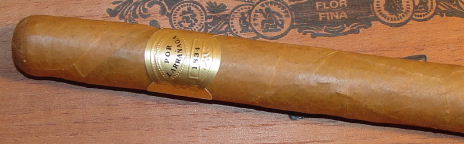
The Honduran PL is made in Santa Rosa de Copan with Honduran filler and binder, and is finished off with a very smooth and supple Ecuadorian grown wrapper. The Churchill is a standard 7 inches by 48.

This is a well-made, mild to maybe medium, but mostly mild bodied cigar with a great Ecuadorian wrapper. The aroma of the wrapper really made the cigar. There are some muted nutty flavors here as well, but without the wrapper there wouldn’t be much here to go on. It smells great, it burns well, it’s entirely inoffensive…  it’s everyone’s favorite political candidate!  Actually, it’s the opposite of cigars that are marketed to “seasoned smokers only.” But it really needs something to give it a little more traction, in my opinion.  On the other hand, I’ll admit it’s a pretty decent mild cigar. Better than a Don Diego, for example.

The Honduran PL is available from JR Cigars. Whether this means it’s an Altadis product or a new Santa Clara line, I don’t know. And furthermore, I don’t care. It’s just not my kind of smoke. But it could be yours, if you dig the super mellow stuff.