Padilla Artemis

Padilla’s Artemis series is the first box pressed cigar for Padilla, but just about everything else about it is quite familiar — it’s a Nicaraguan puro utilizing Aganorsa tobacco, and it’s made at the Raices Cubanas factory in Honduras. Those are enticing details, and enough to get my salivary glands going.

Artemis uses Cuban-seed criollo and corojo from Nicaragua’s now-famous Aganorsa company, a tobacco grower affiliated with Casa Fernandez cigars. The line was originally released in 2011 as a brick-and-mortar exclusive, but it now appears to be available online as well.

It looks like the lion from the Dominus line has clawed its way to the top of the advertising department and has been declared the company’s icon. It now appears on the bands for Padilla’s Miami and 1932 lines as well, bringing some needed consistency to the brand’s presentation. (I was always fond of the fountain pen nib on the bands of some of the older blends, but there is something to be said for a single and recognizable emblem.)

Padilla’s Artemis is available in four sizes:

  • Robusto: 5 x 54
  • Torpedo: 6 1/4 x 52
  • Toro: 6 x 54
  • Double torpedo: 6 3/4 x 56

Construction Notes

I’m glad I smoked the Artemis in two sizes, the robusto and the double torpedo, because one was simply superior to the other. Both are nice looking sticks, especially the double torpedo. In reality this is a zepellin perfecto, and a big one, with a finely finished head and foot. (The head and the foot are distinguishable only by the placement of the band.)

The wrapper is a dark colorado maduro with a moderate amount of oil. Both sizes had an accessible draw, and the box press didn’t seem to have much of an effect on the performance of the cigar. But I experienced a burn problem with the double torpedo that I didn’t with the robusto, and it wasn’t the irregular burn that is the hallmark of many box-pressed cigars.  This was a more serious problem that affected the taste of the cigar — the wrapper would not burn in sync with the binder and filler, resulting in a flavor that was at first merely tepid, but quickly made it hot, bitter, and unbalanced.

For this reason I’m going to focus on the robusto and not the double torp.

Overall construction: Very good for the robusto; Needs improvement for the double torpedo.

Tasting Notes

If you’re familiar with the Padilla 1932 or some of the cigars from Casa Fernandez you’ll recognize the flavor of Aganorsa tobacco. It’s a little different in the Artemis, but it’s there. The first notes are of leather with some sweetness and a little bite. The aroma is slightly fruity, but also reminiscent of hardwood smoke — something like hickory, perhaps. After a minute or two the pepper begins to build on the palate.

The mid-section is earthy but a little sharp. The flavor isn’t quite as clean as Illusione’s “original document” line, but it has that crisp minerally tang which is Aganorsa’s trademark.

The final inch and a half is rich and powerful in flavor, though the cigar is still medium-to-heavy in both body and strength. The last section bottoms out a little as the spice takes over and edges out the subtle notes on the nose.

Conclusion

Fans of Padilla and Aganorsa leaf will probably enjoy the Artemis, though perhaps not as much as some other blends that employ that particular leaf. The flavors are quite pronounced, and in the robusto were well balanced up to the last third of the cigar.

I was more than a little disappointed in the double torpedo, but I would probably pick up the robusto again at the right price. The right price for me is a little south of the MSRP, which is in the 9 to 10 USD range. To be honest, Padilla has already provided this cigar’s competition in the Padilla 1932, and in that contest the winner goes to the elder blend.

Final Score: 86

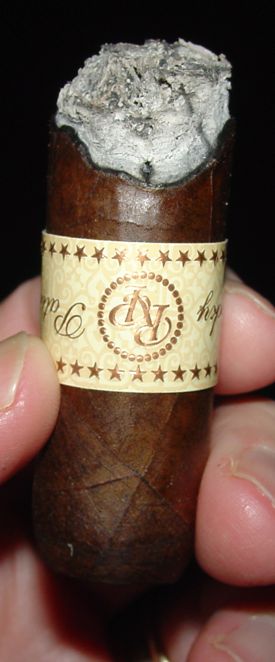
Due to a memory error in my camera I lost my cigar-in-progress photos. I know you only come here for the articles, but my apologies anyway. 

Gurkha Cellar Reserve Prisoner

This year marks the quasquicentennial anniversary (that’s 125 years) of the Gurkha brand name, and Beach Cigar Group, the maker of Gurkha cigars, has marked the occasion by changing its name. The manufacturer of “the world’s most expensive cigar” is now the Gurkha Cigar Group. It’s a sensible name change, and for a company well versed in the subtle art of branding it seems a long time coming.

A few other changes have occurred at Gurkha in the past year — a new president and CEO is at the helm (Gary Hyams, formerly of CAO), and a new subsidiary brand was launched: East India Trading Company. And while the company still produces very high end “luxury” cigars like the cognac-infused His Majesty’s Reserve, they have renewed efforts to engage the unwashed masses, represented here by yours truly.

Three new blends released last year at the 2011 IPCPR were geared toward the retail market, and for the moment this one appears to still be a brick-and-mortar exclusive. The Gurkha Cellar Reserve utilizes a Criollo 98 wrapper, a Dominican Olor binder, and filler which includes 15 year-old Nicaraguan Criollo.

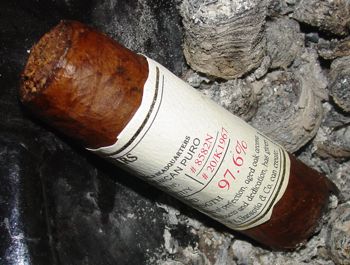
In line with the “cellar” theme, this cigar arrives in a box that is ribbed like a wine barrel. (I don’t always like Gurkha blends, but Hansotia’s baroque boxes are the best in the business.) The bands are just as odd and beautiful, though in this case the information is a little bit confusing.

The “blend strength” is labeled on the band as 97.6%. This inevitably prompts the question: 97.6% of what? I also have to admit some confusion at the “Dominican Puro” statement. The cigar is made in the Cuevas factory in the Dominican Republic, but according to Gurkha’s press release it is not a Dominican puro. Maybe it’s best to see the band as graphic art rather than a source of salient information. In any case, the Cellar Reserve is produced in five sizes:

Perfecto “Koi” – 4 x 58
Doble Robusto “Solaro” – 5 x 58
Gran Rothschild “Hedonism” – 6 x 58
Churchill “Prisoner” – 7 x 54
XO “Kraken” – 6 x 60

Construction Notes

The Prisoner is, to my mind, more of a double corona than a churchill. This is a cannon of a cigar, and with its somewhat veiny and dark colorado maduro wrapper it’s a serious looking stick. The head is nicely formed. The cap is not a work of art but shears cleanly and does its job. The large band has the effect of minimizing the size of the cigar, or putting it into a different perspective somehow. Optical illusions aside, this is a good 1.5 to 2 hour smoke.

I’ve smoked five or six of these now and each one has shown excellent construction. The cigar feels a bit light in the hand, but that is no indication of its burning characteristics, which are generally slow, even, and cool. Each time I ashed this cigar it fell into the ashtray like a fat piece of chalk.

Overall construction: excellent.

Tasting Notes

The Prisoner starts up with a sweet grassy flavor but after a puff or two the oaky-vanilla aroma begins to remind me of the wine cellar theme of this cigar. The smoke is smooth but somewhat dry on the palate. After a minute or two the base flavor turns from sweet and grassy to roasted nuts.

After about twenty or thirty minutes the flavors begin to deepen without venturing into any new territory. The aftertaste grows slightly peppery, and the strength becomes more evident. The oaky-vanilla aroma is still the highlight of the cigar.

Into the third section the Prisoner is a consistent and straight-forward cigar without a lot of complexity. The aroma is very pleasant, and by the last third it delivers a pretty good kick. It starts to char near the band and after that becomes a little too sharp to smoke. But after 90 minutes I am ready to call it a night anyway.

Conclusion

Gurkha’s Cellar Reserve is an enjoyable cigar but it lacks the kind of complexity I was hoping for. I might smoke this one again in a smaller size because the flavors are good, but 90 minutes of plain ol’ good can still get a bit monotonous. The price is a little bit high for me as well — MSRP runs from $8 to $10 for this line. I was fortunate enough to recieve these samples from Gurkha, so I won’t complain about the price… but if I had to shell out the retail I might hesitate a little.

Final Score: 87

Rocky Patel Edicion Unica 2011

No one will ever accuse Rocky Patel of missing a special occasion for a limited edition cigar release. This one comes courtesy the Humo Jaguar International Tobacco Festival celebrated last year in Tegucigalpa and Danli, Honduras. The purpose of the Festival is to promote the Honduran cigar industry, which lags a bit behind that of Nicaragua. But if this cigar is any indication of the strides that Honduras is making, it may be catching up with its neighbor to the south quite soon.

The festival was named Humo Jaguar after the 12th ruler of Copan, who ruled from 628 to 695 A.D.  Humo Jaguar (Chan Imix K’awiil) was sort of like the Caesar Augustus of ancient Mayan culture — his reign was long and marked by stability and progress. The archaeological record he left behind includes monuments and stelae now preserved in the Copan Archaeological Park. Archaeologists assigned names to the rulers based on the hieroglyphs found on these stelae — hence names like Moon, Macaw, and Jaguar. Evidently smoke is depicted in the carvings as well; the Mayans were among the first cultures in the world to use tobacco, and presumably the King’s humidor was well stocked.

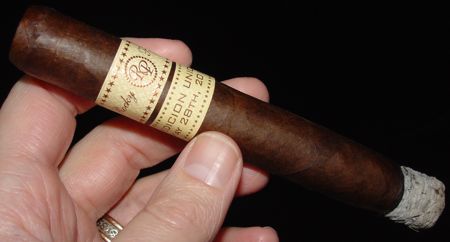
I’d like to think that Humo Jaguar would be quite pleased with the progress that the cigar industry has made in the last 1300 years, and that the Honduran puro that Rocky Patel created for the first festival in his name would have been a big hit with him. The dark wrapper that graces this toro is from the Jamastran valley, beneath which lies an unspecified Honduran binder. The filler is from Talanga and Jamastran. Only one size was created — a 6 x 52 toro. The initial release was limited to 500 boxes, but it seems likely that more were produced afterwards.

Construction Notes

The wrapper on the Edicion Unica is dark and somewhat dry — it reminds me a little of the San Andres wrapper that is showing up on so many high-end maduro cigars these days. The roll is firm, as is the draw. The head of the cigar is well formed. The cap seams are a bit ragged, but the cigar cuts cleanly and takes an easy light. Even though the draw is on the tight side, the smoke volume is more than adequate. The ash holds together and the burn is trouble free.

Overall excellent construction.

Tasting Notes

I am initially reminded of Rocky Patel’s Decade line, which for the last couple of years has gradually been supplanting the Olde World Reserves in my humidor. (I attribute the decline of the OWR — or what I perceive as such — to the prodigious number of blends in the RP portfolio. Maintaining consistency over that many lines for years on end has to be a considerable challenge.)

The first flavors to emerge from the Unica are dark chocolate or unsweetened cocoa, layered over the spicy sweetness of Spanish cedar. It’s a great combination that so far I haven’t been able to find at Ethel M. The aroma is strong but sweet.

After an inch or two the cigar showcases coffee and an acidity that I usually associate with Nicaraguan tobacco. The aroma is rich but slightly fruity, like an Ethiopian Sidamo style coffee. The smoke texture is smooth and full without being too powerful. At this point the woody underpinning gives way and becomes more leathery.

The last third picks up some black pepper on the tongue to add to the acidic zing, and the sweet maduro-style aroma lingers on the nose. The cigar remains balanced and smooth to the very end. It’s pretty rare for me to nub any cigar, but this one I didn’t want to put down.

Conclusion

The RP Edicion Unica is sold in boxes of 100, which makes it more suitable for retail distribution than for online sales, but even so the price is right — around $6.50 per stick. Rich flavors in a balanced and medium-bodied package don’t often come with such an economical price tag.

This is a limited run, so snap up a few if you have the chance. I recommend them highly for fans of Rocky’s other maduro offerings like the Decade or the OWR maduro. I just hope there a few left at the shop where I picked up this pair.

Final Score: 92

Casa Magna Domus Magnus Limitada

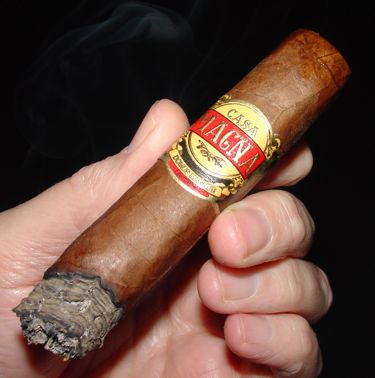
Casa Magna won the critics’ hearts in 2008 with its original release, the Casa Magna Colorado. It won my heart as well, and its modest price has kept me coming back for more. So it’s no surprise that the team of Quesada and Plasencia have extended the brand twice now, and as far as I’m concerned it’s just getting better.

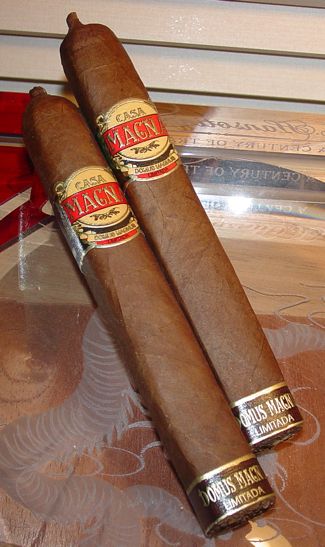
Domus Magnus is a Nicaraguan puro utilizing a sun grown wrapper leaf from Jalapa. The blenders do not disclose too much detail about the rest of the cigar’s composition, merely noting that the binder and filler are Nicaraguan. Only two sizes are made, a  5 3/4 x 52 size called “Optimus” and a slightly larger 6 1/2 x 55 parejo called “Primus.” The cigars are presented in 10-count boxes in a limited release.

SAG Imports states that the Domus Magnus

…is a full bodied cigar that should be enjoyed after a steak dinner and paired with a single malt Scotch from the Speyside sub-region of the Scotland Highlands.

 So I naturally smoked mine after a burger and paired it with a Sierra Nevada pale ale from the sub-region of my refrigerator’s bottom shelf.

Construction Notes

The Casa Magna Domus Magnus is a box-pressed cigar presented in boxes of 10.  The wrapper is a soft ruddy color, somewhat dry but smooth with a few fine veins. The cap is well constructed and terminates in a pig-tail which has been clipped instead of tied in the traditional knot.

I really dislike foot bands, but this one is easy to remove and discard. The draw is firm and the roll is solid. I would have preferred the draw to be slightly looser, but the few reservations I had about the draw were compensated by a rock-solid ash. The burn was mostly even, above average for a pressed stick, and required no correction.

Overall excellent construction.

Tasting Notes

My first impression was that this is a much smoother cigar than the Casa Magna Colorado. The smoke texture is mild to medium, but the flavors are quite complex, especially on the nose. Woody aromas predominate — cedary spice and softer notes of sandalwood, while the palate flavor is understated, at least for the first half of the cigar.

In the second half the smoke picks up a little more body and palate structure as flavors of nuts and earth emerge. The scents on the nose continue to complement these new flavors, but the increasing richness of the earthy component tends to overpower those more delicate subtleties. Some black pepper appears in the last inch of the cigar, just to verify the blend’s Nicaraguan birthright.

Conclusion

I was pleased but not thrilled by the Domus Magnus’ opening act, but the dramatic transition in the second half was truly impressive. A little more body in the first part of the smoke and this could easily be a Top Ten cigar for me. As it is, it’s still a very fine cigar.

At around 8 to 9 USD this incarnation of the Casa Magna is not a cheap thrill, but for fans of complex and medium-bodied cigars, I think it’s well worth the expense. This is a limited edition blend, so be sure to snap up a few of these if you can.

Final Score: 90

Santos de Miami by Jameson

Not many American cigar lovers found it an occasion to celebrate, but last week marked the 50th anniversary of John F. Kennedy’s Proclamation 3447 and the U.S. trade embargo of Cuba. Since February 7, 1962, Americans have either had to seek out Non-Cuban substitutes for their inimitable Cuban favorites or to skirt the law and risk possible legal sanctions. Many of us — and I won’t say who — have done both.

Whatever your political viewpoint — and there are as many points for as there are against the embargo — a positive consequence of the ban has been the development of cigar industries in the Dominican Republic and Nicaragua that now rival that of Cuba’s. And this has been a huge boon for cigar lovers everywhere.

The “forbidden fruit” factor has always been an element at play in the blending and marketing of cigars to Americans, but to a certain extent this has faded with the introduction of super premiums from Fuente, Padron, Tatuaje, Davidoff, and many others. But the elusive flavor of Cuban tobacco is never far from our minds. And every once in a while a cigar comes along that gets very close to that flavor. I think Jameson has done that with Santos de Miami.

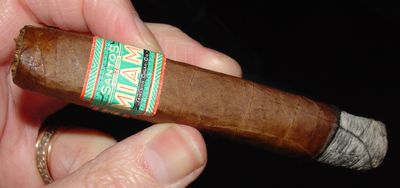
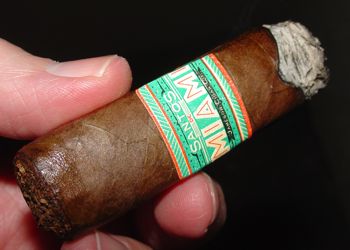
Santos de Miami is a Dominican puro with a Havana corojo wrapper, Criollo 98 binder, and a blend of criollo and corojo filler leaves. Only two sizes are made: a corona size called Alma (5 x 46) and a toro sized Haven (6 x 56). The cigars feature a box press so extreme that the sticks resemble wafers. They are presented in 10-count boxes of Spanish cedar that preserve the press. (Similar to La Flor Dominicana’s Factory Press line.)

Construction

Jameson’s Santos de Miami cigar is already distinctive with its box press and art deco band — add a pig tail cap and the distinction is complete. The claro wrapper shows some fine veins, but is otherwise clean. The draw is excellent, and the burn is only a little off kilter. This seems to be standard with box-pressed cigars, but in this case the uneven burn was a minor issue and corrected itself over time. The ash was solid, smooth, and delightfully quadrilateral.

Overall construction: Excellent.

Tasting Notes

The Haven and the Alma sizes smoke like very different cigars, though they share the same musky, earthy and Cubanesque aroma. The corona-sized Alma is a sharper, somewhat bolder smoke. It fires up with a pinch of cayenne pepper in the sinuses and then quickly evens out to a smoother but still full-flavored profile of cedar and musk. The Alma burns with a little more passion, but is also less complex than the larger vitola.

The toro-sized Haven is much less peppery and leans on the musk and cedar more heavily than the smaller cigar. The smoke texture is just as creamy smooth though, and it seems to have an additional bass note that the Alma lacks. The middle section is earthy with a sweet cedar edge, and the final third rests on its woody foundation while the earthy flavors take a back seat.

What both sizes have in common is an earthy and musky scent with a cedar note. I’m certainly no expert when it comes to Cuban cigars, but this aroma is really close to what I’ve found in many standard line Habanos. The scent is not quite as delicate, but I find it to be very similar. In any case the aroma complements the sharper character of the Alma just as well as the more complex flavors of the Haven.

Conclusion

Santos de Miami is not an easy cigar to find, but truly “boutique” cigars generally aren’t. This is one worth seeking out if your tastes run to earthy and medium-bodied Cuban-style smokes. At least you won’t have to get them from a guy who knows a guy and end up with cigars of mysterious provenance.

The retail price for the Alma is around 7 USD and the Haven sells for 8. They are available from a few online outlets, but you might as well go straight to the source at Jamesoncigars.com. Pick up a pound of Rockstone coffee while you’re at it and let me know how it is.

Final Score: 91

VegaFina Jose Seijas 2011

After 35 years in the trenches, José Seijas is hanging up his hat. For over 30 years Seijas has been responsible for some of Altadis USA’s most popular blends, and for much of that time he has been the manager for Tabacalera de Garcia, the world’s largest cigar factory.

Most of us started out smoking Altadis cigars, if only because they are ubiquitous: Romeo y Julieta, Montecristo, H. Upmann — the classic Dominicans with the Cuban names. But over the years Seijas went beyond the standard name brands and brought us brands like Mi Dominicana, Onyx Reserve, and the Seijas Signature Collection.

Maybe it was meant to cap off his career, or maybe not, but last year Seijas developed a limited release blend which was introduced with no fanfare, no flashy ads in the cigar mags, and no press release that I am aware of. That cigar was the VegaFina José Seijas 2011. I saw a stack of pretty black boxes in the B&M and thought it was strange that VegaFina, a fairly mild econo-smoke, was getting yet another makeover. I grabbed a few and thought nothing of it. A few weeks later I did a little research and discovered that it was a limited edition, and by that time the remaining boxes were sold out.

VegaFina is extremely popular in Europe and might be Altadis USA’s best-selling Dominican, at least in countries like Spain and Portugal. It hasn’t done quite as well in the United States, but that hasn’t been for lack of trying. In the late 90’s it was a Honduran cigar with an Indonesian binder, then after a hiatus in production it was re-introduced as a milder cigar with an Ecuadorian Connecticut wrapper.

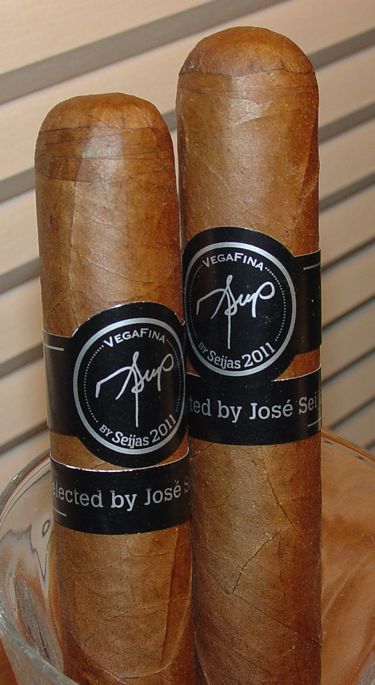
But the 2011 blend is different from both of those. It utilizes a Mexican wrapper from San Andres, but it isn’t maduro, which is what I automatically think of when I hear “San Andres.” It’s criollo. The binder and filler leaf is Dominican, and only one size was made: a 6 x 56 toro. It was originally released in black laquer boxes of ten, and the first release was limited to 2,500 boxes.

Construction Notes

The wrapper on the Vegafina 2011 is darker than the Ecuadorian Connecticut on the standard line, and even with a few unobtrusive veins it is still attractive. The roll is firm and consistent — the large ring gauge is hefty, but the stick feels comfortable in the hand. The head is wound nicely, but a ragged edge to the leaf obscures the quality of the cap. It clips cleanly and the draw is effortless.

The wrapper is fairly thin and I somehow managed to chip the cigar as I transported it from the humidor to my smoking lounge. (Some people say my “lounge” looks an awful lot like a deck chair perched on a sand lot. True enough. What used to be a volleyball court now looks a lot like the world’s largest ashtray.) In any case, the chips and nicks at the foot of the cigar were soon put out of mind as the cigar was lit and turned to a smooth light gray ash.

Tasting Notes

The Vegafina 2011 starts out smooth and creamy with just a pinch of black pepper at the back of the palate. The smoke texture is pleasantly full and the aroma is complex — it’s not as floral as Connecticut shade, but it’s still mildly sweet with woody scents. It’s hard to believe a Mexican wrapper leaf can be this subtle, but it is.

A mildly dry aftertaste develops in the middle section, but the smoke is still rich and aromatic. The base flavor is both earthy and nutty — something like walnuts maybe — and the cedary aromatics add a nice balancing touch.

The dry flavor continues into the last section, but unfortunately it also tends to become a tad bitter. I was suddenly reminded of the Mexican element of this cigar, though I don’t think that the wrapper is to blame. In any case, I couldn’t smoke this one much past the secondary band.

Conclusion

I really enjoyed the first half of this cigar — the flavors are rich and complex without having to flex much muscle. But the dryness in the second half and final bitter note are an unfortunate conclusion to an otherwise very interesting cigar. I am keeping in mind that some people like that bitter note, and since it isn’t overwhelming I think there are many people who won’t be bothered by the last inch of this stick. But at around $6.00 per cigar, there are also many fine alternatives.

Final Score: 87

Torano Vault Robusto

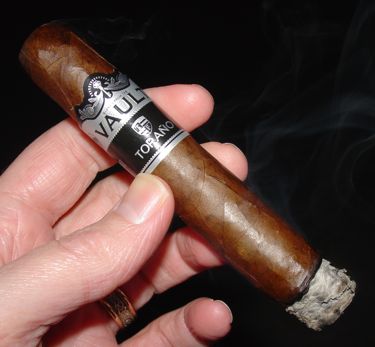
One of the reasons I’ve always liked Toraño Cigars is that they have the consistency I expect from a large manufacturer, but they frequently take chances on inventive new blends. The Single Region (which garnered a spot on my Top Ten list last year) is one of those — a cigar made entirely with tobacco from one small region of Nicaragua.

Toraño’s Vault is almost a Nicaraguan puro (it includes a binder from Jamastran, just north of Nicaragua in Honduras) and is quite a bit more geographically diverse than the Single Region, but it shows the same kind of ingenuity. It’s also a much heavier cigar than the Single Region. In fact, it’s supposedly one of the heaviest blends Toraño has developed thus far. The name of the cigar comes from the safe which houses Toraño’s “blend book,” a history of every blend developed by the Toraños since 1982. Some of these have been commercially released, and others never made it to production.

One of the blends that fell to the wayside was the Liga A-008, which was first created in 2000. The original recipe utilized fillers from Condega and Esteli, a Jamastran binder, and a shade grown Nicaraguan binder. For the Vault, the Toraños tweaked the blend by adding some peppery ligero from the volcanic soil of Ometepe island in Lake Nicaragua. A binder from Ometepe was added to the Jamastran, and some Ometepe ligero was folded into the filler.

The Vault was released in 2011 in three sizes:

  • Toro – 6 x 50
  • Torpedo – 6 1/8 x 52
  • Robusto – 5 x 52

Construction

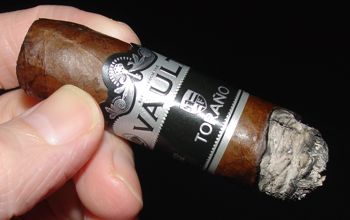
The Vault robusto is a solid, well-rolled stick with a glossy, dark colorado maduro wrapper. (It looks too dark to be shade grown, but that must be the variety or the aging process at work.) The head is flat and the cap is functional. It clips crisply and the draw is easy.

The cigar burns very slowly, perhaps due to the relatively high ligero content, but with no diminution of smoke volume. I needed to touch up the burn once or twice, but it wasn’t really problematic. The ash flakes a little, but it’s as solid as the roll.

Overall very good construction.

Tasting Notes

The Vault robusto comes jumping out of the gate with pepper on the palate and a bite on the tongue. This seems to be the norm for medium-to-full bodied Nicaraguan cigars these days, and the Vault is no exception. The spice is accompanied by an aroma of grilled meat and a touch of caramelized sugar.

The flavors are tempered a bit as the sharpness of the pepper fades in the middle section. The meaty tones in the aroma turn leathery but the sugary note remains. The smoke is medium in body but full in flavor and potency.

There are no big surprises in the last lap. The pepper returns, as expected, but it doesn’t drown out the other flavors as it tends to do in the first inch. The sweetness fades, but the pepper and leather lingers in the aftertaste.

Conclusion

I would be interested to see what the original Liga A-008 tasted like, because I think the Ometepe might be a little bit overdone in the Vault. It’s still a nicely balanced, full-flavored cigar, but it’s a bit sharp and a little less complex than I would like. A few more months in the box might serve these cigars well, unless you’re after that big spicy flavor — and of course there are a lot of folks who want exactly that. If that’s your preference, the Vault should be on your shopping list now rather than later.

Final Score: 88

Cigar Chemistry: Lignin

Cigar Science is an occasional feature of Cigarfan.net, an occasion which is usually prompted by the common cold or flu. In lieu of a cigar review, this is my humble effort to identify the organoleptic properties of cigar tobacco and to determine if the outlandish olfactory findings of certain cigar reviewers are justified… or if we should just keep our hallucinations to ourselves.

Lignin is an essential element of wood, and of most vascular plants, including tobacco.  (The word itself is derived from the Latin lignum, meaning wood.) Lignin fills the spaces between the cell walls of many plants, provides strength, and is thought to be responsible for moving water through cell structures.

This would be of no interest to cigar smokers except for one fact: lignin is “the most abundant natural organic aromatic polymer found in the vascular plant kingdom.”¹ Lignin accounts for 4 to 5 percent of tobacco weight; far less than hard wood, but significant nevertheless.

When burned, lignin produces phenols with specific aromatic properties, the most evident of which is the smell of wood burning. Two of these phenols, guaiacol and syringol, are responsible for the flavors of smoked foods. That is one of the reasons why more highly lignified woods (hardwoods) are preferred for barbeque.

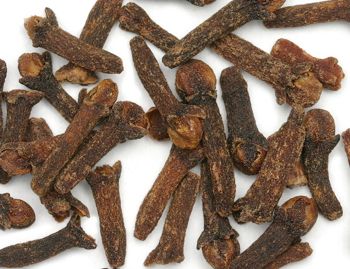
Guaiacol is associated with smoky flavor, and is present in roasted coffee compounds, while syringol is associated with the aroma of wood smoke. Guaiacol is also a precursor to other phenolic compounds that contribute to flavors commonly found in cigar smoke: vanillin and eugenol. We all know what vanillin is, but the term eugenol is derived from the scientific name for clove, and its aroma is exactly that: clove-like. It has also been extracted as an essential oil from nutmeg, cinnamon, and basil.

Other phenols produced include cresols, which have a petroleum-like scent. Cresols are also found in coal tar, crude oil, and creosote. Cresols are also, apparently, a component of Sharpie markers. I’m already on the lookout for a cigar review that includes “a whiff of Sharpie marker.”

These phenolic constituents are also produced as pheromones by certain insects. The desert locust is ardently attracted to guaiacol, and the orchid bee is erotically aroused by both eugenol and p-cresol. So don’t be surprised if these guys crash your next herf. They only want to make friends.

It’s difficult to say what chemical compounds are specifically responsible for the flavors and aromas of cigar tobacco –there are thousands of them — but it seems reasonable to me to say that we aren’t hallucinating when we find vanilla, or clove, or related aromas in cigar smoke.  Some cigar smokers are more sensitive to subtle aromas than others, and some people are just better at putting names to sensations; but I don’t think that it’s fair to say that an unexpected flavor, like honey or aniseed, is the product of an overactive imagination. Different people won’t always agree on the flavors they find in a particular blend, but to deny that those flavors are there seems unwarranted when there is a basis for it in chemical analysis.

Other flavor and aroma compounds have been discussed in previous articles, available here.

Notes and Selected References

1. Leffingwell, J. (2001) Chemical constituents of tobacco leaf and differences among tobacco types. Leffingwell Reports, 1(2).  Retrieved from: http://www.leffingwell.com/leffrept.htm

2. McGee, H. (2004) On food and cooking: the science and lore of the kitchen. New York: Scribner.

3. Hardwood Smoke Science. Steel Town BBQ. retrieved from: http://steeltownbbq.com/7.html

Best Cigars of 2011

Despite all the adversity the cigar industry faced in 2011 — threats of unfair government regulation, an economy stuck in neutral, the gradual elimination of venues that permit the time-honored tradition of setting fire to tobacco — there are still fantastic cigars on the shelves. Blenders continue to be as inventive as ever, and cigar prices are as reasonable as can be expected. It was a bad year for a lot of things, but cigars helped us through them.

I didn’t get to review as many new cigars as I wanted to this year, but with the blossoming of the cigar review blog scene, it wasn’t really necessary. The quality of reviews has never been better, and many sites are reviewing blends before they’re even released. The cordiality of many cigar manufacturers, blenders, and distributors has made the blogging experience only that much more enjoyable for all of us. It says a lot about the cigar community that this is the case.

A little over a third of the cigars I reviewed this year scored 90 or better, which either means I need to raise my standards or there are some really good smokes out there. In addition to these, there are many others that I have enjoyed but either didn’t review, or didn’t review in 2011. So it’s not very accurate to call this list the Best of 2011. It’s more of a retrospective, a glance back at 2011 on this last day of the year, and a very limited one at that.

Which is to say: All of the usual disclaimers apply.

10. Alec Bradley Family Blend D3

9.  Berger and Argenti Clasico Rothschild

8.  Carlos Toraño Master BFC

7. Undercrown Robusto

6. Padilla Dominus Robusto

5. Los Blancos NINE Toro

4. JML 1902 Torpedo

3. Carlos Toraño Single Region Serie Jalapa Toro

2. Alec Bradley Prensado Robusto

And El Puro Numero Uno de 2011: 

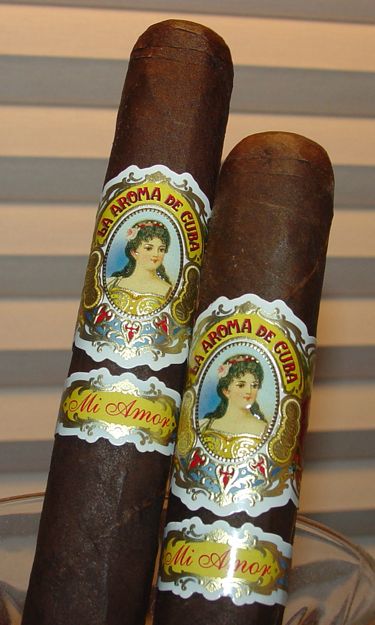
1. La Aroma de Cuba Mi Amor Magnifico

Have a safe and happy 2012, everyone. 

A. Fuente Rosado Sun Grown Magnum R52

The original Arturo Fuente Sun Grown line is based on the familiar Gran Reserva blend, but with a Sumatra seed wrapper grown in Ecuador by the Oliva Tobacco Company. It’s a classic smoke, easily identified by the black band at the foot. It’s probably my favorite of the mainstream Fuente cigars, and I always try to have a few around.

When the original Sun Grown line was created, the wrappers intended for the blend were put aside in favor of a higher priming leaf. That cache of rejected wrapper leaf has been lying around for eight to ten years now, and it is now being put to use in the Rosado Magnum line. The lower priming leaf results in a flavor that is a little more mellow, less concentrated, and creamier than the standard Sun Grown wrapper.

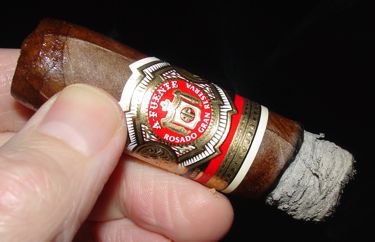
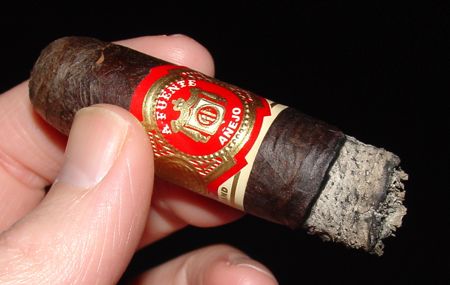
The Sun Grown Rosado is distinguished from the original Sun Grown line by the white border at the bottom of the band (the original has a black border, and not so much gold.) It looks a little like the Añejo band.

Carlos Fuente Jr. told  Cigar Aficionado that “he intended to go old school with this blend, moving away from the power trend that he helped create.” (A trend that arguably began with the Opus X.) “They have a sweet, long finish,” Fuente said. “It’s very flavorful, very complex — it’s my father’s idea of what a good cigar should be.”

The Rosado Sun Grown series was launched in December 2009 in three chunky sizes (hence the Magnum appellation) named for their ring gauge size. Since their premiere other sizes have been planned, some of which have been released. For now the lineup appears to be:

  • R-52 – 5 x 52 (robusto)
  • R-54 – 6 1/4 x 54 (toro)
  • R-56 – 5 5/8 x 56 (gordo)
  • R-58 – 5 1/4 x 58 (torpedo)

Construction Notes

As expected, the highlight of the Sun Grown Rosado R52 is its gorgeous colorado maduro wrapper. I’m not sure how “rosado” differs from colorado, but this cover leaf is a dark natural shade with a touch of red. If that’s rosado, well then this is rosado. The leaf has some veining, but it’s smooth, consistent in coloration, and it shines.

The head is nearly flat and the stick appears to have a slight box press. The cap shears neatly and the draw is spot on. It burns evenly and slowly, building a solid ash that is very light gray to white in color.

Nearly perfect construction.

Tasting Notes

This robusto opens sweetly, with mildly spicy scents of cedar. The base flavor is woody and slightly nutty. The smoke is medium to full in texture, but fairly mild in strength. After an inch or so the cigar serves up an elusive taste of honey or graham cracker. I thought it was caramel at first, but it’s not quite that sweet.

The second half of the R52 is muskier. The sweetness is still present in the aroma, but the flavors get a little earthier and pick up some spice at the end. It’s a gentle transition — the flavors remain balanced even though they gradually darken. There is virtually no aftertaste at the beginning of the stick, but by the end the smoke leaves a nice earthy char and some saltiness.

Conclusion

The Fuente Rosado Sun Grown robusto is a nice find for fans of medium-bodied cigars. The flavors are interesting and well developed, though they are admittedly muted when compared to full bodied classics like Fuente’s Opus and Añejo blends. But this cigar serves a different purpose, I think.

The R-52 robusto runs around $6 USD per stick, which is pretty decent for the quality of the cigar. The superb construction qualities alone might be worth this price. As long as you’re not a dedicated ligero lover who demands power from everything in your humidor, this is a smooth smoke worth checking out.

Final Score: 90