Alec Bradley Sun Grown Robusto

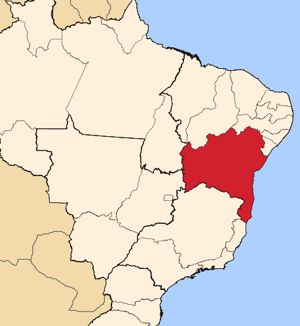
Alec Bradley’s Sun Grown cigar is distributed as a Famous Cigar private label, so there is limited information about it available. The distinguishing feature of the blend is a Mata Fina wrapper from the Bahia region of Brazil.

Mata Fina is a region in the Reconcavo Bahiana, the “bay area” of the state of Bahia. Much of this part of Brazil has been cleared of its natural forest over the years and secondary regrowth has taken place. “Mata Fina” is a farmer’s term for the type of regrowth, secondary forest, in this area. The climate and soil is excellent for tobacco cultivation — tropical weather with plenty of sun (though an average of 42 inches of rain annually) and sandy soil that provides good drainage. Tobacco farmers like to point out that Bahia is the same distance south of the equator that Cuba is north of it.
Tobacco is native to Brazil and was quickly adopted by early Dutch and Portuguese settlers. By the late 19th century it was one of Brazil’s leading exports, both in raw form and finished cigars. Brazil still produces a prodigious amount of tobacco (and a few blends of Brazilian puros) but the vast majority is now exported to major cigar manufacturers in Central America and the Dominican Republic.

All of the tobacco in Mata Fina is sun grown, which is part of the reason for its dark appearance. When mata fina is naturally cured it turns quite dark and can be mistaken for maduro, but the leaf is actually less robust, more refined and more highly aromatic than most maduro wrappers. Mata fina is most frequently used as wrapper leaf (which is hand-picked) but it can also be used as binder and filler (which is stalk cut.)

In addition to a Mata Fina wrapper, the Alec Bradley Sun Grown employs a Honduran binder and fillers from Nicaragua and Colombia. Three sizes are in production:

Churchill – 7 x 48
Robusto – 5 x 50
Toro – 6 x 52

Construction Notes

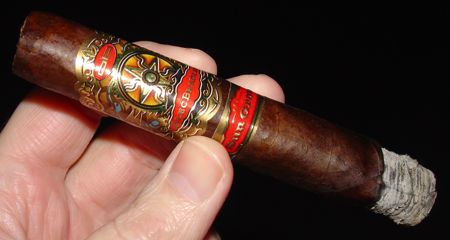
I haven’t seen how the Alec Bradley Sun Grown is packaged (I picked up a five-pack from Famous), but they look box-pressed to me. The roll is a little bit soft and seems to have taken on some press. The wrapper is dark and rich in appearance, though every bit as rustic as you’d expect from a sun-grown leaf. The cap is purely functional. Actually, the stick seems to have been designed without aesthetics in mind at all — maybe after looking at the wrapper they just threw in the towel. The band, on the other hand, is gorgeous. The secondary “Sun Grown” band is probably unnecessary though.

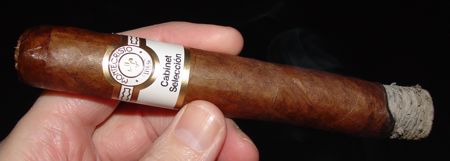
The robusto burns quite well — straight, with an even draw, and a smooth light gray ash.

Overall construction very good.
Tasting Notes

The robusto starts up with a flare of sweet spice, but it’s not the explosion of pepper that is common to a lot of Nicaraguan cigars. It’s palate-tingling, but it’s more like the minty flavor found in  Cameroon. There is a mild bite on the tongue and the aroma is sweet and complex. I have a hard time distinguishing the scents on the nose at this point, but the base flavor is coffee and earth.

Cruising into the mid-section the smoke gets a bit smoother on the palate but remains spicy upstairs. As the flavors settle and coalesce there’s a hint of cherry over the continuing coffee and earth underneath.

The complexity of the cigar diminishes as the cigar burns into its final stage, concentrating on coffee, earth, and that minty or clove-like scent with which it opened. The coffee dwindles into a burned flavor and starts to turn bitter at the very end of the smoke.

(One of the three I’ve smoked so far was a dud. I’m going to count that one out of my assessment, but I’d be interested in hearing if anyone has had a similar experience. Maybe there was a bad leaf in there or something.  If anything it shows that you have to smoke more than one cigar (preferably several) before passing judgment on a blend.

Conclusion

I don’t usually expect much from large distributors’ exclusive cigars, but the Alec Bradley Sun Grown was a good one. The complexity of aromas that the mata fina wrapper contributes really distinguishes the cigar, and at a price around 5 USD it makes a great everyday smoke.

Pick up a five-pack and let me know what you think. (Strangely, buying four five-packs is significantly cheaper than buying a 20-count box. And it’s not like Kaizad Hansotia designed the box.)

Final Score: 89

Hoyo de Monterrey Reposado en Cedros

Introduced at the IPCPR last year, Hoyo de Monterrey Reposado en Cedros also marks the introduction of a new aging process developed by the mad scientists at General Cigar’s HATSA facility in Cofradia, Honduras. The process has been dubbed “Inmersión”™ and duly trademarked.

I haven’t found a detailed description of what all this entails (because it’s a trade secret, I’m sure), but I’m guessing “Inmersión” is probably similar to barrel-aging. The end result of the process is an extra cedary kick given to the wrapper leaf. As the developers explain,

Enveloped in fragrant cedar, the cigar matures to a complex medium-bodied smoke with a uniquely spicy, rich taste.

The core of the cigar is a blend of Honduran, Nicaraguan, and piloto cubano from the Dominican Republic, which is then bound in Connecticut Broadleaf and topped off with the specially aged and treated Ecuadorian Sumatra wrapper.

Three sizes are in production:

  • Liso – 7 x 49
  • Marco – 6.25 x 54
  • Sueno – 5.25 x 54

Construction Notes

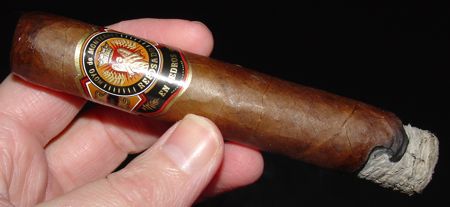
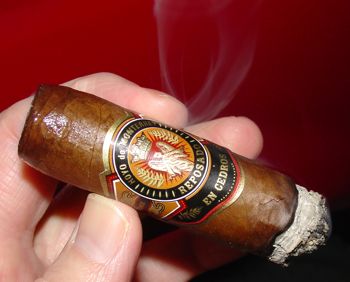
The Hoyo de Monterrey Reposado is a solid but generally unattractive cigar. The wrapper is smooth in texture, but very thin, showing the contours of the binder beneath. The color of the wrapper is an unusual yellowish-golden brown.  The cap is slapped on without much concern for looks, but it slices away nicely and reveals a very nice draw. The overall effect is rough and weathered, though this is offset somewhat by the packaging — the cedar sleeve is not only in keeping with the cedar theme, it improves the looks of the cigar.

The burn is good, though somewhat uneven, and the ash is solid. The wrapper cracks and tears very easily, so this might not be the one to smoke outside on a frigid day.

Overall construction — good to very good.

Tasting Notes

The Hoyo Reposado en Cedros is appropriately named — cedar, cedar everywhere. A pre-light whiff of this cigar is like walking into a well-tended humidor. The first inch is extremely smooth, with no harsh edges and a very short finish. The flavors include (Surprise!) cedar with a touch of honey over a earthy, slightly vegetal tasting base. The aroma is all cedar, all the time. Even the aftertaste is of cedar.

The middle section is a little richer tasting, bringing in a deeper woody flavor that balances out the high sweet cedar notes that still dominate the aroma. The finish lengthens a bit and there is the slightest hint of spice on the tongue. The smoke texture is medium in body, but the cigar is still mild in strength.

The Reposado continues on this track till it reaches its  medium-bodied, mildly spicy, sweet, and cedary destination.  At times I grew impatient with the cigar and puffed a little too frequently, resulting in a flavor that veered toward bitterness. Don’t do this. Let the cigar be it’s own mild-mannered lazy self and imagine that you’re in a sauna. One made of cedar. Relax. It’s not a crime to be bored.

Conclusion

The Sueños I smoked for the review were all consistent in flavor and performance, that is, consistently decent if a little dull. This is a very smooth smoke which announces cedar before flame ever touches foot, so if cedar isn’t your thing, you might look elsewhere. Aside from that, this is a well-made cigar.

If this cedar-aged profile appeals to you, then the price tag will be sure to please as well. The Sueños sell for only 5 to 6 USD per stick, and the larger sizes only slightly more. I might look for this one after breakfast sometime, if I get the hankering for a walk in the woods and there are no woods to walk in.

Final Score: 85

Thanks to General Cigar for providing samples of this cigar for review.

Warlock Robusto

Boutique and Altadis go together like B.J. Raji and ballet, but it looks like boutique is the word being used to review the new Warlock cigar. It used to be a boutique was a place girls went for clothing and accessories, but not any more. Now Altadis, the mammoth cigar manufacturer, is dangling a dainty tobacco treat before our eyes and dazzling us with its boutiquiness.

I suppose it’s a testament to the efficacy of the Altadis marketing department, or perhaps it’s only an indication of the gullibility of consumers in general (your truly not excepted) but I defy anyone to identify a “boutique” cigar without the band. It’s just not possible, and furthermore, it’s not necessary. The proof is in the puffin’, not the puffery.

Warlock is blended by Omar Ortez, which says more than any advertising slogan or buzzword ever could. Ortez is doing great things for Altadis; from his Originals, which have been out for a few years, to last year’s Don Diego Fuerte, he’s blending much more interesting and bolder cigars for this industry giant. And without letting Altadis off the hook for making some massively popular and incredibly boring cigars, I have to say that it’s nice to be able to find these sticks on the shelf.

With all the “boutique” nonsense floating around this cigar I expected it to be a Nicaraguan puro, but it’s not. It has an Ecuadorian Cubano wrapper, a Nicaraguan binder, and filler from Nicaragua and the Dominican Republic. Five wide-mouthed sizes are (widely) available:

  • Churchill 7 x 54
  • Toro 6 x 54
  • Robusto 4 3/4 x 54
  • Belicoso 6 x 54
  • Corona 5 1/2 x 44

Construction Notes

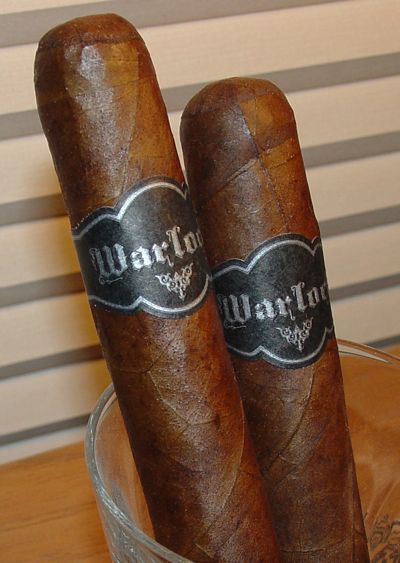
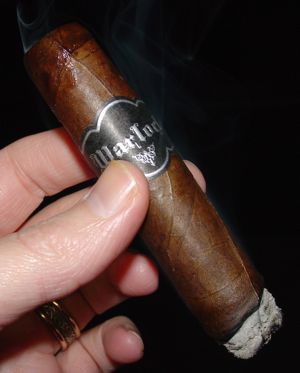
The Warlock robusto is rugged but rich in appearance. The wrapper is dark, mottled, and exhibits a nice sheen of oil. It’s veiny, but attractive nonetheless. The roll is solid and the draw is fine. The head is rounded off and finished with a plain but functional single cap. The only thing that yells “boutique!” here is the band, which foregoes ornate gold foil for some hipster gothic script.

The burn is haphazard, but doesn’t really need correction unless you’re compulsive about a straight-edge burn. The ash is a bit flaky and loose, but not particularly problematic.

Overall construction: Very Good.

Tasting Notes

The Warlock robusto starts out smoothly, which was surprising until I reminded myself that this isn’t a Nicaraguan puro. The initial flavor is woody, but it’s not nearly as robust I expected. The finish is strangely short for a cigar billed as full-bodied and “powerfully intoxicating.” The flavor is balanced, but not as pronounced as I anticipated.

The flavor builds in the middle section, remaining primarily woody with notes of earth and coffee on the side. There is still no pepper. On the nose there is spice aplenty, but it’s subtle (and actually quite nice). Sweet notes of caramel blend with the coffee and wood to produce an aroma that is almost Illusione-esque.

Finally in the last section the pepper arrives, bringing with it some char. The power of the blend is evident at this point as well, but it’s not exactly brutal. Most medium-bodied cigar buffs will be able to smoke this one without difficulty.

Conclusion

The Warlock robusto is a fine smoke, though it was not what I expected. It’s balanced and well made, and I like the Ecuadorian Habano cover leaf a lot. The price is not bad either — around 6-7 bucks for the robusto.

On the other hand, I would be much more inclined to smoke this cigar again if there were a size with a 46 or 48 ring gauge. I’m getting a little tired of the 50+ RG trend.

Final Score: 89
Torano Single Region Jalapa Serie

The word terroir means “land” in French, but it is most commonly used in the wine trade to indicate the qualities that are imparted to grapes by the growing environment. This basically comes down to soil quality and weather, both of which have a tremendous impact on the quality of the fruit.

The same thing goes for tobacco (and coffee, and probably all agricultural products.) Tobacco is a resilient plant that will grow almost anywhere, but black tobacco suitable for cigar making is much more finicky and is in many ways sensitive to the terroir. A tobacco grower does everything he can to produce the ideal conditions that will result in the type of leaf he wants —  from buttressing the soil with minerals and fertilizers to shading the plants with cloth to create a lighter shade of wrapper leaf.

Cigar blends usually incorporate leaves from several different regions to create a balance of the best qualities of each region. As an example (maybe not a great one), piloto cubano from the Dominican Republic might be used for spice, combined with a milder volado leaf to promote an even burn; a broadleaf binder from Connecticut might be used to give it a round leathery taste, and it might be finished off with a maduro wrapper from the San Andres Valley of Mexico for a chocolatey sweetness. It would be unusual to find tobacco with all of those qualities in one region, let alone one farm.

But that is exactly what the Toraño family has done with its Single Region release. Part of the reason they are able to do this is because it’s a hell of a region — the Jalapa Valley of Northern Nicaragua is one of the most fertile and productive places to grow cigar tobacco outside of Cuba. The Jalapa Valley is known for the sweetness and rich flavor of its tobacco, and is sometimes contrasted with tobacco from Esteli, which tends to be sharper and stronger.

All of the tobaccos in the Toraño’s Single Region come from one farm called El Estero after a stream that runs through the farm. Three sizes are in production:

  • 5 x 52 – Robusto
  • 6 x 54 – Toro
  • 7 x 50 – Churchill

Construction Notes

The Toraño Single Region Toro is a finely crafted cigar. The wrapper is ruddy, slightly veiny and rough, but it’s oily and luscious all the same. The roll is solid and the head is well formed. The neatly wound triple cap clips cleanly. The tobacco is packed tightly but it draws perfectly. The burn is slow, albeit somewhat uneven at times, and the ash is remarkably dark. I’ve only seen ashes this dark on Cuban and a few Nicaraguan cigars.

Overall construction: excellent.

Tasting Notes

The Single Region toro is nicely balanced from the very first puff. The smoke is soft and subtle with a peppery note that serves as an accent rather than the central flavor. It is medium in body, but high-toned with a notably acidic zing. Notes of cedar are prominent.

Cocoa and caramel come to the fore in the second stage, creating a sweetness that is almost syrupy at times. The aroma is complex, balancing cedar with something slightly fruity. It’s fairly unusual.

The last third becomes more concentrated as the pepper returns and the tobacco picks up a touch of char. At one point I found overtones of whisky on the nose, or maybe butterscotch. The body of this cigar seems to be uniformly medium, with a relatively light nicotine kick.

Conclusion

Based on some lukewarm reviews I was prepared to be underwhelmed by the Single Region, but it turns out this is a fantastic smoke. It reminds a little of Pepin Garcia’s Troya Classico, another medium-bodied Nicaraguan puro that I like a lot (and which is unfortunately no longer in production.) In some ways it’s a classic Nicaraguan cigar — woody with notes of cocoa and that characteristic zing — but it’s more complex than most cigars in its class, particularly on the nose.

This is a really interesting cigar that is both wonderfully complex and also very easy to smoke. I enjoyed it a lot, and with a price around 5 or 6 dollars, I’m think I’m going to be enjoying it a lot more in the near future.

Final Score: 92

Montecristo Cabinet Seleccion

Like many cigar smokers on a budget, I tend to find the best deals online. I would really prefer to patronize my local cigar shop, especially in an economy as devastated as this one, but it simply isn’t practical to spend $150 at the B&M for a box that I can easily find for half that online. As a budget-minded consumer I am simply driven to the cigar auctions like so many other lemmings trying to snag a deal.

So I assuage my guilt for succumbing to market forces by visiting my B&M and buying cigars I know I can’t get online. Some cigar manufacturers have gone so far as to distribute certain blends exclusively through local cigar shops, which accomplishes two things: it helps out the the small businesses who have to struggle with a bad economy and an onerous tax system, and it helps to promote and maintain the culture of cigar smoking, something a small cigar shop with a lounge does much better than an online monolith.

For all the flak Altadis takes as a monolith in its own right, the company has done its part to help out brick and mortar cigar shops with its Cabinet Selección Series, which is distributed exclusively through vendors with a physical presence. (Which I understand means that brick-and-mortars can sell them online, as long as they also have a physical store to sell them from.)

So whenever I hit the B&M I take a look at this line. I reviewed the Por Larrañaga entry last summer, and these Montecristo toros have been waiting patiently in line since then. Their time has arrived.

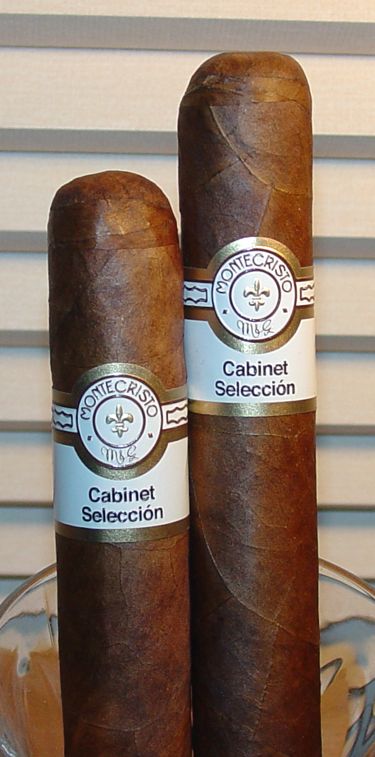
The Montecristo Cabinet Selección features an Ecuadorian Sumatra wrapper leaf, a Connecticut broadleaf binder, and filler from the Dominican Republic, Nicaragua, and Peru.

Five sizes are in production:

  • Churchill – 7 x 54
  • Belicoso – 6 1/8 x 52
  • Toro – 6 x 52
  • Robusto – 5 x 52
  • Corona – 5 1/2 x 44

Construction Notes

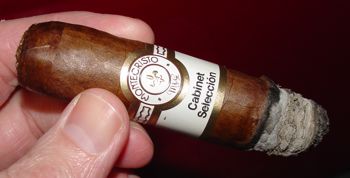
The appearance of just about any cigar would be improved by the addition of a Montecristo band, but the Montecristo Cabinet Selección Toro is, even without the band, a nice looking stick.  The wrapper is even and smooth, if a bit dry looking, and the roll is rock solid. The head of the cigar is not formed very well and the cap is not applied with great attention (which seems typical for Altadis), but once cut the cigar reveals a draw that is exactly where it should be. The burn is even and the ash is firm.

Overall very good construction.

Tasting Notes

This Monte Cab is for most part a dry smoke. It opens with pepper and tannin, a dry spicy combination that reminds me more of a Nicaraguan style cigar than any Montecristo. The cigar’s best features are apparent in the aroma, which from the start is cedary with a touch of cocoa.

The middle section drops the tannin down a notch and picks up an earthier cast. It’s still fairly spicy on the tongue, but somewhat bitter as well.

The last third is earthy and remains tannic. The aroma has an interesting butterscotch-like scent which is a nice counterpart to the the tannins, but the bitterness overwhelms what little sweetness there is. The last inch is charred in flavor and a little too sharp on the tongue.

Conclusion

The Montecristo Cabinet Selección retails for around 6 USD, a quite reasonable asking price if this flavor profile tickles your fancy. Unfortunately I found the tannins to be too heavy, pushing the blend slightly off balance, and the peppery edge was a bit harsh.

On the other hand, I loved the wrapper leaf and the aroma of the cigar. And it is a well constructed stick, as one would expect from any cigar bearing the august title Montecristo, so I can see how many people would think highly of the blend. But in the final analysis, it’s not for me.

Final Score: 83

Padilla Dominus Robusto

Padilla is best known for his Miami blend and the year-branded lines that were created while Jose “Don Pepin” Garcia was manufacturing his cigars: Signature 1932, Padilla 1948, and the Serie 68. When Pepin withdrew from the partnership in 2009, the brand names stayed. There is some debate about how much the blends really changed at this point — to me they seem very similar but not exactly the same. In any case I think the new ones are just as good, if not better, than the old ones.

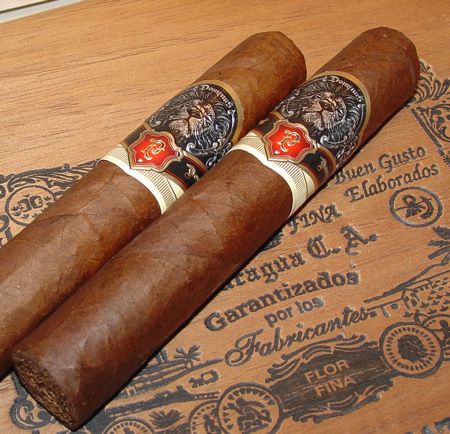
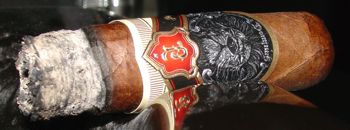
Dominus is one of the post-Pepin brands that was released in 2009. The name “Dominus” means master or lord in Latin, which along with the lion on the band seems to indicate that Padilla has not suffered any loss of self-esteem after the Pepin thing. (As he shouldn’t, because his cigars are still among the best Nicaraguan puros on the market.)

The Dominus  line is composed of Cuban seed corojo from the Esteli and Jalapa regions of Nicaragua. The tobacco was harvested in 2007, but is called Corojo 2006 — I’m not sure if that refers to the strain of tobacco or the crop year. The flavors here are clearly Nicaraguan, but I’ll go a bit further out on the limb and say this is Aganorsa — to me, it has that sweet caramel tang that is so characteristic of Aganorsa leaf in Illusione, Casa Fernandez, and the Padilla 32. Whatever it is, it’s good stuff.

Seven sizes are in production:

  • Perla – 4 x40
  • Robusto – 5 x 50
  • Torpedo – 6 1/8 x 52
  • Corona Gorda – 5 5/8 x 46
  • Toro – 6 x 52
  • Churchill – 7 x 48
  • Double Robusto – 5 x 54

Construction Notes

The Dominus robusto has an oily, dark colorado maduro wrapper. It’s ruddy with a few veins, but very rich in appearance. The cap is wound three to four times and set solidly on the head of the cigar. The roll is compact, almost hard to the touch, which results in a firm but still productive draw. The cigar burns evenly and builds a solid dark ash.

Overall construction very good.

Tasting Notes

The robusto opens with pepper, cedar, and a sweetness on the nose that is typical of Aganorsa leaf. It has a caramel-cocoa sweetness to it, with a whiff of hazelnut.

After an inch or so the cigar deepens into leather and the finish lengthens, leaving a peppery aftertaste. It’s bracing, rather than harsh or sharp tasting. The woody notes fade a bit on the palate but the aroma still carries the cedar. At the mid-way point the cigar is medium bodied.

The Dominus grows earthier in its last stage. The woody notes get a little darker, turning from cedar to hard wood with a touch of clove. The sweetness on the nose continues, like caramel spiked coffee. The band, which is fairly large, must be removed to reach the final smokeable inch of the cigar. At this point the potency of the blend is apparent.

Conclusion

The Padilla Dominus is a very tasty smoke with fine construction values. I’m tempted to say it’s a little earthier, and a little more rambunctious than the Signature 1932 and Miami blends. (If palate memory serves, which it may not.) Regardless, I love the dark woody flavor and sweet edge of this tobacco. And it’s nice to start off the year with a hit.

The Dominus is reasonably priced for the quality of the cigar, but it’s still on the high end of the spectrum at around $9 USD for the robusto. At this price it is in competition with several other very good blends in a similar style (Illusione), so we’ll see how it fares over the long run.

Final Score: 91

Other Reviews of Note

Walt and Mike team up on the Dominus for the Stogie Review (and it makes Walt’s Top Ten List for 2010.)

Adam digs the torpedo for Fire Up That Cigar, but he prefers the 1932.

The Perfect Draw gives the robusto a 93.

99 Cigar Guy gets uncharacteristically gushy on the churchill.

Don Diego Fuerte by Omar Ortez


Don Diego cigars have been around for decades and are known for being mild, aromatic, and inoffensive. The introduction of a Don Diego “Fuerte” is therefore somewhat oxymoronic, bringing to mind George Carlin’s bit about jumbo shrimp. The words “Don Diego” and Fuerte (Spanish for strong) just don’t go together.

Unless, that is, you append the words “By Omar Ortez” to the end. The Don Diego Fuerte is not like some other mild-to-medium bodied cigars that have been fuertified over the years — Indian Tabac “Super Fuerte” and Fonseca “Series F”, for example, which were made a tad bolder but never reached the “fuerte” threshold, in my opinion. The Don Diego Fuerte is not like those cigars. This sucker is FUERTE.

It’s also surprisingly good.

There isn’t much information available on the genesis of the blend, or why Altadis decided to exploit a brand name known for mildness to promote a very bold smoke. Aside from its being made in Nicaragua by Omar Ortez, I wasn’t able to dig up too much.

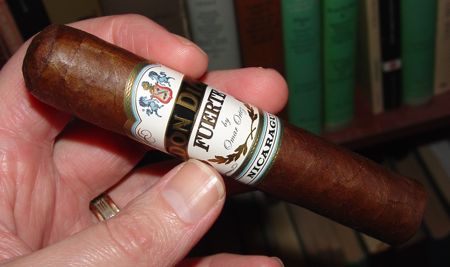
The wrapper for this cigar is a dark and oily Ecuadorian Cubano that I suspect has received processing as a maduro leaf. The binder is Nicaraguan, and the filler is a blend of Nicaraguan and Dominican tobaccos. With the exception of the corona, all of the sizes in the line have a 54 ring gauge. They’re thick sticks.

  • Churchill – 7 x 54
  • Belicoso – 6 x 54
  • Toro – 6 x 54
  • Robusto – 4 3/4 x 54
  • Corona – 5 1/2 x 44

Construction Notes

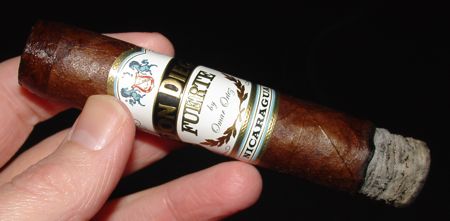
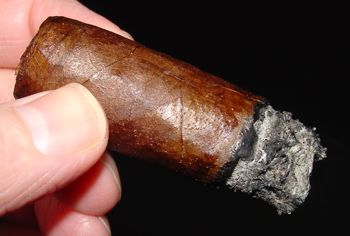
The Don Diego Fuerte has a gorgeously oily maduro wrapper. The roll is dense and consistent, resulting in a perfect draw. The cap is standard for Altadis — nothing fancy, but executed well. The burn is incredibly even for a maduro wrapper, and the ash is solid. With a cigar this short it probably wasn’t necessary to ash it at all, but I did.

Overall excellent construction.

Tasting Notes

It starts up like a full-bodied maduro: chocolate with a touch of black pepper, though not as much pepper as many other Nicaraguan cigars. The smoke is thick and the aroma sweet and cedary with a touch of raisin. After a half-inch or so the potency of this cigar becomes evident. It’s smooth, but it means business.

Leathery flavors emerge in the middle section, with more spice on the nose than on the palate. There is also an earthy, sulfurous smell at play — something like gunpowder. This blends nicely with the leathery aspect.

The last inch brings coffee with an earthy sweet caramel-like aroma. At this point my stomach was churning a bit, so I had to take it slowly.  I usually call it a night if a cigar is making me feel green, but I really didn’t want to put this one down.

Conclusion

Basically shock, both at the strength and the quality of the cigar. I wasn’t expecting much from the Don Diego Fuerte and based on the paucity of reviews, it looks like nobody else is expecting much either. But clearly Omar Ortez has done something entirely new with a tired old brand.

Single stick prices hover around $5 USD for the robusto, or $120 for a 27 count box. Full bodied cigar smokers will have to check out this new formulation. It most definitely is not your father’s Don Diego.

Final Score: 90

E.P. Carrillo Core Line

Ernesto Perez-Carrillo is best known as the blender of La Gloria Cubana, El Rico Habano, and as the former owner of the El Credito Cigar Company. His father, Ernesto Perez-Carrillo, Sr., had been a tobacco buyer and a member of the Cuban Senate before the revolution. He started the company in 1968, about a decade after he brought his family to Miami. Four years after the company was established in Miami, he acquired the rights to the Gloria Cubana trademark.

The young Ernesto was an aspiring musician, and he entered the cigar business on a part-time basis. But when his father passed away in 1980 he took over El Credito and became a full-time tobacco man. El Credito was a fairly small-time operation in the early 80’s, making mostly short filler cigars and barely squeaking by financially. But in 1992 Cigar Aficionado gave the LGC Wavell a 90 and the business started rolling in. Almost two decades of continued success followed, after which Ernesto sold the company to Swedish Match/General Cigar.

In 2009 Perez-Carrillo re-entered the industry with his children as business partners. He wanted to make a cigar that was different from LGC or El Rico Habano, and he was willing to step away from the trend for bigger, bolder cigars. The E.P. Carrillo 2009 inaugural cigar was just that — with an unusual and limited supply of an Ecuador Habano wrapper leaf from ASP tobacco he was back in it again. After that came the “Short Run,” yet another limited edition.

The “Core Line” is described by Ernesto as a cross between the Inaugural 2009 Edition and the Short Run, but it presumably will be more consistently and widely available. The wrapper used is an Ecuadorian Sumatra from the Oliva Tobacco Company and the filler is roughly 80% Nicaraguan and 20% Dominican. The Core Line also employs a double binder from Nicaragua.

Construction Notes

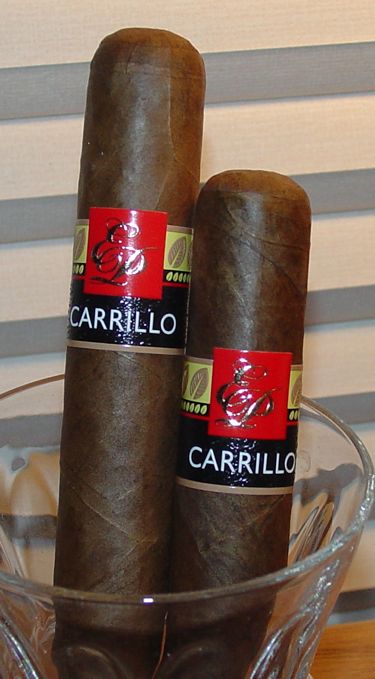
The exterior of the Core Line is bumpy and veiny, but the color is an even colorado maduro. The triple cap is finely crafted and the roll is solid. The burn is a little uneven at times, and the ash is a bit crumbly. She may not be the prettiest debutante at the cotillion, but we’re going to burn her and leave her in the ashtray anyway. (I hope my wife isn’t reading this.)

Overall construction: Very good.

Tasting Notes

The EPC Core Line opens with a grassy flavor and a dry, somewhat tannic finish. The aroma is very nice from first light though — mild cedar with notes of vanilla and butterscotch.  After an inch or so the texture becomes almost buttery.

Nutty flavors take over in the mid-section, but the aroma continues to steal the show. It’s floral like Connecticut shade, but woodier. I noticed a touch of salt on the tongue as well.

There isn’t a whole lot of complexity to this cigar — the flavors just continue on the same nutty trajectory until they fall just before the band to a prematurely ashy end.

Conclusion

The EP Carillo Core Line is a welcome addition to the medium-bodied cigar market. It could easily be enjoyed as a morning or mid-day cigar, or even a dinnertime smoke if you prefer medium-bodied fare. The aroma is expressive enough to compete against most Connecticut Shade style cigars, although it is a bit heavier than most shade sticks. In any case it’s one of the nicer mediums I’ve smoked this year. I just wish it had a little more staying power though the last third.

Prices for singles are in the $5 USD range, and boxes run around $115-140. That results in a pretty reasonable price to quality quotient.

Final Score: 89
Casa Fernandez Aganorsa Leaf

As one of the purveyors of Nicaragua’s finest black tobacco, Casa Fernandez (and its farms) really ought to be better known by now. If you enjoy Illusione or Padilla cigars, both of which employ Aganorsa Leaf as a key ingredient,  you’re just going to have to hunt up some Casa Fernandez products: Particulares, Condega, and JFR (Just for Retailers) are all bangin’ smokes.

Last year I surveyed a few of their offerings, including the flagship Casa Fernandez cigar,  so I got a little chill up my spine when I saw there was a new formulation on the shelves.

Aganorsa is an acronym for Agricola Norteña S.A., the tobacco manufacturing arm of Casa Fernandez, and one of Jose “Don Pepin” Garcia’s first employers after he left Cuba. For quite a long time the company (also known as Tabacalera Tropical) was satisfied with rolling just a few different blends and concentrating its resources on tobacco production. With the advent of Casa Fernandez it looks like they are promoting the cigar side of their business with more gusto. It’s not hard to see why.

The Aganorsa Leaf extension of Casa Fernandez is similar to the original line in flavor, but with its dark corojo wrapper it is bolder and more potent. It might sacrifice a little complexity in exchange for power, but until I do a side-by-side comparison I can’t say for sure.

The binder and filler are also Nicaraguan, of course, and are probably from the Aganorsa farms as well. The Aganorsa Leaf line is box-pressed and sold in boxes of 15.  Three sizes are available:

  • Robusto: 5 x 52
  • Toro: 6 x 54
  • Torpedo: 6 1/2 x 52

Construction Notes

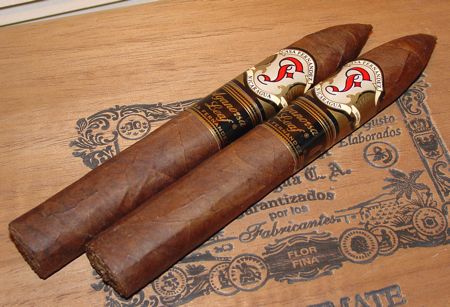
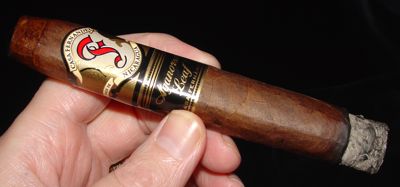
The Aganorsa Leaf torpedo is a solid and swarthy looking cigar. Its sturdy square press and dark, weathered wrapper give it a rustic appeal. The head is wrapped well and clips cleanly. It draws perfectly, though the burn is somewhat irregular, which is fairly typical of both maduro or oscuro wrappers and of box pressed cigars. The ash is a dark dirty gray streaked with black. If you smoke Illusione cigars you know what this looks like.

Overall excellent construction.

Tasting Notes

When you light up this cigar it is almost immediately apparent that you’re in for a ride. The smoke is thick, full-bodied, and rich. The flavors are crisp and sweet but heavy.

The first inch of the cigar is dominated by a sweet woody flavor, reminiscent of juniper smoke and the smells of late autumn as the temperature drops and people fire up the wood stoves and fireplaces. The smoke is smooth, but assertive.

In the middle section the assertion becomes more of an insistence. The flavors turn a little darker and less sweet: coffee and baker’s chocolate come to mind. The flavor is still crisp, but the smoke starts to bite a little. The finish is lengthy and the aftertaste spicy.

By the last third you’re either in it to win it or staring at the stars. This is a powerful smoke. The aftertaste is profound and cries out for a beverage to match — whisky would be a welcome companion. A strong aftertaste of pepper and char lingers long after the last puff.

Conclusion

For lovers of full bodied Nicaraguan style cigars, the Casa Fernandez Aganorsa Leaf is a must-try. Its powerful finish, peppery aftertaste, and solid kick are exactly what a lot of full-bodied cigar smokers are after. It is a little too aggressive for me to smoke on a regular basis, but occasionally even I like to get out the big guns. As long as it has the flavor and finesse to match the fire-power there is a place for it in my humidor. And this one achieves that balance. I also expect this cigar will age very well.

Boxes of 15 sell for around 100 USD, and singles are hovering around the $7 mark. Pick up a five-pack and let me know what you think.

Final Score: 89

La Traviata Maduro Divino

CAO’s La Traviata is about the best thing to happen to cigar smokers on a budget since the invention of the coolidor. I took a look at the original La Traviata earlier this year, and I’ve been enjoying them ever since.

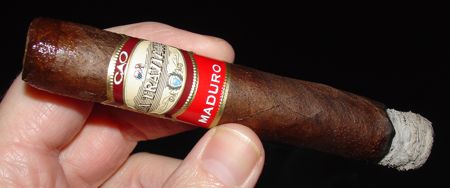
This summer CAO released the maduro version of La Traviata, which employs the same filler blend — a Cameroon binder and filler from Nicaragua and the DR — but uses a Connecticut broadleaf wrapper leaf instead of the tradition Ecuadorian Habano.

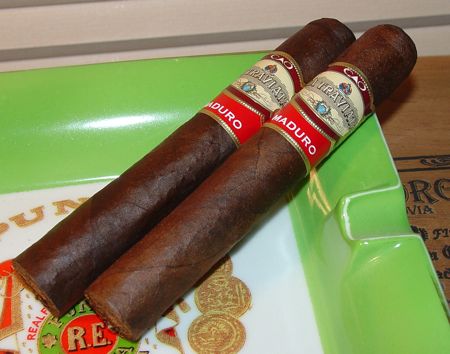
I grabbed two from a box at the B&M the other day and left in a rush. When I got home I slipped the cello from the sticks and noticed something a little odd: the two robusto-sized Divinos that I had were slightly different shades of dark brownish-black, and one was slightly smaller in ring gauge than the other. Not by much, but noticeably so.

La Traviata Maduro is not mentioned on the CAO website, but it’s safe to assume that the size lineup is the same as for the regular Traviata. And looking at my sales receipt, it appears the pricing is similar as well.

Construction Notes

I started with the lighter and slightly narrower one of the two. The wrapper on this maduro is thick, oily and very toothy. The darker one is especially rich in appearance, but the lighter one is still a highly presentable stick. The roll is solid and the cap is tight. The draw is fairly good — a little loose on one of the sticks, which is why it might have smoked a little hot at the end. The other one was just about perfect though.

The ash is solid gray in color and fairly sturdy, though it crumbled a bit in the ashtray. The burn is uneven, which is typical of thick maduro wrapper, but it never required correction or re-lighting.

Overall construction: Good to Very Good, with some concerns about consistency.

Tasting Notes

I was surprised at how tame the Maduro version of La Traviata smokes by comparison with the natural version. It starts with a touch of pepper, but that fades pretty quickly until it reappears in the final inch. The primary flavors here are classic maduro: bittersweet chocolate and dark roasted coffee bean. Underneath this is a woody foundation with an earthy touch.

The smoke is quite smooth, and not nearly as complex as the natural Traviata. The cigar stays within the standard range of maduro flavors for the duration of the smoke — 35 to 40 minutes — and attempts no major transitions. It’s just a simple, solid smoke.

Conclusion

At around five bucks a stick La Traviata doesn’t really need to make a huge splash, and for me it didn’t. But it’s still a solid performer, and there is always room in the humidor for a reliable medium-bodied maduro at this price.

Final Score: 86