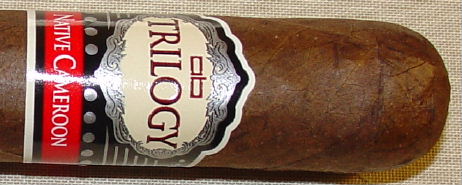
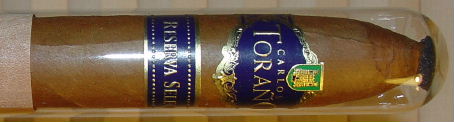
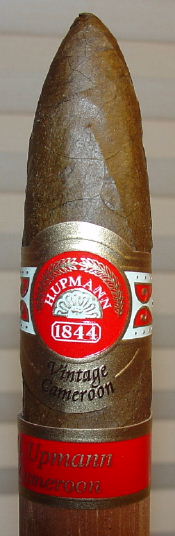
Gurkha Master’s Select…I think.

cnv0199.jpg

Courtesy K. Hansotia, here is yet another mystery, this time from his Gurkha department. I received this in a "pay it forward" trade, and haven't quite decided what species it belongs to. I have scoured the internet and pored over the Gurkha site with much frustration in an attempt to identify this cigar.

The Gurkha website is not much help because there are incorrect pictures posted. The picture for the Master's Choice is of the Expedition cigar. My best guess is that my cigar is in fact a Master's Select, though the picture on the website shows the Select without a cedar sleeve. Maybe someone out there can set me straight on this one.

Obviously this review is based on one lonely smoke, so I can't judge it as far as consistency. What I can tell you is that it's a rich reddish maduro in color with a great prelight scent of leather and earth.

The draw and burn are both excellent. At first light this cigar is quite similar to the Signature 101, but after an inch or so it shows a slightly different personality. The foundation flavor is an earthy char, complemented with cedar and just a touch of spice. The smoke is creamy and abundant– a great one for smoke rings if that's your thing. I'd rate the body of this cigar at a beefy medium, verging on full. The ash is well formed and perfectly white.

The aftertaste is quite earthy, a bit too much for my taste actually. I had the same problem with the Signature 101 — these are both great cigars with lots of body and flavor, but the aftertaste is just a little too funky for me. Maybe an appropriate beverage could lend an assist with this, but I'm not sure what that would be. What goes with funk?

My final thought is that this can't be the Master's Choice, which is described as mild to medium in body. So I'm going to go with the Master's Select Double Corona, which is billed at 6 x 52. But really, who knows… and who cares? It was a fine smoke to wile away a hot desert evening.
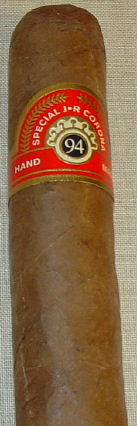

JR Special Corona No. 5

cnv0198.jpg

I found this cigar buried at the bottom of my desktop humidor where I keep my "everyday" smokes, cigars that are good enough for walking the dog or mowing the lawn. I remember liking this cigar a couple years ago, but evidently this single got away from me. It's been there long enough for the cello to take on a yellow tinge and for the label to fade somewhat. Now that this fugitive has been apprehended I plan to bring it to justice.

This is a JR Cigars house brand produced by Rolando Reyes, Sr., maker of Puros Indios and Cuba Aliados. This is enough to make some people run in terror, but not me. I think Rolando makes great affordable cigars. The copy on the JR website says that these "used to sell like hotcakes in plain plastic bags" with no bands. At some point the Rothmans and the Reyes had difficulties, resulting in the cessation of "Special Coronas" production in 1994.

Starting a few years back Lew and Rolando patched things up and now the Special Corona is again available, like the Puros Indios "Special Aged," in packs of 6. (Why Reyes likes six packs, I don't know.)

The No. 5 is a classic robusto size at 5 inches by 50 ring gauge and comes equipped with Ecuador Sumatran wrapper and binder, and filler from Nicaragua and the Dominican Republic.

The pre-light disposition of this stick is unremarkable. It lights easily and the draw is good. The first taste is classic Puros Indios — a light nutty flavor with an earthy base that can be slightly cloying. But there is something different here about the aroma. It's a richer, much more interesting scent. I can only attribute this to the wrapper. It seems to me somewhat floral, but muted, with a very mild cocoa overtone.

Which makes it sound more sophisticated than it really is… I'd say the JR Special Corona is basically a dressed up Puros Indios. A PI in a bow tie. If you happen to like Puros Indios as an "everyday" kind of cigar, you'll probably like the Special Corona as well.

Towards the middle of the stick it picks up a flinty, graphite flavor, and ends with a slightly sour finish. The aftertaste is earthy but mild.

The JR Special Corona No. 5 is not a cigar you'll want to break out to celebrate a special occasion, but it's not bad for a walk around the block. It's slightly more expensive than the standard Puros Indios rothschild, but it's also slightly better. 

Rocky Patel “The Edge” Maduro Toro

cnv0197.jpg

The Edge cigars were introduced by Rocky Patel in 2004, soon after which their popularity took off like a rocket. Interestingly, there was no marketing campaign to announce Patel’s new brand, no advertising, not even a band on the cigar! By word of mouth alone this cigar quickly gained a solid reputation as a kickass smoke.

When I first saw these cigars in my local smoke shop they were on a lower shelf in a wooden bin. Because I couldn’t see the lid on the bin and they didn’t have bands, I had to ask what they were. “Rocky Patel,” said the manager, as if that were all the information necessary. Later I learned that they were Edges, distinguished by their lack of bands and presentation in rough crates of 100 sticks.

The Edge is made in Danli, Honduras, with the assistance of the Plasencia family. Patel has been coy about the makeup of the cigar, saying that he will not reveal the “secret leaf” he uses in the filler because it comes from an area rarely used for tobacco cultivation. What we do know is that the Edge maduro comes wrapped in a Nicaraguan maduro, a binder from Mexico, and filler from Nicaragua and Panama (as well as the other classified location.) The wrapper shines with oil.

I found this toro to be an extremely well constructed cigar, somewhat better than the RP Vintage lines. It burns evenly, draws perfectly, and earns an A in deportment. The ash is a mottled light gray and is fairly solid.

The Edge starts up with a rich burst of classic maduro flavors– a little sweetness, a little char– and quickly transitions to a smooth but full flavored smoke. I’ve found all the Edges I’ve smoked to be a little tannic. Even though this cigar is aged well enough to smoke now, the tannin indicates that these could benefit from some time in the box. In a year or two these could be even better than they are now. (Or it could be the Mexican binder. Mexican leaf always gives me bitter beer face.)

It gathers a little more strength as it burns to the end, but maintains the same character– smooth and rich with a charred wood foundation. At some point a slogan was attached to the Edge: “For professional smokers only.” I don’t think that job description can be found in the Dictionary of Occupational Titles, but if it ever surfaces my resume is ready. In any case, the power of this cigar is in my opinion a little overstated. It’s a medium to heavy bodied cigar, but it’s not a brontosaurus. On the other hand, it’s not a stick to be fired up on an empty stomach either.

The Edge is a fine cigar, and the maduro in particular is a tasty and attractive after dinner selection. Try one with with a stout or espresso.

K. Hansotia Gold Edition Robusto

cnv0195.jpg

This cigar is a bit of a mystery to me, as are most of Hansotia's cigars. Kaizad Hansotia is himself a mysterious character, as noted in my previous review of the Signature 101.

All mystery and conjecture aside, Hansotia can certainly design a fine cigar. While I didn't care too much for the Signature 101, I think the Symphony (review coming soon) and this Gold Edition are finely crafted smokes definitely worth sampling.

This robusto is in actuality a toro size at six inches long, with a ring gauge of 50. I can't shed much light on the anatomy of the Gold Edition, but Cigars International declares it to have a Connecticut wrapper and filler from the Cibao Valley in the Dominican Republic. (CI should know, since they appear to be the only "major" vendor stocking this cigar.)

By looking at it, I wouldn't guess that this is Connecticut wrapper. With its rich colorado maduro hue it seems certain that this leaf is not shade grown. More of a broadleaf I would say, though not fermented to a true maduro.

The Gold Edition is a mild, sweet cigar that transitions nicely to a solid medium body. All of the three samples I smoked had a good draw and a problematic burn. The one I had this evening actually left a C shape of unburned wrapper near the band. Unfortunately I can't award it points for this creativity.

The predominate non-tobacco flavor here, oddly enough, is honey, or maybe cognac. It's a very aromatic cigar, and this is definitely its strong point. It is a little too mild to score big on flavor, but it earns a passing grade here as well. Towards the band it picks up enough of a solid tobacco twang to satisfy my taste buds and leaves a slightly tannic aftertaste.

All told, the K. Hansotia Gold is a very good boutique brand. The Gurkha website does not list the brand, so it may no longer be in production. The retail price is a little outlandish, but for the moment it is available from CI and can still be found from time to time on Cbid at a reduced price.

Recommended, especially for fans of milder maduros and possibly for pipe smokers who are branching out to cigars.

Eureka Silver Toro

Cnv0196.jpg

I picked up this cigar in a downtown Las Vegas cigar shop — it was a pretty stick and I had some change jingling in my pocket, so I bit the lure. I had never heard of the Eureka brand, and I've come to learn that there's precious little information posted about it. What little I've been able to find is from cigarcylopedia.com

What caught my eye in the cigar shop was the pedigree posted on each individually signed box– it's a Costa Rican puro made in Puriscal. Having had some good experiences with Costa Rican maduro (the best maduro leaf in my opinion) I couldn't resist an encounter with a CR puro.

The roll on this cigar is solid, and the prelight scent is fairly mild. The draw is quite firm, but there might be a reason for this: the foot on this cigar is flagged and the flag is folded over the foot like so:

Cnv0188.jpg

The flag burns up quickly and helps initiate an even burn that continues to the end. What strikes me first about this cigar is how mild it is. The dark oily wrapper is a ruse– this is an extremely mild smoke.

So mild, in fact, that is has little taste, and absolutely no aftertaste. On the other hand, it has a fantastic maduro aroma. What a curious cigar… What little taste I can detect is sweet, and slightly metallic. At one point I think it's almost like cotton candy, with a little licorice. All the while, the aroma is a rich and smoky coffee/cocoa combo I would expect from a good maduro. Fascinating: a super-light maduro.

The construction is very good: a uniformly even burn with a crumbly gray ash and a smooth easy draw. The cherry on this cigar forms a perfect pyramid shape with a sharp point. Everything about this stick is unusual.

The last few inches are a little bitter, but not unpleasantly so.

The Eureka, in this form at least, is too mild for my taste, but it's a well made cigar worth picking up just for an unusual experience. The rich maduro aroma coupled with its super mild body is totally bizarre. This is the "Silver" version, the mildest of their three blends. I might continue my experimentation with one of the bolder varieties if they can still be found.

CAO Brazilia Gol!

Cnv0191.jpg

With the World Cup underway and Brazil in the spotlight as usual, I thought this would be an opportune time to break out a CAO Brazilia Gol! As if I needed an excuse…

CAO makes many quality cigars, but the Brazilia line is probably my favorite. A dark Brazilian arapiraca wrapper provides a very distinctive aroma that nicely complements the Nicaraguan binder and filler. The Brazilias are made in the Toraño factory in Danli, Honduras. (I can’t seem to escape Toraño these days.)

The Gol! is a fat robusto at 5 x 56. The prelight smell is rich and somewhat leathery, and the roll is solid. The oily sun-grown wrapper is worth taking a moment to admire. After a quick cut of the cap I take a draw and I’m surprised at how easy it is because this cigar is packed like a rock. That’s quality craftsmanship.

It lights up with no fuss and starts an even burn. The initial flavor is heavy on the pepper, but this soon gives way to a woody flavor I have come to associate with good Nicaraguan cigars. What really makes this cigar special is the aroma– it’s a complex blend of wood, earth, a little sweetness, and sulfur. Sulfur might not be what one looks for first in a cigar, but it really works here for some reason. It’s all in the blend, I guess.

Toward the band it starts to burn a little hot, but the flavor doesn’t suffer for it. It gathers more strength at this point, but never becomes harsh or bitter.

The Brazilia Gol! is a medium to heavy bodied cigar with mountains of flavor and very good construction. It’s priced in the 5 USD range, and it’s worth it. If you like the Nicaraguan flavor profile and a heavier bodied smoke you should most definitely give this one a shot. It certainly has earned a place in my rotation.

Trilogy Cameroon Robusto by Alec Bradley

Cnv0190.jpg

A couple months ago I was bidding on boxes of Toraño 1916 Cameroons and having no luck at all. The 1916 is probably my favorite Cameroon, but being the frugal and wise consumer that I am (i.e. cheap bastard) I started looking around for alternatives. I read somewhere that Toraño makes the Trilogy Cameroon for Alec Bradley, so I thought it might come close to the 1916. I've liked all the other AB cigars I've tried, so why not give the Trilogy Cam a shot? The price was right –not cheap, but reasonable.

The Alec Bradley company is named after the sons of Alan Rubin, the chief of the Alec Bradley company. Rubin started the company at the height of the cigar boom, in 1996, and when the boom went bust he somehow survived a market flooded with cigars. (Perhaps the secret to his success is that many of these cigars were garbage and he was simply offering a superior brand.) One of those brands was the Occidental Reserve, blended by Henke Kelner of Davidoff, which helped to establish the company.

The Trilogy is named such because from 2002 to 2004 it was "tri-pressed," meaning it was three-sided. An interesting gimmick that some smokers appreciated for the way the cigar fit in the hand. The roll was changed in 2005 and is now round.

An interesting blend is used for the Trilogy Cameroon:

  • Wrapper from Cameroon (Native Cameroon, as opposed to Central African?)
  • Binder from Honduras
  • Filler from Italy and Nicaragua

It's a nice looking cigar with a mildly toothy wrapper that is nearly maduro in color.

The initial burn is even and soon I have an inch of solid light gray ash to admire. The spice from the cameroon is an accent flavor, the way I like it. It's a nice complement to a medium bodied blend that has a woody, slightly leathery base. No particular flavor jumps out at me, just a well blended tobacco flavor that results in a nice smooth smoke.

The Trilogy is not as earthy or distinctive as my benchmark Cameroon, the 1916. The last third of the Trilogy is a little finicky– it burns hot, and pulling too often results in a bitter taste. Aside from that, it's a well made, balanced cigar with great spicy cameroon overtones that don't overpower the rest of the cigar.

And they're available for just under 3 USD. Close, but not quite a "bargain cigar."

Carlos Toraño Reserva Selecta Torpedo

Cnv0189.jpg

Toraño’s Reserva Selecta line has been praised highly by Smoke magazine, Cigar Aficionado, and the leading European cigar magazine, European Cigar Cult Journal. In fact, last year the Cigar Cult Journal named Toraño Best Honduran Brand, and a Toraño made brand, the CAO Criollo, best Nicaraguan Brand. (As mentioned in a previous review, Toraño has factories in three countries: Honduras, Nicaragua, and the Dominican Republic.)

Evidently Sr. Toraño is no slouch.

The Reserva Selecta cigars are made in the Danli, Honduras factory with tobacco aged from three to five years. There is a maduro version as well as this Connecticut shade natural. The binder is Indonesian, and the filler comes from the Dominican Republic, Honduras, and Nicaragua.

This complex five-country blend is wrapped in cedar sleeves, banded twice, and then packaged in glass tubes. This is a very attractive cigar– If I weren’t so eager to smoke it I might try to frame it.

The wrapper is a classic example of Connecticut shade– smooth and silky with no prominent veins. The roll is firm. The pre-light draw is grassy, with a bitter taste on the tongue.

The initial taste is herbal and a little tannic, though this may be from the taste of the wrapper. Soon it becomes creamier and very very smooth. This is definitely a mild one, though it does build up to about a medium body in the final act. At about the half-way point it gets toasty and further on down it reveals nutty notes with just a hint of spice. The aftertaste is negligible.

The construction of this stick is superb. It lights up easily with a good draw and burns level straight. The light gray ash is solid and persistent. I ashed this cigar only three times.

While not huge on flavor, this is a very respectable cigar. I would recommend this to new smokers or aficionados of smooth mild cigars. Toraño has this available as a five pack gift package which would make a perfect gift for fathers, or fathers-in-law, or that godfather who has finally called upon you to do that service for him.

Joya de Nicaragua Celebracion Consul

Cnv0187.jpg

The Joya de Nicaragua of the 90's was a decent but fairly innocuous cigar. But back then it seemed like anyone would smoke anything that had a cigar label on it. After the last echoes of the "boom" faded away, serious cigar smokers became more discriminating. To satisfy this growing crowd of tobacco cognoscenti Joya de Nicaragua introduced the Antaño 1970 series, a powerhouse extra-full bodied cigar that blew everyone's socks off.

But not everyone wants a bunker buster like the Antaño, and most cigar smokers don't want a super powerful cigar every time they light one up. To temper the power of the Antaño the makers of Joya de Nicaragua went to a master of mild yet flavorful cigars: Manuel Quesada of MATASA. Quesada lightened up the ligero and came up with a more serene blend of tobaccos for the Celebracion.

Made in Esteli, Nicaragua by Tabacos Puros de Nicaragua, the oldest cigar company in Central America, the Celebracion is a Nicaraguan puro (as is the Antaño) with a havana seed criollo wrapper.

It's a bit short for a robusto at 4 1/2 inches, but a bit fatter as well with a 52 ring gauge. The wrapper is a leathery looking colorado maduro. The stick is a little bumpy and the cap is rough.

The construction on this stout fellow is very good. It burns just a mite unevenly, but corrects itself. The draw is spot on.

The primary flavor is wood, with some sweet highlights. It's definitely a milder cigar than its big brother, but still not a lightweight. I'd say it's medium to almost full. It gathers some strength in the home stretch, but doesn't quite reach a solid full body. Toward the end what it lacks in strength it makes up for with a peppery finish.

It reminds me of a CAO Criollo, more than anything, but I'd have to give the CAO an edge for a slightly more refined flavor. The Celebracion Consul is nevertheless a very good cigar. At less than five USD in the B&M it's a pretty good value as well.

H. Upmann Vintage Cameroon Belicoso

Cnv0185.jpg

Wrapper: Cameroon

Binder: Nicaragua

Filler: Dominican Republic, Nicaragua, and Peru

Dimensions: 6 1/8 x 52

Like almost all of the Upmanns I've had, this cigar had really good construction. It burned evenly from the first touch of the match to the end, and the draw was just right. Not too loose, not too tight, like Goldilocks' third bed. (Maybe that's the Cuban version of the story.)

The Vintage Cameroon Beli starts up a bit sharp. The spice hit me in the back of the throat and stung my nostrils just a little, but after an inch or so it started to mellow out and I was able to enjoy that classic cameroon aroma.

The wrapper on this smoke is fairly toothy, not as much as a Fuente Hemingway, but it's still a very attractive cigar. There are a few prominent veins that do not obstruct the burn in any way. It arrives encased in a cedar sheath which is handy as a spill to light the cigar.

The predominate flavor, aside from the aroma, is earth. Similar to the Toraño 1916 cameroons, but a little heavier, a little darker. Not as sweet, I'd say, and much saltier. You'll definitely want a cool drink on hand.

The ash on this puppy is solid; no surprise considering the excellent construction. The aftertaste is tannic.

All told, this is clearly an above average cigar. Maybe not the absolute best cameroon out there, but for a medium bodied cigar with faultless construction it's certainly worth a test drive.