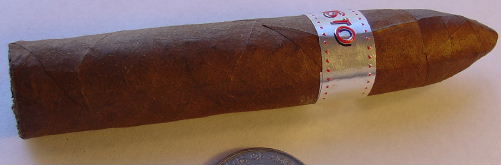
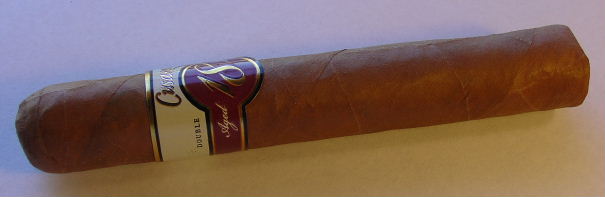
Gispert Belicoso Maduro

Cnv0080.jpg

6 1/8 x 52

Wrapper: San Andres Marron (Mexico)

Binder: Nicaragua

Filler: Honduras and Nicaragua

Here be another Altadis cigar with a brand name borrowed (in the loosest sense) from a traditional Cuban make. The original was created in the 40’s by Simon Palaez in the Pinar del Rio region and designed to be a discount, bargain smoke. Charles del Tedesco’s The Havana Cigar, (1997) lists only three sizes, and says each one is “for beginners.” Elsewhere I’ve read that they are considered to be a collector’s item due to their scarcity.

The Honduran variety may be considered a bargain cigar as well. Both the Natural and the Maduro fall in the 3 to 5 dollar range, and both are pretty decent cigars.

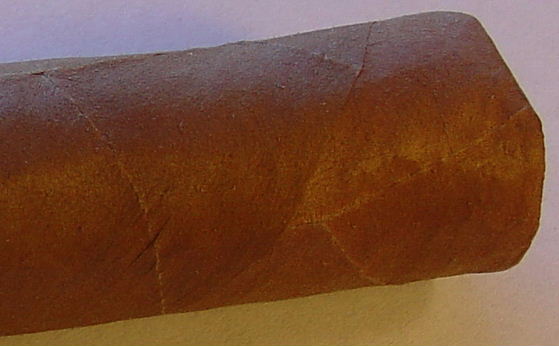
The Maduro is a square pressed, medium bodied, sweet smoke with a bite. Not a very nuanced cigar, but reasonable for the price. It starts out a little rough, and doesn’t get real friendly at any point. At the halfway point it picks up a musky element, which is a nice counterpoint to the sweet aroma. A short finish. Don’t think I would ever nub this one.

My only serious criticism of the belicoso is the construction: a loose roll, which I think may contribute to the bite, and an uneven burn which required three or four touch ups with a torch. (I haven’t had this problem with the toro.) But even with these flaws, at 3 bucks a pop it’s a good value everyday cigar.

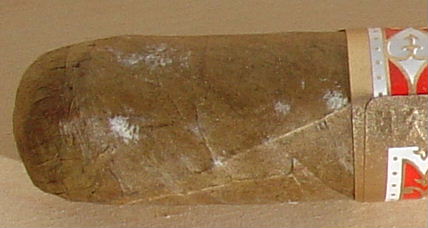
Yikes! MOLD!

Opened up an H. Upmann Monarch tube (Dominican) yesterday and saw spots on my seegar. I thought for an instant…maybe it’s bloom. No such luck. It’s patchy, irregular, and to my eyes it looks furry. Bloom ain’t furry.

Cnv0078.jpg

Luckily the mold wasn’t extensive. Even luckier, the Monarch was in a tightly sealed tube, so it didn’t have a chance to launch spores to other cigars in the humidor. Of course, if it hadn’t been in a tube I would have noticed it and not put it in my humidor in the first place.

I went searching for information about mold on cigars and found that there’s a fair amount of confusion as to what is mold and what is bloom. It is a frequently discussed topic on the cigar boards for a good reason.

The mold wiped off easily with a paper towel. Too easily, it seemed. And it left no marks, which I’ve read mold will do. Could it possibly be bloom?

Cnv0077.jpg

I kinda doubt it. Bloom is crystalline, distributed more uniformly, and doesn’t wipe off easily. Mold it is, until someone can convince me otherwise. In any case I incinerated the evidence, so the decision will have to be rendered without the corpus delecti.

Vital stats on the Monarch:

7 x 46

Wrapper: Indonesian TBN Shade grown

Binder: Dominican

Filler: Dominican and Brazilian

The H. Upmann Dominican is supposedly the sixth best selling brand in the U.S. The largest market share (though not the largest hype) in the U.S. is held by mild smokes, and this one is no different. It starts out mild bodied and dry, develops some faint notes of wood, and finishes very slightly spicy. An understated but nice aroma. A grassy aftertaste. I thought I detected mushrooms at one point. Maybe that was the mold. Yum.

I’ve never been a great fan of Indonesian wrappers, and since I got this in a blind grab bag deal from JR (see the Salad Days post) I didn’t choose this cigar knowingly. Even so, I wasn’t too disappointed with this smoke. (I think that’s called “faint praise.”)

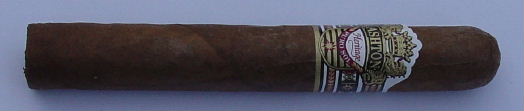
Ashton Heritage Puro Sol Robusto

Cnv0073.jpg

5.5 x 50

Wrapper: Cameroon

Binder: Dominican Republic

Filler: Dominican Republic.

The Ashton Heritage Puro Sol is touted as a joint venture between the Fuente family and Richard Meerapfel, the savior of Cameroon leaf. When the French abandoned their tobacco industry in Cameroon, Meerapfel took over and saved this magnificent sweet leaf from extinction. As a lover of Cameroon wrappers, I have much gratitude for his efforts. Sadly, he passed away in late 2003. He hand picked the wrapper leaf for the first Heritage Puro Sol cigars, and the highly respected Fuente family is responsible for the blend.

This robusto is a nicely spiced medium bodied smoke that exhibits what is so great about Cameroon wrapper leaf. It’s slightly sweet and extremely aromatic. It makes you want to sniff the foot of the cigar as it smolders. Lovely kitchen spices abound, as if you were in a kitchen around the holidays with the smell of ginger and cinnamon and nutmeg in the air. The spices eventually give way to a mild leather flavor on the finish.

There is almost no bite to this cigar, and I would recommend it to those who normally smoke only mild cigars. The relative mildness of this cigar is somewhat surprising given the fact that it is all sun-grown leaf. The Ashton Virgin Sun Grown is a very powerful cigar, far heavier than this sweet guy.

The Puro Sol is smooth, tasty, and among the best products of the Fuente family. (I prefer these to the Hemingways, if that says anything.) If they weren’t quite so expensive (7 to 10 dollars) I’d smoke these all day long.

Smoke one for Richard Meerapfel, a true cigar star.

Montecristo Platinum Petite Belicoso

Cnv0070.jpg

4 x 42

Wrapper: Mexico (San Andres)

Binder: Nicaragua

Filler: Dominican, Nicaraguan, and Peruvian

I think this is a discontinued size, since Altadis USA does not list it. I think it may have also been called the “Petite No. 2.” It’s a tasty little treat when you’re pressed for time or just in the mood for a short smoke.

It fires up nicely and burns well with no construction issues. The wrapper is exceptional, a Mexican grown Cuban seed leaf — I’ve had bad luck with Mexican produced cigars, so maybe this is a good sign.

The flavor profile is toasty, with some nuts with a bit of spice. Since this is such a small cigar there isn’t much time for development. It pretty much ends where it started. I’ve noticed an unpleasant metallic tinge on other Platinums (and no, it’s not word association) but nothing like that on this little guy. If you can find these cheap, which you might because it looks like they’re closing them out, grab a few. Tins of four are their usual mode of transport.

Camacho Corojo Monarca

Cnv0068.jpg

5 x 50

Wrapper: First Generation Corojo (Honduras)

Binder: First Generation Corojo (Honduras)

Filler: First Generation Corojo (Honduras)

The corojo leaf is the original Cuban wrapper leaf. At one time corojo leaf was the standard wrapper for Cuban cigars, and the criollo variety was the standard filler. They are both, however, very sensitive to blue mold and other maladies, so the genetically pure forms are no longer grown in Cuba. Hybrids have instead been developed that are resistant to tobacco diseases.

The makers of Camacho, the Eiroa family, have revived the original pure corojo strain on their farms in the Jamastran valley of Honduras. The plant evidently thrives there, even though it is still susceptible to the same problems in Honduras as it is in Cuba. The Eiroas obtained the seeds from the grandson of the farmer who first developed the corojo plant on a vega in the Vuelta Abajo called Santa Ines del Corojo.

The Camacho Corojo line is a little different than the traditional Cuban blend — it is pure corojo. Not just the wrapper. The whole shebang. With a band that looks like the classic brown and white labels of the oldest Cuban brands, you might reasonably expect this cigar to rival the best of Cubans.

Don’t confuse this line with some other cigars that include the name “Corojo” — the Punch Rare Corojo comes to mind, since it doesn’t even contain the corojo leaf. The Camacho line is something entirely different.

The Monarca is a fantastic robusto. Excellent construction with a firm draw and perfectly even burn. The ash drops with a thump on the ground when tapped after an inch or so. A full bodied cigar with an intriguing aroma — it starts out earthy, with a really nice floral element, and builds up to a smooth leathery taste. A serious cigar, but one with subtleties as well.
Probably not a beginner’s cigar, but not a steamroller either. For a steamroller try the Camacho Corojo Diploma. For a great after dinner smoke, paired with a single malt or a Guinness, the Monarca does it for me.

La Gloria Cubana Serie R Maduro No. 4

Cnv0067.jpg

4 7/8 x 52

Wrapper: CT Broadleaf

Binder: Nicaragua

Filler: Nicaragua and Dominican

The La Gloria Cubana brand has been around for a long time. (The original Cuban brand was established in 1885.) Ernesto Perez-Carrillo, Sr. began making cigars in Cuba in 1948. Like so many other great cigar makers, he had to leave Cuba in the late fifties. He settled in Miami, owned a bar for a while, worked for other cigar makers, and finally bought El Credito cigar factory in 1968. The company's first long-filler cigar was El Rico Habano, a brand which has since been revived.

Perez-Carrillo's son, an aspiring jazz musician, took over the business at the last minute as his father was about to sell the company. Ernesto Perez-Carrillo, Jr. then began work on La Gloria Cubana. He changed the box lithography and cigar band to closely resemble the original Cuban brand's artwork, and modeled a new blend on the Cuban Davidoff of 1982. (I think this was the original Cohiba blend distributed by Davidoff, before Cubatabaco put the Cohiba brand directly on the market in 1983.)

In 1996 the El Credito factory moved to the Dominican Republic, though some LGCs are still made in Miami. By the late 90's Perez-Carrillo Jr. began developing another line of La Gloria Cubana with a heavier body. The line he came up with became the Serie R — R for robusto, since they all have large ring gauges.

The Serie R maduros I've sampled are indeed rich, hearty cigars. I was prepared to be blown away, but was pleasantly surprised by their smoothness. There is a solid woody element with a touch of sweetness on the nose. The construction and burn were perfect, which is not an easy feat with a maduro wrapper as luscious as this one. For some reason Connecticut broadleaf fermented to this hue with all its oils does not want to burn as readily as the rest of the cigar, but in this case that proved to not be true.

Slow down at the midway point to avoid a tarry aftertaste. This one does not want to be rushed. A great 30 to 45 minute smoke, and in my opinion the best LGC yet.

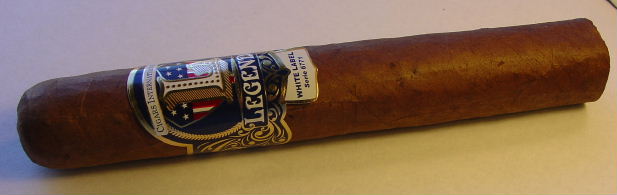
Legends Series White — Camacho

Cnv0066.jpg

The Legends Series is a line distributed by Cigars International. There are now six different manufacturers represented, and this one is Camacho’s entry. As a fan of Camacho, I had to try it.

My first impression is that it isn’t quite as good as Camacho’s standard brands, but it’s still a fine smoke. The draw is fairly loose, but it burns well. The Havana seed wrapper reminds me a lot of the Camacho Havana line — slightly leathery with some vanilla overtones. Maybe it’s the same leaf.

On the other hand, the Legend White is not as powerful as the Havana, especially after the midway point when the flavor sort of peters out. It starts out peppery and quickly becomes smoother, but maintains a full body until that midway point when it becomes a little bland.
For the money, especially if you can grab a box on Cigarbid, it’s a great everyday cigar.

The other lines in the Legends series are reportedly of lesser body, but if this one is any indication they’re worth checking out. They’re all the same size– 5.75 x 54, so they’re a mouthful. A sampler pack of all six — Puros Indios, Graycliff, Perdomo, Matasa, and Patel, in addition to Camacho — would be a wonderful way to compare the styles of these cigar makers.

Fitzcarraldo

After the wreck and recovery of the Molly Aida, Fitzcarraldo (played by Klaus Kinski) sells back the ship and sends for a few items:

Paul, listen. You’ll travel to Manaus with all this money.

Bring me a tailcoat and the best cigar in the world.

And from the theater I want an armchair with red velvet upholstery.

I made a promise to a pig that loves Caruso very much.

–Werner Herzog

Klaus Kinski later appears with a giant floppy cigar, no band, puffing and smiling insanely.

A great film. See it, and then watch Burden of Dreams, a documentary by Les Blank about the making of Fitzcarraldo. The Criterion edition includes a short featuring Herzog eating his shoes (nicely boiled with some onions) after losing a bet that Errol Morris could not complete his wonderful Gates of Heaven.

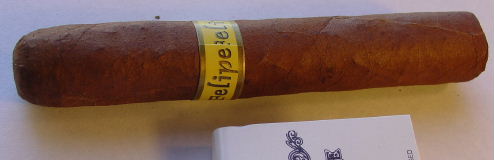
Felipe II Reserva “N”

Cnv0064.jpg

The Felipe II Reserva “N” is a petite corona with a lot of heart. Made in Felipe Gregorio’s Nicaraguan factory with filler from the Condega and Jalapa regions, a binder from Esteli, and a shade grown Habana 92 wrapper, this is a mighty little smoke.

Especially nice at this time of year for those of us who are relegated to smoking in the great outdoors– big flavor in a ten to fifteen minute smoke. Long enough to enjoy the cigar, but not enough to succumb to hypothermia.

You might say that I have no grounds for complaint, seeing that I reside in the Mojave desert. And you would be right. I am in no danger of frostbite as I walk down Las Vegas Boulevard. But the nights can still drive the mercury down, sometimes as low as 35 degrees.
Okay, it’s not the battle of Stalingrad. But I do remember years ago when I lived in rural Minnesota — so I do know what real cold is. And if I had to pick a quick smoke to puff in the garage for ten minutes, this little 4.5 x 44 beauty is what I’d grab:

Cnv0065.jpg
It’s a smooth, rich smoke with a nutty, creamy base and some coffee notes. No harshness to speak of, but if you get greedy it will in turn get a little bitter. Take your time and resist the urge to huff it. And to gild the lily, it’s reasonably priced.

Stay warm and fire one up!

Cusano 18 Double Connecticut Robusto

Cusano 18

The filler in the Cusano 18 line is reportedly 18 year old Dominican Oro. It was originally grown on an experimental basis by Hendrik Kelner, producer for Davidoff and many others, in an attempt to develop a Dominican wrapper leaf. Evidently that didn’t work out– according to an interview with Michael Chiusano in Smoke magazine they couldn’t roll a cigar longer than four inches with the resulting product. So after many years it found its way into the filler for the Cusano 18.

Both the binder and the wrapper are Connecticut Shade, and it’s a handsome wrapper, as you can see here:

Cnv0063.jpg

There are spots of green which I wasn’t able to pick up with my camera (still working on that lighting thing.) Aside from that, it’s a truly gorgeous cigar.

It was given a very respectable 91 by Cigar Insider, and at around 3.00 US it’s also eminently affordable. I wouldn’t rate it as high as that, I’m afraid.
It starts out a little rough, and it has an aftertaste I don’t particularly care for. For a mild to medium bodied smoke the nicotine content is quite high. On the plus side, it burns evenly with a lovely aroma. Woody with a caramel overtone, and a little vanilla. There’s also a nice spice here. For three bucks it’s definitely worth a shot.

It sounds stupid to say these might improve with age, seeing that they’re made with 18 year old filler, but they still seemed a little young to me. I might put a few away as an experiment, mad scientist that I am…emphasis on the mad. If I can find a Paired Maduro version I’ll be a maduro scientist!

Bwaa haa haa!!!

… here comes my wife with the fire extinguisher again. Gotta run.